TEACHING DIVERSITY MANAGEMENT THE ALTERNATIVE WAY Nasima M. H. Carrim
Faculty of Economic and Management Sciences, University of Pretoria, Pretoria Private Bag X20, Hatfield, Pretoria, 0002, Republic of South Africa
Abstract
The increase in diverse groups within organizations and their management has made it important for educators to teach diversity management from an alternative perspective. One of the aims of the diversity management course taught at undergraduate level was to teach students content that would enhance internalizing and retaining information and creating a class environment where mutual understanding among and between individuals and groups are fostered. In order to achieve this aim the class structure was formulated in terms of pre-lecture, during lecture and post-lecture activities. A survey was conducted over a period of two years with two different sets of undergraduate students responding to questions relating to the diversity management class structure. The results of the surveys indicated that the majority of students over the two year period were satisfied with the class structure.
Key words: instructor, diversity management, pre-lecture activities, during lecture activities, post-lecture activities
1. INTRODUCTION
Compared to the past in the last twenty years South African organizations have slowly but steadily become more racially and ethnically heterogeneous. Furthermore, 45.2% of the economically active workforce is female, while 88.7% is Black (which includes Indian, colored and African), 1.4% are considered disabled and 151 815 foreigners are working in South African organizations across all occupational levels (CEE Report, 2013). In addition, the onset of globalization has increased the need for intercultural awareness and understanding. These figures imply that many individuals are likely to find themselves managing, or under the management of someone demographically dissimilar to themselves.
Managers therefore need to understand, embrace, and leverage the demographic differences among their employees if they are to succeed in multicultural organizations. Hence, understanding diversity and its impact on workplace relationships has become a critical business competency and in many cases a necessity. The curricula related to diversity management instruction have to therefore be formulated in such a way as to prepare students to enter the workplace already equipped with the skills of managing a diverse workforce. There is therefore a need to teach the diversity management module from a different perspective and not provide traditional instructional methods as this will not enhance understanding of multicultural individuals within the workplace and society.
et al. 1998). In the words of McKendall (1994, p.410) ‘learning to effectively manage a diversified workforce involves unlearning, or at least questioning much of what standard management courses advocate’ as many management theories and techniques downplay the impact of individual differences. These are some of the reasons why the undergraduate diversity management course taught at the University of Pretoria was revised.
Motivated by a need to gear students to embrace diverse individuals, the class structure was revised to enable students to learn the content from varied exposure to the course content. During the research and class presentations concerted effort was made to include student perceptions of the structure and to enhance the quality of instruction from their feedback.
2. RESEARCH METHODOLOGY
The research on an alternate teaching method for diversity management was conducted using a questionnaire which was especially designed for this purpose. An expert dealing with curriculum and classroom interaction design was consulted and provided inputs to the questionnaire. An effort was made to make questions clear, transparent, unambiguous and concise. Prior to the commencement of the study the research questionnaire was tested on a group of forty students. These students provided feedback on the clarity of each question on the research questionnaire. Certain technical features were also clarified in order to avoid uncertainty and vagueness. The questionnaire consists of questions related to pre-lecture activities, namely completing quizzes on an online University system called ‘ClickUP’. Questions related to during lecture activities focused on class presentations and class discussions. Questions related to post-lecture activities focused on completing case studies and uploading on Discussion Boards where peers are provided the opportunity to comment on each other’s responses to the case study questions related to the various themes covered during class. Students also completed a post-lecture quiz that focused on how much knowledge they had gained related to the theme after the topic was completed in class. The questionnaire consisted of Likert-type questions ranging from 1 (strongly disagree), 2 (disagree), 3 (not sure), 4 (agree), 5 (strongly agree).
Pie chart for XRACE
African: 35.8 % Indian: 4.94 %
White: 58.02 %
Coloured: 1.23 %
Chart 1.1: Percentage of Africa, Indian, White and colored students for 2012
Pie chart for XRACE
African: 44.62 %
Indian: 3.08 %
White: 50.77 %
Coloured: 1.54 %
Chart 1.2: Percentage of Africa, Indian, White and colored students for 2013
3. RESULTS- DIVERSITY MANAGEMENT CLASS STRUCTURE
3.1 Pre-lecture quiz and class discussions
The module has five major themes with sub-themes. Before each major theme students are expected to complete a quiz related to the material that will be covered in class on a specific topic. The aim is to ascertain whether completing a quiz before the commencement of a theme assists students in preparing for class discussions. This is an important question as it determines whether reading through the study material and completing the quiz adequately prepares students to engage in class discussions. Table 1.1 indicates the frequency table related to completing the pre-lecture quiz and students’ readiness for class discussions for 2012 and 2013:
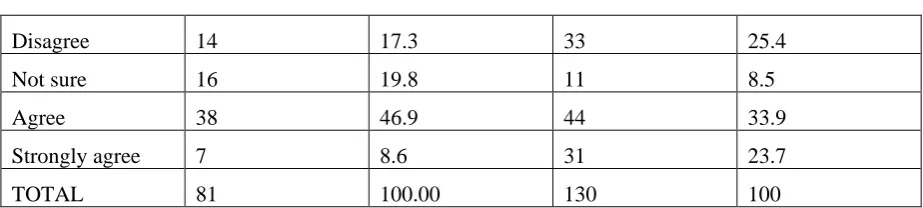
Value N (2012) % (2012) N (2013) % (2013)
Disagree 14 17.3 33 25.4
Not sure 16 19.8 11 8.5
Agree 38 46.9 44 33.9
Strongly agree 7 8.6 31 23.7
TOTAL 81 100.00 130 100
Table 1.1: The pre-lecture quizzes has assisted me to prepare for class discussions
Based on the 2012 results from table 1.1 the majority of the class agrees (46.9 %) and strongly agrees (8.6 %) that completing the pre-lecture quizzes before the class sessions have assisted them in preparing for class discussions. While the minority of students disagree (17.3 %) and strongly disagree (7.4 %) that pre-lecture quizzes prepare them for class discussions.
Based on the 2013 results from table 1.1 the majority of the class agrees (33.9 %) and strongly agrees (23.7 %) that completing the pre-lecture quizzes before the class sessions have assisted them in preparing for class discussions.
3.2 During lecture activities- class presentations
Students are expected to work in groups and to prepare a specific sub-theme to present on the day the topic is being discussed in class. Students are asked to form groups of five peers working in each team. Each student is expected to prepare a different section of the sub-theme. The class notes given to students has some information on the topic and students who present on the theme are expected to elaborate on the material by doing extra reading on the subject matter. Table 1.2 is a frequency table that focuses on whether preparing for class presentations has assisted students in learning more about a specific topic during 2012:
Value N % Cum. %
Strongly disagree 1 1.2 1.2
Disagree 8 9.9 11.1
Not sure 9 11.1 22.2
Agree 53 65.4 87.6
Strongly agree 10 12.4 100.00
TOTAL 81 100.00
Table 1.2: Preparing for class presentations has assisted me in learning more about a specific topic
Based on the 2012 results from table 1.2 the majority of the class agrees (65.4 %) and strongly agrees (12.4 %) that preparing for class presentations has enabled them to learn more about a specific sub-theme. Only a few of the students disagree (9.9 %) and strongly disagree (1.2 %) that doing extra reading on the sub-themes for presentation has enabled them to learn more about the topic.
Value N % Cum. %
Disagree 7 5.4 5.4
Not sure 3 2.3 7.7
Agree 75 57.7 65.4
Strongly agree 45 34.6 100.00
TOTAL 130 100.00
Table 1.3: Preparing for class presentations has assisted me in learning more about a specific topic
Based on the 2013 results from table 1.3 the majority of the class agrees (57.7 %) and strongly agrees (34.6 %) that preparing for class presentations has enabled them to learn more about a specific sub-theme. Only a few of the students disagree (5.4 %) and none strongly disagree (0.0 %) that doing extra reading on the sub-themes for presentation has enabled them to learn more about the topic.
3.3 During lecture activities- Class discussions
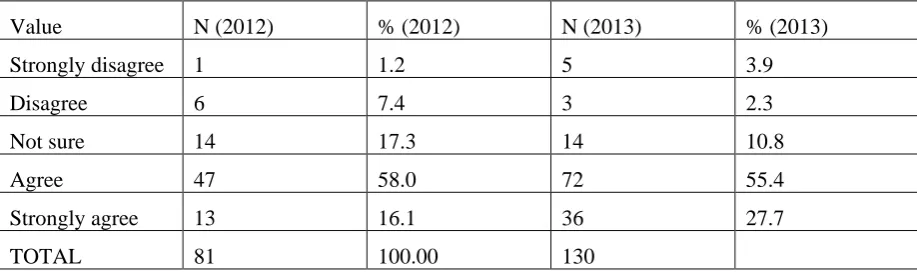
Class discussions are another activity that students engage in during lectures. The aim of class discussions on the various themes is for students to provide their perspectives on diverse issues and for them to learn from each other’s varied experiences and backgrounds. Class discussions are also a way of stimulating students to think through themes in a critical manner and to approach the subject matter from a broad and not a narrow perspective. Table 1.4 is a frequency table that draws attention to class discussions being important in students gaining insight into the different themes presented in class during 2012 and 2013:
Value N (2012) % (2012) N (2013) % (2013)
Strongly disagree 1 1.2 5 3.9
Disagree 6 7.4 3 2.3
Not sure 14 17.3 14 10.8
Agree 47 58.0 72 55.4
Strongly agree 13 16.1 36 27.7
TOTAL 81 100.00 130
Table 1.4: Class discussions have assisted me to gain insight into the various themes
Based on the 2012 results from table 1.4 the majority of the class agrees (58.0 %) and strongly agrees (16.1 %) that class discussions has enabled them to learn more about a specific sub-theme. Only a few of the students disagree (7.4 %) and strongly disagree (1.2 %) that class discussions are not important in gaining valuable insight into the subject matter.
3.4 Post-lecture quiz
Students have to complete a post-lecture quiz for each theme. The aim of a post-lecture quiz is to ascertain the knowledge students acquired related to the topic after completing the pre-lecture quiz, engaging in class discussions and presentations. Table 1.5 is a frequency table that draws attention to post-lecture quizzes assessing knowledge gained in successfully completing various class activities related to a specific theme during 2012:
Value N % Cum. %
Strongly disagree 4 4.9 6.2
Disagree 5 6.2 12.4
Not sure 13 15.0 27.4
Agree 47 58.0 85.4
Strongly agree 12 14.6 100.00
TOTAL 81 100.00
Table 1.5: The post-lecture quiz has enabled me to assess knowledge gained from reading class notes, engaging in class discussions and presentations
Based on the 2012 results from table 1.5 the majority of the class agrees (58.0 %) and strongly agrees (14.6 %) that knowledge gained before and during class activities assisted them to successfully complete post-lecture quizzes. A few of the students disagree (6.2 %) and strongly disagree (4.9 %) that pre lecture and during lecture activities did not assist them in gaining valuable insight into the subject matter.
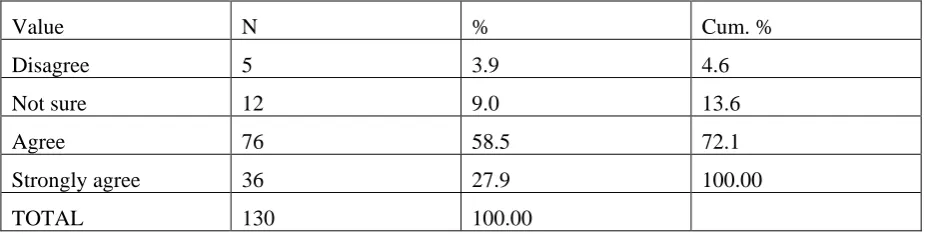
Table 1.6 is a frequency table that draws attention to post-lecture quizzes assessing knowledge gained in successfully completing various class activities related to a specific theme during 2013:
Value N % Cum. %
Disagree 5 3.9 4.6
Not sure 12 9.0 13.6
Agree 76 58.5 72.1
Strongly agree 36 27.9 100.00
TOTAL 130 100.00
Table 1.6: The post-lecture quiz has enabled me to assess knowledge gained from reading class notes, engaging in class discussions and presentations
3.5 Post-lecture activity: case studies
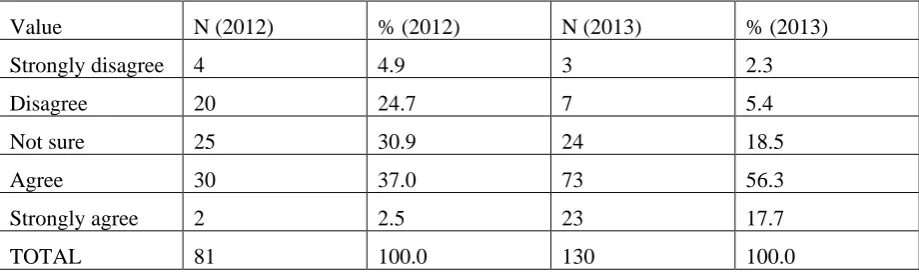
Students are also expected to complete a case study related to sub-themes. These case studies are uploaded for other students to view and to comment on. Table 1.7 is a frequency table that draws attention to students completing case studies and other students commenting to their responses and also providing their insight into the themes during 2012 and 2013:
Value N (2012) % (2012) N (2013) % (2013)
Strongly disagree 4 4.9 3 2.3
Disagree 20 24.7 7 5.4
Not sure 25 30.9 24 18.5
Agree 30 37.0 73 56.3
Strongly agree 2 2.5 23 17.7
TOTAL 81 100.0 130 100.0
Table 1.7: The post-lecture case study and comments from peers has enhanced my knowledge related to the various themes
Based on the results from table 1.7 the majority of students during 2012 agree (37.0 %) and strongly agree (2.5 %) that the post-lecture case study that are commented on by peers has allowed them to gain insight into the various themes. However, many students disagree (24.7 %) and some strongly disagree (4.9 %) that the post-lecture case studies that classmates comment on do allow them greater insight into the various themes. A large number of students are also unsure (30.9 %) if the post-lecture case studies based on fellow-student comments enhance their knowledge of the various themes presented in the module.
Based on the results from table 1.7 the majority of students during 2013 (56.3 %) agree and strongly agree (17.7 %) that completing the case studies and obtaining peer comments have assisted them in greater insight into the topics.
4. CONCLUSION
In conclusion the students are satisfied with the pre-lecture, during lecture and post-lecture activities they engage in. The majority of the students agreed that completing the pre-lecture quizzes assisted them to gain knowledge of the subject matter. The majority of the students indicated that having activities during class lectures allowed them to do well in the post-lecture quizzes. During lecture activities also allowed students to retain information relating to the subject matter and to gain a deeper insight into diversity issues. Feedback from peers also allowed students to gain a different view of how the case studies are approached by their peers.
In the past the diversity management module was presented from a lecturer-centered approach. Since then modifications has been made to the course and it is now being taught a-synchronously. That is, the focus is on the student. The onus lies on the student to prepare for lectures and to ensure that all activities are completed successfully as each phase entails a certain percentage of marks. For example, students are given 10% for class presentations which is added to their overall semester mark.
This method of teaching can be used across various disciplines and is not confined to a teaching method that can be used in diversity management module only.
REFERENCES
Avery, DR, & Thomas, KM 2004, ‘Blending content and contact: The roles of diversity curriculum and campus heterogeneity in fostering diversity management competency’, Academy of Management Learning & Education, vol. 3, no. 4, pp. 380-396.
DiTomaso, N, Kirby, DC, Milliken, F J, & Triandis, HC 1998. Effective and inclusive learning environments, American Assembly of Collegiate Schools of Business, St. Louis, Missouri
Jackson, L C 1999, ‘Ethnocultural resistance to multicultural training: Students and faculty’ Cultural diversity and ethnic minority psychology, vol. 5, pp. 27–36.
McKendall, M 1994, ‘A course in “work-force diversity”: Strategies and issues,’ Journal of Management Education, 18, pp. 407-423.
South Africa 2013, Commission for Employment Equity 2012-2013 Report, Department of Labour, Republic of South Africa, viewed 20 March 2014,