University of Huddersfield Repository
Moxham, Claire, Bamford, David, Dehe, Benjamin and Kauppi, Katri
Well played? Examining strategy and performance in offfield sporting operations
Original Citation
Moxham, Claire, Bamford, David, Dehe, Benjamin and Kauppi, Katri (2014) Well played?
Examining strategy and performance in offfield sporting operations. In: 21st EurOMA Conference, 2025 June 2014, Palermo, Italy.
This version is available at http://eprints.hud.ac.uk/id/eprint/21022/
The University Repository is a digital collection of the research output of the University, available on Open Access. Copyright and Moral Rights for the items on this site are retained by the individual author and/or other copyright owners. Users may access full items free of charge; copies of full text items generally can be reproduced, displayed or performed and given to third parties in any format or medium for personal research or study, educational or notforprofit purposes without prior permission or charge, provided:
• The authors, title and full bibliographic details is credited in any copy;
• A hyperlink and/or URL is included for the original metadata page; and
• The content is not changed in any way.
For more information, including our policy and submission procedure, please contact the Repository Team at: [email protected].
1
Well played? Examining strategy and performance in
off-field sporting operations
Dr Claire Moxham ([email protected])
University of Liverpool Management School, Liverpool, UK
Professor David Bamford
The Business School, University of Huddersfield, Huddersfield, UK
Benjamin Dehe
The Business School, University of Huddersfield, Huddersfield, UK
Dr Katri Kauppi
Aalto University School of Business, Helsinki, Finland
Abstract
Professional sport is in many ways a type of business. From an operations management perspective it is worthy of note that professional sport exhibits several specific features that require a customised set of practices to ensure effective operations (Smith and Stewart, 2010). In this paper we focus on developing four key constructs that exemplify the special characteristics of the sport industry: i) limited control of the sports product, ii) uncertainty of on-field outcome, iii) spectator co-creation and iv) enforced collaboration. We outline the development of a survey on stadium operations and share the next steps in the research.
Keywords: Strategy, sport industry, survey research
Purpose of the study
The relationship between operations strategy, operations management and improved business performance has been the subject of empirical investigation in manufacturing firms since the 1960s (Skinner, 1969). Studies have shown how competitiveness and profitability are the key drivers for the adoption of operations management tools and techniques (Rho et al., 2001) and how the alignment of manufacturing strategy and business strategy positively influences the improvement of business performance (Sun and Hong, 2002). In translating these findings to a service setting, it is commonly agreed that consistency between an organisation’s competitive priorities and decisions regarding operations is important (Prajago and McDermott, 2008). The key difference with services is the complex strategic issue of the influence of the customer on the service production and delivery process (Kellogg and Nie, 1995).
2
quality, cost, dependability and flexibility (Wheelwright, 1984) would seem to apply here; however the complexity of their achievement is amplified due to particular industry characteristics (Smith and Stewart, 2010), for example:
i) Limited control over the sports product - operating rules and regulations are often imposed by external parties.
ii) Uncertainty of on-field outcome – can affect the perceived quality of the sporting experience.
iii) Spectator co-creation – fans are both producers and consumers of the sporting experience.
iv) Enforced collaboration – sporting rivals must collaborate to organise competitive events.
These industry specific characteristics provide an interesting backdrop against which to pose the following research question:
What is the relationship between operations strategy, the characteristics of the operating environment and performance in off-field sports service operations?
In this paper we present our empirical findings to date that address the research question posed. We firstly discuss relevant literature on the distinct characteristics of the sport industry and develop hypotheses. We then outline the methodology of our on-going data collection efforts through an international survey and present some preliminary descriptive results and construct testing. Finally we outline our future research plans and potential contributions.
Literature review: Operations Management Implications of the Distinct Characteristics of the Sport Industry
The sport industry is part of the service industry and shares many of the characteristics typical of services (i.e. perishability, intangibility, inseparability and heterogeneity) (Bitran and Logo, 1993; Karmarkar and Pitbladdo, 1995; Prajogo, 2006). Such service characteristics have implications for the off-field operations and quality management of sporting events as they are time bound, unable to be stored, delivered in real time and non-standardised. There is an established body of literature that considers service industry operations management; some of which has been applied to the sport industry (Chang and Chelladurai, 2003; de Knop et al., 2004; Heim and Ketzenberg, 2011).
In addition to the operations challenges associated with services, the sport industry also exhibits distinct characteristics that have implications for off-field operations and quality management that are now discussed. In the following, we present preliminary hypotheses regarding the relationship between sport industry special characteristics and stadium operations management practices.
Limited control over the sports product
Sport is subject to local, national and international rules and regulations that are not present in other industries. Examples include the fact that product specifications, such as competition duration and format, are outside of the control of the individual sporting organisation. This limits ability of the sporting organisation to make decisions about the sports product and can restrict opportunities for differentiation.
3
entry. This restrictive setting may stifle the desire for continuous improvement in the pursuit of off-field sports operations management as there is a perception that there is little incentive or opportunity to change the status quo. We therefore hypothesise that:
H1: The more limited the control an organisation has over the sports product the less it will apply operations and quality management approaches to off-field sports operations.
Uncertainty of on-field outcome
A distinguishing feature of sport is the unpredictability of outcome associated with a contest (Neale, 1964; Trenberth, 2012). As on-field performance is variable (Stewart and Smith, 1999), sport managers are perceived to be in the business of managing uncertainty (Chadwick, 2009). Uncertainty is seen as a troublesome yet unavoidable feature of professional sport (Stewart and Smith, 1999); the implications of which can have severe consequences for the management of off-field operations. For example, a negative on-field outcome can impact the perceived quality of the off-field sport operations (e.g. length of queues, customer service) and uncertainty of outcome creates challenges for league and cup competitions as future game locations are known only at short notice (Kauppi et al., 2013b).
H2a: The more uncertainty related to the on-field outcome, the more an organisation will put emphasis on quality as a strategic operations objective.
H2b: The more uncertainty related to the on-field outcome, the more an organisation will apply quality management techniques in their off-field operations.
Spectator co-creation
Experience and perception are seen as essential to value determination (Vargo and Lusch, 2006) and one of the primary reasons that spectators attend sporting events is to be part of the atmosphere; which means that fans are co-creators of the sporting experience (Basole and Rouse, 2008; Vargo et al., 2008). Co-creation creates complexity for sport operations managers as fans not only purchase and consume the product, they also help to create the atmosphere which gives strength to the product. Fans are co-creators of the sporting experience but often have to pay for the experience and therefore have expectations in terms of both on-field and off-field performance. With respect to service quality, the concept of fans paying to attend and being part of the co-production of the event is extremely important to recognise. To maintain a high level of service quality the sport organisation must identify how to maintain interest, enjoyment and attendance at the events, even when games are not markedly exciting (Clemes et al., 2011). Spectator co-creation also creates an element of uncertainty and uncontrollability to the stadium operations that needs to be controlled for; both to ensure smooth operations and a good customer experience. We therefore expect to see a greater uptake and application of quality management tools and techniques in spectator sporting events, and thus hypothesise that:
H3: Higher levels of spectator co-creation increase the use of quality management techniques in off-field sport operations.
Enforced collaboration
4
meet the expectations of their stakeholders (Stewart and Smith, 1999). This creates a conundrum for the sport industry in that competition and co-operation are required in parallel; competition to create the sporting interest and co-operation to enable the event to take place (Smith and Stewart, 2010). Researchers have paid limited attention to the phenomenon of enforced collaboration in the sporting context and it is has been argued that the way in which competitors collaborate in the scheduling of contests requires further attention from scholars (Chadwick, 2009). Enforced collaboration requires a high degree of planning and scheduling, which in turn suggests the use of established operations management tools and techniques. We therefore posit that:
H4: The more enforced collaboration an organisation encounters, the higher the use of operations management tools and techniques.
Research Methodology
Our data collection process is still on-going at the time of the paper submission to the conference. In this paper we will therefore present our on-going data collection methodology and preliminary descriptive analysis of the data that we have collected thus far.
Data collection method
Our data collection method is designed along the lines of the International Manufacturing Strategy Survey (see e.g. Voss and Blackmon, 1998; Gimenez et al. 2012) and the International Purchasing Strategy Survey (see e.g. Kauppi et al. 2013a). The data is being collected through the International Sport Operations Management Survey (ISOMS) project. This survey was developed to identify and study the operations management tools and techniques that are currently used by sport stadiums operations managers in the United Kingdom, United States, Canada, Australia and New Zealand. The target countries were chosen because an English language questionnaire and similar linguistic background reduces possible data equivalence issues in our sample.
Our unit of analysis is sport stadiums and the target respondents are stadium operations managers (or equivalent). Sampling is difficult in this context given that no databases of stadium operations managers exist from which to draw a random sample, as is typical in e.g. SCM research with different membership lists of purchasing and supply professionals. Sport stadiums and other spectator locations do not have their own ISIC code either. We therefore set out to develop a database of sports operations management professionals with the aim of representativeness (proportional amount of contacts in different types of stadiums/sports given the popularity of the sport and in the different countries) using sport club websites. Based on targets in countries and sports leagues, we have been attempting to identify potential stadiums and respondents therein through organisational websites and LinkedIn. Additionally, we are using snowball sampling in that respondents are also asked to recommend colleagues at other stadiums that could be contacted to complete the survey. Respondents are first sent a pre-notification letter to inform them of the survey, followed by an email and/or paper survey. Several reminders are sent to increase the response rate.
Survey design and constructs
5
development, pre-existing scales from operations strategy and management literature were used as much as possible or were slightly modified to fit the stadium context where appropriate. In survey design, several attempts were made to avoid common method bias: questions on strategies, practices and performance were placed at different sections in the questionnaire (proximal separation), (Podsakoff et al., 2003) and the sequence of items was randomized for the online version (Chang et al., 2010).
While the special characteristics of the sport operating environment have been discussed conceptually in past literature, they have not been used in empirical studies. Therefore, the items and constructs to measure them were developed via the q-sorting procedure. Following Moore and Benbasat (1991), the instrument development contained three steps: 1) item creation, conducted to produce pools of items for each construct through item identification from literature, and by creating additional items matching the construct definitions, 2) scale development, where panels of judges (professionals and academics in the field) sorted these items into separate categories in several rounds. The sorting was done based on the similarities and differences among the items. After each round, items were eliminated or reworded to come up with the final set of items. 3) Instrument testing. This can only be completed after all responses are collected.
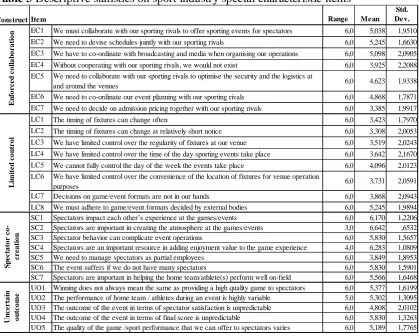
The four constructs developed via this method are: uncertainty of outcome, spectator co-creation, limited control over the “product” and enforced collaboration. In the survey they were measured on a 7-point Likert scale with five, seven, eight and seven items respectively. The items are available in Table 3. Operations strategy was measured by asking the respondents to indicate the degree of strategic emphasis on several objectives in their venue operations (scale from 1 to 7, with 1 = a very low emphasis and 7 = very high emphasis). The items were modified from/inspired by Prajago and McDermott (2008), Ward et al. (1998) and Wong et al. (2011) to suit the sport industry context. Specifically for quality as a strategic objective, the three items were “Having repeat visits from customers”, “Providing a high level of service to customers at events” and “Reducing customer complaints”. Quality management was
measured by eight items from Zhang et al. (2012). Respondents were asked to indicate on a 7-point agree/disagree scale the use of several quality management techniques for quality exploration and exploitation.
Descriptive statistics
At the time of the conference paper submission we have 53 responses. In table 1, the distribution of responses based on stadium spectator capacity, sport played at venue and venue type is shown. Table 2 shows the characteristics of the respondents (the stadium operations managers). From Table 2 it can be seen that almost half of the operations managers at sport stadiums have had no formal operations management training at all, with only 23% holding a degree or formal certificate in the area. This reinforces our research motivation in terms of the need to study and further develop the application of operations management practices in sport stadiums.
6
Table 2 Stadium operations management background statistics (n=53)
Construct validation
Given the incomplete data collection, detailed analysis on the relationships between variables cannot yet be provided. More data cleaning will also be needed once the full response set is available. Here we will thus present preliminary results regarding the construct characteristics with a focus on the newly developed sport operating environment characteristics. The goal is to later test the models in more detail with exploratory and confirmatory factor analysis and regression analysis as well as structural equation modelling, once response numbers reach a sufficient level for more advanced models.
The descriptive statistics (mean, standard deviation and range) for each of the sport industry special characteristics constructs are shown in Table 3.
Spectator capacity Frequency Percentage Sport at venue Frequency Percentage
below 1 000 8 15 % American Football 1 2 %
1 000-9 999 15 28 % Basketball 1 2 %
10000 - 50 000 24 45 % Cricket 7 13 %
over 50 000 5 9 % Horse racing 6 11 %
Venue type Frequency Percentage Rugby 10 19 %
Indoor 6 11 % Football/soccer 8 15 %
Outdoor 39 74 % Tennis 4 8 %
Both 8 15 % Multiple sport venue 16 30 %
Not at all 24 45 %
1 module 5 9 %
Several modules 12 23 %
Professional certificate 7 13 %
Undergraduate degree 2 4 %
Postgraduate degree 3 6 %
Frequency Amount of operations
management training
taken Percentage
Respondent
background Frequency Percentage Professional athletic
background
No athletic
background 16
30 7
30 % 57 % 13 % Amateur athletic
7
Table3 Descriptive statistics on sport industry special characteristic items
Construct validity was estimated via Cronbach’s alpha (with standardised variables). For established scales, a minimum level of 0.70 is expected (Nunnally, 1978) while for newly established scales in an exploratory study, an alpha value of over 0.6 is deemed sufficient (Kahn and Mentzer, 1994). The results are shown in Table 4. From it we can observe that all the newly developed constructs demonstrate high construct reliability with the data so far, apart from “uncertain outcome”. While the quality management items from Zhang et al. 2012 in their study were used as several constructs (quality exploitation and exploration with customer focus and process control), in the sport stadium context they appear to load onto a single construct of quality management (also in exploratory factor analysis).
Table 4 Construct reliability statistics
Construct Range Mean
Std. Dev.
EC1 We must collaborate with our sporting rivals to offer sporting events for spectators 6,0 5,038 1,9510 EC2 We need to devise schedules jointly with our sporting rivals 6,0 5,245 1,6630 EC3 We have to co-ordinate with broadcasting and media when organising our operations 6,0 5,098 2,0905 EC4 Without cooperating with our sporting rivals, we would not exist 6,0 3,925 2,2088 EC5 We need to collaborate with our sporting rivals to optimise the security and the logistics at
and around the venues 6,0 4,623 1,9338 EC6 We need to co-ordinate our event planning with our sporting rivals 6,0 4,868 1,7871 EC7 We need to decide on admission pricing together with our sporting rivals 6,0 3,385 1,9917 LC1 The timing of fixtures can change often 6,0 3,423 1,7970 LC2 The timing of fixtures can change at relatively short notice 6,0 3,308 2,0053 LC3 We have limited control over the regularity of fixtures at our venue 6,0 3,519 2,0243 LC4 We have limited control over the time of the day sporting events take place 6,0 3,642 2,1670 LC5 We cannot fully control the day of the week the events take place 6,0 4,096 2,0123 LC6 We have limited control over the convenience of the location of fixtures for venue operation
purposes 6,0 3,731 2,0591
LC7 Decisions on game/event formats are not in our hands 6,0 3,868 2,0943 LC8 We must adhere to game/event formats decided by external bodies 6,0 5,245 1,9894 SC1 Spectators impact each other’s experience at the games/events 6,0 6,170 1,2206 SC2 Spectators are important in creating the atmosphere at the games/events 3,0 6,642 ,6532 SC3 Spectator behavior can complicate event operations 6,0 5,830 1,5657 SC4 Spectators are an important resource in adding enjoyment value to the game experience 4,0 6,283 1,0809 SC5 We need to manage spectators as partial employees 6,0 3,849 1,8953 SC6 The event suffers if we do not have many spectators 6,0 5,830 1,5901 SC7 Spectators are important in helping the home team/athlete(s) perform well on-field 6,0 5,566 1,6468 UO1 Winning does not always mean the same as providing a high quality game to spectators 6,0 5,377 1,6199 UO2 The performance of home team / athletes during an event is highly variable 5,0 5,302 1,3095 UO3 The outcome of the event in terms of spectator satisfaction is unpredictable 6,0 4,808 2,0102 UO4 The outcome of the event in terms of final score is unpredictable 6,0 5,830 1,3263 UO5 The quality of the game /sport performance that we can offer to spectators varies 6,0 5,189 1,7765
[image:8.595.91.511.94.430.2]8
Next steps in the research will include more detailed construct analysis through confirmatory factor analysis, followed by regression analysis to test our hypotheses.
Findings
The work so far has developed new constructs to measure uncertainty of outcome, spectator co-creation, limited control over the “product” and enforced collaboration in the context of sport stadium operations. Three of the constructs demonstrate high construct reliability with the data that has been collected thus far. Data collection is on-going and further analysis of the findings is expected to extend research on the link between operations strategy and performance in manufacturing settings to service operations, specifically sport stadiums. As Hensley (1999) states, the development of scales is in itself not a contribution to theory development, but the real contribution is that the scales can be used to relate the construct to other constructs or to organisational performance. This is our next intended step in the study. We expect to identify links between operations strategy, practices and performance within the sport services setting and to detect best practices that drive performance improvements within these service contexts.
Relevance/Contribution
As limited work has examined operations strategy in an off-field sporting context, this study makes a timely contribution. The findings of the study can be used to ascertain whether taxonomies of operations strategy that have been proven in manufacturing can be extended to services. The forthcoming hypotheses testing between strategies, practices, industry context characteristics and performance has the potential to identify how operations can make a positive contribution to the performance of off-field sporting operations.
References
Basole, R.C. and Rouse, W.B. (2008), "Complexity of service value networks: conceptualization and empirical investigation", IBM Systems Journal, Vol. 47 No. 1,pp. 53-70.
Bitran, G. and Logo, M. (1993), "A framework for analyzing service operations", European Management Journal, Vol. 11 No. 3,pp. 271-282.
Chadwick, S. (2009), "From outside lane to inside track: Sport management research in the twenty -first century", Management Decision, Vol. 47 No. 1,pp. 191-203.
Chang, K. and Chelladurai, P. (2003), "System-based quality dimensions in fitness services: development of the scale of quality", The Service Industries Journal, Vol. 23 No. 5,pp. 65-83.
Chang, S.-J., van Witteloostuijn, A. and Eden, L. (2010), "From the editors: Common method variance in international business research", Journal of International Business Studies, Vol. 41 pp. 178-184. Construct
Cronbach's alpha with all items
Cronbach's alpha with item deletions
Enforced collaboration 0,808 N/A
Limited control 0,721 N/A
Spectator co-creation 0,743 0,796a
Uncertain outcome 0,544 0,592b
Quality strategy 0,784 N/A
Quality management 0,812 N/A
aItems SC3 and SC5 deleted due to improve alpha
9
Clemes, M., Brush, G. and Collins, M. (2011), "Analysing the professional sport experience: A hierarchical approach", Sport Management Review, Vol. 14 No. 4,pp. 370-388.
de Knop, P., van Hoecke, J. and de Bosscher, V. (2004), "Quality management in sports clubs", Sport Management Review, Vol. 7 pp. 57-77.
Gimenez, C., Sierra, V. and Rodon, J. (2012), "Sustainable operations: Their impact on the triple bottom line", International Journal of Production Economics, Vol. 140 No. 1,pp. 149-159.
Heim, G. and Ketzenberg, M. (2011), "Learning and relearning effects within innovative service designs: An empirical analysis of top golf courses", Journal of Operations Management, Vol. 29 No. 5, pp. 449-461.
Hensley, R. (1999), "A review of operations management studies using scale development techniques",
Journal of Operations Management, Vol. 17 No. 3,pp. 343-358.
Kahn, K. and Mentzer, J.T. (1994), "The norms that distinguish between marketing and manufacturing",
Journal of Business Research, Vol. 30 No. 2,pp. 111-118.
Karmarkar, U. and Pitbladdo, R. (1995), "Service markets and competition", Journal of Operations Management, Vol. 12 No. 3-4,pp. 397-411.
Kauppi, K., Brandon-Jones, A., Ronchi, S. and van Raaij, E. (2013a), "Tools without skills: Exploring the moderating effect of absorptive capacity on the relationship between e-purchasing tools and category performance", International Journal of Operations and Production Management, Vol. 33 No. 7,pp. 828-857.
Kauppi, K., Moxham, C. and Bamford, D. (2013b), "Should we try out for the major leagues? A call for research in sport operations management", International Journal of Operations and Production Management, Vol. 33 No. 10,pp. 1368-1399.
Kellogg, D.L. and Nie, W. (1995), "A framework for strategic service management", Journal of Operations Management, Vol. 13 No. 4,pp. 323-337.
Machuca, J., Gonzalez-Zamora, M. and Aguilar-Escobar, V. (2007), "Service operations management research", Journal of Operations Management, Vol. 25 No. 3,pp. 585-603.
Moore, G. and Benbasat, I. (1991), "Development of an instrument to measure the perceptions of adopting an information technology innovation", Information Systems Research, Vol. 2 No. 2, pp. 192-222.
Neale, W. (1964), "The peculiar economics of professional sports: A contribution to the theoyr of the firm in sporting competition and in market competition", The Quarterly Journal of Economics, Vol. LXXVIII No. 1,pp. 1-14.
Nunnally, C. (1978) Psychometric Theory, McGraw-Hill, New York.
Podsakoff, P., MacKenzie, J.-Y. and Podsakoff, N. (2003), "Common method biases in behavioural research: A critical review of the literature and recommended rememdies", Journal of Applied Psychology, Vol. 88 No. 5,pp. 879-903.
Prajago, D.I. and McDermott, C.M. (2008), "The relationships between operations strategies and operations activities in service context", International Journal of Service Industry Management, Vol. 19 No. 4,pp. 506-520.
Prajogo, D. (2006), "The implementation of operations management techniques in service organizations",
International Journal of Operations and Production Management, Vol. 26 No. 12, pp. 1374-1390.
Rho, B.-H., Park, K. and Yu, Y.-M. (2001), "An international comparison of the effect of manufacturing strategy-implementation gap on business performance", International Journal of Production Economics, Vol. 70 No. 1,pp. 89-97.
Skinner, W. (1969), "Manufacturing - missing link in corporate strategy", Harvard Business Review, Vol. 47 No. 3,pp. 136-145.
Smith, A. and Stewart, B. (2010), "The special features of sport: A critical revist", Sport Management Review, Vol. 13 No. 1,pp. 1-13.
Stewart, B. and Smith, A. (1999), "The special features of sport", Annals of Leisure Research, Vol. 2 No. 1,pp. 87-99.
Sun, H. and Hong, C. (2002), "The alignment between manufacturing and business strategies: Its influence on business performance", Technovation, Vol. 22 No. 11,pp. 699-705.
Trenberth, L. (2012) The sport business industry, in Trenberth, L. and Hassan, D. (eds), Managing Sport Business: An Introduction, Routledge.
Vargo, S.L. and Lusch, R.F. (2006) Service-dominant logic: What it is, what it is not, what it might be, in Lusch, R.F. and Vargo, S.L. (eds), The service-dominant logic of marketing: Dialog, debate and directions, M. E. Sharpe Inc, Armonk, New York, pp. 43-56.
10
Voss, C. and Blackmon, K. (1998), "Differences in manufacturing strategy decisions between Japanese and Western manufacturing plants: The role of strategic time orientation", Journal of Operations Management, Vol. 16 No. 2/3,pp. 147-158.
Ward, P.T., McCreery, J., Ritzman, L. and Sharma, D. (1998), "Competitive priorities in operations management", Decision Sciences, Vol. 29 No. 4,pp. 1035-1046.
Wheelwright, S.C. (1984), "Manufacturing strategy: Defining the missing link", Strategic Management Journal, Vol. 5 No. 1,pp. 77-91.
Wong, C., Boon-itt, S. and Wong, C. (2011), "The contingency effects of environmental uncertainty on the relationship between supply integration and operational performance", Journal of Operations Management, Vol. 29 No. 6,pp. 604-615.