1 Objective: To investigate the feasibility of unsupervised community use of an array-based 1
automated setup (AS) functional electrical stimulator (FES) for current foot-drop FES users. 2
Design: A feasibility study. 3
Setting: Participants’ gait, total setup (TS) times and satisfaction were evaluated twice in the 4
gait laboratory. Usage, AS times and problems encountered were recorded during a two 5
week period of unsupervised use. 6
Participants: Participants (N=7) with diagnosis of uni-lateral foot-drop of central 7
neurological origin (>6mo), who were regular users of a foot-drop FES system (>3mo). 8
Intervention: Array-based AS FES system for foot-drop (ShefStim). 9
Main Outcome Measures: Logged usage; TS times for both FES systems and logged AS times 10
for ShefStim; diary recording of problems experienced; Quebec User Evaluation of 11
Satisfaction with assistive Technology (QUEST 2.0) questionnaire; walking speed; ankle 12
angles at initial contact and foot clearance during swing. 13
Results: All participants were able to use ShefStim. TS took longer with ShefStim than 14
participants’ own FES systems and AS was longer than in a previous study of a similar system 15
(1). Some problems were experienced but overall participants were as satisfied with 16
ShefStim as their own FES systems. The increase in walking speed (N=7), relative to no 17
stimulation, was comparable between both systems and appropriate ankle angles at initial 18
contact (N=7) and foot clearance during swing (N=5) were greater with ShefStim. 19
Conclusions: This study demonstrates, for the first time, that an array-based AS FES system 20
(ShefStim) for foot-drop can be successfully used unsupervised. Despite setup taking longer 21
and some problems users are satisfied with it and it would appear as effective, if not better, 22
at addressing the foot-drop impairment. Further product development of this unique 23
system, followed by a larger-scale and longer-term study is required before firm conclusions 24
about its efficacy can be reached. 25
Word count: 290 26
Key words: electric stimulation therapy; peroneal nerve; hemiplegia; gait disorders, 27
neurologic; rehabilitation 28
Abbreviations: 29
Functional electrical stimulation=FES ; Automated setup=AS; Odstock drop foot 30
stimulator=ODFS; Inter-quartile range=IQR; Standard deviation=SD; Total setup=TS; Quebec 31
User Evaluation of Satisfaction with assistive Technology=QUEST; Dorsiflexion=DF; 32
Plantarflexion=PF 33
2 INTRODUCTION
35
36
The efficacy, and safety, of functional electrical stimulation (FES) as a treatment for foot-37
drop of central neurological origin is well established (2), however, usability issues have 38
been noted (3, 4). In fact a survey of new and established users of the Odstock drop foot 39
stimulator found that 44% of users reported difficulties in locating the correct electrode 40
position (4), and this finding is of particular relevance to this study. Traditional single-41
channel surface foot-drop FES systems deliver current via a pair of electrodes, accurate 42
placement of which is crucial to the correct functioning of the system. The optimal site for 43
stimulation may vary from day-to-day and even throughout a day which further complicates 44
the setup process (4). Interestingly, despite wide recognition of this issue (5), only one study 45
specifically reported on the impact of user-defined electrode placement on functional 46
outcomes (1), finding a poorer foot response when participants located electrodes 47
themselves, compared with clinician setup. 48
In response to this issue, new designs of FES systems have been produced. These include 49
electrodes integrated into cuffs (6, 7) and implantable systems (5, 8). Most recently, Heller 50
et al. (1) reported on an array-based FES stimulator for foot-drop. The system uses the 51
principle of a ‘virtual electrode’. Stimulation is delivered via a 4x4 cluster of small 52
electrodes, chosen from within an 8x8 array. The choice of which virtual electrode to use 53
and at what level to stimulate is determined automatically during setup by an algorithm, 54
which uses as its input the foot response to stimulation. This approach fully automates the 55
setup process (both location and amplitude of stimulation) thus, potentially, reducing setup 56
difficulty. Heller’s study found that automated setup (AS) was comparably effective and 57
3 further developed and CE marked as ShefStim. This paper is the first feasibility (9) study of 59
ShefStim which combined a period of unsupervised use in conjunction with gait evaluation 60
at the start and end of the study period. The primary aim was to investigate whether 61
ShefStim could be used, unsupervised, by foot-drop FES users within the community 62
environment. In addition a number of other sub-aims were addressed. These were to 63
investigate: 64
1. The community-usage patterns and user-satisfaction with ShefStim. 65
2. The total setup (TS) time compared with their own FES system, as well as AS times 66
for ShefStim. 67
3. The effects of ShefStim on walking speed, ankle angles (at initial contact) and foot 68
clearance during swing, compared with participants’ own FES system. 69
Word count: 404 70
METHODS 71
ShefStim system 72
A detailed description of the operating principles of the stimulator, and changes in order to 73
achieve CE marking, are given in the Heller et al. paper (1). The same fixed parameters 74
(monophasic waveform, charge-balanced, 40Hz, 160µs) were used but the system used in 75
Heller’s study restrained the leg in a support during the AS process. This was deemed 76
impractical for a take-home device so instead users were requested to extend their leg and 77
rest their heel on the floor during home AS. 78
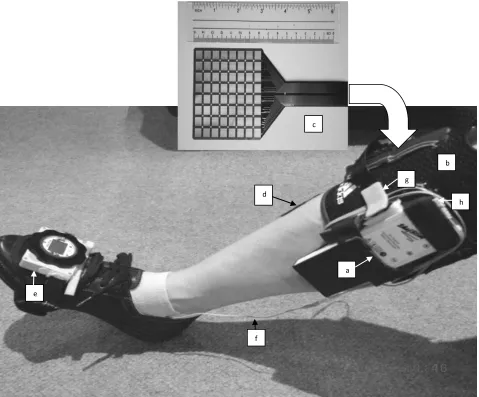
4 The ShefStim consists of (Fig. 1): a leg-worn stimulator (Fig. 1. a.) housed in a modified knee 80
sleevei (Fig. 1. b.); a flexible printed circuit board array of 64 electrodes (cathode electrodes) 81
(Fig. 1. c.), covered with a thin layer of high resistivity hydrogel (10-12) . Sweat ingress 82
changes the conductive properties of the hydrogel sheet so a replacement array fitted with 83
a new sheet of hydrogel is used each day (12); a conventional footswitchii; a conventional 84
anodeiii (Fig. 1.d.) and a foot sensor and remote control device housed in a bespoke foot-85
podiv (Fig. 1. e.). The foot sensor and remote control device detects foot orientation, 86
provides voice commands during AS and acts as a handheld remote unit post AS, allowing 87
the user to pause, and change intensity as required. 88
Word count: 209 89
Donning the system 90
To don ShefStim the following steps are required: 91
1. The footswitch (Fig. 1. f.) is placed under the heel, with the connecting cable 92
extending from the shoe. 93
2. The knee sleeve is donned aligning the stimulator pocket with the long axis of the 94
tibia 95
3. The stimulator is placed in the knee sleeve’s stimulator pocket 96
4. The foot-pod, containing the foot sensor and remote control device is positioned 97
over the shoe locating it approximately centrally over the dorsum of the foot and 98
5 5. Electrode array placement: the centre of the third row of electrodes down from the 100
top of the array is aligned with the head of the fibula and the inner edge parallel to 101
the tibia. 102
6. The electrical connector for the array (Fig. 1. g.) is inserted into the array socket on 103
the side of the stimulator and the array is secured with a Velcro® strap. 104
7. The self-adhesive anode is positioned over the tibialis anterior. 105
8. The footswitch connector (Fig. 1. h.) is inserted in the stimulator. 106
AS is then started. 107
Word count: 177 108
AS 109
For a more detailed description of the AS algorithm refer to Heller’s study (1). The only 110
difference between the algorithm used in Heller’s study (1) and the ShefStim algorithm, 111
relates to the cost function used in stage 3 of the setup process. The cost function enables 112
many factors that are not directly comparable (e.g. the angle of dorsiflexion (DF) and the 113
stimulation current) to be combined into one optimisation routine. In this case, for example, 114
the angle of DF and the stimulation current are related and the benefits of increasing DF 115
have to be balanced against the potential disadvantages of increasing current excessively. 116
The cost function attributes each a cost score, the lower the cost the better, and the 117
optimisation routine is used to find a minimum cost solution. Compared with the cost 118
function described in Heller’s study, the one used in ShefStim reduced the degree of 119
eversion associated with zero cost from 10 to 5 degrees. This change was implemented 120
6 Word Count: 171
122
Participants 123
Ethical Approval was granted from the University of Salford (REP10/113) and the integrated 124
research application system (10/H1003/107) for ten participants. Existing foot-drop FES 125
users within the North-West region were given information by clinicians. Interested 126
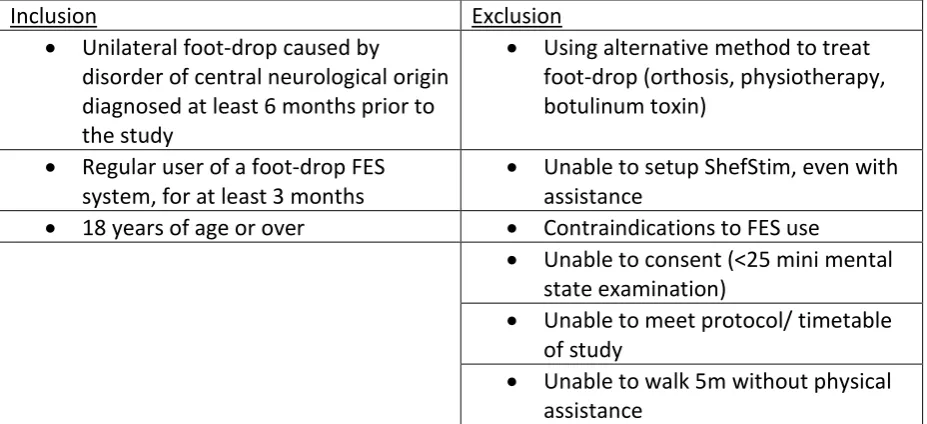
participants contacted the chief investigator. Inclusion/exclusion criteria are shown in Table 127
1. 128
Table 1: 129
Word count: 46 130
Protocol 131
At visit 1 participants attended the University of Salford gait laboratory and were provided 132
with standard shoesv for all conditions to avoid the potential impact of different footwear 133
on foot clearance (13). Participants walked approximately five metres along the gait 134
laboratory up to five times at a self-selected speed initially with no stimulation and then 135
with participant’s own FES system (self-setup). Following visit 1 the knee sleeve, stimulator 136
and electrode arrays were prepared for that individual. Participants returned for visit 2 137
where fitting was completed, rising/falling ramps and extension configured, adjustments 138
made to AS settings if required (to ensure appropriate virtual electrode selection) and 139
ShefStim use taught. Following two weeks of unsupervised use of ShefStim at home (with a 140
home-visit after approximately one week to replenish arrays and answer any queries) 141
participants returned to the gait laboratory (visit 3) which duplicated visit 1 but using 142
7 Word count: 151
144
Measures 145
Estimate of usage (between visits 2 and 3) 146
Usage data has been collected in previous foot-drop FES studies (14-18). ShefStim logs the 147
number of heel lifts per day which can be used as an estimate of usage. 148
Word count: 29 149
TS (visits 1 and 3) and AS time (between visits 2 and 3). 150
With one notable exception (1), setup time has been largely neglected in previous foot-drop 151
FES research . TS times, defined as time from first starting to don equipment to being 152
satisfied with the outcome and walking away (including AS time for ShefStim), were 153
recorded for participants’ own FES (visit 1) and ShefStim (visit 3). Average AS time (time for 154
AS to complete) was logged by ShefStim. 155
Word count: 65 156
Diary recording problems during community use (between visits 2 and 3). 157
Problems encountered were recorded in a paper diary by each participant. User-reported 158
problems have been collected previously (15) but never during the period of use. Recorded 159
problems were collated and grouped into two categories (19): External and Setup. External 160
were classed as being independent of the stimulator design and so referred to the housing 161
of ShefStim (knee sleeve), issues with the standard wired footswitch or issues with charging. 162
8 Word count: 81
164
User-satisfaction (visits 1 and 3) 165
User-satisfaction has previously been captured using purposive questionnaires (4, 15, 18). 166
Given the risk of bias and lack of validation we sought an alternative. The Quebec User 167
Evaluation of Satisfaction with Assistive Technology (QUEST 2.0) device scale (20) is a 168
validated user-satisfaction measure . Participants rated their satisfaction against eight single 169
item criteria (dimensions, weight, ease of adjustment, safety and security, durability, ease of 170
use, comfort, effectiveness) using a five-point Likert scale (1=not satisfied at all to 5= very 171
satisfied: maximum score=40) for their own FES system and ShefStim. In addition, 172
participants ranked their top three priorities from the eight criteria. 173
Word count: 97 174
Speed and ankle angles at initial contact (visits 1 and 3) 175
Increased walking speed indicates an improvement in overall walking performance (21) and 176
is frequently used in FES research (22, 23). Measuring walking speed over five metres from a 177
static starting position is a validated measure with neurological populations (24) and was 178
calculated by averaging the velocity of a recorded waist marker (L3 vertebra) over the 179
measurement space (13). 180
Foot-drop leads to abnormal joint alignment during stance (25) with a tendency for 181
plantarflexion (PF) and inversion (21) which can reduce ankle stability. Sagittal and frontal 182
plane ankle angles were captured at initial contact to measure this. The calibrated 183
anatomical system technique (CAST)(26, 27) was used for shank marker placement. Foot 184
9 Data for both speed and ankle angles was captured at 100Hz using a 16-camera 3D motion 186
analysis systemvi; a fourth-order low-pass Butterworth filter was used with a 6Hz cut-off 187
frequency. Ankle angles at initial contact were analysed using Visual 3Dvii 188
Word count: 152 189
Foot clearance during swing (visits 1 and 3) 190
Foot-drop is associated with an increased risk of tripping and falling due to a lack of foot 191
clearance during swing phase (29). Foot clearance was obtained for seven different points 192
on the shoe sole as described in Thies et al (13). Only three of the seven markers from Thies’ 193
study (13) (distal toe, medial and lateral forefoot) were investigated since these were 194
deemed most relevant. Healthy gait consistently has a minimum clearance value during 195
swing (13, 30). Hemiplegic gait, however, has an altered clearance trajectory and does not 196
always produce a minimum value during swing, so an alternative and consistently definable 197
point along the trajectory was chosen. Specifically, in this study it was calculated at the 198
moment in time when the reference point on the shoe sole passed the contra-lateral medial 199
malleolus. Data was processed using Matlab®viii code (13). 200
Word count: 133 201
Total methods word count: 1311 (not including sub-headings) 202
Data Analysis 203
As a feasibility study (9, 31), statistical analysis was limited to graphical representation of 204
data and descriptive methods. Ratio data (AS log data, speed and ankle angles at initial 205
10 skewed data (usage, TS times and toe clearance (32) , with inter-quartile range(IQR)) and 207
ordinal data (QUEST (33)). 208
Word count: 56 209
RESULTS 210
Table 2: 211
Table 2 provides participant characteristics. Prior to data collection three participants were 212
withdrawn (1, 6, 10). The withdrawal of participants 1 and 10 was due to unrelated medical 213
issues. Subject 6 was withdrawn as it became clear, post recruitment, that he was not a 214
regular user of FES for foot-drop. He had discontinued use following ankle instability 215
problems and a number of falls. The average age of the remaining participants was58 yrs. 216
(SD 12.9)which is comparable to other foot-drop FES studies (1, 21, 34). Of the five men and 217
two women, four had non-progressive and three had progressive neurological disorders, 218
which is representative of the FES user population (16, 35). The FES systems used by 219
participants varied but all use a single cathode and single anode, and so were classed as 220
‘conventional’. 221
Word count: 126 222
Estimate of usage 223
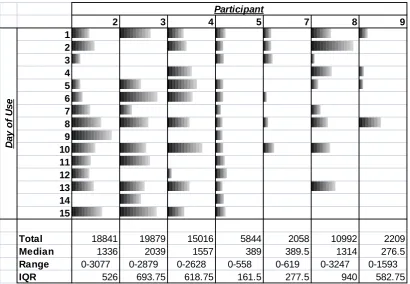
All participants used ShefStim (Fig. 2) with an average of 1314 heel lifts (steps) per day. 224
There was variability in the number of heel lifts from day-to-day for each participant (for 225
example participant 8) and between participants (participants 5 and 7 versus participant 3). 226
11 participants 7 (6/15) and 9 (4/15) using it far less than participants 5 (14/15) or 2 (13/15) 228
(Fig. 2) 229
Word count: 78 230
231
Figure 2: 232
233
TS and AS time 234
TS time for ShefStim took an average of exactly 14 min [range: 12 min 24 s -37 min 30 s] 235
compared to 3 min 20 s [range: 40 s -8 min] for their own FES. The average AS time was 9 236
min [range: 7 min 34 s – 10 min 20 s]. 237
Word count: 51 238
239
Diary recording problems during community use 240
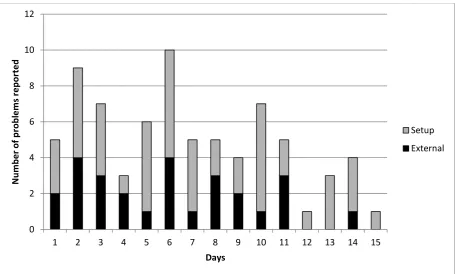
Of the recorded problems 64% [48 problems] were related to setup with poor voice 241
command clarity from the foot sensor and remote control device (e.g. participant 2, day 3 242
“remote voice garbled”), frequent pausing during and/or unacceptable AS specifically cited 243
(e.g. participant 5, day 9 “pausing, why?” and participant 2, day 2 “2x setups as chaplin 244
walk”). 36% [27 problems] were related to external issues, for example participant 8, day 6 245
“despite charging overnight controller battery was flat”. The overall number of reported 246
problems diminished towards the end of the testing period (Fig. 3). 247
Word count: 94 248
249
Figure 3: 250
12 User-satisfaction
252
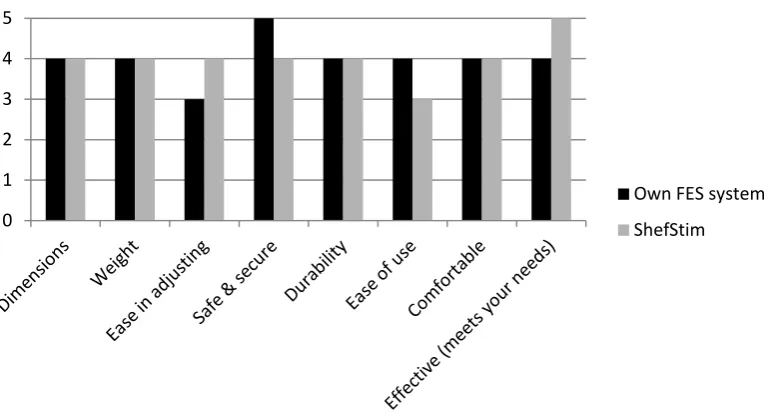
Overall, on average, participants were as satisfied with ShefStim as with their own FES 253
system (Fig. 4). They were more satisfied with their own FES in terms of: ‘Ease of use’, which 254
was the criteria most frequently prioritised on QUEST, and ‘safety and security’. ShefStim 255
outscored participants’ own FES with regards to ‘effectiveness’, the second most frequently 256
cited priority, and ‘ease of adjustment’. On the remaining four criteria the systems scored 257
equally. 258
Word count: 72 259
Figure 4: 260
261
Speed 262
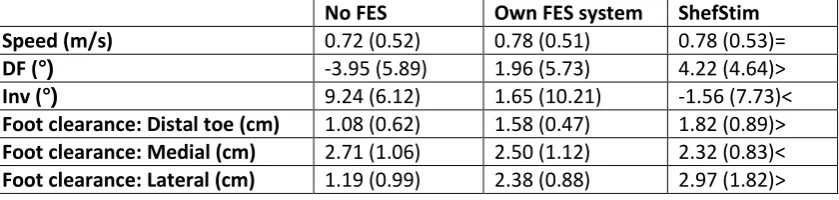
Both FES systems produced the same increase in walking speed [0.06 m/s] compared to no 263
stimulation (Table 3). 264
Word count: 18 265
266
Table 3: 267
268
Ankle angles at initial contact 269
With no stimulation PF with inversion was seen (Table 3). Both ShefStim and conventional 270
systems corrected this; however, ShefStim achieved this to a greater extent (Table 3). 271
Word count: 27 272
273
13 This outcome could not be determined for participants 5 and 7 who both exhibited short 275
step lengths and a significant degree of external rotation of the leg during swing, therefore 276
none of the reference points passed the contra-lateral malleolus during swing as was 277
required by the algorithm. The distal toe marker showed the smallest overall clearance 278
values and with ShefStim the clearance was greatest (Table 3). Table 3 shows that without 279
FES, the median value of the medial marker was higher than the lateral; with participant’s 280
own FES they were approximately equal and with ShefStim the lateral was higher than the 281
medial. This foot pose at mid-swing was consistent with the ankle angles at initial contact 282
(see above). 283
Word count: 118 284
Total results word count: 584 (excluding sub-headings) 285
286
287
DISCUSSION 288
This study sought to investigate the feasibility of unsupervised use of ShefStim by FES users 289
within the community environment. Usage results show ShefStim is a usable device because 290
without exception, albeit with variation, all participants used ShefStim. 291
Previous studies have reported a number of different measures of usage (6, 14, 15, 17, 18). 292
Only our results for steps (heel lifts) per day could be compared to previous, larger, studies 293
(6, 15, 18), with our participants generally walking less. For example Stein et al’s (6) 294
participants took 1842 (+/- 198) steps per day when first starting to use the Walkaide 295
system and van Swigchem et al’s (18) took 5733 (SD 2516). Worthy of note was that van 296
14 day whereas participants in ours and Stein et al’s were not guided in this way. Further, our 298
participants reported a number of problems associated with the pre-commercial nature of 299
the ShefStim system, which may have impacted on use on certain days (see Fig. 3). Further 300
studies should continue to report detailed FES usage to allow further exploration of the 301
population and allow comparison between systems and/or baseline. 302
Results did not fully meet the prediction made by Heller et al (1) that ShefStim would result 303
in shorter TS times. There are a number of possible reasons for this. Firstly, Heller used self-304
report to assess setup time with participants’ own FES systems, finding an average of 11 305
minutes. In our study participants were timed during setup in the lab and took an average of 306
3 minutes to setup their own FES systems. In the Heller study participants placed their 307
affected leg in a rigid brace, thereby removing the possibility of significant leg movement. In 308
our study, the participant’s leg was not constrained during setup and leg movement 309
detected during the AS process led to pauses which lengthened the process, a problem 310
recorded by participants. Further, our ShefStim users relied on audio feedback from the 311
foot sensor and remote control device, which participants reported was sometimes difficult 312
to hear. Participants also sometimes reached the end of setup and decided that the 313
automatically chosen site was not acceptable, then ran the entire AS again. Although a ‘skip-314
site’ function was available (1) to address this issue (alternative sites identified as suitable to 315
be selected manually) participants did not use it, hence further refinement of user training 316
material and/or the user interface is warranted. 317
The finding that, overall, participants were as satisfied with ShefStim as with their own FES 318
systems, is encouraging because unlike conventional foot-drop FES systems ShefStim has 319
15 of use’ was rated lower than participants own FES systems, however, suggests that two 321
weeks was insufficient for participants to fully familiarise themselves with ShefStim. 322
Alternatively it might be due to the cited problems with ShefStim itself. Our results cannot 323
be compared to other studies as QUEST has not been used before in this field of research. 324
Future studies should allow longer unsupervised periods of use and should use a validated 325
measure such as QUEST. 326
Speed increase, for both ShefStim and conventional FES systems, compared to no FES was in 327
keeping with previous studies (21) and classed as clinically meaningful (36). In Heller’s study, 328
in which subjects did not have time to accommodate to the automated setup, speed 329
increase (relative to no FES) when using the automated setup system was smaller than with 330
their own system (0.04 m/s vs 0.11m/s). In both studies foot response with AS was 331
improved compared with participants’ setup of their own stimulators. Although there is a 332
risk of over-interpretation of the results, our findings may suggest that once users become 333
accustomed to a new FES system, their walking speed is relatively insensitive to small 334
differences in foot response. These findings are supported by the foot clearance results and 335
indicate that the underlying operating principle of an array-based FES system with AS may 336
be more effective at addressing foot-drop than conventional FES systems by reducing 337
human error/influence over electrode placement. However, larger scale study is required to 338
fully substantiate these initial findings. 339
Word count: 676 340
16 This was a feasibility study with a small sample size, self-referred participants and was not 342
randomised (9, 31). As such, whilst encouraging, results should be viewed with caution. The 343
outcome measures selected would appear appropriate but many have been largely unused 344
in previous research in this field making comparison to previous studies challenging. 345
Further development of the electrode-skin interface is required (12) to negate the need for 346
daily array replacement and improve future commercial viability. Further iterations of 347
ShefStim need to also consider addressing the cited setup and external problems, such as 348
voice command clarity, the impact of pausing on AS time, user training and charging, to 349
facilitate further study and widespread implementation. 350
Word count: 110 351
352
CONCLUSION 353
This is the first study of ShefStim and one of very few investigating foot-drop FES both 354
within the lab and during unsupervised use (37, 38). Ultimately this study demonstrates, for 355
the first time, an array-based AS FES system (ShefStim) for foot-drop can be successfully 356
used unsupervised. Despite longer and more problematic setup in the population studied, 357
users were satisfied with it and it would appear to have comparable, if not better, effects on 358
gait than conventional foot-drop FES systems. 359
Further product development and a larger-scale, longer-term study is required before firm 360
conclusions about the efficacy and effectiveness of ShefStim, compared to conventional FES, 361
can be reached. 362
Word count: 104 363
17 References
365
366
1. Heller BW, Clarke AJ, Good TR, Healey TJ, Nair S, Pratt EJ, et al. Automated setup of 367
functional electrical stimulation for drop foot using a novel 64 channel prototype stimulator and 368
electrode array: Results from a gait-lab based study. Med Eng Phys. 2013 May 3. PubMed PMID: 369
22559959. Epub 2012/05/09. Eng. 370
2. NICE. Functional electrical stimulation for drop foot of central neurological origin. National 371
Institute for Clinical Excellence, 2009 Contract No.: Interventional procedure guidance 278. 372
3. Wilkie KM, Shiels JE, Bulley C, Salisbury LG. "Functional electrical stimulation (FES) impacted 373
on important aspects of my life"-A qualitative exploration of chronic stroke patients' and carers' 374
perceptions of FES in the management of dropped foot. Physiother Theory Prac. 2012 Jan;28(1):1-9. 375
PubMed PMID: BCI:BCI201200024459. 376
4. Taylor PN, Burridge JH, Dunkerley AL, Lamb A, Wood DE, Norton JA, et al. Patients' 377
perceptions of the Odstock Dropped Foot Stimulator (ODFS). Clin Rehabil. 1999 Oct;13(5):439-46. 378
PubMed PMID: 10498351. Epub 1999/09/25. eng. 379
5. Kottink AI, Hermens HJ, Nene AV, Tenniglo MJ, van der Aa HE, Buschman HP, et al. A 380
randomized controlled trial of an implantable 2-channel peroneal nerve stimulator on walking speed 381
and activity in poststroke hemiplegia. Arch Phys Med Rehabil. 2007 Aug;88(8):971-8. PubMed PMID: 382
17678657. eng. 383
6. Stein RB, Everaert DG, Thompson AK, Chong SL, Whittaker M, Robertson J, et al. Long-Term 384
Therapeutic and Orthotic Effects of a Foot Drop Stimulator on Walking Performance in Progressive 385
and Nonprogressive Neurological Disorders. Neurorehabil Neural Repair. 2010 Feb;24(2):152-67. 386
PubMed PMID: WOS:000274015500005. 387
7. Laufer Y, Ring H, Sprecher E, Hausdorff JM. Gait in individuals with chronic hemiparesis: one-388
year follow-up of the effects of a neuroprosthesis that ameliorates foot drop. J Neurolog Phys Ther: 389
JNPT. 2009;33(2):104-10. PubMed PMID: 19556919. Language: English. Language Code: eng. Date 390
Created: 20090626. Date Completed: 20091208. Update Code: 20111122. Publication Type: Journal 391
Article. 392
8. Weber DJ, Stein RB, Chan KM, Loeb G, Richmond F, Rolf R, et al. BIONic WalkAide for 393
correcting foot drop. IEEE Transactions On Neural Systems And Rehabilitation Engineering: A 394
Publication Of The IEEE Engineering In Medicine And Biology Society. 2005;13(2):242-6. PubMed 395
PMID: 16003906. Language: English. Language Code: eng. Date Revised: 20061115. Date Created: 396
20050711. Date Completed: 20050801. Update Code: 20111122. Publication Type: Journal Article. 397
9. Arain M, Campbell MJ, Cooper CL, Lancaster GA. What is a pilot or feasibility study? A review 398
of current practice and editorial policy. BMC Med Res Methodol. 2010;10:67-73. PubMed PMID: 399
52844644. 400
10. Sha N, Kenney LP, Heller BW, Barker AT, Howard D, Moatamedi M. A finite element model to 401
identify electrode influence on current distribution in the skin. Artif Organs. 2008 Aug;32(8):639-43. 402
PubMed PMID: 18782136. eng. 403
11. Sha N, Kenney LP, Heller BW, Barker AT, Howard D, Wang W. The effect of the impedance of 404
a thin hydrogel electrode on sensation during functional electrical stimulation. Med Eng Phys. 2008 405
Jul;30(6):739-46. PubMed PMID: 17942361. eng. 406
12. Cooper G, Barker AT, Heller BW, Good T, Kenney LPJ, Howard D. The use of hydrogel as an 407
electrode-skin interface for electrode array FES applications. Med Eng Phys. 2011 Oct;33(8):967-72. 408
PubMed PMID: WOS:000295107800010. 409
13. Thies SB, Kenney LPJ, Howard D, Nester C, Ormerod M, Newton R, et al. Biomechanics for 410
inclusive urban design: Effects of tactile paving on older adults' gait when crossing the street. J 411
18 14. Granat MH, Maxwell DJ, Ferguson ACB, Lees KR, Barbenet JC. Peroneal stimulator:
413
Evaluation for the correction of spastic drop foot in hemiplegia. Arch Phys Med Rehabil. 414
1996;77(1):19-24. 415
15. Stein RB, Chong S, Everaert DG, Rolf R, Thompson AK, Whittaker M, et al. A multicenter trial 416
of a footdrop stimulator controlled by a tilt sensor. Neurorehabil Neural Repair. 2006 Sep;20(3):371-417
9. PubMed PMID: 16885423. Epub 2006/08/04. eng. 418
16. Taylor P, Burridge J, Dunkerley A, Wood D, Norton J, Singleton C, et al. Clinical Audit of 5 419
years Provision of the Odstock Dropped Foot Stimulator. Artif Organs. 1999;23(5):440-2. 420
17. Kottink AI, Hermens HJ, Nene AV, Tenniglo MJ, van der Aa HE, Buschman HP, et al. A 421
Randomized Controlled Trial of an Implantable 2-Channel Peroneal Nerve Stimulator on Walking 422
Speed and Activity in Poststroke Hemiplegia. Arch Phys Med Rehabil. 2007;88(8):971-8. 423
18. van Swigchem R, Vloothuis J, den Boer J, Weerdesteyn V, Geurts ACH. Is transcutaneous 424
peroneal stimulation beneficial to patients with chronic stroke using an ankle-foot orthosis? A 425
within-subject study of pateints' satisfaction, walking speed and physical activity level. J Rehabil 426
Med. 2010 Feb;42(2):117-21. PubMed PMID: WOS:000275650700003. 427
19. Graneheim UH, Lundman B. Qualitative content analysis in nursing research: concepts, 428
procedures and measures to achieve trustworthiness. Nurs Ed Today. 2004;24(2):105-12. 429
20. Demers L, Monette M, Lapierre Y, Arnold DL, Wolfson C. Reliability, validity, and applicability 430
of the Quebec User Evaluation of Satisfaction with assistive Technology (QUEST 2.0) for adults with 431
multiple sclerosis. Disabil Rehabil. 2002;24:21-30. 432
21. Voigt M, Sinkjaer T. Kinematic and kinetic analysis of the walking pattern in hemiplegic 433
patients with foot-drop using a peroneal nerve stimulator. Clin Biomech. 2000;15:340-51. 434
22. Kottink AIR, Oostendorp LJM, Buurke JH, Nene AV, Hermens HJ, Ijzerman MJ. The Orthotic 435
Effect of Functional Electrical Stimulation on the Improvement of Walking in Stroke Patients with a 436
Dropped Foot: A Systematic Review. Artif Organs. 2004;28(6):577-86. PubMed PMID: 13154253. 437
23. Roche A, Laighin G, Coote S. Surface-applied functional electrical stimulation for orthotic and 438
therapeutic treatment of drop-foot after stroke -- a systematic review. Phys Ther Rev. 2009;14(2):63-439
80. PubMed PMID: 2010314708. Language: English. Entry Date: 20090821. Revision Date: 20091218. 440
Publication Type: journal article. 441
24. Graham JE, Ostir GV, Kuo Y-F, Fisher SR, Ottenbacher KJ. Relationship Between Test 442
Methodology and Mean Velocity in Timed Walk Tests: A Review. Arch Physl Med Rehabil. 443
2008;89(5):865-72. 444
25. Burridge JH, Elessi K, Pickering RM, Taylor PN. Walking on an Uneven Surface: The Effect of 445
Common Peroneal Stimulation on Gait Parameters and Relationship Between Perceived and 446
Measured Benefits in a Sample of Participants With a Drop-Foot. Neuromodulat : J Internat 447
Neuromodulat Soc. 2007;10(1):59-67. PubMed PMID: 23634177. 448
26. Cappozzo A, Catani F, Della Croce U, Laeardini A. Position and orientation in space of bones 449
during movement: anatomical frame definition and determination. Clin Biomech. 1995;10(4):171-8. 450
27. Whittle M, Levine D, Richards J. Methods of gait analysis. In: Levine D, editor. Whittle's Gait 451
Analysis. 5th ed. Edinburgh: Churchill Livingstone; 2012. p. 83-112. 452
28. Pratt EJ, Reeves ML, van der Meulen JM, Heller BW, Good TR. The development, preliminary 453
validation and clinical utility of a shoe model to quantify foot and footwear kinematics in 3-D. Gait 454
Posture. 2012;36(3):434-8. 455
29. Everaert DG, Stein RB, Abrams GM, Dromerick AW, Francisco GE, Hafner BJ, et al. Effect of a 456
Foot-Drop Stimulator and Ankle–Foot Orthosis on Walking Performance After Stroke: A Multicenter 457
Randomized Controlled Trial. Neurorehabil Neural Repair. 2013 April 4, 2013. 458
30. Thies SB, Jones RK, Kenney LPJ, Howard D, Baker R. Effects of ramp negotiation, paving type 459
and shoe sole geometry on toe clearance in young adults. J Biomech. 2011;44(15):2679-84. 460
31. Medical Research Council. A framework for development and evaluation of RCTs for 461
19 32. Begg R, Best R, Dell’Oro L, Taylor S. Minimum foot clearance during walking: Strategies for 463
the minimisation of trip-related falls. Gait Posture. 2007;25(2):191-8. 464
33. Esnouf JE, Taylor PN, Mann GE, Barrett CL. Impact on activities of daily living using a 465
functional electrical stimulation device to improve dropped foot in people with multiple sclerosis, 466
measured by the Canadian Occupational Performance Measure. Mult Scler. 2010 Sep;16(9):1141-7. 467
PubMed PMID: 20601398. Epub 2010/07/06. eng. 468
34. van Swigchem R, van Duijnhoven HJR, den Boer J, Geurts AC, Weerdesteyn V. Effect of 469
Peroneal Electrical Stimulation Versus an Ankle-Foot Orthosis on Obstacle Avoidance Ability in 470
People With Stroke-Related Foot Drop. Phys Ther. 2012 Mar;92(3):398-406. PubMed PMID: 471
WOS:000300940500004. 472
35. Taylor PN, editor How long do Dropped foot stimulator users continue to use FES and how 473
much does it cost? An eleven and six year clinical audit. IFESS; 2010; Vienna, Austria. 474
36. Perera S, Mody SH, Woodman RC, Studensk SA. Meaningful Change and Responsiveness in 475
Common Physical Performance Measures in Older Adults. J Am Geriatrics Soc. 2006;54(5):743-9. 476
PubMed PMID: 20620658. 477
37. Barrett C, Taylor P. The effects of the odstock drop foot stimulator on perceived quality of 478
life for people with stroke and multiple sclerosis. Neuromodulat : J Internat Neuromodulat Soc. 2010 479
Jan;13(1):58-64. PubMed PMID: 21992766. Epub 2010/01/01. eng. 480
38. Barrett CL, Mann GE, Taylor PN, Strike P. A randomized trial to investigate the effects of 481
functional electrical stimulation and therapeutic exercise on walking performance for people with 482
multiple sclerosis. Mult Scler. 2009 Apr;15(4):493-504. PubMed PMID: 19282417. Epub 2009/03/14. 483
eng. 484
485
20 Suppliers
i
Adidas knee support, Adidas, Herzogenaurach, Germany.
ii
Odstock Medical Ltd, Salisbury, UK
iii
5x5 PALS ®Platinum Neurostimulation electrode, Axelgaard Manufacturing co.Ltd, San Diego, USA.
iv Adapted from an I-pod holder, Signalex, Birmingham, UK.
v
Hotter Comfort Concept shoes, Skelmersdale, UK. (for men) and Clarks Un Betty from Unstructured Autumn /Winter 2011 range, Street, UK. (for women)
vi
Qualisys, Stockholm, Sweden.
vii
C-Motion, Maryland, USA.
viii
Matlab®, Mathworks, Cambridge, UK.
Figure legends
Figure 1: ShefStim system (medial view of leg during AS)
Figure 2: Logged heel lifts (N=7): Blank cells=0 heel lifts; the length of bar represents the number of heel lifts.The median number overall of steps per day was 1314.
Figure 3: Recorded problems over two week unsupervised community use (N=7).
1 Objective: To investigate the feasibility of unsupervised community use of an array-based 1
automated setup (AS) functional electrical stimulator (FES) for current foot-drop FES users. 2
Design: A feasibility study. 3
Setting: Participants’ gait, total setup (TS) times and satisfaction were evaluated twice in the 4
gait laboratory. Usage, AS times and problems encountered were recorded during a two 5
week period of unsupervised use. 6
Participants: Participants (N=7) with diagnosis of uni-lateral foot-drop of central 7
neurological origin (>6mo), who were regular users of a foot-drop FES system (>3mo). 8
Intervention: Array-based AS FES system for foot-drop (ShefStim). 9
Main Outcome Measures: Logged usage; TS times for both FES systems and logged AS times 10
for ShefStim; diary recording of problems experienced; Quebec User Evaluation of 11
Satisfaction with assistive Technology (QUEST 2.0) questionnaire; walking speed; ankle 12
angles at initial contact and foot clearance during swing. 13
Results: All participants were able to use ShefStim. TS took longer with ShefStim than 14
participants’ own FES systems and AS was longer than in a previous study of a similar system 15
(1). Some problems were experienced but overall participants were as satisfied with 16
ShefStim as their own FES systems. The increase in walking speed (N=7), relative to no 17
stimulation, was comparable between both systems and appropriate ankle angles at initial 18
contact (N=7) and foot clearance during swing (N=5) were greater with ShefStim. 19
Conclusions: This study demonstrates, for the first time, that an array-based AS FES system 20
(ShefStim) for foot-drop can be successfully used unsupervised. Despite setup taking longer 21
and some problems users are satisfied with it and it would appear as effective, if not better, 22
at addressing the foot-drop impairment. Further product development of this unique 23
system, followed by a larger-scale and longer-term study is required before firm conclusions 24
about its efficacy can be reached. 25
Word count: 290 26
Key words: electric stimulation therapy; peroneal nerve; hemiplegia; gait disorders, 27
neurologic; rehabilitation 28
Abbreviations: 29
Functional electrical stimulation=FES ; Automated setup=AS; Odstock drop foot 30
stimulator=ODFS; Inter-quartile range=IQR; Standard deviation=SD; Total setup=TS; Quebec 31
User Evaluation of Satisfaction with assistive Technology=QUEST; Dorsiflexion=DF; 32
Plantarflexion=PF 33
2 INTRODUCTION
35
36
The efficacy, and safety, of functional electrical stimulation (FES) as a treatment for foot-37
drop of central neurological origin is well established (2), however, usability issues have 38
been noted (3, 4). In fact a survey of new and established users of the Odstock drop foot 39
stimulator found that 44% of users reported difficulties in locating the correct electrode 40
position (4), and this finding is of particular relevance to this study. Traditional single-41
channel surface foot-drop FES systems deliver current via a pair of electrodes, accurate 42
placement of which is crucial to the correct functioning of the system. The optimal site for 43
stimulation may vary from day-to-day and even throughout a day which further complicates 44
the setup process (4). Interestingly, despite wide recognition of this issue (5), only one study 45
specifically reported on the impact of user-defined electrode placement on functional 46
outcomes (1), finding a poorer foot response when participants located electrodes 47
themselves, compared with clinician setup. 48
In response to this issue, new designs of FES systems have been produced. These include 49
electrodes integrated into cuffs (6, 7) and implantable systems (5, 8). Most recently, Heller 50
et al. (1) reported on an array-based FES stimulator for foot-drop. The system uses the 51
principle of a ‘virtual electrode’. Stimulation is delivered via a 4x4 cluster of small 52
electrodes, chosen from within an 8x8 array. The choice of which virtual electrode to use 53
and at what level to stimulate is determined automatically during setup by an algorithm, 54
which uses as its input the foot response to stimulation. This approach fully automates the 55
setup process (both location and amplitude of stimulation) thus, potentially, reducing setup 56
difficulty. Heller’s study found that automated setup (AS) was comparably effective and 57
3 further developed and CE marked as ShefStim. This paper is the first feasibility (9) study of 59
ShefStim which combined a period of unsupervised use in conjunction with gait evaluation 60
at the start and end of the study period. The primary aim was to investigate whether 61
ShefStim could be used, unsupervised, by foot-drop FES users within the community 62
environment. In addition a number of other sub-aims were addressed. These were to 63
investigate: 64
1. The community-usage patterns and user-satisfaction with ShefStim. 65
2. The total setup (TS) time compared with their own FES system, as well as AS times 66
for ShefStim. 67
3. The effects of ShefStim on walking speed, ankle angles (at initial contact) and foot 68
clearance during swing, compared with participants’ own FES system. 69
Word count: 404 70
METHODS 71
ShefStim system 72
A detailed description of the operating principles of the stimulator, and changes in order to 73
achieve CE marking, are given in the Heller et al. paper (1). The same fixed parameters 74
(monophasic waveform, charge-balanced, 40Hz, 160µs) were used but the system used in 75
Heller’s study restrained the leg in a support during the AS process. This was deemed 76
impractical for a take-home device so instead users were requested to extend their leg and 77
rest their heel on the floor during home AS. 78
4 The ShefStim consists of (Fig. 1): a leg-worn stimulator (Fig. 1. a.) housed in a modified knee 80
sleevei (Fig. 1. b.); a flexible printed circuit board array of 64 electrodes (cathode electrodes) 81
(Fig. 1. c.), covered with a thin layer of high resistivity hydrogel (10-12) . Sweat ingress 82
changes the conductive properties of the hydrogel sheet so a replacement array fitted with 83
a new sheet of hydrogel is used each day (12); a conventional footswitchii; a conventional 84
anodeiii (Fig. 1.d.) and a foot sensor and remote control device housed in a bespoke foot-85
podiv (Fig. 1. e.). The foot sensor and remote control device detects foot orientation, 86
provides voice commands during AS and acts as a handheld remote unit post AS, allowing 87
the user to pause, and change intensity as required. 88
Word count: 209 89
Donning the system 90
To don ShefStim the following steps are required: 91
1. The footswitch (Fig. 1. f.) is placed under the heel, with the connecting cable 92
extending from the shoe. 93
2. The knee sleeve is donned aligning the stimulator pocket with the long axis of the 94
tibia 95
3. The stimulator is placed in the knee sleeve’s stimulator pocket 96
4. The foot-pod, containing the foot sensor and remote control device is positioned 97
over the shoe locating it approximately centrally over the dorsum of the foot and 98
5 5. Electrode array placement: the centre of the third row of electrodes down from the 100
top of the array is aligned with the head of the fibula and the inner edge parallel to 101
the tibia. 102
6. The electrical connector for the array (Fig. 1. g.) is inserted into the array socket on 103
the side of the stimulator and the array is secured with a Velcro® strap. 104
7. The self-adhesive anode is positioned over the tibialis anterior. 105
8. The footswitch connector (Fig. 1. h.) is inserted in the stimulator. 106
AS is then started. 107
Word count: 177 108
AS 109
For a more detailed description of the AS algorithm refer to Heller’s study (1). The only 110
difference between the algorithm used in Heller’s study (1) and the ShefStim algorithm, 111
relates to the cost function used in stage 3 of the setup process. The cost function enables 112
many factors that are not directly comparable (e.g. the angle of dorsiflexion (DF) and the 113
stimulation current) to be combined into one optimisation routine. In this case, for example, 114
the angle of DF and the stimulation current are related and the benefits of increasing DF 115
have to be balanced against the potential disadvantages of increasing current excessively. 116
The cost function attributes each a cost score, the lower the cost the better, and the 117
optimisation routine is used to find a minimum cost solution. Compared with the cost 118
function described in Heller’s study, the one used in ShefStim reduced the degree of 119
eversion associated with zero cost from 10 to 5 degrees. This change was implemented 120
6 Word Count: 171
122
Participants 123
Ethical Approval was granted from the University of Salford (REP10/113) and the integrated 124
research application system (10/H1003/107) for ten participants. Existing foot-drop FES 125
users within the North-West region were given information by clinicians. Interested 126
participants contacted the chief investigator. Inclusion/exclusion criteria are shown in Table 127
1. 128
Table 1: 129
Word count: 46 130
Protocol 131
At visit 1 participants attended the University of Salford gait laboratory and were provided 132
with standard shoesv for all conditions to avoid the potential impact of different footwear 133
on foot clearance (13). Participants walked approximately five metres along the gait 134
laboratory up to five times at a self-selected speed initially with no stimulation and then 135
with participant’s own FES system (self-setup). Following visit 1 the knee sleeve, stimulator 136
and electrode arrays were prepared for that individual. Participants returned for visit 2 137
where fitting was completed, rising/falling ramps and extension configured, adjustments 138
made to AS settings if required (to ensure appropriate virtual electrode selection) and 139
ShefStim use taught. Following two weeks of unsupervised use of ShefStim at home (with a 140
home-visit after approximately one week to replenish arrays and answer any queries) 141
participants returned to the gait laboratory (visit 3) which duplicated visit 1 but using 142
7 Word count: 151
144
Measures 145
Estimate of usage (between visits 2 and 3) 146
Usage data has been collected in previous foot-drop FES studies (14-18). ShefStim logs the 147
number of heel lifts per day which can be used as an estimate of usage. 148
Word count: 29 149
TS (visits 1 and 3) and AS time (between visits 2 and 3). 150
With one notable exception (1), setup time has been largely neglected in previous foot-drop 151
FES research . TS times, defined as time from first starting to don equipment to being 152
satisfied with the outcome and walking away (including AS time for ShefStim), were 153
recorded for participants’ own FES (visit 1) and ShefStim (visit 3). Average AS time (time for 154
AS to complete) was logged by ShefStim. 155
Word count: 65 156
Diary recording problems during community use (between visits 2 and 3). 157
Problems encountered were recorded in a paper diary by each participant. User-reported 158
problems have been collected previously (15) but never during the period of use. Recorded 159
problems were collated and grouped into two categories (19): External and Setup. External 160
were classed as being independent of the stimulator design and so referred to the housing 161
of ShefStim (knee sleeve), issues with the standard wired footswitch or issues with charging. 162
8 Word count: 81
164
User-satisfaction (visits 1 and 3) 165
User-satisfaction has previously been captured using purposive questionnaires (4, 15, 18). 166
Given the risk of bias and lack of validation we sought an alternative. The Quebec User 167
Evaluation of Satisfaction with Assistive Technology (QUEST 2.0) device scale (20) is a 168
validated user-satisfaction measure . Participants rated their satisfaction against eight single 169
item criteria (dimensions, weight, ease of adjustment, safety and security, durability, ease of 170
use, comfort, effectiveness) using a five-point Likert scale (1=not satisfied at all to 5= very 171
satisfied: maximum score=40) for their own FES system and ShefStim. In addition, 172
participants ranked their top three priorities from the eight criteria. 173
Word count: 97 174
Speed and ankle angles at initial contact (visits 1 and 3) 175
Increased walking speed indicates an improvement in overall walking performance (21) and 176
is frequently used in FES research (22, 23). Measuring walking speed over five metres from a 177
static starting position is a validated measure with neurological populations (24) and was 178
calculated by averaging the velocity of a recorded waist marker (L3 vertebra) over the 179
measurement space (13). 180
Foot-drop leads to abnormal joint alignment during stance (25) with a tendency for 181
plantarflexion (PF) and inversion (21) which can reduce ankle stability. Sagittal and frontal 182
plane ankle angles were captured at initial contact to measure this. The calibrated 183
anatomical system technique (CAST)(26, 27) was used for shank marker placement. Foot 184
9 Data for both speed and ankle angles was captured at 100Hz using a 16-camera 3D motion 186
analysis systemvi; a fourth-order low-pass Butterworth filter was used with a 6Hz cut-off 187
frequency. Ankle angles at initial contact were analysed using Visual 3Dvii 188
Word count: 152 189
Foot clearance during swing (visits 1 and 3) 190
Foot-drop is associated with an increased risk of tripping and falling due to a lack of foot 191
clearance during swing phase (29). Foot clearance was obtained for seven different points 192
on the shoe sole as described in Thies et al (13). Only three of the seven markers from Thies’ 193
study (13) (distal toe, medial and lateral forefoot) were investigated since these were 194
deemed most relevant. Healthy gait consistently has a minimum clearance value during 195
swing (13, 30). Hemiplegic gait, however, has an altered clearance trajectory and does not 196
always produce a minimum value during swing, so an alternative and consistently definable 197
point along the trajectory was chosen. Specifically, in this study it was calculated at the 198
moment in time when the reference point on the shoe sole passed the contra-lateral medial 199
malleolus. Data was processed using Matlab®viii code (13). 200
Word count: 133 201
Total methods word count: 1311 (not including sub-headings) 202
Data Analysis 203
As a feasibility study (9, 31), statistical analysis was limited to graphical representation of 204
data and descriptive methods. Ratio data (AS log data, speed and ankle angles at initial 205
10 skewed data (usage, TS times and toe clearance (32) , with inter-quartile range(IQR)) and 207
ordinal data (QUEST (33)). 208
Word count: 56 209
RESULTS 210
Table 2: 211
Table 2 provides participant characteristics. Prior to data collection three participants were 212
withdrawn (1, 6, 10). The withdrawal of participants 1 and 10 was due to unrelated medical 213
issues. Subject 6 was withdrawn as it became clear, post recruitment, that he was not a 214
regular user of FES for foot-drop. He had discontinued use following ankle instability 215
problems and a number of falls. The average age of the remaining participants was58 yrs. 216
(SD 12.9)which is comparable to other foot-drop FES studies (1, 21, 34). Of the five men and 217
two women, four had non-progressive and three had progressive neurological disorders, 218
which is representative of the FES user population (16, 35). The FES systems used by 219
participants varied but all use a single cathode and single anode, and so were classed as 220
‘conventional’. 221
Word count: 126 222
Estimate of usage 223
All participants used ShefStim (Fig. 2) with an average of 1314 heel lifts (steps) per day. 224
There was variability in the number of heel lifts from day-to-day for each participant (for 225
example participant 8) and between participants (participants 5 and 7 versus participant 3). 226
11 participants 7 (6/15) and 9 (4/15) using it far less than participants 5 (14/15) or 2 (13/15) 228
(Fig. 2) 229
Word count: 78 230
231
Figure 2: 232
233
TS and AS time 234
TS time for ShefStim took an average of exactly 14 min [range: 12 min 24 s -37 min 30 s] 235
compared to 3 min 20 s [range: 40 s -8 min] for their own FES. The average AS time was 9 236
min [range: 7 min 34 s – 10 min 20 s]. 237
Word count: 51 238
239
Diary recording problems during community use 240
Of the recorded problems 64% [48 problems] were related to setup with poor voice 241
command clarity from the foot sensor and remote control device (e.g. participant 2, day 3 242
“remote voice garbled”), frequent pausing during and/or unacceptable AS specifically cited 243
(e.g. participant 5, day 9 “pausing, why?” and participant 2, day 2 “2x setups as chaplin 244
walk”). 36% [27 problems] were related to external issues, for example participant 8, day 6 245
“despite charging overnight controller battery was flat”. The overall number of reported 246
problems diminished towards the end of the testing period (Fig. 3). 247
Word count: 94 248
249
Figure 3: 250
12 User-satisfaction
252
Overall, on average, participants were as satisfied with ShefStim as with their own FES 253
system (Fig. 4). They were more satisfied with their own FES in terms of: ‘Ease of use’, which 254
was the criteria most frequently prioritised on QUEST, and ‘safety and security’. ShefStim 255
outscored participants’ own FES with regards to ‘effectiveness’, the second most frequently 256
cited priority, and ‘ease of adjustment’. On the remaining four criteria the systems scored 257
equally. 258
Word count: 72 259
Figure 4: 260
261
Speed 262
Both FES systems produced the same increase in walking speed [0.06 m/s] compared to no 263
stimulation (Table 3). 264
Word count: 18 265
266
Table 3: 267
268
Ankle angles at initial contact 269
With no stimulation PF with inversion was seen (Table 3). Both ShefStim and conventional 270
systems corrected this; however, ShefStim achieved this to a greater extent (Table 3). 271
Word count: 27 272
273
13 This outcome could not be determined for participants 5 and 7 who both exhibited short 275
step lengths and a significant degree of external rotation of the leg during swing, therefore 276
none of the reference points passed the contra-lateral malleolus during swing as was 277
required by the algorithm. The distal toe marker showed the smallest overall clearance 278
values and with ShefStim the clearance was greatest (Table 3). Table 3 shows that without 279
FES, the median value of the medial marker was higher than the lateral; with participant’s 280
own FES they were approximately equal and with ShefStim the lateral was higher than the 281
medial. This foot pose at mid-swing was consistent with the ankle angles at initial contact 282
(see above). 283
Word count: 118 284
Total results word count: 584 (excluding sub-headings) 285
286
287
DISCUSSION 288
This study sought to investigate the feasibility of unsupervised use of ShefStim by FES users 289
within the community environment. Usage results show ShefStim is a usable device because 290
without exception, albeit with variation, all participants used ShefStim. 291
Previous studies have reported a number of different measures of usage (6, 14, 15, 17, 18). 292
Only our results for steps (heel lifts) per day could be compared to previous, larger, studies 293
(6, 15, 18), with our participants generally walking less. For example Stein et al’s (6) 294
participants took 1842 (+/- 198) steps per day when first starting to use the Walkaide 295
system and van Swigchem et al’s (18) took 5733 (SD 2516). Worthy of note was that van 296
14 day whereas participants in ours and Stein et al’s were not guided in this way. Further, our 298
participants reported a number of problems associated with the pre-commercial nature of 299
the ShefStim system, which may have impacted on use on certain days (see Fig. 3). Further 300
studies should continue to report detailed FES usage to allow further exploration of the 301
population and allow comparison between systems and/or baseline. 302
Results did not fully meet the prediction made by Heller et al (1) that ShefStim would result 303
in shorter TS times. There are a number of possible reasons for this. Firstly, Heller used self-304
report to assess setup time with participants’ own FES systems, finding an average of 11 305
minutes. In our study participants were timed during setup in the lab and took an average of 306
3 minutes to setup their own FES systems. In the Heller study participants placed their 307
affected leg in a rigid brace, thereby removing the possibility of significant leg movement. In 308
our study, the participant’s leg was not constrained during setup and leg movement 309
detected during the AS process led to pauses which lengthened the process, a problem 310
recorded by participants. Further, our ShefStim users relied on audio feedback from the 311
foot sensor and remote control device, which participants reported was sometimes difficult 312
to hear. Participants also sometimes reached the end of setup and decided that the 313
automatically chosen site was not acceptable, then ran the entire AS again. Although a ‘skip-314
site’ function was available (1) to address this issue (alternative sites identified as suitable to 315
be selected manually) participants did not use it, hence further refinement of user training 316
material and/or the user interface is warranted. 317
The finding that, overall, participants were as satisfied with ShefStim as with their own FES 318
systems, is encouraging because unlike conventional foot-drop FES systems ShefStim has 319
15 of use’ was rated lower than participants own FES systems, however, suggests that two 321
weeks was insufficient for participants to fully familiarise themselves with ShefStim. 322
Alternatively it might be due to the cited problems with ShefStim itself. Our results cannot 323
be compared to other studies as QUEST has not been used before in this field of research. 324
Future studies should allow longer unsupervised periods of use and should use a validated 325
measure such as QUEST. 326
Speed increase, for both ShefStim and conventional FES systems, compared to no FES was in 327
keeping with previous studies (21) and classed as clinically meaningful (36). In Heller’s study, 328
in which subjects did not have time to accommodate to the automated setup, speed 329
increase (relative to no FES) when using the automated setup system was smaller than with 330
their own system (0.04 m/s vs 0.11m/s). In both studies foot response with AS was 331
improved compared with participants’ setup of their own stimulators. Although there is a 332
risk of over-interpretation of the results, our findings may suggest that once users become 333
accustomed to a new FES system, their walking speed is relatively insensitive to small 334
differences in foot response. These findings are supported by the foot clearance results and 335
indicate that the underlying operating principle of an array-based FES system with AS may 336
be more effective at addressing foot-drop than conventional FES systems by reducing 337
human error/influence over electrode placement. However, larger scale study is required to 338
fully substantiate these initial findings. 339
Word count: 676 340
16 This was a feasibility study with a small sample size, self-referred participants and was not 342
randomised (9, 31). As such, whilst encouraging, results should be viewed with caution. The 343
outcome measures selected would appear appropriate but many have been largely unused 344
in previous research in this field making comparison to previous studies challenging. 345
Further development of the electrode-skin interface is required (12) to negate the need for 346
daily array replacement and improve future commercial viability. Further iterations of 347
ShefStim need to also consider addressing the cited setup and external problems, such as 348
voice command clarity, the impact of pausing on AS time, user training and charging, to 349
facilitate further study and widespread implementation. 350
Word count: 110 351
352
CONCLUSION 353
This is the first study of ShefStim and one of very few investigating foot-drop FES both 354
within the lab and during unsupervised use (37, 38). Ultimately this study demonstrates, for 355
the first time, an array-based AS FES system (ShefStim) for foot-drop can be successfully 356
used unsupervised. Despite longer and more problematic setup in the population studied, 357
users were satisfied with it and it would appear to have comparable, if not better, effects on 358
gait than conventional foot-drop FES systems. 359
Further product development and a larger-scale, longer-term study is required before firm 360
conclusions about the efficacy and effectiveness of ShefStim, compared to conventional FES, 361
can be reached. 362
Word count: 104 363
17 References
365
366
1. Heller BW, Clarke AJ, Good TR, Healey TJ, Nair S, Pratt EJ, et al. Automated setup of 367
functional electrical stimulation for drop foot using a novel 64 channel prototype stimulator and 368
electrode array: Results from a gait-lab based study. Med Eng Phys. 2013 May 3. PubMed PMID: 369
22559959. Epub 2012/05/09. Eng. 370
2. NICE. Functional electrical stimulation for drop foot of central neurological origin. National 371
Institute for Clinical Excellence, 2009 Contract No.: Interventional procedure guidance 278. 372
3. Wilkie KM, Shiels JE, Bulley C, Salisbury LG. "Functional electrical stimulation (FES) impacted 373
on important aspects of my life"-A qualitative exploration of chronic stroke patients' and carers' 374
perceptions of FES in the management of dropped foot. Physiother Theory Prac. 2012 Jan;28(1):1-9. 375
PubMed PMID: BCI:BCI201200024459. 376
4. Taylor PN, Burridge JH, Dunkerley AL, Lamb A, Wood DE, Norton JA, et al. Patients' 377
perceptions of the Odstock Dropped Foot Stimulator (ODFS). Clin Rehabil. 1999 Oct;13(5):439-46. 378
PubMed PMID: 10498351. Epub 1999/09/25. eng. 379
5. Kottink AI, Hermens HJ, Nene AV, Tenniglo MJ, van der Aa HE, Buschman HP, et al. A 380
randomized controlled trial of an implantable 2-channel peroneal nerve stimulator on walking speed 381
and activity in poststroke hemiplegia. Arch Phys Med Rehabil. 2007 Aug;88(8):971-8. PubMed PMID: 382
17678657. eng. 383
6. Stein RB, Everaert DG, Thompson AK, Chong SL, Whittaker M, Robertson J, et al. Long-Term 384
Therapeutic and Orthotic Effects of a Foot Drop Stimulator on Walking Performance in Progressive 385
and Nonprogressive Neurological Disorders. Neurorehabil Neural Repair. 2010 Feb;24(2):152-67. 386
PubMed PMID: WOS:000274015500005. 387
7. Laufer Y, Ring H, Sprecher E, Hausdorff JM. Gait in individuals with chronic hemiparesis: one-388
year follow-up of the effects of a neuroprosthesis that ameliorates foot drop. J Neurolog Phys Ther: 389
JNPT. 2009;33(2):104-10. PubMed PMID: 19556919. Language: English. Language Code: eng. Date 390
Created: 20090626. Date Completed: 20091208. Update Code: 20111122. Publication Type: Journal 391
Article. 392
8. Weber DJ, Stein RB, Chan KM, Loeb G, Richmond F, Rolf R, et al. BIONic WalkAide for 393
correcting foot drop. IEEE Transactions On Neural Systems And Rehabilitation Engineering: A 394
Publication Of The IEEE Engineering In Medicine And Biology Society. 2005;13(2):242-6. PubMed 395
PMID: 16003906. Language: English. Language Code: eng. Date Revised: 20061115. Date Created: 396
20050711. Date Completed: 20050801. Update Code: 20111122. Publication Type: Journal Article. 397
9. Arain M, Campbell MJ, Cooper CL, Lancaster GA. What is a pilot or feasibility study? A review 398
of current practice and editorial policy. BMC Med Res Methodol. 2010;10:67-73. PubMed PMID: 399
52844644. 400
10. Sha N, Kenney LP, Heller BW, Barker AT, Howard D, Moatamedi M. A finite element model to 401
identify electrode influence on current distribution in the skin. Artif Organs. 2008 Aug;32(8):639-43. 402
PubMed PMID: 18782136. eng. 403
11. Sha N, Kenney LP, Heller BW, Barker AT, Howard D, Wang W. The effect of the impedance of 404
a thin hydrogel electrode on sensation during functional electrical stimulation. Med Eng Phys. 2008 405
Jul;30(6):739-46. PubMed PMID: 17942361. eng. 406
12. Cooper G, Barker AT, Heller BW, Good T, Kenney LPJ, Howard D. The use of hydrogel as an 407
electrode-skin interface for electrode array FES applications. Med Eng Phys. 2011 Oct;33(8):967-72. 408
PubMed PMID: WOS:000295107800010. 409
13. Thies SB, Kenney LPJ, Howard D, Nester C, Ormerod M, Newton R, et al. Biomechanics for 410
inclusive urban design: Effects of tactile paving on older adults' gait when crossing the street. J 411
18 14. Granat MH, Maxwell DJ, Ferguson ACB, Lees KR, Barbenet JC. Peroneal stimulator:
413
Evaluation for the correction of spastic drop foot in hemiplegia. Arch Phys Med Rehabil. 414
1996;77(1):19-24. 415
15. Stein RB, Chong S, Everaert DG, Rolf R, Thompson AK, Whittaker M, et al. A multicenter trial 416
of a footdrop stimulator controlled by a tilt sensor. Neurorehabil Neural Repair. 2006 Sep;20(3):371-417
9. PubMed PMID: 16885423. Epub 2006/08/04. eng. 418
16. Taylor P, Burridge J, Dunkerley A, Wood D, Norton J, Singleton C, et al. Clinical Audit of 5 419
years Provision of the Odstock Dropped Foot Stimulator. Artif Organs. 1999;23(5):440-2. 420
17. Kottink AI, Hermens HJ, Nene AV, Tenniglo MJ, van der Aa HE, Buschman HP, et al. A 421
Randomized Controlled Trial of an Implantable 2-Channel Peroneal Nerve Stimulator on Walking 422
Speed and Activity in Poststroke Hemiplegia. Arch Phys Med Rehabil. 2007;88(8):971-8. 423
18. van Swigchem R, Vloothuis J, den Boer J, Weerdesteyn V, Geurts ACH. Is transcutaneous 424
peroneal stimulation beneficial to patients with chronic stroke using an ankle-foot orthosis? A 425
within-subject study of patients' satisfaction, walki