2017 3rd International Conference on Electronic Information Technology and Intellectualization (ICEITI 2017) ISBN: 978-1-60595-512-4
Real-time Extraction of MPEG-2 Stream
Based on FPGA
Shiru Zhang, Xiuxian Jin, Juzheng Liu and Shining Jin
ABSTRACT
MPEG-2 is the main standard of digital broadcasting television system both at home and abroad in transmission and video coding. The analysis of video stream in TS has always been the focus of research, and has great significance for copyright protection of digital TV programs. This paper designs and implements a real-time extraction scheme of video frame classification based on FPGA for MPEG-2 transport stream, and validates the scheme designed by Modelsim simulation software. The results show that the design scheme can extract the TV program number in the TS stream, and output the TS packets contain of the I-frame, B-frame and P-frame respectively.
INTRODUCTION
The MPEG-2 is still the main standard of the applications of digital broadcasting television system in the transmission and video coding at home and abroad. In digital TV system, according to the MPEG-2 standard, analog video and audio signals are sampled, quantized and compressed to form the basic stream ES (Elementary Stream). That is, ES is an encoded video data stream or audio data stream. The ES data stream is encapsulated into packets of variable length, which are called PES (Packetized Elementary Stream). By PES packing, the ES is changed into a PES packet containing only one kind of ES, for example, a PES packet
___________________________
Shiru Zhang, Xiuxian Jin, Juzheng Liu. Xi’an University of Science and Technology, Xi’an, China.
containing only a video ES or an audio ES, according to which the video information of the digital television program can be extracted without affecting the TS (Transport Stream) additional information about the program in the stream [1].
TSSTREAMBASICS
MPEG-2 Transport Stream Data Structure
MPEG-2 transport stream is the organizational unit of business data and management information in the digital TV front-end system and the standard for interoperability between devices. In the TS stream, various types of service data and management information are organized in groups, and various types of grouping information are identified by different packet identifications [2]. There are three types of data that the TS stream mainly transmits:
Video, audio and related data.
Private information for digital TV programs.
TV broadcast data, including data channels, cyclic data, multi-protocol encapsulation and other data information.
The MPEG-2 transport stream contains a series of transport stream packets (TS packets) of fixed length of 188 bytes each consisting of 4-byte header and subsequent 184 bytes of payload data. The header contains the TS packet synchronization field, flag bits, adjust field indicator bits, PID and other important information. The adjustment field indication bit is used to indicate whether there is an adjustment field behind the header. If there is an adjustment field, it is located at the beginning of the load data [3]. PID indicates the type of valid data in the TS packet, and different payloads in the TS packet correspond to different PIDs. For example, the TS packet containing the Program Association Table (PAT) has a PID of 0.TS streams are multiplexed by multiple programs. In order to distinguish different programs, TS packets containing PSI (Program Specific Information) will appear periodically in TS streams. The PSI developed by the MPEG-2 system layer includes a Program Association Table (PAT), a Program Map Table (PMT), a Network Information Table (NIT) and a Conditional Access Table (CAT) [4]. In analyzing the TS stream, the PAT should be parsed first. The PAT contains the PID of the PMT corresponding to the TV program. Based on this PID, the PMT of the TV program is parsed again. The PMT includes the original video, audio, and data belonging to the same program Flow PID. After finding the PMT, the de-multiplexer can find the PID of each original stream corresponding to a program, and then obtain the original stream according to the original stream PID.
Program Association Table
where the network information table (NIT) is located. PAT exists in one or more TS packets, these TS packets are combined together to form a complete and effective PAT.
Program Map Table
The PMT provides the mapping between the program numbers and all the original code streams that make up them. This mapping table is a collection of all program definitions for a TS all the way up, with the PID specified by the PAT table in the TS. The TS of the single program is composed of PES with the same time base, such as one video and multiple audio PESs, and the PES of each path is mapped in this PMT. Therefore, each program in the TS must have a PMT corresponding to it, indicating which PES the program is composed of and what the PID of these PESs is, and according to this PID, the video original stream can be successfully found.
Video Elementary Stream
After the MPEG-2 data stream is encoded by the video encoder, the encoded stream formed by the six video layers of MPEG-2 is called a video elementary stream, and the basic video stream passes through the multiplexer to form a transport stream [5]. The six video layers are video sequence layer, image group layer, graphics layer, slice layer, macro block layer, and tile layer. Each layer contains some information of the video frame, and the most important is the picture layer, which starts with the picture header. The picture header giving information such as time reference information, picture coding type and video buffer verifier [6]. The graphics in MPEG-2 use three encoding methods:
(1) Intra-coding (I), using only the image itself encoded information, and has no relation with other images in the encoding process.
(2) Prediction encoding (P), encoding the image first using the previous I-picture or P-I-picture motion compensation prediction encoding.
(3) Bidirectional predictive coding (B) is similar to predictive coding, but the reference picture becomes bidirectional and motion-compensated from past and future I-pictures and P-pictures.
REAL-TIMEEXTRACTIONOFVIDEOBASICSTREAM
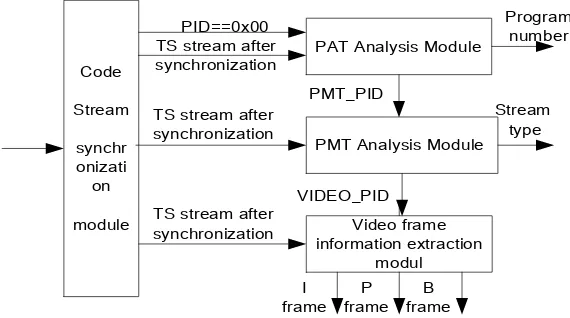
information analysis module is to parse the PMT PID from the synchronized TS stream according to the input PID and output the TV program number. The PMT information analysis module parses the PMT_PID parsed out by the PAT information analysis module, parses the information about the video stream corresponding to the television program in the PMT table, and outputs the type of the video stream and the PID of the corresponding video PES.
Code Stream synchr onizati on module
PAT Analysis Module
PMT Analysis Module
Video frame information extraction
modul PID==0x00
TS stream after synchronization
TS stream after synchronization
TS stream after synchronization
I
[image:4.612.154.439.198.357.2]frame frameP frameB PMT_PID Program number Stream type VIDEO_PID
Figure 1. Overall design diagram.
Code Stream Synchronization Module
MPEG2 transport stream is prone to interference and transmission errors during the broadcast process, so it is necessary to detect and synchronize the received bit-stream in this design. ETR101290 standard gives the syntax of MPEG-2 transport stream and the method of correctness detection. The ETR101290 transport stream detection standard specifies how to detect 0X47 sync bytes in a TS packet. The function of this module is to detect and locate the synchronization byte of TS according to this standard and realize the synchronization with TS. In the MPEG-2 transport stream, if the header is continuously detected three 0X47 TS stream, a TS stream is completed synchronization. The module is implemented by a finite state machine.
STATE1 state, when the pkt value is 1, if 0x47 is detected at this time, the synchronization word counter is recorded as 2, and the finite state machine enters the STATE2 state; otherwise, the IDLE state is returned; In the STATE2 state, when the pkt value is 1, if 0x47 is detected at this time, the synchronization word counter is recorded as 3 to enter the SYNC state; otherwise, the IDLE state is returned; In the SYNC state, the TS packet is completely synchronized, the synchronization completion flag data_sync is set to 1, and the TS code stream output enable signal data_out_vid is set to 1 to allow the TS code stream to be output.
IDLE
STATE1
STATE2
SYNC Data_in!=0x47
data_in==0x47 pkt_cnt==1 sync_cnt=1
data_in==0x47 pkt==1 sync_cnt==2
data_in==0x47 pkt==1 sync_cnt==3
data_sync==1 data_out==data_in
data_out_vld==1 Dyssynchr
ony Dyssynchr
ony
Figure 2. Bit-stream synchronization state machine.
PID Detection Module
frame information extraction module. According to the data structure of the TS packet, the PID of each TS packet is located in 13 bits of bits 12 to 24 of the TS packet. When the PID detecting, it can determine a start bit 0x47 of a TS packet in accordance with the sync field, and then extracts the PID value of the TS packet.
Program Association Table Analysis Module
The function of the PAT analysis module is to parse the PID value of the PMT of the digital television program and output the program number of the digital television program at the same time. Because the PID of the TS packet with PAT is 0x00, the PID detection module is first instantiated in the PAT analysis module, and the input PID of the module is set to 0x00. The TS packet with the payload PAT is extracted, and then we can parse it to get the PID of the digital television program map PMT.
Program Mapping Table Analysis Module
In the PMT parsing module, the PID detection module should also be instantiated. Inputting the PMT_PID output from the PAT parsing module into the PID detection module, and the TS packet containing the PMT is obtained, and then the TS packet is parsed.
Video Frame Information Extraction Module
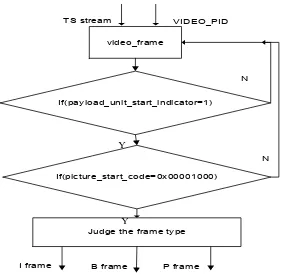
The PID of the TS packet including the video PES parsed by the PMT parsing module is taken as an input to extract a video PES packet. It can be seen from the foregoing that the picture_header value exists in the PES packet whose
payload_unit_start_indicator is 1, so the TS packet whose
video_frame
If(payload_unit_start_indicator=1)
Y
N
If(picture_start_code=0x00001000)
Judge the frame type
Y
VIDEO_PID TS stream
N
[image:7.612.158.439.85.360.2]I frame B frame P frame
Figure 3. Video frame extraction module design flow.
SIMULATIONRESULTS
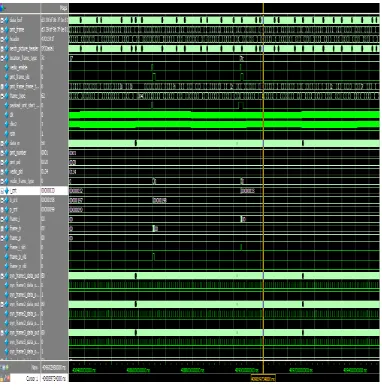
Figure 4. Simulation results.
CONCLUSIONS
REFERENCES
1. Tao Fang. 2003. Digital Television Business Information and Its Coding[M]. BeiJing: National
Defense Industry Press. (In Chinese)
2. Ke Chen. 2003, Digital TV Broadcast Business Information[J]. TV Engineering, (4):44-52 (In
Chinese)
3. Cheng-hui Huang. Yu-zhao Deng. 2008. Structure and Functions of Transport Stream Packet of
MPEG-2[J]. China Digital Cable TV, (3):246-250 (In Chinese)
4. Xiu-hua Jiang, Yong-hui Zhang. 2007. Principles and Applications of Digital Television
Broadcasting [M]. BeiJIng: The People's Posts and Telecommunications Press, First Edition. (In Chinese)
5. ISO/IEC.MPEG-2 Generic Coding Of Moving Pictures And Associated Audio Part-2
ISO/lEC13818, 1996.