2017 2nd International Conference on Artificial Intelligence and Engineering Applications (AIEA 2017)
ISBN: 978-1-60595-485-1
Interior Ballistic Modeling and Charge Structure
Optimization of Cased Telescoped Ammunition
YONGJIE CAO, WENLONG YUE, ZHIFEI LI, JING HU, XUESONG LI, MINGCHEN SU and RUFENG HAN
ABSTRACT
In order to improve the muzzle velocity of the cased telescoped ammunition (CTA) with a certain caliber, a kind of charge structure with the shear form when engraving the grooves of the CTA was designed, a theoretical interior ballistic model was established and the optimization design plan was proposed. Results show that the interior ballistic model can generally describe the interior ballistic characteristics of the CTA, the calculated results agree well with the experimental ones. On the basis, by optimizing the charge structure parameters of the CTA using the multi-objective particle swarm optimization algorithm, the muzzle velocity of the projectile is improved by 2.58% with the maximum chamber pressure unchanged. The study can provide reference for the interior ballistic modeling and the charge structure of the CTA.
KEYWORDS
Cased telescoped ammunition, interior ballistics, charge structure, optimization design.
INTRODUCTION
The cased telescoped ammunition (CTA) gun is a kind of gun with the rotation chamber and the compact turret, and it can effectively improve the power of the active combat vehicle. This gun uses the CTA, the projectile of which is telescoped in a cylindrical cartridge, so that the automatic ramming system is greatly simplified. At present, lots of researches in the CTA technology have been made by the ballistic scholars from the United States, England, France, Russia and China [1, 2]. The principle of the two-ignition sequential combustion is widely adopted, which works in the manner the projectile is firstly propelled into the barrel by the auxiliary propellant, and then the propellant is ignited fully. Therefore, the charge structure and the interior process are much more complicated than the conventional ammunition. According to the requirement of the combat mission, the armour-piercing projectile and the shrapnel are generally adopted as the projectile of the CTA.
_________________________________________
It is necessary to increase the muzzle velocity of the projectile, whether it is to improve the piercing power of the armour-piercing projectile or to improve the firing range of the shrapnel. The purpose can be achieved by optimizing the charge structure. In this paper, a kind of charge structure of the CTA with the shear form when engraving the grooves was designed and the interior ballistic model was established according to the characteristics of the CTA. And the particle swarm optimization algorithm [3] was used to optimize the charge structure of the CTA for a certain caliber.
INTERIOR BALLISTIC MODEL OF CTA
Physical Model.
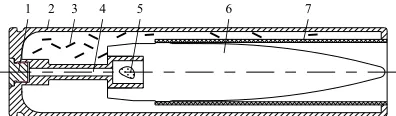
A kind of charge structure with the shear form when engraving the grooves of the CTA was designed, as shown in Figure 1. The ammunition is mainly consist of the cartridge case, the primer, the igniter tube, the auxiliary propellant, the combustible guiding tube, the main propellant and the projectile. The projectile and the cartridge case are connected by the metal shear ring on the igniter tube. The working principle of this kind of CTA is as follows. Firstly, the primer is triggered and ignites the auxiliary propellant in the igniter tube, i.e., the first ignition. When the pressure in the igniter tube comes to a certain value, the shear ring is sheared and the projectile is activated to move along the combustible guiding tube by the gas generated by the auxiliary propellant until the bearing band touches the grooves. Then, the main propellant is fully ignited to generated vast gas with high temperature and high pressure , i.e., the second ignition. The projectile is propelled to engrave into the grooves and accelerates in the barrel until out of the muzzle, which is similar to the interior ballistic process with the conventional ammunition.
1 2 3 4 5 6 7
[image:3.612.198.396.54.112.2]1-primer; 2-cartridge case; 3- main propellant; 4- igniter tube; 5- auxiliary propellant; 6-projectile; 7-combustible guiding tube
Figure 1. Sketch of the charge structure of CTA.
Mathematical Model.
The theoretical model can be divided into two phases according to the characteristics and the assumptions of the interior ballistic process.
The first phase
The first phase is the working period of the auxiliary propellant, and the projectile slides freely along the guiding tube. The controlling equations include the burning rate(1) and the shape function(2) of the auxiliary powder, the motion equation of the projectile(3), the relationship of the velocity and the travelling distance(4), and the state equation of the combustion gas(5).
1 1,1 1,1
1 1
1 1 d
d
0
1 n
u
p Z
Z e
t
Z
(1)
1 1
1(1 2 1 1
d d
dt Z ) d
Z t
(2)
a
1
a 0 < d
d
p p v
Sp
p p t
m
(3)
d d l
v
t (4)
2,1 1 1 1 1
2
p Sl V f mv
(5)
In which, V1 V0,11(1 1) 1 1 1.
Where t is time; Z1 and ψ1 are the relative burnt thickness and percentage of the
auxiliary propellant; χ1 and λ1 are the parameters for the shape characteristics of the
auxiliary propellant; u1,1and n1 are the burning rate coefficient and exponent of the
auxiliary propellant, respectively; e1,1 is half of the thickness of the auxiliary propellant; p and pa are the average pressure and the shear pressure, respectively; S is the
respectively; φ1 is the correction factor of the secondary power for the projectile in the
guiding tube and it can be set as 1.0; l is the travelling distance of the projectile; f1, ω1
and ρ1 are the force, the mass and the density of the auxiliary propellant, respectively; α
is the co-volume of the combustion gas of the propellant; θ=k-1, where k is the specific heat ratio of the combustion gas; V0,1 and Vψ,1 are the initial volume and the free
volume of the charge chamber in the first phase, respectively.
The second phase
The second phase is the working period of the main propellant, and it is similar to the process of the conventional ammunition. But it is necessary to consider the effect of the energy released by the guiding tube combustion on the interior ballistic process for the mass of the combustible guiding tube cannot be ignored. Besides the above equations (1), (2) and (4), the following equations should be replenished: the burning rate (6) and the shape function (7) of the main propellant, the shape function of the combustible cartridge(8), the motion function of the projectile(9), the state function of the combustion gas(10), the insensitive function of the burning rate(11) and the engraving resistance function(12).
2 1,2 k 2 , 2 2 1 2 k d d 0 n u
p Z Z
Z e t Z Z (6) 2 2 2
2(1 2 2 2 3 2 2 )
d d
d Z d
Z t Z t
(7)
3
1 2
d
(1 )
dt M M p p
(8)
2 d
d
v Sp R t m
(9)
2,1 ,2 2
2 i i i i
p Sl V V f mv
(10)
2 1,2 21,2
1,2 2
1
Z u Z H
K u u Z K H H
(11)
1 1 g 2 2 3 3 0 ( ) ( ) 0 l l l l l r l
R
l l l r l
l l l
In which, ,2 0,2 i(1 i) i i i
i i
V
V
.Where Z2 is the relative burnt thickness of the main propellant; Zk is the relative
burnt thickness of propellant at the burning completion instant; u1,2and n2 are the
burning rate coefficient and exponent of the main propellant, respectively; e1,2 is half of
the thickness of the main propellant; ψ2 is the relative burnt percentage of the main
propellant;χ2, λ2 and μ2 are the parameters for the shape characteristics of the auxiliary
propellant; ψ3 is the relative burnt percentage of the combustible guiding tube; M1 and M2 are the calculating coefficients of the combustible guiding tube combustion; R is the
engraving resistance; φ2 is the correction factor of secondary power for the projectile in
the gun barrel; ε is the coefficient for the friction; l1, l2 and l3 are the locations of the
bearing band touching the grooves, the end of the deformation of the grooves, the end of the bearing band engraving the grooves, respectively; lg is the maximum travelling
distance of the projectile; V0,2 and Vψ,2 are the initial volume and the free volume of the
charge chamber in the second ignition phase, respectively; fi, ωi and ρi are the force, the
mass and the density of the ith energetic material, respectively; H and K are the relative depth and coefficient of the insensitive propellant.
EXPERIMENT AND NUMERICAL SIMULATION
0 2 4 6 8 10 12 0
100 200 300 400
p
/MP
a
t /ms
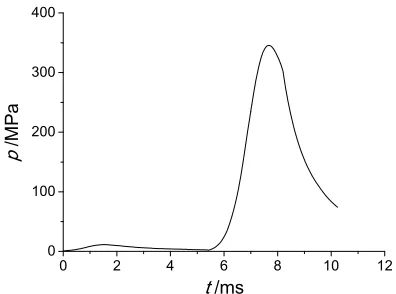
Figure 2. The calculated breech pressure versus time.
0 2 4 6 8 10 12
0 300 600 900 1200
t /ms
v/
m
s
[image:6.612.198.396.53.200.2]-1
[image:6.612.203.400.239.383.2]Figure 3. The calculated velocity versus time.
TABLE 1. COMPARISON OF THE CALCULATED RESULT AND THE EXPERIMENTAL RESULT.
Parameter Experimental value Calculated result Relative error
pm/MPa 394.0 392.1 -0.48%
v0/m·s-1 1169.0 1177.6 0.74%
OPTIMIZATION OF CHARGE STRUCTURE OF CTA
Establishment of Optimization Model.
The purpose of this study is to improve the muzzle velocity and the power of the projectile by optimizing the charge structure of the CTA. The parameters related to the charge structure design include the mass of the main propellant ω2, the thickness of the
propellant 2e1, 2, the relative insensitive depth H and the insensitive coefficient K, the
impetus of the combustible cartridge f3 and the shear pressure pa. All of these
parameters have a certain effect on the ballistic performance of the CTA, and the optimization design of the charge structure is just a reasonable match for these parameters. The following points should be noted during the design process. (1) Since the inner structure of the chamber is unchanged, the firing maximum pressure pm
should not exceed the designed maximum pressure Pm. (2) The loading density Δ
should not exceed the loading density limit Δj. (3) The relative location of the
internal chamber. In addition, the muzzle pressure pg should be as low as possible to
decrease the probable error of the muzzle velocity. Therefore, the multiple-objective optimization problem can be described as follows.
g
g
T
2 1,2 3
max ( )
min ( )
, 2 , , , , a
v p
e H K f p
X
X
X
(13)
The constrain condition is
m m
k
j 0.75
p P
(14)
0 100 200 300 400 500 600 700 200
400 600 800 1000 1200 1400
v/m
s
-1
p/MPa
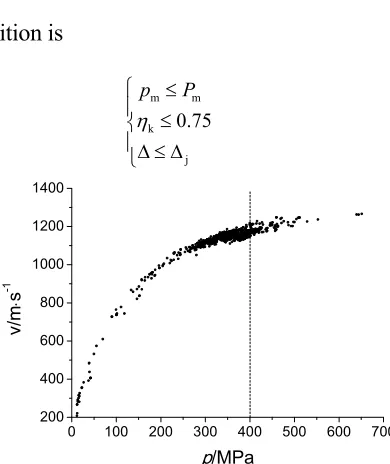
[image:7.612.198.393.170.402.2]Figure 4. Solution distribution in the optimization process.
TABLE 2. COMPARISON OF THE BALLISTIC PARAMETERS BEFORE AND AFTER OPTIMIZATION.
Paramet
er ω2/g
2e1,2/m
m H K
f3/kJ·k
g-1 pa/MPa pm/MPa pg/MPa v0s/m·-1
Original
scheme 320.0 0.55 - - 600 3.0 392.1 58.2 1177.6 Optimal
scheme
321.
6 0.54
0.2 0
0.8
3 750 2.5 399.9 60.9
1207. 0
Optimization Result and Analysis.
carried out using the particle swarm algorithm. The solution distribution in the optimization process is shown in Fig. 4, in which the points on left side of the dotted line represent the non-inferior solution. The ballistic parameters before and after optimization are shown as Table 2. It is shown that the optimized muzzle velocity can be improved by about 30m/s (the amplification is 2.58%).
SUMMARY
In the paper, the interior ballistic model for describing the two-phase ignition process of the CTA was established. The numerical simulation shows that the calculated result agrees well with the experimental ones, which lays a theoretical foundation for the optimization design of the interior ballistics of the CTA. On this basis, an optimization model was proposed and the charge structure was optimized using the multi-objective particle swarm algorithm, which could improve the muzzle velocity by 2.58%. The method is of great reference value for the optimization design of the charge structure of the CTA.
REFERENCES
1. Woodley C.R. Development of One-Dimensional Internal Ballistics Model of a Cased Telescoped Ammunition Gun. Proceedings of the 15th International Symposium on Ballistics. Israel Jerusalem, 1995, p. 181-187.
2. Lu X., Zhou Y.H., Yu Y.G.. Experimental Study and Numerical Simulation of Propellant Ignition and Combustion for Cased Telescoped Ammunition in Chamber. Journal of Applied Mechanics, Vol. 77(2010) No. 5, p. 051402-1-051402-5.