Carol Ann Norton
T hesis submitted for the degree o f Doctor o f Philosophy
Institute o f Social Psychology, The London School o f Econom ics and Political Science October 2009
Psychological consistency,
inconsistency
a n d
cognitive dissonance
in the relationship
between
eating meat
and
UMI Number: U615504
All rights reserved
INFORMATION TO ALL USERS
The quality of this reproduction is dependent upon the quality of the copy submitted.
In the unlikely event that the author did not send a complete manuscript and there are missing pages, these will be noted. Also, if material had to be removed,
a note will indicate the deletion.
Dissertation Publishing
UMI U615504
Published by ProQuest LLC 2014. Copyright in the Dissertation held by the Author. Microform Edition © ProQuest LLC.
All rights reserved. This work is protected against unauthorized copying under Title 17, United States Code.
ProQuest LLC
789 East Eisenhower Parkway P.O. Box 1346
cA
V
'
Declaration
I certify that the thesis I have presented for examination for the M Phil/PhD degree o f the London School o f Economics and Political Science is solely my own work other than where I have clearly indicated that it is the work o f others (in which case the extent o f any work carried out jointly by me and any other person is clearly identified in it).
The copyright o f this thesis rests with the author. Quotation from it is permitted, provided that full acknowledgement is made. This thesis may not be reproduced without the prior written consent o f the author.
I warrant that this authorization does not, to the best o f my belief, infringe the rights o f any third party.
A bstract
Despite much research into vegetarianism, the psychological relationship between eating meat and evaluating animals remains relatively neglected. Through focus groups, questionnaires and experiments, this study investigated whether people
experienced psychological inconsistency in this relationship and, if so, how they handled that inconsistency.
Unlike vegetarians’ attitudes, the content o f meat-eaters’ attitudes towards eating m eat rarely included animals. Meat-eaters’ positive attitudes towards eating meat were consistent with their eating behaviour; however, their attitudes towards farm animals were more positive than their attitudes towards eating meat. It therefore depends upon which attitudes are salient at any given time to determine whether psychological consistency is maximised overall.
By focusing on the relationship between their own genuinely-held attitudes towards farm animals, animals’ slaughter, and eating meat, meat-eaters’ cognitive dissonance increased. Their attitudes towards eating meat were expected to become more positive in order to restore consonance between their attitudes and eating
behaviour. However, meat-eaters’ attitudes towards eating meat became less positive and their attitudes towards animals’ slaughter became more negative. In contrast, their attitudes towards farm animals resisted change. Therefore meat-eaters’ attitudes towards farm animals became relatively even m ore positive than their attitudes towards eating meat and animals’ slaughter. Hence, the attitudes stimulated by this research, in an environment which prevented psychological denial strategies, caused (a) meat eaters’ attitudes to become m ore inconsistent with their behaviour and (b) the consequent lack o f consonance restoration.
A ck n ow led gem en ts
Thanks to my supervisor, D r Bradley Franks, as well as Sharon Attia,
Linda Bayles, Steve Bennett, Andrew Blackman, P ro f Cathy Campbell, Maggie Cartlidge, Nigel Cartlidge, Alistair Currie, Egerton W omen’s Institute, Steve Gaskell,
P rof Anthony Greenwald, Carol Hart, Annie Hooper, Michelle Kearsey, Michael Matthews, D r Alain Samson, D r Jan Stockdale, Dennis Stuart,
C ontents
Chapter 1 Psychological relationships between
evaluating farm animals and eating m e a t__________________________ 10 1.1 Definitions ____________________________________________12 1.2 Competing cultural com m entators____________________________ 14 1.3 Framing the problem _____________________________________ _ 17 Chapter 2 Theories o f psychological and cultural avoidance
o f the life and death behind meat__________________________________ 19 2.1 Comparing meat-eaters to vegetarians__________________________21 2.2 Locating potential inconsistencies_____________________________ 22 2.3 Avoiding the meeting o f animals and m eat_____________________ 25 2.4 Can historical patterns predict the future?______________________ 27 2.5 The roles of nature and n u rtu re ______________________________ 30 2.6 The explanatory power o f existing theories and their
views o f consistency________________________________________34 Chapter 3 Theories o f attitudes, cognitive dissonance and d en ial_______________ 36 3.1 Attitudes and behaviours___________________________________ 37 3.2 What role might cognitive dissonance play?____________________ 42 3.3 Are people in denial about the life and death
behind m eat?_________________________________ __________ 51 3.4 Drawing together theories o f consistency______________________ 56 3.5 Debates and contributions__________________________________ 60 Chapter 4 Research m ethods________________________________________________ 64 4.1 Research questions_________________________________________ 65 4.2 Choice o f research m ethods_________________________________ 65 4.3 Focus groups_____________________________________________ 66 4.4 Quantitative m ethods_______________________________________ 68 4.5 Quantitative p r o c e d u r e _________________________________ 77 Chapter 5 Qualitative research results ________________________________________81 5.1 Method o f analysis_________________________________________ 82 5.2 Analysing the most grounded and dense codes__________________ 86 5.3 Answers to research questions______________________________ 103 Chapter 6 Quantitative research resu lts _________________________________ 106
6.1 Explicit attitudes towards farm animals, eating meat
and animals’ slaughter______________________________________108 6.2 How people evaluate farm animals___________________________ 109 6.3 Reasons for eating m e a t___________________________________ _ 112 6.4 Reasons for avoiding m e a t__________________________________114 6.5 Implicit attitudes towards farm animals, eating meat
and animals’ slaughter______________________________________116 6.6 Experience o f cognitive dissonance through
6.8 Key attitudes and causal relationships_________________________ 122 6.9 Evaluating hypotheses and answers to
research questions ______________________________________ 125 C hapter 7 Psychological consistency, inconsistency and cognitive
dissonance in evaluating farm animals and eating m e a t___________ 131
7.1 Patterns of meat-eaters 132
7.2 Consistent and inconsistent relationships between
attitudes and behaviour____________________________________ 138 7.3 How dissociation variables and denial remove animals
from meat 141
7.4 Cognitive dissonance______________________________________ 145 7.5 Key differences between meat-eaters and vegetarians____________ 150 C hapter 8 Summary and future developm ents_______________________________ 154 8.1 Summary o f research findings_____________________________ 155
8.2 Research restrictions 160
8.3 Research implications and opportunities for
future developments___________________________________ __162
R eferences 172
A P P E N D IX A Internet re so u rces______________________________________________ 182 A P P E N D IX B Focus group sch e d u le s_________________________________________ 189 A P P E N D IX C Atlas.ti code networks (original images also on
Figures
Figure 1: Food taboos in modern society_________________________________________ 32 Figure 2: What makes taboos taboo? _______________________________________ 33 Figure 3: Variables influencing behaviours and attitudes_____________________________ 59 Figure 4: Example IAT test screen pairing Animal with Good
and Meat with B a d ___________________________________________________71 Figure 5: Example IAT test screen pairing Meat with Good
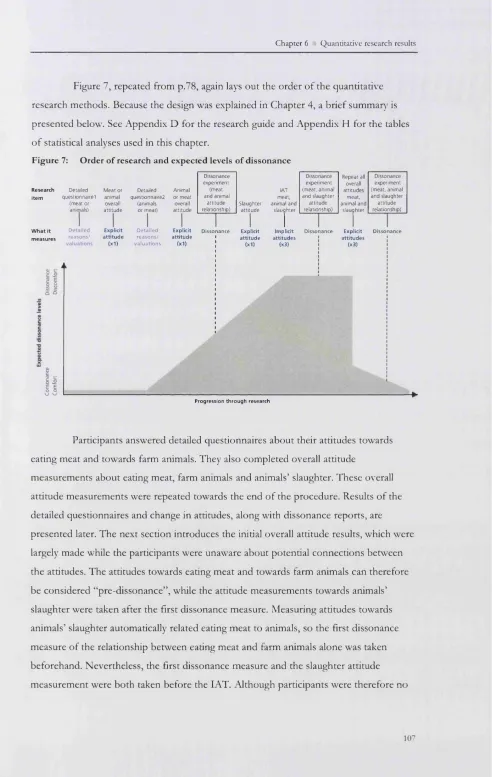
and Animal with Bad_________________________________________________ 71 Figure 6: IAT test alternatives__________________________________________________ 75 Figure 7: Order o f research and predicted dissonance in the quantitative
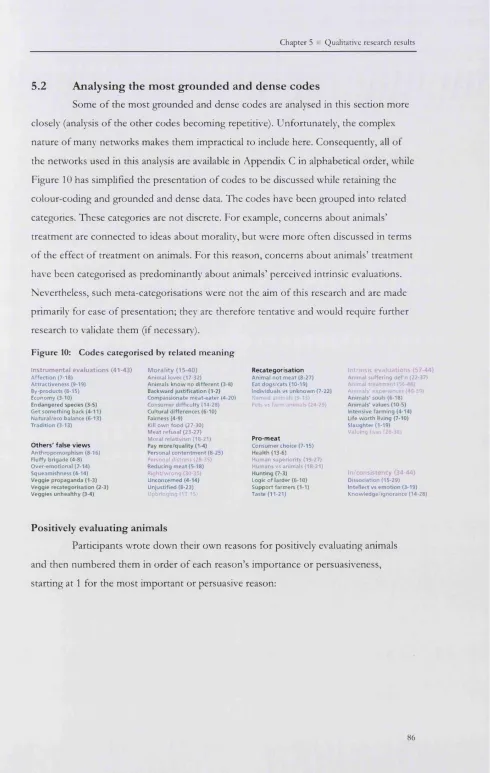
research stag e_____________________________________________________ 78 Figure 8: Atlas.ti hermeneutic unit editor_________________________________________ 82 Figure 9: ‘Hunting’ network____________________________________________________ 85 Figure 10: Codes categorised by related m eaning____________________________________ 86 Figure 11: Reasons for and against positively evaluating animals _______________________ 87 Figure 12: Reasons for and against eating meat _____________________________________ 95 Figure 13: Disparity between predicted and actual consonance restoration______________ 119 Figure 14: Path analysis of key meat-eaters’ relationships in the
quantitative s tu d y ___________________________________________________ 123 Figure 15: Rationale behind posed questions______________________________________ 192 Figure 16: Schematic descriptions and illustrations o f the IA T ________________________ 287
Charts
T a b les
Table 1 Number o f animals eaten by an average British
meat-eater during a lifetime (excluding fish") 20
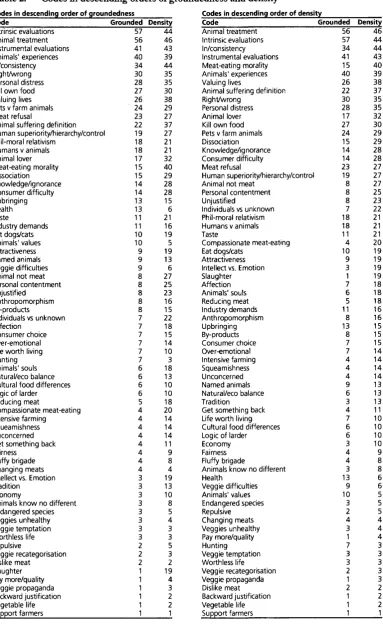
Table 2 Codes in descending orders o f groundedness and densitv 84 Table 3 Meat-eaters’ evaluations o f farm animals: factor analysis 111 Table 4 Vegetarians’ evaluations o f farm animals: factor analysis 112
Table 5 Why meat-eaters eat meat: factor analysis 114
Table 6 Why vegetarians avoid meat: factor analvsis 115
Table 7 Experience o f dissonance: factor analysis 118
Table 8 How farm animals are evaluated: correlations 294
Table 9 Why meat-eaters eat meat: correlations 295
Table 10: Why vegetarians avoid meat: correlations 296
Table 11: Relationship between meat-eaters’ attitudes towards animals’
slaughter and evaluating farm animals: regression analvsis 297 Table 12: Relationship between meat-eaters’ range o f meat consumption
and evaluating farm animals: regression analvsis 297
Table 13: Relationship between meat-eaters’ attitudes towards meat-eating
and farm animals’ component evaluations: regression analysis 297 Table 14: Relationship between meat-eaters’ attitudes towards animals’
slaughter and farm animals’ component evaluations:
regression analysis________________________________________________ 298 Table 15: Relationship between vegetarians’ attitudes towards animals and
evaluating farm animals: regression analysis______________________________ 298 Table 16: Relationship between vegetarians’ altitudes towards meat-eating
and evaluating farm animals: regression analysis _________________________ 298 Table 17: Relationship between vegetarians’ attitudes towards animals’
slaughter and evaluating farm animals: regression analysis__________________ 299 Table 18: Relationship between vegetarians’ attitudes towards animals and
farm animals’ component evaluations: regression analysis__________________ 299 Table 19: Why meat-eaters eat meat: regression analysis____________________________ 299 Table 20: WTiy meat-eaters eat meat: factor analysed regression analysis_______________ 300 Table 21: Relationship between attitudes towards animals’ slaughter and
avoiding meat: regression analysis_____________________________________ 300 Table 22: Relationship between attitudes towards animals’ slaughter and
factor analysed reasons for avoiding meat: regression analysis_______________300 Table 23: Relationship between meat-eaters’ attitudes and experience of
dissonance: regression analysis_________________________________________ 301 Table 24: Relationship between meat-eaters’ attitudes and increase in
dissonance: regression analysis_________________________________________ 301 Table 25: Relationship between meat-eaters’ attitudes and evaluating
animals for intrinsic reasons: regression analysis _________________________ 301 Table 26: Relationship between meat-eaters’ attitudes and overall attitudes
towards animals’ slaughter: regression analysis____________________________302 Table 27: Relationship between meat-eaters’ attitudes and overall attitudes
Table 28: Table 29: Table 30: Table 31: Table 32: Table 33: Table 34: Table 35: Table 36: Table 37: Table 38: Table 39: Table 40: Table 41:
Relationship between meat-eaters’ attitudes and overall attitudes towards farm animals: regression analysis __________________ Relationship between vegetarians’ attitudes and overall attitudes towards farm animals: regression analysis __________________ Reliability statistics o f meat-eaters’ Intrinsic com ponent________ Reliability statistics o f meat-eaters’ Normalised component/Habit variable and variance explained____________________________ Reliability statistics o f vegetarians’ Intrinsic component.
Reliability statistics of vegetarians’ Principled & Health component/Ethical variable and variance explained__
Relationship between meat-eaters’ dissonance and factor analysed components of evaluating farm animals: regression analysis_____ Relationship between meat-eaters’ dissonance increase and overall attitudes towards eating meat, farm animals and animals’
CHAPTER 1
Psychological relationships between
Chapter 1 - Psychological relationships between valuing animals and eating meat
O n a hot summer’s day a village hall housed a focus group o f three m en and three women. They had been chatting comfortably; but suddenly silence fell. O ne woman finally broke the silence to exclaim: “O h that’s interesting isn’t it” !
Their attention had been drawn to two statements to which they had all previously agreed: “I eat meat” and “I like animals”. Earlier these statements had been disconnected, but when they were presented together the group’s easy conversation was arrested. The statements had not changed; what had changed was the relationship between them. This relationship is the focus for this study.
Contributors to the tenth anniversary issue o f the journal Society & Animals (2002) lament the state o f ‘human-animal1 studies’. The consensus is that, despite blossoming interest, the area remains under-researched and under-recognised
(Shapiro, 2002). According to Fiddes (1994), vegetarians and other non-orthodox eaters have been scrutinised, while the W estern mainstream diet has been relatively ignored. This is to science’s detriment because the ‘normal’ can be as revealing as the ‘abnormal’, and all the more perplexing because many people argue that widespread meat-eating and high regard for animals is inconsistent. The thesis here is that i f meat-eating is
psychologically inconsistent with positively evaluating animals, then there w ill be evidence o f that perceived inconsistency. This evidence, if it exists, must demonstrate how inconsistency is handled to allow both meat-eating and positively evaluating animals to co-exist within the same culture and the same people.
The focus on meat-eaters demands a shift in focus, away from what has traditionally stood out to W estern researchers— vegetarianism— and towards what has often been ignored and treated as invisible. This shift, elevates the dominant ideology from ‘the invisible norm ’ and values it both as an alternative that is full o f content and meaning against which vegetarians are studied, and as a research topic in its own right. In seeking to understand meat-eaters, they are compared with vegetarians to identify differences that might illuminate both groups in the context o f one another. In this sense, the study echoes political and feminist psychology (e.g. Iyengar and McGuire, 1993) that interrogates the culture in which research and its topics are embedded.
Chapter 1 * Psychological relationships between valuing animals and eating meat
The main theory used here to investigate this evidence is cognitive dissonance theory (see section 3.2). As Chapter 3 outlines, the empirical topic benefits from being originally explored via an established theory, while the theory’s explanatory power is tested by a real-world phenom enon. This study therefore contributes to social psychology both empirically and theoretically.
This Chapter unpacks the issues before the next Chapter outlines the work that has already been done on this topic.
1.1
Definitions
‘M eat’, ‘evaluating animals’, ‘consistency’ and ‘inconsistency’ are defined here to explain how they are used in this thesis.
M eat
A supermarket list o f products sold in the category “meat and poultry” (Anon, 2005) provides a list o f “meat” :
Bacon Beef Chicken Lamb
Offal (kidneys, liver, hearts)
Organic (chicken, beef, pork, lamb, sausages) Pate
Pork Sausages
Speciality poultry (duck, poussin) Turkey
Prepared meats (including burgers, meat in sauces and coatings)
It means both cooked and uncooked meat. While this list is not exhaustive, fish or other species, for example, are unlikely to be ordinarily included without making this explicit.
E v a lu a tin g an im als
Attitude theories are explored in m ore detail in section 3.1. Here two o f the dimensions on which attitudes towards animals may vary are explored, these are intrinsic and instrumental dimensions.
Chapter 1 Psychological relationships between valuing animals and eating meat
for the products that can be made from their bodies. Intrinsic reasons for positively evaluating animals focus only on the animals themselves, emphasising, for example, animals’ souls or essences, experience o f life, sentience, intelligence or abilities (e.g. Singer, 1993).
‘Loving animals’ brings to m ind theories o f other human relationships, for example those that emphasise exchange and equity (e.g. Hom ans, 1961; Hatfield, et. al., 1985). Exchange and equity are instrumental ideas and may indeed be good models for human-animal relationships and people’s love for animals. But they exclude the range o f other possible instrumental and intrinsic reasons for positively evaluating animals that people may have.
C o n sisten cy and in c o n siste n c y
W hen this thesis asks whether someone’s views are consistent, this means: are their views consistent by their own standards?
Stone (2001) defines psychological inconsistency, “ ... as an intermediate discrepancy between behaviour and a specific attitude . . . ” (2001, p.57). This is a narrow definition from the field o f cognitive dissonance theory that will be explored more fully in Chapter 3 and, although it is relevant to this thesis, a wider definition is helpful at this stage to frame the topic. More generally, ‘inconsistency’ means lacking in consistency, agreement, or compatibility. It embodies the idea that the consistent application o f principles means not making exceptions without good reasons (Warburton, 1999).
‘Consistency’ also demands that the things about which one can be consistent or inconsistent are related. T hat is, if someone supported the principle o f ending world poverty one minute but did n o t the next, then, all other things being equal, this would be inconsistent. But if that person was thrifty with their own money, these things are not necessarily related or, therefore, inconsistent. Yet again, if they believed that they could help end others’ poverty by donating to charity, then failing to donate would be inconsistent with their ideals, while donating would be inconsistent with their frugal accounting. This is where W arburton’s (1999) ‘exceptions with good reasons’ come to the fore. The thrifty campaigner would make an exception to one o f their proclivities. They would inevitably be consistent in one respect and inconsistent in another.
Chapter 1 ^ Psychological relationships between valuing animals and eating meat
behaviour and donate. Conversely, if they cared m ore about their own money than world poverty, then, all other things being equal, they could be expected to make an exception to their ideals and not donate. This maximises consistency overall.
O f course, world poverty and one’s own money are just two things that might be opposed under certain conditions. People daily make such choices: hitting the alarm clock’s snooze button or getting to work on time, for a start. Bigger choices make news headlines, particularly in politics. In the run-up to the 2005 general election, the
Conservative Party manifesto promised to spend on public services and lower taxes. O ther parties claimed that this was impossible; it was inconsistent with what everyone knew about spending and taxation, which were opposed in nature. The point here is to discover whether people believe that their own attitudes towards eating meat and evaluating animals involve similar oppositions.
The inclusion o f denial in this study (which is explored in Chapter 3) involves an assumption about the topic; an assumption that, for some people at least, the life and death behind meat is unpleasant to think about. Further, that this unpleasantness cannot be easily resolved or removed; it is something with which the owner has to live, perhaps uncomfortably. Put like this, the problem does not seem inconsistent. There is nothing inconsistent about finding death unpleasant. Where any inconsistency might arise is in the relationship between disliking death and endorsing, or even demanding, it.
People may eat some meat but not others. I f they like the taste o f white meat but dislike the taste o f red meat then they are not inconsistent because taste is a sound reason on which to decide what to eat. But cultural differences provide some less clear examples where one meat is eaten but another avoided depending on from which part o f the body, or which species, it came. For example, horse meat is generally avoided in Britain, in contrast to neighbouring France, while meat from similar hoofed animals (e.g. cows) is eaten in Britain. O ne o f the questions that this thesis poses is whether eating some meat and avoiding others is consistent by people’s own standards.
1.2
Com peting cultural commentators
In Britain many people eat meat and also like animals. H ow this relationship is represented in our culture might indicate whether its members experience it as
Chapter 1 J: Psychological relationships between valuing animals and eating meat
circulation, and (c) that the topic is ‘live’: it is on, at least some, people’s minds, being discussed and debated. The following five cultural comm entators’ views will be used as frameworks for comparing against ordinary meat-eaters’ views throughout this study.
Scruton (2000)
Using arguments later called “logic-of-the-larder” (Matheny, et. al., 2005), Scruton (2000) is explicitly concerned with consistency:
... I find myself driven by my love o f animals to favour eating them. Most o f the animals which graze in our fields are there because we eat them. Sheep and beef cattle are, in the conditions which prevail in English pastures, well fed, comfortable and protected, cared for when disease affects them and, after a quiet life among their natural companions, despatched in ways which human beings, if they are rational, must surely envy. There is nothing immoral in this. O n the contrary, it is one o f the most vivid triumphs o f comfort over suffering in the entire animal world. It seems to me, therefore, that it is not just permissible, but positively right, to eat these animals whose comforts depend upon our doing so. (Scruton, 2000, pp.218-9)
First Scm ton (2000) claims to be consistent by loving animals and therefore creating them. Many animals only exist because they are eaten, therefore, we should eat them in order for animals to be created. Second, he argues that ‘correctly’ farmed animals are happy. Again, if it is good to create happy lives, and this is only possible due to people eating animals, then we should eat meat. Third, he argues that the animals’ m anner o f death is enviable. H e implicitly claims that there is nothing wrong with killing: killing an animal does not harm them. Fourth, he argues that as this manner o f death is so good, people should consistently receive it too. Scruton (2000) proclaims himself to be consistently both an animal-lover and a meat-eater.
F ea m ley -W h ittin gstall (2004)
O ther commentators demonstrate the flexibility o f people’s approaches to consistency. Fearnley-Whittingstall (2004) is ambivalent about killing an animal but is determined to be informed about, or even involved in, it. H e takes a m ore ‘cost-benefit’ approach than Scruton (2000) and sees others’ ‘hypocrisy’ as worse than his own perceived inconsistency.
Chapter 1 " Psychological relationships between valuing animals and eating meat
piece of factory-farmed meat in a supermarket... it’s hypocritical to draw a veil over the fact that meat is a result of killing. It enables us to treat animals badly, because we want it out of sight and mind. (Fearnley-Whittingstall, 2004 p. 146)
Even though Feamley-Whittingstall (2004) would be willing to kill whatever he ate, he still has opposing feelings. This is evidenced by the ‘pang’ at killing, which he accepts as an unavoidable side-effect. H e does not explain why he feels this pang but believes that animals should be ‘treated well’. This suggests that he is concerned for animals’ experiences, and therefore that he holds intrinsic cognitions about farmed animals. Indeed he went on to publicly challenge supermarkets about the suffering o f broiler chickens in particular (e.g. Fearnley-Whittingstall, 2009). However, in his view, the benefits o f eating meat outweigh the costs o f killing an animal. Thus his approach is, for him, the m ost consistent possible while accommodating some inconsistency.
Jo h n son (2004)
Johnson (2004) is an ex-vegetarian, tempted back to meat because he loves it so. But in a BBC2 television programme he learnt more about the film-engulfed meat that many people encounter every day. Johnson (2004) visited a free-range beef farm where, he admitted, cattle were better cared for than on more com m on intensive farms. H e found choosing a cow for slaughter difficult. A calf reminded him o f his own child, while the cow he chose (a decision based on her thick rump) felt warm: like his dog rather than meat. W hen the cow was killed in a small slaughterhouse (unlike the more usual large-scale slaughterhouses where, he tells viewers, workers are paid by piecework), Johnson (2004) cried. Despite the point o f the investigation being to follow the meat
from animal to plate, in the end, Johnson (2004) simply could not bring himself to eat the meat that he had seen being prepared. He remains, however, a committed meat-eater and in 2006 presented advertisements for Birds Eye 100% beefburgers.
The fact that Johnson (2004) did not eat the steak suggests that his ordinary behaviour was out o f tune, or inconsistent, with his experience; so m uch so that he physically could n ot ‘stomach’ the meat. But not eating that particular steak was entirely consistent with the empathy he felt for this cow and his distress at her killing.
C o h en (2000)
Chapter 1 1 Psychological relationships between valuing animals and eating meat
ethical principles. The quotation below comes from his book which explores the denial that enables people to avoid challenging social wrongs.
I have Pooked] at my own reactions to environmental and animal rights issues. I cannot find strong rational arguments against either set of claims. But emotionally, they leave me utterly unmoved. I am particularly
oblivious— in total denial— about animal issues. I know that the treatment o f animals in cruel experiments and factory farming is difficult to defend. I can even see the case for becoming a vegetarian. But in the end ... my filters go into automatic drive: this is not my responsibility; there are worse problems; there are plenty of other people looking after this. What do you mean, I’m in denial every time I eat a hamburger? (2000, p.289)
C ohen’s (2000) consistency-inspired reasoning bears the hallmarks o f utilitarian philosophy, but his lack o f ‘emotional m ovem ent’, he believes, leads him to ignore, or ‘deny’, his intellectually-derived logic. Cohen (2000) seems bemused by what he sees as his own inconsistency. Overall his book bemoans people’s tendency to deny others’ suffering and thus to prevent ending it. In this quotation he demonstrates that he too is a victim o f the same tendency.
A d am s (2000,1995)
Adams (2000,1995) has also been struck by people’s ability to reach different conclusions about the same issue:
Meat eaters see themselves as “eating life”. Vegetarians see meat eaters as “eating death”. (Adams, 2000, p.15)
Vegetarians and corpse eaters approach the same phenomenon— the consumption o f dead animals— and come to opposite opinions: is it “meat” or a corpse? life or death? humane slaughter or murder? delicious or repulsive? nutritious or fat-laden? departure from tradition or return to tradition? Corpse eaters see vegetarianism as a fad; vegetarians see eating animals as a larger fad. Corpse eaters see vegetarians as Puritans, legislating others’ enjoyments; vegetarians see animal eaters as resisting awareness, indulging in fantasy about where flesh comes from. Corpse eaters generally accept the cultural construction o f the farm as benign, friendly, and family- based. Vegetarians see an alternate view: industry-owned, cruel and factorylike ... While vegetarians regard the word vegetable with respect..., flesh-advocating cultures see it as an appropriate term for brain-dead individuals. (Adams, 1995, p.26)
1.3
Framing the problem
Chapter 1 ; Psychological relationships between valuing animals and eating meat
demonstrated that consistency is not an all-or-nothing affair. People may accept some inconsistency as an unavoidable consequence o f a balance-sheet approach that maximises consistency overall, experience great emotional angst, feel intellectually befuddled, or be utterly oblivious. People may reject any discomfort, or they may change their whole lifestyles.
In some cases, it is easy to see inconsistency: Johnson’s (2004) inability to eat meat while being fervently pro-meat-eating seems paradoxical and his strong emotional response suggests that, at the time at least, even he might have been unable to offer any ‘reasonable exceptions’ to consistency. A stronger example still is Cohen’s (2000) own befuddlement that he rejects suffering and the denial that allows it, appreciates the arguments for animals’ ‘rights’, and yet remains emotionally unmoved by animals’ suffering. H e sees his own ‘denial’ and knowingly does not apply his own principles and theory.
The question remains whether there are patterned private phenomena underlying these public representations o f the issue. The task in this study is to identify ordinary meat-eaters’ attitudes to these issues, which can be compared against these cultural com m entators’ public representations.
Already there is disagreement over the central question o f whether or not people find the relationship between eating meat and evaluating animals to be inconsistent and whether or not people are troubled, either by their perceived
CHAPTER 2
Chapter 2 "■ Theories o f psychological and cultural avoidance o f the life and death behind meat
The British have a reputation as a nation o f animal-lovers, from the media appetite for wildlife programmes, to the num ber o f welfare organisations clamouring for donations— and getting them— to demands for a bill o f rights for pets. A M ORI opinion poll confirmed that 97% o f British adults believed that animals have ‘rights’ and 45% considered that animals’ ‘rights’ should be respected as much as hum ans’ (Ryder, 2000).
The British are also a nation o f meat-eaters. Although British meat-eating is epitomised in the traditions o f Christmas turkeys and Sunday roasts, British meat-eaters consume their own weight in meat each year (Gellatley, 2000).
Table 1: Number of animals eaten by an average British meat-eater during a lifetime (excluding fish)
C attle 5
Pigs 20
Sheep an d lam bs 29
C hickens 7 8 0
Turkeys 4 6
Ducks 18
Rabbits 7
G eese 1 Z i
(Gellatley, 2000, p.3)
So, the question is: do these culturally empirical phenomena interact to create any psychological inconsistency? Ryder (2000) argues that the relationship between using and positively evaluating animals is paradoxical:
Two themes stand out in the extraordinary history of Homo Sapiens’ relationship to the other animals: first its perennial importance in the human psyche and, secondly, the ambivalence and inconsistency o f that relationship. (2000, p. 15) His observations may lack scientific rigour, but Serpell (1996) agrees with Ryder (2000):
Many meat-eating consumers react with horror to the sight o f a recently butchered carcass, and it is clear that people do not like to be reminded that the plucked and trussed-up chicken, or the leg o f lamb they had for Sunday lunch was once a warm-blooded sentient life-form like themselves.
(Serpell, 1996, p.195)
This identifies the key issue o f disconnection between the animal and meat, which recurs in many o f the following theories.
Chapter 2 : Theories o f psychological and cultural avoidance o f the life and death behind meat
missing from many current theories (exceptions being Ryder’s, 2000, Serpell’s, 1996, and E der’s, 1996, explanations). The central problem identified by this thesis is the
relationship between eating meat and evaluating animals (although both may be worthy research topics individually).
2.1
Comparing meat-eaters to vegetarians
This study focuses on meat-eaters, however, vegetarians make a point o f contrast against which meat-eaters can be better understood.
Povey, et. al.’s (2001) research enabled participants to express their own views towards their diets. Meat-eaters were m ore ambivalent towards their own diets than towards vegetarian diets and were the only respondents to report anything positive about eating meat. Their views emphasised taste, fattening, nutritional or balanced qualities o f meat in a diet, the wide and varied choice they experienced and concern over health scares. Comparing their views with vegetarians’ about eating meat shows that “cruel and barbaric”, “inhumane” and “m urderous” were missing from the meat-eaters’
spontaneous expressions, as was any acknowledgement at all o f the animal in their meat. This shows that meat-eaters may not consider the animals in their diets at all unless prompted. Health, however, was evident in their concerns. So a key difference seems to be that vegetarians automatically equate meat with killing animals; meat-eaters do not. Consequently, what many vegetarians see as the greatest advantage o f their diet— animal welfare— does not naturally occur to meat-eaters. H ursthouse’s (2000) recollection o f how she became vegetarian both demonstrates the shift in thought between meat-eating and vegetarian perspectives and the benefit o f studying the contrast between them, one in the context o f the other, rather than seeing them as isolated groups:
I saw my interest and delight in nature programmes about the lives o f animals on television and my enjoyment o f meat as side by side and at odds with one another, instead of as totally distinct and having no bearing on each other. (2000, p. 165)
M cEachern and Schroder’s (2002) Scottish interviewees showed little concern for ethical issues when purchasing meat and held inaccurate beliefs about livestock production. Their findings, along with Povey et. al.’s (2001), agreed with Serpell’s (1996) view that people prefer not to connect meat to an animal.
Chapter 2 Theories o f psychological and cultural avoidance o f the life and death behind meat
vegetarian diet. Health benefits came first, second and third. Fourth came animal welfare/rights benefits. So although these meat-eaters were concerned about animals, changing animals’ fates was not the primary advantage o f avoiding meat in their view. In contrast, W right and How croft (1992), McDonald (2000) and Santos and Booth (1996) found that vegetarians were vegetarian for ethical (welfare) reasons, while Kenyon and Barker’s (1998) vegetarian sample were generally unconcerned with any health benefits o f their diet. This evidence all supports Povey et. al.’s (2001) work.
Therefore the greatest difference between meat-eaters and vegetarians, identified by a num ber o f independent researchers, is that vegetarians, unlike meat-eaters, connect animals to meat. Meat-eaters resist this connection even when prompted. However, perceived advantages o f a vegetarian diet also differ between vegetarians and meat-eaters, with vegetarians citing ethical (welfare) reasons as param ount, and meat-eaters citing health reasons.
This could suggest that vegetarians care more for animals than do meat-eaters. However, as will be explored, M cEachern and Schroder’s (2002) study is one o f many to find that meat-eaters’ understanding o f the meat industry is largely incorrect, with animals’ experiences considered to be m ore natural and positive than industry and independent reports suggest is the case. Consequendy, if many meat-eaters, perhaps like Scruton (2000), think that farmed animals lead satisfactory lives, then they are unlikely to be concerned for their welfare. Thus it cannot be said from this research that one group evaluates animals differendy to another as the differences may lie in understandings o f the meat industry, or indeed elsewhere.
More importandy, though, meat-eaters’ lack o f spontaneous connection between animals and meat, and resistance to that connection when it is made for them, also cautions against simplistic assumptions. These findings are supported by other research following in this Chapter, and prom pt this study’s interest in cognitive
dissonance theory to explore the potential reasons for this motivated lack o f connection that has so far been identified but not explained.
2.2
Locating potential inconsistencies
Chapter 2 : Theories o f psychological and cultural avoidance o f the life and death behind meat
concern for animal suffering in other settings, like the wild, laboratory, or in abusive/ neglectful conditions. This analysis is supported by Britain’s many animal welfare groups whose supporters care about animals and eat meat: RSPCA, Cats Protection League, National Canine Defence League, etc. Taylor’s (2004) ethnographic research conducted over three years found that welfare workers in British animal sanctuaries cared
passionately about animals. In some cases they broke the law to protect animals. And yet all but two o f these welfarists ate meat. A t the other end o f the spectrum, however, Serpell (1999) found that all o f the vivisectors in his survey emphasised that they disliked killing animals and many were vegetarian.
There is evidence to raise concern for the mental health o f such workers. Rholf and Bennett (2005) found quantitative evidence o f Perpetration-induced Traumatic Stress (“PiTS”) in those who euthanase animals. This included “recurrent thoughts, nightmares and feelings (intrusion) and avoidance o f emotions and ideas” (2005, p.214). Emotional numbing, distressing recollections, sleep disturbances, an increased startle response, difficulty concentrating and irritability have also been reported through qualitative research in the same area (Arluke, 1992; White and Shawhan, 1996). These symptoms (similar to post-traumatic stress but with the added stressor o f feeling personally responsible) are like those suffered by soldiers and police officers who have killed people (Rholf and Bennett, 2005). Such research might explain why people do not conventionally want to be involved in, or even know about, animals’ slaughter,
irrespective o f how much they love meat or how necessary they deem the slaughter to be. Hence, consistency can be maximised overall, yet acting against (inconsistently with) a strong view can still cause extreme discomfort. For some people, this discomfort can threaten their mental health.
Chapter 2 ■ Theories o f psychological and cultural avoidance o f the life and death behind meat
Hills (1993) also found that her sample o f the Australian ‘urban public’ agreed with both ‘equality’ and ‘dominance’ arguments about animals. That is, they felt that animals should receive consideration equal to people, and be dominated for people’s use. Although some respondents saw this as inconsistent, Hills (1993) concluded that the issue was unim portant to respondents and so the inconsistency was easily tolerated. O ther respondents either did not see, or acknowledge, their views as inconsistent.
Pious (1993) argues that psychological mechanisms reduce the conflict resulting from the collision o f people’s perceptions o f themselves as compassionate with the realisation that they, albeit indirectly, harm animals. For Pious (1993) this is the core inconsistency. Pious (1993) suggests that the m ost com m on conflict reduction mechanism when such a collision occurs is avoiding the topic, but a range o f rationalisations can also support the use o f animals. Alternatively people may eat less meat.
Like many others, Knight et. al.’s (2003) interviewees demonstrated that eating meat and evaluating animals are often unrelated to each other, but Knight et. al. (2003) also identified people’s ‘backwards’ approach to answering questions:
... rather than people considering the “facts” and then forming an attitude based on these factors, it seems that people often work backward. Although they like animals, they also eat meat and, therefore, need to justify this contradictory behavior. Thus, they “build” their argument to justify their existing view or behavior, rather than forming an attitude based on the arguments. Therefore, information is actively sought after, or actively avoided, depending on whether it supports or undermines the existing attitude or behavior. (2003, p.313)
Generally, the more Knight et. al.’s (2003) interviewees liked animals, the less they supported using them and the m ore participants knew about animals’ lives on farms and in laboratories, the less they agreed with these uses o f animals. However, as the quotation demonstrates, interviewees are prone to rationalisations. The fact that Knight et. al.’s (2003) interviewees worked backward, ‘building’ their arguments from their behaviour, supports a cautious interpretation o f this data. Although it seems sensible that liking animals would precede low support for using them, it is possible that these
Chapter 2 > Theories o f psychological and cultural avoidance o f the life and death behind meat
Knight et. al.’s (2003) work between whether animals are intrinsically or instrumentally evaluated, it is also difficult to identify what their ‘liking for animals’ might mean.
Like Fearnley-Whittingstall (2004), Knight et. al.’s (2003) interviewees often weighed up the perceived costs o f using animals against the perceived benefits. However, many interviewees admitted that they knew litde about the costs (e.g. distress/pain) and said that they did not want to know. This further supports M cEachern and Schroder’s (2002) research discussed previously. Knight et. al. (2003) conclude, like the Braithwaites (1982) and McEachern and Schroder (2002) before them, that the small amount o f supermarket space dedicated to free-range and organically farmed meat indicates that people’s shopping behaviour does not reflect their desire for farmed animals to be treated and killed humanely. This is supported by Serpell’s (1999) research with farmers who complained that they were forced to rear animals intensively because consumers demanded cheap meat, eggs and dairy products.
2.3
Avoiding the m eeting o f animals and meat
Sufficient studies have now agreed that meat-eaters do not spontaneously connect animals to meat, and do not want the connection to be pointed out to them. Although theorists have thus far not labelled the phenom enon as such, Cohen (2000) argues that this motivated disconnection is typical in cases o f ‘denial’, where one must simultaneously know and not know something (this is explored further in the next Chapter). Knight et. al.’s (2003) interviewees exemplify this phenomenon:
... most participants claimed that they didn’t know about the procedures because they didn’t want to know. Participants talked about avoiding information concerning animal use because it led to unpleasant feelings o f discom fort... Thus, dissociation— avoiding knowledge of animal use, or repression, in terms o f somehow failing to remember such knowledge— are often the preferred options. ... the process o f avoiding information is less o f a form o f repression and more a deliberate strategy developed to manage emotion and justify behaviour. (2003, p.317)
This is exactly the problem that Fearnley-Whittingstall (2004) identified for people who avoid meat’s origins; it is also the ‘denial’ that Cohen (2000) feared afflicted him.
Chapter 2 <• Theories o f psychological and cultural avoidance o f the life and death behind meat
variables include surreptitious farming, renaming meat (e.g. pig/pork), differences in media interest and portrayals between species, and children’s socialisation. Dissociation variables might lead to animals becoming what Adams (2000) calls the ‘absent referent’ in meat; that is, animals are conceptually missing from the end product.
Pious (1993), W ood (1971) and Serpell (1996) have all independently argued that the remoteness o f animal industries conceals them from consumers. Serpell (1996) emphasises that farming’s buildings, transportation and slaughterhouses are more surreptitious, far-removed and closed-off from the public than are other industries. Parker (2005) also observed that farming animals is traditionally a media-shy industry. Pious (1993) emphasises the renaming o f animals into meat, and marketing publications’ advice to farmers regarding the packaging and presentation o f themselves, their animals and meat to the public, to demonstrate the roles that language and appearance play in this dissociation. Serpell (1996) independently agrees and, like Pious (1993), reinforces his ideas with industry evidence:
We talk about ‘beef, ‘veal’ and ‘pork’ rather than bull-meat, calf-meat or pig-meat because the euphemisms, in every sense, are more palatable than the reality. The meat industry is only too well aware o f this. A recent edition o f the British Meat Trades Journal recommended a change in terminology designed to ‘conjure up an image o f meat divorced from the act of slaughter’. Suggestions included getting rid o f the words ‘butcher’ and ‘slaughterhouse’ and replacing them with the American euphemisms ‘meat plant’ and ‘meat factory’. (1996, p. 195)
Further endorsing this is a British Governm ent report that concluded that animal welfare messages should not be directed towards consumers because of: “the risk o f reducing demand by reminding consumers o f the link between animals and meat” (MAFF, 1999). Here the Governm ent body responsible for agriculture and food endorses the concept o f dissociation variables, and demonstrates their manipulation.
Serpell (1996), the British Meat Trades Journal (Serpell, 1996) and MAFF (1999) support Plous’s (1993) concept o f dissociation variables, the reasons for them (because people dislike the idea o f slaughter) and the part that language plays in this dissociation. Kenyon and Barker (1998) also include ‘meat’ itself in such dissociation.
Chapter 2 Theories o f psychological and cultural avoidance o f the life and death behind meat
committed consumers without inconsistent beliefs. Here is a simple explanation o f Plous’s (1993) finding that young children do not consider ‘pig’ and ‘pork’ to be related.
As children are taught both to love and consume animals, it is hardly surprising that Pious (1993) finds social characteristics which aid this learning. Children are
socialised to believe that meat is nutritionally necessary in their diet, and that farmed animals are happy. Pious (1993) contrasts the materials from which children learn (storybooks and trips to visit old-fashioned farms) with health authorities’ statements and intensive factory farms. Unsurprisingly, Pious and D oty (see Pious, 1993) found that many children are unaware o f how farmed animals are used and believe that they lead happy lives (Pious, 1993, implicitly disagrees, therefore, that farmed animals are happy). Consequently, the different learning contexts associated with children’s exposure to, and experience of, animals and eating meat can account for the acquisition o f seemingly inconsistent attitudes. This is explored in m ore detail in section 3.1.
2.4
Can historical patterns predict the future?
Ryder (2000) notes that from the 17th to the 19th centuries, England was exceptionally carnivorous. Then, meat was thought essential to the human diet, a status symbol, and an assertion o f the difference between ‘Englishmen’ and ‘brutes’. However, Ryder (2000) found writings on vegetarianism dating from the 16th century, and the first m odem evidence o f revulsion at the slaughter o f animals and eating o f meat in the late 17th century, when the first animal protection laws also arose. Organised vegetarianism appeared in the early 19th century, coinciding with humane children’s publications, the concealment o f slaughter from public view, the obscurance o f the animal origin o f meat dishes, the introduction o f effective legislation, and the foundation o f the SPCA (to become the RSPCA).
Chapter 2 Theories o f psychological and cultural avoidance o f the life and death behind meat
becoming widely known. However, Ryder (2000) also notes that overcoming reluctance to inflict pain was seen as a sign o f rationality and manliness.
The animal welfare movement recovered from the 20th century’s world wars with literary attacks on factory farming in the 1960s. According to Ryder (2000), post- 1960s’ ideologies emphasise compassion, questioning machismo and patriarchy, while science, including psychology, started to demystify the human species and discover more about other animals’ intelligence and sentience. However, the 20th century also produced technology and science, making greater demands on other species than ever before.
Although research into patterns o f vegetarianism is often funded by special interest groups, meaning that it must be interpreted cautiously, it does seem to show increasing vegetarianism over time.
Chart 1: Vegetarians in the British population
50
45 ET
40 ft> 35 K
30 |
25 5
20 a
*o
15 -8 c _
10 a.
o 5 a
0
■ M ale v e g e ta r ia n s ■ Fem ale v e g e ta r ia n s ■ V eg eta ria n s (m en a n d w o m e n ) Eating le ss m e a t (m en a n d w o m e n )
Source: Haldane Foods Group; www.vegsoc.org/info/rcalcat.html (2002)
H e ig h t o f
BSE crisis
Chapter 2 i Theories o f psychological and cultural avoidance o f the life and death behind meat
I f you are over forty, you might remember how many people used to wear real fur coats in the winter; you do not see many now in Britain. British supermarkets now offer free-range chickens and free-range eggs; they didn’t twenty years ago. People working in university laboratories in Britain used to experiment on living creatures without any formalized constraint; now their experiments (supposedly) have to be approved by ‘ethics committees’. In some circles at least, vegetarianism has increased dramatically. I never knowingly encountered a vegetarian at the philosophy conferences I went to twenty or more years ago; now they are quite common, and at some ethics conferences ... they are the rule rather than the exception. (2000, p. 12)
Foot and m outh disease, BSE, bird flu, blue tongue and salmonella have made our use o f farmed animals front-page news. The BBC’s ICM poll conducted in April 2001— the height o f a foot and m outh crisis— showed that just over a quarter o f the 9% o f vegetarians in the sample had stopped eating meat recently. BBC Radio 4’s Today programme (Anon, 2001) reported on the Vegetarian Society being inundated with enquires from traumatised news viewers in response to images o f animals being slaughtered.
However, the last two Realeat Surveys show a decline in vegetarianism from the 1997 high o f 5.4% (Anon, 1999). While the latest report explains this as a return to pre-BSE levels, as those who rejected meat for health reasons resume consumption as their fears subside, it is possible that were the research to have continued it might show continued decline in vegetarianism.
Further, despite a reduction in animal experiments in Britain since 1976, having almost halved over the last 30 years, there were increases in the preceding six years to the last available figures in 2007 (Anon, 2009a). Animal procedures rose by 18% between 1995 and 2007. Passariello (1999) also points out that the U K ’s huge pet industry demands the slaughtering o f many animals to feed heavily carnivorous pet animals. And a few years after the publication o f Hursthouse’s (2000) book, from which her above quotation was taken, fur and leather are back in fashion (Anon, 2003e; Marsh, 2004). Consumers are reported to know, but be uninterested in, the cost to animals; they just want to look glamorous (Anon, 2003a).
Chapter 2 • Theories o f psychological and cultural avoidance o f the life and death behind meat
and therefore increased pressure on animal welfare. Young (1999), agreeing with Fearnley-Whittingstall (2004) and contradicting Scruton (2000), draws attention to the routine deprivation o f farm animals’ basic psychological needs. While Lawrence (2009) argues that it is the job o f economics and biology to find the optimal balance, he also accepts that animal welfare concerns have recently moved from being a northern European concern to a global concern, including developing countries. While British animal welfare has enjoyed a good reputation globally for many years, other countries are now considered to be catching up, hence, Lawrence (2009) argues, Britain is not
‘levelling down’, but the rest o f the world is ‘levelling up’. There have been a num ber o f global conferences already this year on animal welfare in farming.
The historical anlayses and sometimes conflicting m odern observations o f our relationship with meat and other animals have not definitively answered the question o f whether individual people find this relationship consistent or not. N either have they identified a clear behavioural trend.
2.5
T he roles o f nature and nurture
Serpell (1996) argues that because humans lived as hunter-gatherers for more than 90% o f their history, it is natural for m odern people to empathise with animals and to feel guilt at harming them, as these are contemporary hunter-gatherers’ sentiments. Further, m ost hunter-gatherers kill limited numbers o f animals and make some form o f symbolic reparation, while animals’ economic exploitation is a modern, Western phenom enon. Nevertheless, even in W estern laboratories Serpell (1999) found that individual animals can be nurtured, named and spared experimentation by scientists who, he argues, in some way attempt to atone or compensate for their treatm ent o f less fortunate, anonymous animals. Serpell (1996) suggests that hatred for animals may be psychologically abnormal across all cultures (in contrast to meat-rejection), and argues that significant health benefits o f living with companion animals (e.g. Serpell, 1991, Anderson, et. al., 1992, Friedmann and Thom as, 1995, Rogers, et. al., 1993) demonstrate the effects o f evolved tendencies to feel positively towards animals.
Chapter 2 v Theories o f psychological and cultural avoidance o f the life and death behind meat
In any case, Serpell (1996) and Ryder (2000) agree that m ost people cannot normally harm animals with indifference. Serpell (1996) suggests that the natural tendency to interpret other people is automatically extended to animals. Ryder (2000) claims that people’s compassion for animals arose from increased familiarity, especially once other species had been domesticated. Ryder (2000) thus postulates that compassion is innate due to natural selection, but that so too is the contrary drive to dominate based upon our ancestors’ dependence on other species’ bodies for food, clothing and tools. Thus, inconsistency is a natural hum an inevitability.
I f Ryder (2000) is right, and dominating and compassionate tendencies are innate, then this could explain the recent decline in vegetarianism and the return o f fur to the fashion industry. Changes in recent years could represent m inor oscillations around a stable balance that is resistant to change, as in an ‘evolutionary stable strategy’ where a proliferation o f one force inadvertendy allows its opposite force to prosper before the balance tips and the original force is once again advantaged.
Hills’s (1993) survey effectively independendy tests Ryder’s (2000) theory because these theorists use ‘equality’ and ‘compassion’ synonymously. Hills (1993) concludes that:
... it is as if equality and dominance exist as two orthogonal dimensions for the urban public, while for animal rights supporters, and to a lesser extent for farmers, they have become opposite poles o f a single dimension. (1993, p. 124)
In other words, ordinary meat-eaters may not recognise themselves in Ryder’s (2000) description, but there is some evidence for his theory. Nevertheless, both Ryder (2000) and Serpell (1996) include cultural influences in their theories.
Meat is regularly consumed by a minority o f the world’s people (Fiddes, 1994). Willard (2002) and Eder (1996) independendy observe that animal products are the m ost regulated and m ost commonly avoided foods in the world.
Perhaps the best example o f cultural differences in perceived ‘edibility’ (at least, to those in the West) is the dog:
Chapter 2 Theories o f psychological and cultural avoidance o f the life and death behind meat
In Britain, as in other countries, eating many animals remains taboo. If the reasons for this can be understood, it may explain how consistency is, or is not, applied between animals. In recent years British interest has flickered in ‘exotic meats’
(e.g. ostrich, kangaroo, reptilian) and ‘nose-to-tail’ eating. But this has not revolutionised the prevailing meat-and-two-veg and hamburger cultures. Figure 1, proposed by Leach in 1964, identifies ‘edible’ animals through dichotomies. It was still relevant for Eder (1996) and, on the whole, remains so today. (Clearly horses, dogs, cats, many insects and so on are ‘edible’, but according to taboos in Britain these species are ‘inedible’.)
Figure 1: Food taboos in modern society
NATURE
1___________
r~
A n im a te
1 . . .
Inan im ate
W a r m -b lo o d ed (m ea t)
LAND CREATURES
C o ld -b lo o d e d (n o t m ea t)
BEASTS BIRDS
( S o m etim es ed ib le)
I I
(A m b ig u o u s creatures) WATER CREATURES
‘ ' I - 1 - 1
INSECTS REPTILES FISH
hH
(Inedible) (Edible)I
T am e
h
PETS
(Inedible)
HOUSE
(Inedible)
i
i
I
D o g C a t H orse
Source: Leach (1964) p.41
(A m b ig u o u s)
I
LIVESTOCK GAME
I
(Edible su b je c t t o rules)
FARM
(Edible if ca stra ted )
Pig Ox S h e e p
OPEN FIELD
(Near) I (Far)
(Edible if h u n te d a t correct s e a s o n )
Rabbit Hare D eer
Wild
WILD
(Inedible)
REMOTE
(Inedible)
Fox "1Z oo
[image:34.595.29.520.29.709.2]Chapter 2 t. Theories o f psychological and cultural avoidance o f the life and death behind meat
that food taboos express an unconscious collective moral feeling, or moral norms, that represent the symbolic foundations o f social order and are pre-requisites o f a prevailing moral consciousness. According to Eder (1996), the variety o f species lend themselves to classification and order, making animals good to think about, as well as to eat and prohibit. This ‘thinking about’— classifying and ordering— produces a model o f social order and morality for a society’s members. So, rather than being just a receptacle for, or manifestation of, pre-ordained moral codes, the way in which people treat animals is actually part o f the foundation o f morality.
In this view, meat is not just a food that could be substituted for another protein. Rather, a way o f life that features right and wrong, liberty and choice, not to m ention status and wealth, is tied up with meat. Indeed, Kenyon and Barker (1998) found that some teenagers associated meat with good times, im portant meals, quality food and status.
So what makes some animals taboo and others meat? Eder (1996) answers that universally, cognitively anomalous animals are taboo (although what defines a feature as anomalous is culturally-specific). Therefore, at the heart o f E der’s (1996) social
constructionist theory is an evolved, cognitive ability. Disorder is avoided by
distinguishing anomalies from convention. For example, turtles that have four legs, yet lay eggs; snakes that are land animals, yet grow no feet; pets that are part animal, yet part human ... Eder (1996) concludes, as shown in Figure 2, that:
... edible animals are those that occupy an intermediate position between those closest to human beings and the predators. (1996, p.82)
Figure 2: What makes taboos taboo?
Distance to the self Near M---► Far
Pets Livestock (farm) G am e (field) Wild
Food taboos T aboo Edible Edible T aboo
Source: Based on Eder (1996) p.82
Chapter 2 : Theories o f psychological and cultural avoidance o f the life and death behind meat
hand, pets are very near to the self and often anthropom orphised in fairy tales. So, animals that are similar to people also contradict a constructed order o f nature.
Serpell (1996) argues that m ost Westerners assume an ‘economic’ attitude towards farmed animals while animals kept as pets are exempt from the same treatment for no obvious reason. H e claims that the result would be morally and psychologically intolerable if both types o f treatm ent were equally important, so one type o f treatm ent is labelled abnormal and therefore unimportant. Thus, Serpell (1996) argues that we have assumed a disparaging and condescending attitude toward pet-keeping so that the economic use o f animals may remain unchallenged.
Eder (1996) also includes m odern slaughtering techniques in his theory. Like the theorists already introduced who emphasise the dissociation o f slaughter and animals from meat, Eder (1996) independendy asserts that there is more to the m odern
specialisation and abstraction o f slaughter from society than can be explained as simply the way o f W estern business. But in contrast to the other theorists, he argues that it is a moral ritual.
2.6
The explanatory power o f existing theories and their views
o f consistency
T he theories do n ot explain the public representations from Chapter 1 o f Scruton (2000), Fearnley-Whittingstall (2004), Johnson (2004), Cohen (2000) or Adams (2000) very well. The greatest problem is that, according to the theories, such
representations should not be available. Dissociation variables should prevent people from confronting the issue altogether. Indeed, it is questionable whether people
experience inconsistency if dissociation variables do their job properly. Perhaps there is a reason why the representations o f the cultural commentators are articulated and
Chapter 2 ^ Theories o f psychological and cultural avoidance o f the life and death behind meat
Only Ryder (2000), Serpell (1996) and Eder (1996) address the question o f why people positively evaluate animals. All the other theorists take this for granted when asking why animals are used as they are. Ryder (2000), Serpell (1996) and Eder (1996) argue that people’s concern for animals is either an evolved disposition, or evolved ability to construct order out o f socially-defined animal features. Ryder (2000) and Eder (1996) offer psychological explanations for the continued W estern consumption o f meat and concern for animals, but at different ends o f the nature/nurture dimension. A t one end are the innate drives o f dominance and compassion, and at the other end is the communicative and moral structure o f the cultural unconscious that binds together a society and its people. For other theorists, e.g. Pious (1993), the emphasis falls on meat- eating as the crucial phenom enon to be explained.
E der’s (1996) emphasis on taboos sees consistency defined in the different cultural roles fulfilled by animals. For Pious (1993), Ryder (2000) and Serpell (1996), however, dissociation variables are evidence that our uses o f animals are psychologically inconsistent.
CHAPTER 3
Theories o f attitudes,
Chapter 3 H ow psychology can help to understand attitudes towards farm animals and eating meat
This Chapter explores theories that may contribute to understanding the psychological relationship between eating meat and evaluating animals. The dominant theory is cognitive dissonance theory. However, complementary theories that can enrich both cognitive dissonance theory and the topic are also included. Attitude theories are introduced first.
3.1
Attitudes and behaviours
One way to conceptualise the topic is through attitudes: one attitude towards meat, another towards farm animals, and another towards animals’ slaughter. Billig (1996) introduces attitude theory as problematic:
Certainly within the history of social psychology, the notion of an ‘attitude’ has been a troublesome one. Different psychologists have offered different definitions. Some have argued that our attitudes reflect our emotions, whilst others stress that our attitudes are habits o f thinking. For other
psychologists our attitudes are neurological states o f readiness. All these psychologists will dispute with those others who see our attitudes as abstractions dreamt up by ‘attitude theorists’ ... (1996, p.205)
For those who accept that the attitude construct is helpful, however, an uncontentious view is that attitudes demonstrate people’s preferences. Zanna and Rempel (1988) offer this description:
... an attitude [is] the categorisation of a stimulus object along an evaluative dimension based upon, or generated from, three general classes of
information: (1) cognitive information, (2) affective/emotional information, and/or (3) information concerning past behaviours or behavioural
intentions. (1988, p.319)
Much early attitude research failed to predict behaviour (see Potter, 1996). Myers (1993) concludes that the correlation between attitudes and behaviour is optimised when the attitude is salient and specific to behaviour, and the influences on how people express their attitudes, and influences on the behaviour itself, are minimised.
However, Potter (1996) argues that accounting for situational and normative factors means that the usefulness o f the general attitude notion is diminished. As Knight et. al. (2003) found (and Bern and McConnel, 1970, before them), people may construct their attitudes backwards from their behaviour. Research findings o f a strong connection between attitudes and behaviour are therefore hardly surprising, but also
Chapter 3 H ow psychology can help to understand attitudes towards farm animals and eating meat
Nevertheless, attitude theory draws on well-established measurement techniques and, when used carefully, can predict people’s actions.
Ajzen’s (2002) theory o f planned behaviour is one o f the best-known theories that aims to draw together attitudes and behaviours, explaining why they may match, or fail to match, depending on a num ber o f variables. Relevant variables include normative beliefs (perceived expectations o f others) and the subjective norm (perceived social pressure). But it is Ajzen’s (2002) concept o f behavioural beliefs that is m ost interesting here.
Yablo (1992) highlights the difficulty o f assuming psychological causal relations. The intention o f eating meat does not cognitively demand the act o f killing animals. M ost W estern meat-eaters do not kill animals in order to eat meat, so killing animals is not an intentional or unintentional act. Thus animals and their slaughter may not constitute ordinary behavioural beliefs o f eating meat for m ost meat-eaters. This could explain the findings o f Povey, et. al. (2001), explored in section 2.1, that meat- eaters, in contrast to vegetarians, do not normally think o f animals in relation to meat.
Attitudes are considered to be formed through cognitive, affective and behavioural processes, and to have similarly varied responses (Eagly and Chaiken, 2005; Zanna and Rempel, 1988), which may be malleable by situational influences and inner states. Hence, as discussed in section 2.3, children’s socialisation may account for apparently inconsistent attitudes towards animals and eating meat (Sanders and
Hirschman, 1996; Pious, 1993) as children’s experience o f animals is as objects o f both affection and consumption.
Campbell (1963) envisages an attitude as an experience resulting from some interaction with the perceived attitude object. This experienced response leaves a mental residue, predisoposing the owner to a similar response on subsequent encounters. If the tendency o f evaluation has developed over many encounters with the attitude object at different timepoints, different aspects o f that residue o f past experience may form the basis o f attitudinal response under differing circumstances.