2016 International Conference on Computer, Mechatronics and Electronic Engineering (CMEE 2016) ISBN: 978-1-60595-406-6
Research and Development of Brand Value
Evaluation Service Information System
Hua-li CAI
1, *, Fang WU
1, Ji-rong NING
2, Jian KANG
1, Ya-wei JIANG
1and Qi DUAN
11China National Institute of Standardization, Beijing. China
2The Standardization Institute of Xinjiang, Xinjiang, China
*Corresponding author
Keywords: Brand value evaluation, Information system, System development.
Abstract. The brand value evaluation service information system was developed according to the demand for brand value evaluation. In the system, portal, evaluation and authority management functions were provided according to the evaluation procedures including declaration, recommendation, review, measurement and calculation. Through application, the system enjoys a good reliability and practicability and gives an accurate result of calculation, which would increase the efficiency of brand value evaluation to a large extent.
Introduction
Brand reflects the core competitiveness of an enterprise and even a country. Brand building relates to the social development as well as economic transformation and upgrading of a country. And whether brand value is high or low determines the status of different countries in the global industry value chain. Currently, brand is mainly evaluated from three perspectives, namely financial perspective, brand-based market power perspective and consumer-based perspective [2]. Most of the brand value evaluation is on an offline basis. The software was developed with the aim to increase evaluating efficiency.
Functional Configuration
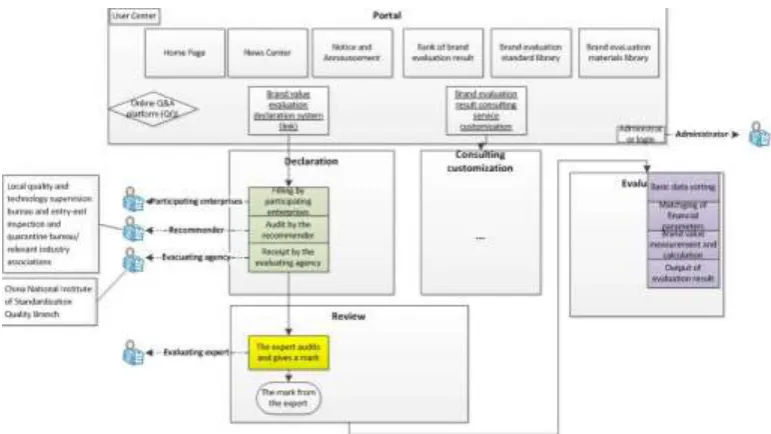
The procedures for brand value evaluation are described as follows:
(1)The enterprise fills in basic information, makes declarations by year, fills in financial and comprehensive indexes and uploads certifying materials.
(2)The recommender audits the declaration materials of the enterprise and then recommends the enterprise to the evaluating agency after successful audit.
(3)The evaluating agency selects the expert from expert database according to industry and allocates declaration materials to the evaluating expert, who will give a mark of declaration materials in a quantized way.
(4)The system conducts measurement and calculation according to the mark given by the expert and the indexes of declaration materials and obtains the mark of brand value evaluation.
Figure 1. Functional configuration.
System Design
Subsystem Functions
Portal System. The portal system is used to allocate the information that relates to brand value evaluation. Pages are classified according to different columns. Users are guide by the navigation menu and column links to browse relevant information. The system administrator may, via the backstage system, edit and customize the columns and entries of the portal and gradually update portal information.
Service System of Brand Evaluation. The brand evaluation service system includes functional modules such as declaration, recommendation, review, measurement and calculation. The system submits declaration information of an enterprise level by level upon audit; makes a quantified evaluation and finally generates the evaluation result. The content and criteria of evaluation may differ depending on the characteristics of different industries. The system packed these differences into the evaluation modules customized for different industries. Before the start of the evaluation each year, the evaluation agency first prepares configuration; then the enterprise makes a declaration according to the template designated and the evaluating expert give a mark according to the template and proceed to the unified measurement and calculation link after obtaining the brand strength mark. Some data may require modification due to the difference among the enterprises in the same industry in addition to industry difference. The system enables the evaluating agency to adjust or modify data upon unified measurement and calculation so as to make the result of evaluation reflect the actual conditions. The evaluating agency may export the evaluation result into an Excel file.
The comprehensive indexes submitted by the enterprise should be evaluated and quantified by the evaluating expert. The service system classifies the experts in the expert database according to industry type. Then, the evaluating agency allocates the declaration materials audited after recommendation to a proper list of expert tasks. After the expert gives a mark upon review, the system will collect the mark for subsequent calculation and treatment. The multi-cycle excess earnings method is adopted, as shown in the follows.
, , 1 1
1
(1 ) ( ) (1 )
T
BC t BC T
B t T
t
F F
V
R R g R
(1) where: B Vmeans brand value;
FBC, t means brand cash flow in Year t;
FBC, T+1 means brand cash flow in Year T+1;
T means high-growth period, normally 3 to 5 years, depending on industry characters; R means discount rate of brand value;
g means perpetual growth rate; long-term expected inflation rate may be used.
User Authority Management Module. Brand evaluation involves multiple institutions and corresponds to different types of users in the system. The system designs different roles to indicate different types of users, including enterprises, recommender, evaluating expert and evaluating agency. Declaration materials may undergo links including filling, submittal, recommendation and review, etc. during the procedure of brand evaluation, corresponding to multiple statuses. The operating authority of users in different roles differs depending on user type and status of declaration materials, such as view, edit, grade, add and delete. The user authority management module can realize user authority management. Also, the enterprise can only view the information they fill in so as to protect the sensitive information of other enterprises and the certifying materials they submit. No access to declaration materials via download link is allowed without authorization.
User Role
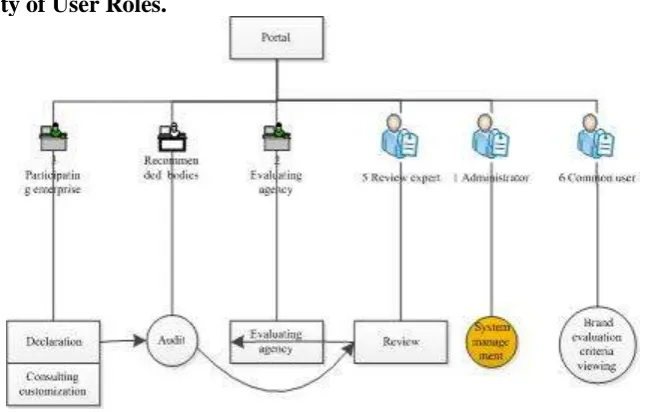
Definition. The system involves six types of user roles, the main functions of which are described as follows:
1)System administrator: user management, portal management;
2)Evaluating agency: building industry evaluation template, setting measurement and calcuation constants, distributing evaluation and calcuation tasks, having access to and exporting the evaluation result;
3)Participating enterprise: filling and modifying decleration indexes and uploading certifying mateirals;
4)Recommender: Auditing the decleration materials submmitted by the enterprise and recommending to the evaluating agency;
5)Evaluating expert: Evaluating the declaration materials and giving a mark of comprehensive indexes in a quantified manner.
6)Common user : Viewing portal information.
Relationship among Users in Different Roles. The relationship among users in different roles is described as follows:
1)The participating enterprise selects the industry it belongs to and its recommender when filling in its basic information;
Operating Authority of User Roles.
Figure 2. System user roles.
The operating authority of different roles is specified according to brand value evaluation procedures: 1)Participating enterprise: adding, deleting, editing and viewing the declaration materials of the enterprise. The materials may not be edited or deleted upon they are submitted. If they are returned by the recommender, they shall be modified before being submitted again. The returned materials may be edited but shall not be deleted.
2)Recommender: The declaration materials submitted by the corresponding enterprise may be viewed. After the materials pass audit, they may be submitted to the evaluating agency; if failing, they shall be returned to the participating enterprise for modification.
3)Evaluating expert: The declaration materials allocated by the evaluating agency may be viewed. A mark will be given to the materials in a quantified manner and may be modified after the mark is saved. After the materials are confirmed to be submitted, they may not be modified.
4)Evaluating agency: The declaration materials of all participating enterprises may be viewed. And the brand evaluation measuring and calculating result may be viewed. Declaration materials may be exported into an Excel file. And the result of measurement and calculation may be adjusted or corrected.
System Realization
The system user design and division of functions are shown as follows:
[image:4.595.99.498.588.782.2]The system is developed based on Java platform. The framework Struts2+Hibernate is adopted and Mysql is used as database. The Struts2 framework is a Java Web open source framework with powerful functions and light weight. The MVC architecture realization has a clear hierarchy, which can make the development focus on realization of business logics and improve development efficiency. As an independent hibernate framework for open source object, Hibernate packs JDBC at the level of light weight, which facilitates database operation through the application of object-oriented thought and realizes the function of data persistence.
Acknowledgment
This work was funded by the Dean fund project of China National Institute of Standardization under grant No. 552016Y-4667, the National Key Technology R&D Program of the Ministry of Science and Technology under grant No. 2015BAK46B02 and 2015BAK46B03-3.
References
[1] Chematony, L.D.; McWilliam, G. Branding Terminology: The Real Debate. Marketing Intelligence and Planning, 1989 (17): 29 - 32.