4366
MULTI HYBRIDIZATION OF SWARM INTELLIGENCE
METHODS
TO SOLVE JOB SHOP SCHEDULING PROBLEM
1JEBARI HAKIM, 2RAHALI EL AZZOUZI SAIDA, 3SAMADI HASSAN, 4SIHAM REKIEK
1,2,3 National School of Applied Sciences of Tangier, University Abdelmalek Essaâdi, Morocco
4 Faculty of Science and Technique of Tangier, University Abdelmalek Essaâdi, Morocco
E-mail: 1[email protected], 2[email protected], 3[email protected], 4[email protected]
ABSTRACT
Scheduling is one of the fundamental and crucial elements in making production organizations efficient and effective in the usage of resources. It also concerns the allocation of resources over a period of time to execute a set of jobs. The purpose of paper is to establish multi hybridization of swarm intelligence methods HABCPSOGA to solve job shop scheduling problems. The performance of proposed algorithms are evaluated by applying it to all well-known benchmark instances and by comparing theirs results with the results of others methods HABCGA available in the literature.The experiment results show that the multi hybridization of swarm intelligence methods improve the effectiveness of the algorithm and they indicate how these proposed methods influence the resolution of the defined problem.
Keywords: Scheduling, Job Shop, Multi Hybridization, Swarm Intelligence, GA.
1. INTRODUCTION
Production scheduling is a process of arranging, controlling and optimizing work and workloads with the purpose of performing some tasks and satisfying some criteria [1, 2].
Job shop scheduling is the essential subject for manufacturing systems due to its NP-hard kind. The core problem in job shop scheduling is to optimize the utilization of machines to obtain the shortest time in completing the activities. Therefore, many different metaheuristics are developed for this problem. These metaheuristics do not ensure converging to globally best solutions but provide high quality or near optimal solutions in a short time. Amongst the metaheuristics approaches, hybrid and adaptive techniques provide very good solutions.
The efficiency of population based metaheuristic depends on two components: Exploration and exploitation [3].
The exploration is required to guarantee that every section of the space is searched enough to furnish a reliable estimate of the global optimum. However, exploitation is significant since the elaboration of the current solution will often generate a better solution. The inconvenience of exploration is waste of many computational efforts because a large number of new solutions can be far
from global optimality. However, the inconvenience of exploitation is that can get stuck in a local optimum because the final solution point depends on the starting point.
The hybrid strategies have been constructed to improve the speed of convergence of the metaheuristic and to improve the quality of the solutions obtained by the metaheuristic. Any types of algorithms could be hybridized [4]. There are three hybridization classifications:
1. Sequential hybridization consists of applying a variety of methods, the solution of the first method is an initialization of the next method.
2. Synchronous parallel hybridization consists of including a method in an operator of another method.
3. Asynchronous parallel hybridization, the hybrid methods share data throughout the search process.
In the literature, authors frequently considered basic hypothesis while solving job shop scheduling problem [5]:
a. Job can’t visit one machine more than once.
b. There are no precedence constraints on operations of different jobs.
c. Machine can process only one job at current time.
d. No specifications of release and due dates.
4367 The objective is to minimize the makespan, which is the total time for all jobs accomplished.
In the last few years, researchers has extended towards flexible job shop scheduling problems in which more than one machine for performing each operation are considered. It present more complexity.
The methods proposed to solve the JSSP are categorized into two types: Exact methods and approximation methods. The exact method purpose to find an optimal solution, and they consume a high amount of time as they explore the solution space, as consequence their use has been limited for small real-life problems. The approximation method, as the name indicates, do not guarantee an optimal solution, they do provide an approximate but useful solution in a reasonable time.
For several years great effort has been dedicated to solve the Job shop scheduling problem, in fact many researchers have proposed various methods: Simulated annealing [6-8], genetic algorithm [9-13], search tabu [14-18], ant colony optimization [19, 20], neural network [21] shifting bottleneck procedure [22, 23], guided local search [24] , GRASP [25] and propagation of constraints [26, 27], invasive weed optimization [28], guided ejection local searches [29], genetic programming [30] , multi-modal immune algorithms [31], immune system [32], particle swarm optimization [33-36], harmony search [37], imperialist competitive algorithm [38] , parallel genetic algorithm and neural network [39], beam search [40], One of the popular solution models considered by many researchers has been a hybrid methods such as hybrid genetic algorithm and tabu search [41], hybrid genetic algorithm with a random key representation [42], hybrid methods combining various heuristic techniques [43-46], hybrid GA [47-50], hybrid swarm intelligence algorithm based on particle swarm optimization [33]. The summary of some contributions to solve job shop scheduling problem has been presented in [51].
However, to the authors' knowledge, very few publications are available in the literature that studied multi hybridization of swarm intelligence methods and that made an in-depth analysis for verifying how the multi hybridization of swarm intelligence methods influence the resolution of job shop scheduling problems.
The rest of the paper is structured into three sections: The material and method are described in section 2. In section 3, the authors presented the results and discussion. The conclusion is reported in section 4.
2. THE MATERIAL AND METHOD
2.1. Fundamentals of Particle Swarm Optimization
Particle swarm optimization (PSO) is a swarm-based optimization technique inspired by nature and was presented by [52]. The algorithm is inspired by the collecting and teaching patterns of birds and fish. It is an adaptive algorithm based on a social-psychological metaphor; a population of individuals changes by returning stochastically toward antecedent successful zones. The particularity of this technique is represented by the transmission and sharing of information [53].
The procedure of PSO is as follows:
1. Initialize randomly a population of n particles.
2. Calculate fitness value for each particle, if the fitness value is better than the best fitness value pbest .
3. Set current value as the new pbest.
4. Choose particle with the best fitness value of all the particles as the gbest.
For each particle, calculate particle position and velocity according to the equation [54]: V [k+1] = µ*V [k] +C1*rand()*(pbest[k]-current[k])+ C2*rand()*(gbest[k]-current[k]) Where current [k+1] = current[k] +V[k], V [] is the particle velocity, current [] is the current solution, rand () is random functions in the range [0, 1]. µ is the inertia factor and used to control intensification and diversification. C1 and C2 are the apprenticeship factors, C1 + C2 = 1.
5. Particle velocities on each dimension are fixed to a maximum velocity Vmax. If the sum of
acceleration would cause the velocity on that dimension to exceed Vmax specified by user,
the velocity on the dimension is limited to Vmax.
6. Terminate if maximum of iterations is reached. Else, goto 2.
4368
2.2. Fundamentals of Artificial Bee Colony Algorithm
Artificial bee colony algorithm ABC is a swarm-based metaheuristic algorithm, developed by [55] for numerical problems optimization. The algorithm is interested by the intelligent behavior of honeybees, that is, foraging behavior of honeybee colonies. The artificial bee colony algorithm is constituted by four steps: initialization step, employed bees step, onlooker bees step and scout bees step.
The basic artificial bee colony steps are as follows:
1. Sent the employed bees to the food sources and measure their nectar amounts, randomly.
2. If an employed bee discovers a better solution, update the memory of employed bee.
3. Then, counts the number of the searches around the source in the memory of employed bee.
4. Share the nectar and position information of the food sources with the onlooker bees if all employed bees complete the search operation.
5. Evaluate all the information from employed bees by the onlooker bee and choose a probably profitable food source.
6. Search the neighborhood of the source by the onlooker bee after arriving at the selected area and update the food source position just as an employed bee does if the onlooker bee discovers a better solution. The criterion for determination of a new food source is founded on the visually comparison process of food source positions.
7. Stop the intensification process of the sources abandoned by the employed/onlooker bees if the new solution cannot be further improved through a predetermined number of trials limit. At this moment, the employed/onlooker bees become scout bees.
8. Send the scouts into the search area for discovering new food sources, randomly.
9. Remember the best food source found so far.
10. Repeat these steps until a termination criterion is satisfied.
The stopping criterion of the artificial bee colony defines the maximum number of cycles that a food source can keep without improving before being replaced.
2.3. Fundamentals of Genetic Algorithm
Genetic algorithm is one of the popular metaheuristics, developed by [56]. The motivation of GA is to promote the survival and reproduction of the best-adapted individuals to the environment.
The element and mechanism of genetic algorithm are representation, population, evaluation, selection, operators and parameter.
The procedure of GA is as follows:
1. Initialize randomly the population of individual.
2. Evaluate the fitness function of each individual
3. Repeat the following phases until the termination criteria are satisfied:
i. Select the best appropriate individuals for reproduction.
ii. Perform genetic operations, crossover and mutation to generate new offspring.
iii. Evaluate the individual fitness of new members.
iv. Replace the least appropriate individuals with new individuals.
4. Report the best solution of the appropriate individual.
The crossover operator and the mutation operator represents the core operators in GA.
The crossover operator is selected in such a way that the formed offspring’s have more probabilities of survival than the parents.
In the literature, several crossover operators have been applied in job shop scheduling such as partially-mapped crossover (PMX), order crossover (OX), linear order crossover (LOX), cycle crossover (CX), order-based crossover (OBX), position-based crossover (PBX), job based order crossover (JOX), subsequence-exchange operator (SSX), uniform crossover (UOX), extrapolation-directed (EDX), partial schedule exchange crossover, extended precedence preservative crossover (EPPX). However, this study take into account only four crossover operators: PMX [57], PBX [58], PPX [59] and OX [60].
The mutation operator has two objectives, the first one is to ameliorate the random local search ability of algorithm and the second one is to preserve the diversity of the individuals in the population. In the literature, different mutation operators have been recommended such as swap [61], inversion [62], insertion [63] and displacement mutation [64].
2.4. The proposed Methods
4369 Generating a new food source in ABC by using crossover, mutation operations in the ABC specific phases explore the search space and search for new area of solution. When mutation is achieved, there is an opportunity of changing the local best position and the algorithm may not be trapped into local optima. During the life cycle of ABC optimization technique, the mutation phase is effectuated on the probabilistic way in each food searching operation for each iteration.
In order to surmount the weakness existing in these algorithms, the proposed multi synchronous parallel hybridization is applied.
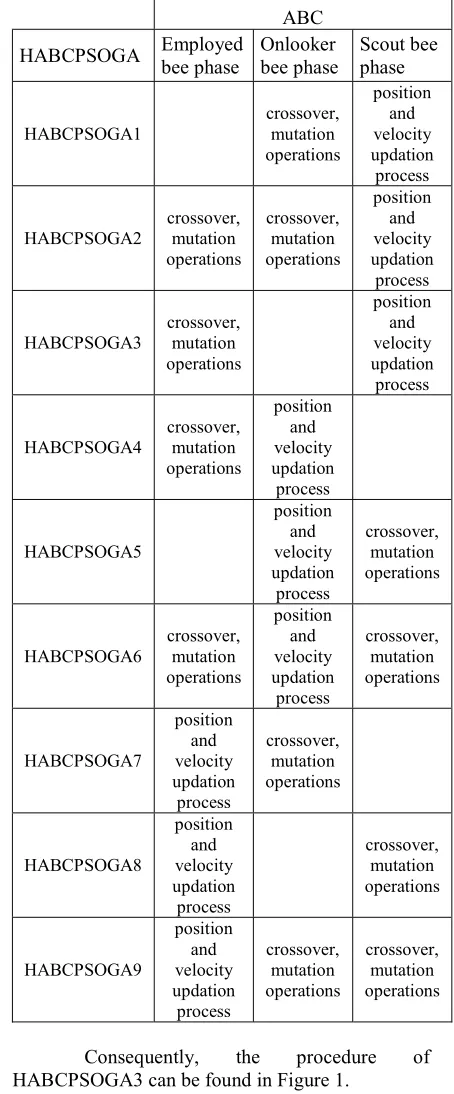
The authors established a new technique of multi hybridization (multi synchronous parallel hybridization) of ABC, PSO and GA denoted as HABCPSOGA, this technique consist to use in the employed bees phase or/and in the onlooker bees phase or/and in the scout bees phase, the crossover and the mutation operator, or the position and the velocity updating process. This is illustrated in Table 2.
[image:4.612.307.534.111.658.2] [image:4.612.91.296.452.683.2]Therefore, the hybridization of ABC, GA and PSO is according to the configurations given in Table 3.
Table 3: The Configurations Of Hybridization Of ABC, PSO and GA .
Configuration Crossover Mutation
Configuration 1 PMX Inversion
Configuration 2 OX Inversion
Configuration 3 PPX Inversion
Configuration 4 PBX Inversion
Configuration 5 PMX Insertion
Configuration 6 OX Insertion
Configuration 7 PPX Insertion
Configuration 8 PBX Insertion
Configuration 9 PMX Swap
Configuration 10 OX Swap
Configuration 11 PPX Swap
Configuration 12 PBX Swap
Configuration 13 PMX Displacement
Configuration 14 OX Displacement
Configuration 15 PPX Displacement Configuration 16 PBX Displacement
Table 2: The Structure Of Hybrid ABC, PSO And GA.
ABC
HABCPSOGA Employed bee phase Onlooker bee phase Scout bee phase
HABCPSOGA1 crossover, mutation operations position and velocity updation process HABCPSOGA2 crossover, mutation operations crossover, mutation operations position and velocity updation process HABCPSOGA3 crossover, mutation operations position and velocity updation process
HABCPSOGA4 crossover, mutation operations position and velocity updation process HABCPSOGA5 position and velocity updation process crossover, mutation operations HABCPSOGA6 crossover, mutation operations position and velocity updation process crossover, mutation operations HABCPSOGA7 position and velocity updation process crossover, mutation operations HABCPSOGA8 position and velocity updation process crossover, mutation operations HABCPSOGA9 position and velocity updation process crossover, mutation operations crossover, mutation operations
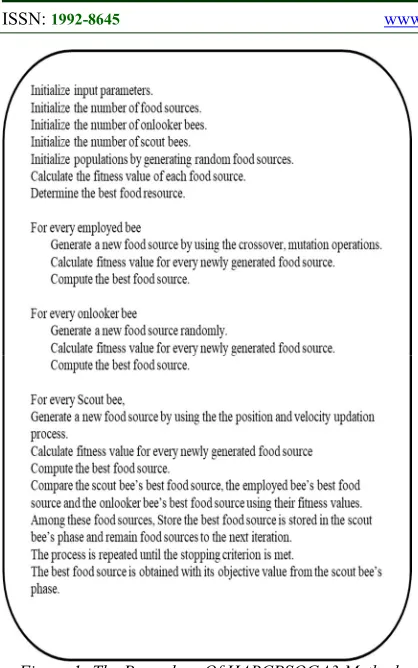
4370 Figure 1: The Procedure Of HABCPSOGA3 Method.
3. RESULTS AND DISCUSSION
The proposed hybrid techniques were programmed in Eclipse. The PC configuration is as follows: Processor: Intel Core i7, OS: Windows 8.1, CPU speed: 2.10 GHz, RAM: 6 GB. There were tested on 250 Benchmark instances from the classical OR-library. The Benchmark instances are as follows : FT instances [65], LA instances [66], ORB instances [67], SWV instances [68], ABZ instances [69], YN instances [70], TA instances [71], DMU instances [72], CAR instances [73].
The obtained results are compared with other best-known solutions obtained by using others techniques and compared with the results of methods HABCGA available in the literature[51].
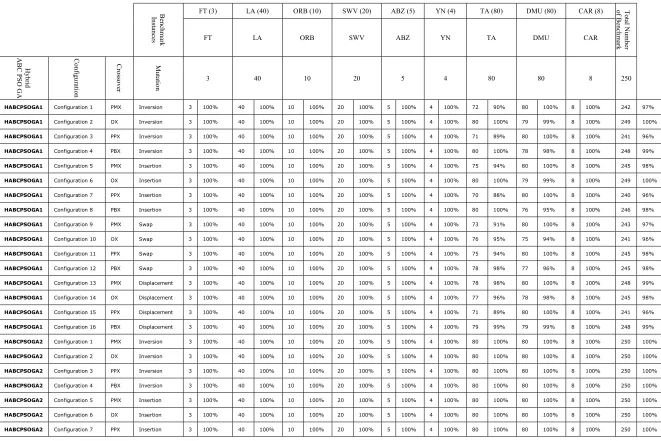
The overall results of proposed methods are summarized in Table 4.
The analysis and simulation indicate that only the proposed methods HABCPSOGA2, HABCPSOGA6 and HABCPSOGA9 in all configurations are given 100% results equal to the best-known solution in all benchmark instances FT (3), LA (40), ORB (10), SWV (20), ABZ (5), YN (4), TA (80), DMU (80) and CAR (8), this is
[image:5.612.314.518.199.320.2]illustrated in Figure 2. Regardless the crossover operator type and mutation operator type and regardless if these methods are employed in its employed bees phase, onlooker bees phase and scout bees phase, crossover operator and mutation operator, or position and velocity updating process, the proposed methods are given result 100% equal to the best-known solution in all benchmark instances.
Figure 2: The Obtained Result Of The Proposed Methods HABCPSOGA2, HABCPSOGA6 And HABCPSOGA9 In
All Configurations.
It has been found that all proposed methods in all configurations are produced 100% results equal to the best-known solution in FT (3), ORB (10), SWV (20), ABZ (5), YN (4) and CAR (8) instances as shown in Figure 3. These methods are given the best results independent of hybridization type, crossover operator type and mutation operator type in FT (3), ORB (10), SWV (20), ABZ (5), YN (4) and CAR (8) instances.
Figure 3: The Obtained Results Of All Proposed Methods In All Configurations To Solve FT (3), ORB (10), SWV
(20), ABZ (5), YN (4) and CAR (8) Instances.
[image:5.612.313.523.475.586.2]4371
Table 4: The Obtained Results Of Hybridization Of ABC, PSO And GA In All Configurations.
B
en
ch
m
ark
In
sta
nc
es
FT (3) LA (40) ORB (10) SWV (20) ABZ (5) YN (4) TA (80) DMU (80) CAR (8) Tota
l N
um
be
r
of
B
en
ch
m
ar
k
FT LA ORB SWV ABZ YN TA DMU CAR
H
yb
rid
A
B
C
P
SO
G
A
C
on
fig
ur
ati
on
C
ro
ss
ov
er
M
uta
tio
n 3 40 10 20 5 4 80 80 8 250
HABCPSOGA1 Configuration 1 PMX Inversion 3 100% 40 100% 10 100% 20 100% 5 100% 4 100% 72 90% 80 100% 8 100% 242 97%
HABCPSOGA1 Configuration 2 OX Inversion 3 100% 40 100% 10 100% 20 100% 5 100% 4 100% 80 100% 79 99% 8 100% 249 100%
HABCPSOGA1 Configuration 3 PPX Inversion 3 100% 40 100% 10 100% 20 100% 5 100% 4 100% 71 89% 80 100% 8 100% 241 96%
HABCPSOGA1 Configuration 4 PBX Inversion 3 100% 40 100% 10 100% 20 100% 5 100% 4 100% 80 100% 78 98% 8 100% 248 99%
HABCPSOGA1 Configuration 5 PMX Insertion 3 100% 40 100% 10 100% 20 100% 5 100% 4 100% 75 94% 80 100% 8 100% 245 98%
HABCPSOGA1 Configuration 6 OX Insertion 3 100% 40 100% 10 100% 20 100% 5 100% 4 100% 80 100% 79 99% 8 100% 249 100%
HABCPSOGA1 Configuration 7 PPX Insertion 3 100% 40 100% 10 100% 20 100% 5 100% 4 100% 70 88% 80 100% 8 100% 240 96%
HABCPSOGA1 Configuration 8 PBX Insertion 3 100% 40 100% 10 100% 20 100% 5 100% 4 100% 80 100% 76 95% 8 100% 246 98%
HABCPSOGA1 Configuration 9 PMX Swap 3 100% 40 100% 10 100% 20 100% 5 100% 4 100% 73 91% 80 100% 8 100% 243 97%
HABCPSOGA1 Configuration 10 OX Swap 3 100% 40 100% 10 100% 20 100% 5 100% 4 100% 76 95% 75 94% 8 100% 241 96%
HABCPSOGA1 Configuration 11 PPX Swap 3 100% 40 100% 10 100% 20 100% 5 100% 4 100% 75 94% 80 100% 8 100% 245 98%
HABCPSOGA1 Configuration 12 PBX Swap 3 100% 40 100% 10 100% 20 100% 5 100% 4 100% 78 98% 77 96% 8 100% 245 98%
HABCPSOGA1 Configuration 13 PMX Displacement 3 100% 40 100% 10 100% 20 100% 5 100% 4 100% 78 98% 80 100% 8 100% 248 99%
HABCPSOGA1 Configuration 14 OX Displacement 3 100% 40 100% 10 100% 20 100% 5 100% 4 100% 77 96% 78 98% 8 100% 245 98%
HABCPSOGA1 Configuration 15 PPX Displacement 3 100% 40 100% 10 100% 20 100% 5 100% 4 100% 71 89% 80 100% 8 100% 241 96%
HABCPSOGA1 Configuration 16 PBX Displacement 3 100% 40 100% 10 100% 20 100% 5 100% 4 100% 79 99% 79 99% 8 100% 248 99%
HABCPSOGA2 Configuration 1 PMX Inversion 3 100% 40 100% 10 100% 20 100% 5 100% 4 100% 80 100% 80 100% 8 100% 250 100%
HABCPSOGA2 Configuration 2 OX Inversion 3 100% 40 100% 10 100% 20 100% 5 100% 4 100% 80 100% 80 100% 8 100% 250 100%
HABCPSOGA2 Configuration 3 PPX Inversion 3 100% 40 100% 10 100% 20 100% 5 100% 4 100% 80 100% 80 100% 8 100% 250 100%
HABCPSOGA2 Configuration 4 PBX Inversion 3 100% 40 100% 10 100% 20 100% 5 100% 4 100% 80 100% 80 100% 8 100% 250 100%
HABCPSOGA2 Configuration 5 PMX Insertion 3 100% 40 100% 10 100% 20 100% 5 100% 4 100% 80 100% 80 100% 8 100% 250 100%
HABCPSOGA2 Configuration 6 OX Insertion 3 100% 40 100% 10 100% 20 100% 5 100% 4 100% 80 100% 80 100% 8 100% 250 100%
4372
HABCPSOGA2 Configuration 8 PBX Insertion 3 100% 40 100% 10 100% 20 100% 5 100% 4 100% 80 100% 80 100% 8 100% 250 100%
HABCPSOGA2 Configuration 9 PMX Swap 3 100% 40 100% 10 100% 20 100% 5 100% 4 100% 80 100% 80 100% 8 100% 250 100%
HABCPSOGA2 Configuration 10 OX Swap 3 100% 40 100% 10 100% 20 100% 5 100% 4 100% 80 100% 80 100% 8 100% 250 100%
HABCPSOGA2 Configuration 11 PPX Swap 3 100% 40 100% 10 100% 20 100% 5 100% 4 100% 80 100% 80 100% 8 100% 250 100%
HABCPSOGA2 Configuration 12 PBX Swap 3 100% 40 100% 10 100% 20 100% 5 100% 4 100% 80 100% 80 100% 8 100% 250 100%
HABCPSOGA2 Configuration 13 PMX Displacement 3 100% 40 100% 10 100% 20 100% 5 100% 4 100% 80 100% 80 100% 8 100% 250 100%
HABCPSOGA2 Configuration 14 OX Displacement 3 100% 40 100% 10 100% 20 100% 5 100% 4 100% 80 100% 80 100% 8 100% 250 100%
HABCPSOGA2 Configuration 15 PPX Displacement 3 100% 40 100% 10 100% 20 100% 5 100% 4 100% 80 100% 80 100% 8 100% 250 100%
HABCPSOGA2 Configuration 16 PBX Displacement 3 100% 40 100% 10 100% 20 100% 5 100% 4 100% 80 100% 80 100% 8 100% 250 100%
HABCPSOGA3 Configuration 1 PMX Inversion 3 100% 40 100% 10 100% 20 100% 5 100% 4 100% 80 100% 80 100% 8 100% 250 100%
HABCPSOGA3 Configuration 2 OX Inversion 3 100% 40 100% 10 100% 20 100% 5 100% 4 100% 80 100% 76 95% 8 100% 246 98%
HABCPSOGA3 Configuration 3 PPX Inversion 3 100% 40 100% 10 100% 20 100% 5 100% 4 100% 80 100% 80 100% 8 100% 250 100%
HABCPSOGA3 Configuration 4 PBX Inversion 3 100% 40 100% 10 100% 20 100% 5 100% 4 100% 80 100% 78 98% 8 100% 248 99%
HABCPSOGA3 Configuration 5 PMX Insertion 3 100% 40 100% 10 100% 20 100% 5 100% 4 100% 80 100% 80 100% 8 100% 250 100%
HABCPSOGA3 Configuration 6 OX Insertion 3 100% 40 100% 10 100% 20 100% 5 100% 4 100% 80 100% 79 99% 8 100% 249 100%
HABCPSOGA3 Configuration 7 PPX Insertion 3 100% 40 100% 10 100% 20 100% 5 100% 4 100% 80 100% 80 100% 8 100% 250 100%
HABCPSOGA3 Configuration 8 PBX Insertion 3 100% 40 100% 10 100% 20 100% 5 100% 4 100% 80 100% 76 95% 8 100% 246 98%
HABCPSOGA3 Configuration 9 PMX Swap 3 100% 40 100% 10 100% 20 100% 5 100% 4 100% 80 100% 80 100% 8 100% 250 100%
HABCPSOGA3 Configuration 10 OX Swap 3 100% 40 100% 10 100% 20 100% 5 100% 4 100% 77 96% 78 98% 8 100% 245 98%
HABCPSOGA3 Configuration 11 PPX Swap 3 100% 40 100% 10 100% 20 100% 5 100% 4 100% 80 100% 80 100% 8 100% 250 100%
HABCPSOGA3 Configuration 12 PBX Swap 3 100% 40 100% 10 100% 20 100% 5 100% 4 100% 76 95% 76 95% 8 100% 242 97%
HABCPSOGA3 Configuration 13 PMX Displacement 3 100% 40 100% 10 100% 20 100% 5 100% 4 100% 80 100% 80 100% 8 100% 250 100%
HABCPSOGA3 Configuration 14 OX Displacement 3 100% 40 100% 10 100% 20 100% 5 100% 4 100% 78 98% 78 98% 8 100% 246 98%
HABCPSOGA3 Configuration 15 PPX Displacement 3 100% 40 100% 10 100% 20 100% 5 100% 4 100% 80 100% 80 100% 8 100% 250 100%
HABCPSOGA3 Configuration 16 PBX Displacement 3 100% 40 100% 10 100% 20 100% 5 100% 4 100% 77 96% 79 99% 8 100% 246 98%
HABCPSOGA4 Configuration 1 PMX Inversion 3 100% 40 100% 10 100% 20 100% 5 100% 4 100% 72 90% 80 100% 8 100% 242 97%
HABCPSOGA4 Configuration 2 OX Inversion 3 100% 40 100% 10 100% 20 100% 5 100% 4 100% 80 100% 79 99% 8 100% 249 100%
HABCPSOGA4 Configuration 3 PPX Inversion 3 100% 40 100% 10 100% 20 100% 5 100% 4 100% 71 89% 80 100% 8 100% 241 96%
HABCPSOGA4 Configuration 4 PBX Inversion 3 100% 40 100% 10 100% 20 100% 5 100% 4 100% 80 100% 78 98% 8 100% 248 99%
HABCPSOGA4 Configuration 5 PMX Insertion 3 100% 40 100% 10 100% 20 100% 5 100% 4 100% 70 88% 80 100% 8 100% 240 96%
4373
HABCPSOGA4 Configuration 7 PPX Insertion 3 100% 40 100% 10 100% 20 100% 5 100% 4 100% 70 88% 80 100% 8 100% 240 96%
HABCPSOGA4 Configuration 8 PBX Insertion 3 100% 40 100% 10 100% 20 100% 5 100% 4 100% 76 95% 77 96% 8 100% 243 97%
HABCPSOGA4 Configuration 9 PMX Swap 3 100% 40 100% 10 100% 20 100% 5 100% 4 100% 71 89% 80 100% 8 100% 241 96%
HABCPSOGA4 Configuration 10 OX Swap 3 100% 40 100% 10 100% 20 100% 5 100% 4 100% 79 99% 79 99% 8 100% 248 99%
HABCPSOGA4 Configuration 11 PPX Swap 3 100% 40 100% 10 100% 20 100% 5 100% 4 100% 75 94% 80 100% 8 100% 245 98%
HABCPSOGA4 Configuration 12 PBX Swap 3 100% 40 100% 10 100% 20 100% 5 100% 4 100% 76 95% 78 98% 8 100% 244 98%
HABCPSOGA4 Configuration 13 PMX Displacement 3 100% 40 100% 10 100% 20 100% 5 100% 4 100% 73 91% 80 100% 8 100% 243 97%
HABCPSOGA4 Configuration 14 OX Displacement 3 100% 40 100% 10 100% 20 100% 5 100% 4 100% 80 100% 76 95% 8 100% 246 98%
HABCPSOGA4 Configuration 15 PPX Displacement 3 100% 40 100% 10 100% 20 100% 5 100% 4 100% 71 89% 80 100% 8 100% 241 96%
HABCPSOGA4 Configuration 16 PBX Displacement 3 100% 40 100% 10 100% 20 100% 5 100% 4 100% 80 100% 78 98% 8 100% 248 99%
HABCPSOGA5 Configuration 1 PMX Inversion 3 100% 40 100% 10 100% 20 100% 5 100% 4 100% 74 93% 80 100% 8 100% 244 98%
HABCPSOGA5 Configuration 2 OX Inversion 3 100% 40 100% 10 100% 20 100% 5 100% 4 100% 80 100% 76 95% 8 100% 246 98%
HABCPSOGA5 Configuration 3 PPX Inversion 3 100% 40 100% 10 100% 20 100% 5 100% 4 100% 70 88% 80 100% 8 100% 240 96%
HABCPSOGA5 Configuration 4 PBX Inversion 3 100% 40 100% 10 100% 20 100% 5 100% 4 100% 80 100% 79 99% 8 100% 249 100%
HABCPSOGA5 Configuration 5 PMX Insertion 3 100% 40 100% 10 100% 20 100% 5 100% 4 100% 75 94% 80 100% 8 100% 245 98%
HABCPSOGA5 Configuration 6 OX Insertion 3 100% 40 100% 10 100% 20 100% 5 100% 4 100% 77 96% 77 96% 8 100% 244 98%
HABCPSOGA5 Configuration 7 PPX Insertion 3 100% 40 100% 10 100% 20 100% 5 100% 4 100% 71 89% 80 100% 8 100% 241 96%
HABCPSOGA5 Configuration 8 PBX Insertion 3 100% 40 100% 10 100% 20 100% 5 100% 4 100% 78 98% 78 98% 8 100% 246 98%
HABCPSOGA5 Configuration 9 PMX Swap 3 100% 40 100% 10 100% 20 100% 5 100% 4 100% 75 94% 80 100% 8 100% 245 98%
HABCPSOGA5 Configuration 10 OX Swap 3 100% 40 100% 10 100% 20 100% 5 100% 4 100% 77 96% 79 99% 8 100% 246 98%
HABCPSOGA5 Configuration 11 PPX Swap 3 100% 40 100% 10 100% 20 100% 5 100% 4 100% 72 90% 80 100% 8 100% 242 97%
HABCPSOGA5 Configuration 12 PBX Swap 3 100% 40 100% 10 100% 20 100% 5 100% 4 100% 77 96% 78 98% 8 100% 245 98%
HABCPSOGA5 Configuration 13 PMX Displacement 3 100% 40 100% 10 100% 20 100% 5 100% 4 100% 74 93% 80 100% 8 100% 244 98%
HABCPSOGA5 Configuration 14 OX Displacement 3 100% 40 100% 10 100% 20 100% 5 100% 4 100% 80 100% 78 98% 8 100% 248 99%
HABCPSOGA5 Configuration 15 PPX Displacement 3 100% 40 100% 10 100% 20 100% 5 100% 4 100% 70 88% 80 100% 8 100% 240 96%
HABCPSOGA5 Configuration 16 PBX Displacement 3 100% 40 100% 10 100% 20 100% 5 100% 4 100% 80 100% 79 99% 8 100% 249 100%
HABCPSOGA6 Configuration 1 PMX Inversion 3 100% 40 100% 10 100% 20 100% 5 100% 4 100% 80 100% 80 100% 8 100% 250 100%
HABCPSOGA6 Configuration 2 OX Inversion 3 100% 40 100% 10 100% 20 100% 5 100% 4 100% 80 100% 80 100% 8 100% 250 100%
HABCPSOGA6 Configuration 3 PPX Inversion 3 100% 40 100% 10 100% 20 100% 5 100% 4 100% 80 100% 80 100% 8 100% 250 100%
HABCPSOGA6 Configuration 4 PBX Inversion 3 100% 40 100% 10 100% 20 100% 5 100% 4 100% 80 100% 80 100% 8 100% 250 100%
4374
HABCPSOGA6 Configuration 6 OX Insertion 3 100% 40 100% 10 100% 20 100% 5 100% 4 100% 80 100% 80 100% 8 100% 250 100%
HABCPSOGA6 Configuration 7 PPX Insertion 3 100% 40 100% 10 100% 20 100% 5 100% 4 100% 80 100% 80 100% 8 100% 250 100%
HABCPSOGA6 Configuration 8 PBX Insertion 3 100% 40 100% 10 100% 20 100% 5 100% 4 100% 80 100% 80 100% 8 100% 250 100%
HABCPSOGA6 Configuration 9 PMX Swap 3 100% 40 100% 10 100% 20 100% 5 100% 4 100% 80 100% 80 100% 8 100% 250 100%
HABCPSOGA6 Configuration 10 OX Swap 3 100% 40 100% 10 100% 20 100% 5 100% 4 100% 80 100% 80 100% 8 100% 250 100%
HABCPSOGA6 Configuration 11 PPX Swap 3 100% 40 100% 10 100% 20 100% 5 100% 4 100% 80 100% 80 100% 8 100% 250 100%
HABCPSOGA6 Configuration 12 PBX Swap 3 100% 40 100% 10 100% 20 100% 5 100% 4 100% 80 100% 80 100% 8 100% 250 100%
HABCPSOGA6 Configuration 13 PMX Displacement 3 100% 40 100% 10 100% 20 100% 5 100% 4 100% 80 100% 80 100% 8 100% 250 100%
HABCPSOGA6 Configuration 14 OX Displacement 3 100% 40 100% 10 100% 20 100% 5 100% 4 100% 80 100% 80 100% 8 100% 250 100%
HABCPSOGA6 Configuration 15 PPX Displacement 3 100% 40 100% 10 100% 20 100% 5 100% 4 100% 80 100% 80 100% 8 100% 250 100%
HABCPSOGA6 Configuration 16 PBX Displacement 3 100% 40 100% 10 100% 20 100% 5 100% 4 100% 80 100% 80 100% 8 100% 250 100%
HABCPSOGA7 Configuration 1 PMX Inversion 3 100% 40 100% 10 100% 20 100% 5 100% 4 100% 80 100% 80 100% 8 100% 250 100%
HABCPSOGA7 Configuration 2 OX Inversion 3 100% 39 98% 10 100% 20 100% 5 100% 4 100% 79 99% 75 94% 8 100% 243 97%
HABCPSOGA7 Configuration 3 PPX Inversion 3 100% 37 93% 10 100% 20 100% 5 100% 4 100% 80 100% 80 100% 8 100% 247 99%
HABCPSOGA7 Configuration 4 PBX Inversion 3 100% 39 98% 10 100% 20 100% 5 100% 4 100% 76 95% 75 94% 8 100% 240 96%
HABCPSOGA7 Configuration 5 PMX Insertion 3 100% 34 85% 10 100% 20 100% 5 100% 4 100% 80 100% 80 100% 8 100% 244 98%
HABCPSOGA7 Configuration 6 OX Insertion 3 100% 38 95% 10 100% 20 100% 5 100% 4 100% 78 98% 78 98% 8 100% 244 98%
HABCPSOGA7 Configuration 7 PPX Insertion 3 100% 36 90% 10 100% 20 100% 5 100% 4 100% 80 100% 80 100% 8 100% 246 98%
HABCPSOGA7 Configuration 8 PBX Insertion 3 100% 38 95% 10 100% 20 100% 5 100% 4 100% 79 99% 79 99% 8 100% 246 98%
HABCPSOGA7 Configuration 9 PMX Swap 3 100% 40 100% 10 100% 20 100% 5 100% 4 100% 80 100% 80 100% 8 100% 250 100%
HABCPSOGA7 Configuration 10 OX Swap 3 100% 39 98% 10 100% 20 100% 5 100% 4 100% 80 100% 75 94% 8 100% 244 98%
HABCPSOGA7 Configuration 11 PPX Swap 3 100% 40 100% 10 100% 20 100% 5 100% 4 100% 80 100% 80 100% 8 100% 250 100%
HABCPSOGA7 Configuration 12 PBX Swap 3 100% 38 95% 10 100% 20 100% 5 100% 4 100% 80 100% 78 98% 8 100% 246 98%
HABCPSOGA7 Configuration 13 PMX Displacement 3 100% 38 95% 10 100% 20 100% 5 100% 4 100% 80 100% 80 100% 8 100% 248 99%
HABCPSOGA7 Configuration 14 OX Displacement 3 100% 39 98% 10 100% 20 100% 5 100% 4 100% 80 100% 76 95% 8 100% 245 98%
HABCPSOGA7 Configuration 15 PPX Displacement 3 100% 40 100% 10 100% 20 100% 5 100% 4 100% 80 100% 80 100% 8 100% 250 100%
HABCPSOGA7 Configuration 16 PBX Displacement 3 100% 39 98% 10 100% 20 100% 5 100% 4 100% 80 100% 77 96% 8 100% 246 98%
HABCPSOGA8 Configuration 1 PMX Inversion 3 100% 33 83% 10 100% 20 100% 5 100% 4 100% 80 100% 80 100% 8 100% 243 97%
HABCPSOGA8 Configuration 2 OX Inversion 3 100% 38 95% 10 100% 20 100% 5 100% 4 100% 77 96% 78 98% 8 100% 243 97%
HABCPSOGA8 Configuration 3 PPX Inversion 3 100% 38 95% 10 100% 20 100% 5 100% 4 100% 80 100% 80 100% 8 100% 248 99%
4375
HABCPSOGA8 Configuration 5 PMX Insertion 3 100% 40 100% 10 100% 20 100% 5 100% 4 100% 80 100% 80 100% 8 100% 250 100%
HABCPSOGA8 Configuration 6 OX Insertion 3 100% 38 95% 10 100% 20 100% 5 100% 4 100% 76 95% 78 98% 8 100% 242 97%
HABCPSOGA8 Configuration 7 PPX Insertion 3 100% 37 93% 10 100% 20 100% 5 100% 4 100% 80 100% 80 100% 8 100% 247 99%
HABCPSOGA8 Configuration 8 PBX Insertion 3 100% 39 98% 10 100% 20 100% 5 100% 4 100% 78 98% 78 98% 8 100% 245 98%
HABCPSOGA8 Configuration 9 PMX Swap 3 100% 39 98% 10 100% 20 100% 5 100% 4 100% 80 100% 80 100% 8 100% 249 100%
HABCPSOGA8 Configuration 10 OX Swap 3 100% 37 93% 10 100% 20 100% 5 100% 4 100% 80 100% 76 95% 8 100% 243 97%
HABCPSOGA8 Configuration 11 PPX Swap 3 100% 40 100% 10 100% 20 100% 5 100% 4 100% 80 100% 80 100% 8 100% 250 100%
HABCPSOGA8 Configuration 12 PBX Swap 3 100% 37 93% 10 100% 20 100% 5 100% 4 100% 80 100% 75 94% 8 100% 242 97%
HABCPSOGA8 Configuration 13 PMX Displacement 3 100% 40 100% 10 100% 20 100% 5 100% 4 100% 80 100% 80 100% 8 100% 250 100%
HABCPSOGA8 Configuration 14 OX Displacement 3 100% 39 98% 10 100% 20 100% 5 100% 4 100% 80 100% 75 94% 8 100% 244 98%
HABCPSOGA8 Configuration 15 PPX Displacement 3 100% 40 100% 10 100% 20 100% 5 100% 4 100% 80 100% 80 100% 8 100% 250 100%
HABCPSOGA8 Configuration 16 PBX Displacement 3 100% 37 93% 10 100% 20 100% 5 100% 4 100% 80 100% 79 99% 8 100% 246 98%
HABCPSOGA9 Configuration 1 PMX Inversion 3 100% 40 100% 10 100% 20 100% 5 100% 4 100% 80 100% 80 100% 8 100% 250 100%
HABCPSOGA9 Configuration 2 OX Inversion 3 100% 40 100% 10 100% 20 100% 5 100% 4 100% 80 100% 80 100% 8 100% 250 100%
HABCPSOGA9 Configuration 3 PPX Inversion 3 100% 40 100% 10 100% 20 100% 5 100% 4 100% 80 100% 80 100% 8 100% 250 100%
HABCPSOGA9 Configuration 4 PBX Inversion 3 100% 40 100% 10 100% 20 100% 5 100% 4 100% 80 100% 80 100% 8 100% 250 100%
HABCPSOGA9 Configuration 5 PMX Insertion 3 100% 40 100% 10 100% 20 100% 5 100% 4 100% 80 100% 80 100% 8 100% 250 100%
HABCPSOGA9 Configuration 6 OX Insertion 3 100% 40 100% 10 100% 20 100% 5 100% 4 100% 80 100% 80 100% 8 100% 250 100%
HABCPSOGA9 Configuration 7 PPX Insertion 3 100% 40 100% 10 100% 20 100% 5 100% 4 100% 80 100% 80 100% 8 100% 250 100%
HABCPSOGA9 Configuration 8 PBX Insertion 3 100% 40 100% 10 100% 20 100% 5 100% 4 100% 80 100% 80 100% 8 100% 250 100%
HABCPSOGA9 Configuration 9 PMX Swap 3 100% 40 100% 10 100% 20 100% 5 100% 4 100% 80 100% 80 100% 8 100% 250 100%
HABCPSOGA9 Configuration 10 OX Swap 3 100% 40 100% 10 100% 20 100% 5 100% 4 100% 80 100% 80 100% 8 100% 250 100%
HABCPSOGA9 Configuration 11 PPX Swap 3 100% 40 100% 10 100% 20 100% 5 100% 4 100% 80 100% 80 100% 8 100% 250 100%
HABCPSOGA9 Configuration 12 PBX Swap 3 100% 40 100% 10 100% 20 100% 5 100% 4 100% 80 100% 80 100% 8 100% 250 100%
HABCPSOGA9 Configuration 13 PMX Displacement 3 100% 40 100% 10 100% 20 100% 5 100% 4 100% 80 100% 80 100% 8 100% 250 100%
HABCPSOGA9 Configuration 14 OX Displacement 3 100% 40 100% 10 100% 20 100% 5 100% 4 100% 80 100% 80 100% 8 100% 250 100%
HABCPSOGA9 Configuration 15 PPX Displacement 3 100% 40 100% 10 100% 20 100% 5 100% 4 100% 80 100% 80 100% 8 100% 250 100%
4376 Figure 4: The Obtained Results Of The Proposed Methods except HABCPSOGA7 and HABCPSOGA8 In
All Configurations To Solve LA (40) Instances.
[image:11.612.314.521.370.515.2]The results show that the proposed methods HABCPSOGA7 in configuration 1, configuration 9, configuration 11 and configuration 15 (that used PMX with inversion mutation or swap mutation and that used PPX with swap mutation or displacement mutation), are given 100% results equal to the best-known solution in LA (40) instances as shown in Figure 5.
Figure 5: The Obtained Results Of HABCPSOGA7 In Configuration 1, Configuration 9, Configuration 11,
Configuration 15 To Solve LA (40) Instances.
As follows from Figure 5:
The proposed method HABCPSOGA7 that used PMX with inversion mutation or swap mutation and the HABCPSOGA7 that used PPX with swap mutation or displacement mutation are produced better results than the HABCPSOGA7 that used PMX with insertion mutation or displacement mutation.
The proposed method HABCPSOGA7 that used PMX with inversion mutation or swap mutation and the HABCPSOGA7 that used PPX with swap mutation or displacement mutation are produced better results than the HABCPSOGA7
that used PPX with insertion mutation or inversion mutation.
The proposed method HABCPSOGA7 that used PMX with inversion mutation or swap mutation and the HABCPSOGA7 that used PPX with swap mutation or displacement mutation are produced better results than the HABCPSOGA7 that used OX with others mutation operators. The proposed method HABCPSOGA7 that used
PMX with inversion mutation or swap mutation and the HABCPSOGA7 that used PPX with swap mutation or displacement mutation are produced better results than the HABCPSOGA7 that used PBX with others mutation operators.
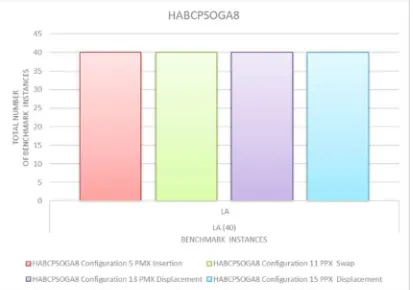
[image:11.612.90.297.390.535.2]The results show that the proposed methods HABCPSOGA8 in configuration 5, configuration 11, configuration 13 and configuration 15 ( that used PMX with insertion mutation or displacement mutation and that used PPX with swap mutation or displacement mutation) are given 100% results equal to the best known solution in LA (40) instances as shown in Figure 6.
Figure 6: The Obtained Results Of HABCPSOGA8 In Configuration 5, Configuration 11, Configuration 13 And
Configuration 15 To Solve LA (40) Instances.
As follows from the Figure 6:
The proposed method HABCPSOGA8 that used PMX with insertion mutation or displacement mutation and the HABCPSOGA8 that used PPX with swap mutation or displacement mutation are produced better results than the HABCPSOGA8 that used PMX with swap mutation or inversion mutation.
4377 mutation or inversion mutation.
The proposed method HABCPSOGA8 that used PMX with insertion mutation or displacement mutation and the HABCPSOGA8 that used the PPX with swap mutation or displacement mutation are produced better results than the HABCPSOGA8 that used OX with others mutation operators.
The proposed method HABCPSOGA8 that used PMX with insertion mutation or displacement mutation and the HABCPSOGA8 that used PPX with swap mutation or displacement mutation are produced better results than the HABCPSOGA8 that used PBX with others mutation operators.
[image:12.612.313.517.208.352.2]The results show that the proposed methods HABCPSOGA1 in configuration 2, configuration 4, configuration 6 and configuration 8 (that used OX with inversion mutation or insertion mutation and that used PBX with inversion mutation or insertion mutation) are given 100% results equal to the best known solution in TA (80) instances as shown in Figure 7.
Figure 7: The Obtained Results Of HABCPSOGA1 In Configuration 2, Configuration 4, Configuration 6 And Configuration 8 To Solve TA (80) Instances.
As follows from the Figure 7:
The proposed method HABCPSOGA1 that used OX with insertion mutation or inversion mutation and the HABCPSOGA1 that used PBX with insertion mutation or inversion mutation are produced better results than the HABCPSOGA1 that used PPX with others mutation operators or the HABCPSOGA1 that used MPX with others mutation operators. The proposed method HABCPSOGA1 that used
OX with insertion mutation or inversion mutation and the HABCPSOGA1 that used PBX with insertion mutation or inversion mutation are produced better results than the
HABCPSOGA1 that used OX with others mutation operators or the HABCPSOGA1 that used PBX with others mutation operators.
The results show that the proposed methods HABCPSOGA3 in all configurations except in configuration 10, configuration 12 and configuration 14 are given 100% results equal to the best known solution in TA (80) instances as shown in Figure 8.
Figure 8: The Obtained Results Of HABCPSOGA3 In Configuration X, X= {1,… , 9, 11, 13, 15, 16} To Solve
TA (80) Instances.
As follows from the Figure 8:
The proposed method HABCPSOGA3 that used OX with swap mutation or displacement mutation and the HABCPSOGA3 that used PBX with swap mutation or displacement mutation are produced bad results than the proposed method that used OX with insertion mutation or inversion mutation.
The proposed method HABCPSOGA3 that used OX with swap mutation or displacement mutation and the HABCPSOGA3 that used PBX with swap mutation or displacement mutation are produced bad results than the HABCPSOGA3 that used PBX with insertion mutation or with inversion mutation.
The proposed method HABCPSOGA3 that used OX with swap mutation or displacement mutation and the HABCPSOGA3 that used PBX with swap mutation or displacement mutation are produced bad results than the HABCPSOGA3 that used others crossover operators (PMX, PPX) with others mutation operators (swap, inversion, insertion, displacement).
The results show that the proposed methods
HABCPSOGA4 and HABCPSOGA5 in
4378 mutation or displacement mutation and that used PBX with inversion mutation or displacement mutation) are given 100% results equal to the best known solution in TA (80) instances as shown in Figure 9.
Figure 9: The Obtained Results Of HABCPSOGA4 and HABCPSOGA5 In Configuration 2, Configuration 4, Configuration 14 And Configuration 16 To Solve TA (80)
Instances.
As follows from the Figure 9:
The proposed methods HABCPSOGA4 and HABCPSOGA5 that used OX with inversion mutation or displacement mutation and that used PBX with inversion mutation or displacement mutation are produced better results than the proposed methods that used the PPX with others mutation operators.
The proposed methods HABCPSOGA4 and HABCPSOGA5 that used OX with inversion mutation or displacement mutation and that used PBX with inversion mutation or displacement mutation are produced better than the proposed methods that used MPX with others mutation operators.
The proposed methods HABCPSOGA4 and HABCPSOGA5 that used OX with inversion mutation or displacement mutation and that used PBX with inversion mutation or displacement mutation are produced better than the proposed methods that used PBX with insertion mutation or swap mutation.
The proposed methods HABCPSOGA4 and HABCPSOGA5 that used OX with inversion mutation or displacement mutation and that used PBX with inversion mutation or displacement mutation are produced better results than the proposed methods that used the OX with insertion mutation or swap mutation.
The results show that the proposed methods HABCPSOGA7 and HABCPSOGA8 in all
[image:13.612.89.298.161.306.2]configurations except in configuration 2, configuration 4, configuration 6 and configuration 8 are given 100% results equal to the best known solution on TA (80) instances as shown in Figure 10.
Figure 10: The Obtained Results Of HABCPSOGA7 And HABCPSOGA8 In Configuration X, X= {1, 3, 5, 7, 9, 10,
11, 12, 13, 14, 15, 16} To Solve TA (80) Instances.
As follows from the Figure 10:
The proposed methods HABCPSOGA7 and HABCPSOGA8 that used OX with insertion mutation or inversion mutation and that used PBX with insertion mutation or inversion mutation are produced bad results than the proposed methods that used OX with swap mutation or displacement mutation.
The proposed methods HABCPSOGA7 and HABCPSOGA8 that used OX with insertion mutation or inversion mutation and that used PBX with insertion mutation or inversion mutation are produced bad results than the proposed methods that used PBX with swap mutation or displacement mutation.
The proposed methods HABCPSOGA7 and HABCPSOGA8 that used OX with insertion mutation or inversion mutation and that used PBX with insertion mutation or inversion mutation are produced bad results than the proposed methods that used others crossover operators (PMX, PPX) with others mutation operators (swap, inversion, insertion, displacement).
4379 Figure 11: The Obtained Results Of HABCPSOGAX, X = {1, 3, 4, 5, 7, 8} In Configuration X, X= {1, 3, 5, 7, 9, 11,
13, 15} To Solve DMU (80) Instances.
As follows from the Figure 11:
The proposed methods HABCPSOGAX, X= 1, 3, 4, 5, 7, 8 that used PPX with all mutation operators are produced better results than the proposed methods that used OX with all mutation operators.
The proposed methods HABCPSOGAX, X= 1, 3, 4, 5, 7, 8 that used PPX with all mutation operators are produced better results than the proposed methods that used PBX with all mutation operators.
The proposed methods HABCPSOGAX, X= 1, 3, 4, 5, 7, 8 that used PMX with all mutation operators are produced better results than the proposed methods that used OX with all mutation operators.
The proposed methods HABCPSOGAX, X= 1, 3, 4, 5, 7, 8 that used PMX with all mutation operators are produced better results than the proposed methods that used PBX with all mutation operators.
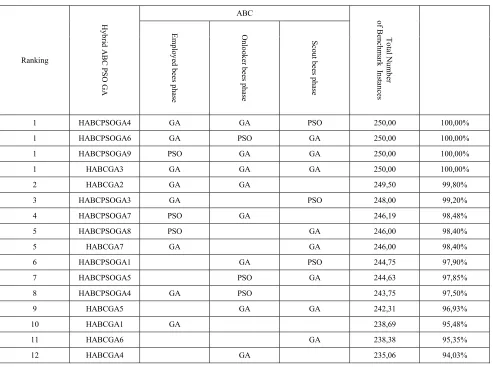
The ranking of the proposed methods HABCPSOGA in terms of performance is illustrated in Figure 12 and in the Table 5.
The authors’ attention was concentrated not only to develop multi hybridization of swarm intelligence methods to solve job shop scheduling problems but also to make an in-depth analysis for verifying how the multi hybridization of swarm intelligence methods influence the resolution of defined problem.
Summing up the results according to the ranking of the proposed methods HABCPSOGA in terms of performance, it can be concluded that:
The proposed methods HABCPSOGA
hybridized in its two phases (employed bees phase and scout bees phase) that used crossover operator and mutation operator in employed bees phase and that used position and velocity updating process in scout bees phase are produced the best results than the proposed methods HABCPSOGA hybridized in its two phases (employed bees phase and scout bees phase) that used position and velocity updating process type in employed bees phase and that used crossover operator and mutation operator in scout bees phase.
The proposed methods HABCPSOGA
hybridized in its two phases (employed bees phase and scout bees phase) that used crossover operator and mutation operator in employed bees phase and that used position and velocity updating process in scout bees phase are produced the best results than the proposed methods HABCPSOGA hybridized in its two phases (employed bees phase and scout bees phase or employed bees phase and onlooker bees phase or onlooker bees phase and scout bees phase) that used others disposition of crossover operator and mutation operator, position and velocity updating process in its two phases.
The proposed methods HABCPSOGA
hybridized in its two phases (employed bees phase and onlooker bees phase) that used position and velocity updating process in employed bees phase and that used crossover operator and mutation operator in onlooker bees phase are produced the best results than the proposed methods HABCPSOGA hybridized in its two phases (employed bees phase and onlooker bees phase) that used position and velocity updating process in onlooker bees phase and that used crossover operator and mutation operator in employed bees phase.
The proposed methods HABCPSOGA
4380
Figure 12: The Ranking Of The Proposed Methods.
Table 5: The Ranking Of The Proposed Methods According To The Hybridization Number
Ranking Hybrid ABC PSO GA
ABC
Total Number
of Benchmark Instances Employed bees phase Onlooker bees phase
Scout bees phase
1 HABCPSOGA4 GA GA PSO 250,00 100,00%
1 HABCPSOGA6 GA PSO GA 250,00 100,00%
1 HABCPSOGA9 PSO GA GA 250,00 100,00%
2 HABCPSOGA3 GA PSO 248,00 99,20%
3 HABCPSOGA7 PSO GA 246,19 98,48%
4 HABCPSOGA8 PSO GA 246,00 98,40%
5 HABCPSOGA1 GA PSO 244,75 97,90%
6 HABCPSOGA5 PSO GA 244,63 97,85%
[image:15.792.126.615.332.521.2]4381
The proposed methods HABCPSOGA
hybridized in its three phases are produced the best results in all configurations regardless if HABCPSOGA are employed in its employed bees phase, onlooker bees phase and scout bees phase, crossover operator and mutation operator, or position and velocity updating process.
The proposed methods HABCPSOGA
hybridized in its three phases are produced the best result in all configurations regardless of crossover operator type and mutation operator type.
The proposed methods HABCPSOGA
hybridized in its three phases are produced the best results than the proposed methods HABCPSOGA hybridized in its two phases.
The ranking of the proposed methods HABCPSOGA in terms of performance compared with the methods HABCGA available in the literature [51] is demonstrated in the Table 6.
The findings of our research are quite convincing, and thus the following conclusions can be drawn :
The proposed methods HABCPSOGA
hybridized in its three phases are produced the equal results to the methods HABCGA hybridized in its three phases, in all configurations regardless of crossover operator type and mutation operator type.
The proposed methods HABCPSOGA
hybridized in its three phases (regardless if HABCPSOGA are employed in its employed bees phase, onlooker bees phase and scout bees phase, crossover operator and mutation operator, or position and velocity updating process) are produced the equal results to the methods HABCGA hybridized in its three phases (HABCGA are employed in its employed bees phase, onlooker bees phase and scout bees phase, crossover operator and mutation operator) in all configurations. The methods HABCGA hybridized in its two
phases (employed bees phase and onlooker bees phase) that used crossover operator and mutation operator in these two phases are produced the best results than the proposed methods HABCPSOGA hybridized in its two phases (employed bees phase and onlooker bees phase) that used position and velocity updating process type in employed bees phase and that
used crossover operator and mutation operator in onlooker bees phase.
The methods HABCGA hybridized in its two phases (employed bees phase and onlooker bees phase) that used crossover operator and mutation operator in these two phases are produced the best results than the proposed methods HABCPSOGA hybridized in its two phases (employed bees phase and onlooker bees phase) that used crossover operator and mutation operator in employed bees phase and that used position and velocity updating process type in onlooker bees phase.
The proposed methods HABCPSOGA
hybridized in its two phases (employed bees phase and scout bees phase) that used crossover operator and mutation operator in employed bees phase and that used position and velocity updating process in scout bees phase are produced the best results than the methods HABCGA hybridized in its two phases (employed bees phase and scout bees phase) that used crossover operator and mutation operator in these two phases.
The proposed methods HABCPSOGA
hybridized in its two phases (employed bees phase and scout bees phase) that used position and velocity updating process in employed bees phase and that used crossover operator and mutation operator in scout bees phase are produced the best results than the methods HABCGA hybridized in its two phases (employed bees phase and scout bees phase) that used crossover operator and mutation operator in these two phases.
The methods HABCGA hybridized in its two phases (employed bees phase and scout bees phase) that used crossover operator and mutation operator in these two phases are produced the best results than the rest of proposed methods HABCPSOGA hybridized in its two phases.
The proposed methods HABCPSOGA
4382
Table 6: The Ranking Of The Proposed Methods HABCPSOGA In Terms Of Performance Compared With The Method HABCGA
Ranking
H
yb
rid
A
B
C
P
S
O
G
A
ABC
T
ota
l N
um
be
r
of
B
en
ch
m
ark
I
ns
ta
nc
es
E
m
plo
ye
d b
ee
s p
ha
se
O
nlo
ok
er
be
es
p
ha
se
Sc
ou
t b
ee
s p
ha
se
1 HABCPSOGA4 GA GA PSO 250,00 100,00%
1 HABCPSOGA6 GA PSO GA 250,00 100,00%
1 HABCPSOGA9 PSO GA GA 250,00 100,00%
1 HABCGA3 GA GA GA 250,00 100,00%
2 HABCGA2 GA GA 249,50 99,80%
3 HABCPSOGA3 GA PSO 248,00 99,20%
4 HABCPSOGA7 PSO GA 246,19 98,48%
5 HABCPSOGA8 PSO GA 246,00 98,40%
5 HABCGA7 GA GA 246,00 98,40%
6 HABCPSOGA1 GA PSO 244,75 97,90%
7 HABCPSOGA5 PSO GA 244,63 97,85%
8 HABCPSOGA4 GA PSO 243,75 97,50%
9 HABCGA5 GA GA 242,31 96,93%
10 HABCGA1 GA 238,69 95,48%
11 HABCGA6 GA 238,38 95,35%
4383
The proposed methods HABCPSOGA
hybridized in its three phases and in its two phases are produced the best results than the methods HABCGA hybridized in its one phase by crossover operator and mutation operator.
The proposed methods HABCPSOGA
hybridized in its two phases (onlooker bees phase and scout bees phase) that used position and velocity updating process in onlooker bees phase and that used crossover operator and mutation operator in scout bees phase are produced the best results than the methods HABCGA hybridized in its two phases (onlooker bees phase and scout bees phase) that used crossover operator and mutation operator in these two phases.
4. CONCLUSION
The job shop scheduling problem represents a challenge for the researchers, which has been known as an NP-hard. Due to its complexity, hybrid techniques for solving this type of problem are required.
The aim of paper is to establish multi hybridization of swarm intelligence methods HABCPSOGA to solve job shop scheduling problems. The performance of proposed approaches are evaluated by applying it to all well-known benchmark instances and by comparing theirs results with the results of others methods namely HABCGA available in the literature.
Based on the results, it can be concluded that the research into multi hybridization of swarm intelligence methods to solve job shop scheduling problems has been very successful.
The finding supports the theory that the multi hybridization of swarm intelligence methods outperforms the results that were published in the literature and that is broadly consistent with the major investigation which have demonstrated that the hybridization improves the effectiveness of the technique.
The paper presents a pilot study for verifying how the multi hybridization influence the resolution of job shop scheduling problem.
On the basis of the promising findings presented in this paper, work on multi hybridization is continuing and will be presented in future papers.
REFRENCES:
[1] R. Kumar, and D. Sankha, “A Genetic Algorithm-Based Approach for Optimization of Scheduling in Job Shop Environment”, Journal of Advanced Manufacturing Systems, Vol. 10, No. 2, 2011, pp. 223-240.
[2] M. Gen, and R. Cheng, “Genetic Algorithms and Engineering Optimization”, John Wiley & Sons, Inc., New York. 2000.
[3] M. Repinsek, S.H. Liu, and M. Mernik, “Exploration and exploitation in evolutionary algorithms: A survey”. ACM Computing Surveys, Vol. 45, No. 3, 2013, pp. 1-33. [4] E. Talbi, “A Unified Taxonomy of Hybrid
Metaheuristics with Mathematical
Programming, Constraint Programming and Machine Learning”, Hybrid Metaheuristics. Heidelberg: Springer; 2013
[5] T. Bagchi, “Multiobjective Scheduling By
Genetic Algorithm (1999 edition)”, New York:
Springer US, 1999.
[6] P. Brucker, and B. Jurisch, “A branch and bound algorithm for the job-shop scheduling problem”, Discrete Applied Mathematics, Vol. 49, No. 1-3, 1994, pp. 107-127.
[7] M.E. Aydin, and T.C. Fogarty, “A Distributed Evolutionary Simulated Annealing Algorithm for Combinatorial Optimisation Problems”, Journal of Heuristics, Vol. 10, No. 3, 2004, pp. 269-292.
[8] T. Satake, K. Morikawa, K. Takahashi, and N. Nakamura, “Simulated Annealing Approach for Minimizing the Makespan of the General Job- Shop”, International Journal of Production Economics, Vol. 60-61, No. 1, 1999, pp. 515-522.
[9] H. Piroozfard, and K.Y. Wong, “Job shop scheduling problem with late work criterion”,
AIP Conference Proceedings, Vol. 1660, 2015,
pp. 050061-1, 050061-5.
[10] C. Bierwith, “A Generalized Permutation Approach to Job ShopScheduling with Genetic Algorithms”, OR Spektrum Vol. 17, No. 2-3, 1995, pp. 87-92.
[11] J.F. Goncalves, J.M. Mendes, and M. Resende, “A hybrid genetic algorithm for the job shop scheduling problem”, European Journal of Operations Research, Vol. 167, No. 1, 2004, pp. 77-95.
4384 Publication of the 2014 Annual Conference on Genetic and Evolutionary Computation
(GECCO Comp '14) , 2014, pp. 1449-1450.
[13] H. Piroozfard, and K. Y. Wong, “Solving multi-objective job shop scheduling problems using a non-dominated sorting genetic algorithm”, AIP Conference Proceedings, Vol. 1660, 2015, pp. 050062-1, 050062-6.
[14] L. Asadzadeh, “A local search genetic algorithm for the job shop scheduling problem with intelligent agents”, Computers & Industrial Engineering, Vol. 85, Issue. C, 2015, pp. 376-383.
[15] E. Nowicki, and C. Smutnicki, “A Fast Taboo Search Algorithm for the Job Shop Problem”, Management Science, Vol. 42, No. 6, 1996, pp. 797-813.
[16] F. Pezzella, and E. Merelli, “A Tabu Search Method Guided by Shifting Bottleneck for the Job Shop Scheduling Problem”, European Journal of Operational Research, Vol. 120, No. 2, 2000, pp. 297-310.
[17] V. A. Armentano, and C. Scrich, “Tabu search for minimizing total tardiness in a job shop”,
International Journal of Production
Economics, Vol. 63, No. 2, 2000, pp. 131-140. [18] E. Nowicki, and C. Smutnicki, “An advanced tabu search algorithm for the job shop problem”, Journal of Scheduling, Vol. 8, No. 2, 2005, pp. 145-159.
[19] C. Zhang, P. Li, Z. Guan, and Y. Rao, “A tabu search algorithm with a new neighborhood structure for the job shop scheduling problem”, Computers & Operations Research, Vol. 34, No. 11, 2007, pp. 3229-3242.
[20] C. Blum, and M. Sampels, “An Ant Colony Optimization Algorithm for Shop Scheduling Problems”, Journal of Mathematical Modelling and Algorithms, Vol. 3, No. 3, 2004, pp. 285-308.
[21] A. Colorni, M. Dorigo, V. Maniezzo, and M. Trubian, “Ant System for Job-Shop Scheduling”, Belgian Journal of Operations Research, Statistics and Computer Science (JORBEL), Vol. 34, No. 1, 1994, pp. 39-53. [22] T. Satake, K. Morikawa, K. Takahashi, and N.
Nakamura, “Neural Network Approach for Minimizing the Makespan of the General Job- Shop”, International Journal of Production Economics, Vol. 33, No. 1-3, 1994, pp. 67-74. [23] J. Adams, E. Balas, and D. Zawack, “The
Shifting Bottleneck Procedure for Job Shop
Scheduling”, Management Science, Vol. 34, No. 38, 1988, pp. 391-401.
[24] W. Huang, and A. Yin, “An Improved Shifting Bottleneck Procedure for the Job Shop Scheduling Problem”, Computers & Operations Research, Vol. 31, No. 12, 2004, pp. 2093-2110.
[25] E. Balas, and A. Vazacopoulos, “Guided Local Search with Shifting Bottleneck for Job Shop Scheduling”, Management Science, Vol. 44, No. 2, 1998, pp. 262-275.
[26] R.M. Aiex, S. Binato, and M.G.C. Resende, “Parallel GRASP with Path-Relinking for Job Shop Scheduling”, Parallel Computing, Vol. 29, No. 4, 2003, pp. 393-430.
[27] U. Dorndorf, E. Pesch, and T. Phan-Huy, “Constraint Propagation and Problem Decomposition: A Preprocessing Procedure for the Job Shop Problem”, Annals of Operations Research, Vol. 115, 2002, pp. 125-145. [28] Y. Zhou, H. Chen, and G. Zhou, “Invasive
weed optimization algorithm for optimization no-idle flow shop scheduling problem”, Neurocomputing, Vol. 137, No. 0, 2014, pp. 285-292.
[29] Y. Nagata, and S. Tojo, “Guided ejection search for the job shop scheduling problem”, In: Cotta, C., Cowling, P. (eds.) EvoCOP. LNCS, Springer, Heidelberg. Vol. 5482, 2009, pp. 168-179.
[30] R. Hunt, M. Johnston, and M. Zhang, “Evolving "less-myopic" scheduling rules for dynamic job shop scheduling with GP”, in
Proc. GECCO.ACM, 2014, pp. 927-934.
[31] G.C. Luh, and C.H. Chueh, “A multi-modal immune algorithm for the job-shop scheduling problem”, Information Sciences, Vol. 179, No. 10, 2009, pp. 1516-1532.
[32] C.C. Coello, D. Rivera, and N. Cortés, “Use of an Artificial Immune System for Job Shop Scheduling”, in Artificial Immune Systems.,J. Timmis, P. Bentley, and E. Hart, Eds., ed: Springer Berlin Heidelberg, Vol. 2787, 2003, pp. 1-10.
4385 [34] S. Mekni, B.F. Chaâr, and M. Ksouri, “Flexible
job-shop scheduling with TRIBES-PSO approach”, Journal of Computing, Vol. 3, No. 6, 2011, pp. 97-105.
[35] M. Akhshabi, and J. Khalatbari, “A particle swarm optimization algorithm for solving flexible job-shop scheduling problem”, Journal of Basic and Applied Scientific Research Vol. 1, No. 12, 2011, pp. 3240-3244. [36] A. Sadrzadeh, “Development of both the AIS and PSO for solving the flexible job shop scheduling problem”, Arabian Journal for Science and Engineering, Vol. 38, No. 12, 2013, pp. 3593-3604
[37] F. Zammori, M. Braglia, and D. Castellano, “Harmony search algorithm for single-machine
scheduling problem with planned
maintenance”, Computers & Industrial Engineering, Vol. 76, Issue. C, 2014, pp. 333-346.
[38] H. Piroozfard, and K.Y. Wong, “An imperialist competitive algorithm for the job shop scheduling problems”, IEEE International Conference on Industrial Engineering and
Engineering Management (IEEM), 2014, pp.
69-73.
[39] H.C. Lee, and C.H. Dagli, “A parallel genetic-neuro scheduler for job-shop scheduling problems”, International Journal of
Production Economics, Vol. 51, No. 3, 1997,
pp. 115-122.
[40] I. Sabuncuoglu, and M. Bayiz, “Job shop scheduling with beam search”, European Journal of Operational Research, Vol. 118, No. 2, 1999, pp. 390-412.
[41] B. Ombuki, and M. Ventresca, “Local Search Genetic Algorithms for the Job Shop Scheduling Problem”, Applied Intelligence, Vol. 21, No. 1, 2004, pp. 99-109.
[42] L. Liu, and Y. Xi, “A Hybrid Genetic Algorithm for Job Shop Scheduling Problem to Minimize Makespan”, The Sixth World Congress on Intelligent Control and
Automation, WCICA, 2006, pp. 3709-3713.
[43] K.L. Huang, and C.J. Liao, “Ant colony optimization combined with taboo search for the job shop scheduling problem”, Computers & Operations Research, Vol. 35, No. 4, 2008, pp. 1030-1046.
[44] J.C. Beck, T.K. Feng, and J.P. Watson, “Combining constraint programming and local search for job-shop scheduling”, INFORMS
Journal on Computing, Vol. 23, No. I, 2011, pp. 1-14.
[45] T. Rakkiannan, and B. Palanisamy, “Hybridization of genetic algorithm with parallel implementation of simulated annealing for job shop scheduling”, American journal of Applied Sciences, Vol. 9, No. 10, 2012, pp. 1694-1705.
[46] H. Karimi, S.H.A. Rahmati, and M. Zandieh, “An efficient knowledge based algorithm for the flexible job shop scheduling problem”, Knowledge-Based Systems, Vol. 36, No. 0, 2012, pp. 236-244.
[47] J. Yang, L. Sun, H.P. Lee, Y. Qian, and Y. Chun Liang, “Clonal selection based memetic algorithm for job shop scheduling problems”, Journal of Bionic Engineering, Vol. 5, No. 2, 2008, pp. 111-119.
[48] J. Nalepa, and Z. J. Czech, “New selection schemes in a memetic algorithm for the vehicle routing problem with time windows”, in Proc. ICANNGA , ser. Lecture Notes in Computer Science. Springer, Vol. 7824, 2013, pp. 396-405.
[49] J. Nalepa, and M. Kawulok, “A memetic algorithm to select training data for support vector machines”, in Proc. GECCO, ser. GEC CO ' 14. ACM, 2014, pp. 573-580.
[50] J. Nalepa, and M. Blocho, “Co-operation in the parallel memetic algorithm”, International Journal of Parallel Programming, Vol. 47, No. 2, 2014, pp. 1-28.
[51] H. Jebari, S.R. Elazzouzi, H. Samadi, S. Rekiek, “The search of balance between diversification and intensification in artificial bee colony to solve job shop scheduling problem”, Journal of Theoretical and Applied Information Technology, Vol. 97, No. 2, 2019, pp. 658-673.
[52] J. Kennedy, and R. Eberhart, “Particle swarm optimization”, Proceedings of IEEE
International Conference on Neural Networks,
Vol. 4, 1995, pp. 1942-1948.
[53] E. Bonabeau, M. Dorigo, and T. Theraulaz, “From Natural to artificial Swarm Intelligence”, Oxford University Press, New York, 1999.
[54] M. Dorigo, and M. Brittari, “Ant Colony Optimization and swarm intelligence”, Springer, 2004.