IJPSR (2016), Vol. 7, Issue 6 (Research Article)
Received on 31 December, 2015; received in revised form, 17 February, 2016; accepted, 01 March, 2016; published 01 June, 2016
STUDY OF NEUTRALIZATION OF ENZYMATIC ACTIVITY OF DABOIA RUSSELII VENOM
BY VARIOUS PLANT EXTRACTS AND THEIR COMBINATIONS USING IN VITRO
METHODS
M. Ghag-Sawant *1, T. V. More1, L.S. Samant 1 and A.S. Chowdhary 2
Venomous Animal Unit 1, Haffkine Institute for Training, Research and Testing, Acharya, Donde Marg, Parel, Mumbai, Maharashtra, India
Department of Microbiology 2, Grant Medical College and Sir J. J. Hospital, Mumbai, Maharashtra, India
ABSTRACT: Snakebite is an important cause of morbidity and mortality and is one of the major health problems in India. Russell‟s viper (Daboia russelli) appears to be the commonest cause of fatal snakebite in many Asian countries and especially in the Indian subcontinent. Intravenous administration of anti venom serum neutralizes the systemic actions, but it is of little effect on the reversal of local symptoms and often induces adverse reactions, a context that drives the search for complementary treatments for snakebite accidents. Plant extracts with a range of antiophidian activities constitute an excellent alternative. The methanolic extracts of seeds of
Pongamia pinnata, fruits of Piper longum and Sapindus laurifolius and leaves of
Adhatoda zeylanica were tested for the snake venom neutralizing capacity using in
vitro methods. The venom of Daboia russelii (Russell‟s viper) was used to evaluate the antivenom activity of these extracts individually and in combinations. The parameters assessed were the neutralization of procoagulant activity, proteolytic activity and phospholipase A2 activity. All the extracts studied exhibited significant activity in neutralizing the venom effects and among the four extracts tested
Pongamia pinnata showed superior activity followed by Piper longum. The present
study suggests the effectiveness of the above extracts in the treatment of snake bite and also supports the use of herbal extracts by tribal and Vaidya‟s.
INTRODUCTION: Snake bite is a major socio-medical problem of tropical countries, especially in India. 20,000 deaths per year have been reported in India (Swaroop & Grab, 1954). Snake bite is a global problem especially in tropical countries like India. It is estimated that deaths due to snake bite in the Indian subcontinent is more than 25000 every year. There are about fifty varieties of venomous snakes found in India, among which most of the deaths are attributed to the commonest species like, Viper, Cobra & Krait.
QUICK RESPONSE CODE
DOI:
10.13040/IJPSR.0975-8232.7(6).2531-36
Article can be accessed online on:
www.ijpsr.com
DOI link: http://dx.doi.org/10.13040/IJPSR.0975-8232.7 (6).2531-36
The major pathophysiological problems generally starts with the development of systemic side effects, like nausea, vomiting, headache, diarrhoea, abdominal pain, fall of blood pressure, etc, followed by late systemic effects, like neuromuscular blockage, respiratory failure, renal failure, haemorrhage, etc. Sometimes, snake envenomation is associated with local side effects like pain, swelling, necrosis, etc. 1, 10
Russell‟s viper is the common snake found in India and a large number of deaths occur due to envenomation by this snake. The most effective and accepted therapy for snake bite is the immediate administration of anti venom. However this therapy carries an associated risk of mediated cell lysis, anaphylactic shock and serum reactions. Also its development in animal is time consuming, expensive and requires ideal storage condition. In Key words:
Daboia russelii venom, plant
extracts, snake bite, procoagulant activity, proteolytic activity, PLA2 Correspondence to Author: Dr. Mrunal Ghag-Sawant
Scientific Officer,
Venomous Animal Unit, Department of Zoonosis, Haffkine Institute of Training, Research & Testing, Acharya Donde Marg, Near Wadia Hospital, Parel East, Mumbai - 400012, Maharashtra, India
this context, many attempts have been made over the years for the development of snake venom antagonists from plant sources. Many Indian medicinal plants are recommended for the treatment of snake bite. The present study investigates the venom antagonizing activity of four plants that are stated in ancient medicinal folklore used for the treatment of snake bite. 2, 3, 4,
10, 11
MATERIALS AND METHODS: Materials:
[image:2.612.345.530.53.403.2]Freeze dried Russell‟s viper venom was obtained from Haffkine Institute, Parel, Mumbai and was preserved at -200C for further use 1(Fig. 1). Seeds of Pongamia pinnata, fruits of Piper lomgum and Sapindus laurifolius was purchased from a local Ayurvedic shop at lalbaug, Parel. Leaves of Adhatoda zeylanica was collected from garden of Haffkine institute.2, 3, 4, 5, 7, 8, 9
FIG. 1: EXTRACTION OF SNAKE VENOM
Methods:
Preparation of plant extracts:
The plant material was shade dried for 7 to 8 days and then powdered in a mixer grinder. The extracts were prepared by soxhlet extraction method using methanol as the extraction solvent 3, 5. The Methanolic extracts were concentrated by keeping them at room temperature to allow the solvent to evaporate. After complete evaporation of solvent the yield (grams) of the extract was measured 6, 7, 8,
12
[image:2.612.73.274.337.449.2]. Before use it was dissolved in distilled water to prepare a stock of 500 mg/ml. (Fig. 2 to 5)
FIG.2: SEEDS OF PONGAMIA PINNATA
FIG.3: FRUITS OF PIPER LONGUM
FIG. 4: FRUITS OF SAPINDUS LAURIFOLIUS
FIG. 5: LEAVES OF ADHATODA ZEYLANICA Preliminary phytochemical screening:
The Methanolic extracts obtained by soxhlet extraction were subjected to phytochemical screening for its constituents by standard methods.11, 12
Cytotoxicity test for plant extracts:
Prior to assessing the inhibitory effects of the plant extracts on viper venom, their in-vitro cell cytotoxicity levels were checked using the MTT assay 13. The MTT assay was carried out on Baby Hamster Kidney (BHK) cell lines to determine the CC50 concentration of the extract. It is the concentration of the plant extract at which 50% of the BHK cells are killed. All the later tests that were performed were done with a concentration of the plant extracts below the cytotoxicity level.16, 17
Inhibition of procoagulant activity:
[image:2.612.87.258.651.745.2]as the venom concentration which induced clotting of plasma within 60 seconds. Plasma incubated with PBS alone served as the control. In neutralization assays, constant amount of venom was mixed with various dilutions of plant extracts in 1:1 ratio. The mixtures were incubated for 30mins at 370C. Then 100µl of the mixture was added to 200μl of human citrated plasma and the clotting timed recorded. In control tubes, plasma was incubated with either venom or plant extracts alone. Neutralization was expressed as effective dose (ED), defined as the concentration of plant extract at which clotting time increased three times when compared with clotting time of plasma incubated with MCD dose alone 15, 20.
Inhibition of Proteolytic activity:
Different concentrations of agar and casein were tried out on a trial error basis, and it was decided that the agar concentration to be used was to be 2.5% and that of casein was 1%. For standardization experiments, 9mm wells were punched in the „casein agar‟ plates and different concentrations Russell‟s viper venom (50 µl) were
loaded into them. The plates were then kept for an overnight incubation at 37oC. Zone diameters were checked and the one which showed a constant gradation with time was selected for the test experiments.
In test experiments, constant amounts of venom (which was selected from the standardized experiment) were mixed with different concentrations of plant extracts in 1: 1 ratio and the mixtures were incubated for an hour before loading them into the wells in the agar plates. They were then kept for overnight incubation at 37oC. Positive controls for both venom and plant extracts were used. After incubation, all the plates were seeded with 5% Trichloroacetic acid and the resulting zones were visualized after 10 minutes and measured. The effective plant dose which reduced the diameter of the precipitation zone by 50% as compared to diameter of zone induced by the dose of venom alone was selected. The recorded data was statistically analysed using „one tailed T-Test.
21, 22
TABLE 1: PRELIMINARY PHYTOCHEMICAL SCREENING
Compound P. Pinnata P. Longum S. Laurifolius A. Zeylanica
Phenols + + + +
Terpenoids + + + +
Organic acids -- -- -- --
Flavonoids + + -- --
Saponins -- -- + --
Tannins + + -- +
Alkaloids -- -- -- --
Cytotoxicity test for plant extracts:
The CC50 values of the plant extracts are tabulated in Table 2.
TABLE 2: CYTOTOXICITY TEST OF PLANT EXTRACTS
Plant extracts CC50(mg)
Pongamia pinnata 218.43
Piper longum 151.24
Sapindus laurifolius 198.41
Adhatoda zeylanica 127.94
Inhibition of Phospholipase A2 activity
Phospholipase A2 activity was measures using an indirect hemolytic assay on agarose-erythrocyte-egg yolk gel plate by the method described by Alvarado et al. (1988). Increasing doses of Daboia
russelii venom (30µl) were added to 8mm wells in
agarose gels (0.8% in PBS, pH 8.1) containing 1.2
% egg yolk as a source of lecithin and 10 mM CaCl2. Plates were incubated at 37oC overnight and
The efficacy of antivenom (plant extracts) in neutralizing the phospholipase activity was determined by mixing constant amount of venom (ug) with various amount of plant extracts and incubated for 30 minutes at 37oC. Then aliquots of 30 µl of the mixture were added to wells in agarose-egg yolk human erythrocyte gels. Controlled samples contained venom without plant extracts. Plates were incubated at 37oC for 20 hours. The effective plant dose which could reduce the diameter of haemolytic halo by 50% when compared to the diameter of haemolytic halo induced by venom alone, was selected. The recorded data was statistically analysed using „one tailed T-Test. 12, 24, 26
RESULTS AND DISCUSSION: Deaths
following snakebite are common problem throughout the world especially in India. The only available treatment for this is the use of snake venom antiserum, despite several side effects. Therefore, more scientific attention has been given since last 20 years to find a safer alternative to
antiserum therapy. The use of plants for the treatment of snakebite has long been recognized and many Indian plants have been recommended for this purpose out of which few have been examined for the neutralization of venom.
In the present study, we evaluated the potential of methanolic extracts of Ponagamia pinnat, Piper longum, Sapindus laurifolius, Adhatoda zeylanica and their combinations in neutralizing the procoagulant, proteolytic and hemolytic activities of Russell‟s viper venom in vitro.
Preliminary phytochemical screening
[image:4.612.142.472.387.563.2]Preliminary phytochemical studies revealed the presence of phenols, terpenoids, flavonoids, saponins and tannins. The methanolic extracts obtained by soxhlet extraction were subjected to phytochemical screening for its constituents by standard methods and the results are tabulated in Table 1. Preliminary phytochemical studies revealed the presence of phenols, terpenoids, flavonoids, saponins and tannins.
FIG. 6: CYTOTOXICITY VALUES OF PLANT EXTRACTS
Inhibition of procoagulant activity:
The minimum coagulant dose of Russell‟s viper venom was determined by testing increasing concentrations of venom (10-1000µg) to find the concentration that effected the clotting of human citrated plasma in 60 seconds. The activity of plant extracts in neutralizing this effect was assessed by observing the absence of clotting in 60 seconds when various doses were incubated with a fixed dose of venom. All the plant extracts used in the study showed good inhibition of procoagulant
activity. The Effective Dose (ED) values of the plant extracts are mentioned in Table 3.
TABLE 3: INHIBITION OF PROCOAGUALNT
ACTIVITY
Plant extract MCD (µg) ED (mg)
P. pinnata
400
20
P.longum 20
S. Laurifolius 80
Inhibition of Proteolytic activity:
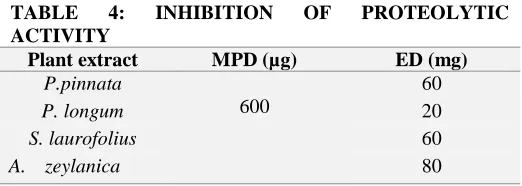
The venom induced proteolytic activity was determined by modifying the qualitative test used to screen proteolytic activity of microbes. The minimum proteolytic activity was defined as the amount of venom which produced clear zone of casein precipitation. The proteolytic activity of venom was effectively antagonized by all the plant extracts tested. The ED values of the plant extracts are mentioned in Table 4.
TABLE 4: INHIBITION OF PROTEOLYTIC
ACTIVITY
Plant extract MPD (µg) ED (mg)
P.pinnata
600
60
P. longum 20
S. laurofolius 60
A. zeylanica 80
Inhibition of phospholipase A2 activity:
Phospholipase activity was measured using indirect hemolytic assay on agarose-erythrocytes-egg yolk gel plate. Minimum indirect hemolytic dose was determined by applying increasing doses (10-1000µg) of venom in the wells made in the agarose-gels. 200µg of Russell‟s viper venom produced 11.2 mm hemolytic halo. This shows that Russell‟s viper venom has phospholipase A2 enzyme which has the ability to cause lysis of human RBC's. The various plant extracts tested have shown good inhibition of this enzyme activity in a dose dependant manner. The ED values of the plant extracts are mentioned in Table 5.
TABLE 5: INHIBITION OF PHOSPHOLIPASE A2 ACTIVITY
Plant extract MIHD(µg) ED (mg)
P.pinnata
200
20
P.longum 100
S.laurifolis 60
A. zeylanica 40
All these plant extracts showed significant potential in inhibiting the venom induced activities in plasma and blood. This experimental work also successfully proved the effectiveness of combination therapy or polyhedral formulation, the area which is not yet extensively ventured, but has been an old practice of ayurvedic medicine. Some plant extracts showing significant anti venom potential, when mixed with other extracts in
suitable proportion displayed increased anti venom activity. These combinations have the potential to be formulated as effective drugs against envenomation after assessing its neutralization effect in pre-clinical and clinical studies. The so-called „secondary metabolites‟ which are present in plants can be held responsible for the neutralizing effect of plants against the action of snake venoms, in popular use. Pongamia pinnata was found to be most effective against all tested pharmacological activities of Daboiarusselii venom followed by
Piper longum. The plants showed anti venom
potential at concentrations below the CC50 value of respective plants. It is noteworthy that these studies were performed using the crude extracts and thus an increase in the extent of activity can be expected with the use of highly purified extracts or isolated constituents.
CONCLUSION: Results of the present study conducted on the few important in vitro activities of venom reveal the presence of antivenom principles in the methanolic extracts of Pongamia pinnata, Piper longum, Sapindus laurifolius and Adhatoda zeylanica. The efficacy of these extracts also justifies the traditional use of herbal extracts in the treatment of snake bite. However, further research including the isolation of antivenom compounds and in vivo assays is needed to establish these plants as a remedy for snakebite.
ACKNOWLEDGMENTS: The authors would
like to thank the Haffkine Institutes for Training, Research and Testing for providing laboratory facilities and funding for this research work.
REFERENCES:
1. WHO Guidelines for Production, Control and regulations of snake antivenom immunoglobulin adopted by the WHO Expert Committee on Biological Standardization at its 59th meeting which took place in Geneva from 13 to 17 October 2008. Published in 2010.
2. Abhijit D. and Jitendra N. D: Psychopharmacology of anti ophidian botanicals: A review. International journal of pharmacology 2012; 8(2): 62-79.
3. P. Dzomba, D. Shasha, T. Chayamiti, G. Murambasvina, N. Mudavanhu Rationale Behind the Use of Temnocalyx Obovatus Roots as Antivenins Against Snakebites in Primary Health Care American Journal of Phytomedicine and Clinical Therapeutics 2013;1(1): 098-106
4. B. Kalyan, S. S. Nanda, P. Venkateshwarlu, Y. Kiran, and R. T. Jadhav: Antisnake venom serum ( ASVS ) 2010; 1(3): 76–89. 5. Anabolicminds Archive, “Beginners Guide to Soxhlet extraction”,
[image:5.612.43.304.206.299.2]6. A. Gomes, R. Das, S. Sarkhel, R. Mishra, S. Mukherjee, S. Bhattacharya, and A. Gomes: Herbs and herbal constituents active against snake bite. Indian journal of experimental biology 2010; 48(9) : 865–78.
7. Behera Saiprasanna, S. Manohar Babu, Y. Roja Ramani: Phytochemical investigation and study on Antioxidant properties of Pongamia pinnata hydro-alcoholic leaf extract. Plant Sciences Feed 2012; 2 (5): 74-78
8. S.Khaleel Basha , G.sudarsanam. Traditional Use of Plants against Snakebite in Sugali tribes of Yerramalais of Kurnool district, Andhra Pradesh, India Asian Pacific Journal of Tropical Biomedicine (2012): 575-579.
9. Inder Kumar Makhija, Devang Khamar: Anti-snake venom properties of medicinal plants”, Der Pharmacia Lettre, 2013 2(5): 399-411.
10. Kanojia Anita Chaudhari K.S. Gothecha V.K.: Medicinal plants active against snake envenomation. International Journal of Research in Ayurveda and Pharmacy 2012: 3(3): 363-366. 11. Anas Ahmed, K. Rajendaran, Durga Jaiswal: Anti-snake venom
activity of different extracts of Pouzolzia indica against Russell’s viper venom. International Journal of Chem Tech Research, 2010; 2 (1): 744-751.
12. Yao Lu, Teng-Jin Knoo, Christophe Wiart. Phytochemical Analysis and Antioxidant Activity Determination on Crude Extracts of Melodinus eugeniifolus Barks and Leaves from Malaysia Pharmacology & Pharmacy, (2014) 5: 773-780. 13. ATCC, MTT Cell Proliferation Assay Instruction Guide: ATCC®
30-1010K. 2011; 306; 1–6.
14. P. Dzomba, D. Shasha, T. Chayamiti, G. Murambasvina, N. Mudavanhu: Rationale behind the Use of Temnocalyx obovatus Roots as Antivenins against Snakebites in Primary Health Care. American Journal of Phytomedicine and Clinical Therapeutics 2013; 1: 098-106.
15. R.D.G. Theakston, D.A. Warrell, E. Griffiths: Erratum to Report of WHO workshop on the standardization and control on antivenoms. Toxicon 2003; 41 (5), 541–557.
16. Nor Azurah Mat Akhir, Lee Suan Chua, Fadzilah Adibah Abdul Majid and Mohamad Roji Sarmidi Cytotoxicity of Aqueous and Ethanolic Extracts of Ficus deltoidea on Human Ovarian Carcinoma Cell LineBritish Journal of Medicine & Medical Research 2011: 1(4): 397-409
17. Pavan Kumar Bellamakondi, Ashok Godavarthi, Mohammed Ibrahim, Seetaram Kulkarni, Ramachandra Naik.M, Maradam Sunitha In Vitro Cytotoxicity of Caralluma Species by MTT and Trypan Blue Dye Exclusion Asian J Pharm Clin Res, 2014;7 (2), 17-19
18. L. YA. Yukelson, G. Tans, M. C. L. G. D. Thomassen, H. C. Hemker and J. Rosing: Procoagulant activities in venoms from central Asian snakes. Toxicon 1991; 29 (4/5): 91-502
19. Steven Fernandez , Wayne Hodgson , Janeyuth Chaisakul, Rachelle Kornhauser, Nicki Konstantakopoulos, Alexander Ian Smith and Sanjaya Kuruppu In Vitro Toxic Effects of Puff Adder (Bitis arietans) Venom, and Their Neutralization by Antivenom.Toxins 2014; 6, 1586-1597
20. S Meenatchisundaram and M.K. Sindhu: In Vivo and In Vitro Studies on Neutralizing Effects of A corus calamus and Withania somnifera root e xtracts against Echis carinatus venom. Iranian Journal of pharmacology and therapetics 2011;10:26–30. 21. M. A. Ibrahim, A.B. Aliyu, A. Abusufiyanu, M. Bashir and A. B.
Sallau: Inhibition of Naja nigrolis (Reinhardt) venom protease activity by Luffa egyptiaca (Mill) and Nicotiana rustica (Linn.) extract. Indian Journal of Experimental Biology 2011; 49: 552-554.
22. Yamara A. S. de Menezes, Juliana Félix-Silva, Arnóbio A. da Silva-Júnior , Ivanise M. M. Rebecchi ,Adeliana S. de Oliveira , Adriana F. Uchoa and Matheus de F. Fernandes-Pedrosa ,Protein-Rich Fraction of Cnidoscolus urens (L.) Arthur Leaves: Enzymatic Characterization and Procoagulant and Fibrinogenolytic Activities Molecules 2014, 19, 3552-3569; 23. J. E. Burke and E. a Dennis: Phospholipase A2 structure/function,
mechanism, and signaling. Journal of lipid research 2009; 50 : 237–242.
24. Inn Ho Tsai: Phospholipases A2 of Asian Snake venoms. Journal of Toxicology and Toxin reviews 1997; 16(3) : 79-1 13
25. Rhiannon Kuchel: Cytoskeleton rearrangements in human red blood cells induced by snake venoms: light microscopy of shapes and NMR studies of membrane function”, Cell Biology International 2012; 36, 87-97.
26. Sarkiyayi S, Sherif B.H. and Godwin A.A: Studies on Antivenom Activities of Ficus Iteophyla MIQ and Borassus Aethiopum Plant Extracts against Naja mossandica Snake Venom. Research Journal of chemical science 2012, 2(9): 1-4.
27. P. Dzomba, D. Shasha, T. Chayamiti, G. Murambasvina, N. Mudavanhu Rationale Behind the Use of Temnocalyx Obovatus Roots as Antivenins Against Snakebites in Primary Health Care American Journal of Phytomedicine and Clinical Therapeutics 2013;1(1): 098-106
28. S. Swaroop and B. Grab Snakebite Mortality in the World. Bull. Org. mond. Sante Bull. and Wld Hlth Org.1954; 10, 35-76. 29. W. B. Mors, M. C. Nascimento, B. M. Pereira, and N. a Pereira:
Plant natural products active against snake bite--the molecular approach. Phytochemistry, 2000; 55(6) : 627–42.
30. H. Noguchi : Snake Venoms- An Investigation of Venomous Snakes. The Carnegie Institution of Washington 1909; 422. 31. Rhiannon Kuchel: Cytoskeleton rearrangements in human red
blood cells induced by snake venoms: light microscopy of shapes and NMR studies of membrane function”, Cell Biology International 2012; 36, 87-97.
32. Jorge Alvarado and José María Gutiérrez. Anticoagulant effect of myotoxic phospholipase2 isolated from the venom of the snake Bothrops asper (Viperidae)Rev. Biol. Trop. 1988; 36 (2B): 563-565.
All © 2013 are reserved by International Journal of Pharmaceutical Sciences and Research. This Journal licensed under a Creative Commons Attribution-NonCommercial-ShareAlike 3.0 Unported License.
This article can be downloaded to ANDROID OS based mobile. Scan QR Code using Code/Bar Scanner from your mobile. (Scanners are available on Google Playstore)
How to cite this article: