IJPSR (2013), Vol. 4, Issue 8 (Research Article)
Received on 07 April, 2013; received in revised form, 02 May, 2013; accepted, 15 July, 2013; published, 01 August, 2013
LEAD FINDING FROM WHOLE PLANT OF CURCUMA LONGA WITH OXIDATIVE POTENTIAL
Sadhana Singh*1, Ashok Kumar Gupta 1, Amit Chattree 1 and Amita Verma 2
Department of Chemistry 1, Department of Pharmaceutical Sciences 2, Faculty of Health Sciences, Sam Higginbottom Institute of Agriculture, Technology and Sciences- Deemed University, Allahabad, Uttar Pradesh, India
ABSTRACT: The present study deals with the antioxidant activity, drug likeness score and bioactivity score of the compounds isolated from Curcuma longa and search lead antioxidant compound through molinspiration software. We have taken ten compounds from this plant. All the compounds were further subjected to molecular properties prediction and drug likeness by Molinspirstion and found in compliance with Lipinski’s rule of five. The compounds IV, V, IX, X fulfill Lipinski’s rule and show good drug likeness score. Milog P of these compounds was found below 5 that means these shows good permeability across cell membrane. TPSA below 160 Ǻ2, n violatios =1 or <0 it means compound easily bind to receptor, molecular mass <500, n rotb < 5 [10], Number of hydrogen bond donors ≤ 5 (The sum of OHs and NHs), Number of hydrogen bond acceptor ≤ 10 (The sum of Os and Ns). Compounds I-X were taken further calculation of bioactivity score by calculating the activity score of GPCR ligand, ion channel modulator, nuclear receptor legend, kinase inhibitor, protease inhibitor, enzyme inhibitor. Our study shows that compound IV α-bisabolol has good drug likeness score with no violations and good bioactivity score as compared to BHT (standard compound). So, compound IV α-bisabolol can be a lead compound with antioxidant activity from Curcuma longa.
INTRODUCTION: Antioxidants are naturally occurring molecules capable of counteracting the damaging effects of oxidation in the body. They are a diverse class of compounds that include nutrients (vitamins, minerals) as well as enzymes (proteins in the body that catalyze reactions) and amino acids, and are believed to play a vital role in preventing the development of many diseases.
QUICK RESPONSE CODE
DOI:
10.13040/IJPSR.0975-8232.4(8).3142-46
Article can be accessed online on:
www.ijpsr.com
DOI link: http://dx.doi.org/10.13040/IJPSR.0975-8232.4(8).3142-46
Free radicals are highly reactive molecules with an odd number of electrons generated from oxygen; they can damage various cellular structures, such as DNA, proteins, and cellular membranes. It is one of the principal theories to explain the cause of aging in the body. In the skin, free radical damage leads to the breakdown of collagen fibers, resulting in skin relaxation and wrinkled appearance. They also may lead to inflammation, which is thought to play an additional role in skin aging. Oxygen is most prevalent element in the earth’s crust. It exists in air as a diatomic molecule. Reactive oxygen species are involved in several disorders. The harmful action of the free radicals can, however, is blocked by antioxidant substances which scavenge the free radicals and detoxify the organism.
Keywords:
Curcuma longa, Antioxidant Activity, Lipinski’s Rule
Correspondence to Author:
Sadhana Singh
Department of Chemistry, Sam Higginbottom Institute of Agriculture, Technology and Sciences- Deemed University, Allahabad, Uttar Pradesh, India
E-mail:
Oxidative stress is considered to play a pivotal role in the pathogenesis of antiaging & several degenerative diseases, such as atherosclerosis, cardiovascular disease, cancer 1, 2. Therefore, plant derived antioxidants are now receiving a special attention. A large number of phenolic compounds present in vegetable, foods, such as fruits and nuts, peanuts, essential oils, aromatic plants have been reported to possess good antioxidant properties 3-4.
Curcuma longa (Turmeric) exhibits antioxidant
activity and protect from free radical damage. Curcumas also exhibits anti-tumor activities and prevent cancer. It inhibits the topoisomerase enzyme, which is required for cancer. Turmeric held a place of honor in Indian traditional Ayurvedic medicine.
In Ayurvedic, it was prescribed for the treatment of many medical problems ranging from constipation to skin diseases. It was used as digestive aid and treatment for fever, inflammation, wounds, infections, dysentery, arthritis, injuries, trauma, jaundice and other liver problems.5
On the basis of literature survey we find many compounds isolated from Curcuma longa as β-bisabolene, linoleic acid, α-selinene, α-bisaboloonel, β-pinene, Curcumin-I, Curcumin II, Curcumin III, Limonene, Carvone etc. In present study we evaluate compounds for antioxidant activity. The objective of our research work was to compare different compounds which are isolated from Curcuma longa with standard compound BHT (butylated hydroxy toluene) on the basis of Lipinski,s Rule and physiological interpretation by Molinspiration software.
MATERIALS AND METHODS:
Lipinski’s Rule: Lipinski's rule of five also known as the Pfizer's rule of five or simply the Rule of five (RO5) is a rule of thumb to evaluate drug likeness or determine if a chemical compound with a certain pharmacological or biological activity has properties that would make it a likely orally active drug in humans. The rule was formulated by Christopher A. Lipinski in 1997. The rule describes molecular properties important for a drug’s
structure is optimized stepwise for increased activity and selectivity, as well as drug like properties. The modification of the molecular structure often leads to drugs with higher molecular weight, more rings, more rotatable bond and a higher lipophilicity. Physicochemical parameters play a vital role in generation and escalation of bioactivity of chemical entity 6.
Molinspiration, web based software 6, 7 was used to obtain parameter such as MiLogP, TPSA, drug likeness. MiLogP (octanol/water partition coefficient) is calculated by the methodology developed by Molinspiration as a sum of fragment based contributions and correction factors and used to predict the permeability of molecule across the cell membrane. The method is very robust and is able to process practically all organic and most organometallic molecules. Molecular Polar Surface Area TPSA is calculated based on the methodology published by Ertl et al. as a sum of fragment based contributions in which O- and N- centered polar fragments are to be considered and calculated by surface areas that are occupied by nitrogen and oxygen atoms and by hydrogen atoms attached to them 8. TPSA has been shown to be a very good descriptor characterizing drug absorption, including intestinal absorption, CaCO2 permeability and
blood brain barrier penetration, bioavailability.
Thus, the TPSA is closely related to the hydrogen bonding potential of a compound. Method for calculation of molecular volume developed at Molinspiration is based on group contributions. Number of Rotatable Bonds – (n rotb) it measures molecular flexibility. It has been shown to be a very good descriptor of oral bioavailability of drugs 9. Rotatable bond is defined as any single non-ring bond, bounded to non-terminal heavy atom.
Orally Lipinski’s rule states:
An octanol-water partition coefficient log P not greater than 5
Not more than 10 hydrogen bond acceptors (nitrogen or oxygen atoms)
Not more than 5 hydrogen bond donors (nitrogen or oxygen atoms with one or more hydrogen atoms)
A molecular mass less than 500 daltons
No more than one number of violations.
Bioactivity Score6, 7, 10: Bioactivity of the drug can be checked by calculating the activity score of GPCR ligand, ion channel modulator, nuclear
receptor legend , kinase inhibitor, protease inhibitor, enzyme inhibitor. All the parameters were checked with the help of software Molinspiration
drug-likeness score online (www.
molinspiration.com). Calculated drug likeness score of each compounds and compared with the specific activity of each compound, and the results were compared with standard drug.
For organic molecules the probability is if the bioactivity score is (>0), then it is active, if (-5.0-0.0) then moderately active, if (< -5.0) then inactive.
RESULT
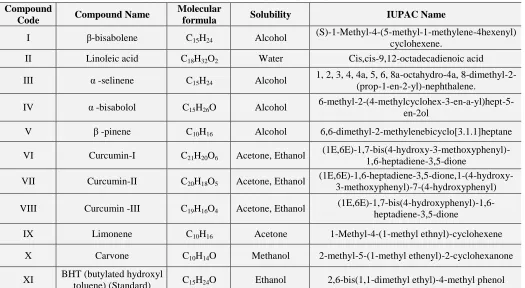
[image:3.612.46.571.316.604.2]Physiochemical properties: The physicochemical properties as molecular formula, solubility of the compounds (I-X) are summarized in Table 1.
TABLE 1: PHYSICO-CHEMICAL PROPERTIES OF THE COMPOUNDS Compound
Code Compound Name
Molecular
formula Solubility IUPAC Name
I β-bisabolene C15H24 Alcohol
(S)-1-Methyl-4-(5-methyl-1-methylene-4hexenyl) cyclohexene.
II Linoleic acid C18H32O2 Water Cis,cis-9,12-octadecadienoic acid
III α -selinene C15H24 Alcohol
1, 2, 3, 4, 4a, 5, 6, 8a-octahydro-4a, 8-dimethyl-2-(prop-1-en-2-yl)-nephthalene.
IV α -bisabolol C15H26O Alcohol
6-methyl-2-(4-methylcyclohex-3-en-a-yl)hept-5-en-2ol
V β -pinene C10H16 Alcohol 6,6-dimethyl-2-methylenebicyclo[3.1.1]heptane
VI Curcumin-I C21H20O6 Acetone, Ethanol
(1E,6E)-1,7-bis(4-hydroxy-3-methoxyphenyl)-1,6-heptadiene-3,5-dione
VII Curcumin-II C20H18O5 Acetone, Ethanol
(1E,6E)-1,6-heptadiene-3,5-dione,1-(4-hydroxy-3-methoxyphenyl)-7-(4-hydroxyphenyl)
VIII Curcumin -III C19H16O4 Acetone, Ethanol
(1E,6E)-1,7-bis(4-hydroxyphenyl)-1,6-heptadiene-3,5-dione
IX Limonene C10H16 Acetone 1-Methyl-4-(1-methyl ethnyl)-cyclohexene
X Carvone C10H14O Methanol 2-methyl-5-(1-methyl ethenyl)-2-cyclohexanone
XI BHT (butylated hydroxyl
toluene) (Standard) C15H24O Ethanol 2,6-bis(1,1-dimethyl ethyl)-4-methyl phenol
Drug likeness calculation on the basis of Lipinski’s rule of five: The drug likeness score was calculated by considering Milog P (partition coefficient), number of heavy atoms, number of hydrogen donor, number of hydrogen acceptor and
TABLE 2: DRUG LIKENESS SCORE FOR COMPOUNDS
S. No. Compd. No. miLogP TPSA N
Atoms n ON N OHNH
n
violation n
rotb. volume MW
1 I 5.46 0.0 15 0 0 1 4 234.878 204.357
2 II 7.583 37 20 2 1 1 15 318.839 282.46
3 III 5.239 0 15 0 0 1 1 229.95 204.357
4 IV 4,679 20.228 16 1 1 0 4 248.229 222.372
5 V 3.329 0.0 10 0 0 0 0 152.369 136.238
6 VI 2.303 93.066 27 6 2 0 8 306.636 338.359
7 VII 2.484 83.832 25 5 2 0 7 368.385 332.182
8 VIII 2.666 74.598 23 4 2 0 6 281.09 308.333
9 IX 3.615 0.0 10 0 0 0 1 157.296 136.238
10 X 2.513 17.071 11 1 0 0 1 159.478 150.221
11 XI (standard) 5.435 20.228 16 1 1 0 2 240.996 220.356
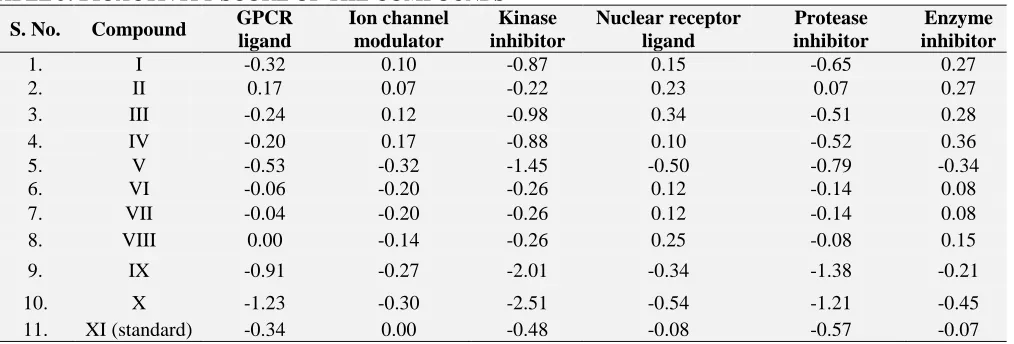
Bioactivity score of the Compounds: The Bioactivity scores of the isolated compounds (I-X) are compared with standard drug on the basis
of GPCR ligand, ion channel modulator, nuclear receptor legend, kinase inhibitor, protease inhibitor, enzyme inhibitor in Table 3.
TABLE 3: BIOACTIVITY SCORE OF THE COMPOUNDS
S. No. Compound GPCR ligand
Ion channel modulator
Kinase inhibitor
Nuclear receptor ligand
Protease inhibitor
Enzyme inhibitor
1. I -0.32 0.10 -0.87 0.15 -0.65 0.27
2. II 0.17 0.07 -0.22 0.23 0.07 0.27
3. III -0.24 0.12 -0.98 0.34 -0.51 0.28
4. IV -0.20 0.17 -0.88 0.10 -0.52 0.36
5. V -0.53 -0.32 -1.45 -0.50 -0.79 -0.34
6. VI -0.06 -0.20 -0.26 0.12 -0.14 0.08
7. VII -0.04 -0.20 -0.26 0.12 -0.14 0.08
8. VIII 0.00 -0.14 -0.26 0.25 -0.08 0.15
9. IX -0.91 -0.27 -2.01 -0.34 -1.38 -0.21
10. X -1.23 -0.30 -2.51 -0.54 -1.21 -0.45
11. XI (standard) -0.34 0.00 -0.48 -0.08 -0.57 -0.07
DISCUSSION: The compounds IV, V, IX, X fulfill Lipinski’s rule and show good drug likeness score (Table 2). Milog P < 5. TPSA< 160 Ǻ2, n
violations = 0 it means compound easily bind to receptor, molecular mass <500, n rotb < 5, No. hydrogen bond donors ≤ 5 (The sum of OHs and NHs), No. hydrogen bond acceptor ≤ 10 (The sum of Os and Ns). Compound I - X were taken further calculation of bioactivity score from Table 3. Compounds IV, V, IX, X showed good bioactivity score. Compound IV (α-bisabolol) showed good drug likeness score and bioactivity score, on comparison with other compounds.
CONCLUSION: Comparing drug likeness score and bioactivity score of compounds (I-X), Compound IV (α-bisabolol), in respect of standard
ACKNOWLEDGEMENT: We are thankful to Department of Chemistry, Sam Higginbottom Institute of Agriculture Technology and Sciences – Deemed University for providing necessary facilities.
REFERENCES:
1. Battu GR, Veda PG, Swathi PK, Chandrika, Rao VA , et al. Evaluation of antioxidant and anti-inflammatory activity of
Euphorbeaheyneana Spreng. Asian Pac. J Trop Bio Med 2011; S191-4
2. Saha P, Mazumder UK, Haldar PK, Naskar S, Kundu S, Bala A, et.al. Anticancer activity of methanol extract of
Cucurbita maxima against Ehrlich ascites carcinoma. Int J Res Pharm Sci 2011; 2(1):52-59.
3. Kim HJ, Chen F, Wang Xi, Cheng HY, Zhengyn J. Evaluation of antioxidant activity of Vetiveriazizanioides L.
5. Lal J, Turmeric, Curcumin and our life : A Review .Bull.Envior.Pharmacol.LifeSci. 2012; 7:11-17.
6. Verma A, Lead finding from Phyllanthus debelis with hepatoprotective potentials. Asian Pacific Journal of Tropical Biomedicine 2012;S1735-S1737
7. Molinspiration cheminformatics [homepage on the internet], Novaulica, SK-900 26 Slovensky Grob, Slovak Republic; [cited 2012 July3], Available from http://www.molinspiration.com.
8. Ertl P, Rohde B, Selzer P. Fast Calculation of Molecular Polar Surface Area as a Sum of Fragment-Based Contributions and Its Application to the Prediction of Drug
Transport Properties J. Med.Chem 2000: 43 (20);3714-3717.
9. Veber DF, Johnson SR, Cheng HY, Smith BR, Ward KW, Kopple KD. Molecular Properties That Influence the Oral Bioavailability of Drug Candidates J. Med. Chem. 2002 :45(12); 2615-2623.
10. Lipinski CA, Lombardo F, Dominy BW, Feeney PJ. Experimental and computational approaches to estimate solubility and permeability in drug discovery and development settings Adv. Drug Delivery Rev. 1997: 23 (1-3); 3-25.
All © 2013 are reserved by International Journal of Pharmaceutical Sciences and Research. This Journal licensed under a Creative Commons Attribution-NonCommercial-ShareAlike 3.0 Unported License.
This article can be downloaded to ANDROID OS based mobile. Scan QR Code using Code/Bar Scanner from your mobile. (Scanners are available on Google Playstore)
How to cite this article: