IJPSR (2012), Vol. 3, Issue 11 (Research Article)
Received on 01 August, 2012; received in revised form 03 September, 2012; accepted 29 October, 2012
INFLUENCE OF FORMULATION VARIABLES ON THE IN VITRO DISSOLUTION OF GUM DAMAR BASED MATRIX TABLETS
J. Lakshmi Prasanna*, B. Deepthi and N. Rama Rao
Department of pharmaceutics, Chalapathi Institute of Pharmaceutical Sciences, Lam, Guntur- 522034, Andhra Pradesh, India
ABSTRACT
The objective of the study was to examine the influence of two variables, concentration of the matrixing agent and diluent on the release of diclofenac sodium from hydrophobic matrix tablets. A 32 full factorial design was employed to optimize drug release profile. Concentration of the hydrophobic matrixing agent (X1) and type of diluent (X2) were taken as independent variables. The dependent variables selected were percentage drug release at 3h, 6h, 9h, time required for 50% drug release and zero order rate constant. Matrix tablets were evaluated for hardness, friability, weight variation and in vitro drug release. Polynomial equations and response surface plots were generated for all dependent variables. It was observed that all the factors had significant contribution on all dependent variables.
INTRODUCTION:Oral route of administration has been received more attention in the pharmaceutical field because of the more flexibility in the designing of dosage form than drug delivery design for other routes 1. In pharmaceutical CRDDS, matrix based systems are the most commonly used type of release controlling methodology owing to their simple manufacturing process, level of reproducibility, stability of the raw materials and dosage forms as well as ease of up operation and also resistant to dose dumping. These systems improve patient compliance and decreased adverse drug reactions 2.
Natural gums are promising biodegradable polymeric materials. The fact for increase in importance of natural plant based material is that plant resources are renewable and if cultivated or harvested in a sustainable manner, they can provide a constant supply of raw materials 3. Many natural polymeric materials have been successfully used in
sustained-Gum damar is a hard resin collected by tapping trees from Shorea spp. (including S. javanica, S. lamellata, S. retinodes), Dipterocarpaceae from South-East Asia, including Malay & Indonesian archipelagos. Damar gum is a triterpenoids resin, containing a large number of triterpenes and their oxidation products. Many of them are low molecular weight compounds (Dammarane, Dammarenolic acid, Oleanane, Oleanonic acid, etc), but dammar also contains a polymeric fraction, composed of polycadinene.
Their main use is in the manufacture of paper or wood varnishes and lacquers, particularly as a varnish for the fine art, and some paints.
Correspondence to Author: J. Lakshmi Prasanna
Department of Pharmaceutics, Chalapathi Institute of Pharmaceutical Sciences, Lam, Guntur- 522034, Andhra Pradesh, India
E-mail: [email protected]
Keywords: Gum damar,
Diluent, Response surface design,
Matrix tablets
QUICK RESPONSE CODE
IJPSR:
ICV (2011)- 5.07
Website:
It is a water- resistant coating, sometimes also used for its glazing functionality, and found in the indigenous system of medicine 4.A few works were reported on gum dammar using it as a matrixing agent for sustained release 5, 6.
Diclofenac sodium is one of the potential NSAIDS which is commonly used as an anti-inflammatory, analgesic and anti-pyretic. It is used for the long term symptomatic treatment of several alignments such as osteoporosis, rheumatoid arthritis, ankylosing spondolitis. Diclofenac is rapidly and completely absorbed after oral administration and peak plasma concentration is reached within 2-3 hr. it undergoes extensive first pass metabolism; hence only 50% of Diclofenac is available systemically. Its half-life in plasma is 1-2 hr. It is also used for acute musculo skeletal injury, acute painful shoulder post-operative pain; dysmenorrheal 7-9. From several investigations, it was found that diclofenac sodium was feasible for the development of sustained release formulation.
MATERIALS: Diclofenac is obtained as a gift sample from Hetero Drugs, Hyderabad. Gum Damar (GD) is procured from Girijan co-operastive corporation, Vizag. All other ingredients are of analytical grade.
METHODS:
Preparation of Matrix Tablets: Diclofenac sodium matrix tablets were prepared by wet granulation method. Diclofenac sodium (100mg) was blended with appropriate quantities of GD (5%, 10% and 15%) and diluents (lactose, starch and MCC). This Premix blend was wet granulated with 3% w/v solution of PVP K-90. The wet mass was passed through No.10 sieve. The wet granules were air dried at for 1 hour and the dried granules were sieved through No. 16 sieve.
The granules were dried and passed through mesh no: 16. Granules were evaluated for angle of repose bulk density (BD) and tapped density (TD). Carr’s index (CI) and Hausner’s ratio were calculated using following equations 10 after evaluation These granules were blended with lubricating agents (1% w/w magnesium stearate and 1% w/w talc) and compressed using 16 station rotary punching machine, equipped with flat-faced, round punches of 8-mm diameter.
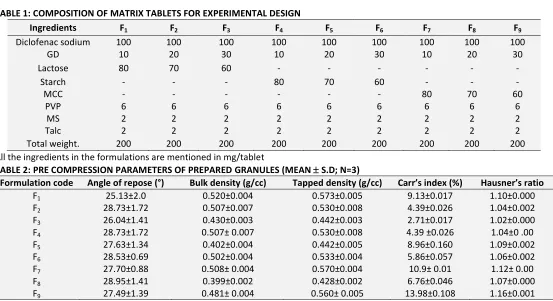
Composition of the matrix tablets and the pre compression parameters of the granules were given in the Table 1 and 2 respectively.
Hausner’s Ratio= TD BD %CI = TD-BD x 100
[image:2.612.32.585.447.748.2]TD
TABLE 1: COMPOSITION OF MATRIX TABLETS FOR EXPERIMENTAL DESIGN
Ingredients F1 F2 F3 F4 F5 F6 F7 F8 F9
Diclofenac sodium 100 100 100 100 100 100 100 100 100
GD 10 20 30 10 20 30 10 20 30
Lactose 80 70 60 - - - -
Starch - - - 80 70 60 - - -
MCC - - - 80 70 60
PVP 6 6 6 6 6 6 6 6 6
MS 2 2 2 2 2 2 2 2 2
Talc 2 2 2 2 2 2 2 2 2
Total weight. 200 200 200 200 200 200 200 200 200
All the ingredients in the formulations are mentioned in mg/tablet
TABLE 2: PRE COMPRESSION PARAMETERS OF PREPARED GRANULES (MEAN S.D; N=3)
Formulation code Angle of repose (°) Bulk density (g/cc) Tapped density (g/cc) Carr’s index (%) Hausner’s ratio
Experimental Design: A 32 factorial design was employed to study the effect of the gum and their concentration on the release rate of diclofenac sodium matrix tablets. The levels of the two factors were selected on the basis of the preliminary studies carried out before implementing the factorial design. The percent of drug release in 3rd h (Q3), 6th h (Q6), 9th h (Q9), time to release 50% drug (t50%) and zero order rate constant (K0) were taken as response variables. The factors, levels and the experimental runs with their factors combination were given in Table 3 and 4
respectively.
The response surface graphs and mathematical models were obtained from DOE software.
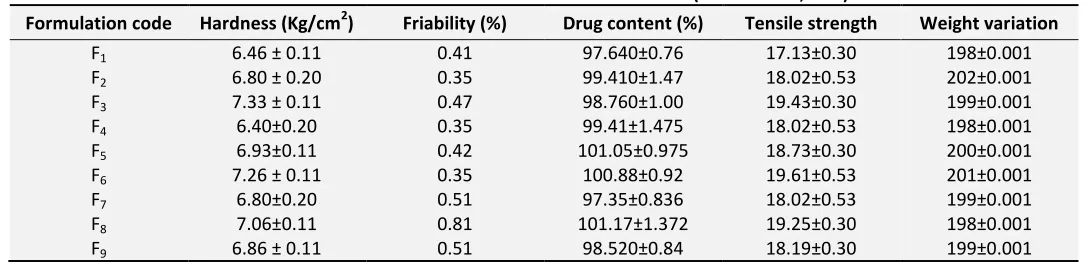
Determination of Hardness, Friability and Drug Content: The prepared matrix tablets were evaluated for hardness, friability, thickness, uniformity of the weight and content uniformity. Hardness was determined by using Pfizer hardness tester. Friability was determined using Roche friability testing apparatus. Thickness was measured using Vernier calipers. Uniformity of the weight and content uniformity were performed according to the I.P. method 11, 12 (see table 5).
TABLE 3: FACTORS AND LEVELS OF THE EXPERIMENTAL DESIGN
Factor/ Level -1 0 +1
X1 (Concentration of the gum) 5% 10% 15%
X2 (type of diluent) Lactose Starch MCC TABLE 4: DISSOLUTION CHARACTERISTICS OF FORMULATIONS IN A 32 FULL FACTORIAL DESIGN
Trail no. Formulation code Coded factor levels Percentage drug released Zero order
rate constant T50
X1 X2 Q3 Q6 Q9
1 F1 -1 -1 14.53 47.8 73.35 5.974 8.36
2 F2 0 -1 9.66 30.6 51.66 3.881 12.88
3 F3 1 -1 3.73 13.52 22.95 2.177 22.96
4 F4 -1 0 21.51 68.41 96.65 10.84 4.61
5 F5 0 0 7.35 59.47 81.52 8.89 5.62
6 F6 1 0 5.05 40.71 72.59 7.17 6.97
7 F7 -1 1 29.06 79.25 99.47 11.75 4.25
8 F8 0 1 19.48 75.7 92.91 10.52 4.75
[image:3.612.34.579.469.601.2]9 F9 1 1 11.44 40.82 69.88 7.14 7
TABLE 5: PHYSICAL CHARACTERISTICS AND DRUG CONTENT OF THE MATRIX TABLETS (MEAN S.D; N=3)
Formulation code Hardness (Kg/cm2) Friability (%) Drug content (%) Tensile strength Weight variation
F1 6.46 ± 0.11 0.41 97.640±0.76 17.13±0.30 198±0.001 F2 6.80 ± 0.20 0.35 99.410±1.47 18.02±0.53 202±0.001 F3 7.33 ± 0.11 0.47 98.760±1.00 19.43±0.30 199±0.001
F4 6.40±0.20 0.35 99.41±1.475 18.02±0.53 198±0.001
F5 6.93±0.11 0.42 101.05±0.975 18.73±0.30 200±0.001 F6 7.26 ± 0.11 0.35 100.88±0.92 19.61±0.53 201±0.001
F7 6.80±0.20 0.51 97.35±0.836 18.02±0.53 199±0.001
F8 7.06±0.11 0.81 101.17±1.372 19.25±0.30 198±0.001 F9 6.86 ± 0.11 0.51 98.520±0.84 18.19±0.30 199±0.001
Drug Release Studies: The in vitro drug release studies were assessed by USP type II dissolution apparatus (paddle method) at 50 rpm in 900 ml of 0.1N HCl for first 2 hours and the phosphate buffer pH 6.8 from 3 to 10 hours, maintained at 37°C ± 0.5°C. An aliquot (5ml) was withdrawn at specific time intervals and replaced with the same volume of pre warmed (37°C ± 0.5°C) fresh dissolution medium.
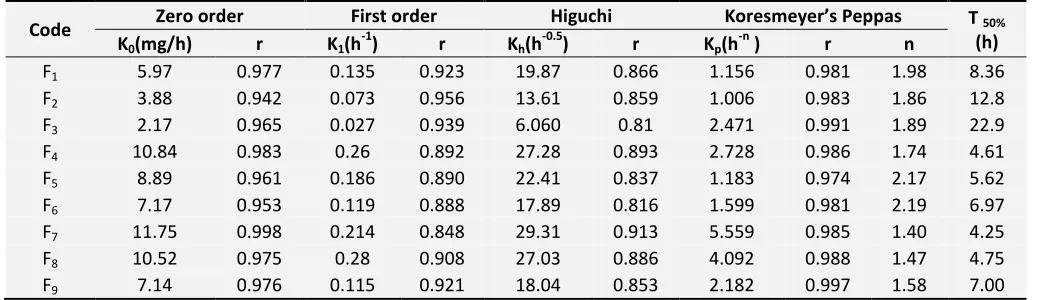
Release Kinetics: To analyze the mechanism of drug release from the matrix tablets, the release data was fitted into various mathematical models viz., Zero order, first order and Higuchi equation 13. The dissolution data was also fitted to the well-known experimental equation (Koresmeyer’s Peppas equation), which is often used to describe the drug release behavior from polymer systems 14.
log(Mt/Mf)= logk + nlog t
Where, Mt is the amount of drug release at time t, Mf is the amount of drug release after infinite time; K is a release rate constant incorporating structural and geometrical characteristics of the tablet and n is the differential exponent indicative of the mechanism of drug release.
To clarify the release exponent for the different batches of matrix tablets, the log value of %drug was plotted against log time for each batch according to the equation 4. A value of n=0.45 indicates Fickian (case I) release; >0.45 but <0.85 for non Fickian (anomalous) release; > 0.89 indicates super case II type of release. Case II gradually refers to the erosion of the polymeric chain and anomalous transport (non- Fickian) refers to a combination of both diffusion and erosion controlled drug release 15. Mean dissolution time (MDI) was calculated for dissolution data using the following equation 16.
[image:4.612.48.569.307.457.2]Where n= release exponent and K= release rate constant.
TABLE 6: MATHEMATICAL MODELLING OF MATRIX TABLETS
Code Zero order First order Higuchi Koresmeyer’s Peppas T 50%
(h) K0(mg/h) r K1(h-1) r Kh(h-0.5) r Kp(h-n ) r n
F1 5.97 0.977 0.135 0.923 19.87 0.866 1.156 0.981 1.98 8.36 F2 3.88 0.942 0.073 0.956 13.61 0.859 1.006 0.983 1.86 12.8 F3 2.17 0.965 0.027 0.939 6.060 0.81 2.471 0.991 1.89 22.9 F4 10.84 0.983 0.26 0.892 27.28 0.893 2.728 0.986 1.74 4.61 F5 8.89 0.961 0.186 0.890 22.41 0.837 1.183 0.974 2.17 5.62 F6 7.17 0.953 0.119 0.888 17.89 0.816 1.599 0.981 2.19 6.97 F7 11.75 0.998 0.214 0.848 29.31 0.913 5.559 0.985 1.40 4.25 F8 10.52 0.975 0.28 0.908 27.03 0.886 4.092 0.988 1.47 4.75 F9 7.14 0.976 0.115 0.921 18.04 0.853 2.182 0.997 1.58 7.00
Experimental Design Data Analysis: The effect of formulation variables on the response variables were statically evaluated using a commercially available software package design of Experiments® 8.0 (design expert). The fitting of an empirical polynomial equation to the experimental results facilitates the evaluation of the responses. The general polynomial equation is as follows:
Y = b0 + b1 X1 + b2 X2 + b12 X1 X2 + b11 X12 + b22 X22 Where Y is the dependent variable, b0 is the arithmetic mean response on nine runs and b1 is the estimated coefficient for factor X1. The main effects (X1, X2) represent the average values of changing one factor at a time from its low to high value. The interaction terms (X1X2) show how the response changes when two factors are changed simultaneously.
The polynomial terms (X12 and X22) are included to investigate nonlinearity.
RESULTS AND DISCUSSIONS: The granules of
diclofenac sodium matrix tablets were prepared by wet granulation method according to the formula given in Table 1. The formulation blends were characterized with respect to angle of repose, BD and TD. The angle of repose was less than 29° indicates satisfactory flow behavior. Physical characteristics of the prepared granules were given in Table 2.
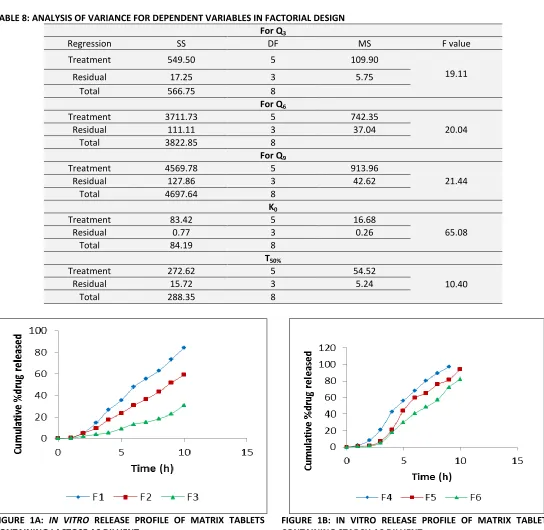
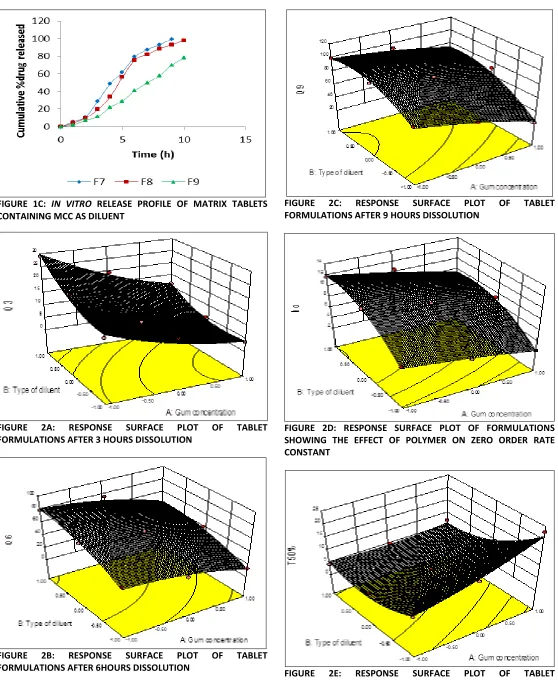
The drug content was found to be uniform for all the batches of tablets prepared and was found to be within 99±2% of labeled claim. The tensile strength of the tablet ranges from 17.13 – 19.43. Evaluation data of the matrix tablets were given in Table 5. The hardness and friability values indicated good handling properties of the prepared matrix tablets. The prepared matrix tablets were also studied to in vitro drug release studies. Table 6 indicates the data analysis of release profiles according to different kinetic models. Drug release from the matrix tablets was found inversely proportional to the concentration the gum and depends on type of diluent. The drug release fitted zero order kinetics and mechanism of release is by diffusion. The dissolution profile of matrix tablets was depicted in Figures 1 (A- C).
In vitro release data obtained from formulations prepared were fitted to multiple linear regression analysis. The factors selected are concentration the gum (5%, 10% and 15%) and type of diluent (lactose, starch and MCC). The responses selected are drug release at 3rd h (Q3), 6thh (Q6), 9th h (Q9), t50% and K0. Mathematical relationships generated using multiple linear regression analysis (MLRA) for the studied response variables are expressed as Equations and were given below. The regression coefficients are given in Table 7.
Q3 = +9.93 -7.48X1 + 5.3 X2 -1.70 X1X2 + 2.06X12 + 3.35X22 Q6 = +60.76 -16.74X1 +17.31X2 -1.04X1X2 -6.84X12 - 8.25X22
Q9 = +85.51-17.34X1 + 19.05X2 + 5.20X1X2 - 2.88X12 -15.22X22
K0 = +9.14 -2.01X1 +2.90X2 -0.20X1X2 - 0.26 X12 -2.06X22 T50% = +4.88 +3.29X1 -4.70X2 -2.96X1X2 +1.28 X12 + 4.30 X22
The high levels of correlation coefficients for the dependent variables indicate a good fit i.e., good agreement between the dependent and independent variables. The polynomial equation can be used to draw a conclusion after considering the magnitude of the coefficient and the mathematical sign it carries (positive or negative).
Positive sign before a factor in polynomial equations represents that the response increases with the factor, while a negative sign means the response and factors have reciprocal relation.
From the equations it was quite clear that the release of drug from matrix tablets had negative effect on the concentration of the gum (X1) and positive effect on the type of diluent (X2). The results indicated that Q3 is mainly based upon the X1 compared to X2. The release of drug in 6h, 9h and t50% mainly based upon the X2 compared to X1 and zero order rate constant depends on the both independent variables. It is indicating that the release of the drug from the dosage form initially depends upon concentration of gum and finally on type of diluent.
The quadratic models generated by regression analysis were used to construct 3D response surface plots in which rsponse parameter was generated by a curvature surface as a function of independent variable. Figure 2(A – E) show the effect of the two factors on the drug release at 3h, 6h and 9h, t50% and K0. Fig. 2 depicts a curvilinear relationship for the responses. This can be attributed to the potential occurrence of interaction between the two independent variables at the corresponding factor levels, construing that each independent variable is tending to modify the effect of another towards the release of diclofenac sodium.
Concentration of the gum has synergistic effect on Q3, Q6, Q9, K0 and antagonistic effect on t50% whereas type of diluent has antagonistic effect on the Q3, Q6, Q9, and K0 with decrease in the drug release and synergistic effect on t50%. The rate diclofenac sodium release was related inversely to the concentration of the gum in all the studied responses suggesting that the concentration of the gum along with the type of diluent was the most effective factor in controlling the drug release.
TABLE 7:SUMMARY OF THE REGRESSION OUTPUT OF SIGNIFICANT FACTORS FOR THE MEASURED RESPONSES
Parameters Coefficients of regression parameters
b0 b1 b2 b12 b11 b22 R2
Q3 9.93 -7.48 5.3 -1.70 2.06 3.35 0.9696
Q6 60.76 -16.74 17.31 -1.04 -6.84 -8.25 0.9709 Q9 85.51 -17.34 19.05 5.20 -2.88 -15.22 0.9728
K0 9.14 -2.01 2.90 -0.20 -0.26 -2.06 0.9909
[image:6.612.30.561.83.678.2]T50% 4.88 3.29 -4.70 -2.96 1.28 4.30 0.9455
TABLE 8: ANALYSIS OF VARIANCE FOR DEPENDENT VARIABLES IN FACTORIAL DESIGN For Q3
Regression SS DF MS F value
Treatment 549.50 5 109.90
19.11
Residual 17.25 3 5.75
Total 566.75 8
For Q6
Treatment 3711.73 5 742.35
20.04
Residual 111.11 3 37.04
Total 3822.85 8
For Q9
Treatment 4569.78 5 913.96
21.44
Residual 127.86 3 42.62
Total 4697.64 8
K0
Treatment 83.42 5 16.68
65.08
Residual 0.77 3 0.26
Total 84.19 8
T50%
Treatment 272.62 5 54.52
10.40
Residual 15.72 3 5.24
Total 288.35 8
FIGURE 1A: IN VITRO RELEASE PROFILE OF MATRIX TABLETS CONTAINING LACTOSE AS DILUENT
[image:6.612.33.577.143.673.2]FIGURE 1C: IN VITRO RELEASE PROFILE OF MATRIX TABLETS CONTAINING MCC AS DILUENT
FIGURE 2A: RESPONSE SURFACE PLOT OF TABLET FORMULATIONS AFTER 3 HOURS DISSOLUTION
FIGURE 2B: RESPONSE SURFACE PLOT OF TABLET FORMULATIONS AFTER 6HOURS DISSOLUTION
FIGURE 2C: RESPONSE SURFACE PLOT OF TABLET FORMULATIONS AFTER 9 HOURS DISSOLUTION
FIGURE 2D: RESPONSE SURFACE PLOT OF FORMULATIONS SHOWING THE EFFECT OF POLYMER ON ZERO ORDER RATE CONSTANT
CONCLUSION: Study indicates that release of diclofenac sodium from gum dammar based matrix tablets highly depends on type of diluent along with the concentration of the gum. However, in developing SR formulations with gum damar containing DS, it has been shown that higher release rates are observed with matrix tablets containing MCC as diluent whereas lactose with gum damar provides a better result. In addition, better results have been seen with higher concentrations of gum with starch and MCC. The calculated release exponents (n values) and rate constants (K values) indicated the release behavior of all the formulations was super case II transport mechanism with zero order kinetics. Response surface methodology was an important tool for understanding the change of responses and effect of formulation variables.
ABBREVIATIONS:
CRDDS = Controlled drug delivery system. NSAID = Non-steroidal anti-inflammatory drug. GD = Gum Damar. MCC = Micro crystalline cellulose. BD = Bulk density. TD = Tapped density. CI = Carr’s index.
ACKNOWLEDGEMENTS: The authors are thankful to Chalapathi Institute of Pharmaceutical Sciences for providing facilities for bringing out this work.
REFERENCES:
1. Hegde DD, Nagarsenker MS and Gardd SD: Design and evaluation of extended release tablets of prochlorperazine maleate. Indian Drugs2001; 38(2):69-70.
2. Banker GS and Rhodes CT: Modern Pharmaceutics. Marcel Dekker Inc., New York, Edition 4, 2002: 505 – 507.
3. Perepelkin KE: Polymeric materials of the future based on renewable plant resources and biotechnologies: Fibres, films, plastics. Fibre Chem2005; 37: 417-30.
4. http://www.starlightproducts.com.
5. Morkhade DM, Fulzele SV, Satturwar PM and Joshi SB: Gum copal and gum dammar: novel matrix forming materials for sustained drug delivery. Indian J. pharm. Sci.2006; 68 (1): 53-58.
6. Morkhade DM and Joshi SB: Evaluation of gum dammar as a novel microencapsulating material for ibuprofen and diltiazem hydrochloride. Indian J. pharm. Sci.2007; 69(2): 263-268. 7. Hardman JG, Limbird LE and Gillman AG: Goodman and
Gillman’s: The pharmacological basis of theraupeutics. Mc.Graw-Hill medical publishing division, Edition 10: 709. 8. Swectman SC: Martindale: the complete drug reference.
Pharmaceutical press, Masachusetts, Edition 36, 1999: 44. 9. Chlao CSL and Robinson JR: Remingtons Pharmaceutical
Sciences. Mack Publishing Company, Pennsylvania, Edition 20, 1995: 1536.
10. Aulton ME and Wells T.I: Pharmaceutics: The science of Dosage Form Design. London, UK: Churchill Livingstone, 1998: 207. 11. Government of India Ministry of Health and Family Welfare: The
Pharmacopoeia of India. India: Controller of publication, Delhi, 1997: 1020-1022.
12. Leon Lachmann, Lieberman HA and Kanig JL: The Theory and practice of Industrial Pharmacy. CBS publishers and distributors, Special Indian edition, 2009: 297-301.
13. Highuchi T: Mechanism of sustained action medication: Theoretical analysis of rate of release of solid drugs dispersed in solid matrices. Journal of Pharmaceutical Sciences 1963, 52: 1145-1149.
14. Korsmeyer RW, Gurny R, Docler E, Buri P and Peppas NA: Mechanism of solute release from porous hydrophilic polymers. International Journal of Pharmaceutics 1983, 15: 25-35. 15. Peppas NA: Analysis of Fickian and Non-Fickian drug release
from polymers. Pharma Acta Helv. 1985, 60: 110-111.
16. Mockel JE and Lippold BC: Zero order release from hydro-colloid matrices. Pharm Res. 1993, 10: 1066-1070.
How to cite this article:
Prasanna JL, Deepthi B and Rao NR: Influence of Formulation Variables on the in vitro Dissolution of Gum Damar Based Matrix Tablets.