BIROn - Birkbeck Institutional Research Online
Yule, P. and Cooper, Richard P. (2003) Express: a web-based technology
to support human and computational experimentation. Behavior Research
Methods, Instruments, & Computers 35 (4), pp. 605-613. ISSN 0743-3808.
Downloaded from:
Usage Guidelines:
Please refer to usage guidelines at
or alternatively
Birkbeck ePrints: an open access repository of the
research output of Birkbeck College
http://eprints.bbk.ac.uk
Yule, Peter and Cooper, Richard P. (2003).
Express: a web-based technology to support
human and computational experimentation.
Behavior Research Methods, Instruments, &
Computers
35
(4) 605-613.
This is an exact copy of a paper published in
Behavior Research Methods,
Instruments, & Computers
(ISSN 0743-3808). Copyright and all rights therein
are retained by authors or by other copyright holders. All persons
downloading this information are expected to adhere to the terms and
constraints invoked by copyright. © 2003 Psychonomic Society, Inc.
Citation for this copy:
Yule, Peter and Cooper, Richard P. (2003). Express: a web-based technology
to support human and computational experimentation.
London: Birkbeck
ePrints.
Available at:
http://eprints.bbk.ac.uk/archive/00000557
Citation as published:
Yule, Peter and Cooper, Richard P. (2003). Express: a web-based technology
to support human and computational experimentation.
Behavior Research
Methods, Instruments, & Computers
35
(4) 605-613.
http://eprints.bbk.ac.uk
Behavior Research Methods, Instruments, & Computers 2003, 35 (4), 605-613
Many researchers and teachers of research methods now routinely use computer-based experimentation pack-ages to generate and present a wide variety of experiments to participants via standard desktop computer hardware. However, most experiment presentation packages provide limited support for coordinating multiple participants and collating the resulting data. Typically, a data file is gen-erated for each participant, and the experimenter must collect all of these files (often from multiple computers, especially if the experiment is run as part of a laboratory class) and merge those data files, using a utility program supplied with the experiment presentation package. The process of collating data in this manner is laborious, time-consuming, and prone to error. In the case of exper-iments with between-subjects factors, it also requires that the experimenter monitor group sizes and explicitly assign individuals to each group to ensure that group sizes are balanced across conditions.
Perhaps surprisingly, similar issues arise within the field of computational modeling (Yule & Cooper, 2001). Many computational models of cognitive processes con-tain parameters (e.g., learning rate or level of noise) on
which the model’s behavior is dependent, and in these cases model evaluation requires exploring the behavior of the model for different values of the parameters. This is necessary to determine the best fit to the data, to es-tablish independence of behavior from parameters thought to be noncritical, or to determine how the model behaves when impaired (see Plaut & Shallice, 1993, for an ex-tended example of the methodology).
There is a direct correspondence between exploring the behavior of a model for different parameter values and performing a standard psychological experiment with human (or indeed animal) participants. Parameters correspond to between-subjects factors, and different values for the parameters correspond to different levels of those factors. As in a standard experiment, the factors may be ordinal (e.g., degree of connectivity, learning rate, etc.) or categorical (e.g., if alternative mechanisms or subprocesses within a model are being explored), and each run of the model for a given combination of param-eter values may be thought of as corresponding to one experimental participant. The behavior of the model, as in the case of living participants, may be summarized through values of dependent variables, and within-subjects fac-tors may be included in both human and model experi-ments by collecting values of the dependent variables over multiple trials or multiple blocks of trials. Finally, models frequently include random elements that affect their behavior (e.g., noise affecting activation values). In such cases, it is necessary to run the model multiple times for each combination of parameter values, to establish the model’s mean behavior. Running the model Ntimes
605 Copyright 2003 Psychonomic Society, Inc.
We are grateful to John Fox for his continuing support, to David Glasspool and Rachel McCloy for help with testing Express, and to Ulf-Dietrich Reips and William Schmidt for insightful comments on an ear-lier draft of this paper. This research was supported by EPSRC Grant GR/M89621. Correspondence concerning this article should be ad-dressed to P. Yule, School of Psychology, Birkbeck College, University of London, Malet Street, London WC1E 7HX, England (e-mail: p.yule@ bbk.ac.uk).
Express: A Web-based technology to support
human and computational experimentation
PETER YULE and RICHARD P. COOPER
Birkbeck College, Universisty of London, London, England
606 YULE AND COOPER
in this way corresponds to running a group of N partici-pants in the same condition.
There are just two differences between the standard experimental situation and the situation of model evalu-ation: participant type (living participants vs. computer models) and scale (tens or hundreds of participants vs. tens of thousands of model runs). The difference in scale arises because, even with just a few parameters, the space of model instances (i.e., the number of conditions) can quickly become large. For example, if there are just three parameters (e.g., connectivity, learning rate, and noise) having 4, 3, and 10 levels respectively, then 120 (433310) model instances must be explored. With, say, 100 replications for each model instance, we find that we require 12,000 simulations to fully explore the model.
The scale of model evaluation means that thorough evaluation can require massive computing power and can generate several orders of magnitude more data than a standard experiment. With regard to the former, it is not uncommon in the computational literature for models to take weeks or months of processor time to develop and evaluate. Advances in computing technology have not helped reduce this time; rather, they have allowed ever more complex models to be evaluated. It is, therefore, common practice for modelers to run simulations on sev-eral computers simultaneously (when they are available), with each machine exploring a different region of the pa-rameter space. Once all the machines are finished, the results can be collated. This use of multiple machines to speed up model evaluation raises exactly the same issues as those raised by current experiment presentation pack-ages: The modeler must manually allocate machines to regions of the parameter space so that all combinations of parameter values are explored with approximately the same number of simulations (i.e., the modeler must man-ually balance the size of groups for each condition), and when the evaluation is complete, the modeler must man-ually collate the data from the various machines (or write a special purpose computer program to automate the job). The first of these issues can be complicated further by the fact that the available machines may run at differ-ent speeds, so optimizing the assignmdiffer-ent of regions of parameter space to machines in such a way that every-thing is done in the least possible time is nontrivial.
This article describes Express, a Web-based system that automates the coordination of “clients” and the col-lation of the data that they generate. It has a variety of other features, including an experiment design editor, fa-cilities for tabulation of data and export of raw data as text files, a range of common statistical tests, and an ex-tensive help system. In the remainder of this article, the basic client–server model of Express is described. This is followed by a detailed discussion of the capabilities of the Express server and a description of the client–server interface. Two case studies, illustrating use of the server both in a standard experimental setting and as a harness for evaluating a computational model, are then
de-scribed. We conclude by discussing a number of residual issues, including security, system requirements, and the distribution policy.
EXPRESS: A GENERAL CLIENT–SERVER SOLUTION
The Internet provides a means by which the difficul-ties described above may be overcome. The essence of the approach adopted by Express is to treat both human participants interacting through experiment presentation software and computational models as clients that inter-act across the Internet (or across an intranet) with a server. The complete Express system consists of the Ex-press server (a set of programs that run on a standard Web server and respond to Web requests) and an inter-face definition that specifies how clients may interact with the server.
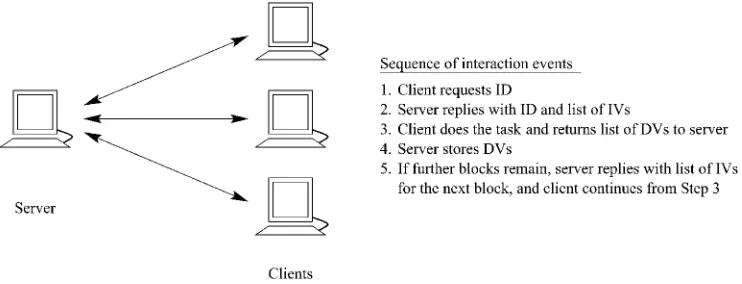
The role of the Express server is to coordinate clients, independently of client type, and collate their results. When a client is run, it begins by querying the server for a set of parameters (typically values of the experiment’s independent variables). It then operates on these param-eters to produce a set of dependent measures (i.e., values for the experiment’s dependent variables). These measures are then returned to the server, which stores them for analysis. In the case of experiments with within-subjects variables (where each client is required to perform under a variety of conditions), the server will return further pa-rameters that define the next experimental condition. Client–server interactions will continue until the client has returned dependent measures for all the conditions. Figure 1 shows this interaction.
At present, two forms of clients are supported by the Express system: HTML/script clients, consisting of a system written in HTML and a browser scripting lan-guage (JavaScript or VBScript), for displaying an inter-face to a (presumably human) participant within a Web browser, and C/C++ clients, consisting of a computer program written in C or C++ and using a C Application Programming Interface (API) to interact with the Ex-press server. This second form of client is particularly useful in computational modeling work, in which the model may be augmented to allow interaction with the Express server. However, it may also be of use for human experiments written within any programming language that allows interface to C. In either case, the server does not know or care whether the clients with which it inter-acts are humans performing a computer-based experi-ment or computer models attempting to simulate human behavior.
A WEB-BASED TECHNOLOGY FOR EXPERIMENTATION 607
the built-in statistical facilities. This has proven to be particularly useful when upward of 20 participants are completing an experiment simultaneously during labo-ratory classes, and real-time monitoring can provide an early indication of a bug in a client or a problem with an experimental design, allowing remedial action to be taken quickly. With respect to cognitive modeling, the client–server system makes large-scale parameter stud-ies, with many parameters and/or levels, more practica-ble than they might otherwise be, since it enapractica-bles the dis-tributed parallel execution of the client on all available processors, to avoid the typically long execution times on single-processor systems.
The use of a client–server architecture is not new in experimental psychology; in fact, it is inherent in Web-based experiment presentation systems (e.g., Birnbaum, 2000; Birnbaum & Wakcher, 2002; Hewson, Yule, Lau-rent, & Vogel, 2003; Reips, 2001; Schmidt, 1997), and several systems of this type are available, such as WEX-TOR (Reips & Neuhaus, 2002),1 and SurveyWiz and FactorWiz (Birnbaum, 2000).2However, to our knowl-edge, none of these systems offers explicit support for modeling applications or even real-time analysis facili-ties. The problem of large-scale parameter manipulation in distributed computing has also been addressed by a number of general purpose systems, such as screensaver supercomputing systems (such as the United Devices toolkit),3and the Grid project.4 None of these systems has support for both human and model participants, since this is a rather specialized requirement of the social and cognitive sciences.
The aim of Express is to provide a general facility for all experimental purposes in the social and cognitive sciences. In principle, Express could even be used as a back endfor existing stand-alone computer-based experiment presenta-tion packages, such as E-Prime (MacWhinney, St. James, Schunn, Li, & Schneider, 2001), ERTS (Beringer, 1994), SuperLab (Haxby, Parasuraman, Lalonde, & Abboud, 1993) and PsyScope5 (Cohen, MacWhinney, Flatt, &
Provost, 1993); interfaces for these systems may be de-veloped in future work.
In the case of cognitive modeling, this generalized ap-proach has an additional methodological advantage: It allows both models and human participants to interact with the same experimenter system. Human and model behavior may be directly compared by declaring client type as a between-subjects factor and allowing clients of both types to perform the same task. This ensures that all the factors of the experimental design (including within-subjects and between-subjects variables, stimu-lus randomization, and dependent measures) are held fixed between the two cases, which in turn ensures max-imum possible comparability between human and model data sets. Several authors (e.g., Anderson & Lebiere, 1998; Ritter, Baxter, Jones, & Young, 2000; Yule & Cooper, 2001) have recently argued that this is an im-portant step in improving the methodology of cognitive modeling.
THE EXPRESS SERVER
The functions of the Express server may be divided into two categories: functions involved in experiment ad-ministration and functions involved in client–server interaction. Express is implemented as a pair of CGI (common gateway interface) server programs, one for each set of functions. Both programs share a set of con-figuration and data files.
The Experiment Administration System
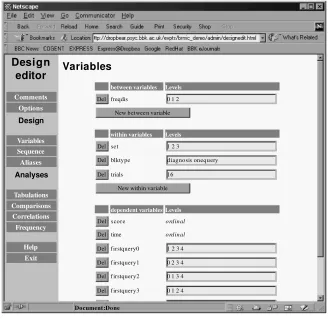
[image:5.532.81.452.53.195.2]The experiment administration system provides Web-based tools for specifying the design of an experiment and for monitoring the experiment while it is being run. The design editor. The design editor appears as a Web page with a series of buttons on the left and one of a number of forms on the right (see Figure 2). The but-tons provide access to the various aspects of the design that may be configured via the editor, and the forms Figure 1. The relation of the server to clients and the sequence of interactions between the two. Clients
608 YULE AND COOPER
allow the experimenter to specify details of those aspects. Specifically, the design elements allow the experimenter to do the following: provide a title and description of the experiment; declare independent (between-subjects and within-subjects) and dependent variables; declare scales and levels for all variable types; define pseudovariables or aliases(defined as functions of real variables); spec-ify the sequential structure of the experiment in terms of blocks of trials and of trial-by-trial variable assignments and materials sequences; specify “include” files (typi-cally containing HTML and JavaScript or VBScript, for use in human Web-based experiments); specify the num-ber of replications in each between-subjects condition (typically used for model-based experiments); and spec-ify various types of tabulations and statistical analyses based on previously declared variables. Information specified through the design editor is stored on the server as a design file. When the experimenter makes a request (e.g., by selecting to view a tabulation) or when a client makes a request (as will be described below), the server program uses the design file to determine how to fulfill the request.
Monitoring: Tabulations and statistical tests. The administration system allows real-time monitoring of an experiment’s progress. The form of this monitoring is
dictated by the tables and statistics specified within the design editor, as has been described above. Tabulations may show means, standard deviations, or other common descriptive statistics and may be defined for multiple in-dependent and in-dependent variables. Statistics functions include a variety of standard parametric and nonpara-metric univariate and multivariate statistical tests. The integrity of these tests has been validated by comparing their results with those of SPSS on a range of test cases. Tables and statistics are recalculated on request, allow-ing the experimenter to monitor results as the experiment progresses. Thus, the experimenter can use a Web browser on one machine to monitor the progress of a class of par-ticipants completing a lab. This may involve monitoring the number of participants who have completed each trial or monitoring trends in the data as they emerge.
Data may be displayed either in the form of HTML ta-bles for human inspection or as tab-formatted plain text for export to commonly used statistical packages and spreadsheets, such as SPSS and Excel.
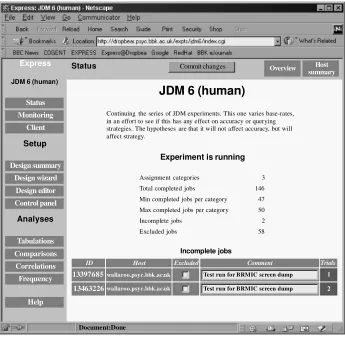
Other administrative functions. Express provides a variety of other administrative functions. These include the following: a status page (see Figure 3), which may be refreshed at any stage to show the progress of an periment and which functions as a front end to the
ex-Design
editor
VariablesDesign
Analyses
Comments Options
Variables Sequence Aliases
Tabulations Comparisons Correlations Frequency
Help Exit
between variables
within variables Levels
Levels
dependent variables Levels
Del freqdis 0 1 2
New between variable
Del set 1 2 3
Del blktype diagnosis onequery
Del trials 16
New within variable
Del score ordinal
Del time ordinal
Del firstquery0 1 2 3 4
Del firstquery1 0 2 3 4
Del firstquery2 0 1 3 4
Del firstquery3 0 1 2 4
[image:6.532.101.429.56.375.2]Document:Done
A WEB-BASED TECHNOLOGY FOR EXPERIMENTATION 609
periment administration system; a design summary page, which summarizes in one place key aspects of the ex-perimental design, such as the number of factors and the levels of each factor; a host summary page to monitor the performance and activity of participating hosts; con-trol functions for creating, copying, deleting, archiving, and renaming experiments (accessed through a special control panel); control functions for initialization of the experiment and starting and stopping execution; a mech-anism for excluding selected participants from the analy-sis (allowing the experimenter to exclude outliers or par-ticipants whose data may be incomplete or otherwise suspect); and a contextual help system that provides doc-umentation on all aspects of the server and that is keyed to automatically load the help text associated with the currently displayed administration page.
Client–Server Interaction
The experiment administration system is comple-mented by a client–server interaction system that re-sponds to client requests. A client is any program that periodically delivers data to the server. As has been
ex-plained above, the data may be generated either by a human participant interacting through a front end that is presenting the experiment or by a computer model or other program using the C API.
The primary functions of the client–server interaction system are to control client access and assign clients to appropriate experimental conditions, to control the se-quence of trials within a client, and to collate data re-turned by clients. Client requests are implemented as HTTP FORMsubmissions. Thus, HTML/script
experi-ments may be implemented using standard HTML FORM
elements or raw URLs. In such cases, the server responds to client requests by generating an HTML page (based on a template provided by the experimenter) containing a list of variable assignments embedded within a script envi-ronment. The API used for server interaction by models and experiments written in C includes functions that en-code and submit client requests, wait for a response from the server, and decode the resulting variable assignments. Participant identifier assignment and access con-trol. Before a client begins an experiment, it should re-quest a participant identifier (PID) from the Express
Document:Done Express
JDM 6 (human)
Status
Setup
Analyses
Incomplete jobs Experiment is running
JDM 6 (human)
Tabulations Comparisons
Correlations Frequency
Help Design summary
Design wizard Design editor Control panel
Status Monitoring
Client
Overview summaryHost Commit changes
Continuing the series of JDM experiments. This one varies base-rates, in an effort to see if this has any effect on accuracy or querying strategies. The hypotheses are that it will not affect accuracy, but will affect strategy.
Assignment categories 3 Total completed jobs 146 Min completed jobs per category 47 Max completed jobs per category 50 Incomplete jobs 2
Excluded jobs 58
ID Host Excluded Comment 13397685
13463226
wallaroo.psyc.bbk.ac.uk wallaroo.psyc.bbk.ac.uk
Test run for BRMIC screen dump Test run for BRMIC screen dump
Trials 1 [image:7.532.93.438.54.393.2]
2
610 YULE AND COOPER
server. The server will respond with a unique identifier code, and a sequence of <Var= Val> pairs specifying lev-els of between- and within-subjects variables. This al-lows the client to begin the experiment.
Between-subjects balancing. If there are between-subjects variables, the server assigns PIDs to each com-bination of levels of these variables (i.e., each between-subjects condition) in a balanced way. When a client requests a new PID, the PID is assigned to the condition that currently has the fewest PIDs assigned to it (or if more than one such condition exists, to a randomly se-lected condition from this set). This method combines randomness of assignment of PIDs to conditions with evenness of assignment and ensures that group sizes are balanced whenever possible.
The participant assignment method is also able to cope with cases in which a between-subjects variable is a natural group variable, rather than an experimenter-assigned variable (e.g., sex). If a client request for a PID specifies a value for one or more between-subjects vari-ables, participant assignment is constrained to the con-ditions defined by those values.
If the experimenter has specified a maximum number of replications in the experimental design and there are no conditions with fewer than this number of completed clients, a request for a new PID will yield a PID of 0 (zero). This indicates that the experiment is complete and that no further clients are required. This mechanism errs on the side of overassignment, in that it continues issuing new (nonzero) PIDs until all replications are com-plete. Replications in progress are discounted. This en-sures that the requested number of replications is met, even if one or more clients fail, for one reason or another, to complete the experiment. However, it can lead to over-assignment, where one or more conditions end up with more replications than requested. If necessary, the par-ticipant exclusion system (as used for excluding outliers or otherwise suspect data) may be applied to rebalance group sizes and exclude any excess replications from all the analyses.
Sequencing. When the client initiates the experiment or submits data (as at the end of a trial), the server must provide the next set of within-subjects variable assign-ments to the client (or a stop signal if there are no further within-subjects assignments for the current client). Each set of variable assignments defines a single trial, and each PID can participate in multiple trials, one after the other. Although between-subjects variable assignments are necessarily constant across trials for the same PID, within-subjects variables are typically varied across trials. Express supports the specification of one or more series of blocks, where each block contains a series of trials. There is full control over within-subjects variable assign-ments both between and within blocks, and different types of trials may be presented in the same block. If desired, trial order can be randomized within each block. Finally, different sequences of blocks can be associated with levels of a between-subjects variable, allowing between-subjects order counterbalancing.
Data collation. When the client submits data, the server saves them as a data record, using the client’s PID to ensure that data records from the same participant are appropriately tagged. The primary mechanism saves the values of declared dependent variables; the built-in tab-ulation and statistics facilities may be configured to use these data as described above. Express also supports a secondary mechanism for saving arbitrary raw or unin-terpreted data.
Restarting client sessions. Sometimes a client ses-sion can be interrupted due to software or hardware error or because a participant inadvertently closes the browser window. Express supports a means of continuing an in-terrupted experiment, provided the original PID is sup-plied. This presents the last, uncompleted trial again, after which the sequence continues as normal. An addi-tional mechanism allows the client to save some state in-formation to the server on each trial, enabling even those clients that maintain their own state information across trials to be restarted properly.
TWO CASE STUDIES
Case Study 1: Harnessing a Standard Experiment
Much of our own empirical work has been concerned with categorization and information-seeking behavior in such tasks as medical diagnosis (e.g., Cooper & Yule, 1999; Cooper, Yule, & Fox, 2003; Yule, Cooper, & Fox, 1998). This work has been supported by successive ver-sions of the Express server, driving a client written in JavaScript and HTML and presented through a standard Web browser.
The experiments have consisted of between four and six blocks, each of between 12 and 20 trials. The participants’ goal was to learn the associations or correspondences be-tween symptom patterns and hypothetical diseases, whose correspondences were generally not deterministic: Symp-toms were typically unreliable indicators of diseases. Two types of block have been used. In one, participants are presented with full information about all the symptoms (i.e., which symptoms are present and which are absent), and they are required to use this information to make their diagnoses. Feedback indicating the correct diagno-sis is then given, allowing them to learn the symptoms for that disease. In the other type of block, participants are given just one presenting symptom (e.g., The patient has headache) and must query additional symptoms (e.g., Is vomiting present?) before making a diagnosis. Again, feedback indicating the correct diagnosis is then given.
A WEB-BASED TECHNOLOGY FOR EXPERIMENTATION 611
is randomized within the row on each trial. Cards are sensitive to mouse clicks, so that clicking on a symptom whose status is unknown reveals that symptom’s status. The lower third of the window contains a randomized row of cards representing diseases, which are also sensi-tive to mouse clicks. The middle panel of the window is reserved for feedback that is provided after the participant makes a diagnosis. Prior to each block, block-specific instructions are presented in the client window.
Different versions of the experiment have used differ-ent independdiffer-ent variables. Between-subjects variables have included the matrix of conditional probabilities of symptoms, given diseases, and the base rates of diseases. Within-subjects variables have included block number (i.e., level of practice) and block type. Dependent vari-ables have included diagnostic accuracy over the block (i.e., the percentage of correct trials in each block), block time, and (in query blocks) the first symptom queried for each presenting symptom.
The design is clearly complex. All of these complexi-ties were programmed through a mix of JavaScript and HTML, with the Express server specifying values of the independent variables on each block and collating val-ues for all the dependent variables.
The experiments were run within a student laboratory class, using the departmental intranet. Over 100 partici-pants completed each experiment, normally in batches of up to 25 participants (using the 25 networked PCs in the lab). The participants generally took between 20 and 30 min to complete the experiment, and the progress of the entire class was monitored throughout the session by the instructors from a further networked PC.
The results of the experiments were interesting in their own right (see Cooper & Yule, 1999; Cooper et al., 2003; Yule et al., 1998), but for present purposes it is the suc-cessful use of the Express server as a harness for the ex-periment that is of primary interest. Most functions of the server were employed, including balancing of participant numbers in each between-subjects condition, sequence control, data collation, and analysis. The monitoring func-tions proved to be particularly useful, allowing the ex-perimenter to see patterns in the data as they emerged and allowing the full dataset to be analyzed and presented to the class (using a standard PC projector attached to a PC showing the relevant Express administration page) as soon as the final participant completed the experiment.
Case Study 2: Harnessing a Computational Model
The use of Express in the evaluation of a computa-tional model is illustrated by our work on modeling ac-tion selecac-tion and its breakdown following neurological damage (Cooper, Schwartz, Yule, & Shallice, 2003). The model consists of three interactive activation networks, with excitatory and inhibitory links between the net-works. A number of parameters govern the activation dy-namics within each network, and additional parameters govern the degree of interaction between the networks. The result is a model with over a dozen parameters, each
ranging in value from zero to one. (See Cooper & Shal-lice, 2000, for a detailed description of an earlier version of the model.) When the model is run, it generates a se-quence of actions. The dependent variables relate to the integrity of that action sequence and include measures of the frequency of different types of action error, in-cluding, for example, omission errors (leaving out a re-quired action) and perseverative errors (repeating an ac-tion or group of acac-tions unnecessarily). The quesac-tions of interest concern the effects of various parameters on the profile of errors produced by the model and the relation of such error profiles to data generated by neurologically impaired individuals (see Schwartz et al., 1998).
The model was originally written in C as a stand-alone application, and initial evaluation used standard tech-niques (i.e., running the model over portions of the pa-rameter space and collating the results manually). More recently, however, the API has been used to allow evalu-ation via the Express server. The dependence of the model on several different parameters, individually and in combination, has since been explored. Thus, one “ex-periment” varied the level of decay in all networks, with 20 different decay values and 50 replications for each value. A second experiment varied the ratio of top-down to bottom-up influences in the primary network over a similarly sized parameter space. Since this ratio is not a simple parameter of the model (it is a function of two complementary parameters) a pseudovariable was de-fined within the experiment’s design file to allow ma-nipulation of the ratio as if it were a parameter of the model. A third experiment varied four parameters si-multaneously (levels of noise in two key networks and the levels of interaction between these two networks). In all cases, an additional independent variable—whether distractor objects were available within the model’s sim-ulated environment—was varied, allowing the model’s behavior under various conditions to be compared with data from human participants under the two conditions (see Schwartz et al., 1998).
Our most extensive simulation experiments have in-volved over 15,000 runs of the model, with each run gen-erating values for 10 dependent variables. These runs were conducted on a heterogeneous network of seven Linux processors (ranging from a 200-MHz Pentium Pro to two 1.3-GHz Athlon processors), and each was com-plete within 8 h. Previously, this kind of evaluation exercise would involve either running the model for several days or manually assigning different parts of the parameter space to different machines and manually collating the results from the various machines once all the machines had completed their assigned jobs. Express therefore greatly simplifies the model evaluation process.
612 YULE AND COOPER
conditions (i.e., large, possibly multidimensional param-eter spaces), the conditions are filled in uniformly (rather than, e.g., from one corner of the parameter space to the opposite corner). The result is that a picture of model per-formance over the entire parameter space emerges rela-tively quickly. This can allow the model evaluator to abort an evaluation exercise relatively early in processing if it appears unpromising or, conversely, to extend the param-eter space being scanned if the evaluation appears promis-ing in some region. Our evaluation of the action selection model has employed both of these techniques.
The scale of these simulation experiments raised sev-eral performance-related issues. First, the experiments generated up to 5 MB of data each. With such large amounts of data, there is a noticeable slowing in server response times. However, Express was still able to gen-erate all necessary tables of statistics within 15 sec. (This time is, of course, a function of the machine running the Web server—in our case, a Pentium III with dual 1-GHz processors, although a less powerful machine will suf-fice, such as the 200-MHz Pentium Pro we started with.) Second, since the individual jobs were small (requiring less than 5 sec of processor time on our fastest ma-chines), and since multiple jobs were running in parallel, the Express server was required to handle frequent in-teractions. Often these interactions overlapped, with re-quests from multiple clients being served simultane-ously. This stressed the abilities of the server to function in parallel, but the server was, in all cases, able to re-spond satisfactorily. Finally, there were occasional prob-lems with clients failing (e.g., through memory manage-ment problems in the client code and network failure). Because data from each job are registered on the server when the job is completed, such failures led to the loss of data from, at most, one job per client (i.e., less than 10 sec of processing). In any case, Express’s job alloca-tion mechanism ensured that no “holes” in the scanning of the parameter space arose through such failed clients.
RESIDUAL ISSUES AND CONCLUDING REMARKS
We have presented Express, a Web-based experiment server for the coordination of both human and computa-tional experiments. Express automatically manages between-subjects variable assignment and data collation and allows real-time monitoring of participant progress. In addition, it makes the parallel execution of computa-tional experiments as easy as serial execution, largely overcoming the practical limitations traditionally asso-ciated with intensive model evaluation techniques. The server can provide these benefits, through the use of the API, to virtually any computational model in the cogni-tive sciences. In this final section, we consider several residual issues relating to the use of Express in both human and computational settings and its relation to other relevant software.
Comparative Modeling and Model Validation We have seen that model parameters can be varied au-tomatically to allow comparison of the same model across different sets of parameter settings. But it is also possible to run experiments comparing different models, by using the natural group variables facility; to do this, each model just needs to declare its identity (a level of a natural group variable) at assignment time. The same method can be used to compare the performance of human participants with one or more models. Again, each distinct model type corresponds to a level of the natural group variable, and humancorresponds to another level.
Natural group variables, although not randomly as-signed, are nonetheless frequently analyzed as ordinary between-subjects variables in psychological research. We merely suggest extending this practice to encompass a wider range of natural group variables applying to models. Such an approach could be used to identify sig-nificant differences in performance among models or between models and humans.
Security
Because Express is a Web-based system, it may be ac-cessed using a standard Web browser from any machine connected to the Internet. This can be very convenient, since it allows the experimenter to access the data re-motely and participants located at remote sites to com-plete the experiment. However, it also means that, if ap-propriate security measures are not taken, malicious (or merely curious) individuals may access an experiment, view sensitive data, and even possibly damage data.
In order to guard against this possibility, Express has been designed to support a range of security policies, via the Web server’s access control mechanism. The simplest security policy is unrestricted access, allowing everyone access to read and modify all administration settings and data. This is clearly inadequate for most, if not all, pur-poses. Beyond this, an experimenter may adopt a range of policies, including unrestricted read access coupled with restricted write access and complete restriction of both read and write mechanisms. Because the client– server interaction script is separate from the administra-tion system, they can be treated separately—for exam-ple, to allow unrestricted access to the experimental client while controlling access to the administration system.
JavaScript
A WEB-BASED TECHNOLOGY FOR EXPERIMENTATION 613
Buchanan and Reips (2001) have shown that a small minority of users, but especially those with a high edu-cational level, tend to disable JavaScript in order to avoid pop-ups and other on-line irritations, so such people might be excluded from script-reliant experiments. However, scripting is enabled by default on modern browsers, and those who elect to disable it should be able to reenable it temporarily if this is required for an exper-iment. This issue, therefore, does not raise insuperable difficulties.
Availability and System Requirements
The Express server is currently available only for var-ious flavors of UNIX (currently, Linux, Solaris, and MacOS X), running standard Web server software (e.g., Apache, but others should be usable). We are investigating the feasibility of porting the server to Microsoft Windows. Access to the Express administration system requires a networked machine with a standard Web browser (e.g., Version 4 or higher of Netscape Navigator or Internet Explorer, on any platform). The administration system can run with JavaScript disabled on the administrator’s Web browser if necessary, but with a less user-friendly interface and without design-editing capabilities.
Binary versions of the Express server (Version 1), as well as ANSI C source code and documentation for the client-side API, may be downloaded for free from the Express project Web site at http://express.psyc.bbk.ac.uk/.
CONCLUSIONS
We have argued that Express provides a general server facility to support experimentation with human and model participants. Unlike other Web-based human experi-mentation systems, and in order to maximize the flexi-bility of client design, Express makes no attempt to gen-erate client-side code. It is, therefore, explicitly compatible with the use of nonbrowser-based clients, such as mod-els. It also seems to be unique in supporting extensive statistical analysis of the collected data. Express pro-vides the multiprocessing capability required for model-ing, along with psychological experimental design prin-ciples, making it a good domain-specific solution for general psychological experimentation and model eval-uation purposes.
REFERENCES
Anderson, J. R., & Lebiere, C. J. (1998). The atomic components of thought. Mahwah, NJ: Erlbaum.
Beringer, J. (1994). ERTS: A flexible software tool for developing and running psychological reaction time experiments on IBM PCs. Be-havior Research Methods, Instruments, & Computers, 26, 368-369.
Birnbaum, M. H. (2000). SurveyWiz and FactorWiz: JavaScript Web pages that make HTML forms for research on the Internet. Behavior Research Methods, Instruments, & Computers, 32, 339-346.
Birnbaum, M. H., & Wakcher, S. V. (2002). Web-based experiments controlled by JavaScript: An example from probability learning. Be-havior Research Methods, Instruments, & Computers, 34, 189-199.
Buchanan, T., & Reips, U.-D. (2001). Platform-dependent biases in online research: Do Mac users really think different? In K. J. Jonas, P. Breuer, B. Schauenburg, & M. Boos (Eds.), Perspectives on Internet
research: Concepts and methods. Available on line at http://www. psych.uni-goettingen.de/congress/gor-2001/contrib/buchanan-tom.
Cohen, J., MacWhinney, B., Flatt, M., & P rovost, J. (1993). PsyScope: An interactive graphic system for designing and control-ling experiments in the psychology laboratory using Macintosh com-puters. Behavior Research Methods, Instruments, & Computers, 25, 257-271.
Cooper, R. P ., Schwartz, M., Yule, P ., & Shallice, T. (2003). The sim-ulation of action disorganisation in complex activities of daily living. Manuscript submitted for publication.
Cooper, R. P ., & Shallice, T. (2000). Contention scheduling and the control of routine activities. Cognitive Neuropsychology, 17, 297-338.
Cooper, R. P ., & Yule, P . (1999). Comparative modelling of learning in a decision making task. In M. Hahn & S. C. Stoness (Eds.), Pro-ceedings of the Twenty-First Annual Conference of the Cognitive Sci-ence Society(pp. 120-125). Mahwah, NJ: Erlbaum.
Cooper, R. P ., Yule, P ., & Fox, J. (2003). Cue selection in category learning: A systematic comparison of three theories. Cognitive Sci-ence Quarterly, 3, 143-182.
Haxby, J. V., P arasuraman, R., Lalonde, F., & Abboud, H. (1993). SuperLab: General-purpose Macintosh software for human experi-mental psychology and psychological testing. Behavior Research Methods, Instruments, & Computers, 25, 400-405.
Hewson, C., Yule, P ., Laurent, D., & Vogel, C. (2003). Internet re-search methods: A practical guide for the social and behavioural sci-ences. London: Sage.
MacWhinney, B., St. James, J., Schunn, C., Li, P ., & Schneider, W.
(2001). STEP—A System for Teaching Experimental Psychology using E-Prime. Behavior Research Methods, Instruments, & Com-puters, 33, 287-296.
P laut, D. C., & Shallice, T. (1993). Deep dyslexia: A case study of connectionist neuropsychology. Cognitive Neuropsychology, 10, 377-500.
Reips, U.-D. (2001). The Web Experimental Psychology Lab: Five years of data collection on the Internet. Behavior Research Methods, Instruments, & Computers, 33, 201-211.
Reips, U.-D., & Neuhaus, C. (2002). WEXTOR: A Web-based tool for generating and visualizing experimental designs and procedures. Be-havior Research Methods, Instruments, & Computers, 34, 234-240.
Ritter, F. E., Baxter, G. D., Jones, G., & Young, R. M. (2000). Sup-porting cognitive models as users. ACM Transactions on Computer-Human Interaction, 7, 141-173.
Schmidt, W. C. (1997). Word-Wide Web survey research: Benefits, po-tential problems, and solutions. Behavior Research Methods, Instru-ments, & Computers, 29, 274-279.
Schwartz, M. F., Montgomery, M. W., Buxbaum, L. J., Lee, S. S., Carew, T. G., Coslett, H. B., Ferraro, M., Fitzpatrick-De Salme, E. J., Hart, T., & Mayer, N. H. (1998). Naturalistic action impairment in closed head injury. Neuropsychology, 12, 13-28.
Yule, P ., & Cooper, R. P . (2001). Towards a technology for computational experimentation. In E. M. Altmann, A. Cleeremans, C. D. Schunn, & W. D. Gray (Eds.), Proceedings of the Fourth International Conference on Cognitive Modeling(pp. 223-228). Mahwah, NJ: Erlbaum.
Yule, P ., Cooper, R. P ., & Fox, J. (1998). Normative and information processing accounts of medical diagnosis. In M. A. Gernsbacher & S. J. Derry (Eds.), Proceedings of the Twentieth Annual Conference of the Cognitive Science Society(pp. 1176-1181). Mahwah, NJ: Erlbaum.
NOTES
1. http://www.genpsylab.unizh.ch/wextor/index.html.
2. http://psych.fullerton.edu/mbirnbaum/programs/.
3. United Devices: http://www.ud.com/.
4. Grid forum: http://www.gridforum.org/.
5. See http://www.pstnet.com/E-Prime/e-prime.htm, http://www.erts.
de, http://www.superlab.com, and http://psyscope.psy.cmu.edu, respec-tively.