5264
TECHNOLOGY MANAGEMENT TO INCREASE THE
EFFICIENCY OF THE SUPPLY CHAIN
1DIAZ-MARTINEZ, JORGE J.,2RUIZ-ARIZA, JOSÉ D., 3CONTRERAS-SALINAS, JHEISON., 4HERNÁNDEZ-PALMA, HUGO G.
1Assoc. Teacher of Universidad de la Costa, Department of Systems Engineering.
2Electronic engineer, member of GIECUC Group, Universidad de la Costa, Barranquilla – Colombia. 3Magister in Administrative Engineering, Universidad del Norte - Universidad Simón Bolívar, Barranquilla
- Colombia.
4Industrial Engineering, Magister in Management Systems, Teacher at Corporación Universitaria Latinoamericana (CUL).
E-mail: 3[email protected], 4[email protected].
ABSTRACT
This article is an effort to determine the status and contribution of technology management as an integral part of the supply chain, In the present article it starts from the premise that, the technology management system is an integral part of the supply chain; To corroborate the hypothesis, a field study was carried out in the city of Barranquilla, Colombia, aimed at medium-sized service, commercial and industrial companies, in order todiagnose the management of technological processes related to identify how technological management processes related to the supply chain are carried out and Logistic processes in these organizations. One of the conclusions reached in the study is that although the majority of participating companies currently use the technology management, this is not effective, since some activities in the supply chain are outside of its scope which prevents a true control and traceability of the products and services offered by companies.
Keywords:Technology Management, Supply Chain, Logistics Processes.
1. INTRODUCTION
From the globalization advent, the repeated and intense financial crisis and the constant increase of the worldwide competence, companies have been forced to get better their internal processes, to optimize the resources and also refine the quality of their products and services, in order to be more competitive and ensure their permanence in the marketing.
One of the strategies that make the development of the previous actions easier and that, allow new companies to generate value for their interest parts, is the technology management, the one that guides the different organizations to make a better use of the science and technology generate both the external way and the internal way [1] and, basing on that change strategies to canalize resources, reduce the cost, get a higher productivity and even get more synergies in their value chain [2], [3] [4] y [5].
For the technology management to be efficient, companies must understand the nature and the technology range that they use or pretends to use, in the same way, the implications and risks that it has in the development of their processes; inside the more relevant risks are: the underutilization of technologies, the negative responses from the personal and the acquisition of technologies that change in a negative way the process of the company; according to [6] companies invest huge amounts of money to get technology, however, they can’t extract its value because of two initial factors: First of all because, according to [7], companies invest 85% in technological infrastructure and 15% in innovation and, on second place, because the majority of companies don’t have the necessary discipline to keep a competitive advantage based on technology.
5265 enterprises, is the identification and adequate selection of the technology to implement, which some authors as Porter define it as a global strategy for competitiveness [8] and [9].
Of all of the above, the importance that companies plan their strategic and operational responses that let them counter the risks of the incorporation of new technologies, but in the same way, let them take advantage of the opportunities that these last offer, process that can be developed in an effective way while the new technologies are integrate in a structure of organization [10] and the company create a collective consciousness about its use.
Now, one of the bases for the business development of the service, commercial or industrial organizations that is personally involved to the technology management, is the supply chain, the one that is made by a set of integrated elements that, in a direct or indirect way, have an influence in customers satisfaction, such as the suppliers of raw material, logistics processes and, production and distribution of products or services. From another perspective, the supply chain is then understood as a group of entities that are interrelated to generate flow of products or services, from a specific source to final consumers or customers [11]
According to [12] in services companies, supply chains are very short; in the commercial companies are medium sized and poorly elaborated because of the better management of the stock, but, in the industrial companies, supply chains are very complex and the logistics processes act in a determinant way on them.
The technology management has had a clear leadership in the empowerment and improvement of the supply chain, changing the traditional paradigm that has the supply chain as a body of isolated processes, to a global and new paradigm that considers supply chain as an integral process in which a variety of elements join each other, oriented towards a creation of added value to the clients. [13] and [14]. From the technology management, companies can give a major visibility to the supply chain, in the same way, accomplish containment processes of cost and risk management in a systematic way; technology management allows to build an intelligent supply chain with higher flexibility,
integration and optimization because it involves I+D, an important element for competitiveness.
It is important to note that, according to [15], the operational stages of the technology management cover 16 main objectives that must be developed, as described below:
1. Determine the technological area. 2. Determine the technological alternatives. 3. Evaluate the alternatives technically. 4. Establish the necessary conditions for the implementation.
5. Fully evaluate the alternatives identified. 6. Express the benefits clearly to the experts and interest groups.
7. Feedback the process based on experts opinion.
8. Acquire the technology. 9. Incorporate the technology.
10. Maintain and optimize the technology. 11. Perform monitoring and control technology.
12. Evaluate the technology.
13. Discorporate technology that is considered obsolete.
14. Have interchangeable parts. 15. Dispose of unwanted outputs.
Another of the relevant aspects of technology management and its relation with supply chain is that it promotes in the company the execution of activities with different actors, for example, it allows a constant communication of the logistic area with the receiving orders area, to minimize operative mistakes that lead to losses in competitiveness; in the same way, it allows the achievement of strategic purposes in the way that involves the environment of the company.
On this aspect, and specifically in what refers to the inventory management, which forms an integral part of the supply chain, it can be mentioned that a competitive management of inventory implies, in addition to the operational aspects mentioned above, promote long-term relationships with suppliers based on the confidence of both [8].
5266 system by supplier, known as Vendor-Managed Inventory (VMI), which provides manufacturers belonging to a supply chain access to relevant information about the demand [16]
Therefore, the technology management is extremely important for all logistical processes in the supply chain, such as manufacturing processes, inventory management, impacting directly on the profitability of the company and its growth [11]
However, not all the companies know the relevance of the technology management in the supply chain, some companies get software and hardware without knowing their potential and benefits, also they use them in a segmented way, ignoring that management of this type of processes needs to be systematic and needs to have the principal activities to reach the effectiveness of the logistic and that the delivery of the product or service has the quality required by the clients and users. [17] For this reason this investigative effort will contribute to the development of studies that deepen the analysis of this problem.
The objective of the present investigation is to diagnose the current status of the management of technological processes related to the supply chain and logistic processes of the service, industrial and commercial companies located in the city of Barranquilla; this study, will be deepened in technical and administrative aspects and how these companies handle their distribution centers, data flow and make the traceability processes of the products or services that they offer.
The main contribution of this research work lies in to perform an approach to a problem little explored at a local level and that besides, serve as a basis for future research in the area by promoting knowledge about the use of technology management to increase the effectiveness of the supply chains in the companies of the city of Barranquilla.
The bibliographic review in different databases, repositories and indexes such as Scielo, Scopus, Scimago, Latindex, among others, indicate that the specific literature on technological management as a vehicle to increase the effectiveness of the supply chain is scarce, even more at the local level. Diagnosing
the current status of technology management in supply chains will contribute to outline strategies and actions that drive improvements in the supply chains of companies in the Barranquilla area, thus improving its efficiency, effectiveness and therefore impacting positively impact on the local economic dynamics.
2. METHODOLOGY
To understand how the technology management contributes to the increase of effectiveness of the supply chain, in the present investigation it is studied the medium-sized companies of the sectors: commercial, industrial and of service located in the city of Barranquilla, department of Atlántico. The research is descriptive in character with a non-experimental design. The main variables taken into account in the study are: articulation between technological management and strategic direction, technological management to manage logistics processes, application of inventory control software, process traceability, and use of technological management to execute the logistic cycle and information on capital flows, materials and real time data.
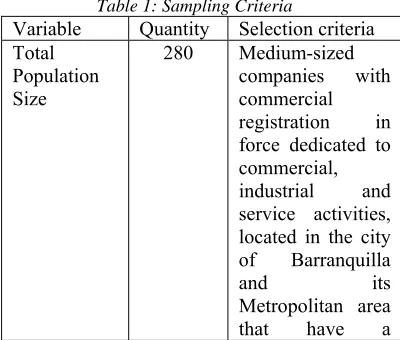
[image:3.612.328.528.556.726.2]For the development of the field work, was collected information of a finite population sampling, through the design and the application of a closed questionnaire, the one that shows aspects as the technological infrastructure and traceability systems and in the same way how to quantify and schematize them in a graphic/percentage way. The sample was selected under the following criteria:
Table 1: Sampling Criteria
Variable Quantity Selection criteria Total
Population Size
280 Medium-sized companies with commercial registration in force dedicated to commercial, industrial and service activities, located in the city of Barranquilla
and its
5267 coverage of the regional-national market
Confidence
level 95% This estimate is made to adjust the results of the research to the reality of the companies under study
Margin of
error 5% It is estimated that 95% of the surveyed
companies will not apart more than 5% to guarantee the veracity of the study.
Sample size 58 From the
application of the statistical formula:
∗ ∗ ∗
∗ ∗ ∗
The subjects necessary for the purpose of the investigation correspond to 58
Source: Own Elaboration
It’s important to stand out that the study is totally confidential and keeps the data of the participating companies in a private way; the above, is giving a fulfillment of the law 1581 of 2008-Habeas Data.
3. RESULTS AND DISCUSSION
After doing this field work, developed from the application of a closed questionnaire under the Likert scale (from the “totally agree” category to “totally disagree” category in a scale from 1 to 5); there were found some relevant information for this research. Then, we will show and analyze each of them. Each company that is seriously committed with the fulfillment of its mission and the quality of its products or services, must organize its objectives, goals and projects that allows to configure its strategic direction [18]; The last one is a continuous and systemic process that involves every part and
area of the company [19], and its purpose is centered in make the actions raised by the direction to reach the missionary and strategic purposes of the company.
Given the systematic characteristic that frames the strategic direction, all the activities of the company need to be associated to that direction, because in this way, continuity, convergence and coherence can be ensured in the developed actions of the system.
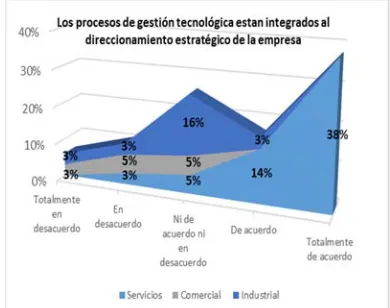
[image:4.612.90.292.70.459.2]Participating companies were asked, if their technology management processes were articulated in a strategic direction. 55% of the companies gave a positive answer according to the question, of this percentage the 52% corresponds to service companies and 3% commercial companies, which shows that the industrial companies don’t articulate their technology management processes to their strategic direction; in fact, industrial companies have the majority participation (16%) in the “neither agree or disagree” answer, a neutral position that shows the ignorance or the negative response of the answer (confidentiality). In the figure 1, it is schematized the last information.
Figure 1. Technology management articulated to the strategic direction.
Source: Own Elaboration
[image:4.612.327.522.433.587.2]5268 ones that best articulate the technological management processes with the strategic direction.
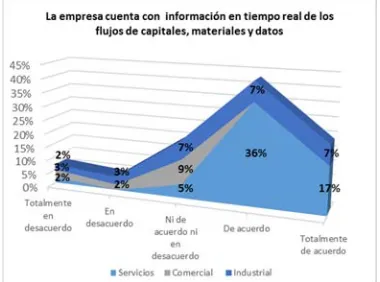
[image:5.612.92.282.348.489.2]Now, another of the questions of the study was pointed to identify if the companies had information about their capital, material and data flows in real time. From 100% of the companies, 24% was totally agree according to the question, percentage integrate by 17% of service companies and a 7% of industrial companies. In the same way 43% of these companies answer “agree” according to the question, which shows that 67% of the companies has the information of the integral elements of each processes in real time. It is important to realize that, inside this positive percentage, the participation of the commercial companies was not here, because their answer was neutral according to the question which means their ignorance respect to the topic. Previous results are shown in figure 2.
Figure 2. Information in real time of work flows.
Source: Own Elaboration.
According to [20], there are technological applications that give to the company all the necessary information about the business; this action is a key aspect because, if the company has information in real time of each area and process, can take assertive decisions according to the environment and the corporative reality, which has a repercussion in a direct way, for example, in the improvement of the supply chain (logistic processes), essential element to the improvement of the quality of the products and services. This agrees with what was raised by [17] and [18] and it evidence that companies give importance to information systems which impacts on the improvement of decision making. However, it stresses that the trade sector shows less knowledge on this particular aspect.
Basing on the previous information, participating companies were asked if nowadays, they have a software or an informatics program to control their inventory; in general terms 64% of the companies affirmed to have a software, of this percentage the majority corresponds to services companies, following by commercial companies and industrial companies.
It’s important to know that, even service companies offer intangible products, a huge part of them make use of the supplies to the development of their activities, it is because these kind of organizations needs to have inventories.
In relation to industrial companies, which had the lowest positive participation according to the question, it is assumed that the majority of these companies don’t have an adequate role model of supply chain in their corporative reality; that situation puts the operation and productivity of the company at risk, because, for example, if the inventory doesn’t manage in the effective way, it could shows a shortage or a gap in the stock, which carries into big failures in the production and operative costs.
The results are shown below in the figure 3.
Figure 3. Inventory control software. Source: Own Elaboration
[image:5.612.326.532.473.637.2]5269 customer with the acquisition. This process is called traceability or tracking and according to [21] has the objective of control the activities of the company ensuring quality and good condition of the products or services, from there, the process is related to the supply chain of the company.
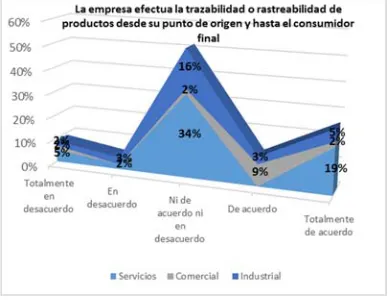
[image:6.612.90.285.325.478.2]Following the previous information, participating companies were asked if nowadays they use traceability on its products (tangible or intangible) from an origin point to the final consumer; The majority of these companies (52%) are disagree with the question, which shows that these companies don’t have a traceability automatic system, or post-sell service that let them verify if the product or the service was of total satisfaction of the customer. In figure 4, the results are shown.
Figure 4. Process of Traceability Source: Own Elaboration
Traceability allows the company to identify all the things that happen on the product that they create or the service that they give, having in count from the supplies used in the production process or in the provision of service, to the opinions and the level of satisfaction of the final consumer. Therefore, companies should take into account the procedures related to its quality control, in this way, products won’t be defective to the consumers and, the service given, will guarantee the complete satisfaction of the customer.
It’s important to know that to guarantee the effectiveness of the traceability system is necessary to have a determined tool or technology application as in the case of ERP, which allows more reactiveness and flexibility on the system, key elements to ensure
traceability in the different activities, procedures management and the analysis of the results (feedback). [22]
[image:6.612.328.531.336.491.2]Besides contributes to the tracing or traceability in the products or services (process related to the supply chain), Technology management promotes the company to administrate in an effective, fast and correct way its logistic processes; this affirmation was in the debate with participating companies, letting as a result a 17% of companies in “totally agree with this affirmation” and a 30% that are “agree”; therefore, a 47% of service, commercial and industrial companies consider that technology management can help to administrate its logistic processes. However, a high percentage of 35% gives a neutral position and a 17% gives a negative response. In the Figure 5, the results are shown.
Figure 5. Technology management to administrate logistic processes.
Source: Own Elaboration
5270
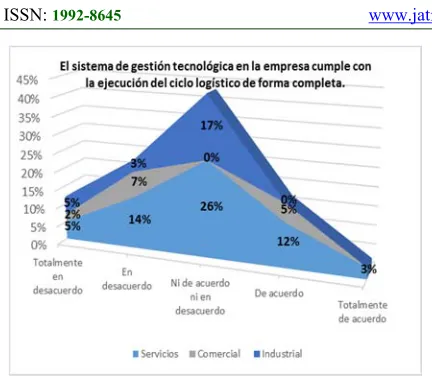
Figure 6. Logistic cycle Execution through technology management. Source: Own Elaboration
According to [23], technology management system is an important part in the logistic cycle, in the way that it allows to find the balance between costs and services, because it helps to control the inventories, storage and products transportation and, in general, all the activities related to the deliver and service of the customer. Therefore, if the company don’t manage and execute in an effective way its logistic cycle through its technology system, it means that there is an evidence of a failure in the disposition of tools and technological applications, which can break the operation and puts products and services quality at risk.
4. CONCLUSION
The biggest mistake that a company can make is consider that just having the latest technology in its spaces, they can get better its internal processes and hence increase its incomes; is the other way around, this mistaken posture can bring to the companies big losses or even setback in its technology management and the idea is to achieve that all the steps that are missing with this actualization be completed with the initial objective. [18]
The study shows that even though the majority of the services, commercial and industrial companies make use nowadays of the technology management to support its logistic processes, that’s not all effective, because it’s not an ally with the logistic cycle in a completed way, it means, some of the activities of the supply chain are let outside of the reach of the
technology management, which don’t allows to keep a real control and traceability of the products and services that the companies offer.
It’s important to know, that even though this is the knowledge age, a lot of companies don’t have a software for the inventory management, this is a negative situation because the stock control has an influence in a determined and important way in the quality and in production times, which affects in a direct way operative costs, productivity and competitiveness between companies in the market.
In the study it is shown, a commitment by the services companies with the technology management, these companies have a good technological base that allows them that their servuction process complies with the requirements of their customers.
REFRENCES
[1] Fundation COTEC, The Spanish sytem of innovation. Situation in 2004, Madrid, 2004.
[2] J. M. . M. «Use of the technologies of information and communications in the value chain processes in the companies of the cacaotero sector,» Magazine of
Economía & Administración, vol. 10 , nº
2, pp. 18-29, 2013.
[3] Y. G. y J. D. , «The impact of technology on organizational performance,»
Optimum, The Journal of Public Sector
Management , vol. 28, nº 1, pp. 19-31,
1998.
[4] W. P. y N. T. , «The Relationship between Information and Communication technologies Adoption and Management in Thai's Business Organization,»
International Proceeding of economics
Development and Research (IPEDR), vol.
43, pp. 57-61, 2012.
[5] E. A. M. Cabrera, , «Technology management in innovative companies
mexicanasrai,» Magazine of
Administração e Inovação, vol. 7, nº 3,
5271 [6] J. B. «Wharton University Pennsylvania,»
4 06 2007. [Online]. Available: http://www.knowledgeatwharton.com.es/
article/desventajas-de-aplicar-la-tecnologia-en-los-negocios/. [Last access: 18 12 2016].
[7] D. L. «Gartner, Inc.,» 27 04 2012.
[Online]. Available:
https://www.gartner.com/doc/1991317/in formation-innovation-innovation-key-initiative. [Last access: 18 12 2016]. [8] Aguilar O. G J, «Gestión de inventarios
como factor de competitividad, en el sector metalmecánico de la región occidental de Venezuela». Revista de Ciencias Sociales (Ve) 2009XV509-518.
Disponible en:
http://www.redalyc.org/articulo.oa?id=28 014489012. Fecha de consulta: 5 de octubre de 2017.
[9] Porter, Michael. Ventajas
Competitivas.Técnicas para Analizar Sectores. Ed.Free Press. New Cork, 2002
[10]F. O. Omotayo, «Knowledge Management as an important tool in Organisational Management: A Review of Literature,» Library Philosophy and
Practice (e-journal) , nº 1238, pp. 1-24,
2015.
[11]Ornelas, Carlos, et al. "Impacto De La Gestión De La Cadena De Suministros Sobre El Desempeño Competitivo En
Empresas Manufactureras De
Aguascalientes, México (Impact of Management Supply Chain on the
Competitive Performance in
Manufacturing Companies in
Aguascalientes, Mexico)." 2014.
[12]S. C. y P. M. , «Understand what the supply chain is.,» de Supply Chain
Management, Pearson/Prentice Hall.,
2006.
[13]J. R. V. Arto, «Supply chain management,» Industrial Organization School, pp. 1-14, 2011.
[14]Á. N. y E. . P. , «The impact of the technology management in the business context,» Venezuelan Magazine of
Ciencias Sociales, vol. 9, nº 2, pp.
488-504, 2005.
[15]Kalenatic, Dusko; González, Leonardo J.; López, César A.; Arias, Laura H. "EL SISTEMA DE GESTIÓN TECNOLÓGICA COMO PARTE DEL SISTEMA LOGÍSTICO
EN LA ERA DEL
CONOCIMIENTO". Cuadernos de
Administración, num. Julio-Diciembre, pp. 257-286, 2009.
[16]Borade, A. y Bansod, S. Domain of supply chain management – a state of art, Journal of Technology Management & Innovation, 2(4), 109-121, 2007.
[17]TELEFONICA, ISO/IEC 20000 Complete guide of the applications for the management of services of technologies of the information, Madrid: AENOR Editions, 2009.
[18]J. A. R. Gonzalez, R. A. Z. Villegas y G. B. Ramirez, «Evolution of the strategic direction process: School of strategic sciences Ponticifia Bolivariana
University,» Magazine Ciencias
estratégicas, vol. 16, nº 20, pp. 351-369,
2008.
[19]S. R. Erazo y A. A. Castro, «Strategic direction supported by TIC Management
studies, vol. 25, nº 111, pp. 127-143,
2009.
[20]M. C. «work flows key in each information system,» Business
Perspective, nº 33, pp. 60-61, 2009.
[21]M. C. L. Valencia, «Elaboration of the traceability system in the production plant of the company El Horno de Mikaela,» University Corporation Lasallista, Caldas, Antioquia, 2014.
[22]V. S. «Analysis of the integration of the MES systems – ERP in industries of manufacture,» of Latin American and Caribbean Conference for Engineering
and Technology, San Cristóbal,
Venezuela., 2009.
[23] J. Simanca, F. Meléndez, R. Sánchez & J. Vélez. «Aproximation to the rate calculation of return about the investment on Intranet projects»
Magazine Espacios, vol. 37, nº 16, pp.26,
5272
ANNEXED
Research Sheet
Target Population Medium sized services, industrial and comercial Companies.
Sample Unit Manager, Logistics managers
Ambit Local (City)
Collecting Information Method For the development of the field work, it was collected information starting of a finite population sampling, with the application and design of a closed questionnaire, which allows to see different aspects such as the technologic infrastructure and traceability system, in the same way, how to quantify and schematize them in a graphic/percentage way.
Sample Size 58 Companies
Field Work Date