4934
A REVIEW OF INTRINSIC MOTIVATION ELEMENTS
IN GAMIFIED ONLINE LEARNING
1, 2RUJIANTO EKO SAPUTRO, 3SAZILAH BINTI SALAM, 4MOHD HAFIZ ZAKARIA
1Department of Information System, STMIK AMIKOM Purwokerto, Purwokerto, Indonesia
2,3,4 Faculty of Information and Communication Technology Universiti Teknikal Malaysia Melaka, Durian
Tunggal, Melaka, Malaysia
E-mail: 1[email protected], 2[email protected], 3[email protected],
ABSTRACT
The advent of information and communication technology provides the opportunity and convenience to anyone to be able to follow online-based learning, so that teaching and learning can be arranged without limits of space and time. Today, online-based learning is offered by many higher education institutions and commercial industries. A variety of strategies to increase student motivation approach on online-based learning has been studied, one of them by using gamification approach. Previous researches were found to adopt motivational theories to stimulate the intrinsic and extrinsic level of gamification approach in education, According to the promise of gamification to enhance the intrinsic motivation of students based on elements of motivation through online-based learning, in this research, we focus on examining; 1) How the application of gamification in online-based learning is, 2) what game design elements that exist in the gamified-based online learning are, and 3) how to increase student motivation in gamified-online learning based on intrinsic motivation elements. The results of our study showed that gamification on online based learning increased, both regarding to utilization, approaches, methods, testing and determination of game design elements are used. Gamification also gave positive impact on student motivation in learning, although it depended on various factors and conditions. We provided reviews and examples based on the literature for the designer in determining the game design elements based on intrinsic motivation elements in the online-based learning.
Keywords: Gamification, Online Learning, Game Design Elements, Intrinsic Motivation Elements
1. INTRODUCTION
Information and communication technology provide opportunity and convenience for anyone to be able to follow online-based learning, so that teaching and learning can be arranged without limits of space and time. For many years, the benefits that can be obtained by students in the use of online-based learning have been extensively discussed. The advantages of online learning are students can be more confident and be able to manage the learning process [1], [2]; it is affordable and easy to get material from anywhere [3], [4], [5], [6], [7]. For the instructors can easily administer the deployment of lectures and learning materials [8].
Today, online-based learning is offered by many higher education institutions and commercial industries. One of them is a Massive Open Online Course (MOOC). MOOC is a media online course provided by learning institutions. The purpose is to facilitate free and high-quality education. It becomes
trend in the field of online-based learning [9], [10], [11].
According to [12], MOOC is a method of web-based online course which is open to the participation rate indefinitely. It means MOOC provides an online course format, organized by an institution that can be followed by anyone without limiting the number of participants.
Online learning gives students easy access. However, the problem that arises is the large number of students enrolled in this course is not proportional to the number of students completing the course, in particular, the high rate of student drop-rate in MOOC [13], [14], [15], [16]. One of the factors that causes students stop completing the course is the lack of motivation in learning [17]. Hew and Cheung [18] found that nearly 90% of students chose to drop out by the lack of motivation of students to complete the course with a variety of reasons.
4935 studied, one of them by using gamification approach. According to [19], gamification provided a positive effect although the effect was very dependent on the context in which gamification was implemented and how the user used it. In fact, [20] claimed that education was an area that had a high prospect of the use of gamification because gamification could increase students’ learning motivation to perform and achieve something [21].
The terms of gamification that most widely cited by the researchers are from [22], [23], [24]. They defined gamification as “the use of game design elements in non-game contexts.” Game design elements refered to elements of dynamics, mechanics, and aesthetics or commonly called by MDA framework. Hunickle et al. [25] explained that these elements were considered as the "lens" or "view" of a game, separated but were interrelated to each other to connect the spacing among the game design and development, game criticism, and technical game research.
In education, gamification was usually used to improve user engagement in learning applications [26], [27], [28], [29] due to the game design elements’ ability for engaging and motivating students thus lead to increase learning processes and outcomes [20]. According to [30], one key to the success of the implementation of gamification was the success in choosing the right elements from the game design. It means that the game design elements have an important role both in support of good gamified learning and increasing students' interest
towards learning applications. Removing
gamification elements from an application made a significant negative impact on the user activity [31]. It was predicted that in 2014, 80 percent of applications using gamification failed to meet its business objectives due to the poor design of gamification [52]. Gamification failure was because of the design of gamification that disregarded the rules of the theory empirically, the lack of systematic guidance in the design of gamification, no investigation in its implementation and the impact of the use of game design elements of gamification itself [26], [33], [53].
Based on these problems, there are some research questions that need the answer. Particularly the failure of gamification due to poor design by overriding the empirical approach in building and defining the right game elements that can lead to the increasing dropout rate of students in online learning due to the low level of intrinsic motivation in their
learning. The research questions addressed by this research are:
RQ1: How is the implementation of gamification in online-based learning? The review intended to investigate the utilization of gamification in online learning, such as; research objectives, framework or models, other approaches that may be adopted or used, types of platforms and courses selected, testing methods, and research results achieved.
RQ2: What are the game design elements that exist in the gamified-based online learning? The review intended to collect all selected game design elements and to identify new game design elements that might be proposed by previous researchers.
RQ3: How to increase student motivation in gamified-based online learning based on the intrinsic motivation elements? The review intended to analyze the existence of intrinsic motivational elements in online learning based on game design elements and methods used by researchers.
2. INTRINSIC MOTIVATION ELEMENTS
To enhance motivation both intrinsically and extrinsically mainly on gamification approach in education, the researchers usually adopt a theory of motivation. The motivation theory that is commonly used in the gamification to motivate students intrinsically in several studies is Self-Determination Theory (SDT) [32], [33]. SDT was introduced by Deci & Ryan [34], [35], [36], [37], [38]. In education, SDT was a motivation theory assuming that all students with different backgrounds had a tendency internal growth (e.g., intrinsic motivation, curiosity, and psychological needs) which provided a foundation of motivation for the involvement of high-quality grade and an active school functions [39].
SDT distinguished two types of motivation, namely intrinsic and extrinsic motivation. Intrinsic motivation was a condition in which people do something on their own, or encouragement of personal interest or the like caused by interest or pleasure. In contrast, extrinsic motivation effect was resulted from external factors in the achievement, such as remuneration, salary, or other [35]. According to [39], there were five mini-theories which supported SDT, one of them was Basic Psychological Needs Theory (BPNT).
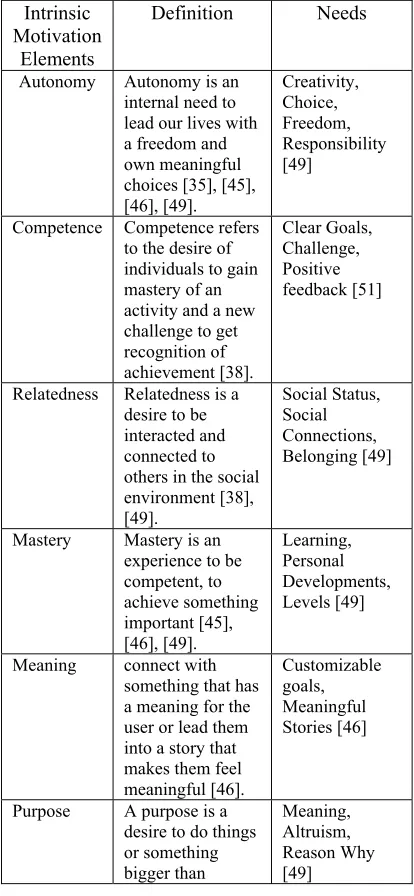
4936 intrinsic motivation in individuals at gamification [40], [41], [42], [43], [44]. Meanwhile [45] argued that there were three elements, namely intrinsic motivation; Autonomy, Mastery, and Purpose. In contrast, [46] as cited by [47], [48], stated that meaning, mastery, and autonomy as a secret ingredient that was missing in most of the application of gamification to increase motivation. Meanwhile [49] as cited by [32], [50], combined some elements of intrinsic motivation previous researchers into four, namely; relatedness, autonomy, mastery, and purpose, or commonly referred to as the RAMP intrinsic motivation. Intrinsic motivation elements and each definition are described in Table 1.
Table 1: Intrinsic Motivation Elements. Intrinsic
Motivation Elements
Definition Needs
Autonomy Autonomy is an internal need to lead our lives with a freedom and own meaningful choices [35], [45], [46], [49].
Creativity, Choice, Freedom, Responsibility [49]
Competence Competence refers to the desire of individuals to gain mastery of an activity and a new challenge to get recognition of achievement [38].
Clear Goals, Challenge, Positive feedback [51]
Relatedness Relatedness is a desire to be interacted and connected to others in the social environment [38], [49].
Social Status, Social Connections, Belonging [49]
Mastery Mastery is an experience to be competent, to achieve something important [45], [46], [49].
Learning, Personal Developments, Levels [49]
Meaning connect with something that has a meaning for the user or lead them into a story that makes them feel meaningful [46].
Customizable goals, Meaningful Stories [46]
Purpose A purpose is a desire to do things or something bigger than
Meaning, Altruism, Reason Why [49]
Intrinsic Motivation
Elements
Definition Needs
ourselves [45], [49].
The primary goals of this paper are to provide an overview of the types of gamification elements used by previous researchers, the implementation of gamification in online learning and classification elements of the game that meet basic human needs. Also, this study provides knowledge of the efforts and approaches used by researchers related to the increase of intrinsic motivation, as well as the issues that arise for further research for the development of online learning.
Our contribution to this analysis is to provide a reference to the designer to determine and apply the right game elements to the development of gamification in online learning, especially in the effort to increase intrinsic motivation in students based on the intrinsic motivation element approach.
3. METHODS
A survey of literature was conducted to explore existing gamification approaches to improve learners’ motivation. There were five steps applied in this study. The first step was general database searching: A review of the literature was undertaken to explore the gamification approaches on online-based learning. The second step was focusing the search: After collecting some papers, this study concentrated on exploring the application of gamification in online-based learning based on predetermined criteria. The third step was additional searching: at this stage, the filtering process ran on articles based on several categories to get more accurate information. Next step was the result and discussion; this level was conducted to discuss how the implementation of gamification was, existing game design elements, and analysis of the utilization of intrinsic motivation elements in online-based learning. The final step was to draw conclusion from the results of this study.
3.1 General Database Searching
A literature searching was conducted in the
following database; Scopus, ScienceDirect,
4937 keywords used for all areas (including title, abstract, keywords and full text). Literature searching results were included in Table 2. The column of Table 2 lists the name of the digital library and the total result of journals or conference proceedings.
Table 2: Result from Database.
Digital Libraries Total Result
Scopus 208
ScienceDirect 137
EBSCOHost 12
ACM Digital Library 176
3.2 Focus Searching
[image:4.612.318.515.499.629.2]After the literature was obtained from the database, the next step was performing initial screening criteria as shown in table 3.
Table 3: Screening Criteria Used on the Articles
# Screening Criteria
1 Studied on gamification, not game-based learning, serious game or full game
2 Focused on the implementation of gamification in online learning, rather than on the conventional learning
3 Empirical studies included
4 The research method used was explicated 5 Paper study clearly identified game design
elements and motivation outcomes for learners
3.3 Additional searching through referrals
The papers in the literature search that did not meet the criteria set were mostly divided into the following four categories as shown in table 4
Table 4: Type of Articles that Did Not Meet the Criteria.
# Type of Articles
1 Conceptual papers
2 Engineering paper describing a system architecture without evaluation
3 Gamification was mentioned in the text, but the actual substance did not have a connection with gamification
4 Short papers, research-in-progress or extended abstract
The results of the three steps from literature searching, a total of 10 articles on ScienceDirect, 20 articles from Scopus, 4 articles from ACM and 2 articles from EBSCOhost. A total of 36 research papers on gamification identified for review.
4. RESULT AND DISCUSSION
4.1 Gamification in Online-Based Learning
There were challenges and inconsistencies of gamification approach presented by researchers in online learning. The main issue was the high number of drop-out rate in online learning as well as found by previous studies [54], [55], [56], [57], [58], [59]. Those problems were found to be influenced by several factors, including; monotone activity, boredom, lack of motivation and interest in learning, and other factors lead to the low performance of students' [60]. Another psychological issue besides motivation was the increasing of students’ engagement in online learning [30], [40], [54], [55], [56], [59], [61], [62], [63], [64], [65], [66], [67], [68], [69], [70], [71], [72], [56].
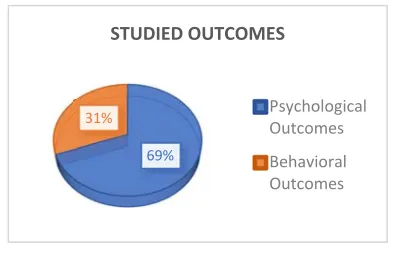
The researchers also conducted an investigation of the effects of gamification to behavioural outcomes and also several learning desirable outcomes, such as; increasing learning experiences and performance [60], [67], [68], [72], [73], [74], [75], [76], [77], [78], [79], students interaction [73], the effectiveness of gamification [70], [30], the pattern of student behaviour on gamified online learning for a long time [61], student interest, satisfaction, student learning and perception of pedagogical outcomes [80]. Additionally, some researchers conducted an investigation on the impact of game design elements [30], such as; badges [81], [57], points, leaderboards [69] as well as the impact of gamification elements based on a psychological need satisfaction [82], different age groups [63], [78], [56]. and gender [60]. For more details can be seen in Figure 1.
Figure 1: Studied Outcomes
Peculiar to the content, some researchers examined the effect of gamification implemented in online learning, such as investigating the implementation of gamification on the quiz [64], [76], peer assessment [66], online discussion [71]. They also studied the effect of gamification collaborated with social networking such as;
69% 31%
STUDIED OUTCOMES
Psychological Outcomes
[image:4.612.92.301.508.610.2]4938
collaborative work, community building,
competition, and cooperation, boost participation [65], share and gift rewards to other students, notification of other student’s achievement [83], e-portfolio, and polls [74]. The goal was to provide experience and engagement students in interacting with others.
Gamification was also used to solve problems on a particular subject. For example, in mathematics [59], [73], Software Engineering [56], [58], [84], [67], [61], programming course [54], [55], [57], [68], [85], Language Course [62], [63], [86], computer science [59], [60], [81], [65], [75] Special Education Needs (SEN) [87], Accounting and Finance [70], Computer Graphics [30], [80], natural science course [79], research methods subject [69], digital simulation setting [82], Politics and Economics [76], Computer Networking [74], [77], and Multimedia Content Production [72].
The amount of application of gamification was as a general construction without regard to other factors such as the determination of the proper game design elements to the attention of the researchers. Lamprinou and Paraskeva [40] developed and implemented E-class, a gamified e-learning course that built on Moodle platform with a broad range of components based Werbach Pyramid game theories and the three basic human needs on Self-Determination Theory. Utomo and Santoso [75] used a pedagogical agent to provide notification and information about the activities in real active learning to increase student interest.
Another approach is to incorporate the personality traits of students in gamification. Buckley and Doyle [70] performed a testing on different learning styles and personality traits (Extraversion, Agreeableness, Conscientiousness, Neuroticism and Openness to Experience). Tu et al. [71] conducted an investigation to answer the question whether the four types of gaming personality like explorer, socializer, killer and achiever can predict the level of game dynamics in the online discussion environment. Meanwhile, Barata et al. [72] conducted a study on the long-term online courses on campus gamification to measure the behaviour and performance of participants using a pattern on the approach of six student types.
Also, there were researchers who formulated and conducted testing of their gamification framework and models. Lamprinou and Paraskeva [40], established a framework based on Self-Determination Theories and basic human needs, such as; Autonomy, competence, and relatedness.
Malas and Hamtini [85] built Gamified E-learning design Model (GED) by combining the framework and e-learning to improve motivation, participation, and performance of student learning. Fogg theoretical approaches like behavioural models, Bartle player types and MDA framework were used in designing the framework. GED was divided into seven levels; plan, design, development, deployment and view. Mora et al. [56], formulated a framework SPARC (Sense, Purpose, Autonomy, Relatedness and Competency) to determine the elements of game design that was appropriate to the learning context. Simoes et al. [83] built and tested a social gamification framework for the K-6 social learning environment. Tenorio et al. [66] developed peer assessment models for online learning environments to engage students in peer assessment activities, and conducted tests using an intelligent guidance system called MeuTutor.
In a mobile-based learning system, Su and Cheng [79] built the Mobile Gamification Learning System (MGLS) framework based on the concept of gamification and social constructivism. They also used the ARCS model (Attention, Relevance Confidence and Satisfaction), a motivational theory approach introduced by Keller in 1983.
While in MOOC, Gene et al. [58] built Gamification Cooperative MOOC (GcMOOC) model as a series of practical recommendations and tools to enhance motivation, learning level and graduation rate of MOOC course participants in Technical Education.
From the platform side, some researchers applied gamification on Massive Open Online Course (MOOC) [58], [55], [54]. While [68], [59], [56], [76], [81], [61], [75], [60], [30], [83], [78], [57], [85], [73], [40] on e-learning, online learning environments [66], [70], web based educational system [84], lab activities [67], web learning [86], online simulation environment [82], ClassDojo and ClassBadges [87], [63], learning and social
networking [65], half-anonymized real-time
education support system [64], mobile learning [79],
students response system [77], Learning
Management System [80], [69], [72], SocialWire [74], language course [62], and on online discussion instruction [71].
4939 Bartle's Taxonomy approach was used to understand the attraction of students to the interaction of gamification elements based on the types of players [71], [85]. Fog behavioural model approach assisted researchers in understanding the behaviour of students and present behavioural outcomes [85]. The social constructivist theory was used to create meaningful learning through personal interaction with the surrounding environment [79]. Index of learning styles (ILS) and personality traits with the Five-Factor Models (FFM) to examine the impact of gamified learning based on different learning styles and personality traits of students' perception, engagement, and performance learning [70]. Bloom's Taxonomy was used to arrange matter internally subject to the level of cognitive abilities towards a higher level of thinking [61].
There were several types of research used by researchers, such as the quantitative method by using experiments, questionnaires, and data analysis [82], [70], [65], [72], [83], [66], [69], [86], [73], [40], [67], [64], [85], [79], [55], [77], [74], [75], [76], [62], [30], [84], [78], [81], [57], [54], [60], [59], [71], and mix methods, combining with quantitative and qualitative methods [65], [87], [68], [61], [58], [56], [80].
From the results of testing the gamification approach and its elements in online-based learning, some researchers stated positive results and were able to answer all research questions [30], [40], [54], [55], [56], [57], [58], [59], [62], [63], [64], [65], [66], [67], [68], [70], [72], [73], [74], [75], [77], [78], [79], [81], [82], [83], [84], [85], [86], [87].
Meanwhile, some researchers got partially positive of the gamification approach in online-based learning, meaning that gamification proved positive but with various notes or findings of new problems. Hew et al. [69] stated that the use of game mechanics had a positive impact on improving students' motivation to engage in tougher challenges in a task, as well as proving the quality of outcomes among experimental groups over the control group. However, based on observations, it was found that game mechanics had no impact on increasing the number of re-accessing by students to courses and forums. Tanaka et al. [76] used a quiz with a ranking on gamified online learning and analyzed its effects on students' motivations and scores. Although there was a positive effect on the increase of students’ motivation, based on the test result it was obtained that students with low competitive-mind received only a small effect on ranking or even received an ill effect compared with students who have high competitive-mind. Also, there was no significant
difference between the use of rankings on the quiz score and non-ranking. Pedro et al. [60] tested the game’s mechanics effect on gender, game mechanics had a positive effect on motivation, especially for boys. However, the results of the evaluation found no significant differences in learning outcomes between boys and girls.
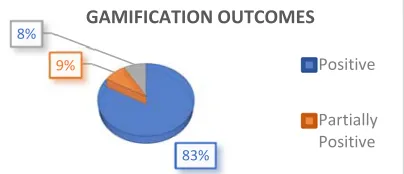
[image:6.612.318.520.513.600.2]Although gamification had a positive effect on motivation, some researchers got different results. Barkling and Thomas [61], stated that there were only 23% of students who claimed to be able to receive gamification, 25% of students felt gamification was not beneficial to them in learning. While at the level of task completion in e-learning, up to 13.8% almost completed the study, 30.8% a half of work, and 38.5% in the initial of new stages, also 16.9% had not started working on the task. Frost et al. [80] concluded that gamification had no effect on student engagement, and even had some adverse effects. The researchers found that the primary determinant of gamification for their voluntary action of the participants, but in a system that was set up like LMS, members may appreciate gamification elements but did not significantly increase motivation. While Tu et al. [71], stated that the negative impact resulting from the gamification was caused by a wrong conception of the game. The game moved and could change the behaviour, but on educating, educators should also focus on the dynamics of the game which are active and efficient to support learning, rather than only used the game mechanics. The right gamification can improve learning and involve students more social in decision-making and problem-solving context of the tasks given. For more details can be seen in Figure 2.
Figure 2: Gamification Outcomes
Based on the reviews, we can answer the RQ1 of this research. Gamification approach to resolve the problem on the online-based learning is growing. Issues raised varied, such as levels drop rates, engagements, motivation, learning experiences and performance, the effectiveness and impact of gamification and game design elements in online learning based on age, gender, personal traits, gaming personalities and subject. E-learning became
83% 9%
8% GAMIFICATION OUTCOMES
Positive
4940 the most widely disseminated platform by researchers related to efforts to improve students' motivation with the most widely chosen subjects in software engineering and programming courses. Researchers used various theoretical approaches. One of the most widely used theories was Self-Determination Theory (SDT). Four researchers proposed and tested the new framework. Most of researchers used quantitative methods in testing by distributing questionnaires and analyzing data from the experiment results. Based on the test results, 30 researchers got positive results, 3 researchers got a partially positive and 3 researchers got negative results from the implementation of gamification or game design elements on online based learning.
4.2 Game Design Elements
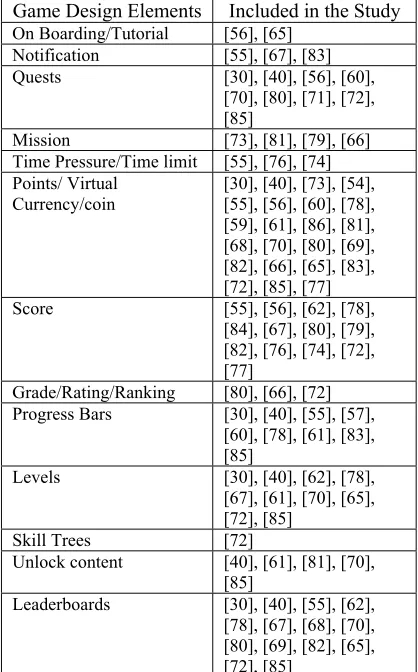
[image:7.612.90.299.397.733.2]Many researchers carried out a summary of the game features on learning applications and their outcome for learners. In pursuance of [88], we collected and discussed new game design elements found in research based on the terminology used in the reviewed papers. Table 5 provides a summary of the game design elements.
Table 5: Summary of Game Design Elements Game Design Elements Included in the Study On Boarding/Tutorial [56], [65]
Notification [55], [67], [83] Quests [30], [40], [56], [60],
[70], [80], [71], [72], [85]
Mission [73], [81], [79], [66] Time Pressure/Time limit [55], [76], [74] Points/ Virtual
Currency/coin
[30], [40], [73], [54], [55], [56], [60], [78], [59], [61], [86], [81], [68], [70], [80], [69], [82], [66], [65], [83], [72], [85], [77] Score [55], [56], [62], [78],
[84], [67], [80], [79], [82], [76], [74], [72], [77]
Grade/Rating/Ranking [80], [66], [72] Progress Bars [30], [40], [55], [57],
[60], [78], [61], [83], [85]
Levels [30], [40], [62], [78], [67], [61], [70], [65], [72], [85]
Skill Trees [72]
Unlock content [40], [61], [81], [70], [85]
Leaderboards [30], [40], [55], [62], [78], [67], [68], [70], [80], [69], [82], [65], [72], [85]
Game Design Elements Included in the Study Performance Graphs [82]
Social Graphs [70]
Avatars/ Profiles [30], [55], [60], [63], [64], [67], [87], [80], [82], [72]
Representation
/narrative/Story line/epic meaning
[30], [40], [80], [79], [82], [71], [65]
Competition (Combat/leagues) & Collaboration (Group Task/Teammates)
[40], [84], [58], [63], [82], [71], [65], [72]
Badges [30], [40], [54], [55], [57], [58], [60], [62], [63], [73], [78], [59], [84], [67], [86], [81], [68], [87], [70], [80], [79], [82], [69], [66], [71], [65], [83], [74], [75], [72]
Freedom to fail [30], [80] Dashboards [55], [65], [72] Sharing & gifting [61]
AvatarWorld [72] Freedom to Choose [61] Scaffolding [40], [69]
According to [89], points, badges and leaderboards or commonly referred to as "PBL Triad" were the most commonly game design elements used by designers in building gamification. Based on Table 5 it shows that game design elements, such as points, badges, leaderboards, still dominate its utilization in gamification until now.
Nevertheless, some researchers continued to try to modify and propose new game design elements to enhance students’ motivation and engagement in online-based learning. Filipcik and Bielikova [84] used a dynamic score that automatically increased the number of points to the task that was rarely chosen by the students, in turn reducing the value of points on the activities most preferred by students. Paiva et al. [73] used a personal mission for students to improve learning outcomes. The mission was given specifically to students who had low scores or did not meet the standards of assessment. Based on the test results, there was significant improvement in student learning outcomes compared with the previous achievements. Other game design elements were AvatarWorld, where researchers built a virtual environment to provide autonomy and space for interaction among students [72].
4941 about the game design elements that are present in today's online learning.
4.3 Intrinsic Motivation Elements in Gamified
Online Learning
Based on the literature review, we presented the investigation results of motivational elements in gamified online learning. Then we classified the gamification elements that met the criteria of intrinsic motivation elements that supported the increase of students’ intrinsic motivation.
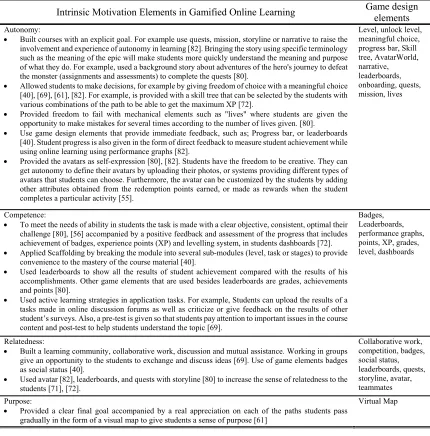
Based on the investigation results in Table 6, we were able to answer RQ3 from our research on how to increase student motivation in gamified based
online learning based on the intrinsic motivation elements. A sense of autonomy was felt by students when the system provided space for students to learn
in their way. The freedom to choose, to fail, to show self-expression, to get immediate feedback and clear
learning goals will make students act with the impulse of their desires, without feeling in control by others.
[image:8.612.91.521.159.595.2]Students can gain the sense of competence if gamified online learning provided challenges to students to achieve gradual mastery of the material. Also, by providing opportunities for students to be able to give feedback by way of criticism, comment and provided an assessment of the work from other Table 6: Investigation Results based on a Review of Intrinsic Motivation Elements
Intrinsic Motivation Elements in Gamified Online Learning Game design elements
Autonomy:
Built courses with an explicit goal. For example use quests, mission, storyline or narrative to raise the involvement and experience of autonomy in learning [82]. Bringing the story using specific terminology such as the meaning of the epic will make students more quickly understand the meaning and purpose of what they do. For example, used a background story about adventures of the hero's journey to defeat the monster (assignments and assessments) to complete the quests [80].
Allowed students to make decisions, for example by giving freedom of choice with a meaningful choice [40], [69], [61], [82]. For example, is provided with a skill tree that can be selected by the students with various combinations of the path to be able to get the maximum XP [72].
Provided freedom to fail with mechanical elements such as "lives" where students are given the opportunity to make mistakes for several times according to the number of lives given. [80].
Use game design elements that provide immediate feedback, such as; Progress bar, or leaderboards [40]. Student progress is also given in the form of direct feedback to measure student achievement while using online learning using performance graphs [82].
Provided the avatars as self-expression [80], [82]. Students have the freedom to be creative. They can get autonomy to define their avatars by uploading their photos, or systems providing different types of avatars that students can choose. Furthermore, the avatar can be customized by the students by adding other attributes obtained from the redemption points earned, or made as rewards when the student completes a particular activity [55].
Level, unlock level, meaningful choice, progress bar, Skill tree, AvatarWorld, narrative, leaderboards, onboarding, quests, mission, lives
Competence:
To meet the needs of ability in students the task is made with a clear objective, consistent, optimal their challenge [80], [56] accompanied by a positive feedback and assessment of the progress that includes achievement of badges, experience points (XP) and levelling system, in students dashboards [72].
Applied Scaffolding by breaking the module into several sub-modules (level, task or stages) to provide convenience to the mastery of the course material [40].
Used leaderboards to show all the results of student achievement compared with the results of his accomplishments. Other game elements that are used besides leaderboards are grades, achievements and points [80].
Used active learning strategies in application tasks. For example, Students can upload the results of a tasks made in online discussion forums as well as criticize or give feedback on the results of other student’s surveys. Also, a pre-test is given so that students pay attention to important issues in the course content and post-test to help students understand the topic [69].
Badges, Leaderboards, performance graphs, points, XP, grades, level, dashboards
Relatedness:
Built a learning community, collaborative work, discussion and mutual assistance. Working in groups give an opportunity to the students to exchange and discuss ideas [69]. Use of game elements badges as social status [40].
Used avatar [82], leaderboards, and quests with storyline [80] to increase the sense of relatedness to the students [71], [72].
Collaborative work, competition, badges, social status, leaderboards, quests, storyline, avatar, teammates Purpose:
Provided a clear final goal accompanied by a real appreciation on each of the paths students pass gradually in the form of a visual map to give students a sense of purpose [61]
4942 students will make students become more critical and have confidence in their ability. Each student's achievement in learning was balanced with positive feedback, such as points, rewards, badges, XP, or score. Performance results can be seen on the
leaderboards when it involved other students to compete. If not, the performance graphs can be an alternative visual for the student to monitor their learning development.
A sense of relatedness was felt by students if the system provided space for collaboration among students to solve a case together. When people feel connected to each other, they will feel motivated as long as the quality of a good relationship.
A sense of purpose came to students if gamified online learning provided opportunities for students to be able to share both knowledge and the results of the rewards that have been acquired by the students. Pink [45] explained that the purpose had associated with autotelic experiences, the experience had a goal to satisfy themselves personally as well as made the journey of life become meaningless. The goal of the purpose was to get a sense of any action taken. Many people wanted to share and help each other when they were able and capable [49]. For example, many people would provide answers or solutions to a problem experienced by others in the forum, although they did not get any compensation. To form a sense of purpose a gamified learning must have space for students to be able to share, both sharing the knowledge between students and sharing the rewards they got to donate to other students.
5. OPEN RESEARCH ISSUES
There are open research issues that can be highlighted for gamification in MOOC platform, the determination of gamification game elements that meet intrinsic motivation needs, and gamification testing.
5.1. The gamification approach on the MOOC
platform
Online-based learning becomes one of the topics that attracts attention for the researchers because there are many problems occur especially on efforts to increase students’ motivation and engagement when students are using learning media. However, most researchers still focused on solving problems on the e-learning platform. While there were only few scientists, who concerned about demotivation on MOOC platform. We gave the significant problems related to low motivation of students to finish the
course on an MOOC, leaving an opportunity for other researchers to resolve these problems.
5.2. Determining which game elements increase
intrinsic motivation.
Intrinsic motivation elements is an essential factor as a guideline for designers in designing gamification and determining appropriate game design elements so as not to get caught up in the use of game design elements that lower the students' intrinsic motivation. However, many researchers ignored these rules, so it can be said that they did not use the proper foundation in determining what game design elements will be utilised in particular to increase students' intrinsic motivation in their works. It may cause gamification success only in the lab testing stage, but not for extended periods of time.
Various types of game elements were adopted by the researchers, from the results of the review indicated that Points, Badges and Leaderboards (PBL), in gamified online learning they were still dominated. Although many studies showed positive results against engagements and motivation, but they needed to be reexamined the effects of PBL, because it can degrade students' intrinsic motivation if it was implemented in the long term [89], [90], [91]. Also, other interesting things that can be examined by researchers was how the game mechanics such as narrative or scenarios can affect student engagement in the long-term period [69].
5.3. Evaluating Gamification
The variety ways have been done by the researchers when they were evaluating gamification in online-based learning. But it was not narrow the possibilities for other researchers to continue to explore other approaches or methods to validate the interaction of the elements of gamification systematically and using a scientific approach, rather than just to investigate the overall effect of gamification. For example, lacking of experimental design on the effects of individual game design elements or groups [82], or gamification design that focused on the relationship between the game
dynamics, gamification contexts, gaming
4943 Finally, research in the field of gamification still leaves problems associated with standardisation to assess the success rate of the study, due to inconsistencies from researchers in using various tested approaches, data sets, and test environments. Therefore, in the future it needs standardisation to enable supporting the comparison of test results and correct meta-analysis in the gamification so that it can serve as a guide for subsequent research.
6. CONCLUSION
Based on this study, it can be concluded that the development of gamification research in education increasingly diverse. However, there are still many things that can be investigated by further researchers, such as the development of gamification in the MOOC Platform, the determination of game elements that can support increasing intrinsic motivation, as well as gamification testing, especially the effects of gamification utilization on students' intrinsic motivation in the long term.
We realize that this study has various limitations. This study is only done by collecting evidence explicitly presented in previous research papers related to the implementation of gamification, gamification elements and elements that can meet basic human needs as an effort to increase student intrinsic motivation. This article is also limited only to the results of research on the application of gamification that has links with efforts to increase motivation in online based learning that has been done by other researchers. The possibility of other researchers who have investigated similar issues is very open, but they discussed under a different name or term, making it difficult to find. In this study, we rely on selection criteria based on an empirical approach to intrinsic motivation element. Therefore this paper can give a brief description of the research done on the topic of gamification and its elements to increase student intrinsic motivation in particular.
In the future, we will propose a model based on intrinsic motivation elements on the MOOC platform which will give a sense of autonomy to the students, to support the achievement of gradual competence to mastery by providing relatedness between students to interact with each other, and is wrapped by a meaningful purpose. The aim is to enhance the students’ intrinsic motivation in completing the course in MOOC.
ACKNOWLEDGMENT
This research is conducted by Pervasive Computing and Educational Technology Research Group, C-ACT, Universiti Teknikal Malaysia Melaka (UTeM), and supported by Sekolah Tinggi Manajemen Informatika dan Komputer AMIKOM Purwokerto, Indonesia.
REFERENCES:
[1] C. Tsai, S. Chuang, J. Liang, and M. Tsai,
“Self-efficacy in Internet-based Learning Environments : A Literature Review,” Educ. Technol. Soc., vol. 14, pp. 222–240, 2011.
[2] J. C. Y. Sun and R. Rueda, “Situational
interest, computer efficacy and self-regulation: Their impact on student
engagement in distance education,” Br. J.
Educ. Technol., vol. 43, no. 2, pp. 191–204, 2012.
[3] S. J. Bartley and J. H. Golek, “Evaluating the
cost effectiveness of online and face-to-face
instruction,” Educational Technology and
Society, vol. 7, no. 4. pp. 167–175, 2004.
[4] C. Gratton-lavoie and D. Stanley, “Teaching
and Learning Principles of Microeconomics
Online : An Empirical Assessment,” J.
Econ. Educ., vol. 40, no. 1, pp. 3–25, 2009.
[5] C. De Varre, J. Keane, and M. Irvin,
“Enhancing Online Distance Education in Small Rural US Schools,” J. Asynchronous Learn. Networks, vol. 18, no. 3, pp. 35–46, 2010.
[6] T. Nguyen, “The Effectiveness of Online
Learning : Beyond No Significant
Difference and Future Horizons,” MERLOT J. Online Learn. Teach., vol. 11, no. 2, pp. 309–319, 2015.
[7] S. Norman, “5 Advantages Of Online
Learning: Education Without Leaving
Home,” 2016. [Online]. Available:
https://elearningindustry.com/5-advantages- of-online-learning-education-without-leaving-home. [Accessed: 09-Feb-2017].
[8] J. J. Williams, “Online Education : A
Unique Opportunity for Cognitive Scientists to Integrate Research and Practice systems using educational data mining As director of the Pittsburgh Science of Learning Center
and,” in Proceedings of the 35th Annual
4944
[9] L. Johnson, S. Adam Becker, M. Cummins,
A. Freeman, D. Ifenthaler, and N. J.
Vardaxis, “Technology outlook for
Australian tertiary education 2013-2018 : an NMC Horizon project regional analysis,” New Media Consort., p. 23, 2013.
[10] N. Pellas, “The influence of computer
self-efficacy, metacognitive self-regulation and self-esteem on student engagement in online learning programs: Evidence from the
virtual world of Second Life,” Comput.
Human Behav., vol. 35, pp. 157–170, 2014.
[11] J. W. Chang and H. Y. Wei, “Exploring
engaging gamification mechanics in
massive online open courses,” Educ.
Technol. Soc., vol. 19, no. 2, pp. 177–203, 2016.
[12] A. M. Kaplan and M. Haenlein, “Higher
education and the digital revolution: About MOOCs, SPOCs, social media, and the Cookie Monster,” Bus. Horiz., vol. 59, no. 4, pp. 441–450, Jul. 2016.
[13] K. Jordan, “MOOC Completion Rates: The
Data,” 2015. [Online]. Available:
http://www.katyjordan.com/MOOCproject. html. [Accessed: 23-Jan-2017].
[14] P. Diver and I. Martinez, “MOOCs as a
massive research laboratory: opportunities and challenges,” Distance Educ., vol. 7919, no. September, pp. 1–21, 2015.
[15] W. . W. Xing, X. . X. Chen, J. . J. Stein, and
M. M. . Marcinkowski, “Temporal predication of dropouts in MOOCs: Reaching the low hanging fruit through
stacking generalization,” Comput. Human
Behav., vol. 58, pp. 119–129, 2016.
[16] K. S. Hone and G. R. El Said, “Exploring the
factors affecting MOOC retention: A survey
study,” Comput. Educ., vol. 98, pp. 157–
168, Jul. 2016.
[17] S. Zheng, M. B. Rosson, P. C. Shih, and J.
M. Carroll, “Understanding Student
Motivation, Behaviors and Perceptions in
MOOCs,” Proc. 18th ACM Conf. Comput.
Support. Coop. Work Soc. Comput. - CSCW ’15, pp. 1882–1895, 2015.
[18] K. F. Hew and W. S. Cheung, “Students’ and
instructors’ use of massive open online courses (MOOCs): Motivations and
challenges,” Educ. Res. Rev., vol. 12, pp.
45–58, Jun. 2014.
[19] J. Hamari and H. Sarsa, “Does Gamification
Work? A Literature Review of Empirical Studies on Gamification,” pp. 3025–3034,
2014.
[20] K. Kapp, “The Gamification of Learning and
Instruction,” San Fr., p. 480, 2012.
[21] G. Zichermann and C. Cunningham,
Gamification by Design : Implementing Game Mechanics in Web and Mobile Apps, First Edit. Canada: O’Reilly Media, Inc.,
1005 Gravenstein Highway North,
Sebastopol, CA 95472, 2011.
[22] S. Deterding, R. Khaled, L. Nacke, and D.
Dixon, “Gamification: toward a definition,” Chi 2011, pp. 12–15, 2011.
[23] S. Deterding, M. Sicart, L. Nacke, K.
O’Hara, and D. Dixon, “Gamification using game-design elements in non-gaming
contexts,” Proc. 2011 Annu. Conf. Ext.
Abstr. Hum. factors Comput. Syst. - CHI EA ’11, p. 2425, 2011.
[24] S. Deterding and D. Dixon, “From Game
Design Elements to Gamefulness: Defining
‘Gamification,’” MindTrek’11, pp. 9–15,
2011.
[25] R. Hunicke, M. LeBlanc, and R. Zubek,
“MDA: A Formal Approach to Game
Design and Game Research,” Work.
Challenges Game AI, pp. 1–4, 2004.
[26] J. J. J. Lee and J. Hammer, “Gamification in
Education: What , How , Why Bother?,” Acad. Exch. Q., vol. 15, no. 2, pp. 1–5, 2011.
[27] F. F. Nah, V. R. Telaprolu, S. Rallapalli, and
P. R. Venkata, “Gamification of Education
Using Computer Games,” Lect. Notes
Comput. Sci. (including Subser. Lect. Notes Artif. Intell. Lect. Notes Bioinformatics), pp. 99–107, 2013.
[28] A. Domínguez, J. Saenz-De-Navarrete, L.
De-Marcos, L. Fernández-Sanz, C. Pagés, and J. J. Martínez-Herráiz, “Gamifying learning experiences: Practical implications and outcomes,” Comput. Educ., vol. 63, pp. 380–392, 2013.
[29] F. Bellotti et al., “A gamified short course
for promoting entrepreneurship among ICT
engineering students,” in Proceedings -
2013 IEEE 13th International Conference on Advanced Learning Technologies, ICALT 2013, 2013, pp. 31–32.
[30] D. Strmečki, A. Bernik, and D. Radošević,
“Gamification in E-Learning: Introducing Gamified Design Elements into E-Learning
Systems,” J. Comput. Sci., vol. 11, no. 12,
4945
[31] J. Thom, D. R. Millen, J. DiMicco, and R.
Street, “Removing gamification from an enterprise SNS,” in Proceedings of the ACM 2012 conference …, 2012, pp. 1067–1070.
[32] A. Mora, D. Riera, C. Gonzales, and J. A.
Moreno, “A literature review of
gamification design frameworks,” 2015.
[33] K. Seaborn and D. I. Fels, “Gamification in
theory and action: A survey,” Int. J. Hum.
Comput. Stud., vol. 74, pp. 14–31, 2015.
[34] E. L. Deci and R. M. Ryan, Intrinsic
Motivation and Self-Determination in Human Behavior. New York: Plenum Press, 1985.
[35] M. R. Richard and E. L. Deci, “Intrinsic and
Extrinsic Motivations: Classic Definitions
and New Directions,” Contemp. Educ.
Psychol., vol. 25, no. 1, pp. 54–67, 2000.
[36] R. M. Ryan and E. L. Deci,
“Self-determination theory and the facilitation of intrinsic motivation, social development, and well-being.,” Am. Psychol., vol. 55, no. 1, pp. 68–78, 2000.
[37] M. Gagne and E. L. Deci,
“Self-determination theory and work motivation,” J. Organ. Behav., vol. 26, no. January, pp. 331–362, 2005.
[38] E. L. Deci and R. M. Ryan,
“Self-determination theory: A macrotheory of human motivation, development, and health.,” Can. Psychol. Can., vol. 49, no. 3, pp. 182–185, 2008.
[39] J. Reeve, Handbook of Research on Student
Engagement. Boston, MA: Springer US, 2012.
[40] D. Lamprinou and F. Paraskeva,
“Gamification design framework based on SDT for student motivation,” Proc. 2015 Int. Conf. Interact. Mob. Commun. Technol. Learn. IMCL 2015, no. November, pp. 406– 410, 2015.
[41] A. F. Aparicio, F. L. G. Vela, J. L. G.
Sánchez, and J. L. I. Montes, “Analysis and application of gamification,” Proc. 13th Int. Conf. Interacción Pers. - INTERACCION ’12, no. May 2015, pp. 1–2, 2012.
[42] G. Barata, S. Gama, J. Jorge, and D.
Goncalves, “Engaging Engineering Students
with Gamification,” 2013 5th Int. Conf.
Games Virtual Worlds Serious Appl., pp. 1– 8, 2013.
[43] L. Shi, A. I. Cristea, S. Hadzidedic, and N.
Dervishalidovic, “Contextual Gamification of Social Interaction – Towards Increasing Motivation in Social E-learning,” in Lecture Notes in Computer Science (including subseries Lecture Notes in Artificial Intelligence and Lecture Notes in Bioinformatics), vol. 8613 LNCS, 2014, pp. 116–122.
[44] C. Dichev, D. Dicheva, G. Angelova, and G.
Agre, “From gamification to gameful design and gameful experience in learning,” Cybern. Inf. Technol., vol. 14, no. 4, pp. 80– 100, 2014.
[45] D. H. Pink, Drive, the Surprising Truth
about What Motivates Us. New York: Penguin Group, 2009.
[46] S. Deterding, “Meaningful Play; Getting
Gamification Right.,” Google Tech Talk,
2011. [Online]. Available:
http://www.slideshare.net/dings/meaningful -play-getting-gamification-right. [Accessed: 19-Jan-2017].
[47] S. Nicholson, A RECIPE for Meaningful
Gamification. Cham: Springer International Publishing, 2015.
[48] S. Nicholson, “A User-Centered Theoretical
Framework for Meaningful Gamification A
Brief Introduction to Gamification
Organismic Integration Theory Situational Relevance and Situated Motivational
Affordance,” GamesLearningSociety 80,
2012.
[49] A. Marczewski, “The Intrinsic Motivation
RAMP,” 2013. [Online]. Available:
https://www.gamified.uk/gamification-framework/the-intrinsic-motivation-ramp/. [Accessed: 19-Jan-2017].
[50] B. Herbert, D. Charles, A. Moore, and T.
Charles, “An investigation of gamification
typologies for enhancing learner
motivation,” Proc. - 2014 Int. Conf. Interact. Technol. Games, iTAG 2014, pp. 71–78, 2014.
[51] R. Van Roy, “Why Gamification Fails in
Education - And How to Make it
Successful,” in Serious Games and
4946
[52] B. Burke, “Gartner Says by 2014, 80 Percent
of Current Gamified Applications Will Fail to Meet Business Objectives Primarily Due to Poor Design,” 2012. [Online]. Available: http://www.gartner.com/newsroom/id/2251 015. [Accessed: 25-Nov-2016].
[53] S. Azmi, N. A. Iahad, and N. Ahmad,
“Gamification in online collaborative learning for programming courses: A literature review,” ARPN J. Eng. Appl. Sci., vol. 10, no. 23, pp. 18087–18094, 2015.
[54] T. Lehtonen, T. Aho, E. Isohanni, and T.
Mikkonen, “On the Role of Gamification and Localization in an Open Online
Learning Environment: Javala
Experiences,” in Proceedings of the 15th
Koli Calling Conference on Computing Education Research - Koli Calling ’15, 2015, pp. 50–59.
[55] M. Krause, M. Mogalle, H. Pohl, and J. J.
Williams, “A Playful Game Changer: Fostering Student Retention in Online Education with Social Gamification,” in Proceedings of the 2nd ACM Conference on Learning @ Scale (L@S’15), 2015, pp. 95– 102.
[56] A. Mora, E. Planas, and J. Arnedo-Moreno,
“Designing game-like activities to engage adult learners in higher education,” in Proceedings of the Fourth International Conference on Technological Ecosystems for Enhancing Multiculturality - TEEM ’16, 2016, pp. 755–762.
[57] M. Olsson, P. Mozelius, and J. Collin,
“Visualisation and gamification of e-Learning and programming education,” Electron. J. e-Learning, vol. 13, no. 6, pp. 441–454, 2015.
[58] O. Borras-Gene, M. Martiñez-nunez, and Á.
Fidalgo-Blanco, “New Challenges for the motivation and learning in engineering education using gamification in MOOC,” Int. J. Eng. Educ., vol. 32, no. 1, pp. 501– 512, 2016.
[59] J. Pirker, M. Riffnaller-Schiefer, and C.
Gütl, “Motivational active learning – Engaging University Students in Computer
Science Education,” in Proceedings of the
2014 conference on Innovation & technology in computer science education - ITiCSE ’14, 2014, pp. 297–302.
[60] L. Z. Pedro, A. M. Z. Lopes, B. G. Prates, J.
Vassileva, and S. Isotani, “Does
Gamification Work for Boys and Girls?: An
Exploratory Study with a Virtual Learning
Environment,” in Proceedings of the 30th
Annual ACM Symposium on Applied Computing - SAC ’15, 2015, pp. 214–219.
[61] K. Berkling and C. Thomas, “Gamification
of a software engineering course and a detailed analysis of the factors that lead to
it’s failure,” in 2013 International
Conference on Interactive Collaborative Learning, ICL 2013, 2013, no. September, pp. 525–530.
[62] A. D. Cahyani, “Gamification Approach to
Enhance Students Engagement in Studying Language course,” MATEC Web Conf., vol. 58, p. 3006, May 2016.
[63] L. da Rocha Seixas, A. S. Gomes, and I. J.
de Melo Filho, “Effectiveness of
gamification in the engagement of students,” Comput. Human Behav., vol. 58, pp. 48–63, May 2016.
[64] A. Ohno, T. Yamasaki, and K.-I. Tokiwa, “A
discussion on introducing half-anonymity and gamification to improve students’ motivation and engagement in classroom
lectures,” in 2013 IEEE Region 10
Humanitarian Technology Conference, 2013, pp. 215–220.
[65] L. De-Marcos, E. Garcia-Lopez, and A.
Garcia-Cabot, “On the effectiveness of game-like and social approaches in learning:
Comparing educational gaming,
gamification & social networking,” Comput. Educ., vol. 95, pp. 99–113, 2016.
[66] T. Tenorio, I. I. Bittencourt, S. Isotani, A.
Pedro, and P. Ospina, “A gamified peer assessment model for on-line learning environments in a competitive context,” Comput. Human Behav., vol. 64, pp. 247– 263, 2016.
[67] E. Kim, L. Rothrock, and A. Freivalds, “The
Effects of Gamification on Engineering Lab
Activities,” in Proceedings - Frontiers in
Education Conference, FIE, 2016.
[68] M.-B. Ibanez, A. Di-Serio, and C.
Delgado-Kloos, “Gamification for Engaging
Computer Science Students in Learning
Activities: A Case Study,” IEEE Trans.
Learn. Technol., vol. 7, no. 3, pp. 291–301, Jul. 2014.
[69] K. F. Hew, B. Huang, K. W. S. Chu, and D.
K. W. Chiu, “Engaging Asian students through game mechanics: Findings from two
experiment studies,” Comput. Educ., vol.
4947
[70] P. Buckley and E. Doyle, “Individualising
gamification: An investigation of the impact of learning styles and personality traits on the efficacy of gamification using a
prediction market,” Comput. Educ., vol.
106, pp. 43–55, Mar. 2017.
[71] C.-H. Tu, C.-J. Yen, L. Sujo-Montes, and G.
A. Roberts, “Gaming personality and game dynamics in online discussion instructions,” EMI. Educ. Media Int., vol. 52, no. 3, pp. 155–172, Jul. 2015.
[72] G. Barata, S. Gama, J. Jorge, and D.
Goncalves, “Studying student
differentiation in gamified education: A
long-term study,” Comput. Human Behav.,
pp. 1–36, 2016.
[73] R. Paiva, I. I. Bittencourt, T. Tenório, P.
Jaques, and S. Isotani, “What do students do on-line? Modeling students’ interactions to improve their learning experience,” Comput. Human Behav., vol. 64, pp. 769–781, Nov. 2016.
[74] S. Sousa‐Vieira, M. E., López‐Ardao, J. C.,
Fernández‐Veiga, M., Rodríguez‐Pérez, M., & Herrería‐Alonso, “An open-source platform for using gamification and social learning methodologies in engineering education: Design and experience,” Comput. Appl. Eng. Educ., vol. 24, no. 5, pp. 813– 826, 2016.
[75] A. Y. Utomo and H. B. Santoso,
“Development of gamification-enriched pedagogical agent for e-Learning system based on community of inquiry,” in Proceedings of the International HCI and UX Conference in Indonesia on - CHIuXiD ’15, 2015, pp. 1–9.
[76] Y. Tanaka, H. Uwano, T. Ichinose, and S.
Takehara, “Effects of Gamified Quiz to
Student’s Motivation and Score,” in 2016
8th International Conference on Games and Virtual Worlds for Serious Applications (VS-GAMES), 2016, pp. 1–4.
[77] C. Morillas Barrio, M. Munoz-Organero,
and J. Sanchez Soriano, “Can Gamification Improve the Benefits of Student Response Systems in Learning? An Experimental Study,” in IEEE Transactions on Emerging Topics in Computing, 2016, vol. 4, no. 3, pp. 429–438.
[78] D. Kermek, D. Strmecki, M. Novak, and M.
Kaniski, “Preparation of a hybrid e-Learning
course for gamification,” in 2016 39th
International Convention on Information
and Communication Technology, Electronics and Microelectronics (MIPRO), 2016, pp. 829–834.
[79] C. H. Su and C. H. Cheng, “A mobile
gamification learning system for improving the learning motivation and achievements,” J. Comput. Assist. Learn., vol. 31, no. 3, pp. 268–286, 2015.
[80] R. D. Frost, V. Matta, and E. MacIvor,
“Assessing the Efficacy of Incorporating Game Dynamics in a Learning Management
System,” J. Inf. Syst. Educ., vol. 26, no. 1,
pp. 59–70, 2015.
[81] L. Hakulinen, T. Auvinen, and A. Korhonen,
“The Effect of Achievement Badges on Students’ Behavior: An Empirical Study in a University-Level Computer Science Course,” Int. J. Emerg. Technol. Learn., vol. 10, no. 1, p. 18, Feb. 2015.
[82] M. Sailer, J. U. Hense, S. K. Mayr, and H.
Mandl, “How gamification motivates: An experimental study of the effects of specific game design elements on psychological need satisfaction,” Comput. Human Behav., vol. 69, pp. 371–380, 2017.
[83] J. Simões, R. D. Redondo, and A. F. Vilas,
“A social gamification framework for a K-6 learning platform,” Comput. Human Behav., vol. 29, no. 2, pp. 345–353, 2013.
[84] R. Filipcik and M. Bielikova, “Motivating
Learners by Dynamic Score and
Personalized Activity Stream,” in 2014 9th International Workshop on Semantic and Social Media Adaptation and Personalization, 2014, pp. 20–25.
[85] R. I. Malas and T. M. Hamtini, “A gamified
e-learning design model to promote and improve learning,” Int. Rev. Comput. Softw., vol. 11, no. 1, pp. 8–19, 2016.
[86] H. Usami, H. Eguchi, M. Ozaki, and Y.
Adachi, “Development of web learning support system using ‘my dictionary’ in
English study,” in Procedia Computer
Science, 2015, vol. 60, no. 1, pp. 944–951.
[87] D. Gooch, A. Vasalou, and L. Benton,
“Exploring the use of a gamification platform to support students with dyslexia,” in 2015 6th International Conference on Information, Intelligence, Systems and Applications (IISA), 2015, pp. 1–6.
[88] J. Webster and R. T. Watson, “Analyzing the
4948
[89] K. Werbach and D. Hunter, How game
thinking can revolutionize your business. Philadelphia: Wharton Digital Press, 2012.
[90] R. N. Landers and A. K. Landers, “An
empirical test of the theory of gamified learning: The effect of leaderboards on time-on-task and academic performance,” Simul. Gaming, vol. 45, no. 6, pp. 769–785, 2014.
[91] K. Berkling, “Gamification Behind the
Scenes Designing a Software Engineering
Course.,” in Communications in Computer
and Information Science, vol. 583,
Switzerland: Springer International