Full Length Research Article
GRAVITATIONAL SEARCH ALGORITHM BASED OPTIMAL PITCH CONTROLLER DESIGN FOR AN
ISOLATED WIND-DIESEL HYBRID POWER SYSTEM
*Kalaichelvi, D., Ramesh Kumar, S. and Ganapathy, S.
Department of Electrical Engineering, Annamalai University, Annamalai Nagar, India
ARTICLE INFO ABSTRACT
In this paper, Gravitational Search Algorithm based optimal pitch controller design is proposed for an isolated wind-diesel hybrid power system. The Gravitational search algorithm (GSA) is one of the newest meta-heuristic searching algorithms, which is motivated by the Newton’s law of gravity and law of motion. The optimal controller parameters are obtained using Integral Square Error (ISE) criterion. Simulation results show that the proposed Controller gives a superior dynamic performance and damps out the frequency deviation and attains the steady state value with less settling time.
Copyright © 2014 Kalaichelvi et al. This is an open access article distributed under the Creative Commons Attribution License, which permits unrestricted use, distribution, and reproduction in any medium, provided the original work is properly cited.
INTRODUCTION
For the technological development of mankind, energy has been the major driving force. As the world population
increases, the demand for energy also increases.
Environmental degradation, social problems, global warming, climate change, etc., are some of the issues that arise from energy demand and use. The opportunity to mitigate the consequences of energy usage has been provided for wind energy. In many regions of the world, wind energy has been proved to be sustainable and abundantly available. Today, a good source of employment around the world is the industry of wind energy. Job opportunities are created by wind technologies such as generators, power converters, and turbines which foster the export markets. In the last 20 years, power capabilities achieved from turbines have increased by a factor of 100 and the cost of energy from wind turbines has been reduced. The industry has been developed to the edge of conventional power generation. The wind power undergoes three main stages before being integrated into the grid: harnessing of wind resources, conversion of the harnessed wind resources into electrical power, and integration of the wind power into the grid (Ayodele and Ogunjuyigbe 2013). There must be a stand-by power source to meet load demand
*Corresponding author:Kalaichelvi, D.
Department of Electrical Engineering, Annamalai University, Annamalai Nagar, India.
since the wind power varies randomly. Wind and diesel system is one of the hybrid systems which utilize more than one energy source. A hybrid wind and diesel system is more reliable because the diesel system acts as a cushion to take care of variation in wind speed. Also it provides the power equal to load power minus the wind power (Tripathy et al., 1991). A number of strategies (Hasanien and Muyeen 2012; Bhatti et al., 1997; Rashedi et al., 1992) have been employed for the suitable control of the wind-diesel hybrid power system. In recent years, Artificial Intelligence based controllers have received increasing attention (Duman et al., 2010; Shashi Kant Pandey et al., 2013). In this work, a new optimization algorithm based on law of gravity, namely Gravitational Search Algorithm (GSA) is proposed. This algorithm is based on Newton’s law of gravity which states that: “Every particle in the universe attracts every other particle with a force that is directly proportional to the product of their masses and inversely proportional to the square of the distance between them”. The designed PI controller with proposed approach is simulated and its performance is compared with that obtained from conventional approach.
System Configuration
The model considered here consists of the following sub-systems:
ISSN:
2230-9926
International Journal of Development Research
Vol. 4, Issue, 3, pp. 532-536, March,2014
DEVELOPMENT RESEARCH
Article History: Received 08th January, 2014
Received in revised form 11th February, 2014
Accepted 15th February, 2014
Published online 14th March, 2014
Key words:
Terms—Gravitational search algorithm, Integral Square Error (ISE),
(i) Wind dynamics model, (ii) Diesel dynamics model,
(iii) Blade pitch control of wind turbine, (iv) Generator dynamics model.
A model which is presented by Anderson
1991), can properly simulate the effect of wind behavior, including gusting, rapid (ramp) changes and background noise. The basic condition for startup and synchronization is that the wind speed is to be within acceptable range and there must be a phase match between the generator voltage and system voltage (Scott et al., 1984). The diesel dynamics is associated with diesel power. The nature of the dynamic behavior in this model is dominated by the diesel speed governor controller. A total power set point is selected in such a manner that it can be manually adjusted from zero to maximum value. The purpose of the adjustable power set point is to allow system utility personnel to lower the power setting than the maximum settings of the wind generator. Also it preve
from dropping to less than 50% of the rated power.
Pitch control has the potential for producing the highest level of interaction because of the presence of both diesel and wind turbine control loops. When wind power rises above the pow set point the pitch control system begins operating to maintain an average power equal to the set point. The pitch control system consists of a power measurement transducer, a manual power set point control, a proportional plus integral feedback function, and a hydraulic actuator which varies the pitch of the blades. Turbine blade pitch control has a significant impact on dynamic behavior of the system. This type of control only exists in horizontal axis machines. Variable pitch turbines operate efficiently over a wider range of wind speeds than fixed pitch machines. However cost and complexity are higher. Generator dynamics model consists of a synchronous generator driven by a diesel engine through a flywheel and connected in parallel with an induction generator driven by a wind turbine. The diesel generator will act as a dummy grid for the wind generator which is connected in parallel. Variations of electrical power due to changes in wind speed should be as small as possible; this is obtained by using induction generator as a wind turbine drive train. Unlike synchronous generators, induction generators are high compliance couplings between the machine and the electrical system. This is true for induction generators with slip of at least 1-2% at rated power (Boenig and Hauer
Thameem Ansari and Velusami 2013)
variables are turbine speed and shaft torque. Control acts on the turbine blade angle (pitch control), since the torque speed characteristic of the induction generator is nearly linear in the operating region, torque changes are reflected as speed changes. Therefore, it is possible to provide a single speed controller to control speed as well as torque.
The transfer function model of an isolated wind model (Mohamed Thameem Ansari and Velusami
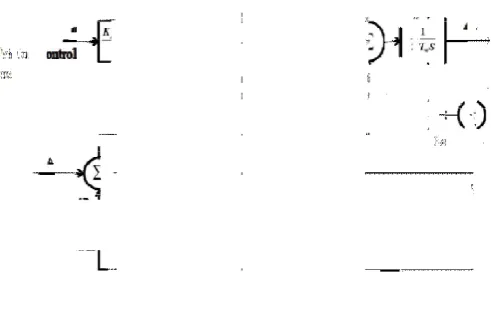
shown in Figure 1. Optimization of the proportional plus integral gains of the blade pitch control mechanism is performed by using the performance index (cost function)
F
F
dt
J
t
0
2 2 2 1
A model which is presented by Anderson (Tripathy et al., , can properly simulate the effect of wind behavior, including gusting, rapid (ramp) changes and background noise. The basic condition for startup and synchronization is that the wind speed is to be within acceptable range and there must be etween the generator voltage and system The diesel dynamics is associated with diesel power. The nature of the dynamic behavior in this model is dominated by the diesel speed governor controller. A ected in such a manner that it can be manually adjusted from zero to maximum value. The purpose of the adjustable power set point is to allow system utility the power setting than the maximum settings of the wind generator. Also it prevents diesel control from dropping to less than 50% of the rated power.
Pitch control has the potential for producing the highest level of interaction because of the presence of both diesel and wind turbine control loops. When wind power rises above the power set point the pitch control system begins operating to maintain an average power equal to the set point. The pitch control system consists of a power measurement transducer, a manual power set point control, a proportional plus integral feedback n, and a hydraulic actuator which varies the pitch of the blades. Turbine blade pitch control has a significant impact on dynamic behavior of the system. This type of control only exists in horizontal axis machines. Variable pitch turbines tly over a wider range of wind speeds than fixed pitch machines. However cost and complexity are higher. Generator dynamics model consists of a synchronous generator driven by a diesel engine through a flywheel and enerator driven by a wind turbine. The diesel generator will act as a dummy grid for the wind generator which is connected in parallel. Variations of electrical power due to changes in wind speed should be as small as possible; this is obtained by using duction generator as a wind turbine drive train. Unlike synchronous generators, induction generators are high compliance couplings between the machine and the electrical system. This is true for induction generators with slip of at Boenig and Hauer 1985; Mohamed ). The controlled variables are turbine speed and shaft torque. Control acts on the turbine blade angle (pitch control), since the torque speed nearly linear in the operating region, torque changes are reflected as speed changes. Therefore, it is possible to provide a single speed controller to control speed as well as torque.
The transfer function model of an isolated wind-diesel hybrid Mohamed Thameem Ansari and Velusami 2013) is 1. Optimization of the proportional plus integral gains of the blade pitch control mechanism is performed by using the performance index (cost function)
[image:2.595.309.555.65.221.2](1)
Fig. 1. Transfer function model block diagram of an isolated wind-diesel hybrid power system
Gravitational Search Algorithm
Gravitational Search Algorithm
a population based search algorithm based on the law of gravity and mass interaction. The algorithm considers agents as objects consisting of different masses. The entire agents move due to the gravitational attraction force acting between them and the progress of the algorithm directs the movements of all agents globally towards the agents with heavier masses. Each agent in Gravitational Search Algorithm is specified by four parameters: Position of the mass in d
mass, active gravitational mass and passive gravitational mass. The positions of the mass of an agent at specified dimensions represent a solution of the problem and the inertia mass of an agent reflect its resistance to make its movement slow. Both the gravitational mass and the inertial mass, which control the velocity of an agent in specified dimension, are computed by fitness evolution of the problem. The positions of the agents in specified dimensions (solutions) are updated with every iteration and the best fitness alon
agent is recorded. The termination condition of the algorithm is defined by a fixed amount of iterations, reaching which the algorithm automatically terminates. After termination of the algorithm, the recorded best fitness at final
the global fitness for a particular problem and the positions of the mass at specified dimensions of the corresponding agent becomes the global solution of that problem.
Consider a system with N agents (masses). The position of the
ith agent is given by
n
i d
i i
i x x x
X 1..., ...,
At a specific time ‘t’, the force acting on mass ‘i’ from mass ‘j’ is given by
) (
) ( * ) ( ) ( ) (
t R
t M t M t G t F
ij aj pi
d ij
where Maj is the gravitational mass related to agent j, M
the passive gravitational mass related to agent I, G(t) is gravitational constant at time t and R
distance between two agents i and j given by:
Fig. 1. Transfer function model block diagram of an isolated diesel hybrid power system
Gravitational Search Algorithm
Gravitational Search Algorithm (Esmat Rashedi et al., 2009) is a population based search algorithm based on the law of gravity and mass interaction. The algorithm considers agents consisting of different masses. The entire agents move due to the gravitational attraction force acting between progress of the algorithm directs the movements of all agents globally towards the agents with heavier masses. Each agent in Gravitational Search Algorithm is specified by
four parameters: Position of the mass in dth dimension, inertia
ational mass and passive gravitational mass. The positions of the mass of an agent at specified dimensions represent a solution of the problem and the inertia mass of an agent reflect its resistance to make its movement slow. Both d the inertial mass, which control the velocity of an agent in specified dimension, are computed by fitness evolution of the problem. The positions of the agents in specified dimensions (solutions) are updated with every iteration and the best fitness along with its corresponding agent is recorded. The termination condition of the algorithm is defined by a fixed amount of iterations, reaching which the algorithm automatically terminates. After termination of the algorithm, the recorded best fitness at final iteration becomes the global fitness for a particular problem and the positions of the mass at specified dimensions of the corresponding agent becomes the global solution of that problem.
Consider a system with N agents (masses). The position of the
For i =1,2,……,N (2)
At a specific time ‘t’, the force acting on mass ‘i’ from mass
( ) ( )
)
t x t
xdj id (3)
is the gravitational mass related to agent j, Mpi is
the passive gravitational mass related to agent I, G(t) is
gravitational constant at time t and Rij(t) is the euclidian
2 ) ( ), ( )
(t X t X t
Rij i j (4)
The total force that acts on agent I in a dimension d be a
randomly weighted sum of dth components of the forces
exerted from other agents.
N
i j j
d ij j d
i t rand F t
F
, 1
) ( )
( (5)
The acceleration of agent i at time t and in direction dth is given by:
) (
) ( ) (
t M
t F t a
ii d i d
i (6)
The next velocity of an agent is considered as a fraction of its current velocity Added to its acceleration. Hence its position and velocity can be calculated by:
) ( * ) ( * )
1
(t rand v t a t
vid i di id (7)
) 1 ( ) ( ) 1
(t x t v t
x id
d i d
i (8)
The gravitational constant G is initialized at the beginning and will be reduced with time to control the search accuracy. G is a function of the initial value (Go) and time (t):
G(t)G(G0,t) (9)
The gravitational and inertial masses are updated by the following equations:
i ii pi
ai M M M
M , i=1, 2,……..,N (10)
) ( )
(
) ( )
( ) (
t worst t
best
t worst t
fit t
mi i
(11)
N
j j i i
t m
t m t M
1
) ( ) ( )
( (12)
For a minimization problem:
( )
min )
(
,... 1
t fit t
best j
N
j
(13)
( )
max )
(
,.... 1
t fit t
worst j
N j
(14)
To improve the performance of GSA by controlling exploration and exploitation, only the Kbest agents will attract
the others. Kbest is a function of time, with initial value Ko at
the beginning and decreasing with time. Equation (5) is modified as
) ( )
(
,
t F rand t
F ijd
i j Kbest j
j d
i
(15)
The algorithm for GSA is explained as follows:
Step1: Search space identification. Step2: Randomized Initialization. Step3: Fitness evaluation of agents.
Step4: Update G(t), best(t), worst(t) and Mi(t) for
i=1,2,…,N.
Step5: Calculation of the total force in different directions. Step6: Calculation of acceleration and velocity.
Step7: Updating agents’ position.
Step8: Repeat steps 3 to 7 until the stop criteria is reached. Step9: End.
Implementation of Gravitational Search Algorithm
The effective application of gravitational search algorithm is to optimize the parameters in optimal pitch control of an isolated wind energy conversion system. The proportional gain
(Kp) and integral gain (Ki) have been optimized to ensure best
performance of the system. The implementation of Gravitational Search algorithm for the design of optimal pitch Controller involves following steps.
1. The objective function (J) is calculated for each set of Kp
and Ki.
2. The objective function value is then mapped into a fitness
value for each set. An appropriate fitness value is obtained using the equation, Fitness= 1/(1+J).
3. When fitness values are found, Gravitational Search
Algorithm proceeds with its algorithmic steps.
These steps are repeated till the termination condition is satisfied and the gain parameter set corresponding to the recorded best fitness is the optimum gain parameter set.
Simulation Results
The Gravitational search algorithm is applied to obtain the optimal pitch controller for the hybrid wind-diesel energy conversion system is obtained. The parameters used for modeling are given in (Rashedi et al., 2010; Esmat Rashedi
et al., 2009). The gains of PI controller are designed by using
classical method and GSA. Performance of each controller is examined from dynamic behavior in time-domain simulations
of the system in isolated mode of operation. The optimal Kp
and Ki values obtained from conventional controller and
Gravitational search algorithm based optimal pitch controller are shown in table 1.
Table 1. Optimal controller parameters
Controller gains Kp Ki J
Conventional controller 7.6 1.5 0.425 GSA based controller 3.66 0.59 0.374
It is observed from table 1 that the cost function value reduces for the optimal gain parameters obtained with GSA tuned
Table 2. GSA control parameters Setting Parameters
N Go α
10 100 10
The closed loop responses of wind frequency deviation, diesel frequency deviation, deviation in wind power generation and deviation in diesel power generation of the wind
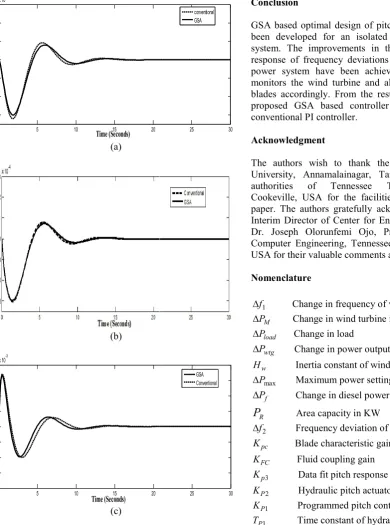
power system obtained using GSA based controller, for a step load change of 0.01 p.u kW, are given in Fig.2. For easy comparison, the responses obtained using conventional controller are also plotted. The results show that the Gravitational Search Algorithm based controller provides less overshoot with better settling time than the conventional PI controller.
(a)
(b)
(c)
0 5 10 15 20
-3 -2 -1 0 1 2
3x 10
-4
Time (Seconds)
Wi
n
d
F
r
e
q
uen
c
y
d
e
v
ia
t
i
o
n
(
H
z
)
0 5 10 15 20
-2 -1.5 -1 -0.5 0 0.5 1 1.5
2x 10
-3
Time (Seconds)
Wi
nd
Po
w
e
r
d
e
v
i
a
t
i
o
n
(
p
.
u.
KW
)
0 5 10
0 0.002 0.004 0.006 0.008 0.01 0.012 0.014
Time (Seconds)
D
i
e
s
e
l
Po
w
e
r
de
v
i
a
t
i
o
n
(
p
.u.
K
W)
GSA control parameters
T 25
[image:4.595.55.446.252.778.2]The closed loop responses of wind frequency deviation, diesel frequency deviation, deviation in wind power generation and deviation in diesel power generation of the wind-diesel hybrid power system obtained using GSA based controller, for a step e of 0.01 p.u kW, are given in Fig.2. For easy comparison, the responses obtained using conventional controller are also plotted. The results show that the Gravitational Search Algorithm based controller provides less han the conventional PI
Fig.2.Closed loop responses of hybrid wind
Conclusion
GSA based optimal design of pitch controller parameters has been developed for an isolated wind
system. The improvements in the quality of the transient response of frequency deviations for the hybrid wind power system have been achieved using a control which monitors the wind turbine and alters the pitch angle of the blades accordingly. From the results, it is observed that the proposed GSA based controller performs better than the conventional PI controller.
Acknowledgment
The authors wish to thank the authorities of Annamalai University, Annamalainagar, Tamil Nadu, India and the
authorities of Tennessee Technological University,
Cookeville, USA for the facilities provided to prepare this paper. The authors gratefully acknowle
Interim Director of Center for Energy Systems Research and Dr. Joseph Olorunfemi Ojo, Professor of Electrical and Computer Engineering, Tennessee Technological University, USA for their valuable comments and suggestions.
Nomenclature
1 f
Change in frequency of wind power
M
P
Change in wind turbine input power
load
P
Change in load
wtg
P
Change in power output of fluid coupling
w
H Inertia constant of wind system, seconds
max P
Maximum power setting
f
P
Change in diesel power
R
P
Area capacity in KW2 f
Frequency deviation of diesel generator
pc
K Blade characteristic gain
FC
K Fluid coupling gain
3
p
K Data fit pitch response gain
2
P
K Hydraulic pitch actuator gain
1
P
K Programmed pitch control gain
1
P
T Time constant of hydraulic pitch actuator
25 30
conventional GSA
25 30
GSA Conventional
15 20 25 30
Time (Seconds)
Conventional GSA
(d)
Fig.2.Closed loop responses of hybrid wind-diesel power system
GSA based optimal design of pitch controller parameters has been developed for an isolated wind-diesel hybrid power system. The improvements in the quality of the transient response of frequency deviations for the hybrid wind-diesel achieved using a control which monitors the wind turbine and alters the pitch angle of the blades accordingly. From the results, it is observed that the proposed GSA based controller performs better than the
e authors wish to thank the authorities of Annamalai University, Annamalainagar, Tamil Nadu, India and the
authorities of Tennessee Technological University,
Cookeville, USA for the facilities provided to prepare this paper. The authors gratefully acknowledge Dr. P. K. Rajan, Interim Director of Center for Energy Systems Research and Dr. Joseph Olorunfemi Ojo, Professor of Electrical and Computer Engineering, Tennessee Technological University, USA for their valuable comments and suggestions.
Change in frequency of wind power Change in wind turbine input power
Change in power output of fluid coupling
Inertia constant of wind system, seconds Maximum power setting
Change in diesel power
Area capacity in KW
Frequency deviation of diesel generator
Blade characteristic gain Fluid coupling gain
Data fit pitch response gain
Hydraulic pitch actuator gain Programmed pitch control gain
REFERENCES
Ayodele T.R. and A.S.O. Ogunjuyigbe, “Wind energy resource, wind energy conversion system modeling and
integration: a survey”, International Journal of
Sustainable Energy, pp. 1-14, 2013.
Bhatti T. S., A. A. F. Al-Ademi, and N. K. Bansal, “Load frequency control of isolated wind diesel hybrid power system”, Energy Conversion Management, vol. 38, no. 9, pp 829-837, 1997.
Boenig H. J. and J. F. Hauer, “Commissioning Tests of the Bonneville Power Administration 30 MJ Superconducting Magnetic Energy Storage Unit”, IEEE Transaction on
Power Apparatus and Systems, vol. 104, no. 2, pp.
302-312, February 1985.
Duman S., U. Guvenç and N. Yorukeren, “Gravitational Search Algorithm for Economic Dispatch with Valve-Points Effects”, International Review of Electrical
Engineering, no. 6, pp. 2890-2895, 2010.
Esmat Rashedi, Hossein Nezamabadi-pour and Saeid Saryazdi, “GSA: A Gravitational Search Algorithm”,
Information Sciences, vol. 179, pp. 2232-2248, 2009.
Hasanien H. M. and S. M. Muyeen, “Design optimization of controller parameters used in variable speed wind energy conversion system by genetic algorithms”, IEEE
Transactions on Sustainable Energy, vol. 3, no.2,
pp.200-208, April 2012.
Mohamed Thameem Ansari M. and S. Velusami, “Design of dual mode linguistic hedge fuzzy logic controller for an isolated wind-diesel hybrid power system with CES unit”,
Engineering Intelligent Systems, vol.21,no.1, pp. 211-235,
2013.
Rashedi E., H. Nezamabadi-pour and S. Saryazdi, “BGSA:
Binary Gravitational Search Algorithm”, Neural
Computing, vol. 9, no. 3, pp. 727-745, September 2010.
Rashedi E., H. Nezamabadi-pour, S. Saryazdi , “ Dynamic and stability af a hybrid wind diesel power system”,
Energy Covversion Management, vol. 33, no. 12, pp.
1063-1072, 1992.
Scott G.W., V.F. Wilreker and R.K. Shaltens, “Wind Turbine Generator Interaction with Diesel Generators on an Isolated Power System”, IEEE Transaction on Power
Apparatus and Systems, vol.103, no.5, pp. 933-937, May
1984.
Shashi Kant Pandey, R. Soumya, N. Mohanty and Kishor, “A
literature survey on load–frequency control for
conventional and distribution generation power systems”,
Renewable and Sustainable Energy Reviews, vol. 25, pp.
318-334, September 2013.
Tripathy S. C., M. Kalantar and R. Balasubramanian, “Dynamics and stability of wind and diesel turbine generators with superconducting magnetic energy storage unit on an isolated power system,” IEEE Transactions on
Energy Conversion, vol. 6, no.4, pp. 579-585, December
1991.