Journal of Chemical and Pharmaceutical Research
__________________________________________________
ISSN No: 0975-7384 CODEN(USA): JCPRC5
J. Chem. Pharm. Res., 2011, 3(1):501-507
501
Ziprasidone as a corrosion inhibitor for zinc in different acid medium
B.S. Shylesha1, T.V. Venkatesha1* and B. M. Praveen2
1
Department of PG Studies and Research in Chemistry, School of Chemical Sciences, Kuvempu University, Shankaraghatta, India
2
Department of Chemistry, Srinivas School of Engineering, Mukka, Mangalore, India
______________________________________________________________________________
ABSTRACT
Inhibition effect of Ziprasidone on the corrosion of zinc in 0.1 M HCl and 0.05 M H2SO4 was
studied by using Weight loss, Tafel polarisation and electrochemical impedance spectroscopy (EIS) methods. Both chemical and electrochemical results indicated that Ziprasidone is an efficient inhibitor. Weight loss method was used to assess the effect of temperature on corrosion of zinc in different medium. Electrochemical and chemical methods results were agreeing each other.
Key words: Acid solutions, zinc, polarization, weight loss, inhibitor.
______________________________________________________________________________
INTRODUCTION
Zinc is an active metal with numerous industrial applications and its coatings is largely used for the protection of steel. In humid atmosphere the zinc coated articles get corroded and thus the service life of articles gets reduced. To avoid the zinc corrosion generally a coating of passive layer is given to its surface. The chromation is one such method wherein the surface of zinc is exposed to chromate solution for few seconds. The chromate solutions have been applied
successfully to protect zinc surface from white rust [1]. But the strict regulation on the
environment restricts the use of chromate solution since chromium element being toxic in nature. The chromate passivation is an industrial process and this has to be replaced with non-toxic solution, which exhibits the same protection as that of chromate solution [2].
502
nature as corrosion inhibitors for zinc [3-5]. Most of these organic compounds are adsorbed on the metal surface and provide a barrier between metal and environment, thereby reducing the rate of corrosion. The effectiveness of inhibition depends on the nature and surface charge of the metal, the nature of the medium, the nature and chemical structure of the inhibitor molecule
such as functional groups, aromaticity, the п orbital character of the donating electron, steric
factor, and electron density at the donor atoms [6-7].
Ziprasidone hydrochloride-Synonym-Ziprasidone (marketed as Geodon, Zeldox), an antipsychotic, Food and Drug Administration (FDA) approved drug for the treatment of schizophrenia. It has many potential characters to function as an inhibitor. Six hetero atoms, each
with lone electron pairs [8-9], π electron rich three aromatic rings, fair molecular size and quite
good planarity to wrap sufficient metal surface. It contains both N and S hetero atoms. In the present work, we were intended compare the role of Ziprasidone on corrosion of zinc in 0.1 M
HCl and 0.05 M H2SO4solution using weight loss, Tafel polarization and electrochemical
impedance spectroscopy(EIS) techniques.
EXPERIMENTAL SECTION
The inhibitor used in this experiment was Ziprasidone. The structure was shown in Fig. 1. The
treatment solution is different concentration of inhibitor in 0.1 M HCl and 0.05 M H2SO4. All the
chemicals used were of AR grade (sd. fine chemicals Ltd., Mumbai) and doubly distilled water was used for the preparation of solutions. All the tests have been conducted in an aerated and unstirred solution. The pure zinc plate (Cu=0.185%, Al=0.006%, Fe=0.004%, Mn=0.3%, Sn=0.003%, Pb=0.002%, Cd=0.002% and the rest zinc) were used. Zinc sheets having rectangular shape with an exposed area of 2 cm x 4 cm x 1 cm were used for the corrosion rate measurements. The samples were first degreased with trichloroethylene, grounded with different grades of emery papers, washed with water and rinsed with alcohol. The dried and weighed
samples were placed in 50cm3 of 0.1M HCl and 0.05 M H2SO4 solutions with and without
inhibitors for a period of 2 hours at 298 K. Runs were also done at different temperatures (308 & 318 K). Duplicate experiments were performed in each case and the mean value of the weight loss was noted. Inhibition efficiency (IE %) were calculated.
Fig. 1. Structure of inhibitor (Ziprasidone)
The polarization studies were carried out for zinc strips having an exposed area of 1 cm2. The
503
Electrochemical measurements were carried out using CHI 660C electrochemical analyzer (USA make). The polarization curves were potentiodynamically obtained at open circuit potential
(OCP) with a scan rate of 1mVs-1. Initially the potentials were scanned in the cathodic direction
from the corrosion potential and consequently in the anodic direction.
The impedance measurements were carried at OCP in the frequency range 1 mHz to 100 kHz
with 5 mV sine wave as the excitation signal. The interfacial double layer capacitance (Cdl) and
charge transfer resistance (Rct ) values were calculated from Nyquist plots.
RESULTS AND DISCUSSION
Mass loss measurements
The Table 1 shows the inhibition efficiencies and surface coverage (θ) obtained from mass loss
method at different concentrations of inhibitors in different corrosive medium at different temperature. The inhibition efficiency was calculated from the following relationship.
Wu - Wi
Inhibition efficiency (IE), ηML = X 100
Wu
where, Wu and Wi are the average weight-losses of test sample after immersion in corrosive
solutions with and without inhibitor, respectively.
The variation of % ηw with different concentration of Ziprasidone, for 2 hrs of immersion time at
30 ºC. Ziprasidone has remarkable inhibitive ability, both in HCl and H2SO4 media.
[image:3.595.60.543.611.731.2]Table 1 corrosion parameters for zinc in different acid media at different temperature obtained from mass loss measurements
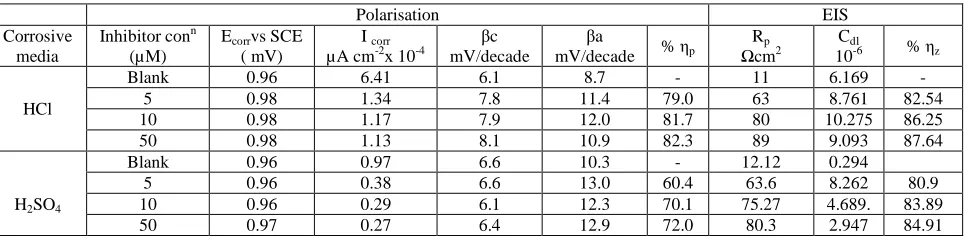
Table 2 Electrochemical corrosion parameters for zinc in different acid media obtained from polarization and impedence method.
Corrosive Media
Inhibitor Concentration
% ηw at different temperature
µM 30º C 40º C 50º C 60º C
HCl
Blank - - - -
5 80.2 70.9 58.3 50.0 10 83.1 71.4 65.0 54.7 50 85.6 72.3 66.6 60.1
H2SO4
5 61.2 55.9 46.4 36.7 10 71.3 60.1 49.3 40.0 50 72.0 68.6 52.9 45.0
Polarisation EIS
Corrosive media
Inhibitor conn (µM)
Ecorrvs SCE
( mV)
I corr
µA cm-2x 10⁻⁴
βc mV/decade
βa
mV/decade % ηp
Rp
Ωcm2
Cdl
10-6 % ηz
HCl
Blank 0.96 6.41 6.1 8.7 - 11 6.169 - 5 0.98 1.34 7.8 11.4 79.0 63 8.761 82.54 10 0.98 1.17 7.9 12.0 81.7 80 10.275 86.25 50 0.98 1.13 8.1 10.9 82.3 89 9.093 87.64 Blank 0.96 0.97 6.6 10.3 - 12.12 0.294
H2SO4
504
To examine the action of inhibitors at elevated temperatures, weight loss experiments were
carried out at different temperature keeping immersion time at 2 hr. The variation of % ηw with
temperature is shown Table 1. It indicated that % ηw, for both acids, decrease with the increase of
temperature meaning that inhibitor molecules may be physisorbed on metal surface.
Polarization studies
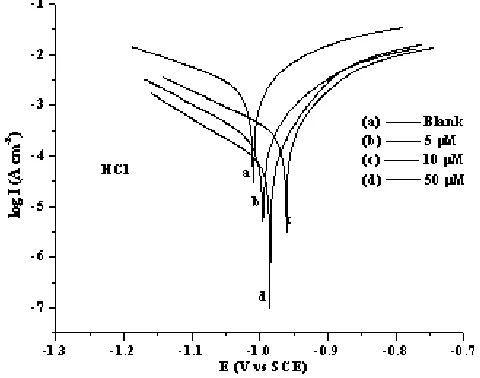
The polarization studies of zinc specimens were carried out in 0.1 M HCl and 0.05 M H2SO4
solutions separately in absence and presence of different concentrations of inhibitor and those are
given in Fig. 2 and 3. The inhibition efficiency (ηpol) was calculated using the relationship:
Where Iocorr and Icorr are the corrosion current densities in absence and presence of inhibitor
respectively. In the presence of inhibitor, the cathodic and anodic curves are shifted and the extent of shift depends on inhibitor concentration. The polarization curves in absence of inhibitor show that the current density in the anodic region increases rapidly indicating extensive
dissolution of metal. The polarization parameters such as corrosion potential (Ecorr)and corrosion
current density (Icorr) obtained by extrapolation of the Tafel lines are listed in Table 2. In
presence of inhibitor, there is a marginal shift in Ecorr and a decrease in Icorr. The inhibitor present
on the surface of metal hinders the attack of corrosive medium, and thereby reduces the I corr. The
[image:4.595.178.418.462.651.2]value of %IE increased with increase in inhibitor concentration, which indicates higher surface coverage of the metal. Corrosion potential values indicated that inhibitor acts as mixed type of inhibitor in both the acid medium.
Fig. 2. Polarization profile of zinc in presence of different concentration of inhibitor in HCl medium
η Icorr
o I
corr
Iocorr
505
[image:5.595.175.420.427.626.2]Fig. 3. Polarization profile of zinc in presence of different concentration of inhibitor in HCl medium
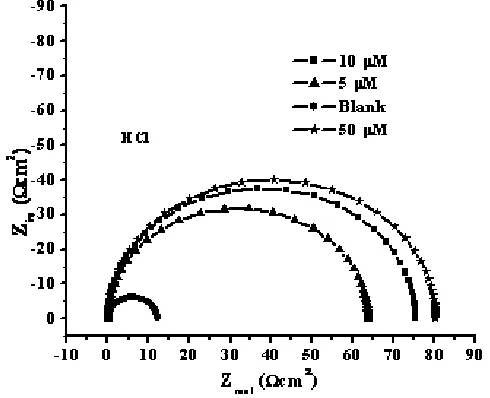
Fig . 4 Nyquist plots for zinc in HCl containing different concentrations of inhibitor.
Electrochemical impedance spectroscopy (EIS)
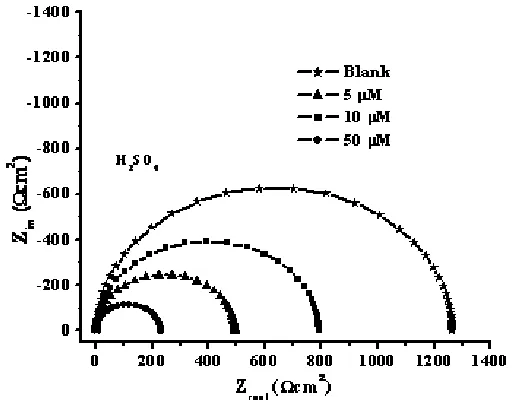
Nyquist plots for zinc in 0.1 M HCl and 0.05 M H2SO4 with different concentration of inhibitor
are shown in Fig. 4 and 5. It was evident from these plots that the impedance response of zinc Polarization resistance is unequivocally to the corrosion current density in relatively simple corrosion
systems characterized by a charge transfer controlled process [10]. The results show Rct values to
-1.050 -1.025 -1.000 -0.975 -0.950 -0.925 -0.900 -7
-6 -5 -4 -3 -2
d c
b a
L
o
g
I
(
A
cm
-2
)
E (V v/s SCE)
(a) Blank
(b) 5 µµµµM
(c) 10 µµµµM
506
increase with treatment time. Since Rct is inversely proportional to the corrosion current and it
can be used to calculate the inhibition efficiency (ηE I S %) from the relation [11]
where Rctand RctI are the charge transfer resistances in the presence and absence of inhibitors. It
should be noted from Table 3 that charge transfer resistance values increases with increase in inhibitor concentration, and the decrease in capacitance values indicated the formation of a surface film. The equivalent circuit of the system is a classical Randles circuit, with a parallel
[image:6.595.170.426.270.476.2]capacitor (c) resistor (RP) in series with another resister (RS)
Fig . 5 Nyquist plots for zinc in H2SO4 containing different concentrations of inhibitor
CONCLUSION
Ziprasidone. reduced the corrosion rate of zinc considerably in both HCl and H2SO4 medium.
The IE% resulted from electrochemical and weight loss measurements were in good agreement. The rate of corrosion decreased with inhibitor concentration and increased with temperature.
These results show that Ziprasidone are good corrosion inhibitor for zinc in HCl and H2SO4
medium.
REFERENCES
[1] B RW Hinton; L Wilson. Corros. Sci., 1989, 29, 967
[2] M Ihara; H Nishahara; K Aramaki. Denki Kagaku., 1992, 60, 500
[3] GA El-Mahdy; SS Mohmoud. Bull. Electrochem., 1995, 11(5), 222
[4] AG Gad Allah; MM.Hefny; SA Salih; MS El-Basiouny. Corrosion., 1998 574
[5] L Rodney; Leroy. Corrosion., 1978 NACE 98
[6] E Stupnisek- Lisac; M Metikos-Hukovia. Br Corros J., 1993, 28, 74
X 100 ηEIS =
Rct I Rct- Rct
507
[7] S Tamil Selvi; V Raman; N Rajendran. J Appl Electrochem., 2003 33, 1175
[8] F Bentiss; M. Traisnel; N Chaibi; B Mernari; H Vezin; M Lagrenée. Corros. Sci., 2002, 44,
2271–2289
[9] S. Ramesh, S. Rajeswari. Electrochim. Acta., 2004, 49, 811–820
[10]Mikhail Yu Vagin; SA Trashin; AA Karyakin. Electrochem. Comm., 2006, 8, 60