A ROBUST ESTIMATION METHOD OF LOCATION AND SCALE WITH APPLICATION IN MONITORING PROCESS VARIABILITY
ROHAYU BT MOHD SALLEH
A thesis submitted in fulfilment of the requirements for the award of the degree of
Doctor of Philosophy (Mathematics)
Faculty of Science Universiti Teknologi Malaysia
ABSTRACT
This thesis consists of two parts; theoretical and application. The first part proposes the development of a new method for robust estimation of location and scale, in data concentration step (C-step), of the most widely used method known as fast minimum covariance determinant (FMCD). This new method is as effective as FMCD and minimum vector variance (MVV) but with lower computational complexity. In FMCD, the optimality criterion of C-step is still quite cumbersome if the number of variables p is large because of the computation of sample generalized variance. This is the reason why MVV has been introduced. The computational complexity of the C-step in FMCD is of order O p
( )
3 while MVV is O p( )
2 . This is avi
ABSTRAK
Tesis ini mengandungi dua bahagian; teori dan aplikasi. Bahagian pertama mencadangkan pembangunan kaedah baru untuk penganggaran teguh lokasi dan skala, dalam langkah penumpuan data (C-langkah), dari kaedah yang paling digunakan secara meluas dikenali sebagai penentu kovarians minimum cepat (FMCD). Kaedah baru ini efektif seperti FMCD dan varians vektor minimum (MVV) tetapi kerumitan pengiraannya adalah rendah. Dalam FMCD, secara optimum kriteria bagi C-langkah masih agak rumit jika bilangan pembolehubah p adalah besar disebabkan pengiraan sampel varians teritlak. Inilah alasan mengapa MVV diperkenalkan. Kerumitan pengiraan C-langkah dalam FMCD adalah peringkat O p
( )
3 manakala MVV adalah O p( )
2 . Ini adalah satu peningkatan yangTABLE OF CONTENTS
CHAPTER TITLE
DECLARATION DEDICATION
ACKNOWLEDGEMENTS ABSTRACT
ABSTRAK
TABLE OF CONTENTS LIST OF TABLES LIST OF FIGURES
PAGE
ii iii iv v vi vii xi xiii
1 INTRODUCTION
1.1 Background of the Problem 1.2 Problem Statement
1.3 Research Objective and Problem Formulation 1.4 Scope of Study
1.5 Thesis Organization 1.6 Contribution of the Study
1 6 7 8 8 9
2 LITERATURE STUDY
2.1 Multivariate Outlier Identification
2.2 Evolution of Robust Estimation in High Breakdown Point
2.3 High Breakdown Point Robust Estimation Methods 2.4 Scenarios in Monitoring Process Variability
11
viii
2.4.1 Individual Observation-Based Monitoring 2.4.2 Opportunity for Improvement
2.5 Summary
17 18 18
3 UNDERSTANDING PROCESS VARIABILITY
3.1 Structure of Covariance Matrix
3.2 Understanding the Role of Generalized Variance 3.3 Understanding the Role of Vector Variance 3.4 Critiques to Data Concentration Process 3.5 Summary
20 22 27 28 29
4 PROPOSED ROBUST METHOD
4.1 Theoretical Foundation of FMCD and MVV 4.1.1. Fast Minimum Covariance Determinant (FMCD)
4.1.2 Minimum Vector Variance (MVV) 4.2 Critiques on FMCD and MVV
4.2.1 Computational Complexity 4.2.2 Optimality Criterion of FMCD 4.2.3 Convergence of MVV
4.3 Proposed Robust Method
4.3.1 First Stopping Rule; Covariance Matrix Equality (CME)
4.3.2 Second Stopping Rule; Index Set Equality (ISE)
4.3.3 Non-singularity Problem 4.4 Performance of CME and ISE
4.4.1 Computational Complexity 4.4.2 Special Case
4.5 Summary
30 31 33 34 35 36 37 41 42 43 43 44 44 46 46
5 ROBUST MONITORING PROCESS VARIABILITY
5.1.1 Implementation of the Proposed Method 5.1.1.1 Based on CME
5.1.1.2 Based on ISE
5.1.2 Distribution of T2 Statistic From MANOVA Point of View
5.1.3 The Size of HDS in Phase I 5.1.4 Multivariate Normality Testing
5.2 Monitoring Process Variability in Phase II Operation 5.2.1 Wilks’ W Statistic
5.2.2 Djauhari’s F Statistic
49 49 50 51 53 57 58 58 62
6 SENSITIVITY ANALYSIS
6.1 Simulation Process
6.1.1 Detection of Out of Control Signal by W chart and F Chart
6.1.2 False Negative Detection of W chart and F Chart
6.2 Root Causes Analysis
6.2.1 The Root Causes Analysis in W Chart 6.2.2 The Root Causes Analysis in F Chart 6.3 Summary
64 65 78 84 85 85 87
7 CASE STUDY
7.1 Production Process As Examples 7.2 Female Shrouded Connector 7.3 Spike
7.4 Beltline Moulding 7.5 Summary
88 89 100 108 113
8 CONCLUSIONS AND DIRECTION OF FUTURE
RESEARCH
8.1 Conclusions
8.1.1 First Issue: Robust Estimation Method
x
8.1.2 Second Issue: Robust Monitoring Process Variability
8.1.1.1 Phase I Operation 8.1.1.2 Phase II Operation 8.2 Direction of Further Research
115 116 116 119
REFERENCES Appendices A-D
LIST OF TABLE
TABLE NO TITLE
4.1 Ratio of required running time 4.2 MCD set
4.3 Ratio of running time of proposed methods 5.1 Sample size of approximate distribution
6.1 Percentage of out of control signal detected by W and F charts for p=2 based on RS = 30
6.2 Percentage of out of control signal detected by W and F charts for p=2 based on RS = 100
6.3 Percentage of out of control signal detected by W and F charts for p=3 based on RS =40
6.4 Percentage of out of control signal detected by W and F charts for p=3 based on RS = 100
6.5 Percentage of out of control signal detected by W and F charts for p=3 based on RS = 40 for mix correlation structure
6.6 Percentage of false negative detected for ( , )p n =(2, 30)and (2,100)
6.7 Percentage of false negative detected for ( , )p n =(3, 40)and (3,100)
6.8 Percentage of false negative detected for ( , )p n =(3, 40) based on mix correlation structure
7.1 W statistic
PAGE
36 40 45 54 66
67
71
73
76
79
81
83
xii
7.2 Illustration on computation of W statistic 7.3 F statistic
7.4 Illustration on computation of F statistic
7.5 Complete decomposition of W statistic for sample 5 7.6 Observations detected as out of control
7.7 Summary statistics
7.8 Summary statistics of ADS
7.9 Complete decomposition of W statistic 7.10 Complete decomposition of F statistic 7.11 W statistic and F statistic of beltline process
LIST OF FIGURES
FIGURE NO TITLE PAGE
1.1 Elliptical control region versus rectangular control region 3
3.1
The 3-d plotting for covariance matrix, 1 4 0 0 4
Σ =
23
3.2
The 3-d plotting for covariance matrix, 2 5 3 3 5
Σ =
24
3.3
The 3-d plotting for covariance matrix, 3
5 3
3 5
−
Σ = −
24
3.4
Surface view for 1 4 0 0 4
Σ =
25
3.5
Surface view for 2 5 3 3 5
Σ =
25
3.6
Surface view for 3 5 3
3 5
−
Σ = −
26
3.7 Parallelotope with three principal edges 27
4.1 The value of covariance determinant (a) and vector variance (b) in each iteration, for p=2
38
4.2 The value of covariance determinant (a) and vector variance (b) in each iteration, for p= 4
38
4.2 The value of covariance determinant (a) and vector variance (b) in each iteration, for p=8
xiv
5.1 Approximate Distribution Plot of 2 p
χ for p=2 andn=30 55 5.2 Approximate Distribution Plot of 2
p
χ for p=3 and n=30 55 5.3 Approximate Distribution Plot of 2
p
χ for p=3 and n=40 56 5.4 Approximate Distribution Plot of 2
p
χ for p=5 and n=60 56 5.5 Approximate Distribution Plot of 2
p
χ for p=7 and n=70 57 6.1 Graphical representation of Table 6.1 and Table 6.2 69 6.2 Graphical representation of Table 6.3 and Table 6.4 74 6.3
6.4
Graphical representation of Table 6.5 Visual representation of Table 6.6
78 79 6.5
6.6
Visual representation of Table 6.7 Visual representation of Table 6.8
83 84 7.1 Two dimensional picture of female shrouded connector 89
7.2 Technical drawing of FSC (side view) 90
7.3 Technical drawing of FSC (cross section view) 91
7.4 QQ plot for HDS in Phase I 92
7.5 Robust Phase I Operation 93
7.6 Classical Phase I Operation 94
7.7 W chart of robust Phase I 96
7.8 7.9
F chart of robust Phase I
W chart based on non-robust Phase I
97 98 7.10
7.11 7.12
F chart based on non- robust Phase I Picture of spike in medical industry
Technical drawing (cross section hole view)
98 100 100
7.13 Technical drawing of spike (side view) 101
7.14 QQ plot for HDS in Phase I 101
7.15 Robust Phase I operation 102
7.16 7.17
Classical Phase I operation W chart
103 104
7.18 F chart 104
7.19 QQ plot for HDS 109
7.21 Classical Phase I Operation 111
7.22 W chart based on robust Phase I 112
7.23 F chart based on robust Phase I 112
8.1 Procedure of robust monitoring process variability for individual observation
CHAPTER 1
INTRODUCTION
The aim of this chapter is to introduce the importance of this research. In Section 1.1, the background of the problem will be discussed followed by the statement of problem in Section 1.2. In the section which follows, the research objective and problem formulation will be presented. The scope of the study, thesis organization and the contribution of the study will be presented in Section 1.4, Section 1.5 and Section 1.6, respectively.
1.1 Background of the Problem
There is a quantum leap in modern manufacturing industries when ‘surpass customer expectation’ becomes a philosophy of quality since late 1990s. Industries believe that the importance to stay competitive is by producing not only high quality of process and products but also a creative, innovative and useful with pleasing unexpected features (Djauhari, 2011a). However, those criteria are not likely to be static, and will certainly be changed based on time and demands.
important as monitoring the process mean. However, the effort to manage the process variability is far harder than managing the process mean or, equivalently, process level.
Since the customer demands become more and more complex, the term quality must be considered as a complex system. Statistically, this means that quality is a multivariate entity. Consequently, process quality monitoring must be in multivariate setting. Practically, the quality of the production process is determined by several quality characteristics, of which some or all are correlated. Therefore, since the correlations among characteristics must be taken into consideration, it is not allowed to control each characteristic individually.
In multivariate setting, one of the most widely used control methods and procedures to monitor the process level is based on Hotelling’s T2-statistic. The advantages of this method are (i) this statistic is powerful tool useful in detecting subtle system changes (Mason and Young, 2001), (ii) relatively easy to use (Djauhari, 2005), (iii) appealing to practitioners because of its similarity to Shewhart type charts (Prins and Mader, 1997), (iv) reasonable approach (Sullivan and Woodall, 1996) and, (v) T2 is an optimal test statistic for detecting a general shift in the process mean vector (Mason et al., 1995).
3
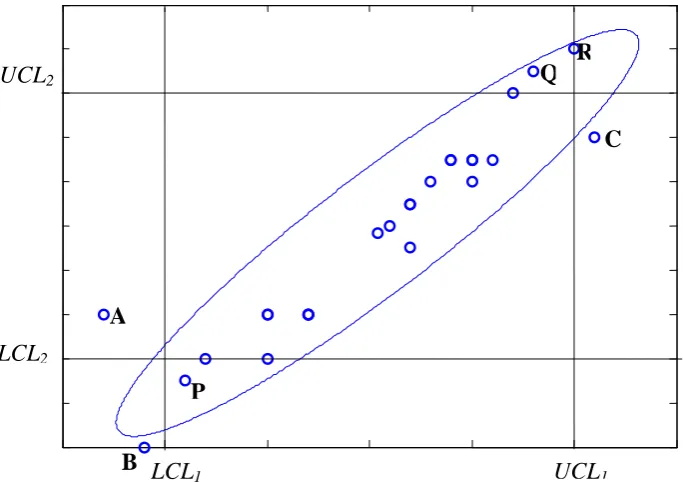
[image:15.595.136.478.343.584.2]In univariate setting, as can be found in any standard book of statistical process control, when only one quality characteristic is involved, process variability is monitored by using MR, R, S or S2 control charts. But, when the number of quality characteristics, p, is more than one and the correlations among them are to be considered, then a multivariate chart is required. There is a great potential for misleading results if univariate chart is used for each characteristics especially of receiving a false alarm or not receiving a signal when the multivariate process is out-of-control. This is illustrated in Figure 1.1, where two quality characteristics that are positively correlated are monitored individually. In that figure, LCLi and UCLi are the lower control limit and upper control limit for the i-th characteristics; i=1, 2. Horizontal axis is for the first characteristic while the vertical axis is for the second.
Figure 1.1 Elliptical control region versus rectangular control region
A few points inside the ellipse are in the state of in-control even though they are detected as out-of-control by using univariate chart for each characteristic. There are also three points A, B and C outside the rectangular control region and ellipse control region, representing significant out-of-control. However, univariate charts can easily fail to detect the potential signal. See the points P, Q and R. This is the danger of monitoring multiple correlated quality characteristics in univariate way.
Q
C
A
R
P
B LCL1 UCL1
Controlling all characteristics one by one is not allowed because of their correlations. Therefore, the requirement to monitor all characteristics simultaneously is demanded in current manufacturing industries. See also Montgomery (2005), Mason and Young (2002) and Ryan (2011) for further discussions.
Construction of control chart generally carried out in two phases; Phase I and Phase II. Phase I is a cleaning process of historical data set (HDS); abnormal or outlier data points examined and remove from the HDS to obtain the reference sample (RS). The existence of those data points may be caused by tools, machines, or human errors. Based on classical method as explained in Tracy et al. (1992), Wierda (1994), and Mason and Young (2001), any data points that lies beyond the control limits is removed after investigation for cause; otherwise they are retained. The process is continued until a homogeneous data set is obtained. This data set becomes the RS and provides the estimates of location and scale to be used for monitoring future observations in Phase II.
In practice, there is a certain situation in Phase I operation where outliers are undetected. It is because the use of classical method, i.e., Hotelling’s T2 statistic, is powerful when there is only one outlier exist (Hadi, 1992) but as explained by Sullivan and Woodall (1996, 1998), Vargas (2003) and Yanez et al., (2010), it will performs poorly when multiple outliers are present. This latter situation as explained by Rousseeuw and van Zomeren (1990, 1991), Hadi (1992), Vargas (2003), Hubert et al. (2008) and Hadi et al. (2009) is usually due to masking and or swamping problems. In masking problem, outliers are considered as clean data points. Conversely, in swamping problem, clean data points are declared as outliers.
5
against the presence of outliers. Robustness of estimators is often measured by the breakdown point (BP) introduced by Donoho and Huber (1983). Maronna et al. (2006) defined the BP of an estimate ˆθ of the parameter θ is the largest amount of contamination such that the data still give information about θ. The higher the BP of an estimator, the more robust it is against outliers. The BP of the classical estimates is 1
n which means that even one outlier will ruin the estimates.
There are many different robust estimation methods for location and scale. The most popular and widely used high breakdown robust parameter estimation method is the so-called Fast Minimum Covariance Determinant (FMCD). It has the properties that the estimates are of high degree of robustness, has bounded influence function which ensures that the presence of outliers can only have a small effect on an estimator, and affine equivariant which ensures that any affine transformation does not affect the degree of its robustness.
As mentioned by Neykov et al. (2012), a recent development known as Minimum Vector Variance (MVV) has been introduced by Herwindiati et al. (2007). It is a refinement of data concentration step in FMCD developed for computational need. Meanwhile, Wilcox (2012) described MVV as a variation of the MCD estimator that searches for the subset of the data that minimizes the trace of the corresponding covariance matrix rather than determinant. However, it should be written as follows ‘minimizes the trace of squared of the covariance matrix’. Both FMCD and MVV consists of two steps; (i) to order p dimensional data points, p > 1, in the sense of centre-outward ordering, and (ii) to find the most concentrated data subset, called MCD set in the literature.
variance is only O p
( )
2 . Although MVV gives a significant improvement in terms of computational efficiency (Herwindiati et al, 2007), the optimal criterion is still superfluous because covariance matrix is symmetric, each upper (or lower) diagonal element is computed twice. Furthermore, our simulation experiments show that the minimum of vector variance could be attained long before the convergence is reached. Therefore, specifically, in terms of computational efficiency, there is a need to find another criterion which ensures the faster running time. This is the first challenging problem that concerns Phase I operation.On the other hand, concerning Phase II operation, most researchers are focused on monitoring process variability without passing through Phase I operation. This means that the initial covariance matrix Σ0 is known which is not always the case in practice. There are very limited studies that concern on the case where Σ0 is unknown which means that Phase I operation is a must to determine RS and estimate
0
Σ . Those who are working in this case are Mason et al. (2009) who used Wilks’ W statistic and Djauhari (2010, 2011b) who proposed squared of Frobenius norm F statistic to monitor process variability in Phase II. Since, these statistics are defined to measure the effect of an additional observation on covariance structure based on different tools, they cannot be used individually. This is the second challenging problem that concerns Phase II operation to construct more sensitive monitoring procedure.
1.2 Problem Statement
7
In Phase I operation:
i. Develop a high breakdown point robust estimation method of location and scale giving the same robust Mahalanobis distance as FMCD and MVV but with lower computational complexity.
ii. Construct a tool for multivariate normality testing. In Phase II operation:
i. Construct a more sensitive Phase II operation by using both Wilks’ W statistic and Djauhari’s F statistic separately.
ii. Construct a tool to identify the root causes of an out-of-control signal, i.e., to identify which quality characteristics that contribute in that signal.
1.3 Research Objective and Problem Formulation
This thesis consists of two parts: theoretical and application. The principal objective of the first part is to find a better optimal criterion with lower computational complexity and giving the same result as FMCD and MVV.
The second part is the application of the proposed criterion in monitoring multivariate process variability based on individual observations. To achieve that, the main objective is to construct a control procedure that combine
i. the high breakdown point robust location and scale estimates in the Phase I operation based on the proposed criterion
ii. a more sensitive Phase II operation.
1.4 Scope of the Study
The scope of study can be divided into 3 aspects. 1. Theoretical aspect
This aspect covers:
i. Multivariate data ordering in the sense of centre-outward ordering based on Mahalanobis distance and multivariate data concentration in FMCD and MVV algorithms.
ii. Two new optimal criteria in order to reduce the computational complexity of data concentration process.
iii. A simulation study to show that the new algorithm produces the same robust Mahalanobis squared distance as FMCD and MVV algorithms. iv. Mathematical derivations of the exact distribution of T2in Phase I and
Wilks’ W statistic in Phase II.
v. A study of the sensitivity analysis of Phase II operation. 2. Computational aspect
From computational point of view, the scope covers:
i. Simulation experiments to show that proposed method produces the same MCD set compared to FMCD and MVV but with higher computational efficiency.
ii. Simulation experiments to study the sensitivity analysis of Phase II operation.
3. Practical aspects
Application in real industrial problem to show the advantages of the method developed in this thesis.
1.5 Thesis Organization
9
research is defined. The scope of study is presented. The contribution of the research is stated at the end of Chapter 1. Chapter 2 covers the literature review. The existing theory of robust estimation methods and the evolution of ideas in high breakdown point robust estimation methods are presented.
Later on in Chapter 3, critiques to data concentration process in FMCD will be delivered. Furthermore, in Chapter 4, a new robust method with lower computational complexity will be proposed. A new algorithm of robust estimation method is developed. An application of the proposed high breakdown robust estimation method in Phase I of monitoring process variability based on individual observations will be discussed in Chapter 5. The procedure of control charting by using W statistic and F statistic in Phase II will be presented and the relationship between Hotelling’s T2 statistic and W statistic will be showed.
In order to show the performance of both statistics, in Chapter 6 a sensitivity analysis in terms of the percentage of outlier detection and the percentage of false positive and false negative will be presented and discussed. The root causes analysis in order to identify the variables that contribute to an out-of-control signal will be conducted. By using real industrial data, the sensitivity to the change of covariance structure of both W and F control chart will be demonstrated in Chapter 7. Chapter 8 concludes the research results followed by a discussion and recommendations for further improvements.
1.6 Contribution of the study
The contributions of this research can be classified into two parts as follows:
Contribution to the country:
the results and findings from this thesis will be useful for the practitioners in Malaysia manufacturing industries to control and monitor their product and process.
Contribution to the field:
The contribution to the fields of robust statistics and statistical process control can be described into two aspects:
1. Theoretical impact: The novelty of this thesis can be described as follows. i. Since MVV is computationally simpler than FMCD (Wilcox, 2012) and
MVV is refinement version of FMCD (Neykov et al., 2012), in this thesis the process of C-step will be refined. Then, a new optimality criterion is developed.
ii. Simulation experiments show that the result of the proposed method in terms of running time is far better than FMCD and even better than MVV.
iii. Pedagogically, the proof given by Wilks (1962, 1963) for the distribution of W is still difficult to digest. In this thesis, that distribution will be derived by using MANOVA point of view.
iv. The relationship between W and T2 statistics is derived. v. A new test for multivariate normality is introduced.
vi. Simulation experiment show that Djauhari’s F statistic is more sensitive than Wilks’ W statistic to the change of covariance structure in terms of false positive and false negative.
vii. A root cause analysis of an out-of-control signal for F chart is proposed. The root causes analysis of W chart can be found in Mason et al. (2010). 2. Manufacturing industrial aspect.
CHAPTER 2
LITERATURE STUDY
If the previous chapter explained about the idea behind this research, in this chapter the literature study of some previous developments and contributions by other researchers is presented. This chapter will cover two main ideas, namely the development of robust estimation method and the development of monitoring process variability. Since both ideas are closely related with outlier issues, then in Section 2.1 the discussion is started with multivariate outlier identification. In Section 2.2, the evolution of robust estimation in high breakdown point will be presented, followed with high breakdown point robust estimation methods and its current development in Section 2.3. Then, Section 2.4 will focus on the discussion of the current scenarios in monitoring process variability. At the end, the state of the art in this thesis will be stated clearly.
2.1 Multivariate Outlier Identification
setting is a very important topic in statistical research. In practice, the inconsistency (Barnett and Lewis, 1984) and abnormality (Gladwell, 2008) of outliers compared to the bulk of data, are not easy to be formulated in general situation because outliers cannot be showed up by using simple visual inspection (Hubert et al., 2008).
Various procedures in identifying outliers both in the univariate case and multivariate case are being introduced from time to time. For instance, in the univariate case, Thomson (1935) proposed a measuring tool to see the ratio between the deviations from its mean and sample standard deviation. Based on the philosophy of Thomson’s statistic, Grubbs (1950), Tietjen and Moore (1972) and Rosner (1975) developed the measure to detect outliers. Grubbs (1950) proposed a statistic to test the largest or smallest data that is suspected as outliers. Tietjen and Moore (1972) developed Grubbs’s research to test k k
(
≥1)
extreme data that deviated away from the group of the other(
n k−)
data simultaneously through the gap. Then, Rosner (1975) introduced generalized extreme studentized deviation (ESD) which is developed from the idea of Tietjen and Moore (1972) to test several outliers simultaneously. Tukey method (1977) considered the data outside a fence as ‘unclean data’ is usually used to label outlier suspects. Then, a development of ESD can be seen in Iglewicz and Hoaglin (1993) and an exact procedure is proposed by Djauhari (1999). The exact critical points of ESD were given by Djauhari (2003) through an inverse beta function.13
However, Mahalanobis distance is very sensitive to the masking and swamping effects (Hubert et al. (2005, 2008) and Hadi et al. (2009)). To handle this problem, the method of robust estimator introduced by Huber (1964) can be used as a theoretical foundation for the construction of robust Mahalanobis distance.
2.2 Evolution of Robust Estimation in High Breakdown Point
Currently, only a few studies can be found in the implementation of high breakdown robust estimates to monitor multivariate process variability based on individual observations. All previous studies are concerned on process monitoring by using Hotelling’s T2- statistic. Since this statistic is powerful if there is only one single outlier (Mason and Young, 2001), robust method is needed to increase its power when several outliers are present. The early development of high breakdown point robust estimates in Phase I is given by Vargas (2003) by using robust approach of minimum volume ellipsoid (MVE), minimum covariance determinant (MCD) and trimmed type estimator. These three approaches have proven very effective in the identification of outlying points. His study concluded that by using simulation results, T2control chart using MVE estimators is effective in detecting any reasonable number of outliers.
Few years later, Jensen et al. (2007) remarked that MVE and MCD are difficult to implement in practice due to the extensive computation required to obtain the estimates. Chenouri et al. (2009) proposed a multivariate robust Hotelling’s T2 chart based on reweighted MCD estimates as an alternative to classical multivariate
2
T control charts for Phase II. The control chart is obtained by replacing the classical mean vector and covariance matrix of the data in the Hotelling’s 2
control and are more efficient than standard T2chart (with and without outlier removal in Phase I) when there are outliers in the process during Phase I. The papers by Midi et al. (2009) and Mohammadi et al. (2011) showed that the use of robust approaches of MCD, MVE and reweighted MCD in monitoring process is very significant for detecting changes, compared to the standard approach. Since MVV give the same robust Mahalanobis distance as FMCD, but with lower computational complexity, the performance of MVV is better than FMCD.
2.3 High Breakdown Point Robust Estimation Methods
The area of robust statistics has been intensively developed since the sixties. It is appeared due to the pioneer works of Turkey (1960), Huber (1964), and Hampel’s idea in 1968 for his PhD research. The term ‘robust’ (strong, sturdy) as applied to statistical procedures was proposed by Box (1953). The major goal of robust statistics is to develop methods that are robust against the possibility that one or several unannounced outliers may occur anywhere in the data. This is the principal motivation that encourages researchers to develop better methods of robust estimation of location and scale.
Outlier identification and robust location and scale estimation are closely related (Werner, 2003). To strengthen this claim, there are a lot of researches in this area. See, for example, Rousseeuw (1985), Rousseeuw and Zomeran (1990), Hadi (1992), Becker and Gather (1999), Pena and Prieto (2001), Herwindiati et al. (2007) and Djauhari et al. (2008).
15
concentrations (Wang and Pham, 2011), instrument behaviour study of geothermal polluted porcelain insulators (Waluyo et al., 2009), manufacturing industry, for example, Vargas (2003), Chenouri et al. (2009) and Pan and Chen (2010). In this thesis, the details of the application of robust methods in manufacturing industry will be presented in Chapter 5.
In the current development of robust location and scale estimation method, minimum covariance determinant (MCD) is as the basic principle. It is because, as have mentioned earlier, MCD possesses some commendable properties such as high breakdown point, bounded influence function, and affine equivariant. The first two properties ensure that the presence of outliers can only have a small effect on the estimators. The last property guarantees that the estimators are not affected by any affine transformation (Hubert et al. 2008). Due to these properties, nowadays FMCD becomes one of the most widely used robust estimation methods that have received considerable attention in literature. This method is originally introduced by Rousseeuw (1985) together with another method called minimum volume ellipsoid (MVE). However, in recent development, the popularity of MCD dominates that of MVE. One reason is that, as mentioned in Hadi (1992), MCD is more effective and efficient than MVE. Moreover, MCD has more attractive geometric interpretation than MVE.
dimension data, and Hubert et al. (2005) improved the performance of FMCD to get the closer solution to the global optimum.
One of the most recent literature is Hubert and Debruyne (2010) who mentioned that FMCD procedure is very fast for small sample sizes n, but it works slower and slower when n gets larger for large p. This statement justified that Werner’s claim (2003) is true. Those papers focused on covariance determinant or also known as generalized variance as the stopping rule in C-step. However, in this step, the optimality criterion of this method is still quite cumbersome if the number of variables p is large (Djauhari et al., 2008).
To improve the running time of FMCD, Djauhari et al. (2008) introduced minimum vector variance (MVV) as a new stopping rule in C- step. As mentioned by Neykov et al. (2011), this method is the refinement step of FMCD constructed for computational efficiency. It has significantly lower computational complexity. More specifically, it gives the same robust Mahalanobis distance as FMCD and its computational complexity is of order
( )
2O p while the former is
( )
3O p . This is a far significant improvement in terms of computational complexity for p > 2. Furthermore, MVV is simple to compute (Wilcox, 2012). However, as will be discussed in Chapter 4, other criteria of the stopping rule which give the same robust Mahalanobis distance with lower running time will be developed. For that purpose, the theoretical foundation of FMCD and MVV will be highlighted in order to show the advantages of both methods.
2.4 Scenarios in Monitoring Process Variability
17
(2006) and Djauhari and Mohamad (2010). The second scenario is based on individual observations, i.e. the subgroup size, m is equal one. The main problem of this scenario is to test the effect of an additional observation on a covariance structure. The idea of this effect can be seen, for example, in Sullivan and Woodall (1996), Khoo and Quah (2003), Huwang et al. (2007), Mason et al. (2009, 2010) and Djauhari (2010, 2011b). The last and the most recent scenario is introduced by Mason et al. (2009) based on sub-group observations where1< <m p. As mentioned earlier, only the second scenario is discussed in this thesis.
2.4.1 Individual Observations-Based Monitoring
In this scenario, we can see many different contributions given by the authors. For example, Sullivan and Woodall (1996) proposed to use the successive different on a covariance matrix estimator which is originally introduced by Holmes and Mergen (1993). Then, Sullivan and Woodall (1996) modified the Hotelling’s T2 statistic by implementing that estimator. They showed that the modified T2 control chart is more effective than the usual one. Later on, Khoo and Quah (2003) proposed a simple way for monitoring shifts in the covariance matrix of a p-dimensional multivariate normal process distribution. In their research, it is assumed that the process covariance matrix is known. In this case, Phase I operation is not needed.
Huwang et al. (2007) proposed two new control charts, namely the multivariate exponentially weighted mean squared deviation (MEWMS) and multivariate exponentially weighted moving variance (MEWMV). Both charts are constructed based on the trace of the estimated covariance matrices derived from the individual observations.
Frobenius norm of D, represents the effect of additional observations on the covariance structure. Furthermore, Djauhari (2011b) described that Wilks’ W statistic is important in the area of industrial application because it has direct, simple geometrical interpretation and easy to implement in practise especially when p is not too large. Still, Wilks’ W statistic alone might not be sufficient to describe the effect of an additional observation on covariance structure. This statistic has serious limitations as mentioned in Alt and Smith (1988), Montgomery (2005) and Djauhari (2005, 2010). Djauhari’s F statistic is used to handle the limitations of Wilks’ W statistic.
2.4.2 Opportunity for Improvement
Actually, W statistic and F statistic are two different measures to quantify the effect of an additional observation to the covariance structure. Therefore, they have different properties. In Chapter 5, a monitoring procedure by using both W chart and F chart separately to construct a more sensitive Phase II operation will be developed.
2.5 Summary
CHAPTER 3
UNDERSTANDING PROCESS VARIABILITY
There is no single measure that can be used to understand process variability either in univariate setting or multivariate setting because of its complexity (Djauhari, 2011c). In univariate setting, there are several tools to measure process variability. For example, range, inter-quartile range, mean absolute deviation, variance and standard deviation. The covariance matrix Σ is a multivariate generalization of the univariate concept of variance, σ2
interpretation of the structure of covariance matrix will be explored in details. The limitations of GV will be discussed in Section 3.2 as well as the limitations of VV in Section 3.3. Then, in the last section a way to handle those obstacles in C-step in FMCD and MVV is highlighted.
3.1 Structure of Covariance Matrix
The structure of multivariate data is hidden in a two dimensional array that can be presented in n×p matrix X where p is the number of variables and n is the number of observations on p variables. The following X matrix contains the information of n observations on p variables; Xij is the measurement of the i-th individual observation on j-th variable.
X =
11 12 1 1
21 22 2 2
1 2
1 2
j p
j p
i i ij ip
n n nj np
X X X X
X X X X
X X X X
X X X X
.
This data matrix can be considered from two points of view. First, each row is a vector of individual observation in a space of p dimension Rp. Second, each column is a vector of individual variable in Rn. If X is the sample mean vector, X = 1 1 n i i X n
∑
=
then
(
)(
)
'1 n
i i
i
A X X X X
=
=
∑
− − is the scatter matrix and 1 1S A
n
=
− is the sample
21
11 12 1
21 22 2
1 2
p
p
p p pp
σ σ σ
σ σ σ
∑ =
σ σ σ
.
Let us write
11 12 1
21 22 2
1 2
p
p
p p pp
s s s
s s s
S
s s s
= .
The element sii is the sample variance of the i-th variable. It can be considered as the squared norm of the centred i-th variable divided by
(
n−1)
. Furthermore, the sample covariance of the i-th and j-th variables, sij, is the scalar product of the centred i-th and j-th variables divided by the same scalar. Therefore, from Linear Algebra, we know that the sample correlationij ij ii jj s r s s =
is nothing more than the cosine of the angle between the centred i-th and j-th point variables in Rn.
The above point of view guides us that the covariance matrix S represents the configuration of p variables in that space defined by the norm (length) of each variable and the angle between two different point variables.
If we write the sample correlation matrix
R=
11 12 1
2 21 22 1 2 p p
p p pp
r r r
r
r r
r r r
,
11 12 1 2 21 22 1 2 p p
p p pp
ρ ρ ρ
ρ
ρ ρ
Ω =
ρ ρ ρ
.
3.2 Understanding the Role of GV
A major role of total variance (TV) generally can be found easily in the problem of data dimension reduction such as, for example, in the principal component analysis, (Anderson (1984) and Johnson and Wichern (2007)), and canonical correlation analysis (Anderson (1984)). This limitation of the role of TV in application is understandable because it involves the variance only without involving the whole structure of covariance. In other words, it is simply involving the diagonal elements of covariance matrix.
Meanwhile, the role of GV can be found in every literature on multivariate analysis particularly in testing hypothesis of two or more covariance structures equality and multivariate dispersion monitoring. See, for example, Kotz and Johnson (1985), Alt and Smith (1988), Montgomery (2005) and Djauhari (2005). The role of GV also can be found in FMCD and minimum volume ellipsoid (MVE); the two robust estimation methods of location and scatter (Rousseeuw, 1985).
The GV provides a way of writing, in the form of scalar representation, the information about covariance structure. Since it is only a scalar representation then it could happen that two different covariance matrices have the same GV. As an illustration, consider the three covariance matrices:
1
4 0 0 4
Σ =
, 2
5 3 3 5
Σ =
, 3
5 3
3 5
−
Σ = −
23
The value of GV of those covariance matrices is the same, i.e.,
1 2 3 16
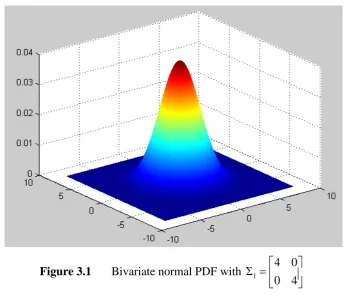
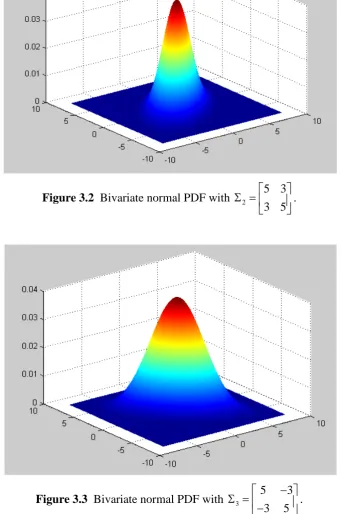
Σ = Σ = Σ = . The three matrices convey considerably different information about covariance structure. The variables represented in Σ1 are independent of each other, but they are positively and negatively correlated according to Σ2 and Σ3, respectively. Therefore, those different correlation structures cannot be distinguished by GV. See Johnson and Wichern (2007), Mason et al. (2009), and Djauhari and Mohamad (2010) for further discussion.
[image:35.595.146.491.365.666.2]A geometrical representation of bivariate normal probability density function (PDF) with zero mean vector and those three covariance matrices will help us to understand what covariance structure is. In order to show the difference of covariance structure among Σ1 , Σ2 and Σ3 , the 3-d image of that PDF is plotted.
Figure 3.1 Bivariate normal PDF with 1 4 0 0 4
Σ =
Figure 3.2 Bivariate normal PDF with 2
5 3 3 5
Σ =
.
Figure 3.3 Bivariate normal PDF with 3
5 3
3 5
−
Σ = −
.
[image:36.595.149.491.164.679.2]REFERENCES
Alt, F. B. and Smith, N. D. (1988). Multivariate Process Control. In Krishnaiah, P. R., Rao, C. R. (Ed.) Handbook of Statistics (pp. 333–351). Elsevier Science. Anderson, T. W. (1984). Introduction to Multivariate Statistical Analysis, Second
Edition, Wiley-Interscience: New York.
Aho. A. V., Hopcroft. J. E., and Ullman, J. D. (1983). Data Structures and Algorithms. Addison-Wesley Publishing Company: California.
Barnett, V., and Lewis, T. (1984). Outliers in Statistical Data. 2nd edition. New York: John Wiley.
Becker, C. and Gather, U. (1999). The Masking breakdown Point of Multivariate Outlier Identification Rules. Journal of the American Statistical Association. 94(447): 947-955.
Box, G. E. P. (1953). Non-normality and Test on Variances. Biometrika. 40(3/4): 318-335.
Chai, I. and White, J. D. (2002). Structuring Data and Building Algorithms. McGraw-Hill: Malaysia.
Chakraborti, S., Human, S. W. and Graham, M. A. (2008). Phase I Statistical Process Control Charts: An Overview and Some Results. Quality Engineering. 21(1): 52-62.
Chatterjee, S. and Hadi, A. S. (1988), Sensitivity Analysis in Linear Regression. New York : John Wiley & Sons.
Chenouri, S., Steiner, S. H. and Variyath, A. M. (2009). A Multivariate Robust Control Chart for Individual Observations. Journal of Quality Technology. 41(3): 259-271.
Djauhari, M. A. (1999). An Exact Test for Outlier Detection. BioPharm International: The Applied Technology of Biopharmaceutical Development. 12(6): 56-59.
Djauhari, M.A. (2002). Mahalanobis Distance From MANOVA Point of View and Its Generalization for Handling Masking and Swamping Effects in Drug Analysis. Final Report of the Tenth Competitive Grant. Institut Teknologi Bandung. Djauhari, M. A. (2003). Statistical Testing for Outliers: Calculating the Critical Point
of the Extreme Studentized Deviation Using the Beta Inverse Function. BioPharm International: The Applied Technology of Biopharmaceutical Development. 16(10): 60-68.
Djauhari, M. A. (2005). Improved Monitoring of Multivariate Process Variability, Journal of Quality Technology. 37(1): 32-39.
Djauhari, M. A. (2007). A Measure of Multivariate Data Concentration. Journal of Applied Probability & Statistics. 2(2): 139-155.
Djauhari, M. A. (2010). A Multivariate Process Variability Monitoring Based on Individual Observations. Journal of Modern Applied Science. 4(10): 91-96. Djauhari, M. A. (2011a). Strategic Roles of Industrial Statistics in Modern Industry.
ASM Science Journal. 5(1): 53-63.
Djauhari, M. A. (2011b). Manufacturing Process Variability: A Review. ASM Science Journal. 5(2): 123-137.
Djauhari, M. A. (2011c). Geometric Interpretation of Vector Variance. MATEMATIKA, 27(1): 51-57.
Djauhari, M. A. and Mohamad, I. (2010). How to Control Process Variability More Effectively: The case of a B-Complex Vitamin Production Process. South African Journal of Industrial Engineering. 21(2): 207-215.
Djauhari, M. A., Mashuri, M. and Herwindiati, D. E. (2008). Multivariate Process Variability Monitoring. Communications in Statistics-Theory and Methods. 37: 1742-1754.
Donoho, D. L. and Huber, P. J. (1983). The Notion of Breakdown Point. In Bickel, P. J., Doksum, K. A. ad Hodges, J. L. (Ed.) A Festschrift for Eric Lehmann. Belmont, CA: Wadsworth.
122
Egan, W. J. and Morgan, S. L. (1998). Outlier Detection in Multivariate Analytical Chemical Data. Analytical Chemistry. 70(11): 2372-2379.
Escoufier, Y. (1973). Le traitement des Variables Vectorielles. Biometrics. 29: 751 – 760.
Escoufier, Y. (1976). Op´erateur Associ´e `a un Tableau de Donn´ees. Annales de l’INSEE. 22-23: 342 – 346.
Erbacher, R. F., Walker, K. L. and Frincke, D. A. (2002). Intrusion and Misuse Detection in Large-Scale Systems. Computer Graphics and Applications, IEEE. 22(1): 38-47.
Filzmoser, P. (2004). A Multivariate Outlier Detection Method.
http://computerwranglers.com/com531/handouts/mahalanobis.pdf- accessed on
December 2011.
Filzmoser, P., Reimann, C. and Garrett. R. G. (2005). Multivariate Outlier Identification in Exploration Geochemistry. Computers and Geosciences. 31 : 579-587.
Gladwell, M. (2008). Outliers: The Story of Successes. New York: Little, Brown and Company.
Gnanadesikan, R. and Kettering, J. R. (1972). Robust Estimates, Residuals, and Outlier Detection with Multi Response Data. Biometrics. 28 (1): 81-124.
Grubbs, F. E. (1950). Sample Criteria for Testing Outlying Observations. Annals of Mathematical Statistics. 21(1): 27-58.
Grubel, R. (1988). A Minimal Characterization of the Covariance Matrix. Metrika. 35:49-52.
Gottardo, R., Raftery, A. E., Yeung, K. Y. and Bumgarner, R. E. (2006). Quality Control and Robust Estimation for cDNA Microarrays With Replicates. Journal of the American Statistical Association. 101(473): 30-40.
Hadi A. S. (1992). Identifying Multivariate Outliers in Multivariate Data. Journal of Royal Statistical Society B. 53: 761-771.
Hadi, A. S., Imon, A. H. M. R., and Werner, M. (2009). Detection of Outliers. WIREs Computational Statistics. 1: 57-70.
Hardin, J. and Rocke, D. M. (2005). The Distribution of Robust Distances. Journal of Computational and Graphical Statistics. 14(4): 928 – 946.
Hawkins, D. M. and Olive, D. J. (1999). Improved Feasible Solution Algorithm for High Breakdown Estimation. Journal of Computational Statistics and Data Analysis. 30: 1-11.
Herdiani, E. T. (2008). A Statistical Test for Testing the Stability of a Sequence of Correlation Matrices. PhD Thesis, Department of Mathematics, Institut Teknologi Bandung, Indonesia.
Herwindiati, D. E., Djauhari, M. A. and Mahsuri, M. (2007). Robust Multivariate Outlier Labelling. Journal of Communication in Statistics - Computation and Simulation, 36: 1287-1294.
Herwindiati, D. E., and Isa, S. M. (2009). The Robust Distance for Similarity Measure of Content Based Image Retrieval. Proceedings of the World Congress on Engineering 2009. July 1-3. London ,UK: WCE Vol II.
Holmes, D. S. and Mergen, A. E. (1993). Improving the Performance of the T2-chart. Quality Engineering. 5(4): 619-625.
Hubert, M. and Debruyne, M. (2010), Minimum Covariance Determinant. WIREs Computational Statistics. 2.
Hubert, M., Rousseeuw, P. J. and van Aelst, S. (2008). High-Breakdown Robust Multivariate Methods. Statistical Science, 23(1): 92-119.
Hubert, M., Rousseeuw, P.J., and van Aelst, S. (2005). Multivariate Outlier Detection and Robustness. Handbook of Statistics, Edition 24. Elsevier. 263-302.
Huber, P. J. (1964). Robust Estimation of Location Parameter. Annals of Mathematical Statistics. 35: 73-101.
Huwang, L., Yeh, A. B. and Wu, C. W. (2007). Monitoring Multivariate Process Variability for Individual Observations. Journal of Quality Technology. 39(3): 258-278.
Iglewicz, B. and Hoaglin, D. C. (1993). How to Detect and Handle with Outliers. Milwaukee: ASQ Press.
Jensen, W. A., Birch, J. B. and Woodall, W. H. (2007). High Breakdown Point Estimation Methods for Phase I Multivariate Control Charts. Quality and Reliability Engineering International. 23(5): 615-629.
124
Kennedy, G. C., Matsuzaki, H., Dong, S., Liu, W. M., Huang, J., Liu, G., Su, X., Cao, M., Chen, W., Zhang, J., Liu, W., Yang, G., Di, X., Ryder, T., He, Surti, U., Philips, M. S., Boyce-Jacino, M. T., Fodor, S. P., and Jones, K. W. (2003). Large-Scale Genotyping of Complex DNA. Nature Biotechnology. doi: 10.1038/nbt869.
Khoo, M. B. C. and Quah, S. H. (2003). Multivariate Control Chart for Process Dispersion Based on Individual Observations. Quality Engineering. 15(4): 639-642.
Koutsofios, E. E., North, S. C. and Keim, D. A. (1999). Visualizing Large Telecommunication Data Sets. Computer Graphics and Applications, IEEE. 19 (3): 16-19.
Kotz, S. and Johnson, N. L. (1985). Encyclopedia of Statistical Sciences, Edition 6. New York: John Wiley.
Mardia, K. V., Kent, J. T. and Bibby, J. M. (1979). Multivariate Analysis. London: Academic Press.
Maronna, R. A., Martin, R. D. and Yohai, V. J. (2006). Robust Statistics: Theory and Methods. West Sussex, England: John Wiley & Sons Ltd.
Mason, R. L. and Young, J. C. (2001). Implementing Multivariate Statistical Process Control Using Hotelling’s T2 Statistic. Quality Progress, April: 71-73.
Mason, R. L. and Young, J. C. (2002). Multivariate Statistical Process Control with Industrial Applications, Philadelphia: ASA-SIAM.
Mason, R. L., Tracy, N. D. and Young, J. C. (1995). Decomposition for Multivariate Control Chart Interpretation. Journal of Quality Technology. 27(2): 99-108. Mason R. L., Chou, Y. M. and Young, J. C. (1996). Monitoring a Multivariate Step
Process. Journal of Quality Technology. 28(1): 39-50.
Mason R. L., Chou, Y. M. and Young, J. C. (2009). Monitoring Variation in a Multivariate Process When the Dimension is Large Relative to the Sample Size, Communication in Statistics – Theory and Methods. 38: 939-951.
Mason R. L., Chou, Y. M. and Young, J. C. (2010). Decomposition of Scatter Ratios Used in Monitoring Multivariate Process Variability. Communication in Statistics – Theory and Methods. 39: 2128-2145.
Mason R. L., Champ, C. V., Tracy, N. D., Wierda, S. J. and Young, J. C. (1997). Assessment of Multivariate Process Control Techniques; A Discussion on Statistically-Based Process Monitoring and Control. Journal of Quality Technology. 29(2): 140-143.
Mason R. L., Chou, Y. M., Sullivan, J. H., Stroumbos, Z. G. and Young, J. C. (2003). Systematic Pattern in T2 Chart. Journal of Quality Technology. 35(1): 47-58.
Midi, H., Shabbak, A., Talib, B. A. and Hassan M. N. (2009). Multivariate Control Chart Based on Robust Mahalanobis Distance. Proceedings of the 5th Asian Mathematical Conference, Malaysia.
Mohammadi, M., Midi, H., Arasan, J. and Al-Talib, B. (2011). High Breakdown Estimators to Robustify Phase II Multivariate Control Charts. Journal of Applied Sciences. 11(3): 503-511.
Montgomery, D. C. (2005). Introduction to Statistical Quality Control. 5th edition. New York: John Wiley and Sons, Inc.
Neykov, N. M., Filzmoser, P., and Neytchev, P. N. (2012). Robust Joint Modelling of Mean and Dispersion through Trimming. Computational Statistics and Data Analysis. 56: 34-48.
Pagnotta, S. M. (2003). An Improvement of the FAST-MCD Algorithm. http://www.stat.unisannio.it/Pagnotta/paper/SIS2003.pdf - accessed on 23
December 2010.
Pan, J. N. and Chen, S. C. (2010). New Robust Estimators for Detecting Non-Random Patterns in Multivariate Control Charts: A Simulation Approach. Journal of Statistical Computation and Simulation. 81(3): 289-300.
Pena, D. and Preito, J. F. (2001). Multivariate Outlier Detection and Robust Covariance Matrix Estimation. Technometrics. 43(3): 286-300.
Prins, J. and Mader, D. (1997). Multivariate Control Charts for Grouped and Individual Observations. Quality Engineering. 10(1): 49-57.
Ratto, G. Maronna, R., Repossi, P., Videla, F., Nico, A. and Almandos, J. R. (2012). Analysis of Wind Affecting Air Pollutant Transport at La Plata, Argentina. Atmopheric and Climate Sciences. 2: 60-75.
126
Rosner, B. (1975). On the Detection of Many Outliers. Technometrics. 17(2): 221-227.
Rousseeuw, P. J. (1985). Multivariate Estimation with High Breakdown Point. In: Grossman, B. W., Pflug, G., Vincze, I., Wertz, W. (Ed). Mathematical Statistics and Applications (pp. 283 – 297). D. Reidel Publishing Company. Rousseeuw, P. J. and Leroy, A. M. (1987). Robust Regression and Outlier Detection.
John Wiley: New York.
Rousseeuw, P. J. and van Driessen, K. (1999). A Fast Algorithm for the Minimum Covariance Determinant Estimator. Technometrics, 41(3): 212 – 223.
Rousseeuw, P. J. and van Zomeren, B. C. (1990). Unmasking Multivariate Outliers and Leverage Points. Journal of the American Statistical Association. 85(411): 633-639.
Rousseeuw, P. J. and van Zomeren, B. C. (1991). Robust Distances: Simulations and Cut-off Values. In Stahel, W. and Weigberg, S. (Ed.) Directions in Robust Statistics and Diagnostics, Part II, The IMA Volumes in Mathematics and Its Applications. 34: 195-203. New York: Springer-Verlag.
Ryan, T. P. (2011). Statistical Methods for Quality Improvement, 3rd edition. John Wiley & Sons, Inc.: New Jersey
Seber, G. A. F. (1984). Multivariate Observations. John Wiley & Sons, Inc.: New York.
SEMATECH, USA. http://www.itl.nist.gov/div898/handbook/index.htm. National Institute Science and Technology. Accessed on July 2004.
Serfling, R.J. (1980). Approximation Theorems of Mathematical Statistics. New York: John Wiley.
Sullivan, J. H. and Woodall, W. H. (1998). Adapting Control Charts for the Preliminary Analysis of Multivariate Observations. Communication in Statistics – Simulation and Computation. 27: 953-979.
Sullivan, J. H. and Woodall, W. H. (1996). A Comparison of Multivariate Control Charts for Individual Observation. Journal of Quality Technology. 28(4): 398-408.
Tang, P. F. and Barnett, N. S. (1996). Dispersion Control for Multivariate Processes. Austral. J. Statist., 38(3): 235-251.
Thompson, W. R. (1935). On a Criterion for the Rejection of Observations and the Distribution of the Ratio of Deviation to Sample Standard Deviation. Annals of Mathematical Statistics. 6(4): 214-219.
Tracy, N. D. and Young, J. C. (1992). Multivariate Control Charts for Individual Observations. Journal of Quality Technology. 24: 88-95.
Tukey, J. W. (1977). Exploration Data Analysis. Wesley Canada: Addison.
Tukey, J. W. (1960). A Survey of Sampling from Contaminated Distributions. In Olkin, I. (Ed.) Contributions to Probability and Statistics (pp. 448-485). Stanford: Stanford Univ. Press.
Vargas, J. A. (2003). Robust Estimation in Multivariate Control Charts for Individual Observations. Journal of Quality Technology. 35(4): 367-376.
Vijaykumar, V. R., Vanathi, P. T., Kanagasabapathy, P. and Ebenezer, D. (2009). Robust Statistics Based Algorithm to Remove Salt and Pepper Noise in Images. International Journal of Information and Communication Engineering. 5(3) : 164-172.
Waluyo, Sinisuka, N. I., Suwarno, and Djauhari, M. A. (2009). Robust Canonical Correlation Analysis on Leakage Current Behaviors of Geothermal Polluted Porcelain Insulators. Jurnal Ilmiah Semesta Teknika. 12(2):132-146.
Wang, Y. and Pham, H. (2011). Analyzing the Effects of Air Pollution and Mortality by Generalized Additive Models With Robust Principal Components. International Journal of System Assurance Engineering and Management. 2(3):253-259.
Welsch, R. E. and Zhou, X. (2007). Application of Robust Statistics to Asset Allocation Models. REVSTAT-Statistical Journal. 5(1): 97-114.
Werner, M. (2003). Identification of Multivariate Outliers in Large Data Sets. Doctor Philosophy, University of Colorado, Denver.
Wierda S. J. (1994). Multivariate Statistical Process Control – Recent Results and Directions for Future Research. Statistica Neerlandica. 48(2):147-168.
Wilcox, R. (2012). Introduction to Robust Estimation and Hypothesis Testing. 3rd Edition. Elsevier. Printed in USA.
Wilks, S. S. (1962). Mathematical Statistics. New York: John Wiley & Sons, Inc. Wilks, S. S. (1963). Multivariate Statistical Outliers. Sankhya: The Indian Journal of
128
Woodall, W. H. and Montgomery, D. C. (1999). Research Issues and Ideas in Statistical Process Control. Journal of Quality Technology. 31(4): 376-386. Wu, G., Chen, C., and Yan, X. (2011). Modified Minimum Covariance Determinant
Estimator and Its Application to Outlier Detection of Chemical Process Data. Journal of Applied Statistics. 38(5): 1007-1020.
Yanez, S., Gonzalez, N. and Vargas, J. A. (2010). Hotelling’s T2 Control Chart Based on Robust Estimators. Dyna 77(163): 239-247.
Yeh, A. B., Huwang, L., and Wu, Y. F. (2004). A Likelihood-Ratio-Based EWMA Control Chart for Monitoring Variability of Multivariate Normal Processes. IIEE Transaction. 36: 865-879.