De-clogging Process Highway
Krishnan Gopalakrishnan, Ajith Prabhu, Sunil Jadhav, Vivek Jain
*, Priyanka Katiyar
Reliance Capital Ltd. – Division Commercial Finance, Reliance Center Snatacruz East, Mumbai, India
Copyright©2017 by authors, all rights reserved. Authors agree that this article remains permanently open access under the terms of the Creative Commons Attribution License 4.0 International License
Abstract
Our organization processes loan applications and disburses loans to the customers. Our constant endeavor is to process the file in the least turnaround time. The ability to decide on case faster depends highly on the preceding processes of checking of files for completeness, data entry in to the core system, analysis of bank statements, computation of eligibility and getting internal or external verification done. The project is aimed at improving the turnaround time for pre-approval processing of files. A benchmarking study was carried with the process of traffic management where similar problems exist by visiting the Gemba. We observed various measures taken to control traffic at peak hours like use of (1) Freeway / Ring roads: In most cities ring road is constructed to allow for traffic which bypasses congested areas. We implemented a centralized CPA (Credit processing agent) shop for mandatory data entry. This enabled us to balance different volumes at our 40 odd branches. (2) Junction Control: In some cities we identified areas where roads were unidirectional during certain times of the day and would go in the opposite direction at other times based of traffic. In our organization context we initiated training programs to improve the competency of branch teams to handle multiple process/ products. (3) Making information available: Congestion information helps in diverting vehicular movement on alternate routes. In our company, specific information / status pertaining to each file was not available on a real time basis. This information was stored manually and would take a lot of time and effort to collate. Reports were formed which collate information and case specific requirements are shared with all the stakeholders proactively. To ensure that this effort is sustained we formed a Credit Operations Team with a defined organization structure. PDCA (Plan Do Check Act) approach was followed in executing the project; pilot studies were conducted at Mumbai to check effectiveness of the model, post validation the changes were replicated across branches. The project has resulted in 17% improvement in cases meeting turnaround time for processing along with 33% improvement in productivity as compared to the last Financial Year.Keywords
Centralized Common Processing Unit, Underwriting Process, Benchmarking, Productivity, CPA (Credit Processing Agent)1. Introduction and Background of the
Problem
The main objective of our organization is to process the loan applications and disburse loans to customers. To this effect the core processes are Underwriting Process which starts when the loan proposal is received at our office and ends with loan decision and Disbursement Process which starts with receipt of loan agreement & supporting documents and ends with disbursement of loans to customer.
These processes can further be divided in three types of activities, first being processing of files comprising of checking of files for completeness, data entry in to the core system, analysis of bank statements, computation of eligibility and getting internal or external verification done. Second being decision making on the case based on the updated information, verification reports and discussions with the customers. Third being disbursement of loans for the approved cases post receipt of loan agreement and required documents.
Voice of Customer: Higher Turn Around Time (TAT) for decision (Approval / Rejection) have been highlighted as area of improvement by the External (Customer / DSA), along with the same internal customer (Sales) have highlighted Lack of ownership, Non STP(Straight Through Path) Process as an area of improvement. Hence, we decided to take up a project to streamline the processing of files primarily for the first and the third part of the process i.e. processing of files and disbursement of loans.
1.1. Potential Impact
The project is aimed at improving the performance of the key process of the organization. There is high amount of buy in the senior management team including the CEO and Business Heads & Risk Head. Positive response has been received towards the projects from the regional and zonal leaders at the locations outside Head Offices where the actual processing of files is happening. The project is aimed at bringing in efficiency for >95% of the files processed and >70% of the employees (sales & credit teams) will be involved / impacted by the project.
2. Problem Identification
With the intent to observe the functioning of the process at the branch the project team including the project leader first hit the Gemba “the real place”, observed the functioning of the branch and interacted with the process participants. The process participants (Credit manager and CPA), suppliers (Sales) and the customer (Operations) team members from the Mumbai branch were involved in conducting the initial study and their inputs were taken into consideration throughout the project. The following were observed at the Gemba:
Increased flow of files on month-end i.e. 40% of login
and 69% of Disbursement happens after 20th of the month
Table 1. Login and disbursement trend for Jan’14 to Mar’14
Dates in the month Login Disb
1st to 10th 22% 18%
11th to 20th 34% 13%
20th to Month-end 44% 69%
Some of the activities are mandatorily completed for all files logged in and rest of the activities may or may not happen depending on the case details
There are 3-4 independent teams taking care of different products i.e. vehicles, ML, SME etc (Ref Figure 1)
In each of the teams the process is further divided into 3-4 sub processes i.e. login team, eligibility calculation, banking and disbursement team (Ref Figure 1)
Team members are dedicated to handle some part of the process (Ref Figure 1)
Load balancing issues when some teams are loaded while others are free
There is lack of monitoring of the activities on the floor, organization structure of the teams are not clearly defined
CPA were reporting to the credit managers whose core competency is underwriting of files and have minimum exposure to the shop floor management
Credit Managers are not available at the branch to monitor the activities as they have to meet customers before underwriting the case
Activities carried out during the process were not listed and there was no method for gauging ability of CPAs s in completing each of the activities.
Fectors Vehicle loans (VL) Mortgages Loans (ML) SME Loans(SME) Constructon Equipments Loan (CE) Time taken to get the
loan sanction Critical Improvement Secondary Improvement Secondary Improvement Critical Improvement Time taken to get the
loan disbursed Secondary Improvement Critical Improvement Secondary Improvement Critical Improvement
g y y
FriPicMl : Where ReliMnce score is M) lower PhMn Phe compePiPors Mnd oPher McPiviPies performed inPernMlly SecondMry : BePPer PhMn 1C3 compePiPors, bePPer PhMn few of McPiviPies performed inPernMlly
Figure 2. Organization structure CPA team at locations
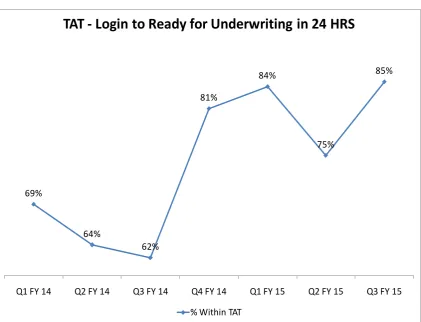
Figure 3. TAT - Login to Ready for Underwriting in 24 HRS
69%
64%
62%
81%
84%
75%
85%
Q1 FY 14 Q2 FY 14 Q3 FY 14 Q4 FY 14 Q1 FY 15 Q2 FY 15 Q3 FY 15
TAT - Login to Ready for Underwriting in 24 HRS
[image:3.595.95.517.230.552.2]84
Activity 1 Activity 2 Activity 3 Activity 4 Activity 5 Activity 6 Activity 7 Activity 8 Activity 9 Activity 10 Activity 11 Activity 12 Activity 13 Activity 14 Activity 15 Activity 16 Activity 17 Activity 18Activity 19 Activity 20 Activity 21 Activity 22 Activity 23Activity 24Activity 25 Activity 26 Activity 27 Activity 28
Sr.No. Name of CPA Region Location Core Product Core Activity DOJ Tele verificatio
n updationTVR CheckLogin Quick Data Entry
Detail Data
Entry DDQC Dedupe Cibil initiationFI verificationRcu Proforma
Rcu
verificationInititationLegal Valuation Initiation verificationIT Bank statement
verification VerificationRC AnalysisRatio Banking plotting Banking Updation in
system Obligation
and
eligibility Mapping Re-work RTR Sanction
letter
makingNDC CheckingDisbursal intitation OTC document PDD checking and updating ROC charge creation 1 Ravindra Shivaji Bandarkar West MUMBAI ML CAM Team 23/09/13 0 0 0 0 0 3 3 3 0 0 0 0 0 0 0 0 3 3 3 3 3 3 3 0 0 0 0 0 36 2 Mayur Ramchandra Avhad West Mumbai ML Team Leader 05/03/12 3 3 3 3 3 3 3 3 3 3 3 3 3 3 3 3 3 3 3 3 3 3 3 3 3 3 3 3 100 3 Ajay Dixit West Mumbai ML Disb Team 02/07/13 1 1 1 1 1 3 3 3 1 1 1 1 1 1 1 1 3 3 3 3 3 3 1 3 3 3 3 3 67 4 Siddharth Subhash Kamath West Mumbai ML Login Team 21/04/13 3 3 3 3 3 0 0 0 3 0 0 0 0 0 0 0 0 0 0 0 0 0 0 0 0 0 0 0 21 5 Prachi Sitaram Sawant West Mumbai SME CAM Team 01/08/07 3 3 3 3 3 3 3 3 3 3 3 3 3 3 3 3 3 3 3 3 3 3 3 3 3 3 3 3 100 6 Mitesh Vijay Rajda West Mumbai SME CAM Team 29/10/07 3 3 3 3 3 3 3 3 3 3 3 3 3 3 3 3 3 3 3 3 3 3 3 3 3 3 1 1 95 7 Dayanand Parab West Mumbai AL Login Team 08/05/07 3 3 3 3 3 1 1 1 3 3 3 3 3 3 3 3 3 3 3 3 3 3 0 3 3 3 1 1 85 8 Nilesh Krishna Bane West Mumbai VL CAM Team 21/11/07 1 1 3 3 3 3 3 3 3 3 3 1 1 3 3 3 3 3 3 3 3 3 0 3 3 3 1 1 82 9 Ajit Kambale West Mumbai AL CAM Team 07/01/08 1 1 3 3 3 3 3 3 3 3 3 1 1 3 3 3 3 3 3 3 3 3 0 3 3 3 1 1 82 10 Ganesh Patil West Mumbai VL Login Team 30/12/09 1 1 3 3 3 0 0 0 3 3 3 3 3 3 3 3 3 3 3 3 3 3 0 0 0 0 3 3 70 11 Dinesh Merchande West Mumbai AL Control Team 08/03/10 3 3 1 1 1 3 3 3 3 3 3 3 3 3 3 3 0 0 0 0 0 0 0 1 1 1 1 1 56 12 Ajay Zepale West Mumbai HL CAM Team 24/12/13 0 0 0 0 0 3 3 3 0 0 0 0 0 0 0 0 0 0 0 0 0 0 3 0 0 0 0 0 14 13 Abhijeet Mishra West Mumbai HL Login Team 13/01/14 0 0 0 3 3 0 0 0 0 0 0 0 0 0 0 0 0 0 0 0 0 0 0 0 0 0 0 0 7 14 Rajshree Chauhan West Mumbai HL Login Team 12/02/14 0 0 0 0 0 0 0 0 0 0 0 0 0 0 0 0 0 0 0 0 0 0 0 0 0 0 0 0 0 15 Shweta Shinde West Mumbai HL Login Team 15/01/14 0 0 0 0 0 0 0 0 0 0 0 0 0 0 0 0 0 0 0 0 0 0 0 0 0 0 0 0 0 16 Samir Desai West Mumbai HL Control Team 20/04/07 0 0 0 0 0 0 0 0 3 3 3 3 3 3 3 3 0 0 0 0 0 0 0 0 0 0 0 0 29 17 Milind Wadkar West Mumbai CV Disb Team 23/08/07 1 1 3 3 3 3 3 3 3 3 3 3 3 3 3 3 1 3 3 3 3 3 0 3 3 3 3 1 87 18 Vyankatesh Lad West Mumbai HL Disb Team 18/01/14 0 0 0 0 0 0 0 0 0 0 0 0 0 0 0 0 0 0 0 0 0 0 0 1 1 1 0 0 4 19 Tausif Shaikh West Mumbai HL Disb Team 10/02/14 0 0 0 0 0 0 0 0 0 0 0 0 0 0 0 0 0 0 0 0 0 0 0 1 1 1 0 0 4 20 Kiran Manjarekar West Mumbai HL Disb Team 16/01/14 0 0 0 0 0 0 0 0 0 0 0 0 0 0 0 0 0 0 0 0 0 0 0 1 1 1 0 0 4
Count of staff got control over
the activity 6 6 9 10 10 10 10 10 11 10 10 8 8 10 10 10 9 10 10 10 10 10 5 8 8 8 5 4
% of staff knows the activity 30% 30% 45% 50% 50% 50% 50% 50% 55% 50% 50% 40% 40% 50% 50% 50% 45% 50% 50% 50% 50% 50% 25% 40% 40% 40% 25% 20% Competency
Weighted Score
[image:4.808.48.761.83.300.2]LOGIN DESK TEAM CAM TEAM CONTROL TEAM CAM TEAM DISBURSAL TEAM
16%
27% 33%
45% 82%
90%
77%
86%
Bangalore Chennai Hyd A'bad
Competency Scores Movement
[image:5.595.92.519.75.726.2]Jul'14 Dec'14
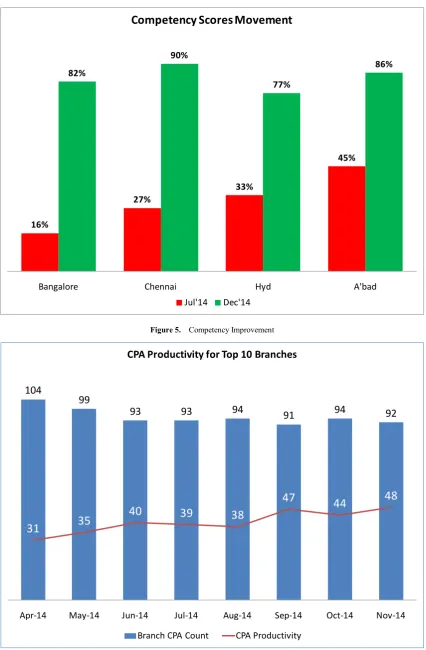
Figure 5. Competency Improvement
104
99
93
93
94
91
94
92
31
35
40
39
38
47
44
48
Apr-14 May-14 Jun-14 Jul-14 Aug-14 Sep-14 Oct-14 Nov-14
CPA Productivity for Top 10 Branches
[image:5.595.94.515.439.723.2]Branch CPA Count CPA Productivity
Figure 7. Organization Structure Revised for CPA Team at locations
22 23 24
28 27
26 28
24 25
30
34 33
32
39
35
40
14% 34% 44% 20% 19%
51%
22%
67%
Apr
May
Jun
Jul
Aug
Sep
Oct
Nov
Per CPA Productivity Month On Month
FY 2013-14 FY 2014-15 % Improvement
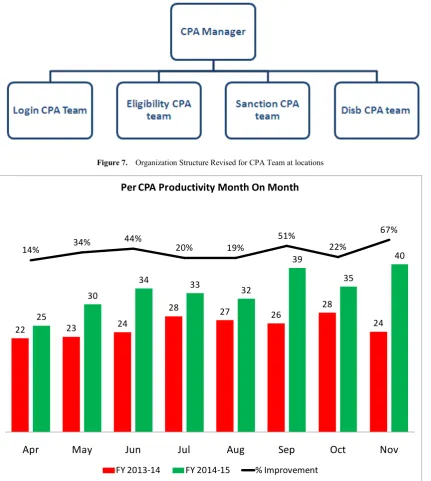
Figure 8. Improvement of Branch CPA Productivity
3. The Approach
The processing of files has different volumes in different parts of the month, is akin to the traffic on the road network in any of metros, where there is huge traffic at peak hours and low traffic during other parts of the day. We started observing the various measures taken to control traffic at peak hours and started analyzing the possibility of using those solutions in streamlining the process. While observing the traffic management in the metros the following were observed.
Use of freeway / ring road for traffic moving from one part of city to other part of city without any requirement of getting into the city
Use of some lanes in one directions for other direction i.e. use of 4 lanes in place of 3 lanes for one direction traffic at peak hours for a 6 lane road
Use of roundabout / bridges in place of crisscrossing junctions with signals
Using roads for one way traffic in place of both side movement in small streets
Traffic control rooms similar to airports and railways
Use of outsourced resources to handle traffic at peak time
4. The Solution
the data and analogy with the traffic problem
4.1. Setting up of Centralized CPA Shop
The use of freeway / ring roads has been successful in freeing up the traffic in central roads of the city. In business parlance we created a central team to manage a part of the process which includes mandatory activities post receipt of the files at our end. By having a central team catering to all locations we are able to concentrate our resources at one place and complete the STP process at one go. As these activities does not require information other than what is available in the loan files the activity could be centralized. The central team works in two shifts which is not feasible in the branches which operate only during - business hours, thus improving service levels & efficiency by using the same infrastructure thereby reducing costs. Moreover the login of files at branch happens mostly towards the end of day. Files were actually processed during the next working day. The central CPA team is able to make files ready for credit manager by working in shifts the next day. With the setting of centralized CPA shop the files being ready for underwriting in one day have moved from sixties to eighties.
4.2. Improving Competency of the Team
The second feature on the Mumbai highways is of switching lanes from 3+3 to 4+2 lanes, typically in a 6 lane highway 3 lanes are for ongoing vehicular movement and vice-versa. During morning hours, the ongoing traffic is crowded on one side, whereas the other 3 lanes are less crowded and in the evening the reverse is true. The Mumbai traffic police follow an interesting mechanism, during morning hours in some pockets which are prone to congestion; they ensure one additional lane is also available for ongoing traffic. This ensures smoothening of traffic in congested areas. When we look at our business we see that the initial days of the month are for logging in fresh cases. The employees who are aligned to the eligibility calculation part of the process (CAM team) are busy during the initial days of the month. The disbursal team on the other hand is relatively free. During the month end it’s the turn of the disbursal team to be neck deep in work whereas the CAM team is relatively free. The solution, obviously a simple one, is to mobilize people from one team to other team depending on the volumes.
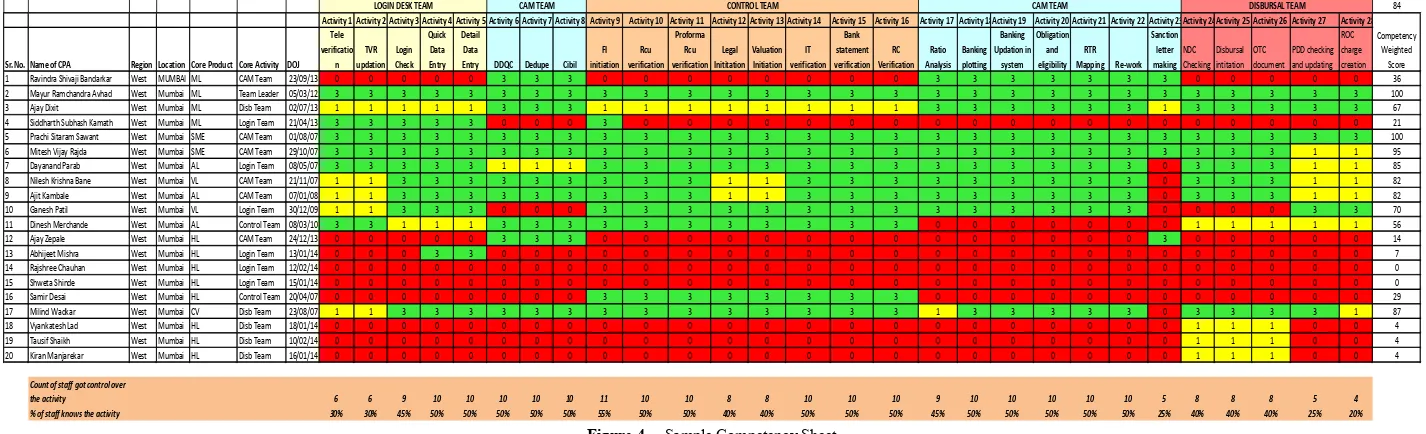
But the processing teams were aligned along products, this compounded the problem. Getting the entire team under one umbrella and multi-skilling then was imperative to load balancing. Activities carried out during the process were not listed and there was no method for gauging competency of the CPAs in completing each of the activities. The project team developed the Competency Sheet comprising of all the activities of the process and all the team members were asked to fill the competency sheet for self with the supervisor on Scale of 1, 2 & 3. Where 1 is ability of complete activity only for one product, 2 is ability to complete activity for >1 product and 3 is ability to complete for all products. Sum
total of all activity rating resulted in competency score of the CPA.
With setting of Common CPA and creating the capability for doing cross product cross activities the competency scores of the team have moved from the range 20-40 to 70-90 across the major locations.
4.3. Using Roads for One Way Traffic in Place of Both Side Movement in Small Streets
The third toll used for traffic management is the concept of one ways. In our business we divided the processing team into three processes. The first process concentrated on the new cases. It focused on login and eligibility calculation. The second process focused on disbursal of sanctioned cases. The third process focused on file control and vendor management. For multi skilling we devised a two phased approach. The first phase concentrated on intra process multi skilling on different products and second phase on inter process multi skilling
4.4. Clubbing of Activities and Making Small Task Forces
Uses of roundabout / fly-over in place of crisscrossing junctions keep the momentum of the vehicles at the junction rather than stop and go scenarios. In the business scenario we have clubbed the similar activities from different part of process and made small task forces in the teams who are doing the activities faster.
4.5. Making Information Available
In advanced countries information is a major weapon to manage traffic. Congestion information is relayed through networks along major roads. Vehicular movement is diverted on alternate routes thereby controlling traffic. In our business process, there are various stake holders. The Sales team, credit team, various supervisory staff and senior management require information. The information requirement ranges from case specific details to aggregate level information. Ideally all such information should be automatically captured on a real time basis. It should be available on a click of a button. Though we have a LOS (Loan origination system) which gives us case specific information, however specific information such as legal and technical valuation status of each case is not available on a real time basis. This information is stored manually and takes a lot of time and effort to collate. We have one-key reports which collate information and present it in dashboards apart from that the case specific requirements are shared with the sales team proactively. MIS and dashboards are available for the CPA managers to ascertain the level of activity pending.
4.6. Setting up Common CPA & Appointment of CPA Managers
and not considering the load in the other parts in major cities the same is managed by synergy of all related traffic force. In the business case we have product level CPA teams into one team which is able to manage all the products seamlessly as compared to working in silos.
The existing organization was akin to a system where the normal police forces responsible for maintaining law & order situation is also taking care of traffic management as an additional responsibility rather than having dedicated traffic police force responsible for managing traffic. In the business scenario we had credit managers supervising the CPA shop along with the core responsibility of underwriting of cases, we have set up Credit Operations Team and CPA Managers are appointed at the major locations responsible for managing the process and making the files ready for underwriting sooner. This has resulted in bringing focus into the processing of the files as this team is solely responsible for smooth flow of files.
4.7. Bringing in Location Level Synergies
In places like Mumbai where during peak hours / festivals / public gathering for rallies the available traffic police force is not adequate to handle, personnel from other locations are called in to manage the situation. In the process what we have done is that in case of high flow of files at one location we are able to pass on load to the teams sitting at smaller locations with low volumes.
5. Implementation of the Project
The project the Central CPA (CCPA) was set up in Mumbai. Prior to implementation of the same an application was developed and rolled out with a workflow enabling the branches to send scanned images to the CCPA team and also received back the processed applications.
During the project pilot CCPA team was setup with the CPAs from Mumbai branch and then new team members were included in the team, credit managers from Delhi, Kolkata & Mumbai gave on the job training to the CCPA for a week, from there the team took it forward.
Setting up the common CPA at location was a huge Change Management Activity as the CPAs were historically reporting into the credit managers and were concerned with the product they were handling. In the revised structure they are detached from their supervisors and required to perform the tasks independently. Each location threw a different challenge due to the local dynamics of the sales & credit team. Like any change management activity there was huge resistance to the initiative in beginning. With the involvement of all stakeholders in the transition process and support from the senior management team we have setup Common CPA at 17 major locations. The remaining small location / single product locations are to be covered by the end of FY 15.
6. Sustainability of Project
The project has resulted in setting up of an independent Credit Processing Team; the team structure is in place with clearly defined roles and responsibilities. The National CPA Manager is reporting into Credit and Risk Head. Key deliverables of the team are included in the CEO’s monthly Quality Dashboard Reviews. Over 95% of the files are being processed at the central team for STP since May’14 and Common CPA Shops are set up at 17 branches, all branches with multiple products are to be covered by the end of financial year 15.
With the current project resulting in significant benefits to the organization the Common CPA team’s scope is being extended to include sales back-office. Initial study for the same has been initiated in Mumbai.
7. Impact of the Project
The project has resulted in significant improvement in the processing of the files and 75% of the files are being processed at 17 Locations where Common CPA team is in place. The Productivity of the CPA at 17 Locations have moved up by 33% during Apr’14 to Nov’14 as compared to corresponding period in last FY.
8. Conclusions
Adaptation of traffic management tools in the loan processing function have significantly improved the process. The project findings have been institutionalized in form of standard work procedures so as to continue reaping the benefits of the project in long run.
9. Limitations
The analogy of related problems in unrelated systems can be used where the problem facing the systems are in similar in nature, the case study may not be useful where the problems faced by the system not overlapping in nature, we may be required to look at diversified sources to find the solutions.
10. Scope for Future Work
REFERENCES
[1] Prof S T Patil, “A Study of Problems and Possible Solutions
for Better Pune Traffic Management”, ASM’s
International’s E-Journals on ongoing Research in Management and IT (E-ISSN-2320-0065) available on www. asmgroup.edu.in
[2] Sanjay Kunar Singh, “Urban Transport in India: Issues, Challenges, and the Way Forward” European Transport \ Trasporti Europei (2012) Issue 52, Paper n° 5, ISSN
1825-3997 available on www.istiee.org
[3] M. Absar Alam and Faisal Ahmed, “Urban transport systems and congestion: A case study of Indian cities”, Transport and Communications Bulletin for Asia and the Pacific No. 82, 2013 available on www.unescap.org