
STUDY ON CUTTING OPERATION IN TURNING PROCESS BY 3D SIMULATION USING DEFORM 3D
MOHD ZAIM BIN MOHD ZUKERI
A thesis submitted as partial fulfillment of the requirement for The Award of Masters of Mechanical Engineering.
Faculty of Mechanical and Manufacturing Engineering University Tun Hussein Onn
ABSTRACT
ABSTRAK
Dalam memahami asas proses pemotongan logam, ia adalah terbatas jika melalui uji kaji. Terdapat cara alternatif untuk memahami dengan lebih baik proses pemesinan di bawah keadaan pemotongan yang berbza. Dengan menggunakan kemampuan “finite element model (FEM)”, ia telah dibuktikan untuk menjadi salah satu cara
sesuai untuk menangani masalah pemotongan logam yang timbul dalam keadaan yang rumit. FEM telah merealisasikan kemungkinan untuk memodelkan beberapa faktor yang hadir dalam pembentukan chip termasuk geseran pada permukaan chip. Tujuan memahami dengan lebih mendalam mengenai pemotongan chip adalah untuk mencari cara untuk mendapatkan permukaan mesin yang mampunyai kualiti yang tinggi di samping meminimumkan masa pemesinan dan kos peralatan. Salah satu subjek yang rumit dalam pemoongan logam adalah sifat geseran antara permukaan alatan dan chip yang memerlukan kerja yang banyak. Beberapa model telah
CONTENT
TITLE i
DECLARATION ii
DEDICATION iii
ACKNOWLEDGEMENT iv
ABSTRACT v
CONTENTS vi
LIST OF TABLE x LIST OF FIGURE xii
CHAPTER 1 INTRODUCTION 1.1 Introduction 1 1.1.1 Turning process 2
1.2 Background of the project 3
1.3 Problem statement 3
1.4 Objective of study 4
1.7 Expected result 6
CHAPTER 2 LITERITURE REVIEW
2.1 Introduction 7
2.2 Fundamental of Metal Cutting 8
2.2.1 Ortogonal cutting 10
2.2.2 Oblique cutting 11
2.3 Friction model 12
2.3.1 Albrecht's Coulomb friction 14
2.4 Analytical force model 16
2.4.1 Merchant’s model 17
2.4.2 Slip-line Field Theory 18
2.5 Finite Element model (FEM) 19
2.5.1 Deform software 20
2.6 Conclusion 22
CHAPTER 3 METHADOLOGY
3.1 Introduction 23
3.2 Finite element Systems 25
3.3 Tool geormetry 25
3.4 Workpiece geometry 27
3.5 Flow stress 28
3.5.1 Flow stress data 28
3.6 Friction in metal cutting 29
3.7 Simulation work 30
3.8 Modeling using Deform 3d 31
3.8.1 Pre-processing 33
3.8.2 Running the simulation 35
3.8.3 Post-processor 33
CHAPTER 4 RESULT
4.1 Introduction 37
4.2 AdvantEdge and Experiment result 38
4.3 Deform result 39
4.3.1 Comparison of friction models 40
4.3.2 Cutting force result 41
4.3.3 Thrust force result 43
4.4 Cmparison between Experiment,
AdvantEdge and Deform result 45
4.4.1 Cutting force 45
4.4.2 Thrust force 47
4.4.3 Shear angle 49
4.4.3.1 Comparison of shear
plane angle result 50
CHAPTER 5 DISCUSSION RECOMMENDATION AND CONCLUSION
5.1 Introduction 52
5.2 Discussion 53
5.3 Recommendation 54
5.3.1 Finite element analysis procedure 55
5.3.2 Friction models 56
5.4 Conclusion 56
REFERENCES 58
APPENDIX 61
LIST OF TABLE
NUM. TITLE PAGE
2.1 History of Cutting Process Modelling 9
3.1 Tool parameter 26
3.2 Composition material of AISI 1045 27
3.3 Mechanical Properties and Thermal Properties of AISI 1045 27 3.4 Value for flow stress in this simulation 29 3.5 Parameter used in the simulation process 31
4.1 Result for cutting force FC 38
4.2 Result for thrust force Ft 38
4.3 Shear plan angle Ø (degree) 38
4.4 Simulation’s parameter 40
4.5 Cutting force, Fc at 100 m/min 41
4.6 Cutting force Fc at 150 m/min 42
4.7 Thrust force, Ft at 100 m/min 43
4.8 Thrust force Ft at 150 m/min 44
LIST OF FIGURE
NUM. TITLE PAGE
2.1 Three dimensional view of turning operation 8
2.2 Orthogonal cutting 11
2.3 Oblique cutting 12
2.4 Explanation of contact between two surfaces 13
2.5 Static and kinetic friction 14
2.6 Force decomposition in the Albrecht's model 14 2.7 Corresponding cutting for different feeds 15 2.8 Thrust force versus cutting force are define of the critical feed rate 16
2.9 Merchant’s orthogonal cutting Model 17
2.10 Slip-line fields in orthogonal Cutting 19
3.1 process flow chart for simulation 24
3.2 Turning process 26
3.3 A schematic of the orthogonal metal cutting process 32 4.1 Comparisons between Experiment and AdvantEdge 39 4.2 Graph shown Cutting force value vs friction factor
for cutting speed 100 m/min 41
4.3 Graph Cutting force value vs Friction factor for
4.4 Graph Thrust force vs Friction factor for speed 100 m/min 43 4.5 Graph Thrust force vs Friction factor for speed 150 m/min 44 4.6 Graph Cutting force versus speed for comparison
between Experiment, AdvantEdge and Deform result 46 4.7 Graph shown thrust force versus speed for comparison
between experiments, AdvantEdge and deform result 48 4.8 Graph shown Comparison between Experiment,
AdvantEdge and Deform 51
CHAPTER I
INTRODUCTION
1.0 Introduction
Machining process such as turning, milling, boring and drilling are among others the most important process for discrete part manufacturing. Researchers have been studying machining processes for more than a century to gain better understanding and develop more advanced manufacturing technology.
1.1.1 Turning process
Turning is the process whereby a single point cutting tool is parallel to the surface. It can be done manually, in a traditional form of lathe, which frequently requires continuous supervision by the operator, or by using a computer controlled and automated lathe which does not. This type of machine tool is referred to as having computer numerical control, better known as CNC, and is commonly used with many other types of machine tool besides the lathe.
When turning, a piece of material (wood, metal, plastic even stone) is rotated and a cutting tool is traversed along two axes of motion to produce precise diameters and depths. Turning can be either on the outside of the cylinder or on the inside (also known as boring) to produce tubular components to various geometries. Although now quite rare, early lathes could even be used to produce complex geometric figures, even the platonic solids; although until the advent of CNC it had become unusual to use one for this purpose for the last three quarters of the twentieth century. It is said that the lathe is the only machine tool that can reproduce itself.
The turning processes are typically carried out on a lathe, considered to be the oldest machine tools, and can be of four different types such as straight turning, taper turning, profiling g or external grooving. These types of turning processes can
1.2 Background of the Project
This research work is executed to compare the orthogonal cutting data from FEM Deform 3d software with experiments by creating numerical model to simulate the orthogonal metal cutting. AISI 1045 is used as the workpiece material in this study because it has been the focus of many recent modeling studies and well
machinability.
Thus, this software is used to simulate the cutting process from the initial to the steady state of cutting force. The orthogonal turning data is verified and a
comparison is made between experimentally and simulations to investigate the cutting forces, thrust forces and chip shear plane angles as a practical tool by
researchers, machine and tool makers. This is the reason why the application of FEM 3d software to cutting operations is quite common nowadays.
To simulate deformation in a three-dimensional environment makes it possible to see the process more in detail and to make more accurate predictions even for processes that are well represented by a plane model (such as orthogonal cutting). Moreover, it allows simulating more complex operations that need to be studied by a three-dimensional model (such as oblique cutting).
1.3 Problem Statement
In recent years, the application of finite element method (FEM) in cutting operations is one of the effective way to study the cutting process and chip formation. In
particular, the simulation results can be used as a practical tool, both by researchers and tool makers to design new tools and to optimize the cutting process.
and this will lead to high costing to the industry manufacturer worldwide in terms of time demanding, human energy and work material respectively. In order to reduce the costs and time, FEM in machining is widely used nowadays and has become main tool for simulating metal cutting process.
Based on cutting experiments, the simulation were carried out to verify using FEM to indicate that the simulation result are consistent or not with the experiments. This study aims to simulate three-dimensional cutting operations and the FEM software used for this study is DEFORM 3D.
1.4 Objective of study
The overall goal of this proposal is to develop methodologies using finite element simulations and to differentiate the actual value from the previous experimental result with the deform 3D simulation result.The data that have been taken into computation are cutting force, thrust force and shear angle. Thus, the objectives are to:
Study and determine the influence of process parameters (feed rate, cutting speed and shear friction factor) upon cutting forces, thrust forces and shear angle. (i) To compare between simulation and experiment cutting test to indicate the
results are consistent or inconsistent.
1.5 Scope of Study
(i) Simulation 3D cutting test is using deform 3D software. (ii) Work piece are use is mild steel of 45% carbon (AISI 1450). (iii) Tool material use is uncoated carbide with rake angle 5o.
(iv) To differentiate between the simulation conducted by using Deform 3d software with the results obtained by the previous researcher as follow: Experiment result; and
Results from advantEdge software.
1.6 Importance and Significance of Study
The significance of this research work is that Finite Element Analysis (FEA) in machining process will be a great help for the researchers to understand the
mechanics of metal cutting process. Furthermore, the FEA technique has proven to be an effective technique for predicting metal flow and selecting optimum working conditions such as tool and workpiece temperatures and cutting force.
1.7 Expected Result
In this study, the investigation indicates the results from simulation cutting test in terms of thrust force, cutting force, and shear plane angle which dependent on the cutting parameters such as shear friction factor and cutting speed.
CHAPTER II
LITERATURE REVIEW
2.1 Introduction
For years, researchers in the area of metal cutting have attempted to develop model of cutting processes that described the mechanisms involved and predict the
important behaviours in the process without requiring a large amount of cutting test. Various models have developed for this purpose. In this chapter, previous
publication relating to the metal cutting is reviewed. The reviewed topics are organized as follows:
(i) Fundamental of metal cutting (ii) Friction models
2.2 Fundamental of Metal Cutting
[image:17.595.189.461.253.483.2]The most widely used metal cutting operation is turning, milling and drilling. Turning is a process of using a single point tool that removes unwanted material to produce a surface of revolution. Figure 2.1 shows a cylindrical surface being generate on a workpiece and the movement of the cutting tool along feed direction [Kalpakjian, 2001].
Figure 2.1: Three dimensional view of turning operation [Kalpakjian, 2001]
The need to understand and model the metal cutting process is driven by a number of technological requirements. Basically, the operation should be feasible to achieve the required quality of machined part and efficiency. Knowledge of the cutting process is also important for improvement of machine tool design.
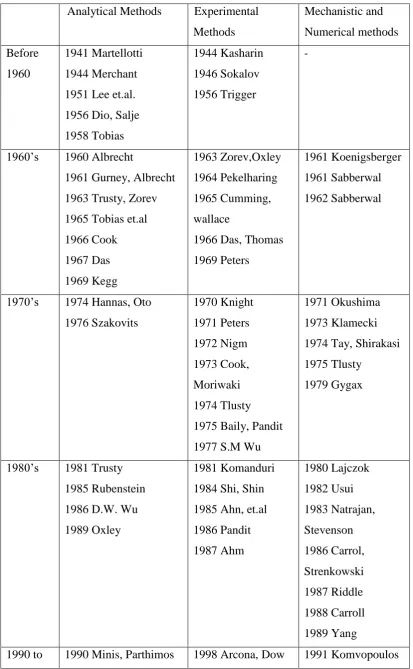
Table 2.1: History of Cutting Process Modelling Analytical Methods Experimental
Methods Mechanistic and Numerical methods Before 1960 1941 Martellotti 1944 Merchant 1951 Lee et.al. 1956 Dio, Salje 1958 Tobias
1944 Kasharin 1946 Sokalov 1956 Trigger
-
1960’s 1960 Albrecht
1961 Gurney, Albrecht 1963 Trusty, Zorev 1965 Tobias et.al 1966 Cook 1967 Das 1969 Kegg 1963 Zorev,Oxley 1964 Pekelharing 1965 Cumming, wallace
1966 Das, Thomas 1969 Peters
1961 Koenigsberger 1961 Sabberwal 1962 Sabberwal
1970’s 1974 Hannas, Oto 1976 Szakovits 1970 Knight 1971 Peters 1972 Nigm 1973 Cook, Moriwaki 1974 Tlusty 1975 Baily, Pandit 1977 S.M Wu
1971 Okushima 1973 Klamecki 1974 Tay, Shirakasi 1975 Tlusty
1979 Gygax
1980’s 1981 Trusty 1985 Rubenstein 1986 D.W. Wu 1989 Oxley
1981 Komanduri 1984 Shi, Shin 1985 Ahn, et.al 1986 Pandit 1987 Ahm 1980 Lajczok 1982 Usui 1983 Natrajan, Stevenson 1986 Carrol, Strenkowski 1987 Riddle 1988 Carroll 1989 Yang
present 1993 Minis 1995 Altintas 1996 Arsecularatne 1998 Waldorf 1999 Moufki
2002 Becze, Elbestawi
1992 Yang 1993 Wayne 1994 Athavale 1995 Shih 1999 Ng et. Al
The importance of machining process modeling has been universally recognized in industry. Basic and applied research result has been employed to provide reliable predictions of the performance of the cutting process and the impact of the process on produce quality and process productivity [Ehmann, 1997].
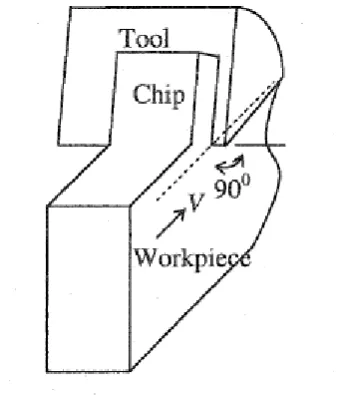
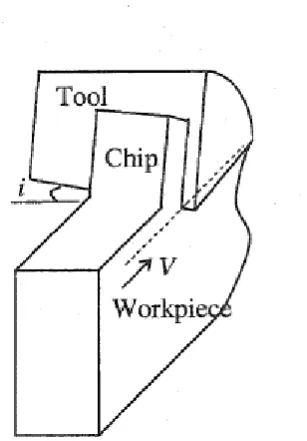
In a simple way, most metal cutting operations can be described in terms of a wedge-shaped cutting tool that is constrained to move relative to the workpiece in such a way that a layer of metal is removed in the form of a chip. When the cutting edge of the tool is arranged to be perpendicular to the direction of cutting velocity, it is called orthogonal cutting. Oblique cutting involves an inclination angle
[Boothroyd, 1989].
2.2.1 Orthogonal Cutting
Orthogonal cutting, as illustrated in Figure 2.2 is the simplest machining process and rarely used in industrial practice. The significance of orthogonal cutting is serving as an ideally simple cutting process model in theoretical and experimental work. It can be modelled as a two dimensional process. In orthogonal cutting, effects of
(i) The tool is perfectly sharp and there is no contact along the clearance face. (ii) The shear surface is a plane extending upward from the cutting edge.
(iii) The cutting edge is a straight line extending perpendicular to the direction of the cutting velocity and generates a plane-machined surface.
(iv) The chip does not flow to either side. (v) The depth of cut is constant.
(vi) The width of cut is constant.
(vii) The workpiece moves relative to the tool with uniform velocity. (viii)A continuous chip is produced with no build-up edge.
[image:20.595.234.404.296.496.2](ix) The shear and normal stresses along shear plane and tool are uniform.
Figure 2.2: Orthogonal cutting
2.2.2 Oblique Cutting
Figure 2.3: Oblique cutting
2.3 Friction model
(a) (b)
Figure 2.4: Explanation of contact between two surfaces: (a) Two bodies with friction after applying the load (b) Free body diagram for the block on a rough surface
Basically, there are two types of friction, which are static and kinetic as shown in Figure 2.5. By increasing the force F, friction force f increases too. The blocks cannot move until the force F reaches the maximum value. This is called the limiting static factional force. Increasing of the force F further will cause the block to begin to move. In the static portion, the limiting friction force can be expressed as:
F
static=
μs N
where μsis called the coefficient of static friction
When the force F becomes greater than Fstatic, the frictional force in the contact
area drops slightly to a smaller value, which is called kinetic frictional force. Machining models generally just consider the kinetic friction coefficient which can be calculated by the following equation:
Figure 2.5: Static and kinetic friction
2.3.1 Albrecht's Coulomb friction coefficient
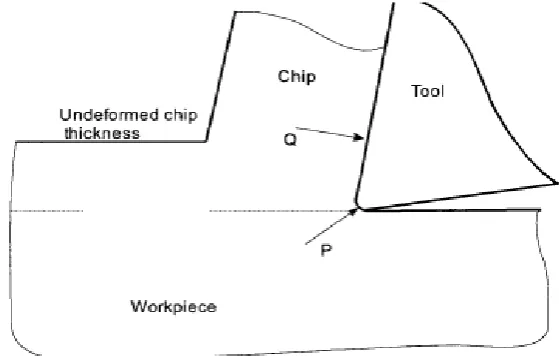
In the the Coulomb friction coefficient, Albrecht's analysis has been used to estimate the coefficient of friction along the chip-tool interface by eliminating the cutting edge effect [P. Albrecht,1960]. Figure 2.6 illustrates the basic concept of Albrecht's model.
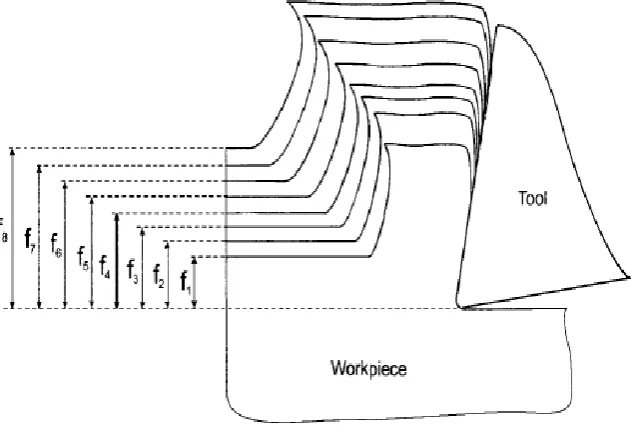
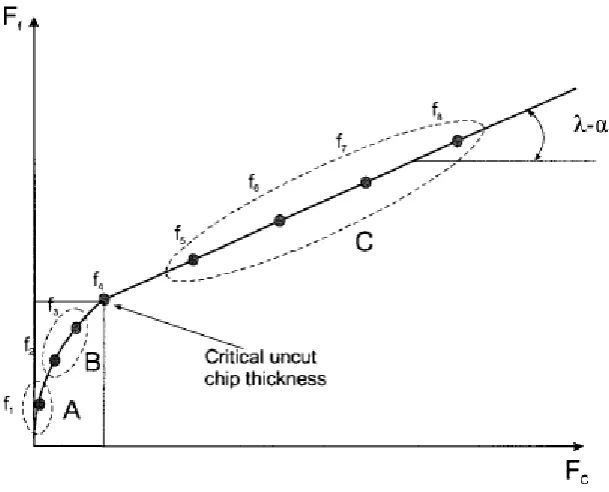
[image:23.595.195.475.555.733.2]The forces are resolved into two components where P is close to the cutting edge and Q is applied on the rake face. With the sharp cutting tool, the ploughing force P has insignificant value. But for the tool that is not sharp, the force P will affect significantly the force model. For uncut chip thickness greater than the critical uncut chip thickness.
Albrecht assumes that the force P has a constant value. However, at feeds less than the critical uncut chip thickness, the force P will affect the thrust force
[image:24.595.165.482.331.545.2]significantly. After passing the critical chip thickness, the force P slightly affects the thrust force. Example feeds and chip thickness are shown in Figure 2.7. The sum of the two force components (cutting and feed) can be obtained by the sum of two vectors P and Q.
Figure 2.7: Corresponding cutting for different feeds
Figure 2.8: Thrust force versus cutting force are define of the critical feed rate
2.4 ANALYTICAL FORCE MODEL
Since 1930, many researchers have tried to understand the machining process under framework plasticity theory. The studies of chip formation were the main goal in order to know the cutting force, stresses and temperatures involved in the process. Various methods were proposed which are several of the study based on
2.4.1 Merchant’s Model
[image:26.595.130.498.231.498.2]Merchant’s analysis is based on the two- dimensional process geometry as show in Figure 2.9[Shaw, 1984]. An orthogonal cutting is defined by cutting velocity V, uncut chip thickness tu, chip thickness tc, shear angle Ø, rake angle α, and width of cut w. The width of cut w is measured parallel to the cutting edge and normal to the cutting velocity.
Figure 2.9: Merchant’s orthogonal cutting Model [Shaw, 1984]
The workpiece material moves at the cutting velocity while cutting tool
remains still. A chip is thus formed and is assumed to behave as a rigid body held in equilibrium by the action of the forces transmitted across the chip-tool interface and across the shear plane. The resultant force Fr is transmitted across the chip-tool
interface. No force acts on the tool edge or flank. Fr can be further resolved into
components on shear plane, rake face, on cutting direction depending upon research interest. Components on shear plane are Fs in the plane and Ns normal to shear plane.
Cutting force Fp is in the cutting direction and a trust force FQ normal to the
workpiece surface. On the rake face, the friction force Fc is in direction of chip flow
On the shear plane: =
(2.1)
On the rake face: =
(2.2)
Shear angle Ø can be experimental determined by: =
(2.3)
The concept of orthogonal cutting and all of the simplifying assumptions helped to build the fundamental cutting force analysis and left space for
improvement in succeeding studies. Most analytical force models follow this shear plane theory or slip-line field theory.
2.4.2 Slip-line Field Theory
Slip-line field solution for shear angle Ø was derived based on two assumptions: (i) The material cut behaves as an ideal plastic solid which does not
strain-hardened.
(ii) The shear plane represents the direction of the maximum stress. A slip-line field ABC in front of the cutting tool, shown in figure 2.10
Figure 2.10: Slip-line fields in orthogonal Cutting [Waldrof, 1996]
Line BC is the line along which the stress is zero. β is the friction angle on the rake face of the cutting. Ø is shear angle. They can be determined by:
β = tan-1
(Fc/Nc) (2.4)
Ø = 45o-β+α (2.5)
2.5 FINITE ELEMENT MODELS (FEM)
consists of elements that are fixed in space and cover the control volume, and the material properties are calculated at fixed spatial locations as the material flows through the mesh [Movahbedy, 2000].
In FEM, the material properties can be handled as functions of strain, strain rate and temperature. Interaction between chip and tool can be modelled as sticking and sliding. Nonlinear geometric boundaries such as the free surface of the chip can be represented as used. Stress and temperature distribution can be obtained as well [Zhang, 1994; Shih, 1995]. However, large deformation of the material results in the distortion of the elements and deterioration of simulation results. The numerical simulation of cutting process can be extremely difficult because of unconstrained flow of material that occurs over free boundaries. As a result, most of the previous analysis used simple models such as rigid-plastic/elastic-plastic and non-hardening material behaviour, or empirical models depending on experimental data, ignored interfacial friction and tool wear on the cutting process.
2.5.1 Deform Software
Deform is a commercial FEM software based process simulation system designed to analyze flow of various metal forming process. It is available in both Lagrangian (Transient) and arbitrary Lagrangian and the Eularian (ALE Steady-State) modeling. Additional, the software is currently capability of Steady-State function and it is required of running a transient simulation previous to steady state cutting simulation.
Ceretti and his colleague [Ceretti, 1996] conducted simulation of orthogonal plane strain cutting process using FE software Deform2D. To perform this
In 2000, Ceretti and his colleague also study simulation using Deform3D. Their objective of this work is to set up two three-dimensional FEM reference models to study three-dimensional cutting operations: one model for orthogonal cutting, one for oblique cutting. This FEM code is based on an implicit lagrangian computational routine, the finite element mesh is linked to the workpiece and follows its deformation. To simulate the chip formation a remeshing procedure is performed very frequently, so that the workpiece mesh is frequently updated and modified to follow the tool progress. This technique makes possible to simulate chip separation from the workpiece without any arbitrary predefinition.
Mamalis, [mamalis, 2001] investigated FE simulation on chip formation in steady-state orthogonal metal cutting using finite element code MARC. The flow stress of the work material is taken as a function of strain, strain rate and temperature in order to know the effect of the large strain, strain rate and temperature associated in cutting process. Additional, the chip formation and the stress, strain and strain-rate distribution in the chip and workpiece, as well as the temperature fields in the
workpiece, chip and tool are determined.
Referring to iqbal and friend [Iqbal. 2006], there were effects of workpiece flow stress models and friction characteristics at the tool-chip interface by predicting on different output parameters. Further, they have been performed 2D orthogonal cutting FE model by Deform2D simulation in order to predict accuracy of cutting force and shear angle. Flow stress models are used extensively in the simulations of deformation processes occurring at high strains, strain rates and temperature.
Jaharah and her colleague [Jaharah et al. 2009] performed the application of FE software Deform2D in simulating the effect of cutting tool geometries on the
2.6 Conclusion
According Merchant’s shear plane analysis, the concept of friction implies that friction force and normal force are uniformly distributed over the sliding interface. However, this is not the case of metal cutting and this approach provides coefficient of friction is too simple. Additionally, the friction formula is relevant only to sliding conditions that was probably bring weakness of this analysis.
CHAPTER III
METHODOLOGY
3.1 Introduction
The software Deform 3D is used in this study to simulate the three-dimensional orthogonal with plane strain deformation metal cutting process. The finite element model is composed of a deformable workpiece and a rigid tool. Overall, there have been a series of cutting test that will be carried out for simulation in varies
machining parameters of cutting speed, feed rate and depth of cut.
No
[image:33.595.105.527.80.708.2]
Yes
Figure 3.1: process flow chart for simulation Workpiece and tool
properties Density
Stress/strain data Poisson ratio
Specific heat Thermal
conductivity
Thermal expansion
FEM Analysis Module Cutting condition
Workpiece geometry Tool geometry Cutting velocity Feed rate
Depth of cut
agree
Output cutting forces and cutting temperatures and compare with result
by previous reseacher
verified start
REFERENCE
A.J. Haglund (2005), "On friction modeling in orthogonal machining: An arbitrary Lagrangian Eulerian finite element model", M.Sc. Eng. thesis, University of New Brunswick,.
Boothroyd, G., W.A Knight (1989). Fundamentals of metal cutting and machine Tools. New York: Marcel Dekker Inc.
Ceretti, E., Fallbohmer, P., Wu W.T and Altan, T.(1996). Application of 2D FEM to chip formation in orthogonal cutting. Journal of Material Processing Technology (59).pp.169-180.
Childs, T.H.C. (1998). Material property needs in modeling metal machining. Proceeding of the CIRP International Workshop on Modeling of Machining Operations, Atlanta,GA. pp 193-202.
Jaharah A.G, Wahid S.W, Che Hassan C.H, Nuawi M.Z, and Ab Rahman, M.N .(2009). The effect of uncoated carbide tool geometries in turning AISI 1045 using finite element analysis. European Journal Of Scientific Research, 28(2), pp.271-277.
Kalpakjian, S., and S.R Schmid. 2001. Manufacturing Engineering and Technology. Prentice-hall.
Koenigsberger, F., and A.J.P Sabberwal.1961. An Investigation into the Cutting Force Pusations During Milling Operations: 15-33
Komvopoulos, K., and S.A. Erpenbeck. 1991. Finite Element Modelling of Orthogonal Metal Cuting. Journal of Applied Mechanics 18: 253-267
Mamalis,A.G, Horvath,M, Branis A.S and Manolakos, D.E.(2001). Finite Element simulation of chip formation in orthogonal metal cutting. Journals of Materials Processing Technology(110).pp.19-27.
P. Albrecht. "New Developments in the Theory of the Metal-Cutting Progress, Part I. The Ploughing Process in Metal Cutting", Journal of Engineering for Industry, Vol. 82, pp. 348-358, 1960.
P. J. Arrazola, F. Meslin and S. Marya., "A technique for the identification of friction at tool/chip interface during maching". Proceedings 6th CIRP International Workshop on Modeling of Machining
Operations, Hamilton, ON, Canada, May 2003.
Shih A. J. 1995. Finite Element Simulation of Orthogonal Metal Cutting. Journal of Engineering for Industry 117: 84-93
Waldorf, D. J 1996. Shearing, ploughing and wear in Orthogonal Machining. Ph.D. University of Illinois at Urbana-Champaign.
![Figure 2.1: Three dimensional view of turning operation [Kalpakjian, 2001]](https://thumb-us.123doks.com/thumbv2/123dok_us/8780412.903896/17.595.189.461.253.483/figure-dimensional-view-turning-operation-kalpakjian.webp)

![Figure 2.9: Merchant’s orthogonal cutting Model [Shaw, 1984]](https://thumb-us.123doks.com/thumbv2/123dok_us/8780412.903896/26.595.130.498.231.498/figure-merchant-s-orthogonal-cutting-model-shaw.webp)
![Figure 2.10: Slip-line fields in orthogonal Cutting [Waldrof, 1996]](https://thumb-us.123doks.com/thumbv2/123dok_us/8780412.903896/28.595.151.493.67.307/figure-slip-line-fields-orthogonal-cutting-waldrof.webp)
