2019 International Conference on Computer Science, Communications and Big Data (CSCBD 2019) ISBN: 978-1-60595-626-8
Effect of Impacting Speed on the Dynamic Response of Truss Structure
Hui-ren GUAN
1,*1
College of Civil and Transportation Engineering, Hohai University, PR China
*Corresponding author
Keywords: Truss, Impact speed, Finite element model, Dynamic response.
Abstract. Dynamic response of truss is related with the safety of truss if impact loading is imposed on truss structure. Impact speed is an important parameter for impact loading. The analysis of the effect of impact speed on the dynamic response of truss helps to the design of truss structure. Here, a finite element model (FEM) was employed to simulate the dynamic response of truss structure. By using the proposed FEM, the effect of impact speed on the maximum displacement was researched. Based on the numerical results, the maximum displacements are different from each other for different impact speeds. The maximum displacement increases with the increasing impact speed and the relationship between maximum displacement and impact speed is nonlinear.
Introduction
Truss structure is widely used in bridge, aerospace and construction because of its high ratio of stiffness to mass. Truss structure can be under dynamic loading during its usage. Maximum displacement is an important parameter during the design of truss structure. If the maximum displacement of truss structure is not satisfied with the available standard, there would be a risk during the usage of truss structure. Therefore, the effect of impact speed on the maximum displacement should be analyzed to make sure the safety of truss structure.
For uniform beam structure, there is a classical theory to calculate the mehcanical resposne [1]. The theoretical model is useful for the homogeneous beam section. For truss structure, the sections of truss are inhomogeneous; therefore, the available theory is useless to calculate the mechanical resposne of truss structure. Fortunately, it has been demonstrated that finite element model (FEM) is a valid technology to analyze mechanical properties of truss structure [2-5]. From then on, the FEMs of truss structure have been widely researched. In order to analyze the elasto-plastic small deformation, an extended multiscale finite element method was developed for 2D periodic lattice truss materials [6]. Before using FEM to predict the deformation of truss structure, the differences between matrix displacement method and finite element method were analyzed [7]. Based on the stiffness and load matrix of bridge frames, a FEM was established to calculate the lateral displacement under the loading of wind [8]. The initial yield surface of periodic 2D trusses of beams and evolution of the yield surface with ongoing hardening were both added into an asymptotic discrete expansion FEM to simulate the elastoplastic homogenized response of lattice truss structure [9]. In order to realize the geometrical nonlinear analysis of the structures with lattice truss materials, an equivalent continuum multiscale formulation was presented by combining the extended multisacle finite element method with the co-rotational approach [10]. The static resposne of truss structure has been widely investigated; however, the effect of impact speed on maximum displacement of truss structure has not been explored.
Finite Element Model
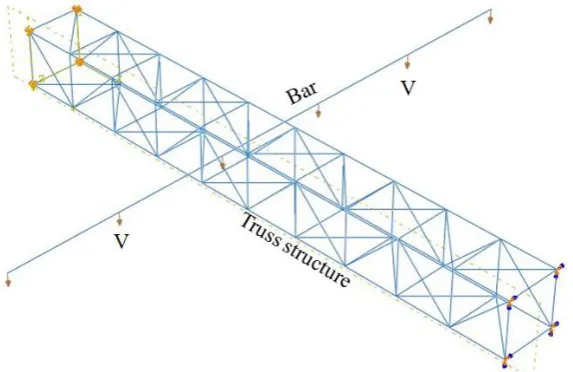
[image:2.595.155.442.335.521.2]The finite element model (FEM) aimed to simulate the mechanical behavior of truss structure, has been developed by means of Abaqus 6.11 [11,12]. In order to research the mechanical properties of truss structure, a 3D FEM has been defined accounting for the truss geometry, materials and boundary conditions. A deformable 3D truss model was generated by means of planar commands. Concerning the meshing of the beam, the truss has been discretized by means of shear-flexible elements adopting the global seeds meshing technique. In order to favor convergence and reduce the computational time, the simplest element type has been chosen, the B31, that is a 2-node linear beam in space. Fig. 1 illustrates FEM of truss structure. The boundaries for simply supported beam was used here. The bar with the length of 10m and the diameter of 50mm is ahead of truss structure. The length of truss structure is 10m and the transverse section of truss structure is 1m×1m. In this study, the parameters of truss structure are fixed and the impact speed varys from 10 m/s to 130 m/s. The different FEMs are shown in Table 1. The model consisted of approximately 1500 elements and 1421 nodes. A dynamic explicit procedure type was chosen to calculate the dynamic response of truss structure. When the calculations of the dynamic response have been accomplished, the Mises stress, strain and maximum displacement of truss structure are obtained by picking up data from the output databases. Based on the calculated results, the effect of impact speed on the maximum displacement was analyzed.
Figure 1. Finite element model (FEM) of 3D truss structure.
Table 1. Different impact speeds for FEM.
No. of FEM 1 2 3 4 5 6 7 8 9 10 11 12 13
Impact speed V (m/s) 10 20 30 40 50 60 70 80 90 100 110 120 130
Dynamic Response
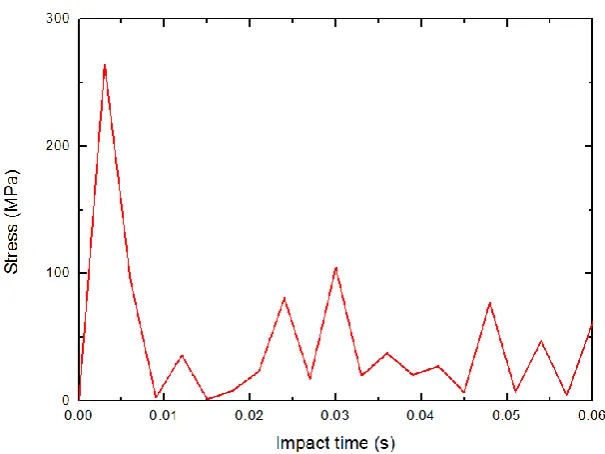
Figure 2. Variation of stress with time at the maximum displacement zone.
Figure 3. Variation of strain with time at the maximum displacement zone.
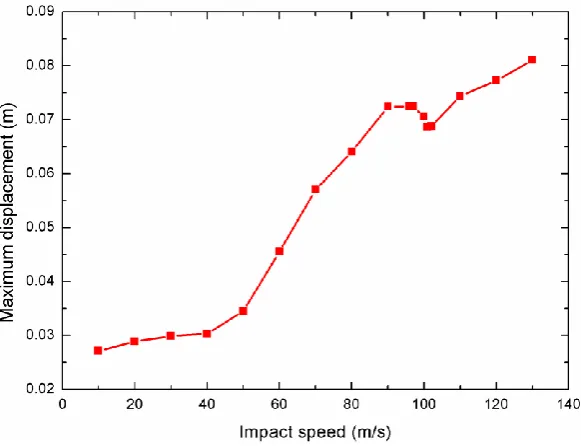
[image:3.595.142.453.324.550.2]Figure 4. Maximum displacement at different impact speeds.
Concluding Remarks
Based on finite element method of ABAQUS, a finite element model (FEM) was employed to research the effect of impact speed on the maximum displacement. According to the simulated results from FEM, the dynamic response was investigated. The maximum strain and the maximum stress happen at the first time of impact. The amplitude of fluctuation varies with the increasing impact time. The relationship between maximum displacement and impact speed is nonlinear. With the increasing impact speed, the maximum displacement increases gradually at small impact speed and increases greatly at high impact speed. It is particular that the maximum displacement decreases gradually with the impact speed if the impact speed is higher than 80 m/s but less than 100 m/s. This is attributed to the yield of local zone in truss structure.
Acknowledgement
This research was financially supported by Fundamental Research Funds.
References
[1] F. P. Beer, E. R. Johnston, J. T. DeWolf. Mechanics of Materials, Fourth Edition. 2006. The McGraw-hill Companies, Inc. New York.
[2] J.M. Guedes, N. Kikuchi. Preprocessing and postprocessing for materials based on the homogenizationmethod with adaptive finite elementmethods. Comput. Methods Appl.Mech.Eng. 83, 143–198 (1990).
[6] T.Y. Hou, X.H. Wu, Z.Q. Cai. Convergence of a multiscale finite element method for elliptic problems with rapidly oscillating coefficients. Math. Comput. 68, 913–943 (1999).
[7] J.E. Aarnes, S. Krogstad, K.A. Lie. A hierarchical multiscale method for two-phase flow based upon mixed finite elements and nonuniform coarse grids. Multiscale Model. Simul. 2, 337–363 (2006).
[8] J.C. Wu, X.Q. Shi, S.J. Ye, et al. Numerical simulation of land subsidence induced by groundwater overexploitation in Su-Xi-Chang area, China. Environ. Geol. 57, 1409–1421 (2009).
[9] Y. Efendiev, T. Hou, V. Ginting. Multiscale finite element methods for nonlinear problems and their applications. Commun. Math. Sci. 2, 553–589 (2004).
[10] G.M. Verderame, G. De Carlo, P. Ricci, G. Fabbrocino. Cyclic bond behavior of plain bars. Part II: analytical investigation. J Constr Build Mater. 23 (2099): 3512-3522 (2009).
[11] G. Desiderio, M. Latour, G. Rizzano. Modellazione Analitica e FEM del Meccanismo di trasferimento degli sforzi tra Fondello in Acciaio e Calcestruzzo nelle Travi PREM. Proceeding of XIV Convegno ANIDIS "L'Ingegneria Sismica in Italia", Bari, CD-rom; 2011.