Open Access
Research article
Reducing work disability in Ankylosing Spondylitis – development of
a work instability scale for AS
Gill Gilworth*
1,3, Paul Emery
2, Nick Barkham
2, M Glyn Smyth
3,
Philip Helliwell
4,5and Alan Tennant
1Address: 1Department of Rehabilitation Medicine, Section of Musculoskeletal Disease, Leeds Institute of Molecular Medicine, University of Leeds,
Leeds, UK, 2Section of Musculoskeletal Disease, Leeds Institute of Molecular Medicine, University of Leeds, Leeds, UK, 3Work Fit Occupational
Physiotherapy and Ergonomics Services Ltd, Leeds, UK, 4Section of Musculoskeletal Disease, Leeds Institute of Molecular Medicine, University of
Leeds, Leeds, UK and 5Bradford Teaching Hospitals NHS Foundation Trust, Bradford, UK
Email: Gill Gilworth* - [email protected]; Paul Emery - [email protected]; Nick Barkham - [email protected]; M Glyn Smyth - [email protected]; Philip Helliwell - [email protected]; Alan Tennant - [email protected]
* Corresponding author
Abstract
Background: The Work Instability Scale for Rheumatoid Arthritis (RA-WIS) is established and is used by physicians to identify patients at risk of job loss for rapid intervention. The study objective was to explore the concept of Work Instability (a mismatch between an individual's abilities and job demands) in Ankylosing Spondylitis (AS) and develop a Work Instability Scale specific to this population.
Methods: New items generated from qualitative interviews were combined with items from the RA-WIS to form a draft AS-WIS. Rasch analysis was used to examine the scaling properties of the AS-WIS using data generated through a postal survey. The scale was validated against a gold standard of expert assessment, a test-retest survey examined reliability.
Results: Fifty-seven participants who were in work returned the postal survey. Of the original 55 items 38 were shown to fit the Rasch model (χ2 37.5; df 38; p 0.494) and free of bias for gender
and disease duration. Following analysis for discrimination against the gold standard assessments 20 items remained with good fit to the model (χ2 24.8; df 20; p 0.21). Test-retest reliability was 0.94. Conclusion: The AS-WIS is a self-administered scale which meets the stringent requirements of modern measurement. Used as a screening tool it can identify those experiencing a mismatch at work who are at risk of job retention problems and work disability. Work instability is emerging as an important indication for the use of biologics, thus the AS-WIS has the potential to become an important outcome measure.
Background
Ankylosing Spondylitis (AS) is a chronic inflammatory disease of joints and entheses, typically affecting patients in their 20s when they are establishing their careers.
Although estimates for Work Disability (WD) in AS vary [1,2] it is clear that absence from work and problems with job retention due to AS are significant. AS has been reported as the reason some patients have to change their Published: 16 June 2009
BMC Musculoskeletal Disorders 2009, 10:68 doi:10.1186/1471-2474-10-68
Received: 23 July 2008 Accepted: 16 June 2009
This article is available from: http://www.biomedcentral.com/1471-2474/10/68
© 2009 Gilworth et al; licensee BioMed Central Ltd.
occupation, reduce their hours of work, or find their career progression limited [3].
The period prior to WD is one of Work Instability (WI), defined as the consequences of a mismatch between a per-son's functional ability and the demands of their job, potentially threatening continuing employment if not addressed [4]. WI has attracted less attention than WD in the literature, however as a clinical concept it may be a key factor in the management of individuals with rheumato-logical conditions that occur during the working years. Data from the UK suggests that of those AS patients of working age, 50% have lost their job due to the activity of their disease, and of those in work 50% are work unstable, at moderate or high risk of job retention problems [5]. If WI is recognised early it may be possible to reduce or elim-inate the risk of work disability by appropriate clinical or work place intervention.
There is no instrument currently available to measure WI in AS, the only way to identify clients who fulfil our defi-nition of WI is through a comprehensive Vocational Assessment. This type of assessment is offered in the UK by Jobcentre Plus, Disability Service and includes analysis of work tasks and postures as well as medical history. Fol-lowing such an assessment various interventions may be offered (for example specialist ergonomic equipment or adaptations to work practices). The degree of intervention required is dependent on the degree of WI.
A validated Work Instability Scale for rheumatoid arthritis (RA-WIS) has previously been developed [4]. From our work exploring WI in different conditions and for differ-ent occupations we have found that each group brings a unique component to WI as well as some common ele-ments [6,7]. Thus there is a need to examine the factors relevant to WI separately, in each condition, to ensure that the scale captures the relevant elements specific to that disease. The objective of this study was to develop and val-idate a Work Instability Scale specific to AS.
Methods
A similar staged methodology to that used in the develop-ment of the RA-WIS [4] was followed (see figure 1).
The entry criteria for the participants for all the stages of the study were as follows:
• Confirmed diagnosis of AS by modified New York criteria
• In paid work (but may be in current employment but "off sick" for less than 6 months in the current period); self-employed and part time workers are included.
• Aged between 18 – 60 years of age.
Qualitative interviews
The aim of this stage of the study was to identify charac-teristics of WI unique to AS. Thirteen qualitative inter-views were undertaken with participants attending rheumatology outpatients and fulfilling the above recruit-ment criteria. This satisfies current guidelines for mini-mum sample size to achieve saturation [8]. Selection of participants was based on a theoretical sample frame to ensure representation for age, gender and work type. Par-ticipants had a good range of occupations including sed-entary workers (for example Administrator and a Town Planner who was mainly office based), light work (for example Hairdresser and Dental Technician) and manual workers (for example Plumber and Refuse Collector). The interviews took the form of informal conversations with the interviewer introducing areas for discussion using a topic list, main areas were as follows:
• Details of occupation at onset of AS, impact of AS then and now, adaptations required, need for part-time working, job security
• Employer – including disclosing diagnosis, attitude, flexibility of employment
• Access to and from work and within work
• Relationships (work and home)
The interviews were tape recorded in full and typed tran-scripts produced.
Item selection
Thematic analysis of the interview transcripts was under-taken. Common issues relevant to WI were formulated into potential items for the draft AS-WIS. Where possible the exact words of the interviewees were used. New items generated from the interviews were combined with items thought to be relevant from the existing RA-WIS.
First postal survey
A questionnaire booklet including demographic details, AS QoL [9] and the draft of the AS-WIS was sent to sub-jects with a confirmed diagnosis of AS, and of the relevant age. Subjects were all attending for treatment at the local rheumatology clinic in Leeds. Only a single questionnaire was distributed, without follow-up. The ASQoL was cho-sen as a comparator measure because it offers a disease-specific 'needs based' quality of life measure which would be expected to have a strong correlation with work insta-bility, which is focused upon the construct of participa-tion (i.e. the need amongst this age group to maintain work).
work-ing. The aims of this stage were to test the scaling proper-ties of the draft WIS, to facilitate item reduction and to provide preliminary evidence of construct validity.
Criterion validity: comparison of draft instruments against a 'Gold Standard".
A sample of volunteers from the postal survey completed the draft AS-WIS a second time. On the same day they were assessed by an experienced Occupational Health Physiotherapist/Ergonomist who was blind to the responses on the draft WIS. A facilitator, who asked the patients to complete the questionnaire, also performed a cognitive debriefing at the same time. The expert allocated each participant a WI score between 0 and 4. This scoring
system was devised and has been used successfully in the development of other WIS [4,6]. The draft AS-WIS ques-tionnaire responses were then validated against the results of the gold standard assessments. Those items that were shown to discriminate across the levels of risk ascertained by the experts were retained for further analysis. Cut points for level of risk were then determined by those which maximised the sensitivity and specificity of the screening questionnaire for concordance with the expert judgement.
Rasch Analysis
The Rasch model [10] is the current standard for the devel-opment of unidimensional scales (e.g. of impairment or quality of life) delivering metric quality outcomes in
[image:3.612.116.493.82.519.2]Stages of the study
Figure 1
Stages of the study.
1.Qualitative Inter views (n=13)
2. Item selection
Transcript analysis and items selection for draft of Work Instability Scale
4. Cr iter ion validity:
Gold standard vocational assessments by Occupational Health Physiotherapist/Ergonomist (n=13) 3. Fir st postal sur vey
134 sent with 68 returned
Item discrimination 5. Rasch Analysis
Final item reduction Tests for differential item function
6. Second postal sur vey
health care [11]. Briefly, data collected from question-naires which include items for a new (or existing) scale, which are intended to be summated into an overall score are tested against the expectations of this measurement model. The model defines how responses to items should be if measurement (at the metric level) is to be achieved. The response patterns achieved are tested against what is expected (a probabilistic form of Guttman scaling [12]), and a variety of fit statistics determine if this is the case [13].
Within the framework of Rasch measurement, the scale should also work in the same way, irrespective of which group is being assessed [14]. For example, in the case of WI, males or females should have the same probability of affirming an item if they have the same underlying level of WI. If for some reason one group did not display the same probability of affirming the item, then this item would be deemed to display differential item function (DIF), and would violate the requirement of unidimensionality [15]. Consequently, every item is checked for DIF by age and gender and, in the current study by time, to ensure stabil-ity in the test-retest sample. Finally, a rigorous check for unidimensionality is undertaken by identifying contrast sets of items on the principal first component of the resid-uals and testing if person estimates derived from these sets differ. The confidence interval for the proportion of indi-vidual t-tests showing a difference between estimates should overlap 5% if the scale is strictly unidimensional [16].
The sample size requirements for Rasch analysis are based upon the degree of precision required for estimates of item difficulty and person ability. For example, in most cases a sample size of 50 will give an item calibration within 1 logit with 99% confidence [17]. This varies according to how well the scale is targeted at the patient sample. Thus a well targeted sample of 108 will give an estimate to within 0.5 logits with 99% confidence. It is important to note that Rasch analysis does not require a 'representative' sample as item difficulty is estimated inde-pendently from the ability of persons taking the test. It is more important to have a uniform distribution of persons such that the degree of precision of item estimates is sim-ilar across the whole of the construct (i.e. work instability) being measured.
Data are fitted to the Rasch model using the RUMM2020 software [18].
Test-retest postal survey
A sample of in-work patients were asked to complete the new draft of the WIS on two occasions, two weeks apart. These patients were attending for routine rheumatology clinic appointments in Bradford, a city in northern
Eng-land adjacent to Leeds. This stage of the study was to assess the test-retest reliability of the scale, and to provide further evidence of its internal construct validity.
Ethical committee approval was granted by Leeds Teach-ing Hospitals NHS Trust Local Research Ethics Committee under a programme of work for 'Reducing Work Disabil-ity in common rheumatic conditions' [Ref CA03/035].
Results
Qualitative interviews
Analysis of the qualitative interview transcripts indicated many common themes with people working with Rheu-matoid Arthritis including the importance of flexibility at work the impact of symptoms and the need to change or adapt work tasks because of impairments. Some impair-ment specific themes were reflected in potential items for the AS-WIS including those relating to mobility (for exam-ple 'getting around at work is hard for me', 'its painful walk-ing').
Item selection
Fifty five potential items were formed into a draft AS-WIS, 40 of these items were derived directly from the AS inter-view transcripts including 6 items identical to those on the RA-WIS. A further 15 items thought relevant to the AS population from the RA-WIS were included.
First postal survey
Of 134 subjects included in this stage of the study, sixty-eight returned the survey (response rate 51%). The mean age of participants in this stage of the study was 41.5. years (SD 9.8; range 26–60). Almost three-quarters (73.7%) were male. Eleven of those responding were currently off sick for a period of more than 6 months so did not meet the entry criteria. There was a trend for those not working to be older, but this did not reach statistical significance (t = 1.90 p = 0.061). The mean duration of disease of the 57 respondents in work was 19.2 years (SD 8.9).
Initial Rasch analysis of the questionnaires from these 57 respondents showed 38 items free of bias for gender and disease duration and which fitted the Rasch model (chi square 37.5; df 38; p 0.494).
Criterion validity: comparison of draft instruments against a 'Gold Standard'
tested for their ability to discriminate across these levels. Following this analysis 20 items of the AS-WIS satisfied these criteria and display good fit to the Rasch model (chi square 32.2;df 20;p 0.04). The items displayed strict uni-dimensionality in the first postal survey data with just 3.6% of the t-tests out of range and still retained good rep-resentation of the major themes identified in the qualita-tive interviews.
Ten items on the final 20 item AS-WIS are common with items on the RA-WIS. For high levels of risk for work insta-bility the sensitivity of the AS-WIS is 100% and specificity 82%. Nearly two-thirds of respondents (58%) were rated as low risk, just over a third (35%) at medium risk, and seven percent at high risk of job loss. Analysis of the AS-WIS and AS Quality of Life scores for the respondents in work showed a correlation of 0.84 (Spearman's rho) showing that 72% of the variation in Quality of Life of those is associated with their level of WI.
Test-retest postal survey
One hundred and twenty two questionnaires were sent of which 52 were returned (43%), and of whom 35 (29%) were returned from people in work, and 25 (71%) returned the questionnaire on both occasions. Pooling the two data sets together no items displayed differential item functioning by time, supporting the invariance of the scale over repeated measurements. Again, given limita-tions of sample size, the scale showed good fit to Rasch model expectations (Chi-Square Interaction p = 0.21) and satisfied the test for unidimensionality (independent t-test 10.8% 95% CI 5–17%). Internal consistency
reliabil-ity was 0.95 and test-retest reliabilreliabil-ity (Spearman) was 0.94.
Combined data
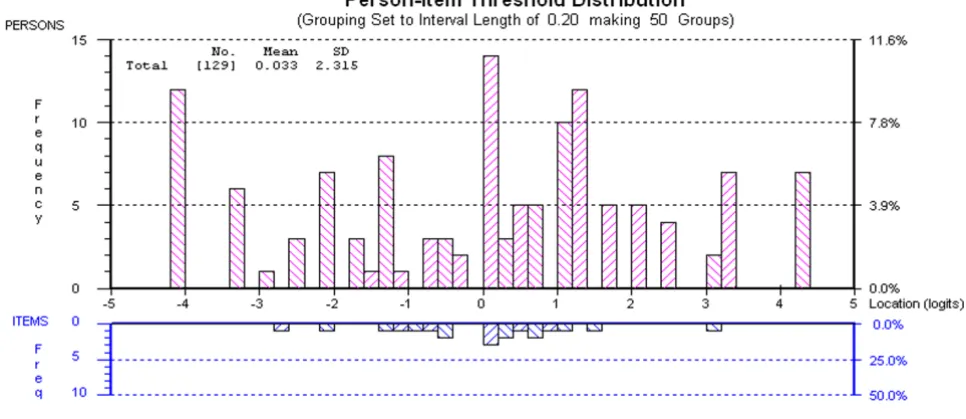
Given the relatively small sample sizes at each stage, the data from each survey was pooled to re-assess fit to the Rasch model, giving a sample of 123 cases with greater power to detect misfit and deviation from unidimension-ality. The results confirmed the robustness of the scale, all individual items were shown to fit model expectations (Table 1), with overall fit (Chi-Square Interaction) show-ing a non-significant deviation from model expectation (p = 0.23) and strict unidimensionality (significant inde-pendent t-tests = 7.2% (CI: 3–11%). Reliability was high at 0.931, supporting the use of the scale at the individual level. The targeting of the scale was good, with a mean per-son estimate of 0.033 logits, suggesting the scale to be cen-tered on the person distribution (Figure 2)
Discussion
This study has produced a simple 20 item questionnaire to measure Work Instability in AS. It satisfies all the most stringent modern psychometric requirements for scale development, and demonstrates high levels of classical reliability. Two-fifths of those subjects who responded to the first postal questionnaire and were in work had medium or high levels of work instability, suggesting that sickness absence or job loss is an ever present threat to a substantial minority of those working with this condition. The high correlation with the disease specific quality of life scale (ASQoL) indicates how much, for those in work, the struggle to maintain work impacts upon quality of life.
[image:5.612.59.542.492.701.2]Targeting of AS-WIS from pooled data
Figure 2
There are a number of settings in which this scale will be potentially useful. In the outpatient clinic or therapy set-ting it will offer a simple, self-report, questionnaire which may be used as a screening tool to alert the clinician to the need for more detailed work assessment. It may also be useful in the employment/occupational health setting to assist in predicting/monitoring work suitability. WI is emerging as an important indication for the use of new therapeutics such as biologics, which are a relatively new type of drug designed to treat AS by targeting overactive cells in the body. Thus the AS-WIS also has the potential to become an important outcome measure in the research setting. Having identified the risk of job loss, a variety of interventions are possible to minimise the physical, finan-cial and psychosofinan-cial impact of AS on the individual their family and their employer these may include early aggres-sive clinical treatment and/or preventative intervention in the workplace focused on reducing WI thus minimising sickness absence and risk of job loss.
We acknowledge that so far the instrument was developed upon and tested on a relatively small sample from the north of England; consequently the generalisability of the scale is currently unknown and predictive validity and responsiveness require further testing. The small sample sizes meant that the Rasch analysis had a relatively low degree of precision for model fit and the estimates of both item difficulty and person work instability. The power to detect DIF in the first postal questionnaire was also low, but we chose to examine this as anything showing DIF at this sample size would suggest substantive bias. The pooled data from the different studies improved the over-all precision and gave greater confidence in the interpreta-tion of the fit statistics, nevertheless a further study with a much larger sample (say > 200) is warranted before firm conclusions can be drawn. As different disease-and occu-pation-specific WI scales are developed, the common components of WI are being identified so that the differ-ent scales can be co-calibrated (by common item equat-ing) to form a single item bank of work instability [19].
Conclusion
A simple screening instrument for Work instability in AS has been developed which, despite some limitations due to small sample sizes, satisfies Rasch model expectations
and has high reliability. Given that in the final scale half the items were shared with the original RA-WIS, the study provides evidence of the communality of some aspects of WI, but also the unique aspects brought to the concept by each diagnostic group. As an increasing number of com-mon items are identified in different Work Instability Scales these can be used to establish an item bank to facil-itate comparability across disease. It is hoped that in the future increased awareness of WI will help towards patients achieving their potential in work as well as other activities. With clinical cut points to identify the level of risk of job loss, the AS-WIS will help to fill a major gap in the currently available instruments for assessing the impact of AS on the working lives of patients.
Copies of the full AS-WIS scale with guidance notes and instructions for scoring are available from the Psychomet-ric Laboratory for Health Sciences; contact [email protected].
Competing interests
The authors declare that they have no competing interests.
Authors' contributions
GG was the project leader contributing to study design, conducted the interviews, qualitative data analysis, postal surveys and prepared first full draft of manuscript. PE facilitated the study contributing to study design, assisted with the literature review, background work on study and assisted with preparation of manuscript. NB assisted with the literature review, background work on study and recruitment of study participants. MGS was the expert employment consultant on the project and completed the Gold Standard assessments. PH assisted with recruitment of study participants and project management. AT Facili-tated study contributing to study design, completed Rasch analysis, wrote first draft of results section and assisted with preparation of the full manuscript and project man-agement. All authors read and approved the final manu-script.
Acknowledgements
[image:6.612.56.554.101.180.2]We would like to thank Richard Melsom, Bradford Teaching Hospitals NHS Foundation Trust, for his assistance with recruitment of participants to this study and all the participants.
Table 1: Best and worse fitting items from the AS Work Instability Scale: Revalidation on First postal Questionnaire
Item Location Residual Chi
Square
Probability*
I have got to watch how much I do certain things at work -0.548 -0.499 0.064 0.968 When I'm feeling tired all the time, works a grind 0.534 -0.479 0.595 0.743 When I'm in pain it affects my concentration -2.146 -0.070 4.521 0.104 My condition is worse when I get stressed at work 0.183 1.824 7.581 0.023
Publish with BioMed Central and every scientist can read your work free of charge
"BioMed Central will be the most significant development for disseminating the results of biomedical researc h in our lifetime."
Sir Paul Nurse, Cancer Research UK
Your research papers will be:
available free of charge to the entire biomedical community
peer reviewed and published immediately upon acceptance
cited in PubMed and archived on PubMed Central
yours — you keep the copyright
Submit your manuscript here:
http://www.biomedcentral.com/info/publishing_adv.asp
BioMedcentral
References
1. Boonen A, de Vet H, Heijde D van der, Linden S van der: Work Sta-tus and its Determinants among Patients with Ankylosing Spondylitis: A Systematic Literature Review. J Rheumatol
2001, 28(5):1056-1062.
2. Boonen A, Chorus A, Miedema H, Heijde D van der, Tempel H van der, Linden S van der: Employment, work disability and work days lost in patients with Ankylosing Spondylitis: a cross sec-tional study of Dutch patients. Annals of the Rheumatic Diseases
2001, 60(4):353-358.
3. Ward M, Kuzis S: Risk Factors for Work Disability in patients with Ankylosing Spondylitis. J Rheumatol 2001, 28(2):315-321. 4. Gilworth G, Chamberlain MA, Harvey A, Woodhouse A, Smith J,
Smyth MG, Tennant A: Development of a work instability scale for rheumatoid arthritis. Arthritis Rheum 2003, 49:349-354. 5. Barkham N, Kong KO, Tennant A, Fraser A, Hensor E, Keenan AM,
Emery P: The unmet need for anti-tumour necrosis factor (anti-TNF) therapy in ankylosing spondylitis. Rheumatology
2005, 44:1277-1281.
6. Gilworth G, Carey A, Eyres S, Sloan J, Rainford B, Bodenham D, Neu-mann V, Tennant A: Screening for job loss: development of a work instability scale for traumatic brain injury. Brain Injury
2006, 20:835-843.
7. Gilworth G, Bhakta B, Eyres S, Carey A, Chamberlain MA, Tennant A: Keeping Nurses Working: Development and psychometric testing of the Nurse-Work Instability Scale (Nurse-WIS).
Journal of Advanced Nursing 2007, 57(5):543-551.
8. Guest G, Bunce A, Johnson L: How many interviews are enough? An experiement with data saturation and variability. Field Methods 2006, 18:59-82.
9. Reynolds S, Doward LC, Spoorenberg A, Helliwell PS, McKenna SP, Tennant A, Heijde DMFM van der, Chamberlain MA: The develop-ment of the Ankylosing Spondilitis quality of life question-naire. Quality of Life Research 1999, 8:651.
10. Rasch G: Probabilistic models for some intelligence and attainment tests. Chicago: University of Chicago Press; 1960. 11. Tennant A, McKenna SP, Hagell P: Application of Rasch Analysis
in the development and application of quality of life instru-ments. Value in Health 2004, 7(s1):S22-S26.
12. Guttman L: The basis for Scalogram analysis. In Measurement & Prediction, The American SoldierVolume VI. Edited by: Stouffer, et al. New York: Wiley; 1950.
13. Smith RM: Fit analysis in latent trait measurement models. J Applied Measurement 2000, 2:199-218.
14. Tennant A, Penta M, Tesio L, Grimby G, Thonnard J-L, Slade A, et al.: Assessing and adjusting for cross cultural validity of impair-ment and activity limitation scales through Differential Item Functioning within the framework of the Rasch model: the Pro-ESOR project. Medical Care 2004, 42(Suppl 1):37-48. 15. Holland PW, Wainer H, (editors): Differential Item Functioning.
Hilldale NJ: Lawrence Erlbaum Associates; 1993.
16. Smith EV: Detecting and evaluation the impact of multidimen-sionality using item fit statistics and principal component analysis of residuals. Journal of Applied Measurement 2002, 3:205-231.
17. Linacre JM: Sample Size and Item Calibration Stability. Rasch Measurement Transactions 1994, 7(4):328.
18. Andrich D, Lyne A, Sheridon B, Luo G: RUMM 2020. Perth: RUMM Laboratory; 2003.
19. Wolfe EW: Equating and item banking with the Rasch model.
J Appl Meas 2000, 1(4):409-34.
Pre-publication history
The pre-publication history for this paper can be accessed here: