Introduction
My thesis project entitled, Dendritic Bloom will discuss theories of nature’s pattern formations and how those patterns take shape in art through the filter of human
perception.Nature is completely unpredictable, yet it is seldom random. Humans have
endeavored to find ways to predict the patterns of nature and sought a mathematical
equation that explains it all. We have a unique adaptation for pattern perception in an
ordered and simplified way. For centuries, artists have taken inspiration from nature by
attempting to capture the chaotic beauty of a landscape or mimic the vivid colors in a
fall leaf. Nature is a complex system and from it patterns are perceived. What is gained
or lost when we order and simplify these patterns?
The Language of Nature
Patterns surround us in nature from the spiral shape of shells, the fur of animals,
the branching of lighting, the rhythmic exchange from day to night, seasons of the year
and countless more. Observers of nature have ventured to find contiguous sequences
that create these patterns; to uncover the deeper pattern amongst patterns. Today, we
have classified several main sequences of patterns that are commonly found in nature.
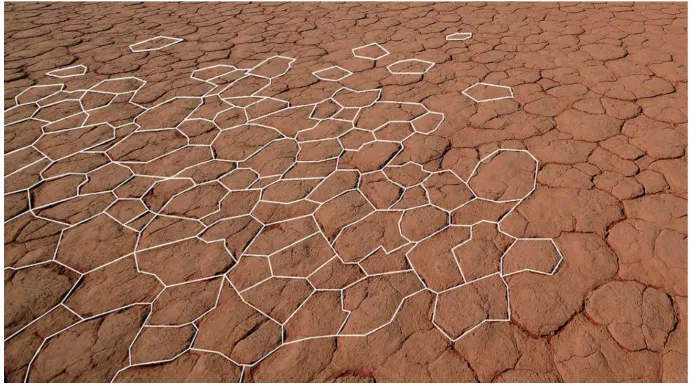
Numbers in Nature: A Mirror Maze is an exhibit by The Chicago Museum of Science and Industry1 that explores Spirals, The Golden Ratio, Fractal Branching, and
the Voronoi pattern, a few of the most common sequences of pattern which nature
creates. The exhibit explains the Voronoi sequence as, “every point within a given region
is closer to the ‘seed’ inside that region than it is to any other point outside that region.
1“Numbers in Nature: A Mirror Maze.” Museum of Science and Industry, Chicago. Access date: 10/15/17
Each point along a region’s edge is equidistant from the two nearest seeds.”(MSI,
[image:3.612.133.481.159.352.2]Chicago, Numbers in Nature) This pattern is commonly found in cracked mud (Fig. 1), giraffe skin and foamy bubbles.
Figure 1: The Voronoi Pattern occurs naturally in cracked mud.
Spirals can also be found everywhere in nature and they are formed in the
geometric proportion of the Golden Ratio also known as divine proportion. The Golden
Ratio is demonstrated by, “dividing a line into two parts, one longer than the other, so
that the whole line, compared to the longer part, is the same proportion as the longer
part compared to the shorter” 2 This is shown in Figure 2 but can also be understood in
the Golden Rectangle in Figure 3. In the Golden Rectangle3, each square is
proportionally decreasing as well as the length of the curve inside. This spiraling ratio
forms the Fibonacci sequence3, where every proportion in the sequence is found by
2Ibid.
adding the two before it: 0, 1, 1, 2, 3, 5, 8, 13, 21, 34 and so on. This is found in pinecones
(Figure 4), sunflowers, pineapples, hurricanes and more.
[image:4.612.120.468.138.187.2]
Figure 2: The blue line is broken down into the Golden Ratio through the red and green lines.
Figure 3: The Golden Rectangle is a perfect example of Figure 4: The Fibonacci Sequence helps
understanding a naturally occurring pattern through a trees on leaves and on other plants to grow
humanly imposed grid. optimally.
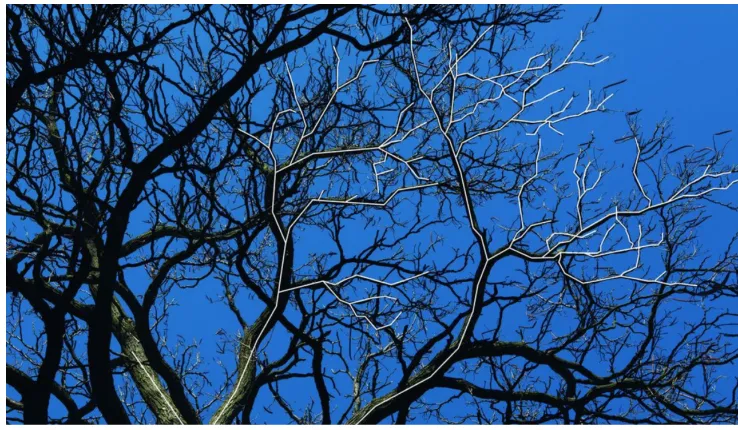
Fractals are another astonishing sequence of pattern found in nature. The unique
aspect of fractal branching is that it is self-similar across different scales (Figure 5).
Driven by recursion, fractals4 become an image of chaos found at macro scales in tree
branches (Figure 6) and river irrigation systems and at the micro scale of crystal
formation in snowflakes. I have been particularly fascinated by the chaotic nature of
[image:4.612.340.547.236.437.2] [image:4.612.47.301.249.425.2]
Figure 5: Ferns are self-similar Figure 6: A tree’s anatomy is a fractal system.
at different scales.
Fractal Branching also named Dendritic patterning and have chosen to focus on this
pattern for my work Dendritic Bloom. Noticing the recursion of these patterns throughout nature helps us to understand their interconnectedness, yet it is still a
reductive way of seeing pattern. We may never be able to fully understand the extent
and nuances of nature’s patterns but through observation and exploration we gain a
sense of connection to the pattern.
Built for Pattern Recognition
Humans have long since tried to understand the seemingly chaotic way that
nature takes shape and have harnessed nature’s patterns to keep things ordered and
flowing, like traffic systems and the fractals of urban planning. According to
Root-Bernstein5, “people are, in fact, pattern-recognizing and pattern-forming
creatures.’(Bernstein, What is the Pattern?) The problem is that people no longer
perceive themselves to be the same as nature. In order to comprehend the immensity of
5M. Root Bernstein andR. Root Bernstein, “What is the Pattern?” Psychology Today, Access date: 10/30/17
[image:5.612.213.582.34.249.2]the political, social, economical and environmental systems operating simultaneously,
people need to perceive it in snapshots, figuratively cropping out what takes longer than
a few moments to cognitively digest. This manner of focusing on parts rather than the
whole can be misleading. When problem solving, it is important to understand the
interconnectedness of every part of a system down to the miniscule. Attempting to
capture the chaotic patterns of nature to understand their interconnectivity has
broadened my perception to see systems as a whole rather than parts.
Particularly in visual arts, specific mechanisms for understanding pattern have
been developed. Through the Gestalt principles of visual perception, artists and
designers have utilized principles like proximity, similarity, continuity, and closure to
evoke pattern recognition. In my work, Dendritic Bloom I have chosen to use the grid as
a metaphorical ‘net’: a tool to catch the anarchic patterns of nature. This allows for
inquiry as to whether the imposition of the grid, a manmade pattern, serves in pattern
comprehension or affirms our limitations.
Matrix of the Grid
The grid is an ancient instrument that has appeared in many cultural and social
manifestations. According to the definition of “grid” from the Oxford English
Dictionary6, the word derives from “gridiron,” a lattice of parallel metal bars serving as
structural frameworks. “The Cartesian map, developed by Rene Descartes, embodies the
notion that humans can manipulate abstract mathematical laws in order to create new,
concrete realities. Its importance coincided with the rise of modern science and the
6“English Oxford Living Dictionaries,” The Oxford English Dictionary, Access Date: 01/10/18
empirical study of natural laws.” 7 ([Grid<> Matrix], Grid, p.12) This manner of mapping out uncharted space correlates to mankind’s tendency to control, discipline
and take possession of nature. In Alan Watts’ book How to be a Genuine Fake8, he
discusses the evolution of the net, from catching rabbits to catching the world through
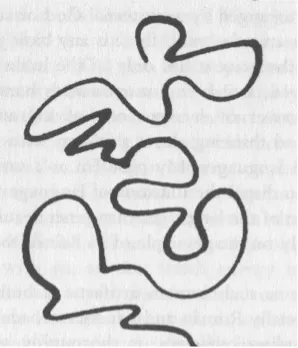
the lines of celestial and terrestrial latitude and longitude. “By itself, if the world goes
[image:7.612.216.514.303.651.2]something like this:
Figure 7: Alan Watts draws
out the world as a wiggly line.
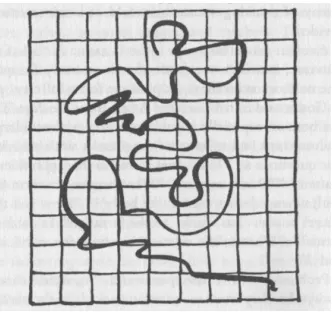
Now look at this wiggle through a net:
Figure 8: Order is imposed
onto chaos when Alan Watts
draws a grid over the line
representing the world.
The net has ‘cut’ the big wiggle into little wiggles, all contained in squares of the same
size. Order has been imposed on chaos. We can now say that the wiggle goes up so many
squares to the left, to the right, up or down.” 9 (The Book, How to be a Genuine Fake, p.59) Therefore, does imposing the grid onto space inform progress and understanding
of the world around us and its natural laws, or does it undermine mankind’s ability to
learn from nature? This is a form of the question I am exploring in my work Dendritic Bloom.
Artists and The Grid
While trying to find answers to how deeply the grid informs pattern, I have
looked to the ways artists have interpreted the grid first as a means to develop realistic
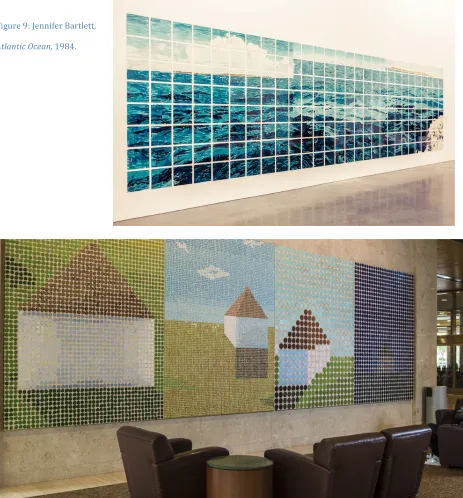
perspectives and later to the forefront as subject matter. Jennifer Bartlett is a painter
that uses the grid as a way to compose landscapes. Similarly to Alan Watt’s thinking,
Bartlett’s paintings can be analyzed through perceiving each square or dot at once. This
[image:9.612.76.539.188.686.2]allows her viewers to see landscapes broken down into singular colors and brushstrokes.
Figure 9: Jennifer Bartlett,
Atlantic Ocean, 1984.
Terry Winters is a painter that explores the grid through the repetition of
brushstroke. Each stroke is unique but ends up being an image of organized chaos.
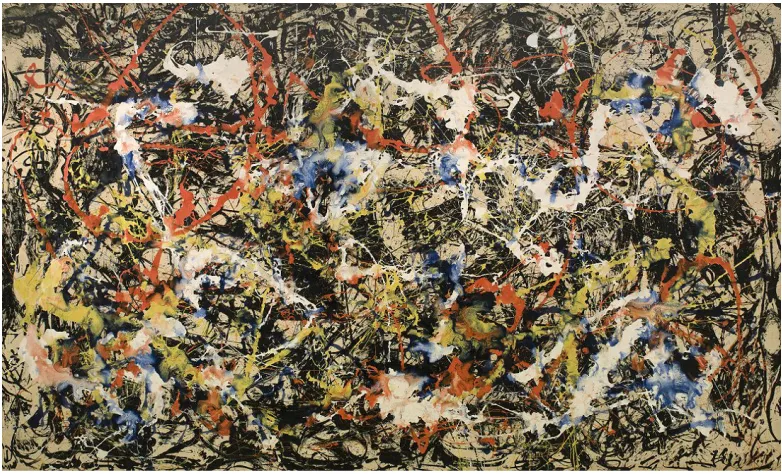
Jackson Pollock pushes this form of making further to break the boundaries of
organized pattern. I have been particularly intrigued by Pollock’s work because there is a
hidden aesthetic geometry within it. According to Richard Taylor, a physicist who has
studied Pollock’s paintings, certain patterns within the paintings are repeated again and
again at various levels of magnification such as fractals in nature. I have been working in
a similar way, using the dendritic pattern in repetition to build a larger image, one that
embodies the judgment of my human eye.
Figure 12: Jackson Pollock, Blue Poles, 1952.
Methodology
I have come to identify myself as a printmaker, but not in the traditional sense.
I look to printmaking as the process of exploring the world around me. I am not
interested in representing the world about me as I see it initially. It is when I look
deeper to notice the repetition of tree bark or intricate lines within a leaf held up to the
sun. These are the details I try to be mindful of noticing and gather to be used as
experience for making.
I am drawn to the technique of monotype in printmaking because I believe it
allows me to become a collaborator with nature. A monotype is defined by its unique
singularity, an image that has been made with ink on a polished plate such as metal or
systems of creating beautiful images and each one is different, like snowflakes. The
collaboration with nature is when the quality of chance enters. Sending something
drawn with my own hand through the printmaking press does not necessarily mean the
image will come out exactly as I had intended. The atmosphere of the room may shift
the paper or cause the ink to change consistency. The pressure of the press greatly
determines how prominent the image is. In a more direct way, I collaborate by making
impressions of natural objects.
My methods have been rooted in exploration of the textures and patterns
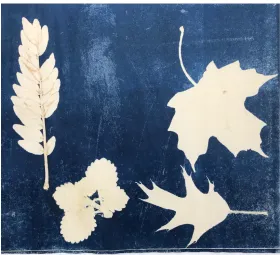
occurring naturally around me. I started by collecting leaves varying in shape and size
and created monotype impressions of them, using the lines and shapes as elements of
design to create repetitive pattern. I’m intrigued by the connection between the
[image:12.612.215.495.414.669.2]repetitive nature of creating a print and the repetitive qualities of nature’s patterns.
Figure 13: Leaf Impression
Figure 14: Leaf Impression, Kaleidoscope Pattern no. 1
After printing with leaves, I played with transforming them into kaleidoscope patterns
to enhance their geometry. I found that finding the hidden geometry of the world
around me has been a continual theme in my work this year. During this time, I picked
up a project I had started in India while studying abroad. I have been learning origami
because I love the geometry of it and seeing the patterns of origami unfolded. I made a
series of woodblocks that consisted of a balloon, a rabbit, and a frog unfolded, revealing
the lines that construct it. The reveal of pattern connects the decisions of my final work
Figure 15: Unfolded Frog Figure 16: Frog
Figure 17: Rabbit Figure 18: Rabbit in the Rain
As I continued to explore and play with the patterns of nature, I battled against
the notion of traditional printmaking and struggled to find the validity in the way that I
was depicting nature- not in the conventional way. I was less satisfied when my work
was representational and more so when my work had a strong correlation to the
patterns from nature. It was when I came upon the technique of dendritic painting that I
had realized a way to not just represent nature, but work with it. Creative Work
In Dendritic Bloom, I explored dendritic painting, a technique of monotype printing by squeezing acrylic paint between sheets of glass, pulling it apart, allowing the
simply by laying paper atop the wet paint. Through this technique, I was not
constructing the imagery with my own hand, but allowing this natural phenomenon to
occur. I began playing with which type of paper was best suited to pick up the paint
pattern and how the paint could be drawn out in different ways. If I added the paint in
dots or lines it would spread slightly and when I brushed the paint, it would not fully
form fractals and start to look like tree bark. As I learned how to control the direction of
the paint, I could harness the chaotic pattern to form according to my aesthetic
intentions. With the individual prints, I began to build a larger image layer by layer.
Initially, I sketched a copious amount of the possible overall patterns and began a
first draft of the final. I quickly understood that the negative space would be equally
important to creating a balanced composition. I started with drawing out a
square-by-square map that I would follow for each print, but it became clear that this approach
was too constructed. It looked more natural if I had a basic idea in mind, and then built
the image after making an abundance of prints. Since I was working with the grid as a
visual component, each print is 12 by 12 inches. In the final piece, I chose to create the
overall pattern on a stiffer fibrous paper, Rives BFK, in a dark blue color. There is a
translucent overlay of printed pattern on rice paper in copper and blue that acts as if the
pattern is permeating through the grid ‘net.’ I decided to elevate each print off of the
wall to activate it slightly more, since the prints would be frameless and on a white wall.
Figure 19: Sketch no. 1 Figure 20: Sketch no. 2
Figure 23: Initially, I created a ‘map’ to follow how each square would be printed and aligned.
Figure 24: I later decided
that printing numerous
pieces and building the
image was more successful
than creating each square
[image:17.612.205.534.502.746.2]Figure 25: Detail of dendritic painting in dark blue color.
Figure 26: Detail of
dendritic painting in
copper color. The line
strokes appear from
brushing the paint before
[image:18.612.190.523.398.731.2]Figure 28: Detail Shot, Dendritic Bloom.
After the installation, I had more time to reflect on the work and the reactions I
received. In my artist statement, I spoke about finding the interconnectedness of nature
to perceive it as a model for creativity and sustainability. I asked whether the matrix of
the grid successfully serves in organizing and understanding nature’s patterns or
whether it affirms the limitations of human perception. I have now come to understand
this question through a different lens: what is gained or lost when we simplify and order
nature’s patterns? On one hand, we reduce these patterns into simple motifs,
romanticizing our connection to nature through wallpaper designs and building
interiors and the need to conserve nature feels lost. On the other hand, a sense of
connection is gained when the viewer recognizes a pattern from nature that is also
within us. This is distinctly the case for dendritic patterns found in our billions of
neurons and circulatory system, which is the same pattern for tree anatomy and the
Earth’s river systems. I see friends and strangers view Dendritic Bloom and make the connection that these patterns are something we all share in common and that we are
nature.
Conclusion
Throughout this year I have been learning extensively about the patterns found in
nature and have been inspired to continue learning through exploration and making. I
now see sustainability as not just something to be passionate about but as a necessity. I
believe that producing work that explores the patterns of nature will reinforce our
connection to it. The first step into living more sustainably is to regain our connection
with the planet.
Through working with dendritic patterns, I have reached the very tip of the
are dendritic patterns found? Uncovering more of these patterns in the world around
me will open up new discoveries and new bodies of work. I will be continuing these
explorations by testing different materials besides glass, choosing different color
palettes or mediums, and using a wider range of papers. I am fascinated by the idea of
combining my work in origami and dendritic printing. After completing my Integrative
Project, I feel fulfilled by the new possibilities it has opened. The year allowed me to
work through what drives me and what does not. The biggest challenge and reward has
been finding validity in my experimental approach and moving past conventionalism in
Bibliography
Eckmann, Sabine and Koepnick, Lutz. [Grid <> Matrix]. Missouri: Mildred Lane Kemper Art Museum, 2006. “English Oxford Living Dictionaries,” The Oxford English Dictionary, Access Date: 01/10/18
https://en.oxforddictionaries.com/definition/grid
“Gestalt Principles.” Interaction Design Foundation. Access date: 01/15/18. https://www.interaction-design.org/literature/topics/gestalt-principles
“Numbers in Nature: A Mirror Maze.” Museum of Science and Industry, Chicago. Access date: 10/15/17
https://www.msichicago.org/explore/whats-here/exhibits/numbers-in-nature/
Quellette, Jennifer. “Pollock’s Fractals.” Discover Magazine, (November, 2001). Račič, Maruša. “Nature’s Patterns and Graphic Design.” Versita, (2013): 5-32.
Root Bernstein M. and Root Bernstein R., “What is the Pattern?” Psychology Today, Access date: 10/30/17
https://www.psychologytoday.com/us/blog/imagine/201103/what-s-the-pattern
Watts, Alan. The Book on the Taboo against knowing who you are. New York: Pantheon Books, 1966. Williams, Christopher. Origins of Form. New York: Architectural Book Publishing Company, 1981.
Image List
Figure 1:“Numbers in Nature: A Mirror Maze.” Museum of Science and Industry, Chicago. Access date: 10/15/17 https://www.msichicago.org/explore/whats-here/exhibits/numbers-in-nature/
Figure 2: Račič, Maruša. “Nature’s Patterns and Graphic Design.” Versita, (2013): p. 22 Figure 3: Kepler’s Discovery. The Golden Rectangle. Access date: 02/12/18.
http://www.keplersdiscovery.com/
Figure 4: Hu, Jennifer. “Why does the Fibonacci sequence repeat in nature?” Quora. Access date: 02/12/18.
https://www.quora.com/Why-does-the-Fibonacci-sequence-repeat-in-nature
Figure 5: “Fractals exhibit self-similarity” The Rockefeller University. Access date: 02/15/18.
https://phe.rockefeller.edu/barcode/blog/2007/05/26/dna-barcodes-suggest-fractal-nature-of-genome/
Figure 6: “Numbers in Nature: A Mirror Maze.” Museum of Science and Industry, Chicago. Access date: 10/15/17 https://www.msichicago.org/explore/whats-here/exhibits/numbers-in-nature/
Figure 7: Watts, Alan. The Book on the Taboo against knowing who you are. New York: Pantheon Books, 1966, p. 58.
Figure 9: Bartlett, Jennifer. Atlantic Ocean. Painting. 1984. http://artfakture.com/uncategorized/jennifer-bartlett-history-of-the-universe-at-the-parrish-art-museum/
Figure 10: Bartlett, Jennifer. Four Houses. Painting. 1998. http://2or3lines.blogspot.com/2013/07/mayo-blue-sky-2012.html
Figure 11: Winters, Terry. Branching Structures. Painting. 1996. https://www.thebroad.org/art/terry-winters
Figure 12: Pollock, Jackson. Blue Poles. Painting. 1952. https://www.jackson-pollock.org/blue-poles.jsp
Figure 13: Allen-Wickler, Olivia. Leaf Impression. Ink on paper. 2017. Figure 14: Allen-Wickler, Olivia. Kaleidoscope pattern no. 1. 2017. Figure 15: Allen-Wickler, Olivia. Unfolded Frog. Paper works. 2017. Figure 16: Allen-Wickler, Olivia. Frog. Print. 2017.
Figure 17: Allen-Wickler, Olivia. Rabbit. Print. 2017.
Figure 18: Allen-Wickler, Olivia. Rabbit in the Rain. Print. 2017. Figure 19: Allen-Wickler, Olivia. Sketch no. 1. Drawing. 2018.
Figure 20: Allen-Wickler, Olivia. Sketch no. 2. Drawing. 2018. Figure 21: Allen-Wickler, Olivia. Sketch no. 3. Drawing. 2018. Figure 22: Allen-Wickler, Olivia. Sketch no. 4. Drawing. 2018. Figure 23: Allen-Wickler, Olivia. Dendritic Map. Drawing. 2018. Figure 24: Allen-Wickler, Olivia. Process. Drawing. 2018.
Figure 25: Allen-Wickler, Olivia. Dendritic Detail no. 1. Print. 2018. Figure 26: Allen-Wickler, Olivia. Dendritic Detail no. 2. Print. 2018. Figure 27: Allen-Wickler, Olivia. Dendritic Bloom. Print works. 2018.