2019 International Conference on Information Technology, Electrical and Electronic Engineering (ITEEE 2019) ISBN: 978-1-60595-606-0
An Efficient Topology Optimization Strategy for Structural
Crashworthiness Using Model and ESLs Reduction Method
Chun REN
1,2, Hai-tao MIN
1and Tian-fei MA
1,*1State Key Laboratory of Automotive Simulation and Control,
Jilin University, Changchun 130025, China
2Ordos Institute of Technology, Ordos 017000, China
*Corresponding author
Keywords: Equivalent static loads, Model reduction method, Structural crashworthiness, Topology optimization.
Abstract. This paper presents an efficient structural topology optimization strategy for crashworthiness. Although equivalent static loads (ESLs) provides a relatively effective way to solve nonlinear dynamic response topology optimization problems, efficiency is still required to improve. To overcome above disadvantage, the proposed method combines the ESLs with model reduction (MR) method. The ESLs method transforms crashworthiness topology optimization problems into a series of linear static topology problems. The model reduction scheme is applicable to reduce the linear matrix equation and ESLs to interface degrees of freedom (DOFs), by selecting interface DOFs between design and non-design space as master DOFs. Therefore, the linear static topology optimization is performed in a reduction manner and the efficiency is improved. The topology optimization results are filtered into a black-white design for the crash simulation to avoid the element distortion problem. The process is repeated until the convergence criteria is satisfied. A numerical example is used to verify the reliability of the proposed method. The results are compared with the dynamic response optimization method using ESLs (ESLSO). The results show that, the proposed method can efficiently solve structural topology optimization problems for crashworthiness.
Introduction
Vehicle safety and environmental protection have become two challenges of rapid development of automobiles. [1]. As a capability to protect occupants during the crash, crashworthiness is an important attribute to be considered in the initial design stage [2]. Automotive lightweighting is an effective manner of developing vehicles for energy conservation and environmental protection [3]. The structural topology optimization considering crashworthiness, referred to as crashworthiness topology optimization, is a conceptual design method of structural lightweight under the crash loads [4]. Many researches have been developed for topology optimization with dynamic and nonlinear characteristics [5,[6,[7]. However, as a typical nonlinear dynamic response topology optimization problem, it is extremely difficulty to consider nonlinearities and dynamic responses simultaneously in topology optimization [8]. Structural optimization methods for nonlinear dynamic responses are generally classified into the gradient-based optimization, non-gradient-based optimization and
employed to incorporate topology results into crash dynamic analysis [8]. Although, the ESLs method provides an effective way to solve linear dynamic response topology problem, it still has limited efficiency when applied to the nonlinear dynamic response topology optimization especially for large-scale problems. Moreover, previous researches on dynamic response optimization using the ESLs on all DOFs, which is not desirable in crashworthiness topology optimization process. Since some elements can have a value of the lower bound during linear topology optimization, directly applying the ESLs mostly beyond the linear range and lead to numerical defects such as high compliance of each element, which significantly increases the number of iterations and deteriorates the efficiency. Especially for crashworthiness topology optimization, the exaggerated
ESLs may be obtained due to large deformations. Model reduction (MR) methods have been widely
used to improve the efficiency of large-system analysis. A number of approaches have been reported [16,[17,[18]. In previous studies, when combined with MR method, the linear dynamic analysis of a large-scale system can be performed in an efficient and reliable manner. However, there has been little discussion on the formulation of an efficient nonlinear dynamic response topology optimization method that employs ESLs on selected DOFs. This paper proposes a powerful crashworthiness topology optimization algorithm that combines ESLs with a model reduction method. The ESLs method transforms crash dynamic problems into linear static problems. The mode reduction scheme is applicable to the linear static topology optimization under the ESLs with multiple loading conditions. The linear matrix equation and the ESLs are reduced to interface DOFs, therefore the efficiency of each iteration enhanced. The effectiveness of the proposed method is demonstrated by investing a numerical example and comparing with the results of the ESLSO method. The results show that, the proposed method can provide a physically appropriate topology layout and has high efficiency.
Statement of the Problem
Formulation of Crashworthiness Topology Optimization
The formulation of crashworthiness topology optimization is [19]:
n
find b: R (1)
min ( , N)
to :F b z (2)
:
( ) N( ) ( ) N( ) N( , N( )) N( ) ( ), 1, ,
subject to
M b z t C b z t K b z t z t f t t l (3)
N
(b, z (t)) 0, 1, ,
i
g i m (4)
, , , 1, ,
L j j U j
b b b j n (5)
wherebis the vector of the design variables;F b z( , N)is the objective function, representing sum of
compliance; M is the mass matrix; Cis the damping matrix; Kis the stiffness matrix; f t
is theexternal load vector at the tth time step; andzN
t andzN
t are the nodal velocity and accelerationvectors, respectively. In addition, the subscriptNindicates that the response has nonlinear dynamic
properties.bLjand Uj
b are the lower and upper bounds of the jth design variablebj, respectively. Eq.
(3) is the governing equation of nonlinear crash analysis, and the constantslandnare the number of
the constraints and design variables, respectively.gjis the j
The Theory of ESLSO
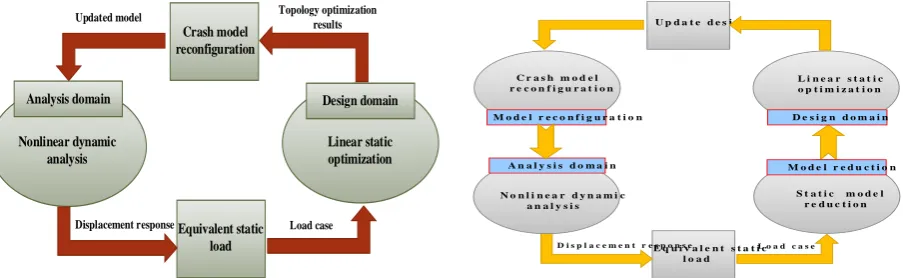
The idea of using the equivalent static loads method for linear dynamic response structural optimization (ESLSO) was initially propose by Choi and Parkand used in linear dynamic size and shape optimization [20]. The ESLSO for nonlinear dynamic response topology optimization is formulated as a sequence of cycles with four modules: nonlinear dynamic crash analysis, equivalent static load construction, topology optimization, and crash model reconfiguration [21]. With this treatment as illustrated in Fig.1, topology optimization can be performed in the linear static framework, and mesh distortion problem can be avoided in the nonlinear dynamic analysis using the crash geometry updating. The details of each module can be briefly described as follows.
Analysis domain Design domain
Nonlinear dynamic analysis
Linear static optimization
Equivalent static load
Displacement response Load case
Crash model reconfiguration
Topology optimization results Updated model
E q u i v a l e n t s t a t i c l o a d
D i s p l a c e m e n t r e s p o n s e L o a d c a s e
D e s i g n d o m a i n L i n e a r s t a t i c o p t i m i z a t i o n
M o d e l r e d u c t i o n S t a t i c m o d e l
r e d u c t i o n M o d e l r e c o n f i g u r a t i o n
C r a s h m o d e l r e c o n f i g u r a t i o n
A n a l y s i s d o m a i n
N o n l i n e a r d y n a m i c a n a l y s i s
[image:3.595.75.527.215.354.2]U p d a t e d e s i g n
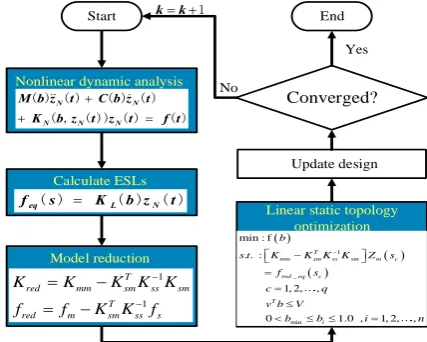
Figure 1. Schematic flowchart of the ESLSO method. Figure 2. Schematic process of the M&ER method.
Crash Dynamic Analysis
A general equilibrium equation of a structure with nonlinear dynamic behavior can be formulated as Eq.(3). By solving it using commercial software program such as LS-Dyna, the response at each time step could be obtained.
Calculation of ESLs
The ESLs can be built by multiplying the linear stiffness matrixKL(b)to the displacement vector ( )
N
z t
, 1, ,2 ,eq L N q
F K b z t tt t t (6)
wheretis the time steps of the dynamic process, and q is the total number of time steps during the crash analysis process.KL
b is the linear stiffness matrix calculated by the linear elastic material parameters.Linear Static Topology Optimization
Under the ESLs, a crashworthiness topology optimization can be convert to the sequence of linear static topology optimization problems. For stiffness design, the time steptcwith maximal internal energy are normally selected as critical time steps. The special optimization problem at the time step can tcbe formulated as.
: n
find bR (7)
1
min :
q
c eq c c
c
to F s Z s
(8)s.t . :K Z sL ( )c Feq( ) ,sc c 1, ,q (9)
T f
min
0.0b bi 1.0, i 1, ,n (11)
whereiis the ith weighting factor,Z s
c andFeq
sc are corresponding displacement vector andequivalent static load vector at thetctime step respectively. The static conditionscis strictly corresponding with the crucial time steptc. V is the total volume of the designable space,vf is the volume fraction andbminis the minimal element density vector to avoid the numerical singularities.
Crash Model Reconfiguration
Direct employing the results of topology optimization for crash dynamic analysis will lead to mesh distortion phenomenon. To avoid this difficulty, the transformation variables were introduced. Transform the values of the design variables into the values of the transformation variables as follows:
1
1
0
: 1, ,
1
i
i e
i where b
i N
where b
(12)
wherebiis the ith optimum design variable.iis the transformation variable forbi. The separation parameter1is a certain value betweenbminand 1, which is defined by the user. If the value of a design variable is smaller than the separation parameter, the corresponding transformation variable has value of 0. Otherwise, the corresponding transformation variable is regard as 1. Through this operation, all the filtered zero density elements will be deleted and not incorporated into the crash dynamic analysis.
Existing Issues
ESLSO method provides a relatively feasible way to solve crashworthiness topology optimization problems. However, in structural crashworthiness topology optimization, the standard ESLs are not suitable to be incorporated into the linear static topology optimization directly, since some elements can have a value of the lower bound during linear topology optimization, directly applying the ESLs mostly beyond the linear range and lead to numerical defects such as high compliance of each element, which significantly increases the number of iterations and deteriorates the efficiency. In addition, for crashworthiness topology optimization, the exaggerated ESLs may be obtained due to large deformations. Furthermore, the full element integral method must be used in the nonlinear analysis to ensure the stability of the calculation, which make the optimization more expensive.
Proposed Model and ESLs Reduction (M&ER) Method
Theoretical Derivation
Calculation of Reduced Model and ESLs
The model reduction (MR) method can remarkably improve the analysis efficiency of structures and reduce optimization calculation cost by eliminating unwanted degrees of freedom [22],[23],[24], so it was extensively used in large-scale structural analysis [25],[26],[27]. The static reduction method is extensively used in the degree of freedom reduction of the finite element model and has been popularized in large-scale finite element analysis software. According to MR theory, all DOFs are categorized into master DOFs and slave DOFs which are simply referred as masters and slaves respectively in this paper. The DOFs on interface between design and non-design space in topology optimization are selected as masters. The displacement vectors of the masters and slaves are expressed asZmandZsrespectively. Then, the static displacement vector can be expressed as [28]:
m
s Z Z
Z
(13)
The static equations of equilibrium, that is
mm ms m m
T
s s
ss ms
K K Z f
Z f
K K
(14)
whereKis the stiffness matrix and f is the force vector with the corresponding subscripts depicting the partitioning on the basis of the masters and slaves. Then, the static equilibrium equation of the reduced model can be expressed as:
red m red
K Z f (15)
The reduced stiffness matrix can be expressed as:
1
T
red mm sm ss sm
K K K K K (16)
The reduced load vector can be expressed as:
1
T
red m sm ss s
f f K K f (17)
At time pointtc, the reduced ESLs acting on masters can be obtained using Eq. (17).
1_ ( ) _ s_ ( )c
T
red eq c m eq c sm ss eq
f s f s K K f s (18)
where, fm eq_ ( )sc and fs eq_ ( )sc are ESLs vectors acting on masters and slaves of full model,
respectively, at time steptc.
Formulation of Optimization Model
At time pointtc, the structural crashworthiness topology optimization problem can be equivalent to a linear static topology optimization problem for the reduced model under the reduced ESLs
_ ( )
red eq c
f s . The specific formulation can be expressed as
: n
find bR (19)
_ 1
min : ( ) ( ) ( ), 1, ,
q
m c red eq c
to f b
Z s f s c q (20)1
_
: T ( ) ( ) , 1, ,
mm sm ss sm m c red eq c
T f
v bv V (22)
min
0.0b bi 1.0, i 1, ,n (23)
where the objective function is the sum of the linear compliance around critical time steptc. In this work, q is set to 3, and the time steps are selected astc1,tc,tc1and corresponding weighting factor are 0.1,0.8,0.1respecitively.
Optimization Process
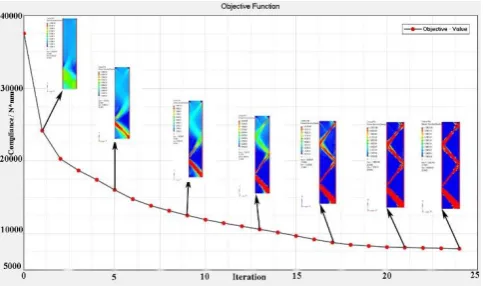
The process of the proposed method is shown in Fig. 3. The specific optimization process is as follows:
Step 1. Prepare the crash simulation model for topology optimization design;
Define the topology optimization problem, and initialize the pre-defined parameters such as volume fraction for the designable region.
Step 2. Nonlinear dynamic analysis is performed;
Structural crash dynamics analysis is performed, and the displacement response vector of all the DOFs is obtained. Then, the time step with the maximal internal energy is selected as the critical time steptc, and the corresponding displacement vectorz tN( )c is output.
Step 3. The ESLs for all the nodes are calculated;
Calculate the ESLs at the critical time steps and serve as a condition of the linear static analysis. Step 4. The masters of the structure are selected;
DOFs on interface between the design space and non-design space in topology optimization are selected as masters for model reduction.
Step 5. The model and ESLs are reduced;
The linear matrix equation and ESLs are reduced to interface DOFs simultaneously; Step 6. The topology optimization is performed in a reduced manner.
The linear static response topology optimization is performed in a reduced manner by using Eqs. (19–23), and the optimization design variables are obtained.
Step 7. Filter the topology optimization results and reconfigure the new crash simulation model; The FE model is reconfigured for crash dynamics analysis by using the filtered design variables in Eq. (12).
Step 8.Check if the optimization is converged, and repeat Steps 2-8 until converged;
If converged condition is satisfied, the optimization process is terminated; otherwise,k k 1and Step 2 is implemented.
Yes No 1 k k
Start End1
Nonlinear dynamic analysis
) ( ) ( )) ( , ( ) ( ) ( ) ( ) ( t f t z t z b K t z b C t z b M N N N N N
Linear static topology optimization Update design Calculate ESLs ) ( ) ( )
(s K b z t
feq L N
Model reduction
Converged?
1
1
T red mm sm ss sm
T red m sm ss s
K K K K K
f f K K f
1 _ min
min : f
. . :
1, 2, ,
0 1.0 , 1, 2, ,
T
mm sm ss sm m c red eq c
T i
b
s t K K K K Z s f s
c q v b V
b b i n
[image:6.595.201.415.552.723.2]
Numerical Examples
The proposed method is applied to a simplified vehicle structure under the conditions of crash to demonstrate its effectiveness. The optimization of the front-end structure is converted to 2D stiffness topology optimization under crash condition. The crash simulation is performed using LS_Dyna, and the ESLs calculation is implemented in MATLAB. The MR and the topology optimization are performed in Optistruct, and the entire optimization platform is established in the
MATLAB environment.
Model Introduction
Fig. 4 (a) shows a vehicle crash problem that may be considered as a simplified idealization of side crash with a moving barrier that has an initial velocity. A cylinder with a diameter of 80 mm is simulated to impact the vehicle’s side at 2.5 m/s. The model consists of 10622 quadrilateral shell elements with a thickness of 2 mm, and the total number of model nodes is 11767. The entire model is divided into three parts. The region in red represents the design space for the front structure. The yellow region represents the exterior area of the design domain. The green remaining area represents the other simplistic idealization structure of the vehicle. The yellow and green areas are non-design spaces and cannot be modified by the optimizer. The total mass of the initial model is 105.6 kg. The entire design process uses each element density as the design variable and the minimum sum of compliance as the objective function. The volume fraction of less than 30% is regarded as the constraint that can improve lightweighting under the premise of crash safety. The time with maximal internal energy during the crash simulation is selected as the critical time step. Then the crashworthiness topology optimization problem is converted to a linear static topology optimization problem under the reduced ESLs.
[image:8.595.177.419.636.779.2]
(b) Results of the M&ER method (c) Results of the ESLSO method
Figure 4. Topology optimization of side crash with rigid impactor.
Result Analysis
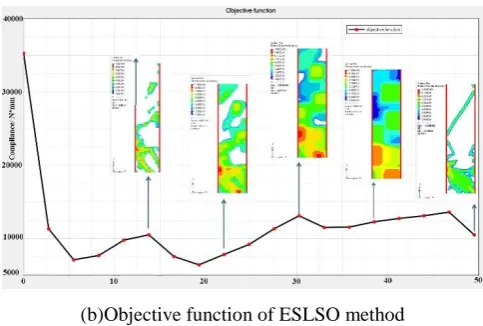
Figs. 4(b) and 4(c) show the topology optimization results of the M&ER and ESLSO methods. By comparison, the optimization result of the M&ER method proposed in this work is more explicit and the density distribution is more reasonable than the ESLSO method. Therefore, the proposed method effectively solve the numerical defects. The optimization iteration history of the objective functions and the topology evolution of the structure in two different methods are compared in Figs. 5(a) and 5(b). Evidently, the M&ER method proposed in this work has less fluctuation of the objective function and less optimization iterations during the entire iteration process than ESLSO. Thus, the proposed method has higher efficiency because the convergence is achieved after 24 optimization iterations with minimum objective function to satisfy the constraint conditions. Table 1 shows the optimization efficiency and the convergence result of the two methods. It can be seen that the stiffness of the proposed M&ER method increases by 15.7%, while the CPU time reduces by 30%.
(b)Objective function of ESLSO method
[image:9.595.91.504.272.324.2]Figure 5 Topology optimization iterative history of objective function.
Table 1 Comparison of optimization efficiency and convergence results.
Optimization
methods Iteration numbers The CPU time (s)
Convergence results (N*mm)
M&ER 24 1266 8627
ESLSO 49 1806 10239
Conclusions and Future Work
In this study, a novel approach for crashworthiness topology optimization is presented. The ESLs method is used to convert the structural crashworthiness topology optimization into the linear static topology optimization under the ESLs acting on all DOFs. The MR method is used to improve topology optimization efficiency and solve numerical defect problem by reducing linear matrix equation and ESLs are reduced to interface DOFs between design and non-design space. Thus, the efficiency of the crashworthiness topology optimization can be improved effectively. There are two major conclusions of the present work. First, directly applying those ESLs in linear static topology optimization mostly beyond the linear range and lead to numerical defects such as high compliance of each element, since some elements have a value of the lower bound during topology optimization. Second, the proposed strategy combining ESLs with model reduction method can effectively improve topology optimization efficiency for crashworthiness. We use numerical example to verify the two contributions and the efficiency. In addition, further research is needed to combine the ESLs with the model reduction for large-scale structural crashworthiness topology optimization.
Acknowledgements
This article expresses gratitude to the Natural Science Foundation Project of Inner Mongolia Autonomous Region (No. 2017MS0520) and the Scientific Research Project of the Institution of Higher Education of Inner Mongolia Autonomous Region (No. NJZY17403).
References
[1] Fang, Jianguang, et al. “On design optimization for structural crashworthiness and its state of the art.” Structural and Multidisciplinary Optimization 55.3 (2017): 1091-1119.
[2] O'Neill, Brian. “Preventing passenger vehicle occupant injuries by vehicle design—a historical perspective from IIHS.” Traffic injury prevention 10.2 (2009): 113-126.
[4] Patel, Neal M., et al. “Crashworthiness design using topology optimization.” Journal of Mechanical Design 131.6 (2009): 061013.
[5] Mayer, Robert Rosario, Noboru Kikuchi, and Richard A. Scott. “Application of topological optimization techniques to structural crashworthiness.” International Journal for Numerical Methods in Engineering 39.8 (1996): 1383-1403.
[6] Forsberg, Jimmy, and Larsgunnar Nilsson. “Topology optimization in crashworthiness design.” Structural and Multidisciplinary Optimization 33.1 (2007): 1-12.
[7] Soto, C. A. “Structural topology optimization for crashworthiness.” International journal of crashworthiness 9.3 (2004): 277-283.
[8] Lee, Hyun-Ah, and Gyung-Jin Park. “Nonlinear dynamic response topology optimization using the equivalent static loads method.” Computer Methods in Applied Mechanics and Engineering 283 (2015): 956-970.
[9] Sun, Guangyong, et al. “An experimental and numerical study on quasi-static and dynamic crashing behaviors for tailor rolled blank (TRB) structures.” Materials & Design 118 (2017): 175-197.
[10]Choi, W. S., and G. J. Park. “Transformation of dynamic loads into equivalent static loads based on modal analysis.” International Journal for Numerical Methods in Engineering46.1 (1999): 29-43.
[11]Jin, Ruichen, Wei Chen, and Timothy W. Simpson. “Comparative studies of metamodelling techniques under multiple modelling criteria.” Structural and multidisciplinary optimization 23.1 (2001): 1-13.
[12]Park, G. J., and B. S. Kang. “Validation of a structural optimization algorithm transforming dynamic loads into equivalent static loads.” Journal of optimization theory and applications 118.1 (2003): 191-200.
[13]Lee, Hyun-Ah, and Gyung-Jin Park. “A software development framework for structural optimization considering non linear static responses.” Structural and Multidisciplinary Optimization52.1 (2015): 197-216.
[14]Jang, H. H., et al. “Dynamic response topology optimization in the time domain using equivalent static loads.” AIAA journal50.1 (2012): 226-234.
[15]Kaushik, Anshul, and Anand Ramani. “Topology optimization for nonlinear dynamic problems: Considerations for automotive crashworthiness.” Engineering Optimization 46.4 (2014): 487-502.
[16]Kim, Hyungi, and Maenghyo Cho. “Two-level scheme for selection of primary degrees of freedom and semi-analytic sensitivity based on the reduced system.” Computer Methods in Applied Mechanics and Engineering 195.33-36 (2006): 4244-4268.
[17]Kim, Hyun-Gi, and Maeng-Hyo Cho. “Transformation of dynamic loads into equivalent static loads by the selection scheme of primary degrees of freedom.” Journal of the Computational Structural Engineering Institute of Korea 20.1 (2007): 57-63.
[18]Kim, Hyun-gi, and Maenghyo Cho. “Study on the system reduction under the condition of dynamic load.” Journal of Mechanical Science and Technology 27.1 (2013): 113-124.
[19]Soto, Ciro A. “Structural topology optimization: from minimizing compliance to maximizing energy absorption.” International Journal of Vehicle Design 25.1-2 (2001): 142.
[21]Bai, Y. C., et al. “An improved numerically-stable equivalent static loads (ESLs) algorithm based on energy-scaling ratio for stiffness topology optimization under crash loads.” Structural and Multidisciplinary Optimization (2018): 1-14.
[22]Kuhar, Edward J., and Clyde V. Stahle. “Dynamic transformation method for modal synthesis.” AIAA Journal12.5 (1974): 672-678.
[23]O'CALLAHAN, John. “A procedure for an improved reduced system (IRS) model.”
Proceedings of 7th IMAC, Las Vegas, NV., 1989 (1989).
[24]Noor, Ahmed K. “Recent advances and applications of reduction methods.” Applied Mechanics Reviews 47.5 (1994): 125-146.
[25]Hoang, N., et al. “System equivalent reduction expansion process.” 11th East Asia-Pacific Conference on Structural Engineering and Construction, EASEC-11. 2008.
[26]Koutsovasilis, P., and M. Beitelschmidt. “Comparison of model reduction techniques for large mechanical systems.” Multibody System Dynamics 20.2 (2008): 111-128.
[27]Lee, Jaehun, and Maenghyo Cho. “Efficient design optimization strategy for structural dynamic systems using a reduced basis method combined with an equivalent static load.” Structural and Multidisciplinary Optimization (2018): 1-16.