2018 International Conference on Computer, Communication and Network Technology (CCNT 2018) ISBN: 978-1-60595-561-2
Design of Classical Washout Algorithm for Six Degree of Freedom Ship
Motion Simulator
Yu XIA, Shu-tao ZHENG
*, Zhi-yong QU, Yu YANG and Chao LIU
Department of Mechatronics Engineering, Harbin Institute of Technology, Harbin 150001, China
*Corresponding author
Keywords: Motion simulation, Sensation simulation, Washout filter.
Abstract. The motion washout aims to bring the actual movement of the ship back to the six degree of freedom motion simulator, and to provide as real motion as possible in the limited space of the simulator. The emphasis of the classic washout algorithm lies in the choice of parameters. This paper analyzes the time domain response of the filter and combines the platform motion range with the human sensory system threshold to impose performance requirements on the system. To optimize the parameter selection according to the system performance, and get a good result of motion washout.
Introduction
The washout algorithm is an important part of the motion simulator, which can convert the actual motion parameters of the ship into the position and pose information of the six degree of freedom platform. However, for the simulation of real ship motion, because the motion range of the platform is limited, it must be switched to the middle position of the platform after once motion completed. It is called the movement to the middle position is washout[1]. The function of the design washout algorithm is that the simulator can slow back to the middle after the simulation of a ship movement, so that the platform can have enough travel in the next motion simulation[2].
The classical washout algorithm has been widely used in the dynamic simulation field because it is simple in form, easy to adjust, fast in execution, and fast in feedback[3,4]. The parameter design of the classic washout algorithm is extremely important. In this paper, the parameters of the filter are selected in terms of the time domain response and the constraints of the platform and the human sensory threshold.
The Structure of the Washout Algorithm
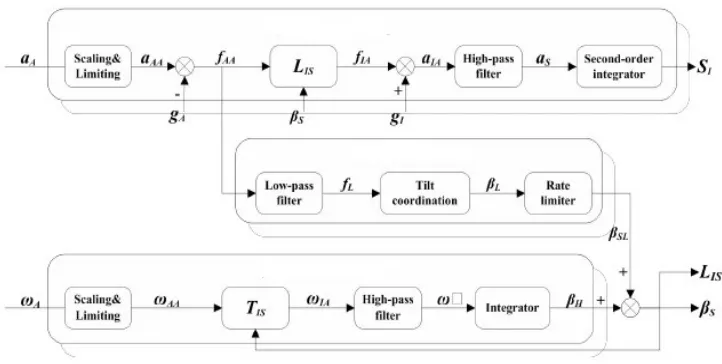
The classic washout algorithm divides the motion of the simulator into three parts: high pass acceleration channel, low pass acceleration channel and high pass speed channel, as shown in Figure 1. The high-pass acceleration channel realizes the sudden overload acceleration of the simulator ,get the displacement of the platform after washout.The low pass acceleration channel realizes the constant acceleration of the simulator, then become a part of the angular displacement of the motion platform after being washed out.The high-pass angular velocity channel implements the angle change of the simulator and is washed out as part of the angular displacement. The composition of the two-part angular displacement achieves the position adjustment of the simulator.
Design of Classical Washout Algorithm
Figure 1. Classical washout algorithm principle.
Proportional Component
The main function of the proportional link is to limit the input acceleration signal and the angular velocity signal not to exceed the threshold of the motion platform or to increase the amplitude of the input signal to make it within the motion area that the human body can feel. In order to make the driver feel the acceleration and angular velocity as close as possible to the actual ship's motion state, the parameters of the proportional link are usually set to 1.
(1)
(2)
High Pass Acceleration Channel
After using high pass filter, it can only simulate the instantaneous acceleration of the motion platform, and the continuous acceleration part is not able to pass, so it can reduce the range of the required motion space well, and can ensure the dynamic fidelity of the motion platform.
In the classical washout algorithm, the two order or three order high pass filters are usually used in the high frequency channel. The expression of the transfer function is shown as follows Eq. 3 and Eq. 4.
(3)
(4) In the formula, and are the damping coefficients of the acceleration filter in the corresponding direction; , and are the natural response frequencies of the acceleration filter in the corresponding direction.
Low Pass Acceleration Channel
(5) In the formula, is the damping coefficients of the acceleration filter in the corresponding direction; is the natural response frequencies of the acceleration filter in the corresponding direction.
For the input low frequency signal, the motion displacement of the platform is not true because of the limit of the motion range of the platform, so the low frequency acceleration is reflected by the tilt angle of the platform. The calculation of the tilt angle (pitch angle , roll angle ) in the tilt coordination is Eq. 6 and Eq. 7 as follows.
(6)
(7)
High Pass Angular Velocity Channel
The transfer function of the two order filter used in the high pass angular velocity is shown in the following formula Eq. 8.
( 8) In the formula, l is the damping coefficients of the angular velocity filter in the corresponding direction; is the natural response frequencies of the angular velocity filter in the corresponding direction.
Simulation and Analysis of Classical Wash Algorithm
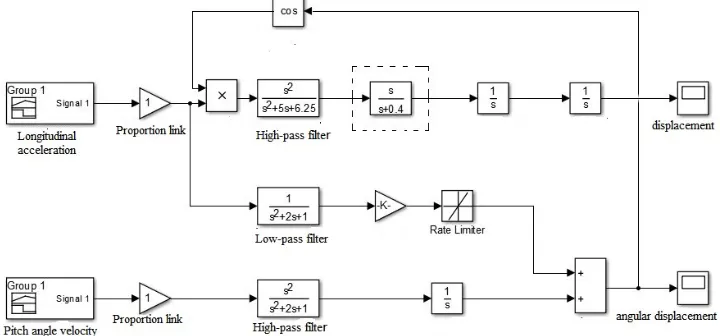
[image:3.612.132.492.536.704.2]Based on the design principle of the classical washout algorithm, a simulation model of the classic eluate algorithm is built in Matlab/Simulink, as shown in Figure 2 as a simulation model of longitudinal mode (two degrees of freedom in the direction of longitudinal and pitching). The selection of the parameters of the filter can be considered as a performance analysis of a multi - order system, combined with the limits of the performance of the motion range of the platform and the threshold of human sensation.
High Pass Acceleration Filter
The high pass filter of platform translation generally adopts two or three order filter, an acceleration signal is simulated as shown in Figure 3. The longitudinal acceleration is a signal of , the duration is 4s, and the acceleration becomes zero after 6s.
[image:4.612.81.533.196.449.2] [image:4.612.218.408.208.307.2]The longitudinal acceleration and displacement are obtained by simulation models, as shown in Figure 4 and Figure 5. In Figure 4, it is shown that the acceleration difference between the two filters. In Figure 5, the washout displacement of the two order filter is obviously greater than the wash out displacement after the three order filtering, and the platform still has a large displacement after the acceleration signal is executed at 6s. The three order filter can be reset to zero in time, so the three order filter should be selected as the acceleration high pass filter.
Figure 3. Input acceleration signal.
Figure 4. Washout acceleration. Figure 5. Washout displacement.
The parameters of the three order filter are selected according to the analysis of the time domain solution and the condition of human perception. The optimal parameters =0.5, =18.1 and
=0.61 are selected.
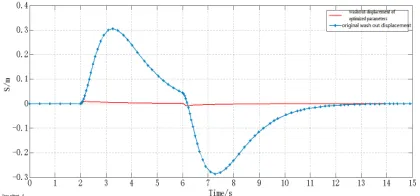
The analysis of Figure 6 and Figure 7 shows that the displacement of the platform is smaller because of the larger natural response frequency after the optimization of the parameters, and the time of the return to the neutral position is shorter, and the size of the acceleration is limited in the process of “back” reset.
Figure 6. Washout acceleration. Figure 7. Washout displacement.
Low Pass Acceleration Filter
[image:4.612.316.526.555.653.2]The role of the tilt coordinative medium angle speed limiter is to avoid the oversize of the angular velocity of the tilt harmonization. For example, in Figure 8, the angular velocity of the inclined channel is too large when the threshold is not added to the human body, and the limit is not satisfied. Figure 9 is a longitudinal acceleration curve. The acceleration after washing out is composed of high acceleration and continuous acceleration coordinated by the tilt. From the acceleration curve after washing out, it can be seen that the classical elution algorithm cannot simulate the actual acceleration completely. The acceleration is not well simulated in the vicinity of the 2.2s, and the driver will be the driver. It feels that the acceleration decreases and increases, and there is a continuous acceleration effect after 6s, and the false hints are larger, which will affect the driver's feeling of operation.
Figure 8. Washout angle of tilt coordination. Figure 9. Longitudinal acceleration.
Summary
In this paper, the time domain response of the filter design in the classical wash out algorithm is studied, and the selection method of the classic eluant filter parameters is proposed according to the time domain response. The parameters calculated by this method make the output of the filter balance the contradiction between the acceleration and the motion space. In the limited space, the acceleration is realized as much as possible, and the satisfactory results are obtained.
But the drawback of the algorithm still exists, and the acceleration has obvious phase delay and hysteresis, and the effect of the simulated continuous acceleration is not ideal, which greatly reduces the driving sense fidelity of the driver. In addition, the inclined angle of the inclined channel reduces the passing angle, which leads to the lack of simulated continuous acceleration, which will eventually lead to the error of the amplitude and phase of the simulated acceleration, and can also be improved for this problem.
References
[1]Casas S, Portalés C, Morillo P, et al. A Particle Swarm Approach for Tuning Washout Algorithms in Vehicle Simulators[J]. Applied Soft Computing, 2018.
[2]An Optimal Washout Filter Design with Fuzzy Compensation for a Motion Platform[J]. IFAC Proceedings Volumes, 2011, 44(1):8433-8438.
[3]Kong X T, Zhu Y C, Di Y Q, et al. Methods to Determine Optimal Washout Position for Single and Multi-Occupant Motion Simulator[J]. Cybernetics & Information Technologies, 2016, 16(1):173-187.
[4]Richard Anthony. Romano. Motion control logic for large excursion driving simulators [microform][J]. 1999.