Finite-Difference Solution of the Helmholtz Equation
Based on Two Domain Decomposition Algorithms
Wensheng Zhang1, Yunyin Dai2
1
Institute of Computational Mathematics and Scientific/Engineering Computing, LSEC, Beijing, China
2
Academy of Mathematics and Systems Science, Chinese Academy of Sciences, Beijing, China Email: [email protected], [email protected]
Received July 2013
ABSTRACT
In this paper, wave simulation with the finite difference method for the Helmholtz equation based on the domain de-composition method is investigated. The method solves the problem by iteratively solving subproblems defined on smaller subdomains. Two domain decomposition algorithms both for nonoverlapping and overlapping methods are de-scribed. More numerical computations including the benchmark Marmousi model show the effectiveness of the pro-posed algorithms. This method can be expected to be used in the full-waveform inversion in the future.
Keywords: Finite Difference; Domain Decomposition; Nonoverlapping; Overlapping; Helmholtz Equation; Preconditioner
1. Introduction
The numerical solution of acoustic wave equation is an important problem. The Helmholtz equation is the ver-sion of acoustic wave equation in the frequency domain. It has applications in seismic wave propagation, imaging and inversion. In the geophysical frequency-domain in-version, one needs to do forward modeling which means solving the Helmholtz equation. During the inversion process, the synthetic model is continuously updated until a convergence is reached. Thus numerical methods for solving the Helmholtz equation have been under ac-tive research during the past few decades. The finite element method and the finite difference method have been used successfully for this problem. The discretiza-tion of the 2D Helmholtz for mid-frequency and high- frequency problems may lead to a large linear system because of the requirement of ten points per wavelength. This makes the problem even harder to solve. Direct me-thods easily suffer from inacceptable computational work. So many iterative methods for the Helmholtz equation have been developed, for instance, see [1-6]. As the re-sulting system is non-Hermitian and indefinite, a good preconditioner is necessary for the iterative methods. Various preconditioners have been proposed [5-11], for example, a tensor product preconditioner [6], the incom-plete factorization preconditioner [7] and the Laplacian preconditioner [8,9]. We will use the shifted-Laplacian preconditioner in this paper [9].
The domain decomposition method (DDM) is an ef-fective technique for solving large-scale problems [12-
22]. It splits the whole computational domain into several smaller subdomains and solves a sequence of similar subproblems on these subdomains. The number and size of subdomains can now be chosen so as to enable direct methods to solve the subproblems. Between adjacent subdomains the boundary conditions are adjusted itera-tively by transmission conditions. For the boundary of whole computational domain, absorbing boundary condi-tions (ABCs) are required. There exist several ABC me-thods, for instance, the paraxial approximation method [23] and the perfectly matched layer method [24]. In this paper, we use the former as our computational domain is a rectangular domain.
In this paper, we focus on solving the Helmholtz with the finite difference method based on the nonoverlapping and overlapping DDM algorithms. More numerical computations demonstrate the correctness of the algo-rithms presented in this paper. The method will be used in the frequency-domain inversion in the future.
2. Theory
2.1. Finite Difference Scheme
The 2-D acoustic wave equation can be written as
2 2 2
2 2 2 2
1
( , ) ( , )
u u u
g x z
v x z t x z
∂ −∂ −∂ =
∂ ∂ ∂ , (1)
with the absorbing boundary conditions
1
0 ( , )
u u
n v x z t
∂ ∂
+ =
where v x z( , ) is the velocity of media and u x z t( , , ) is the wavefield, g x z( , ) is the source term. In the fre-quency domain (1) can be written as
2 2
2
2 2 ( , ) ( , )
u u
k x z u g x z
x z
∂ ∂
− − − =
∂ ∂ , (3)
where k=ω/ ( , )v x z is the wave number and
2 f
ω= π is the angular frequency. The boundary con-dition in the frequency domain is
( , ) 0
u
ik x y u n
∂ − =
∂ , (4)
where n is the outward normal of the boundary and
1
i= − is the imagine unit. We use the second-order difference scheme to discrete (3) and (4) and the result can be written as a linear system
Au=b, A∈CN N×
, u b, ∈CN, (5) where N=N Nx y is the total number of wavefield u
on the computational domain Ωh, and Nx and Ny
are the discretization number along x and z direc- tions respectively. The matrix A is a complex matrix as the boundary condition contains complex number. Moreover, it is non-positive and non-Hermitian matrix. Usually we use the Krylov iterative methods to solve (5) as A is a large-scale sparse matrix. The Bi-CGSTAB algorithm [25,26] is a good choice. The following is the Bi-CGSTAB algorithm for solving Ax=b.
Algorithm 1 [Bi-CGSTAB algorithm]
Step 1. Give the matrix A, vector b and initial val-ue x0, the maximal iterative number kmax and the
to-lerance error εtol, the preconditioned matrix M ,
com-pute r0= −b Ax0 and set k=1 and r0=r0;
Step 2. If k≤kmax and ε ε> tol, turn to step 3;
oth-erwise stop and output xk;
Step 3. Compute 1 1 1
T
k rk rk
ρ − = − − , if ρk−1=0 or
1 0
k
ω − = then stop; otherwise turn to step 4; Step 4. If k=1 then p1 =r0, otherwise compute
1 1 1 2 1 k k k k k ρ α β ρ ω − − − − −
= , pk =rk−1+βk−1(pk−1−ωk−1Vk−1); (6)
Step 5. Solve the system Mpˆ= p and compute
ˆ
k
V =Ap, 1
1 k k T k r V ρ α −
− = , sk =rk−1−αkVk; (7)
Step 6. Set ε=||sk|| , if ε ε> tol then
1 ˆ
k k k
x =x− +α p, otherwise stop and output xk;
Step 7. Solve the systems Msˆ=s and t= Asˆ, then compute 1 T k k T t s t t ρ
ω = −
,xk =xk−1+αkpk+ωksˆ, (8)
and set ε=||rk ||, let k= +k 1, turn to step 2.
For the preconditioner matrixM , we adopt the shifted-
Laplace preconditioned method [9]
2 2
2 2 2 ( , ) SL
M k x y
x y α
∂ ∂
= − − +
∂ ∂ , (9)
where Re( )α >0 and Im( )α >0. A typical choice for
α is
α
=i, named complex shifted-Laplace precondi-tioner.2.2. Two Domain Decomposition Algorithms
In this subsection we discuss how to solve the problem (3) and (4) with DDM, including the nonoverlapping algo-rithm and overlapping algoalgo-rithm. First of all, we consider the nonoverlapping problem. We divide the computa-tional domain Ω into N non-overlapped subdomains
m
Ω , m=1,,N. Denote un m, be the value of uat n
th iteration and on the mth subdomainΩm. Obviously the division satisfies
i
Ω =
Ω , Ωi
Ω =j φ, Γ = ∂Ωij i
∂Ωj, (i≠ j).Given the iteration value u0,m, m=1,,N, solve the following system iteratively:
2 , 2 ,
2 ,
2 2 ( , )
n m n m
n m
ij ij
u u
k u g x y
x z
∂ ∂
− − − =
∂ ∂ ,( , )x y ∈ Ωm (10)
, , 0 n m n m m u iku n ∂ − =
∂ , ( , )x y ∈ ∂Ω
∂Ωm , (11), 1,
, 1,
n m n r
n m n r
m r u u iku iku n n − − ∂ ∂ − = − −
∂ ∂ , (12)
( , )x y ∈ Γ = ∂Ωmr m
∂Ωr.The last Equation (12) is the interface equation. Using the standard five-point difference scheme, we obtain the following system
, , ,
n m n m n n
A u =b , m=1,,N. (14) In the iterations, the un−1,m
is assumed to be known and is used in the interface equation. Thus we can give the following nonoverlapping DDM algorithm.
Algorithm 2 [Nonoverlapping DDM algorithm] Step 1. Select initial value u0,m
and set n=0. Step 2. Obtain bn m, by solving the interface equation discretized from (12).
Step 3. Solve the system (14). Step 4. Set n= +n 1, turn to step 2.
In the following we consider the overlapping DDM. We still divide the computational domain Ω into N
subdomains Ωi, i=1,,N: i
Ω =
Ω , (15) but now any two adjacent subdomains are overlapped,i.e.,
r
m φ
For simplicity we consider the case of two subdomains,
i.e., N =2 and Ω1
Ω ≠2 φ. Notice that theboun-dary
\ ( )
i i i
Γ = ∂Ω ∂Ω
∂Ω (17) doesn’t belong to the sub-domain Ωi. When the iteration for the problemconver-gences, the following conditions are true obviously
, 1,
0
n m n m
u −u− → , (18)
, 1,
0
n m n m
i i
u u
n n
−
∂ −∂ →
∂ ∂ , n→ +∞, (19)
To keep the symmetry of the matrix on the subdo-mains, we construct the auxiliary equation
, 1,
, 1,
n m n r
n m n r
m r
u u
iku iku
n n
−
−
∂ − =∂ −
∂ ∂ . (20)
Thus we get the similar system
, , ,
n m n m n n
A u =b , m=1,,N. (21) Now we can give the following overlapping DDM al-gorithm.
Algorithm 3 [Overlapping DDM algorithm] Step 1. Set n=0 and select initial value un m,
; Step 2. Solve the auxiliary Equation (21); Step 3. Extrapolate un m,
according to the following formulation:
, ,
|
m
n m n m
u Ω =u , , | \ m ,
n m n m
u Ω Ω =u ,
, 1
1 N
n n m
i
u u N =
=
∑
; (22)Step 4. Set n= +n 1 and turn to step 2.
3. Numerical Computations
For testing the correctness of the discretized finite dif-ference schemes, we solve the problem without using DDM first. The first model is a homogeneous model with constant wave number. The computational domain is a square Ω =(0, 1)2
, and the source g x y( , ) is defined as the following δ function:
1, 1 / 2, 1, 2. ( , )
0, other.
x y
x y
δ = = =
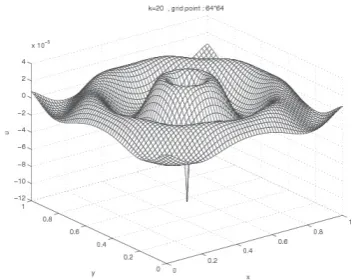
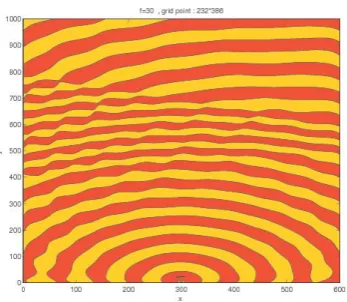
We use the preconditioned Bi-CGSTAB method to solve the problem. Figure 1, Figures 2 and 3 are the simulation results for wave number 20, 30 and 40 respec-tively. We can see that the obtained waveform in these figures is very clear. We also can see that the wave has more vibration as k increases. Next we consider a three-layered model shown in Figure 4. The velocity from top to bottom is 2700 m/s, 1500m/s and 2100 m/s respectively. The computational domain is a rectangle domain: Ω =(0, 600) (0,1000)× , and g x y( , ) is the following
δ
function [image:3.595.334.512.85.225.2]
Figure 1. Wavefield for k=20 obtained by the precondi-tioned Bi-CGSTAB method. The DDM is not used.
[image:3.595.339.508.269.403.2]
Figure 2. Wavefield for k= 30 obtained by the precondi-tioned Bi-CGSTAB method. The DDM is not used.
Figure 3. Wavefield for k= 40 obtained by the precondi-tioned Bi-CGSTAB method. The DDM is not used.
1, 300, 1, 2. ( , )
0, other.
x y
x y
δ = = =
Figures 5 and 6 are the simulation results for this model with wave number 20 and 30 respectively. Our analysis shows the results are right.
[image:3.595.342.508.448.582.2][image:4.595.333.513.171.310.2]
Figure 4. A three-layered model with velocity 2700 m/s, 1500 m/s and 2100 m/s from top to bottom.
Figure 5. Wavefield contour for f = 20 Hz obtained by the preconditioned Bi-CGSTAB method. The DDM is not used.
Figure 6. Wavefield contour f =30 Hz obtained by the preconditioned Bi-CGSTAB method. The DDM is not used.
wavefield result for f = 4 Hz obtained by the nonoverlap-ping DDM algorithm with two subdomains. For a L-type model we divide it into three subdomains. Figure 8 is the corresponding simulation result for f = 4 Hz obtained by the nonoverlapping DDM algorithm with three
subdo-mains. Figure 9 is result for f = 4 Hz obtained by the nonoverlapping DDM method with four equal square subdomains for a square domain.
[image:4.595.90.259.288.430.2]Next we solve the problem with the overlapping DDM algorithm. The velocity media is 2100 m/s. The location of the pulse is at ( , )x y =(3, 2.5). The frequency is
Figure 7. Wavefield for f = 4 Hz obtained by the nonover-lapping DDM algorithm. The square computational domain is divided into two subdomains up and down.
Figure 8. Wavefield for f = 4 Hz obtained by the nonover-lapping DDM algorithm. The L-type computational domain is divided into three square subdomains.
[image:4.595.334.513.362.503.2] [image:4.595.87.261.483.634.2] [image:4.595.336.509.556.697.2]
f = 1 Hz. Figure 10 is the wavefield obtained by the overlapping DDM algorithm with two equal square sub-domains up and down. Figure 11 is the wavefield ob-tained by the overlapping DDM algorithm with three square subdomains for an L-type domain. Figure 12 is the
Figure 10. Wavefield for f = 1 Hz obtained by the overlap-ping DDM algorithm. The computational domain is divided into two equal subdomains up and down.
Figure 11. Wavefield for f = 1 Hz obtained by the overlap-ping DDM algorithm. The square computational domain is divided into three equal square subdomains.
Figure 12. Wavefield for f = 1 Hz obtained by the overlap-ping DDM algorithm. The square computational domain is divided into four equal subdomains.
wavefield obtained by the overlapping DDM algorithm with four equal square subdomains for a square domain.
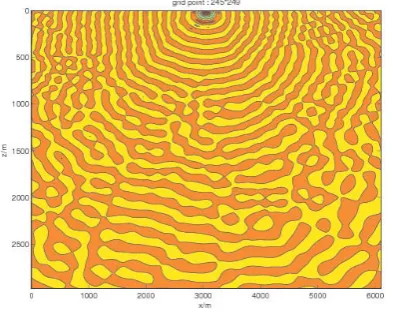
Finally we consider a typical inhomogeneous model named Marmousi model which is usually used to test the ability of seismic migration and inversion [27]. The ve-locity is shown in Figure 13. The velocity varies from 1500 m/s to 5500 m/s. We select a part of this model to simulate wave propagation. Figure 14 is the wavefield contour obtained by the preconditioned Bi-CGSTAB method for f =5Hz andthe DDM algorithm is not used.
Figure 15 is the wavefield contour obtained by the non-overlapping DDM algorithm with two subdomains. Fig-ure 16 is the wavefield contour obtained by the overlap-ping DDM algorithm with two subdomains. Figure 17 is the similar result but for f =20 Hz. Comparing Fig-ures 15 and 16 with Figure 14, we know that they al-most the same which are just we expect.
4. Conclusion
The acoustic wave equation in the frequency domain is solved by the finite difference method based on the do-main decomposition method. The discritizaiton of the
Figure 13. Marmousi model.
Figure 15. Wavefield contour for f = 5 Hz by Bi-CGSTAB preconditioned method. The nonoverlapping DDM algo-rithm with two subdomains is used.
Figure 16. Wavefield contour for f = 5 Hz obtained by Bi-CGSTAB preconditioned method. The overlapping DDM algorithm with two subdomains is used.
Figure 17. Wavefield contour for f = 20 Hz obtained by Bi-CGSTAB preconditioned method. The overlapping DDM algorithm with two subdomains is used.
problem leads to a sparse system which is solved by the complex shifted-Laplace preconditioned Bi-CGSTAB
iteration method. Two DDM algorithms both for non-overlapping and non-overlapping method are given. Many numerical computational examples including the com-plex Marmousi model are implemented which show the correctness and effectiveness of the algorithms presented in this paper. This method can be used in the full-wave- form inversion. It can sometimes reduce the computa-tional complexity.
5. Acknowledgements
This research is supported by the State Key project with grant number 2010CB731505 and the Foundation of Na-tional Center for Mathematics and Interdisciplinary Sciences, Chinese Academy of Sciences. The computa-tions are implemented in the State Key Laboratory of Scientific and Engineering Computing (LSEC).
REFERENCES
[1] A. Bayliss, C. I. Goldstein and E. Turkel, “The Numerical Solution of the Helmholtz Equation for Wave Propaga-tion Problems in Underwater Acoustics,” Computers and Mathematics with Applications, Vol. 11, No. 7-8, 1985, pp. 655-665.
[2] R. E. Plexxis, “A Helmholtz Iterative Solver for 3D Seismic-Imaging Problems,” Geophysics, Vol. 72, No. 5, 2007, pp. SM185-SM197.
[3] A. Bayliss, C. I. Goldstein and E. Turkel, “An Iterative Method for the Helmholtz Equation,” Journal of Compu-tational Physics, Vol. 49, No. 3, 1983, pp.443-457.
[4] C. W. Oosterlee and T. Washio, “Iterative Solution of the Helmholtz Equation by a Second Order Method,” SIAM Journal on Matrix Analysis and Applications, Vol. 21, No. 1, 1999, pp. 209-229.
[5] Y. A. Erlangga, “Advances in Iterative Methods and Pre-conditioners for the Helmholtz Equation,” Archives of Computational Methods in Engineering, Vol. 15, No. 1, 2008, pp. 37-66.
[6] R.-E. Plessix and W. A. Mulder, “Separation of Variables as a Preconditioner for an Iterative Helmholtz Solver,”
Applied Numerical Mathematics, Vol. 44, No. 3, 2003, pp. 385-400.
[7] M. M. M. Made, “Incomplete Factorization-Based Pre-conditionings for Solving the Helmholtz Equation,” In-ternational Journal for Numerical Methods in Engineer-ing, Vol. 50, No. 5, 2001, pp. 1077-1101.
[image:6.595.76.273.509.666.2]
Li-near Algebra with Applications, Vol. 16, No. 8, 2009, pp. 603-626.
[9] T. Airaksinen, E. Heikkola, A. Pennanen and J. Toivanen, “An Algebraic Multigrid Based Shifted-Laplacian Pre-conditioner for the Helmholtz Equation,” Journal of Computational Physics, Vol. 226, No. 1, 2007, pp. 1196- 1210.
[10] Y. A. Erlangga, C. Vuik and C. W. Oosterlee, “On a Class of Preconditioners for Solving the Helmholtz Equa-tion,” Applied Numerical Mathematics, Vol. 50, No. 3-4, 2004, pp. 409-425.
[11] Y. A. Erlangga, C. W. Oosterlee and C. Vuik, “A Novel Multigrid Based Preconditioner for Heterogeneous Helm-holtz Problems,” SIAM Journal on Scientific Computing, Vol. 27, No. 4, 2006, pp. 1471-1492.
[12] T. F. Chan and T. P. Mathew, “Domain Decomposition Algorithms,” Acta Numerica, Vol. 3, 1994, pp. 61-143.
[13] J. D. Benamou and B. Despres, “A Domain Decomposi-tion Method for the Helmholtz EquaDecomposi-tion and Related Op-timal Control Problems,” Journal of Computational Phys-ics, Vol. 136, No. 1, 1997, pp. 62-68.
[14] B. Smith, P. Bjorstad and W. Grop, “Domain Decompo-sition: Parallel Multilevel Methods for Elliptic Partial Differential Equations,” Cambridge University Press, Cambridge, 1996.
[15] A. Quarteroni and A. Valli, “Domain Decomposition Methods for Partial Differential Equations,” Oxford Science Publications, Oxford, 1999.
[16] A. Tosseli and O. Widlund, “Domain Decomposition Methods—Algorithms and Theory,” Springer, Berlin, 2005.
[17] J. Xu, “Iterative Methods by Space Decomposition and Subspace Correction,” SIAM Review, Vol. 34, No. 4, 1992, pp. 581-613. [18] J. Xu and J. Zou, “Some Nonoverlapping Domain
De-composition Methods,” SIAM Review, Vol. 40, No. 4,
1998, pp. 857-914.
[19] S. Kim, “Domain Decomposition Iterative Procedures for Solving Scalar Waves in the Frequency Domain,” Nume- rische Mathematik, Vol. 79, No. 2, 1998, pp. 231-259.
[20] S. Larsson, “A Domain Decomposition Method for the Helmholtz Equation in a Multilayer Domain,” SIAM Journal on Scientific Computing, Vol. 20, No. 5, 1999, pp. 1713-1731.
[21] F. Magoulès, F. X. Roux and S. Salmon, “Optimal
Dis-crete Transmission Conditions for a Nonoverlapping Domain Decomposition Method for the Helmholtz Equa-tion,” SIAM Journal on Scientific Computing, Vol. 25, No. 5, 2004, pp. 1497-1515.
[22] E. Heikkola, T. Rossi and J. Toivaned, “A Parallel Ficti-tious Domain Method for the Three-Dimensional Helm-holtz Equation,” SIAM Journal on Scientific Computing, Vol. 24, No. 5, 2003, pp. 1567-1588.
[23] R. Clayton and B. Engquist, “Absorbing Boundary Con-ditions for Acoustic and Elastic Wave Equations,” Bulle-tin of the Seismological Society of America, Vol. 67, No. 6, 1977, pp. 1529-1540.
[24] J. P. Berenger, “A Perfectly Matched Layer for Absorb-ing of Electromagnetic Waves,” Journal of Computation-al Physics, Vol. 114, No. 2, 1994, pp. 185-200.
[25] H. A. van der Vorst, “Bi-CGSTAB: A Fast and Smoothly Converging Variant of Bi-CG for the Solution of Non-symmetric Linear Systems”, SIAM Journal on Scientific and Statistical Computing, Vol. 13, No. 2, 1992, pp. 631- 644.
[26] Y. Saad, “Iterative Methods for Sparse Linear Systems,” 2nd Edition, SIAM, Philadephia, PA, 2003.