© 2016, IRJET ISO 9001:2008 Certified Journal Page 1935
Abstract
— Nickel-chromium-molybdenum alloy that has been designed to resist a wide range of severely corrosive environments, pitting and crevice corrosion. This alloy shows significantly high tensile, yield and creep-rupture characteristics at high temperatures. The company’s main aim is to reduce the cost of the production without compromising on the quality of the output. Using the optimum resources possible in designing the Jigs & Fixtures An attempt has been made in this direction to Increase life of Jigs & Fixtures.So here we consider an industrial application project consisting of Experimental Analysis of Raw Material & FEA Analysis of Fixture Jaw. This Fixture Jaw has to compensate the forces acting on the Component and has to fulfill certain critical constraints. Solid works simulation is the software has been used for this analysis which uses finite element method for solution. And main resulting, An attempt was made on experimental Analysis carried out on En24 Before hardening main compositions C-0.428, Cr-1.052, Ni-1.4020, Mo-0.2190 And After Heat Treatment were found C-0.4452, Cr-1.2133, Ni-1.3652,
Mo-0.2290 which will drastically changes its mechanical property, which will simultaneously improves its mechanical
properties as well as surface finish. As in previous material defects were found and was not performed good as material used
was EN8 of yield stress 465 N/mm2. In order to have better performance (Nickel-chromium-molybdenum) with heat treatment
used will have yield stress of 716.46 N/mm2 with factor safety 6.
1.INTRODUCTION
The properties of interest in materiel science can be mechanical, electrical, magnetic and optical and so on. The mainly engineering function involved in the industries of electronics, communication, medicine, transportation, manufacturing, recreation, energy and environment. In this various type of materials formed by metals, ceramics, polymers and their various composites. Fundamentals of materiel science broadly classified into many types such as structure, characterization, properties, processing and performance mainly depends upon behavior. A materiel is defining as a ''substance that is intentionally and purposely to be used for certain applications''. There are few materials around us, which can be used for building and aircraft application.
Materials are generally classified into two groups that are crystalline and non crystalline. In this materiel with traditional examples of ceramics, polymers, metals and semiconductors and materials of nano-materials and biomaterials are developed by advanced materials with certain characteristics. In this materials science, they are going to study the structure materials and their appropriate properties. When materiel scientist described about structure-properties correlation then obviously they can study about specific materials in given application. The major contaminants in material structure, their specially properties, components of chemical elements everything processed into final form for certain processes and their application. This is the science in which that investigates the arrangement of the atoms in solid crystalline and this is the very useful tool to
Experimental Analysis and FEA of En24 for CNC Fixture Jaw
[1]
Girish S Chachadi
[2]Prof. S J Patil
[1]
PG scholar, Department of Machine Design, Dept of Mechanical Engineering, KLS Gogte
Institute of Technology Belagavi
[2]
Asst. Professor in KLS Gogte Institute of Technology Belagavi, Department of Mechanical
Engineering
© 2016, IRJET ISO 9001:2008 Certified Journal Page 1936 the material science. The effect of crystalline
arrangement of the atoms in a individual crystal is easy to inspect microscopically because the atomic structure are reflected by the natural shapes of the crystals and then crystalline defects also controlled by the physical properties. In a single crystal the material do not occur in a definite integral. But it will occur in poly-crystalline form like large quantity of small crystal with a different orientation. Ferrous is metal material which contain iron composition. the basic insulation used in ferrous materials such as cast iron and steel is iron. The main thing is its widely used in the form of pig iron. Iron is popularly known as base metal and plays very important role as alloying agent in some of the different materials. Ferrous material mainly including stainless steel, mild steel, carbon steel, and cast iron and these materials mainly used for their durability and tensile strength, specially mild steel which helps to hold for the longest bridges in the world and skyscrapers. These materials which contains the metals and alloys which do not have the iron content and these materials are used mainly because of appreciable properties such as resistance to corrosion low weight and high conductivity mainly including the materials such as aluminum, nickel, chromium, brass, copper as well as important precious materials like gold and the silver.(1)
Objectives and methods:
The objective of this project is the development of high-strength Nickel-chromium-molybdenum with improved surface finish and this alloy that has been designed to resist corrosive environments, pitting and crevice corrosion. This alloy shows considerably high tensile, yield and creep-rupture personality at high temperatures. An limited feature of NCM composition is that niobium is added to allow that allows welding and annealing without spontaneous hardening during heating and cooling.
Experimental material: En24 steel is mainly used for
high tensile alloy steel and is reputation for wear and tear resistance properties as well as high strength mechanical properties. some part, components including large cross section and high stress in this En24 need to be used. This is generally used in the application of automotive, aircraft and engineering application for example aircraft gears, vehicle shafts, propeller or gear shafts, bolts, studs, and connecting rod in engines. En24 steel is a hardening steel which dedicates excellent machinability in T section. This is apparently used to produce components for the heavy equipments know as cranes, coal cutting machine blades, locomotives and rolling mill etc. This materials is high tensile and quality steel which combines shock resistance, high tensile strength, well ductility for material and corrosion resistance to wear. It is measured by Rockwell hardness number(RHN) and Brinell hardness number(BHN) depend on material. European standard having many types of classification. These are En19, En 24, EN36, EN39, En40 and EN42. For example En 36 is combination of Ni-Cr hardening steel, which is mainly used in deep hardening for developing the tough core. Application of this material used in gears, cams and rollers.(3)
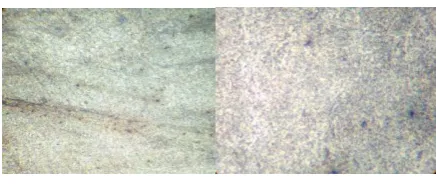
Microstructure of EN24 alloy:
Fig 1-Micro structure of as received EN 24, a) at 100X,
b) at 800X
Heat treatment:
[image:2.595.322.541.556.651.2]© 2016, IRJET ISO 9001:2008 Certified Journal Page 1937 formability, Machining, ductility after the cold working
processes, by increasing in the appropriate characteristics and strength of the material can also improve the product performance.
Heat treatment involves mainly five steps, Annealing, Normalizing, Tempering, hardening and Refining.(8, 11)
Chemical composition of En24 Before HT:
Tensile test:
The Tensile test was done by using Universal Testing Machine at room temperature, a ASTM standard test specimen was placed between two jaws of the machine and then slowly load is applied on the specimen until it breaks. During this process the elongation of gauge section, % of reduction in area, Ultimate tensile strength are recorded against the applied load and the result and graph are shown below,(17)
Chemical composition After HT:
Tensile test after:
© 2016, IRJET ISO 9001:2008 Certified Journal Page 1938
Comparison of En24 with En8 alloy:
En8 steel is supplied with untreated but can be supplied in the form of normalized or heat treated, which can be used in different application. It os also popular grade material of hardened medium carbon steel, which can having machinability properties in any condition. This can used in many manufacturing operation like bolts, nuts, gears and shaft.(11)
Chemical composition and Specification of
En8:
Before Heat treatment:
After Heat treatment:
Calculation Result
Ordinary En24 steelInitial area (A0) =
= = 113 mm2
Final area (A1) =
= = 50.26 mm2
© 2016, IRJET ISO 9001:2008 Certified Journal Page 1939 =
= 429.38N/mm2
Tensile strength =
=
= 609.55 N/mm2
% of Elongation
= 1
00
= 100
= 27.33 %
%of Reduction area
= 100
= 100
= 55.52 %
Similarly the calculation is done for different loads and the values are listed in below table
After heat treatment En24 steel
Initial area (A0) =
=
= 113.04 mm2
Final area (A1) =
=
= 78.52 mm2
Tensile stress =
=
= 804.16 N/mm2
Yield stress =
=
= 716.91 N/mm2
% of Elongation
=
=
= 17.67 %
% of Reduction area
= *100
=
= 30.56 %
© 2016, IRJET ISO 9001:2008 Certified Journal Page 1940
Material removal rate (MRR):
Chip sectional area A=a*s.... mm2
MRR =a*s*v...m3/min
Where, v-cutting speed ...m/min a-depth of cut...mm s-feed rate...mm/rev
MRR=a*s*v...mm3/s
a=4mm, v=45m/min, s=0.4mm/rev
MRR= 4*45*0.4
MRR=7.2*10-5 m3/min
We have , Cutting tool = HSS Side clearance α = 8° Side rake angle = 14°
Surface roughness Ra in micro meter (µm):
Without hardening of En24 Ra= 1.4 µm and hardness= 6HRC
After hardening of En 24 Ra= 0.8 µm and hardness =28HRC
Before hardening of En24, the hardness was low and high rough surface finish. after hardening of material the surface finish improves with
microstructure. So that overall strength of material, toughness, machinability and micro cracks are eliminated. As increase in mechanical properties helps in longer service life.
Steps in ANSYS
To solve the problems it needs to describe the
model, physical properties, boundary conditions. The important step in ANSYS is meshing it cut the structure into finite parts, so this leads to solve the problem more easy. It involves steps like this, initially build the model, describe material properties, meshing, apply loads, obtain the solution, present the results.
Finite element analysis of En24 for CNC
fixture jaw
Before En8 material is used in CNC fixture jaw for
© 2016, IRJET ISO 9001:2008 Certified Journal Page 1941
Meshing
Meshing it has control over the element size, shape
and displacement of nodal. Compared to other part of analysis this is most important step, it affects the exactness and cost of the analysis.
CALCULATION:
Section modules(Z) =
Where,
I = Moment of Inertia mm4
m = Moment at resistive of surface
I =
= = 21720.166 mm4
At Bending moment, if L = 32 M = F*L
= 4905*32 = 156960 N-mm
We know that, = =
ϭ = *Y
=
Stress at inner face = 68.65 N/mm2
At bending stress, if L = 48 mm M = 4905*48
= 235440 N-mm
ϭ = *Y
ϭ =
Stress at outer face = 102.97 N/mm2
CONCLUSION:
An attempt was made on experimental Analysis carried out on En24 Before hardening main compositions C-0.428, Cr-1.052, Ni-1.4020, Mo-0.2190 And After Heat Treatment were found C-0.4452, Cr-1.2133, Ni-1.3652, Mo-0.2290which will drastically changes its mechanical property, which will simultaneously improves its mechanical properties as well as surface finish from Ra1.4µm to Ra Ra0.8µm, gives crack free surface
leads to good fatigue strength. And also finite element analysis of CNC fixture jaw is carried out. The CNC clamping jaw is carefully designed and cross checked, where it does meets the requirements. As in previous material defects were found and was not performed good as material used was EN8 of yield stress 465 N/mm2. In order to have better performance
(Nickel-chromium-molybdenum) with heat treatment used will have yield stress of 716.46 N/mm2 with
factor safety 6.
REFERANCE
1) Callister, Jr., Rethwisch. "Materials Science and Engineering – An Introduction" (8th ed.). John Wiley and Sons, 2009 p.5-6
2) Fundamentals of Materials Science and Engineering: An Integrated Approach Loose Leaf – Import, 22 Nov 2011 by William D., Jr. Callister (Author), David G. Rethwisch (Author) 3)Hemminger, John C. (August 2010). Science for Energy Technology: Strengthening the Link between Basic Research and Industry (Report). United States Department of Energy, Basic Energy Sciences Advisory Committee. Retrieved August 2015
3) Callister, Jr., Rethwisch. Materials Science and Engineering – An Introduction (8th ed.). John Wiley and Sons, 2009 p.10-12
© 2016, IRJET ISO 9001:2008 Certified Journal Page 1942 MR17–MR71. doi:10.1116/1.2815690. PMID 204198
92
5)A. Navrotsky (1998). "Energetics and Crystal Chemical Systematics among Ilmenite, Lithium Niobate, and Perovskite Structures". Chem. Mater. 10 (10):
2787–2793. doi:10.1021/cm9801901.
6) Anil Kumar Sinha, Bohn Piston Division "Defects and Distortion in Heat-Treated Parts" Volume 4: Heat Treating ASM Handbook Committee, p 601-619, 1991
7) George F. Vander Voort, UNDERSTANDING AND MEASURING OF DECARBORIZETION.
8) Z. Odanovica, M. Ður.evicb, J. Krstic Pavlovicc, M. Arsica and B. Katavicd Some Applications of the Image Analysis in the Metal Material Science
9) Kiran valandi, M.vijaykumar, kishan KumarHIGH PEAK STEEL LTD.
10)Harald Porzner, SIMULATING Heat treatment process, addition 1981.281143
11)Chetan D.Borse, Prasad V.Thete, UNIGRAPHICS similarly analysis done by ANSYS workbench