DEMOGRAPHIC RESEARCH
VOLUME 29, ARTICLE 25, PAGES 663-706
PUBLISHED 2 OCTOBER 2013
http://www.demographic-research.org/Volumes/Vol29/25/ DOI: 10.4054/DemRes.2013.29.25
Research Article
Declining health disadvantage of non-marital
children: Explanation of the trend in the Czech
Republic 1990-2010
Martina Štípková
© 2013 Martina Štípková.
This open-access work is published under the terms of the Creative Commons Attribution NonCommercial License 2.0 Germany, which permits use, reproduction & distribution in any medium for non-commercial purposes, provided the original author(s) and source are given credit.
1 Introduction 664
1.1 The spread of non-marital childbearing 664
2 Research goal and hypotheses 666
3 Data and method 669
3.1 Birth register 669
3.2 Multiple imputation of missing data 671
4 Declining selection or increasing support for unmarried mothers? 672
4.1 Socio-demographic characteristics of married and unmarried
mothers – a description of trends
673
4.2 Multivariate models 677
5 The heterogeneity of non-marital children: A multivariate analysis
of recent data
680
6 The heterogeneity of non-marital children: Trends 684
6.1 The idea of the model 684
6.2 The shares of partnered and unpartnered unmarried mothers 685
6.3 Three models 685
6.4 Results 687
7 Conclusions 689
8 Acknowledgement 691
References 692
Declining health disadvantage of non-marital children:
Explanation of the trend in the Czech Republic 1990-2010
Martina Štípková1
Abstract
BACKGROUND
There has been a rapid spread of non-marital childbearing in the Czech Republic during the last two decades. At the same time, the low birth weight rates of children born to married and unmarried mothers have converged.
OBJECTIVE
The goal is to explain the diminishing gap in low birth weight. Two explanations are assessed: the changing selection of unmarried mothers from disadvantaged socio-demographic groups, and increasing social support for unmarried mothers.
METHODS
Data from birth register are analysed. Marital status (married vs. unmarried) disparities in low birth weight are modelled using logistic regression. Further analyses are then performed with a detailed measurement of partnership status. This detailed variable is partially missing and is thus supplemented with multiple imputation.
RESULTS
The main explanation for the narrowing gap between the outcomes of children born to married and unmarried mothers is the increasing social support for unmarried mothers. Unmarried motherhood has become less detrimental to a child’s birth weight net of maternal demographic characteristics. The decline in selection from disadvantaged socio-demographic groups has also contributed to the convergence. However, the convergence of birth weight trends towards marital children seems to refer mostly to children of partnered mothers, with children of single mothers lagging behind.
1 Department of Sociology, University of West Bohemia, Univerzitní 8, 30614 Plzeň, Czech Republic.
CONCLUSIONS
The positive trends in the health of non-marital children are interpreted as being the result of the increasing institutionalisation of parenthood in non-marital unions. However, this does not apply to unpartnered motherhood, which continues to represent a health disadvantage.
1. Introduction
Family status is an important predictor of foetal development and infant health. Studies from several European countries, the United States, and Canada show that non-marital children face a higher risk of foetal death and stillbirth (Arntzen et al. 1996; Balayla, Azoulay, and Abenhaim 2011; Carlson et al. 1999), preterm birth (El-Sayed, Tracy, and Galea 2012; Kramer et al. 1998; Koupilová et al. 1998; Shah, Zao, and Ali 2011), low birth weight (Castro Martín 2010; Kirchengast et al. 2007; Koupilová et al. 1998; Shah, Zao, and Ali 2011; Vågerö et al. 2007), and infant death (Arntzen et al. 1996, Balayla, Azoulay, and Abenhaim 2011; Koupil et al. 2006; Rychtaříková and Demko 2001; Salihu et al. 2004) than do children of married mothers. However, less is known about the time trends of this disadvantage. Does the disadvantage of non-marital children persist when childbearing outside marriage becomes common? And if not, what are the driving forces that change the disparity? This paper addresses these questions using data from the Czech Republic, a country where the proportion of children born outside marriage has increased more than fourfold in only two decades.
1.1 The spread of non-marital childbearing
The rise of non-marital childbearing has been one of the most remarkable changes in reproductive behaviour in the Czech Republic since 1989.2 Figure 1 shows that the proportion of children born outside marriage rose linearly from 9% to 40% between 1990 and 2010. The spread of unmarried cohabitation seems to have played an important role in the rise of non-marital childbearing. Studies based on survey data
2 The transformation of family and reproductive behaviour was very rapid and complex. It also included
suggest that unmarried cohabitation has spread in the Czech population (Kreidl and Štípková 2012; Sobotka et al. 2008; Thornton and Philipov 2009) and parenthood within cohabitation has increased (Hamplová 2007). On the other hand, unpartnered motherhood also seems to be becoming more common (Hamplová 2007).
Figure 1: Percentage of all unmarried mothers (1990-2010) and of unmarried mothers who did and did not provide information about the child’s father (2007-2010)
Data: Live singleton births, selected years 1990-2010, N= 1,351,447.
Unfortunately, data on the partnership arrangements of unmarried mothers prior to the 2000s are very scarce. The birth register provides information about whether unmarried mothers identified the fathers of their children, but only since 2007 (see section 3 for details). Figure 1 shows that only a relatively small proportion (around 22%) of unmarried mothers do not give this information. Unmarried mothers who provide paternal information make up an increasing proportion of unmarried mothers
1990 1995 2000 2005 2010
0
10
20
30
40
50
%
and by 2010 they accounted for 78% of this group (32% of all mothers, married and unmarried together).
2. Research goal and hypotheses
This paper focuses on birth weight as a measure of newborn health. Birth weight is considered a reliable predictor of an infant’s survival chances (Basso, Wilcox, and Winberg 2006; Melve and Skjaerven 2003; Rychtaříková and Demko 2001) and also has an effect on adult health (Barker 1998; Doblhammer 2004). Its impact on cognitive development and school performance and consequently on adult socioeconomic status has also been observed (Conley, Strully, and Bennet 2003; Vågerö and Illsley 1995).
As will be shown in this paper, the birth weight of non-marital children has risen and strongly converged with that of marital children (see Figure 2 in section 4). The goal of this paper is to find an explanation for this trend. The analysis is intended to elucidate which social processes lie behind the observed convergence in birth weight trends of marital and non-marital children.
There are several reasons why the health outcomes of marital and non-marital children should converge. Birth weight results from a very complex bio-psycho-social process, which needs to be explained before outlining possible explanations.
There are two immediate factors of higher or lower birth weight: the length of pregnancy and intrauterine growth. Spencer (2003) has reviewed dozens of studies of the determinants of birth weight and constructed a theoretical model that links proximate (mediating) and indirect determinants of birth weight. The most proximate determinants, which directly influence intrauterine growth and/or gestational duration, work through biological pathways. They include maternal height and weight, maternal age and parity, genital infections, CRH release3, smoking (including passive smoking) and alcohol consumption, blood pressure, micronutrient intake, and genetic factors4 (Spencer 2003: 134-141).
These risk factors may be conceptualised as biological, but exposure to them is socially patterned. In Spencer’s model, the links from the proximate to the more distant causes of birth weight lead from and/or through maternal education, maternal socioeconomic status (SES), the SES of the mother’s background family, and maternal birth weight, which stems from a similarly complex causal pathway. For instance, the SES of the mother’s background family influenced her own birth weight and nutrition during childhood, which then affected her height, weight, etc. (Spencer 2003: 134-141).
3 The release of the hormone Corticotropin is a stress-induced bodily reaction.
The mother’s background family also influenced her educational chances and, consequently, her SES during adulthood, exposure to chronic stress, health-related behaviour, and her chances to marry and find a well-off partner. It is thus important to realize that the effect of such variables as educational attainment or SES represents not only the effect of years spent in the educational process or the amount of money earned. They should be considered as structural factors that are connected with family background, labour market chances, life style (including health-related behaviour), etc. This kind of structural effect is studied in this paper.
Spencer pays no special attention to the role of partnership arrangements in his model; he subsumes it within the broader SES variable. Other authors have focused on explaining the effect of marital/partnership status in a more detailed way. To simplify the causal framework, there are three explanations for the marital status disparity in birth weight or infant health in general:5
1. Selection to marriage (or more precisely to married motherhood): Mothers who marry usually come from a more well off social background, have more education, are healthier, and lead a healthier life style. This makes them more likely to have a healthy newborn. When the family characteristics associated with marital status are taken into account, the positive effect of marriage on various health outcomes declines, but it does not disappear in most outcomes (Balayla, Azoulay, and Abenhaim 2011, Castro Martín 2010, Shah, Zao, and Ali 2011). Selection thus explains only part of the health disadvantage of marital children.
2. The direct effect of marriage: Marriage itself is a source of psychosocial and economic support that contributes to good pregnancy outcomes. Children of unpartnered mothers fare worse than children of cohabiting mothers, although cohabitation is not as protective as legal marriage (Blondel and Zuber 1988; Doucet, Baumgarten, and Infante-Rivand 1989; Luo, Wilkins, and Kramer 2004; Shah, Zao, and Ali 2011; Young and Declercq 2010). Relationship characteristics seem to be responsible for the differences. Married individuals usually report a higher level of partnership quality than cohabiters (Brown and Booth 1996; Skinner et al. 2002) or couples living in other forms of non-marital relationships (Strohm et al. 2009). Cohabitations are also more likely to be dissolved than marriages (Kiernan 2006; Liefbroer and Dourleijn 2006; Osborne et al. 2007). Bird et al. (2000) showed that the marital status disparity in low birth weight risk
can be explained by relationship type and duration.6 Similarly, Bloch et al. (2010) found a positive effect of relationship quality on birth weight in a study of low-income unmarried mothers. Obviously, mothers without partners are the most disadvantaged in this regard.
3. Social acceptance/stigmatization: Unmarried motherhood is usually associated with a more or less severe social stigma (see e.g. Hyde 2000, Wiemann et al. 2005). Deviation from social norms imposes psychosocial stress to unmarried mothers which represents a risk for their children (Woods et al. 2010).
What expectations can be drawn from the three explanations for the convergence of health outcomes observed while extramarital childbearing has become more common? Two hypotheses will be outlined and tested:
1. Declining selection hypothesis. As a rare phenomenon, non-marital childbearing was typical of specific social groups, e.g. divorced or very young women. When non-marital childbearing becomes common, it expands to include other segments of the population (Zeman 2007). Women/couples who have children without being married would therefore be decreasingly selected from groups whose characteristics represent a risk of adverse birth outcomes (e.g. teenagers).
2. Increasing social support hypothesis. As unmarried motherhood becomes more common, two factors increase the average psychosocial support received by an unmarried mother. First, as more people have children outside marriage, such behaviour ceases to be deviant and stigmatizing. Norms of behaviour as unmarried parent(s) and role models become more visible and these provide unmarried mothers/parents with directions of how to perform their roles. Unmarried mothers may then receive more psychosocial support from their social networks (cf. Mollborn 2009), including the fathers of their children. This should rule out social acceptance as the source of disadvantage of non-marital children.
Second, the composition of unmarried mothers by partnership status may influence the average level of support they obtain. As partnered mothers receive more social
support (see above), a disproportionate increase in the size of this group would (everything else being constant) lead to an improvement in the overall trend.
The two explanations, the weakening selection of unmarried mothers from disadvantaged socio-demographic groups and the increasing social support for unmarried mothers, are evaluated in section 4.
After the relevance of these explanations is judged, the question arises of whether the children of both single and partnered unmarried mothers participate equally in the trend of improved birth weights. If the selection has declined and/or social support has increased dramatically among partnered mothers, this may have negated whatever moderate trend existed among single mothers, and vice versa. As noted above, data on the partnership status of unmarried mothers are lacking before 2007. In spite of this limitation, sections 5 and 6 will explore some aspects of the heterogeneity of unmarried mothers. Section 5 focuses on the recent period with complete data and compares whether selection and social support have similar explanatory power among both single and partnered mothers during this period. Section 6 then models trends of the composition of unmarried mothers by partnership status and the birth weight outcomes of single and partnered unmarried mothers.
3. Data and method
3.1 Birth register
The main source of data is the national birth register. The analysed dataset includes anonymous individual records of all children born in 1990, 1992, 1994, 1996, 1998, 2000, 2002, 2004, 2006, and 2007-2010. The total number of newborns in these years is 1,400,920 (ranging from 90,763 to 131,094 per year). Only live singleton births were considered in this paper7, which leaves 1,352,139 observations. Observations with no information about birth weight (692 cases) were excluded.
The dependent variable is a binary indicator of low (<2500 grams) versus other birth weight.
The main independent variable is maternal marital status, used either as a binary indicator (married vs. unmarried) or as a categorical variable with three possible values:
7
married, partnered8 (i.e. unmarried who provided information about child’s father), and single (unmarried who did not provide information about child’s father).Declaration of the father can be used as a proxy for whether the newborn’s parents live together or at least maintain some relationship. If a mother does not identify the father, the most likely reason is that she does not know this information or she does not want to establish any relationship between the father and the child.
However, in much of the data the information about fathers is limited. All information as to whether an unmarried mother identified the child’s father is lacking before 2007. For extramarital births prior to 2007, no information about the father was requested of the mothers. Since 2007 all mothers have been asked to provide information about the child’s father, but some are either unable (when they do not know this information) or unwilling to do so. When the mother agrees to report who the father is, she is asked to provide his name, personal identification number (called birth number in Czech), and level of educational attainment. His age can be determined by the personal identification number. For obvious reasons, the dataset provided for research purposes does not contain the name and identification number of the fathers, but it does include paternal ages. When the paternal age is not missing, it means that the mother identified the child’s father. All marital children have complete information about the father. Non-marital children with complete paternal information are considered to have been born to partnered mothers. Non-marital children born in 2007 or later with missing paternal information are considered to have been born to single mothers. Before 2007, there is no information on the partnership status of unmarried mothers and the value of this variable is obtained using multiple imputation (see section 3.2 below).
Four control variables are included: maternal age (19 and under, 20-24, 25-29, 30-34, 35 and over), educational attainment (elementary, lower secondary, completed secondary, tertiary), parity (no previous birth, 1 previous birth, and 2 or more previous births), and region of the mother’s permanent residence (Northwest region vs. other; living in this region proved to be particularly harmful for pregnancy outcomes – see Appendix A for details). The only missing values for these variables are maternal education, as mothers have increasingly refused to provide this information. Prior to 2007 there had been only 10 such cases, but since then the number has increased from 162 to 3757 per year. These cases form a negligibly small share of births. But the gradual increase in the share may cause some bias, so I decided to use multiple imputation to fill in these data (see below).
3.2 Multiple imputation of missing data
There are two partially missing covariates which were multiply imputed: maternal education and partnership status of unmarried mothers.
The technique of multiple imputation is done in three steps. First, a model is set up to impute the data. The imputation is done several times, leading to a number of alternative ‘measurements’ of the variable with missing values. Second, all of the imputed datasets are analysed independently with whatever method is considered appropriate. Finally, the results obtained in each imputed dataset are pooled according to the rules specified by Rubin (e.g. Rubin 1987).
Each of the repeated imputations creates plausible values that can replace the missing data. It is advisable to use as many predictors as possible in the imputation model. The imputation model is not parsimonious, but provides the maximum amount of information for the imputation. All the relationships that will be evaluated in the analytical steps must be included in the imputation model in order to get accurate results (Rubin 1996). For this reason, I used more variables and a more detailed categorisation of some variables than were used in the analysis. The whole procedure was done in Stata 11 and five rounds of imputation were run.
Concerning maternal education, the problem of missing values which occurs in the period 2007-2010 is minor (less than 2% of cases in this period are missing this information).9 I imputed the missing data for this period with a multinomial logit model with the following predictors: year, region (76 categories), maternal age (5 categories, as above), maternal marital status (4 categories: married, never married, divorced, widowed), parity (3 categories, as above), paternal age (5 categories: unreported, -24, 25-29, 30-34, 35-39, 40+), birth weight (both a binary indicator of low birth weight and the continuous measure), and the child’s sex.
The other imputed variable was maternal family arrangement with three categories: married, partnered, and single. Partnered and single unmarried mothers cannot be distinguished before 2007, so the detailed measurement of family status is missing in 20% of cases in the period 1990-2006. The data are missing at random, because whether or not the value is missing does not depend on the unobserved value, but on the observed variables (year and marital status). This makes the problem of missing data less serious because multiple imputation works well when data are missing at random (Schafer and Graham 2002).
I imputed a binary variable that indicated whether or not the mother was partnered in the subsample of unmarried mothers. The model used for the imputation was logistic
9Another 77 missing values of maternal education (spread across the entire study period) were replaced with
regression with the following predictors: year, region (76 categories), maternal age (5 categories, as above), education (4 categories, as above), parity (3 categories, as above), the child’s birth weight (both a binary indicator of low birth weight and a continuous measure), and a binary indicator of whether the child was born preterm (less than 37 completed gestational weeks). Although the imputation was run only on the subsample of unmarried mothers, I did not want to lose the information about how common unmarried motherhood was. So I included also a continuous variable which gives the proportion of unmarried mothers in a given year. This variable is interacted with maternal age, education, and parity and with the child’s birth weight to allow their effects to change when non-marital childbearing becomes more common. In addition, a variable indicating the period of 2007-2008 was included to control for a policy-induced bias in the reporting of fathers at this time (see section 5 for details)
4. Declining selection or increasing support for unmarried mothers?
Figure 2: Low birth weight rate by maternal marital status
Data: Live singleton births, selected years 1990-2010, N= 1,351,447.
Before the two hypothesized sources of the convergence are assessed, the demographic characteristics of married and unmarried mothers are described.
4.1 Socio-demographic characteristics of married and unmarried mothers – a description of trends10
This section examines whether there is support for the declining selection hypothesis. It assesses whether the socio-demographic characteristics of married and unmarried mothers converged. These characteristics include age, educational attainment, and parity. All of these significantly influence birth weight (see section 2; for an analysis of Czech data, see Koupilová et al. 1998; Štípková and Kreidl 2011), so a change in the
10 To be consistent across the entire analysis, I worked only with data on singleton births, i.e. the number of
children and mothers is the same, and I refer to the same population when describing either children or mothers. The characteristics of all mothers (including mothers of multiples) are almost indistinguishable from those presented here, as only 1-2% of births are multiple.
1990 1995 2000 2005 2010
0
5
10
15
%
Married General trend
age, educational, or parity structure of married and unmarried mothers may explain the convergence of health of their children.
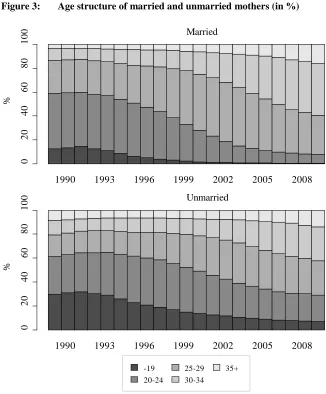
Figure 3 shows the shifting age structure of married and unmarried mothers. Both groups had children at rather young ages in the early 1990s (the mean was about 24), and then started to postpone childbearing. This delay is much more pronounced among married mothers. By 2010, the mean age of a married mother was over 30. The mean age of unmarried mothers started to rise later (in the mid-1990s) and by 2010 had only reached 28. Children born to mothers at the margins of the reproductive age spectrum face an elevated risk of worse health outcomes (e.g. Yang, Greenland, and Flanders 2006). There was a very high proportion of young mothers, both married and unmarried, in the early 1990s. Around 30% of unmarried and almost 15% of married mothers were still under the age of 20 at that time. Currently, there are almost no married mothers and only 7% of unmarried mothers who are that young. On the other hand, there is an increasing share of older women among both married and unmarried mothers. Mothers over the age of 34 made up only 4% of married mothers in 1990. This proportion increased, especially in the late 2000s, to 16%. Around 8% of unmarried mothers were aged 35 or over in 1990. This proportion then slightly declined and then rose to 14% in the 2000s. Although the trends in mean age are diverging between married and unmarried mothers, the share of age groups which represent a health risk for the child grew more similar in both marital status groups. This could have contributed to the convergence of birth weights among marital and non-marital children.
Figure 3: Age structure of married and unmarried mothers (in %)
Data: Live singleton births, selected years 1990-2010, N= 1,351,447.
1990 1993 1996 1999 2002 2005 2008
%
0
20
40
60
80
100
Married
1990 1993 1996 1999 2002 2005 2008
%
0
20
40
60
80
100
Unmarried
-19 20-24
25-29 30-34
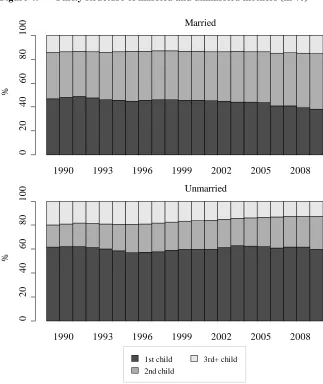
Figure 4: Parity structure of married and unmarried mothers (in %)
Data: Live singleton births, selected years 1990-2010, N= 1,351,447.
1990 1993 1996 1999 2002 2005 2008
%
0
20
40
60
80
100
Married
1990 1993 1996 1999 2002 2005 2008
%
0
20
40
60
80
100
Unmarried
1st child 2nd child
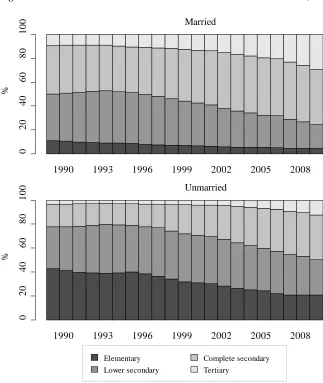
Maternal education is a reliable indicator of socioeconomic status and has a strong effect on birth outcomes: The higher maternal educational attainment is, the better for the child (e.g. Parker, Schoendorf, and Kiely 1994; Raum et al. 2001). Figure 5 compares the educational structure of mothers by marital status. The educational structure of married and unmarried mothers shows similar trends, but persisting disparities. There are shifts towards higher educational attainment in both marital status groups. Married mothers tend to have more education than unmarried ones. Only about 10% of married mothers had attained just the lowest educational level in 1990 and by 2010 that share had decreased by half. In contrast, 40% of unmarried mothers had only an elementary education in 1990; however, that share also decreased by half, so the disparity remained the same. The rising proportion of mothers with university education is also parallel in both married and unmarried mothers. The proportion of mothers with tertiary education increased from 4% to 13% among unmarried mothers. The rise was approximately threefold also among married mothers – from 9% to 29%. Educational attainment has tended to rise in both marital status groups of mothers at a similar pace, so the educational structure of married and unmarried mothers should not contribute to the convergence of the birth weights of marital and non-marital children.
To summarize, the evidence that the socio-demographic characteristics of married and unmarried mothers are becoming more similar is mixed. The age structure is converging but the educational structure, though showing similar trends, remains different. Parity structure has even diverged slightly.
4.2 Multivariate models
I estimated a set of logistic regression models of low birth weight on maternal marital status and further control variables. Five models were estimated with four covariates added: maternal age, parity, education, and region of residence. Marital status is interacted with time in each of the models to see how the effect changed. The detailed results of step-wise built models are shown in Appendix B (see Table B1). Here, I focus only on the main interest of this study, the effect of marital status.
Figure 5: Educational structure of married and unmarried mothers (in %)
Data: Live singleton births, selected years 1990-2010, N= 1,351,447.
1990 1993 1996 1999 2002 2005 2008
%
0
20
40
60
80
100
Married
1990 1993 1996 1999 2002 2005 2008
%
0
20
40
60
80
100
Unmarried
Elementary Lower secondary
Figure 6: Odds ratios from logistic regression models of low birth weight on marital status (unmarried vs. married)
Data: Live singleton births, selected years 1990-2010, N= 1,351,447.
The value of the odds ratio for births outside marriage decreases when the control variables are added. A substantial part of the effect of unmarried status is thus explained by the structure of married and unmarried mothers. The adjusted odds ratio of unmarried status is much lower in all periods and shows a declining trend. When controlling for maternal characteristics, the odds ratio was 1.70 in the early 1990s and only 1.22-1.26 in the second half of 2000s. The declining adjusted odds ratio is in line with the hypothesis of increasing social support for unmarried mothers. The maternal unmarried status represents a declining health risk for newborns, net of demographic characteristics of mothers.
The selection hypothesis is valid as well. The decline of unadjusted odds ratios (by more than one third) is steeper than the decline of adjusted odds ratios (by more than one quarter). Diminishing disparity in the age structure of married and unmarried mothers increased the convergence of birth weight among marital and non-marital children. This trend was not suppressed by persistent selection of unmarried mothers from women with less education and their less favourable parity composition. The importance of maternal socio-demographic characteristics for influencing the disadvantage of non-marital children has declined. Maternal age, parity, and education
1990-1992 1994-1996 1998-2000 2002-2004 2006-2008 2009-2010
0 .0 0 .5 1 .0 1 .5 2 .0 2 .5
1990-1992 1994-1996 1998-2000 2002-2004 2006-2008 2009-2010
explained one third of the odds ratio in the early 1990s and only one quarter in the late 2000s.
In sum, both declining socio-demographic selection and increasing social support of unmarried mothers contributed to closing the marital status gap in the low birth weight rate. The increasing social support has showed to be more important in the process. The strength of the greater social support explanation raises questions about the role of unmarried partnerships in the increasingly supportive arrangements of unmarried motherhood. Is the average amount of social support increasing because there are more partnered mothers, or is support for unmarried arrangements rising? These questions cannot be answered directly because the data are not detailed enough, but two steps will be taken in the next two sections in order to understand the role of non-marital partnerships. First, the current pattern of disadvantage will be investigated in section 5. Second, the hypothetical trends in the pregnancy outcomes of partnered and single mothers will be modelled in section 6.
5. The heterogeneity of non-marital children: A multivariate analysis
of recent data
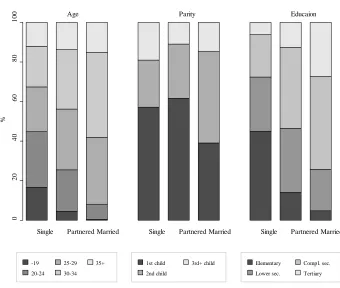
Figure 7: Age, parity, and educational structure of single, partnered, and married mothers in 2009-2010 (in %)
Data: Live singleton births, 2009-2010, N=225,158.
Multivariate models corresponding to those in section 4.2 were estimated in order to assess the validity of the selection and the social support explanations for the low birth weight gap of the two groups of non-marital children. Detailed results of the models are presented in Appendix B. Two time periods were distinguished (2007-2008 and 2009-2010) to control for an effect of a change in the maternity leave and benefits policy. Single mothers received special protection until January 2009. The state’s family policy provides mother with maternity leave for 28 weeks. During this time, the mother’s job is secure and she receives a maternity allowance (Peněžitá pomoc v mateřství in Czech). The amount of the benefit depends on her pre-pregnancy salary. At the end of the maternity leave a mother (or father) can continue to care for the child on parental leave, at which point the financial aid of maternity leave is replaced by another
Single Partnered Married Age
%
0
20
40
60
80
100
-19
20-24 25-29
30-34 35+
Single Partnered Married Parity
1st child
2nd child
3rd+ child
Single Partnered Married Educaion
Elementary
Lower sec.
Compl. sec.
benefit, the parental allowance. The parental allowance is not determined by the woman’s previous salary. The amount is fixed and usually lower than the maternity allowance (except for the lowest income groups). Until 2009, single mothers were entitled to receive the maternity allowance for 37 instead of 28 weeks. It was then financially advantageous for unmarried mothers to pretend that they did not have a partner, even if they did (Soukupová 2006). There is evidence that some of them used this strategy, even though there were risks involved11 (Chaloupková 2007). The extended entitlement to the maternity allowance was cancelled for women who gave birth in 2009 or after.
Figure 8 presents the coefficients of the marital status categories in the logistic regression of low birth weight risk. It compares the results of Model 1 (detailed marital status interacted with time are the only predictors) and Model 5 (the whole set of predictors included, marital status is interacted with time).
When controlling for maternal characteristics, children born to married and partnered mothers are practically indistinguishable. The whole modest disadvantage (unadjusted odds ratio of 1.20) can be explained by the fact that they are, on average, younger, not as well educated, and more often first-time mothers than married mothers. The policy change does not influence the size of the effects.
A comparison of single and married mothers yields a very different result. The substantial disadvantage of children born to single mothers persists when maternal characteristics are controlled for. Moreover, there is a marked response to the policy change. The values for the period 2007-2008 are biased by those mothers who misreported their status as single, so I focus on the period after that. In 2009-2010, the unadjusted odds ratio for single mothers compared to married mothers is 3.61. The value drops to 2.33 when control variables are included, which is still very large. The mother’s single status itself (or its unobserved correlates) accounts for a substantial part of the disadvantage of children born to single mothers.
In sum, the analysis of recent data, in which it was possible to distinguish partnered unmarried mothers from single ones, showed that these two groups are heterogeneous in terms of pregnancy outcomes. The partnered status does not represent a health risk, compared to marriage, once the socio-demographic characteristics of mothers are taken into account. This finding is remarkable because unmarried unions (often defined more strictly than in the present study as cohabiting relationships) are usually found to be less favourable in terms of health of children (cf. Shah, Zao, and Ali
11 Mothers who misreport their status as single face the risk of their true partnership arrangement being
2011).12 Comparative research shows that the more common cohabitation is, the more it is similar to marriage in terms of relationship stability (Liefbroer and Dourleijn 2006). Unmarried unions thus might provide social support equal to marriage in the current Czech society. Alternatively, there might be some unobserved factors that favour partnered mothers. For instance partner selection might be different from the selection of marital partners.13
Figure 8: Odds ratios from logistic regression models (Model 1 and Model 5) of low birth weight on detailed marital status (partnered/single vs. married)
Data: Live singleton births, 2007-2010, N=449,899.
12 However a recent study (Young and Declerq 2010) based on an U.S. sample found pregnancy outcomes of
unmarried mothers with partners to be similar to those of married mothers. On the other hand, a recent Spanish study (Castro Martín 2010) yields contradictory results, with data from a population with a similarly high prevalence of non-marital childbearing.
13 Hamplová 2009 found that partner choice is more similar in married and unmarried relationships when
cohabitation is widespread. However, she refers to couples in general and not specifically to parents.
2007-2008 2009-2010 2007-2008 2009-2010
0
1
2
3
4
2007-2008 2009-2010 2007-2008 2009-2010
0
1
2
3
4
Partnered Single
Children whose mothers do not have partners they wish to indicate in the birth certificate fare much worse than children of partnered mothers. Children of single mothers more often come from socio-demographic groups with an elevated risk of adverse pregnancy outcomes, and, unlike children of partnered unmarried mothers, a large part of their disadvantage is due to the family arrangement itself.
The large disparity between children born to single and partnered unmarried mothers suggests that these two groups are rather distinct. This raises the question of whether they were so different in the past, when both partnered and unpartnered motherhood outside marriage was rare. The next section will model the past trends with incomplete data.
6. The heterogeneity of non-marital children: Trends
This section models the past trends in the low birth weight rates among children born to partnered and single unmarried mothers. The analysis is done on the aggregated data coming from the multiple imputation (see section 3.2). The imputed data are compared with hypothetical scenarios in order to evaluate their plausibility.
6.1 The idea of the model
The models follow this logic. The low birth weight rate of children born outside marriage at time y can be expressed as a weighted mean of two subgroups:
𝑤�(𝑦) = 𝑤𝑝(𝑦) ∗ 𝜋𝑝(𝑦) + 𝑤𝑠(𝑦) ∗ 𝜋𝑠(𝑦) (1)
where 𝑤𝑝(𝑦) is the mean birth weight of children born to partnered mothers, 𝜋𝑝(𝑦) is the proportion of partnered mothers, and 𝑤𝑠(𝑦) and 𝜋𝑠(𝑦) are the same measures for unpartnered (single) mothers.
The 𝜋𝑝 and 𝑤𝑝can be expressed in relation to 𝑤𝑠 and 𝜋𝑠. A factor a is introduced to capture the magnitude of the advantage of partnered mothers relative to single mothers.
𝜋𝑝= 1 − 𝜋𝑠 (2)
After inserting these terms in Equation 1, we obtain:
𝑤𝑠=𝑎(1−𝜋𝑤�𝑠)+𝜋𝑠 (4)
To estimate the low birth weight rate of children born to unpartnered mothers, I had to make some assumptions about a (the ratio of the outcomes of partnered and unpartnered mothers) and the proportions of partnered and unpartnered mothers in the population.
6.2 The shares of partnered and unpartnered unmarried mothers
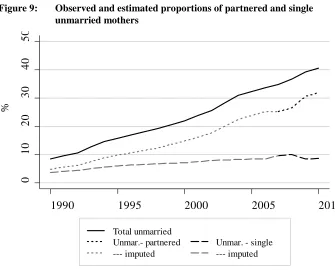
Figure 9 plots the share of unmarried mothers in total and by partnership status as obtained from multiple imputation.14 Both groups of unmarried mothers have expanded over time according to the estimates. The proportion of single mothers more than doubled (4% to 9%), while the share of partnered mothers rose at a much faster pace (5% to 32%) during the study period.
The only marked deviation from the almost linear trend is the policy-induced over-reporting of the single status in the period 2007-2008 (see section 5). The imputation of data in 1990-2006 is not affected because I included a special variable for the 2007-2008 period, which adjusted the bias when the values were imputed. To avoid the bias in subsequent models, I replaced the 2007-2008 shares of single and partnered unmarried mothers with a linear interpolation of the values between 2006 and 2009.
6.3 Three models
After having estimated the shares of unmarried mothers with and without partners, three models of the disparity between the two groups were created with different values for the parameter a, i.e. the ratio of the birth weight of children born to partnered vs. single mothers. An overview of the models and the respective values of a is presented in Table 1.
14 To check whether the estimates are reasonable, I compared them with a trend obtained from a subsample of
Figure 9: Observed and estimated proportions of partnered and single unmarried mothers
Data: Live singleton births, selected years 1990-2010, N= 1,351,447.
Table 1: Values of a (ratio of the outcome of children born to partnered vs. single mothers) used in the analysis
Model A1 Model A2 Model A3
Year Estimated a Constant a
at current level
From total equity to current a
1990 0.648 0.356 1
2000 0.502 0.356 0.661
2010 0.372 0.372 0.372
1990
1995
2000
2005
2010
0
10
20
30
40
50
%
Total unmarried Unmar.- partnered --- imputed
Model A1. The first model is the imputed one. The parameter a results from the multiply imputed dataset.
To locate the results of multiple imputation within a range of possible outcomes, I also created two other models that represent the extreme scenarios of how parameter a might have changed during the study period.
Model A2: The second model represents the scenario of a constantly high disparity between children born to single and partnered mothers. It keeps parameter a constant at the 2009 level in 1990-2009, irrespective of whether childbearing without marriage was marginal or common in the population.
Model A3: The last model assumes that, as both single motherhood and parenthood within an unmarried relationship were rare and rather deviant forms of parenthood in 1990, there was no difference between the birth weights of children born to all unmarried mothers, without regard to the parental partnership status. The value of a is linearly interpolated between 1 and the 2009 value.
Although unlikely, the two scenarios (Models A2 and A3) define the limits of what might have happened with the birth weight disparity by family status and allow for an assessment of how realistic the results of multiple imputation are.
6.4 Results
Figure 10 shows the low birth weight rates among children of partnered and single unmarried mothers that result from the three models. They are plotted against the observed low birth weight rates in married and unmarried mothers. The imputed model A1 falls within the range defined by the two extreme scenarios (Models A2 and A3), which supports its plausibility.
Figure 10: Models of trends in low birth weight rate by partnership arrangement
Data: Live singleton births, selected years 1990-2010, N= 1,351,447.
In sum, the results suggest that the convergence between marital and non-marital children does not mean that the health of children born to both partnered and unpartnered mothers is improving. The opposite seems to be the case. While children born to unmarried couples are becoming more like marital children, the health conditions of the children of single mothers are not significantly improving and some results suggest that they are even worsening. The observed trend in the health of non-marital children is positive because of the rising proportion of partnered mothers and improving health of children born to such unions. This obscures the consistently poorer health of children who are born not only outside marriage, but also outside an unmarried partnership.
1990
1995
2000
2005
2010
0
5
10
15
%
Limits defined by models A2 and A3
Married
Model - partnered
7. Conclusions
The analyses conducted in this paper sought to explain why there was such a substantial improvement in the low birth weight rate of non-marital children in the Czech Republic in the past two decades. The outcome of non-marital children has improved both absolutely and in comparison to the outcomes of married women. The analysis showed that the marital status gap in the low birth weight rate was reduced mainly due to changes of factors associated with marital status itself (these factors were labelled as ‘social support’ in this paper) and partly to changes in maternal socio-demographic characteristics.
The shift towards the decreasing importance of marital status started immediately after the political regime change in the early 1990s, sped up during the course of the 1990s and the early 2000s, but stopped in the late 2000s. It is a question whether the decline had really started in the early 1990s, or whether the importance of this status was actually stable in the long run but experienced a bump during the transition from state socialism to a democratic political regime and associated social change. However, the decline was clear and substantial from the late 1990s. The disparity then stagnated in the late 2000s. The stagnation has two explanations. Firstly, there might be a threshold of convergence, after which the discrepancy between marital and non-marital children is no longer decreasing. Alternatively, there may be some external unmeasured factor that affected married and unmarried mothers differently. A likely external influence might be the economic crisis that hit the Czech Republic in late 2008. Unmarried mothers (especially those without partners – see below) might be more vulnerable to economic turbulence, so they might have been more affected than married mothers.
Within the past two decades, and especially in the most recent one, unmarried motherhood ceased to be limited mainly to the lower social classes and teenage mothers, which was typical in the early 1990s. Unmarried status also provides, on average, much more support for the healthy growth of the foetus now than in 1990. Both of these aspects may be interpreted as the institutionalization of extramarital childbearing, especially as an arrangement for first-order children.
recently. However, three models were estimated to describe aggregated trends in the pregnancy outcomes of partnered and single mothers. The results suggest that the improving birth outcomes of partnered mothers and the increasing share of partnered women among unmarried mothers were the driving forces behind the overall improvement of the pregnancy outcomes of unmarried mothers.
The pregnancy outcomes of unpartnered (single) mothers do not seem to have followed the overall positive trend. The disparity between the pregnancy outcomes of single and married mothers was large in the late 2000s. The estimates of the previous trend do not suggest any clear direction. The recent data, which permit an analysis of the socio-demographic characteristics of single mothers, show that approximately one third of the gap between children born to single and married mothers can be attributed to disadvantages related to age, parity, and educational structure. But a larger part of the gap is tied to the single status itself. Even though single motherhood has become more accepted in Czech society, it has not overcome the reality of the lack of support from a partner. This suggests that there is a need to use public resources to better protect single mothers who are unable to rely on the support of the child’s father. The share of such mothers is small (currently about 10%), but it has been growing continuously in the period studied. If this trend continues to rise and the pregnancy outcomes of single women do not improve, an increasing share of newborns will face a health disadvantage, with all the negative consequences for their lives (and also for the public budgets that would have to cover the increasing expenses for health care).
The spread of extramarital childbearing, including parenthood in unmarried unions, was substantial and rapid. The data collection policy adjusted somewhat late to this new social phenomenon. This represents the main limitation of this study. The parental arrangement was not measured directly, but approximated by the mother’s willingness to identify the child’s father. In addition, this approximation is available only for the most recent data. The past trends were thus reconstructed by multiple imputation which relied only on a very short time series. Further research with more complete data is necessary to understand how the effect of family arrangements on pregnancy outcomes changes at the times of family change. The large gaps in low birth weight risk found in this study highlight the need for a more precise measurement of maternal family arrangements.
8. Acknowledgements
This paper is a part of my doctoral research which I undertook at the Charles University in Prague. The analysis was developed during the European Doctoral School of Demography, which was hosted by the Centre for Demographic Studies at the Autonomous University in Barcelona and the Max Planck Institute for Demographic Research in Rostock in 2011-2012. I was able to participate in this programme thank to the financial support of the National Institute of Demographic Studies in Paris.
I am grateful to Zuzanna Brzozowska, Antonio David Cámara, and Emmanuelle Cambois for their feedback on earlier versions of the paper. I also acknowledge helpful comments by the anonymous reviewers and the associate editor Fran Goldscheider.
References
Arntzen, A., Moum, T., Magnus, P., and Bakketeig, L.S. (1996). Marital status as a risk factor for fetal and infant mortality. Scandinavian Journal of Public Health 24(1): 36–42. doi:10.1177/140349489602400106.
Balayla, J., Azoulay, L., and Abenhaim, H.A. (2011). Maternal marital status and the risk of stillbirth and infant death: A population-based cohort study on 40 million births in the United states. Womens Health Issues 21(5): 361–365. doi:10.1016/j.whi.2011.04.001.
Barker, D.J.P. (1998). In utero programming of chronic disease. Clinical Science 95(2): 115–128. doi:10.1042/CS19980019.
Basso, O., Wilcox, A.J., and Weinberg, C.R. (2006). Birth weight and mortality: Causality or confounding? American Journal of Epidemiology 164(4): 303–311. doi:10.1093/aje/kwj237.
Bird, S.T., Chandra, A., Bennett, T., and Harvey, S.M. (2000). Beyond marital status: Relationship type and duration and the risk of low birth weight. Family Planning Perspectives 32(6): 281–287. doi:10.2307/2648196.
Bloch, J.R., Webb, D.A., Mathews, L., Dennis, E.F., Bennet, I.M., and Culhane, J.F. (2010). Beyond marital status: The quality of the mother-father relationship and its influence on reproductive health behaviors and outcomes among unmarried low income pregnant women. Maternal and Child Health Journal 14(5): 726–734. doi:10.1007/s10995-009-0509-7.
Blondel, B., Kogan, M.D., Alexander, G.R., Dattani, N., Kramer, M.S., Macfarlane, A., and Wu Wen, S. (2002). The impact of the increasing number of multiple births on the rates of preterm birth and low birthweight: An international study. American Journal of Public Health 92(8): 1323–1330. doi:10.2105/AJPH. 92.8.1323.
Blondel, B. and Zuber, M.‐C. (1988). Marital status and cohabitation during pregnancy: Relationship with social conditions, antenatal care and pregnancy outcome in France. Paediatric and Perinatal Epidemiology 2(2): 125–137. doi:10.1111/ j.1365-3016.1988.tb00192.x.
Bobak, M., Dejmek, J., Solansky, I., and Sram, R.J. (2005). Unfavourable birth outcomes of the Roma women in the Czech Republic and the potential explanations: A population-based study. BMC Public Health 5(1): 106. doi:10.1186/1471-2458-5-106.
Bobak, M. and Leon, D.A. (1999). Pregnancy outcomes and outdoor air pollution: An ecological study in districts of the Czech Republic 1986-8. British Medical Journal 56(8): 539–543. doi:10.1136/oem.56.8.539.
Brown, S.L. and Booth, A. (1996). Cohabitation versus marriage: A comparison of relationship quality. Journal of Marriage and Family 58(3): 668–678. doi:10.2307/353727.
Carlson, E., Hoem, J.M., and Rychtaříková, J. (1999). Trajectories of fetal loss in the Czech Republic. Demography 36(3): 327–337. doi:10.2307/2648056.
Castro Martín, T. (2010). Single motherhood and low birthweight in Spain: Narrowing social inequalities in health? Demographic Research 22(27): 863–890. doi:10.4054/DemRes.2010.22.27.
Chaloupková, J. (2007). Vdát se nebo ne? Motivace vdaných a neprovdaných matek [Marry or not? Motivation of married and unmarried mothers]. In: Hamplová, D., Chaloupková, J., Soukupová, E., Sunega, P., and Zeman, K. (eds.). Děti na psí knížku? [Childbearing without marriage?]. Prague: Institute of Sociology, Academy of Sciences of the Czech Republic: 59–78.
Conley, D., Strully, K.W., and Bennett, N.G. (2003). The starting gate: birth weight and life chances. Berkeley: University of California Press.
Czech Statistical Office (2012). Česká republika od roku 1989 v číslech [Czech Republic since 1989 in figures] [electronic resource]. Prague: Czech Statistical Office. [http://www.czso.cz/csu/redakce.nsf/i/cr_od_roku_1989#01].
David, H.P. and Skilogianis, J. (1999). From abortion to contraception: A resource to public policies and reproductive behaviour in Central and Eastern Europe from 1917 to the present. Greenwood Publishing Group.
Doblhammer, G. (2004). The late life legacy of very early life. Berlin: Springer Verlag. doi:10.1007/978-3-662-10349-4.
El-Sayed, A.M., Tracy, M., and Galea, S. (2012). Life course variation in the relation between maternal marital status and preterm birth. Annals of Epidemiology 22(3): 168–174. doi:10.1016/j.annepidem.2012.01.002.
Frejka, T. (2008). Overview Chapter 3: Birth regulation in Europe: Completing the contraceptive revolution. Demographic Research 19(5): 73–84. doi:10.4054/ DemRes.2008.19.5.
Hamplová, D. (2007). Děti bez partnera nebo na psí knížku? [Children without a partner or in cohabitation?]. In: Hamplová, D., Chaloupková, J., Soukupová, E., Sunega, P., and Zeman, K. (eds.). Děti na psí knížku [Childbearing without marriage]. Prague: Institute of Sociology, Academy of Sciences of the Czech Republic: 49–58.
Hamplová, D. (2009). Educational homogamy among married and unmarried couples in Europe: Does context matter? Journal of Family Issues 30(1): 28–52. doi:10.1177/0192513X08324576.
Hyde, A. (2000). Age and partnership as public symbols: Stigma and non-marital motherhood in an Irish context. European Journal of Women’s Studies 7(1): 71–89. doi:10.1177/135050680000700105.
Imaizumi, Y. (2001). Infant mortality rates in single, twin and triplet births, and influencing factors in Japan, 1995-98. Paediatric and Perinatal Epidemiology 15(4): 346–351. doi:10.1046/j.1365-3016.2001.00378.x.
Joseph, K.S., Kramer, M.S., Marcoux, S., Ohlsson, A., Wu Wen, S., Allen, A., and Platt, R. (1998). Determinants of preterm birth rates in Canada from 1981 through 1983 and from 1992 through 1994. The New England Journal of Medicine 339(20): 1434–1439. doi:10.1056/NEJM199811123392004.
Kiely, J.L., Kleinman, J.C., and Kiely, M. (1992). Triplets and higher-order multiple births: Time trends and infant mortality. Archives of Pediatrics & Adolescent Medicine 146(7): 862–868. doi:10.1001/archpedi.1992.02160190094029.
Kiernan, K. (2006). Unmarried cohabitation and parenthood: Here to stay? European perspectives. In: Moynihan, D.P. and Smeeding, T.M. (eds.). The future of the family. New York: Russell Sage Foundation: 66–95.
Koupil, I., Rahu, K., Rahu, M., Karro, H., and Vagero, D. (2006). Major improvements, but persisting inequalities in infant survival in Estonia 1992-2002. The European Journal of Public Health 17(1): 8–16. doi:10.1093/eurpub/ckl104.
Koupilová, I., Bobák, M., Holčík, J., Pikhart, H., and Leon, D.A. (1998). Increasing social variation in birth outcomes in the Czech Republic after 1989. American Journal of Public Health 88(9): 1343–1347. doi:10.2105/AJPH.88.9.1343.
Kramer, M.S., Platt, R., Yang, H., Joseph, K.S., Wu Wen, S., Morin, L., and Usher, R.H. (1998). Secular trends in preterm birth. A hospital-based cohort study. JAMA: The Journal of the American Medical Association 280(21): 1849–1854. doi:10.1001/jama.280.21.1849.
Kreidl, M. and Štípková, M. (2012). Výskyt a načasování nesezdaných soužití v současné ČR [The prevalence, incidence, and timing of unmarried cohabitation in the contemporary Czech Republic]. Demografie 2/2012: 120–137.
Liefbroer, A.C. and Dourleijn, E. (2006). Unmarried cohabitation and union stability: Testing the role of diffusion using data from 16 European countries. Demography 43(2): 203–221. doi:10.1353/dem.2006.0018.
Luo, Z.C., Wilkins, R., and Kramer, M.S. (2004). Disparities in pregnancy outcomes according to marital and cohabitation status. Obstetrics and Gynecology 103(6): 1300–1307. doi:10.1097/01.AOG.0000128070.44805.1f.
Mašková, M. and Stašová, L. (2000). Population development in the Czech Republic in the 1990s. In: Kučera, T., Kučerová, O.V., Opara, O.B., and Schaich, E. (eds.). New Demographic Faces of Europe. Springer: 79–102.
Melve, K.K. and Skjaerven, R. (2003). Birthweight and perinatal mortality: Paradoxes, social class, and sibling dependencies. International Journal of Epidemiology 32(4): 625–632. doi:10.1093/ije/dyg163.
Mollborn, S. (2009). Norms about nonmarital pregnancy and willingness to provide resources to unwed parents. Journal of Marriage and Family 71(1): 122–134. doi:10.1111/j.1741-3737.2008.00584.x.
Osborne, C., Manning, W.D., and Smock, P.J. (2007). Married and cohabiting parents’ relationship stability: A focus on race and ethnicity. Journal of Marriage and Family 69(5): 1345–1366. doi:10.1111/j.1741-3737.2007.00451.x.
premature delivery in the United States. Annals of Epidemiology 4(4): 271–278. doi:10.1016/1047-2797(94)90082-5.
Pulkrábková, K. (2009). The Roma minority: Changing definitions of their status. In: Hašková, H. and Uhde, Z. (eds.). Women and social citizenship in Czech Society: Continuity and change. Prague: Institute of Sociology, Academy of Sciences of the Czech Republic: 171–209.
Raum, E., Arabin, B., Schlaud, M., Walter, U., and Schwartz, F.W. (2001). The impact of maternal education on intrauterine growth: A comparison of former West and East Germany. International Journal of Epidemiology 30(1): 81–87. doi:10.1093/ije/30.1.81.
Rubin, D.B. (1987). Multiple imputation for nonresponse in surveys. New York: John Wiley. doi:10.1002/9780470316696.
Rubin, D.B. (1996). Multiple imputation after 18+ years. Journal of the American Statistical Association 91(434): 473–489. doi:10.1080/01621459.1996. 10476908.
Rychtaříková, J. and Demko, G.J. (2001). Inequalities in infant survival: An analysis of Czech linked records. European Journal of Population/Revue européenne de Démographie 17(4): 323–342.
Salihu, H.M., Chatman, L.M., Alio, A.A., Aliyu, M.H., Kirby, R.S., and Alexander, G.R. (2004). Single motherhood and neonatal survival of twins among blacks and whites. Journal of the National Medical Association 96(12): 1618–1625. Schafer, J.L. and Graham, J.W. (2002). Missing data: Our view of the state of the art.
Psychological Methods 7(2): 147–177. doi:10.1037/1082-989X.7.2.147.
Shah, P.S., Zao, J., and Ali, S. (2011). Maternal marital status and birth outcomes: A systematic review and meta-analyses. Maternal and Child Health Journal 15(7): 1097–1109. doi:10.1007/s10995-010-0654-z.
Skinner, K.B., Bahr, S.J., Crane, D.R., and Call, V.R.A. (2002). Cohabitation, marriage, and remarriage: A comparison of relationship quality over time. Journal of Family Issues 23(1): 74–90. doi:10.1177/0192513X02023001004.
Soukupová, E. (2006). Neprovdané matky v sociálním systému [Unmarried mothers in the social policy system]. In: Hamplová, D., Chaloupková, J., Soukupová, E., Sunega, P., and Zeman, K. (eds.). Děti na psí knížku [Childbearing without marriage]. Prague: Institute of Sociology, Academy of Sciences of the Czech Republic: 79–98.
Spencer, N. (2003). Weighing the evidence: How is birthweight determined? Abingdon: Radcliffe Publishing.
Štípková, M. and Kreidl, M. (2011). Socioeconomic inequalities in birth and pregnancy outcomes in the Czech Republic between 1990 and 2007. An exploration of trends. Sociologický časopis/Czech Sociological Review 47(3): 531–565.
Strohm, C.Q., Seltzer, J.A., Cochran, S.D., and Mays, V.M. (2009). ‘Living apart together’ relationships in the United States. Demographic Research 21(7): 177–214. doi:10.4054/DemRes.2009.21.7.
Tandberg, A., Bjørge, T., Børdahl, P.E., and Skjaerven, R. (2007). Increasing twinning rates in Norway, 1967-2004: The influence of maternal age and assisted reproductive technology (ART). Acta Obstetricia Et Gynecologica Scandinavica 86(7): 833–839. doi:10.1080/00016340701417323.
Thornton, A. and Philipov, D. (2009). Sweeping changes in marriage, cohabitation and childbearing in Central and Eastern Europe: New insights from the developmental idealism framework. European Journal of Population/Revue européenne de Démographie 25(2): 123–156. doi:10.1007/s10680-009-9181-2.
Vågerö, D. and Illsley, R. (1995). Explaining health inequalities: Beyond black and barker a discussion of some issues emerging in the decade following the black report. European Sociological Review 11(3): 219–241.
Vågerö, D., Koupilová, I., Leon, D.A., and Lithell, U.‐B. (2007). Social determinants of birthweight, ponderal index and gestational age in Sweden in the 1920s and the 1980s. Acta Paediatrica 88(4): 445–453. doi:10.1111/j.1651-2227.1999.tb01 138.x.
Wiemann, C.M., Rickert, V.I., Berenson, A.B., and Volk, R.J. (2005). Are pregnant adolescents stigmatized by pregnancy? Journal of Adolescent Health 36(4): 352.e1–352.e7. doi:10.1016/j.jadohealth.2004.06.006.
Yang, Q., Greenland, S., and Flanders, W.D. (2006). Associations of maternal age- and parity-related factors with trends in low-birthweight rates: United States, 1980 through 2000. American Journal of Public Health 96(5): 856–861. doi:10.2105/AJPH.2004.049312.
Young, R.L. and Declercq, E. (2010). Implications of subdividing marital status: Are unmarried mothers with partners different from unmarried mothers without partners? An exploratory analysis. Maternal and Child Health Journal 14(2): 209–214. doi:10.1007/s10995-009-0450-9.
Appendix A: Regional analysis
I conducted a regional analysis to determine how to measure the regional variable used in the models. The birth register provides information about the mother’s permanent residence on the NUTS4 level. There are 76 such units in the analysis.15
The maps in Figure A1 plot the mean birth weight at the beginning, the middle, and the end of the period studied. A belt of districts on the border with Saxony shows a persistently lower mean birth weight. The same pattern is observed also for low birth weight rate (see Figure A2). The same districts consistently have a much higher low birth weight rate than the other regions. There are also other examples of districts that fare badly, but they rarely remained in that situation for the full period studied.
I decided to identify the most disadvantaged districts as those that have a mean birth weight and low birth weight rate of two standard deviations below (above in the case of low birth weight) the total average for more than half of the period studied. Seven districts meet this definition: Cheb, Chomutov, Děčín, Most, Sokolov, Teplice, Ústí nad Labem. They are all concentrated in the Northwest region. This region has opencast coal mines and was highly industrialised during the socialist regime. This caused air pollution, which has been shown to negatively influence pregnancy outcomes, including birth weight (Bobak, Leon 1999; Bobak 2000). Since 1989, many factories in this region have closed and it currently suffers an above-average unemployment rate (Czech Statistical Office 2012). Another source of health disadvantage of children from this region may be its ethnic composition. The area along the German border was originally settled by Germans. They were re-settled shortly after the end of WWII and the vacated area was inhabited by newcomers from different parts of the re-established Czechoslovakia, including people of Roma ethnicity, who now face ethnic/racial discrimination and labour market disadvantages (Pulkrábková 2009). Also, the pregnancy outcomes of the Roma minority were found to be impaired (Bobak et al. 2005).
15 Currently, there are 76 administrative districts plus the capital Prague, which has a special status. Two of
Figure A1: Mean birth weight by region and year
Data: Live singleton births, selected year 1990-2010, N= 1,351,447.
1990
2000
2010
<3200 3200 - 3250 3250 - 3300
Figure A2: Low birth weight rate by region and year
Data: Live singleton births, selected year 1990-2010, N= 1,351,447.
1990
2000
2010
<4 4 - 5 5 - 6 6 - 7
Appendix B: Detailed results of the models
Table B1: Coefficients estimated by logistic regression models of low birth weight (from section 4)
Model 1 Model 2 Model 3 Model 4 Model 5
Maternal mar. status x Year
Married x 1990-92 (ref.) 0.000 0.000 0.000 0.000 0.000 Married x 1994-96 -0.106*** -0.085*** -0.081*** -0.092*** -0.091*** Married x 1998-00 -0.176*** -0.121*** -0.117*** -0.141*** -0.141*** Married x 2002-04 -0.083*** -0.010*** -0.006 -0.037** -0.038** Married x 2006-08 0.004 0.070 0.082*** 0.061*** 0.060***
Married x 2009-10 0.029* 0.083*** 0.105*** 0.106*** 0.104***
Unmar. x 1990-92 0.935*** 0.857*** 0.806*** 0.550*** 0.533*** Unmar. x 1994-96 0.714*** 0.657*** 0.610*** 0.353*** 0.336*** Unmar. x 1998-00 0.592*** 0.573*** 0.528*** 0.279*** 0.261*** Unmar. x 2002-04 0.551*** 0.560*** 0.516*** 0.281*** 0.267*** Unmar. x 2006-08 0.490*** 0.512*** 0.475*** 0.272*** 0.261*** Unmar. x 2009-10 0.544*** 0.561*** 0.531*** 0.345*** 0.336***
Maternal age
-19 0.440*** 0.378*** -0.061*** -0.065***
20-24 0.110*** 0.094*** -0.066*** -0.069***
25-29 (ref.) 0.000 0.000 0.000 0.000
30-34 0.037** 0.033** 0.109*** 0.111***
35+ 0.322*** 0.242*** 0.354*** 0.358***
Parity
No previous birth (ref.) 0.000 0.000 0.000
1 previous birth -0.343*** -0.466*** -0.469***
2 or more previous births 0.158*** -0.195*** -0.201***
Maternal education
Elementary (ref.) 0.000 0.000
Lower secondary -0.681*** -0.668***
Complete sec. -0.938*** -0.922***
Tertiary -1.086*** -1.067***
Northwest Region 0.199***
Intercept -3.119*** -3.253*** -3.143*** -2.214*** -2.240***
*
p<0.1, **p<0.05, ***p<0.001
Table B2: Coefficients estimated by logistic regression models of low birth weight (from section 5)
Model 1 Model 2 Model 3 Model 4 Model 5
Maternal marital status
Married x 2007-2008 (ref.) 0.000 0.000 0.000 0.000 0.000 Married x 2009-2010 0.020 0.020 0.025 0.043** 0.044**
Partnered x 2007-2008 0.180*** 0.138*** 0.082*** -0.032 -0.045**
Partnered x 2009-2010 0.194*** 0.155*** 0.100*** 0.005 -0.001 Single x 2007-2008 1.040*** 0.959*** 0.902*** 0.700*** 0.693*** Single x 2009-2010 1.304*** 1.208*** 1.155*** 0.910*** 0.889***
Maternal age
-19 0.334*** 0.283*** -0.203*** -0.207***
20-24 0.129*** 0.107*** -0.071** -0.075***
25-29 (ref.) 0.000 0.000 0.000 0.000
30-34 -0.068*** -0.017 0.050** 0.052**
35+ 0.109*** 0.130*** 0.242*** 0.246***
Parity
No previous birth (ref.) 0.000 0.000 0.000
1 previous birth -0.416*** -0.527*** -0.532***
2 or more previous births 0.005 -0.285*** -0.294***
Maternal education
Elementary (ref.) 0.000 0.000
Lower secondary -0.562*** -0.546***
Complete sec. -0.795*** -0.778***
Tertiary -0.995*** -0.973***
Northwest region 0.229***
Intercept -3.109*** -3.111*** -2.968*** -2.181*** -2.211***
*
p<0.1, **
p<0.05, ***
p<0.001