Rebekah R. White, … , Bruce A. Sullenger, Christopher P.
Rusconi
J Clin Invest.
2000;106(8):929-934. https://doi.org/10.1172/JCI11325.
The idea of using nucleic acid molecules as therapeutic agents was conceived in the 1970s
with the development of antisense strategies. Antisense compounds are single-stranded
nucleic acids that, in principle, disrupt the synthesis of a targeted protein by hybridizing in a
sequence-dependent manner to the mRNAs that encode it. The mechanism of inhibition by
nucleic acid aptamers is fundamentally different. Aptamers are single-stranded nucleic
acids that directly inhibit a protein’s function by folding into a specific three-dimensional
structure that dictates high-affinity binding to the targeted protein. Through iterative in vitro
selection techniques, aptamers can be generated that bind essentially any protein (or small
molecule) target. A high-affinity, specific inhibitor can theoretically be made to order,
provided that a small quantity of pure target is available. Because they inhibit the activity of
existing proteins directly, aptamers are more similar to monoclonal antibody or small
molecule drugs than to antisense compounds, and this property greatly increases the
number of clinical indications that are potentially treatable by nucleic acid–based
compounds. Aptamers have been generated against a wide variety of targets, a complete
discussion of which is beyond the scope of this article (for review, see ref. 1). As with any
molecular therapeutic approach, the inhibitor is only as effective as the target is important.
Through their ability to specifically inhibit a molecule of […]
Perspective
The idea of using nucleic acid molecules as therapeutic agents was conceived in the 1970s with the develop-ment of antisense strategies. Antisense compounds are single-stranded nucleic acids that, in principle, disrupt the synthesis of a targeted protein by hybridizing in a sequence-dependent manner to the mRNAs that encode it. The mechanism of inhibition by nucleic acid aptamers is fundamentally different. Aptamers are sin-gle-stranded nucleic acids that directly inhibit a pro-tein’s function by folding into a specific three-dimen-sional structure that dictates high-affinity binding to the targeted protein.
Through iterative in vitro selection techniques, aptamers can be generated that bind essentially any protein (or small molecule) target. A high-affinity, spe-cific inhibitor can theoretically be made to order, pro-vided that a small quantity of pure target is available. Because they inhibit the activity of existing proteins directly, aptamers are more similar to monoclonal anti-body or small molecule drugs than to antisense com-pounds, and this property greatly increases the number of clinical indications that are potentially treatable by nucleic acid–based compounds. Aptamers have been generated against a wide variety of targets, a complete discussion of which is beyond the scope of this article (for review, see ref. 1).
As with any molecular therapeutic approach, the inhibitor is only as effective as the target is important. Through their ability to specifically inhibit a molecule of interest, aptamers have already proven useful as reagents for target validation in a variety of disease mod-els. The next step, therapeutic utility, will depend on the efficacy of these novel compounds in humans. In this Perspective, we will focus on the development and sta-tus of aptamers as therapeutic molecules.
Nucleic acids as direct antagonists of protein function
Many viruses, including HIV, have evolved small, structured RNA sequences to recruit viral and host cell proteins to perform essential functions in viral replication. The HIV virus, for example, employs the TAR and RRE RNA sequences to recruit the essential viral regulatory proteins tat and rev, which aid in
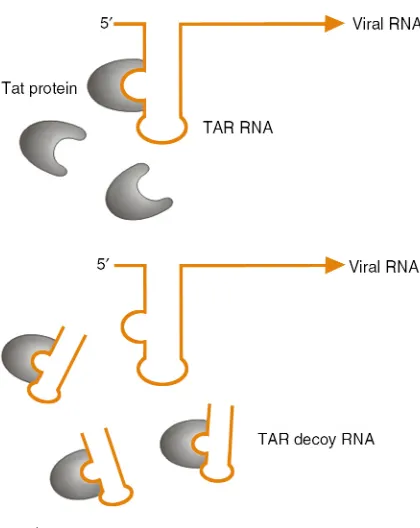
induction and regulation of viral gene expression. The use of small, structured RNAs to inhibit the activity of viral proteins was first explored employing a short transcript corresponding to the TAR RNA sequence (2). This “decoy” RNA competes with the virally encoded TAR sequence for binding to tat (Figure 1). By sequestering the tat protein from the real TAR RNA sequence present in the HIV viral RNA, the decoy RNA can inhibit HIV RNA transcription and thus reduce viral replication. Expression of these TAR decoys in CD4+T-cell lines and in bulk populations of
transduced immortalized T lymphocytes renders these cells highly resistant to HIV replication. These initial studies not only demonstrated that such RNA
Developing aptamers into therapeutics
Rebekah R. White,
1Bruce A. Sullenger,
1,2and Christopher P. Rusconi
11Department of Surgery, Center for Genetic and Cellular Therapies, and
2Department of Genetics, Center for Genetic and Cellular Therapies, Duke University Medical Center, Durham, North Carolina, USA
[image:2.612.314.524.421.685.2]Address correspondence to: Christopher P. Rusconi, Department of Surgery, Center for Genetic and Cellular Therapies, Duke University Medical Center, Medical Sciences Research Building, Campus Box 2601, Durham, North Carolina 27710, USA. Phone: (919) 684-4822; Fax: (919) 684-6492; E-mail: [email protected].
Figure 1
decoys could be used as antiviral agents, but in a more general sense, suggested that short RNA molecules could bind to specific proteins and inhibit their activ-ity. Recently, the use of the RRE decoy to render cells resistant to HIV infection has been translated to the clinic, where its safety, feasibility, and efficacy are being evaluated in pilot clinical trials following retro-viral-mediated gene transfer into CD34+cells from the
bone marrow of HIV-1 infected pediatric patients (3).
Designer nucleic acid antagonists Iterative in vitro selection
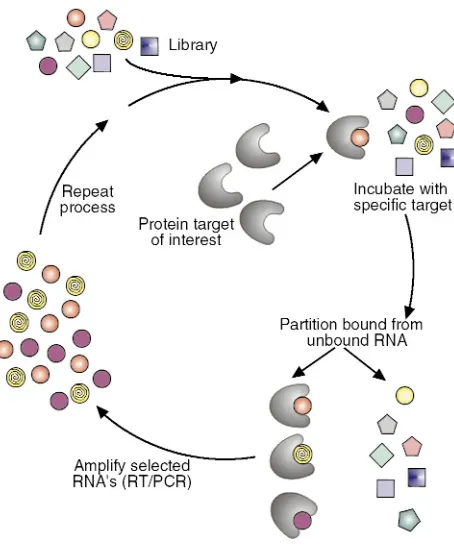
Concurrent with the advent of RNA decoys was the demonstration by several laboratories that iterative in vitro selection techniques could be employed to isolate, from randomized RNA libraries, short RNA ligands to a wide variety of proteins and small molecules (4, 5). The basic approach to such in vitro selection is outlined in Figure 2 and was named SELEX (systematic evolution of ligands by exponential enrichment) by Tuerk and Gold. In principle, SELEX can be considered an extremely powerful purification method in which very rare binding activities (with frequencies of 1 in 1011to 1
in 1013) are isolated by affinity purification from a large
combinatorial library. The starting point for the in vitro selection process is a combinatorial library composed of single-stranded nucleic acids (RNA, DNA, or modified RNA) usually containing 20–40 randomized positions. Randomization creates an enormous diversity of possi-ble sequences (e.g., four different nucleotides at 40 ran-domized positions gives a theoretical possibility of 440
or ∼1024different sequences). Because short
single-stranded nucleic acids adopt fairly rigid structures that are dictated by their sequences, such a library contains a vast number of molecular shapes or conformations. To isolate high affinity nucleic acid ligands to a given target protein, the starting library of nucleic acids (in practice ∼1014to 1015different sequences) is incubated
with the protein of interest. Nucleic acid molecules that adopt conformations that allow them to bind to a spe-cific protein are then partitioned from other sequences in the library that are unable to bind to the protein under the conditions employed. The bound sequences are then removed from the protein and amplified by reverse transcription and PCR (for RNA-based libraries) or just PCR (for DNA-based libraries) to generate a reduced complexity library enriched in sequences that bind to the target protein. This library is then tran-scribed in vitro (for RNA-based libraries), or its strands are separated (for DNA libraries) to generate molecules for use in the next round of selection. After several rounds (usually 8–12), which are typically performed with increasing stringency, the selected ligands are sequenced and evaluated for their affinity for the tar-geted protein and their ability to inhibit the activity of the targeted protein in vitro.
General properties of aptamer compounds
Affinities of aptamers for the targeted proteins tend to be very high, with typical dissociation constants rang-ing from low picomolar (1 ×10–12M) to low
nanomo-lar (1 ×10⁻⁹M). As in vitro selection techniques have
improved, the generation of aptamers with sub-nanomolar affinities for the target has become increas-ingly common. These affinities are similar to those measured for interactions between monoclonal anti-bodies and antigens. However, since the dissociation constants measured for aptamer-target proteins are true affinities, reflecting a bimolecular interaction in solution, they are more accurately compared to the affinities of Fab fragments for their target antigens. On average, the affinities of aptamers for a targeted protein are stronger than is typical for interactions between Fab fragments and their target antigens (1).
[image:3.612.309.536.396.669.2]High-affinity nucleic acid–protein interactions require specific complementary contacts between func-tional groups on both the nucleic acid and the protein. Because the specific three-dimensional arrangement of complementary contact sites that mediate the protein-aptamer interaction are unlikely to be recapitulated in
Figure 2
other proteins, aptamers are generally specific for their targets. For example, aptamers have been generated that are capable of discriminating between isoforms of protein kinase C that share a high degree of identity (6). Modified-RNA aptamers to coagulation factor VIIa (FVIIa) exhibit a greater than 500-fold specificity for FVIIa relative to coagulation factor Xa and greater than 1000-fold relative to coagulation factor IXa, although these proteins share a common set of structural domains (7). Employing subtractive selection strategies can yield aptamers with even greater ability to discrim-inate between the target and related nontargeted pro-teins (8, 9). Furthermore, because the selection process is performed in vitro, schemes to improve the specifici-ty of a given aptamer for the target, or to direct the binding of the aptamer to a particular site on the tar-get, are only limited by knowledge of the target and the investigator’s imagination.
Translation of aptamers from binding agents into potential therapeutic compounds
Postselection compound optimization
The completion of the aptamer selection process typ-ically yields a high affinity and specific antagonist of the targeted protein. Several postselection optimiza-tion steps generally must be performed to translate a molecule from an in vitro antagonist to a molecule that can be tested for pharmacologic effect in animals or used in vivo in target-validation studies. Chemical synthesis is required to produce the quantities of aptamer needed for most if not all in vivo experi-ments. Currently, for efficient and cost-effective chemical synthesis, the size of an aptamer must be reduced to fewer than 40 nucleotides, from a starting molecule of approximately 80 to 100 nucleotides. A number of strategies can be used to determine the minimum-sized aptamer that retains high affinity for the target. Fortunately, unlike peptides isolated from structurally constrained peptide-based combinatori-al libraries, most aptamers can be readily reduced in size with minimal loss of affinity for the target pro-tein. Depending on the indication, once an aptamer suitable for chemical synthesis has been generated, additional modifications may need to be made to the aptamer to enhance its bioavailability or delivery. Ulti-mately, the postselection modification of an aptamer is an empirical process, with each alteration requiring retesting to determine the effects of the modification on the affinity and inhibitory activity of the aptamer. The bioavailability of an aptamer is determined by two key properties of the molecule — stability in bio-logic fluids and systemic clearance. The stability of a nucleic acid in plasma is determined by its backbone composition. The in vitro half-life of a typical RNA oligonucleotide in plasma is a few seconds, while that of a typical DNA oligonucleotide is 30 to 60 minutes.
The plasma stability of an RNA oligonucleotide can be increased by substitution of ribonucleotides with 2′ -amino, 2′-fluoro, or 2′-O-alkyl nucleotides (10, 11). Modified-RNA oligonucleotides containing these sub-stitutions are quite stable in plasma, with in vitro half-lives in the 5 to 15 hour range. Furthermore, because 2′-amino or 2′-fluoro CTP and UTP can be readily incorporated into RNA by in vitro transcription, these backbone modifications can be introduced into the combinatorial library at the outset of the selection process (12, 13). Even when the composition of the starting library has been chosen judiciously, the plas-ma stability of an aptamer plas-may need to be further enhanced after selection. An aptamer can be protected from exonuclease degradation by capping its 3′end (11). Resistance to endonuclease degradation can be further increased by additional substitution of ribose and deoxyribose nucleotides with modified nucleotides or nonnucleotide linkers where possible. Most aptamers can be heavily modified after selection to yield molecules that are very stable in plasma; however, determining the positions within an aptamer that are amenable to such modification is not a trivial task.
A minimized aptamer 25 to 40 nucleotides in length corresponds to a molecular weight of about 8,250–13,200 kDa. Due to this small size, aptamer compounds are cleared from animals via the kidneys in minutes. Therefore, for molecules with even mod-est plasma stability, the in vivo plasma half-life is gov-erned by the rate of clearance from the animal. The clearance rate of an aptamer can be rationally altered by increasing its effective molecular size, such as by the site-specific addition of various molecular weight polyethylene glycol (PEG) moieties or other hydrophobic groups, or by attachment of the aptamer to the surface of a liposome (14, 15). Thus, depending on the indication, a given aptamer can be formulated in such a way as to have a half-life in vivo of a few min-utes or several hours.
Challenges
should allow for submicromolar therapeutic levels with less potential for nonspecific effects.
While the plasma pharmacokinetics of aptamers are gradually being elucidated, the efficient delivery of aptamers remains a consideration for the inhibi-tion of intracellular targets. Methods adopted from other molecular therapeutic strategies may ultimate-ly prove useful for the delivery of aptamers into cells, such as incorporation into liposomes or generation of high effective concentrations using various means of local delivery.
As one advantage over peptide-based inhibitors, aptamers are purported to be nonimmunogenic. Their small size and similarity to endogenous molecules the-oretically makes them poor antigens. Experiments designed with the intent to elicit a humoral response to modified-RNA aptamers have failed to generate a spe-cific response, despite the generation of responses to a variety of adjuvants employed (B.A. Sullenger et al., unpublished results). However, the presence of anti-bodies against nucleic acids in autoimmune diseases makes the possibility of antiaptamer antibodies one that is plausible and worthy of investigation.
The great specificity that aptamers can achieve repre-sents both a strength and a potential weakness of the technology. Being too specific may be problematic if species crossreactivity is desired, as is often the case during the preclinical evaluation of a molecule in ani-mal models. Obviously, the more conserved the pro-tein, the less likely this situation is to occur. With knowledge of the target, subtractive selection schemes may direct the aptamer to a conserved portion of the molecule. Alternatively, this problem may be obviated by driving the selection with targets from different species either in parallel or alternating in series.
Finally, the expense of synthesis is not always consid-ered in the early developmental stages of a novel thera-peutic agent. While small-scale synthesis is feasible for most in vitro applications, the scale of synthesis neces-sary for transition of a candidate aptamer to animal or even human models may be cost-prohibitive for even a well-funded academic laboratory.
Indications
Given the current state of aptamer technology, the ideal indication for a therapeutic aptamer is an acute condition for which an important, spatially confined, extracellular target has been identified and for which no good alternative therapies exist. In such a situa-tion, local delivery of even a small dose of aptamer may be effective, both in terms of clinical response and cost. Aptamers targeting conditions that meet some or all of these criteria have made the most progress towards clinical utility. We will discuss three indications for which aptamers have progressed to animal and/or human models. By no coincidence, all three fall under the umbrella of vascular biology. For
these common clinical conditions, several plasma- or endothelium-based targets have been characterized. Drug delivery can thus be accomplished either intravascularly or locally in the setting of surgery or percutaneous vascular intervention.
Coagulation and thrombosis
The delicate balance between hemostasis and hemor-rhage is maintained by a complex system of plasma, cellular, and endothelial factors. Coagulation, the normal process by which a fibrin clot is generated in response to a vascular injury, is to be distinguished from thrombosis, the pathological formation of clot in response to injury, stasis, or hypercoagulability. The latter is widespread in conditions such as acute coronary syndrome, stroke, peripheral vascular dis-ease, and deep vein thrombosis, and can also occur in response to iatrogenic vascular injury. The clinical demand for more and better antithrombotics, which inhibit the initial formation of the platelet plug, and anticoagulants, which inhibit the cascade of reactions leading to the crosslinking of fibrin, is testimony to the importance of this process. In addition, the vari-ety of patients and scenarios in which such agents are utilized requires an array of inhibitors with different mechanisms, properties, and toxicity profiles.
Thrombin is the most obvious target for the genera-tion of both anticoagulant and antithrombotic com-pounds. Bock et al. (19) generated a 15 nucleotide DNA-based thrombin aptamer that binds thrombin with moderate affinity (apparent Kd∼10–7M) and can
pro-long the clotting time of human plasma. To take advan-tage of its rapid clearance (in vivo half-life of approxi-mately 1–2 minutes), the thrombin DNA aptamer was developed largely as an anticoagulant for use in surgical indications requiring regional anticoagulation of an extracorporeal circuit. When administered by constant infusion, this molecule was successfully used to main-tain the patency of an extracorporeal circuit in sheep and was substituted for heparin in a canine cardiopul-monary bypass model (20, 21). Furthermore, because of its rapid clearance, once infusion of the aptamer was stopped, no reversal of the anticoagulant activity of this molecule was required. Based on its ability to inhibit clot-bound thrombin and platelet thrombus formation in an ex vivo whole artery angioplasty model, this aptamer also exhibited potential as a novel antithrom-botic (22). However, for this thrombin aptamer to be successfully tested in animal models of arterial throm-bosis, it would probably be necessary to modify it to improve its circulating half-life.
states. Physiologic coagulation is initiated by enzymat-ic activity of the protease FVIIa in complex with its req-uisite cofactor, tissue factor. Recently, a 2′-amino mod-ified-RNA aptamer has been generated to coagulation FVIIa (7). This aptamer binds FVIIa with high affinity and specificity and has been shown to block the activi-ty of FVIIa by preventing formation of an active FVIIa–tissue factor complex. This aptamer is stable in plasma, with a half-life of approximately 15 hours, and can prolong the clot time of human plasma. While this aptamer has not been studied in animals, it highlights the potential use of this technology to generate a panel of antagonists to the factors that compose the coagu-lation pathway.
Intimal hyperplasia
The two inner layers — the intima and the media — of a normal vessel wall exist in a nearly quiescent state. When a vessel is injured (for example, during angioplasty or endarterectomy) or subjected to hemodynamic stress (for example, during the arterialization of a venous graft), a complex series of mechanical, cellular, and molecular factors activate key intracellular pathways within the smooth muscle cells (SMCs) of the media. Intimal hyperplasia is the abnormal proliferation and migration of vascular SMCs in response to injury. This process underlies the accelerated restenosis of venous bypass grafts and of arteries following angioplasty or endarterectomy. Intimal hyperplasia occurs to varying degrees in all such patients over the months following revascularization.
The roles of several cell cycle regulatory proteins in this process have been investigated. In particular, blockade of the transcription factor E2F — the com-mon effector of numerous signaling pathways — has been shown to inhibit SMC proliferation both in vitro and in vivo. Double-stranded DNA featuring a highly-conserved promoter sequence functions as an E2F decoy; intraoperative administration markedly inhibits intimal hyperplasia in balloon-injured rat carotid arteries for up to 6 months and significantly decreases failure rates in human lower extremity bypass grafts at 12 months (see Perspective by Mann and Dzau [ref. 23]; refs. 24, 25). These findings cor-roborate those of other studies in which acute sup-pression of cellular proliferation and migration fol-lowing insult may contribute to long-term prevention of intimal hyperplasia and stenosis.
The affinity of decoy DNA for E2F can at best approximate that of native DNA (∼10–7 M, several
orders of magnitude looser than that of a typical aptamer for its target protein), requiring high phar-macologic doses of oligonucleotide for inhibition. A “first-generation,” unmodified-RNA aptamer against E2F binds the DNA-binding site of E2F with high affinity and inhibits fibroblast proliferation when microinjected into cells (26). The transition of such an
intracellular inhibitor to in vivo models requires one of two approaches. Gene therapeutic methods utiliz-ing viral constructs may be used to “express” small, therapeutic RNAs following gene transfer into cells (27). Alternatively, an aptamer may be selected de novo with nuclease-resistant nucleotides and delivered locally or systemically.
To avoid the need for intracellular delivery altogeth-er, Leppanen et al. (28) are studying the effects of NX1975 (see ref. 29), a highly modified, PEG-conju-gated aptamer against PDGF. The importance of PDGF in intimal hyperplasia has been demonstrated in animal models utilizing neutralizing antibodies against PDGF or the PDGF receptor (30). When applied to a restenosis model in rats, intraperitoneal administration of the PDGF aptamer several hours before and after injury led to a 50% reduction in the ratio of intimal to medial thickness, measured one week after the injury.
Angiogenesis
Angiogenesis, the growth of new blood vessels from pre-existing vessels, has been implicated in a variety of human diseases. VEGF is a central positive regulator of physiological angiogenesis, and growing evidence supports its importance in several pathological condi-tions. Inhibition of VEGF function by means of VEGF-neutralizing antibodies has been shown to reduce tumor growth and vascularization in animal models (31). In addition, its expression is elevated in most solid tumors, as well as in mesangioproliferative glomerulonephritis, rheumatoid arthritis, psoriasis, and several retinopathies. Although many other proangiogenic factors have been identified, VEGF has attracted the most interest as a therapeutic target due to its unique ability to potently and specifically stim-ulate endothelial cell proliferation and increase blood vessel permeability.
mesan-gioproliferative nephritis. Renal function in normal rats does not appear to be compromised by this treat-ment (33). These in vivo results have paved the way for further animal and now human studies of NX1838 in the wet form of age-related macular degeneration and diabetic retinopathy, both of which are believed to involve VEGF-induced ocular neovascularization. Cur-rently in phase I clinical trials, NX1838 is the first ther-apeutic aptamer to be administered to humans.
Future
Aptamers are a promising class of compounds, both for target validation and therapy. As designer drugs, they exhibit high specificity, high affinity, and modi-fiable bioavailability. The ability to generate inhibitors with such properties against a variety of target proteins will be invaluable as the human genome and proteome are deciphered.
Further animal and, in turn, human data are now nec-essary to facilitate the transition of these molecules from lab reagents to pharmaceuticals. Safety and effi-cacy in appropriate disease models must be established. Such development has been slowed by medium- and large-scale synthesis costs; however, these have been decreasing as a function of improved production capa-bility. As has been witnessed with other new technolo-gies, production capability will continue to improve if demand exists. Meanwhile, progress toward developing therapeutic aptamers will be expedited through collab-orations between industry and academic researchers.
1. Gold, L., Polisky, B., Uhlenbeck, O., and Yarus, M. 1995. Diversity of oligonucleotide functions. Annu. Rev. Biochem. 64:763–797.
2. Sullenger, B.A., Gallardo, H.F., Ungers, G.E., and Gilboa, E. 1990. Over-expression of TAR sequences renders cells resistant to human immun-odeficiency virus replication. Cell. 63:601–608.
3. Kohn, D.B., et al. 1999. A clinical trial of retroviral-mediated transfer of a rev-responsive element decoy gene into CD34(+) cells from the bone marrow of human immunodeficiency virus-1-infected children. Blood.
94:368–371.
4. Tuerk, C., and Gold, L. 1990. Systematic evolution of ligands by expo-nential enrichment: RNA ligands to bacteriophage T4 DNA polymerase.
Science. 249:505–510.
5. Ellington, A.D., and Szostak, J.W. 1990. In vitro selection of RNA mole-cules that bind specific ligands. Nature. 346:818–822.
6. Conrad, R., Keranen, L.M., Ellington, A.D., and Newton, A.C. 1994. Isozyme-specific inhibition of protein kinase C by RNA aptamers. J. Biol. Chem. 269:32051–32054.
7. Rusconi, C., Yeh, A., Lyerly, H., Lawson, J., and Sullenger, B. 2000. Block-ing the initiation of coagulation by RNA aptamers to Factor VIIa.
Thromb. Haemost.In press.
8. Doudna, J.A., Cech, T.R., and Sullenger, B.A. 1995. Selection of an RNA molecule that mimics a major autoantigenic epitope of human insulin receptor. Proc. Natl. Acad. Sci. USA. 92:2355–2359.
9. Lee, S.W., and Sullenger, B.A. 1997. Isolation of a nuclease-resistant decoy RNA that can protect human acetylcholine receptors from myas-thenic antibodies. Nat. Biotechnol. 15:41–45.
10. Pieken, W.A., Olsen, D.B., Benseler, F., Aurup, H., and Eckstein, F. 1991. Kinetic characterization of ribonuclease-resistant 2’-modified hammer-head ribozymes. Science. 253:314–317.
11. Beigelman, L., et al. 1995. Chemical modification of hammerhead
ribozymes. Catalytic activity and nuclease resistance. J. Biol. Chem.
270:25702–25708.
12. Aurup, H., Williams, D.M., and Eckstein, F. 1992. Fluoro- and 2’-amino-2’-deoxynucleoside 5′-triphosphates as substrates for T7 RNA polymerase. Biochemistry. 31:9636–9641.
13. Jellinek, D., et al. 1995. Potent 2’-amino-2’-deoxypyrimidine RNA inhibitors of basic fibroblast growth factor. Biochemistry.
34:11363–11372.
14. Willis, M.C., et al. 1998. Liposome-anchored vascular endothelial growth factor aptamers [erratum 1998, 9:633]. Bioconjug. Chem. 9:573–582. 15. Tucker, C.E., et al. 1999. Detection and plasma pharmacokinetics of an
anti-vascular endothelial growth factor oligonucleotide-aptamer (NX1838) in rhesus monkeys. J. Chromatogr. B. Biomed. Sci. Appl.
732:203–212.
16. Usman, N., and Blatt, L.M. 2000. Characterization and development of nuclease-resistant synthetic ribozymes as a new class of therapeutics. J. Clin. Invest.In press.
17. Khachigian, L.M. 2000. Catalytic DNA as potential therapeutic agents and sequence-specific molecular tools. J. Clin. Invest.In press. 18. Srinivasan, S.K., and Iversen, P. 1995. Review of in vivo
pharmacokinet-ics and toxicology of phosphorothioate oligonucleotides. J. Clin. Lab. Anal. 9:129–137.
19. Bock, L.C., Griffin, L.C., Latham, J.A., Vermaas, E.H., and Toole, J.J. 1992. Selection of single-stranded DNA molecules that bind and inhibit human thrombin. Nature. 355:564–566.
20. Griffin, L.C., Tidmarsh, G.F., Bock, L.C., Toole, J.J., and Leung, L.L. 1993. In vivo anticoagulant properties of a novel nucleotide-based thrombin inhibitor and demonstration of regional anticoagulation in extracor-poreal circuits. Blood. 81:3271–3276.
21. DeAnda, A., Jr., et al. 1994. Pilot study of the efficacy of a thrombin inhibitor for use during cardiopulmonary bypass. Ann. Thorac. Surg.
58:344–350.
22. Li, W.X., Kaplan, A.V., Grant, G.W., Toole, J.J., and Leung, L.L. 1994. A novel nucleotide-based thrombin inhibitor inhibits clot-bound throm-bin and reduces arterial platelet thrombus formation. Blood. 83:677–682. 23. Mann, M.J., and Dzau, V.J. 2000. Therapeutic applications of
transcrip-tion factor decoy oligonucleotides. J. Clin. Invest.In press.
24. Morishita, R., et al. 1995. A gene therapy strategy using a transcription factor decoy of the E2F binding site inhibits smooth muscle prolifera-tion in vivo. Proc. Natl. Acad. Sci. USA. 92:5855–5859.
25. Mann, M.J., et al. 1999. Ex-vivo gene therapy of human vascular bypass grafts with E2F decoy: the PREVENT single-centre, randomised, con-trolled trial. Lancet. 354:1493–1498.
26. Ishizaki, J., Nevins, J.R., and Sullenger, B.A. 1996. Inhibition of cell pro-liferation by an RNA ligand that selectively blocks E2F function. Nat. Med. 2:1386–1389.
27. Sullenger, B.A., Lee, T.C., Smith, C.A., Ungers, G.E., and Gilboa, E. 1990. Expression of chimeric tRNA-driven antisense transcripts renders NIH 3T3 cells highly resistant to Moloney murine leukemia virus replication.
Mol. Cell. Biol. 10:6512–6523.
28. Leppänen, O., et al. 2000. Intimal hyperplasia recurs after removal of PDGF-AB and -BB inhibition in a rat model of arterial restenosis. Ather-osclerosis, Thrombosis and Vascular Biology.In press.
29. Green, L.S., et al. 1996. Inhibitory DNA ligands to platelet-derived growth factor B-chain. Biochemistry. 35:14413–14424.
30. Ferns, G.A., et al. 1991. Inhibition of neointimal smooth muscle accu-mulation after angioplasty by an antibody to PDGF. Science.
253:1129–1132.
31. Kim, K.J., et al. 1993. Inhibition of vascular endothelial growth factor-induced angiogenesis suppresses tumour growth in vivo. Nature.
362:841–844.
32. Ruckman, J., et al. 1998. 2’-Fluoropyrimidine RNA-based aptamers to the 165-amino acid form of vascular endothelial growth factor (VEGF165). Inhibition of receptor binding and VEGF-induced vascular permeability through interactions requiring the exon 7-encoded domain. J. Biol. Chem.273:20556–20567.
33. Ostendorf, T., et al. 1999. VEGF(165) mediates glomerular endothelial repair. J. Clin. Invest. 104:913–923.