CLEMENT KASONGO, 41179
Managing Corporate Social Responsibility
A Multiple Case Study
Master’s Thesis in the International Information and Knowledge Management Supervisors: Professor Gunilla Widén and Shahrokh Nikou
Faculty of Social Sciences, Business and Economics Åbo Akademi University Åbo 2020
Subject: Information and Knowledge Management Writer: Clement Kasongo
Title: Managing Corporate Social Responsibility: A Case Study
Supervisor: Professor Gunilla Widén Supervisor: Shahrokh Nikou
Abstract: Over the recent past the subject of Corporate Social Responsibility (CSR) has been given growing attention by academics and practitioners. This has contributed to strategic challenges as the corporate world becomes more globalised. CSR has proved to be standard as a management technique, formalized, incorporated, and widely assimilated into organizational frameworks, policies, and procedures. In this multiple case study research on two mining companies in Zambia, CSR knowledge management is studied to explore how organizations can bring this knowledge into action to improve their competitiveness. Information for this study was collected by conducting semi-structured interviews with people involved and knowledgeable about CSR in the two companies. The research question was answered by applying a within-case analysis and cross-within-case analysis. The findings show that internal and external organizational factors, such as, stakeholder engagement, employee involvement, HRM practices, CSR communication and organizational culture are decisive factors that bridge the gap between knowledge management and CSR. The study confirms that CSR activities are a variable resource that needs to be managed well to achieve the company’s competitive advantage. The study background is Zambia, thus, when applying the findings to other cultural and geographical settings, limitations may exist. This thesis offers valuable information on the practical application of CSR knowledge management in the mining sector. A significant part of the literature in the area of strategic management has previously been studied as independent research on subjects such as CSR and knowledge management. This study provides a new insight into the relationship between CSR knowledge management and competitive advantage. Keywords: Corporate Social Responsibility, Knowledge Management, Competitive advantage, Stakeholders
ACKNOWLEDGEMENTS
First and foremost, I would like to thank Åbo Akademi University as an institution, my supervisor Prof. Gunilla Widén for her support, valuable feedbacks and professional guidance throughout the process of this thesis. I also give my best wishes to all those managers who helped provide me with the research data. Special thanks to my co-supervisor Shahrokh Nikou for taking time to read through my manuscript, as well as, Khadijah Khan for the much-appreciated support.
The writing process of the thesis was a long-term project, very unpredictable but I did it in the end. Writing the thesis and at the same time working full-time was daunting, especially at the time when my daughter Shemaiah-Heavenly Kasongo was born. This taught me discipline, and in several ways pushed me. Writing this thesis has given me the urge to learn more about Corporate Social Responsibility and how it connects with Knowledge Management.
Finally, I would like to express my sincere gratitude to my wife Schneider, my son Noah, my daughter Shemaiah and my fantastic family and friends for providing me with unfailing support and constant encouragement during my years of study and through the research and writing process of this thesis. Without whom, this achievement would not have been possible.
Thank you.
TABLE OF CONTENTS PAGE
1. INTRODUCTION 1
1.1.AREA OF RESEARCH 1
1.2.RESEARCH PROBLEM AND RESEARCH GAP 2
1.3.RESEARCH PURPOSE AND RESEARCH QUESTION 3
1.4.LIMITATIONS 4
1.5.THESIS OUTLINE 6
2 THEORETICAL FRAMEWORKS 7
2.1.INTRODUCTION 7
2.2.HISTORY OF SUSTAINABILITY THINKING FROM A BUSINESS PERSPECTIVE 7
2.2.1. Conceptualization of CSR 7
2.2.2. Stakeholder theory 9
2.2.3. The pyramid of corporate social responsibility 12
2.2.4. Corporate social performance 13
2.2.5. Corporate sustainability 13
2.2.6. Strategic CSR 15
2.2.7. Defining CSR 17
2.3.KNOWLEDGE-BASED VIEW OF THE FIRM 18
2.4.KNOWLEDGE MANAGEMENT 19
2.4.1. Knowledge 20
2.4.2. Defining knowledge management 22
2.4.3. Knowledge management and CSR 24
2.4.4. The role of communication 27
2.5.CSR IN PRACTICE 32
2.5.1. Company’s motivation for CSR 33
2.6.IMPLEMENTATION OF CSR IN AN ORGANIZATION 35
2.6.1. Corporate social responsiveness 38
2.6.2. CSR implementation stages 39
2.8.CSR IN THE MINING SECTOR 41
2.8.1. CSR in Zambia 43
2.9.CHAPTER CONCLUSION 44
3. METHODOLOGY 47
3.1.RESEARCH APPROACH 47
3.2.QUALITATIVE AS A METHODOLOGICAL CHOICE 48
3.3.CASE STUDY AS A RESEARCH STRATEGY 49
3.3.1. Case selection procedure 50
3.4.TIME HORIZON 50
3.5.DATA COLLECTION 51
3.5.1. Interviews 51
3.6.DATA ANALYSIS 53
4. EMPIRICAL FRAMEWORK 55
4.1.CASESTUDY1: KONKOLA COPPER MINING PLC. 55
4.1.1. CSR activities and knowledge in the company 59
4.1.2. CSR knowledge management 61
4.1.3. CSR knowledge management as a competitive advantage 66 4.1.4. Management and implementation challenges of CSR 67 4.2.CASESTUDY2:FIRST QUANTUM MINERALS (KALUMBILA MINERALS LIMITED) 68
4.2.1. CSR activities and knowledge in the company 70
4.2.2. CSR knowledge management 74
4.2.3. CSR knowledge management as a competitive advantage 80 4.2.4. Management and implementation challenges of CSR 83
5. CROSS-CASE ANALYSIS 85
5.1.1. CSR activities 85
5.1.2. CSR impacts 88
5.1.3. Types of knowledge related CSR activities 90
5.2.CSR KNOWLEDGE MANAGEMENT 90
5.3.CSR KNOWLEDGE MANAGEMENT AS A COMPETITIVE ADVANTAGE 94
5.4.MANAGEMENT AND IMPLEMENTATION CHALLENGES OF CSR 96
6. DISCUSSION 98
6.1.ANSWERING THE RESEARCH QUESTION 98
6.2.REFLECTING RESULTS IN PREVIOUS RESEARCH 105
6.3.RESEARCH ETHICS 109 6.3.1. Credibility 109 6.3.2. Transferability 110 6.3.3. Dependability 111 6.3.4. Confirmability 111 7. CONCLUSION 112 7.1.THEORETICAL IMPLICATIONS 112 7.2.MANAGERIAL IMPLICATIONS 113 7.3.FUTURE RESEARCH 113 8. REFERENCES 114 9. APPENDICES 123
TABLES AND FIGURES
Table 1. Previous research on related CSR knowledge management 5
Table 2. Theoretical perspectives on CSR 16
Table 3. A three phase CSR cultural model 40
Table 4. Interview Schedule 52
Table 5. KCM Company facts and statistics 57
Table 6. Summary of KCM's CSR activities 58
Table 7. Company facts and Statistics (2018) 69
Table 8. Health-related CSR activities 86
Table 9. Education-related CSR activities 87
Table 10. Community support related CSR activities 87
Table 11. Livelihood related activities 88
Table 12. CSR knowledge related activities 90
Table 13. CSR knowledge management implementation challenges 97
Figure 1. Outline of the thesis structure 6
Figure 2. Stakeholder theory: an illustration of the relationship between corporate
stakeholders 10
Figure 3. The pyramid of corporate social responsibility 12
Figure 4. The triple-bottom line of sustainability 14
Figure 5. The SECI cycle of knowledge creation 22
Figure 6. Concept of knowledge management 23
Figure 7. The interaction of the element and process views of CSR knowledge 25
Figure 8. A framework of CSR communication 30
Figure 9. Motives and drivers for CSR engagement 34
Figure 10. Model of integration of CSR, integration resources and firm performance 36
Figure 11. Multi-level explanation of CSR adoption 42
Figure 12. A conceptual framework of KM and CSR towards firm competitive
advantage. 46
Figure 13. Research methodology outline 47
Figure 14. Components of data analysis: interactive model 54
Figure 15. KCM operation sites 56
Figure 16. Steps involved to integrate CSR into the business and corporate strategy 100
1. INTRODUCTION 1.1. Area of research
In the recent past, rising attention has been paid by scholars and practitioners to the topic of ‘Corporate Social Responsibility’ (CSR). As more companies internationally extend their activities, more complicated issues emerge about how best to manage the variety of interests, norms, laws, and expectations (Freeman, Harrison, Wicks, Parmar & Colle 2010 p. 255). CSR as a management strategy has turned out to be commonplace, formalized, integrated, and deeply assimilated into organizational structures, policies, and practices. Primarily by means of “business case” reasoning, CSR has been speedily adopted as a valuable practice both to businesses and society. In addition, scholastic recognition, enthusiasm, and proliferation are the other components driving the growth trajectory of CSR. In many disciplines there has been an explosion of rigorous theory building and research on the subject, and it is expected that this will continue and grow. (Carroll 2016.) Moreover, there is a consensus among scholars that CSR is divided into three areas: economic, environmental, and social responsibility. The Commission of European Communities (2011) defines CSR as “a concept whereby companies integrate social and environmental concerns in their business operations and in their interaction with their stakeholders on a voluntary basis”. Similarly, both the corporate and stakeholders acknowledge the importance of CSR.
CSR is a tool for companies to contribute to society. For instance, multinational companies (MNCs) in the mining industry, particularly those operating in developing countries (such as Zambia) are continuously scrutinized from numerous societal groups (governments, environmental, indigenous people, and human rights movements). This pressure is as a result of various forces, such as climate change and globalization. Owing to this scrutiny, mining companies have progressively begun focusing on environmental, as well as, social responsibilities to ensure their reputation is protected (Surroca, Ribo & Waddock 2010). However, scholars have argued that there are several ways that CSR benefits the company. For example, Tuan (2015) found a link between CSR and entrepreneurial orientation (the degree of proactivity, innovativeness, and risk-taking in the behaviour of an organization) that has a positive effect on the sharing of knowledge. Similarly, Rupp, Shao, Thornton and Skarlicki (2013) studied the reactions of employees to perceived corporate social responsibility (CSR). Their results show a positive
relationship between CSR and organizational engagement of employees. In addition, Rupp et al. (2013) suggest that the CSR attitudes of individuals contribute favourably to the career pursuit expectations of candidates and the citizenship behaviours of employees. Research in this area, however, is still in its infancy.
1.2. Research problem and research gap
CSR as a concept covers a variety of issues which have grown in significance for global business success. Being socially responsible means that corporations can now take their obligation to allocate enough funds and other resources to allow them to gain a competitive advantage. It is therefore not surprising that the main focus of CSR research was on the institutional level (i.e., addressing community-related CSR activities) (Mayondi 2014), and more recently, at the organizational level of analysis (Lee 2008), with numerous studies focused on the relationship between CSR and firm financial performance. In addition, a review of the literature has highlighted the macro and institutional levels studies, leaving less done at the micro level (Glavas 2016). This study addresses this issue by considering micro level management of CSR knowledge.
Despite increasing attention, in developing countries, particularly in Sub-Saharan African countries (Choongo, van Burg, Masurel, Paas & Lungu 2017), there has been very limited research on CSR. Recent studies suggest that the interpretation and application of CSR vary across countries and time (Tilt 2016). In addition, as economies are increasingly interconnected due to the dynamics of globalization, most developing-countries CSR studies have adapted theories from developed-countries’ research. As stated by Tilt (2016), many developing countries studies choose a structure for their investigation based on those shown to be effective in explaining disclosure in developed, capitalist economies. These studies fail to examine fully the contextual factors that affect firms and their coverage in countries with diverse financial, political, legal and/or cultural backgrounds. Lindgreen, Swaen, and Campbell (2010) emphasize the importance of cultural aspects in deciding what organizations need and expect when addressing economic, legal, ethical, and discretionary issues. This research illustrates this disparity in the knowledge management perspective in the CSR discourse.
Furthermore, taking the scarcity of original theoretical frameworks into account, CSR studies on developing countries need to go beyond what is known to address critical gaps. In addition, most previous CSR studies on developing countries have shown that
companies are beginning to gain competitive advantage by being socially and/or environmentally responsible (e.g., Tilt 2016). Guadamillas-Gómez1, Donate-Manzanares, and Škerlavaj (2010) note that while there is recognition of the need to consider CSR as a fundamental part of the company's strategic activities, there are still scarce models or frameworks that demonstrate how CSR can be permanently integrated into business and corporate strategies.
Constantly, the world is changing at a rapid pace, and organizational awareness in taking critical roles for survival; organisations are required to improve continually to remain "on top of the game." Research has shown that knowledge management is essential to the sustainable competitive advantage of a business (e.g., Hislop 2013). Practitioners and scholarly forums have increasingly discussed topics related to a combination of CSR and the firm's competitive strategy (Sharp & Zaidman 2010). Recent studies have therefore concluded that the company should act strategically with respect to CSR activities. Maxfield (2008), argues that this can be achieved by using the same structure that drives the company's core business choices to make CSR a competitive advantage source. However, the literature suggests that there are few, if any, empirical studies on knowledge management within the CSR context (Glavas 2016). Morgeson, Aguinis, Waldman, and Siegel, (2013) argue that there has been a growing interest among organizational decision-makers in how to manage these activities and how to allocate resources to them due to the rising demands of consumers, investors, suppliers, and workers for CSR. This study therefore fills this gap by attempting to better understand the theoretical underpinning of CSR in Zambia, its management and how this knowledge can be put into practice by the organization in order to increase its competitiveness.
1.3. Research purpose and research question
In line with the preceding section, the purpose of this study is to explore CSR knowledge management at two Zambian mining companies and how organizations can bring this knowledge into action to improve their competitiveness. This thesis is divided into two sections to address this issue. First, there is an overview of CSR and knowledge management (KM) concepts from previous studies. Second, this study uses a qualitative case study to concentrate on knowledge management at the micro-level of CSR. The empirical case study results are evaluated against the assumptions from the literature review. The primary research question (RQ) is therefore formulated as follows:
RQ: How does CSR knowledge management impact an organization?
To answer the central question, four sub-questions (SQ) are:
SQ1: What are the steps involved to integrate CSR initiatives into the business and corporate strategy?
SQ2: What are the main challenges associated with implementing CSR knowledge management initiatives in the focal organizations?
SQ3: How is CSR knowledge identified, assimilated and communicated with the organizations?
SQ4: How can CSR knowledge management generate and sustain competitive advantage?
Zambia has been chosen for three reasons for this analysis. First, the study is different from other CSR studies as samples from a developing country are used (Tilt 2016). Second, there is a gap at the micro level of investigation in CSR research (Aquinis & Glavas 2012; Glavas 2016), particularly in sub-Saharan African countries. Finally, the study improves understanding of CSR knowledge management in a developing sub-Saharan African country, Zambia, where limited research is available (Choongo et al. 2017). Furthermore, all fields (CSR and Knowledge Management) have thus far evolved in isolation. Hence, this thesis aims to investigate whether a combination of these lines of research can provide competitive advantages for companies. The empirical objectives of this thesis thus, are as stated below.
To identify what CSR activities and knowledge are found in the company
To analyse how CSR knowledge is identified, assimilated, and disseminated (capturing, sharing, and mapping of knowledge among various actors, such as employees)
To investigate how CSR knowledge management can be an opportunity to generate and
sustain the company’s competitive advantage (why does it affect employees).
To examine factors affecting the management and implementation of CSR (Institutional theory) (how CSR is experienced by employees)
1.4. Limitations
It is important to clarify at the beginning what this study is attempting to do and is not trying to do. This qualitative study aims to explore CSR knowledge management at two mining companies in Zambia. According to Wiersma (2000 p. 211), since “qualitative
research occurs in the natural setting, it is extremely difficult to replicate studies”. Thus, the results of this study cannot be generalised to all mining companies in Zambia. The thesis also seeks to examine how organizations can implement this knowledge to enhance their competitive advantage. Moreover, there is much debate about the terms associated with CSR. This study, however, does not focus on expanding the debate on accurate meanings and terminology but rather on understanding the underlying assumptions relevant to the wider CSR as a concept. As far as the literature review is concerned, CSR is such a broad term. Thus, the section on CSR specifically addresses the subject from the strategic management perspective.
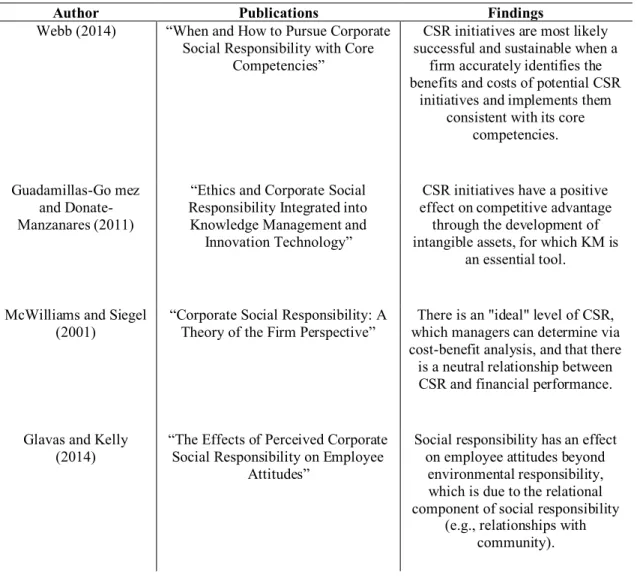
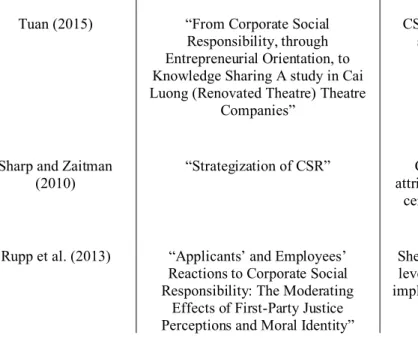
Additionally, compared to previous studies on the topic (see Table 1), this study is aimed at incorporating and synthesizing both literature strands within CSR and strategic management. This study uses the company's stakeholder theory, and knowledge-based view (KBV) to understand micro-level CSR knowledge management.
Table 1. Previous research on related CSR knowledge management
Author Publications Findings
Webb (2014) “When and How to Pursue Corporate Social Responsibility with Core
Competencies”
CSR initiatives are most likely successful and sustainable when a
firm accurately identifies the benefits and costs of potential CSR
initiatives and implements them consistent with its core
competencies.
Guadamillas-Go mez and Donate-Manzanares (2011)
“Ethics and Corporate Social Responsibility Integrated into Knowledge Management and
Innovation Technology”
CSR initiatives have a positive effect on competitive advantage
through the development of intangible assets, for which KM is
an essential tool.
McWilliams and Siegel
(2001) “Corporate Social Responsibility: A Theory of the Firm Perspective” which managers can determine via There is an "ideal" level of CSR, cost-benefit analysis, and that there is a neutral relationship between CSR and financial performance.
Glavas and Kelly (2014)
“The Effects of Perceived Corporate Social Responsibility on Employee
Attitudes”
Social responsibility has an effect on employee attitudes beyond
environmental responsibility, which is due to the relational component of social responsibility
(e.g., relationships with community).
Tuan (2015) “From Corporate Social Responsibility, through Entrepreneurial Orientation, to Knowledge Sharing A study in Cai Luong (Renovated Theatre) Theatre
Companies”
CSR help facilitate knowledge sharing among employees
Sharp and Zaitman
(2010) “Strategization of CSR” attributed to the moral and value-CSR strategization may be centric nature of CSR activity.
Rupp et al. (2013) “Applicants’ and Employees’ Reactions to Corporate Social Responsibility: The Moderating
Effects of First-Party Justice Perceptions and Moral Identity”
Shed light on micro (employee)-level CSR phenomena and offer implications for both research and
practice.
1.5. Thesis outline
The remainder of the thesis is as follows (see Figure 1). Chapter 2 presents the study-relevant analysis of previous CSR literature, particularly from a strategic management point of view. The methods on which this thesis is based are discussed in Chapter 3. The empirical framework is discussed in Chapter 4. Chapter 5 provides the outcome’s analysis and interpretation. Chapter 6 presents further discussions and a summary of the findings.
2 THEORETICAL FRAMEWORKS 2.1. Introduction
This chapter attempted to summarize and inspire the subject in the introductory chapter to the study "managing corporate social responsibility." The intent of this chapter is to link this research to previous scholarly attempts to define, evaluate and clarify CSR knowledge management in organizations. Among the goals, this chapter will assess what was discovered in other academic contexts, as a basis for the findings of this study. Moreover, this chapter attempts to give previous research on the subject a general critical evaluation. The amount of potentially relevant literature is enormous and comes from various sources: for the purpose of this study, the review will focus on the CSR studies linked to strategic management, with special attention given to the management of CSR knowledge that positions an organization competitively in the industry. Next, a brief history of sustainability thinking from a business perspective is given.
2.2. History of sustainability thinking from a business perspective
The concept of Sustainability is not new (Kidd 1992). Literature has shown a long history and evolved over time. Perhaps notably, numerous intellectual and political currents of thought have shaped conceptions of the historical development of sustainability (Kidd 1992 p. 3). This section of the thesis explores the context of sustainable thought from a business perspective. It provides an overview of CSR's underlying debates and approaches, including the theories of stakeholders and knowledge-based view of the firm, the CSR pyramid, corporate social performance, sustainability, and strategic CSR, to form the basis for further discussion. It should be noted in advance that a part of this section is adapted from Takala’s (2016 p. 18-23) literature review (from the CSR pyramid, through to strategic CSR sections). From an academic and practitioner point of view, the concept of corporate social responsibility is then defined.
2.2.1. Conceptualization of CSR
A corporation's duty to society is a complicated and extensive subject that has for decades been at the centre of discussion and debate (Carroll 2008). In order to explore the business motivations and company-level activities of CSR knowledge management (such as stakeholder engagement), one should consider what the idea of corporate social responsibility actually entails and how it evolves.
CSR's origins could be traced back to the 20th century. A review of the literature revealed divergent views of the exact time period and who is the concept's founder. Nevertheless, the early findings and research on the subject are generally agreed. Some scholars, for example, alluded to the fact that in 1917 Ford Motors practiced CSR when Henry Ford claimed that the target was “to do as much as possible for everybody concerned, to make money and use it, give employment and send out the car where people can use it … and incidentally make money.” (Lee 2008 p. 54). At its inception, CSR was initially called Social Responsibility (SR). In the 1950s, social responsibility began to emerge throughout scientific literature according to Carroll (1999). It was first proposed by Bowen (1953) and given its initial definition as the duties of businessmen to implement those strategies, to make those decisions, or to follow those lines of action which are beneficial in terms of society's goals and values (ibid p. 6). According to Bowen (1953), in order to outperform competition, companies need to be aware of business ethics. Over the past decades, studies have shown that CSR as a concept has endured and continues to advance in importance and impact.
The descriptions of CSR began to appear in the 60's and 70's. Davis (1967 p. 46) claims, in particular, that a good-performing business requires a healthy society. In other words, a company is required to consider not only income, but also its social responsibilities. In addition, short-term social responsibility investments are claimed to maximize long-term gains for corporations (Davis 1960 p. 70). In fact, socially responsible activities were still considered businessmen's responsibilities in the 60's, rather than company or organization themselves. According to Carroll (1999), extending the development of the CSR definition beyond economic and legal obligations implied that social responsibilities depend, to some extent, on the degree of voluntarism.
The seventies saw an increase in social responsibility as a corporate act other than an individual act. Given this background, many interpretations of CSR have argued that an activity must be purely voluntary in order to be considered socially responsible; others have argued that it also requires legal compliance; others have argued that ethics is part of CSR; almost all definitions include business donation or corporate philanthropy as part of CSR and many commentators just associate CSR with philanthropy and do not make a factor in these other categories of responsibility (Carroll 2016.) Davis, however, defines CSR as the company's consideration and response to issues beyond its narrow economic,
technical and legal requirements. He argues that, it is the duty of the firm to determine in its decision-making process the impact of its actions on the external social environment in such a way as to obtain social benefits along with the traditional economic gains that the firm seeks (Davis 1973 p. 312–313). Most importantly, when it comes to social responsibility, the emphasis is placed on firms to assume that responsibility. Consequently, CSR appears to have shifted to a more notable term, that of social responsibility. It is also worth mentioning from Davis’ description how CSR was related to its ability to sustain economic gains for the company and to distinguish it effectively from pure philanthropy.
Milton Friedman, on the other hand, joined the CSR debate in 1970, with a slightly different idea from the one discussed above. According to Friedman (1970), an enterprise's prime social responsibility is to maximize shareholder value. In addition, it is in the 1970s that Moskowitz (1972) and Vance (1975) made the first attempt to empirically prove the impact of CSR on stock performance. While empirical research on CSR characterized the seventies and eighties, the nineties saw an evolution of various types of themes. These included: stakeholder theory and corporate social performance (CSP) (Carroll 1999). The stakeholder theory states that, besides shareholders, corporations are responsible for other factors that are affected or may affect an organization's well-being, such as employees, customers and so on (Freeman 1984 p. 25). In other terms, contrary to Milton Friedman’s theory, organizations are obligated to recognize their partnership with stakeholders and ensure effective operations within all of their stakeholder categories.
2.2.2. Stakeholder theory
The ‘Friedman Theory’, also known as the stockholder principle, as the only corporate social responsibility puts emphasis on the stockholder interest (Freeman 1984 p. 25). From the academic literature on CSR, this inconsistency between stakeholder theory and stockholder theory became a centre of attention.
Edward Freeman introduced the stakeholder theory in 1984. According to Freeman (1984 p. 52) stakeholder theory states that managers, ‘‘must pay attention to any group or individual who can affect or is affected by the organization’s purpose, because that group may prevent [the firm’s] accomplishments.’’ Furthermore, the stakeholder theory holds
Mitchell, Agle, and Wood (1997) argue that managers need to know about their environment's influential entities (see Figure 2), those intending to impose their will on the company. Similarly, power and urgency need to be addressed if managers are to serve legitimate stakeholders’ legal and moral interests. Figure 2 below presents an illustration of the relationship between corporate stakeholders.
Figure 2. Stakeholder theory: an illustration of the relationship between corporate stakeholders
Source: Adapted from Freedman (1984 p. 25)
In line with the stakeholder theory, Andriof, Waddock, Husted, and Rahman (2002 p. 20) conclude that strategic partnerships are an integral part of most organizational operations in the dynamic, unpredictable world of today. Likewise, researchers found a contrast between the company's stakeholder theory and resource-based view (Barney 1991) to
Corporation Employees Customers Shareholders Suppliers Government Media Local community Competitors
understand the effect of a stakeholder emphasis. Most scholars argue that by responding to the demands of stakeholders, companies can gain a competitive advantage by developing skills and relationships with their stakeholders that, in turn, serve the firm as valuable, rare, inimitable and non-replaceable resources (Barney 1991; Mellahi, Frynas, Sun & Siegel 2016).
In particular, integrating and extending the resource-based view of the firm and stakeholder management literature, it can be argued that good stakeholder management not only enables a company with maximum profits to maintain its competitive advantage for a longer period of time, but also, more importantly, help poorly performing companies to recover more quickly from disadvantaged positions (Choi & Wang 2009). Choi and Wang (2009) argue that, unlike other traditional company resources, good relations with stakeholders will improve the flexibility of a poorly performing organization in implementing strategic changes, thus helping the company move faster out of its disadvantageous position.
Furthermore, if businesses are to deal successfully with the problems and relationships of stakeholders that threaten them today, they need a better understanding of the complexities and desires that are central to living, behaving and functioning in a collaborative partnership network. Based on the stakeholder theory and resource-based view of the firm, this thesis aims to provide a context for improving awareness of the dynamics and logic of today's increased levels of stakeholder engagement (Andriof et al. 2002 p. 20). CSR operation therefore has the potential to increase not only CSR relationships, perceptions, and recognition but also stakeholders’ intent to commit personal resources (e.g., money, labour, etc.) for the benefit of the company. (Sen, Korschun & Bhattacharya 2006)
In summary, stakeholder theory has developed to address issues of (I) recognizing and managing a business in today's world (the problem of value creation and trade); (ii) bringing together thinking about ethics, accountability, and sustainability problems with the normal economic view of capitalism (the question of capitalism's ethics); and (iii) understanding what managers and students need to know about what it takes to succeed in today's business world (managerial attitude problem).
2.2.3. The pyramid of corporate social responsibility
The pyramid of CSR or as popularly known, Carroll’s CSR pyramid, is a straightforward structure that helps explain how and why companies can fulfil their social responsibilities (Carroll 1991). Through separating the ethical and philanthropic aspects of corporate responsibility, Carroll extended CSR to include obligations that go beyond them, contrary to the conventional economic and legal responsibilities of business. In this context, CSR is defined as including “the economic, legal, ethical, and discretionary expectations society has of organizations at a given point in time" (Carroll 1979), and divided into four separate levels of economic, legal, ethical, and philanthropic obligation (see Figure 3).
Figure 3. The pyramid of corporate social responsibility Source: Carroll (1991)
Carroll's CSR model outlines four forms of corporate responsibilities: economic responsibility for profit making; legal responsibility for fulfilling the legal requirements of the respective society; ethical responsibility for doing what is right, just and fair; and philanthropic responsibility for “engaging in social activities that are not compulsory, not
required by law, and not generally expected of business in an ethical sense” (Carroll 1979, 1991) such as educational, recreational or cultural matters. While being one of the most cited models, however, the CSR pyramid has been criticized for being less relevant in other market contexts outside the United States (Visser 2008). Recent studies, for example, have shown that this concept of CSR and how it is applied differs across countries over time, and that it is the various business cultures that have driven the rate of change and development in this regard (Masoud 2017). However, in his defence, Carroll maintains that CSR pyramid’s primacy has been solidified by four powerful CSR drivers taking hold in the 1990s and going forward. These include globalization, institutionalization, profit-making integration and academic proliferation (Carroll 2016). 2.2.4. Corporate social performance
Another fundamental theory more closely related to the actual practice of CSR is the basis for corporate social performance (CSP) (Carroll 1979; Wood 1991). Wood (1991), defines corporate social performance as “the configuration of social responsibility principles, processes of response to social requirements, and policies, programmes and
tangible results that reflect the company’s relations with society.” In other words, it is more relevant to current corporate experience and how the corporation operates socially in the context of its stakeholders, rather than theoretical viewpoint.
The CSP theory highlights the divergent management behaviour or "social sensitivity ideologies" that organizations might have towards CSR. As Carroll notes, the sensitivity of businesses to social issues will vary based on four potential management intervention strategies, including reaction, defence, accommodation, or proaction. Specifically, businesses can 1) reject any responsibility for social issues and remain passive even when problems arise, 2) accept it and only do what is needed by concentrating on regulatory compliance, 3) recognize their responsibility and meet the needs of relevant stakeholders, or 4) expect social changes and strive to proactively go beyond industry standards. (Carroll 1979)
2.2.5. Corporate sustainability
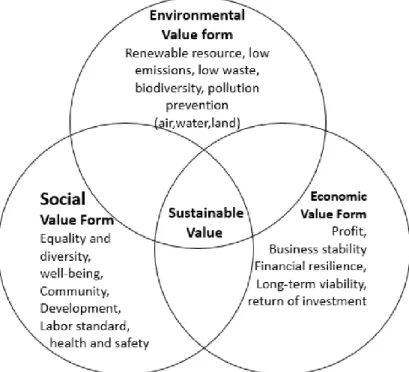
The sustainability idea emerged from the contexts of environmental management and forestry, became a part of the CSR debate in the early 2000s, as business community became increasingly interested in the concept (Carroll & Shabana 2010). According to
without undermining the future generations’ capacity to meet their needs. It is seen by many as the key objective of CSR.
The applicability to three elements of life is fundamental to the concept of sustainability: economic, environmental, and social - the triple bottom line of sustainability by John Elkington (1997). According to Elkington, sustainability is described as a company's ability to achieve its business goals by integrating economic, social, and environmental incentives into corporate strategies, other than simply the profit aspect. In addition, this model (see Figure 4) requires companies to behave in ways that are economically viable for the long term and avoid any short-term acts that are socially or environmentally harmful (Elkington1997).
Figure 4. The triple-bottom line of sustainability Source: Elkington (1997)
In addition, consumers are becoming increasingly interested in the corporate world to understand the effect of universal socio-ecological issues on the competitive result and competitiveness of the organization (Cörvers et al. 2016). The primary indicator of the strategic gains from sustainable ‘practices’ is the value that they generate for the company (Burke & Logsdon 1996). Value creation refers to the readily observable source of economic benefits the company expects to receive (Gonzalez-Padron, Hult, & Ferrell 2016). The environmental and social responsibility actions of the company clearly aid in
value creation and economic performance attainment. Studies have reported that sustainable social practices such as eradicating poverty, regulating child labour, empowering women, and educating disadvantaged society groups inspire retention of workers, improve customer satisfaction, and promote productivity in companies (Longoni & Cagliano 2016). Generally, and from a business perspective, sustainability has been described as a company's ability to endure time, both in terms of profitability and in terms of managing environmental and social assets that include its investments.
2.2.6. Strategic CSR
Over the years CSR has developed into a modern corporate strategy: from the ‘businessmen’ of the 50s to stakeholders and other ideas of the 90s. Research interests on CSR among scholars, companies and global organizations have increased since then, and increasingly by the public (Carroll 1999). Moreover, the beginning of the 21st century no longer saw CSR as a mere subject of study among academics, but as a pressing global issue. Arguably, "Capitalism and its destructive tendencies are manifest through its greatest creation - the Corporation" (Gray 2010 p. 57). Considering the climate change indirectly attributed to their activities, businesses are required to move towards a state where they only use resources consumed at a rate below natural reproduction, or at a rate below substitute growth.
Strategic CSR has been said to include initiatives such as CSR that provide business value and thus create sustainable competitive advantage (McWilliams & Siegel 2011). In other words, as opposed to pure enhancement of society, strategic CSR also aims to make good business sense (Burke & Logsdon 1996; Porter & Kramer 2006). As Peng (2006) puts it, “at the heart of CSR is the concept of stakeholders.” It is society or the public that is playing an increasing role in what determines business success, and not just business executives (Carroll 2008). The findings by Brower and Mahajan (2013) based on a longitudinal, multi-industry sample of 447 US firms during the period from 2000 to 2007 demonstrate that firms which: (1) have greater sensitivity to stakeholder needs as a result of the firm’s strategic emphasis on marketing and/or value creation, (2) face greater diversity of stakeholder demands, and (3) encounter a greater degree of scrutiny or risk from stakeholder action have a greater breadth of CSP in response to the stakeholder landscape that they face. They concluded that organizations that consider stakeholder
needs and wishes can actually boost future opportunities, and that marketing is ideally positioned to help meet various stakeholder demands. (ibid.)
CSR proponents also point to studies arguing that unplanned and insincere CSR is counterproductive and risks negative connotations from their stakeholders instead (see Carroll & Shabana 2010). Therefore, businesses are urged to follow a strategic approach if they plan to benefit from their efforts in CSR (Luo & Bhattacharya 2009) and are recommended to use the same policy process as any other strategic management decision (Porter & Kramer 2006). One proposed way of discussing and analysing planned CSR initiatives is to organize the concept into tangible social impact (e.g., pollution reduction), social programmes (targeting firm-specific goals or needs) or social policies that direct corporate decision-making. It is critical that CSR activities align strategically with firm-level objectives (Orlitzky, Schmidt & Rynes 2003). Table 2 summarizes the main arguments from the discussed theories.
Table 2. Theoretical perspectives on CSR
Approach Author(s) Key Argument
Agency theory Friedman (1970) A corporation's sole responsibility is to maximize the profits of its shareholders.
Stakeholder theory
Freeman (1984); Donaldson & Preston (1995)
The interests of other stakeholder groups, and not just those of shareholders, should also be taken into account by
corporations.
The pyramid of CSR
Carroll (1979; 1991) CSR is made up of economic, legal, ethical and philanthropic responsibility to society and to stakeholders.
Corporate social performance (CSP)
Carroll (1979); Wood(1991)
In the view of stakeholders, businesses perform differently based on their reactions and behaviour towards social issues.
Sustainability Elkington (1997) Industries should minimize adverse impacts on the environment and adhere to societal expectations to be economically viable.
Strategic CSR Porter & Kramer (2006); McWilliams & Siegel (2001); etc.
As well as providing social benefits, CSR can be managed strategically to create value for the company.
However, CSR strategy allows businesses to enhance their internal and external (competitive) context by better understanding and leveraging expertise, stable relationships with stakeholders, and creating and improving intangible resources such as credibility or social capital (Guadamillas-Gomez1 & Donate-Manzanares 2010). Moreover, there are important factors to consider, such as organizational culture, human resource practices, or knowledge management systems, in order for this process to be successfully carried out (ibid).
2.2.7. Defining CSR
Drawing from the debates from the prior sections, it can be deduced that CSR is a well-known and widely used term in business, government, NGOs and academia, but numerous scholars have defined it in various ways. According to Lindgreen and Swaen (2010), CSR does not have a widely accepted academic definition. Apart from the term "CSR" many other similar, and sometimes interchangeable concepts (such as sustainability, stakeholder management, corporate citizenship, corporate social performance) are also used to define the business-society partnership concept (Garriga & Melé 2004; McWilliams, Siegel & Wright 2006; Matten & Moon 2008). Several scholars, however, have identified shared characteristics for CSR, despite the different methods and interpretations (Carroll 1999; Crane, Matten & Spence 2014). For example, according to Crane et al. (2014), in most definitions certain critical CSR characteristics appear to be replicated. First, CSR is characterized by many as a collection of voluntary activities that go beyond legislative and regulatory requirements. Second, it is mostly concerned with taking into account a variety of different stakeholder categories, other than relying on shareholder interests alone. Furthermore, CSR is described by many as a philosophy that highlights the importance and goodness of the motives behind responsible business practices, covering all of the key business functions rather than just philanthropy and charitable activities. (Crane et al. 2014 p. 9.)
By using these scholarly insights as the basis for this work, the study defines corporate social responsibility as "a commitment to improving social well-being through discretionary business practices and corporate resource contributions" (McWilliams & Siegel 2001; Du, Bhattacharya & Sen 2010). The definition emphasizes that CSR is about the various ways to go beyond what regulations and shareholders need to increase the effect of corporate decisions and practices on a larger stakeholder community.
Furthermore, it also includes the idea that CSR encompasses all of the company's core activities and procedures, in addition to those related to corporate philanthropy, including production, supply chain management, marketing, auditing and monitoring, human resource management (HRM), logistics, etc. (Zollo, Minoja, Casanova, Hockerts, Neergaard, Schneider, & Tencati 2009). Accordingly, in this thesis, the term "CSR" is used to highlight both the environmental and social aspects of corporate responsibility equally. Similarly, a more holistic view of CSR is used in terms of commitment motivations, since in reality businesses can decide to act and invest in CSR on the basis of different ethical or strategic reasons (McWilliams & Siegel 2011). The theories and concepts discussed in the preceding sections will now be presented in the following sections.
2.3. Knowledge-based view of the firm
The knowledge-based view (KBV) of the firm assumes that firms are heterogeneous in their resources, that these resources cannot be transferred without cost from firm to firm, and that their characteristics partially determine firm results such as performance (Barney 1991). Consequently, managers have a primary task of acquiring, developing and managing firm resources. Barney (1991) argues that the potential for a sustainable competitive advantage is valuable, scarce and irreplaceable, and difficult to imitate resources.
Michael Porter has explained a way of thinking about business since 1980 that takes the “competitive strategy” metaphor as a central one (Freeman, Harrison, Wicks, Parmar & Colle 2010 p. 14). Porter and Kramer (2006) proposed that companies could add to their strategic arsenals thinking about CSR and sustainability to gain advantage. An assumption that knowledge is an important resource for the strategic competitive advantage of the firm is at the basis of the knowledge-based view (Grant 1997). Scholars have distinguished between ‘explicit knowledge’ capable of articulation and ‘tacit knowledge’ embedded in the mind of the knower and manifest in its application only. Moreover, the knowledge-based view assumes that through the process of knowledge sharing, individuals are the primary agents of knowledge creation. The key management task for the organization is therefore not to accommodate divergent goals, but to create a process by which collaborating individuals can coordinate their activities in order to translate their expertise into productive activity. Scholars have highlighted numerous
strategies for managing a firm’s knowledge, including that sustainable competitive advantage can be achieved by accumulating valuable knowledge stocks.
Also supporting the relationship between responsible stakeholder management and firm performance is the resource-based view (RBV), from which the knowledge-based view derives. According to Sussland (2001), intangible assets such as credibility and efficiency and successful recruiting improve a company's ability to obtain and grow valuable resources. In addition, Barney (1991) argues that market value conditions, uniqueness, irreplaceability, and imitability, provide the business with a source of sustainable competitive advantage. Moreover, the resource-based view of the firm also implies that companies with an in-house capacity to build specific stakeholder-satisfying capabilities can also benefit from competitive advantage (Russo & Fouts 1997).
The knowledge-based view and stakeholder view, as indicated earlier, can also be stated here as being complementary rather than competing (Freeman et al. 2010 p. 118). According to Freeman et al. (2010), knowledge-based views view firms as knowledge bundles, while stakeholder theory views firms as stakeholder networks. Strong competitiveness therefore requires effective management of both organizational knowledge and stakeholder relationships, as the knowledge-based view needs completion of stakeholder theory. Freeman et al. (2010 p.12) argue that “the only way to maximize value sustainably is to satisfy stakeholder interests.” This thesis suggests that knowledge of CSR activities is a valuable resource that needs to be managed well to achieve the company's competitive advantage. According to Freeman et al. (2010 p. 95), an effective management of both organizational resources and stakeholder relationships will result in firm competitive advantage. Nonetheless, since the purpose of this thesis is to examine the aspects of CSR knowledge management, it is important to understand the concept ‘knowledge’ and what constitutes its management in more details.
2.4. Knowledge management
Over the past two decades, the concept of ‘knowledge’ has gained popularity in organizations, as well as, research. Knowledge nowadays is seen as one of an organization's most important resource for competition (e.g., Spender & Sherer 2007 p. 6). Previous studies reveal, according to Hislop (2013 p. 2), that there are three main hypotheses as to the significance of knowledge management in the management of their
took place at the end of the twentieth century, which resulted in knowledge becoming the key asset for organizations to manage (Spender & Sherer 2007 p. 6). A second key observation is that there has also been a significant change in the nature of work, with the importance of intellectual work increasing significantly (Sewell 2005 p. 685-6). The third, related key assumption is that an enterprise will likely provide a source of competitive advantage by efficiently managing its knowledge base (e.g., Swart 2011); profitability (Choi, Lee & Yoo 2010); and performance and other capabilities (Liu & Philips 2011).
Studies on knowledge management reveal several different definitions and viewpoints on the meaning of knowledge. This thesis focusses on Nonaka's analysis of the concept. Moreover, a review of the knowledge management literature reveals that Nonaka's work is well known in the "knowledge creation" area (e.g., Nonaka 1994; Nonaka & Takeuchi 1995). In addition, Nonaka's theory of knowledge creation focuses on innovation, product innovation, strategic innovation and organizational innovation (Nonaka 1994 p. 14). Nevertheless, knowing what "knowledge" is to fully assimilate the principle of knowledge management is important at this point.
2.4.1. Knowledge
In research the concept of ‘knowledge’ and ‘information’ has been examined from a variety of perspectives. Knowledge is defined as "justified true belief" according to Nonaka (1994). Nonaka believes that the concept of knowledge is critical in that it is closely linked to the "belief" of an individual (ibid). From this viewpoint, he suggests that an individual's mind or body is the source of knowledge. Another emphasis on the knowledge view of Nonaka is the knowing dimension of assurance or proof (Nonaka & Takeuchi 1995 p. 26). However, central to this interpretation is the process of ‘doing’. In other words, one not only believe what one knows, but must justify adequately what they think they know with an objective of "truth". According to Chaffet and White (2011), knowledge builds on a combination of theory, information, and experience.
In addition, often the terms "information" and "knowledge" have been used interchangeably. However, Nonaka recognizes that information and knowledge (1994) are clearly distinguishable. Information has been described as “the flow of messages, while knowledge is created and organized by the very flow of information, anchored on commitment and beliefs of its holder” (ibid.). Thus, it can be seen that the importance of
human action as it relates to knowledge is placed at the centre. Brown and Duguid (2000 p. 147-71), likewise, describe three major distinctions between information and knowledge. Knowledge requires a knower; it is far harder to separate, pass and exchange than information; and knowledge is much harder to assimilate and comprehend than information. While these distinctions, however, have represented information as the building blocks of knowledge, it can be argued that knowledge can also be used for information generation (Davenport & Prusak 1998). In fact, knowledge influences the type of information that is collected and how it is measured.
Epistemologically, Nonaka claims two kinds of knowledge exist: tacit and explicit. Explicit knowledge is knowledge that in symbolic form and/or ordinary language can be codified, articulated, and communicated. On the other hand, tacit knowledge is rooted in action, practice, and participation in a particular context. This consists of both cognitive (e.g., opinions, viewpoints) and technological. On the ontological level, Nonaka argues that knowledge originates from an entity, then from a team, community, organization, and onward. Nonaka believes there is a spiral relationship between tacit and explicit knowledge (see figure 5.) that results in "new ideas and concepts" being generated (Nonaka 1994 p. 15; Nonaka & Takeuchi 1995 p. 57). He stresses that while in organizational departments there may be group limits, the degree to which social interaction between individuals who possess such ideas contributes to the creation and development of new knowledge (ibid). Figure 5 below illustrates this idea.
Nonaka thus claims that knowledge can be either form - tacit or explicit. He introduced four modes of conversion of knowledge in his work (Figure 5.), including socialization (tacit to tacit), externalization (tacit to explicit), combination (explicit to explicit), and internalization (explicit to tacit) (Nonaka 1994; Nonaka & Takeuchi 1995). In addition, the theory of Nonaka also provides an interpretation in the organization of the "enlargement" of individual knowledge using these types. Also, circumstances were highlighted suitable for promoting the organization's knowledge creation. These include intention, autonomy, fluctuation, creative chaos, redundancy, and requisite variety. In addition, Nonaka's theory provides a framework for the development of organizational knowledge. Such steps include the exchange of tacit knowledge, the development of concepts, the justification of concepts, the creation of a norm, and cross-level knowledge.
Figure 5. The SECI cycle of knowledge creation Source: Nonaka and Tekeuchi (1995)
2.4.2. Defining knowledge management
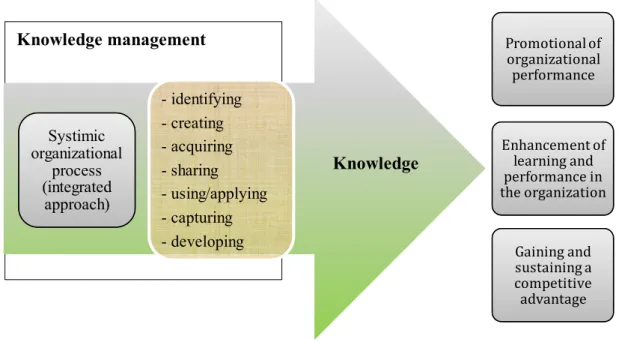
Knowledge management (KM) is the deliberate and systematic planning, coordination, encouragement, and monitoring of the organization's people, processes, and systems to ensure that its knowledge-related assets are strengthened and employed effectively (Dalkir 2011). Researchers agree that KM can be seen as a process (see figure 6) of knowledge acquisition, creation, refinement, storage, transfer, sharing, and utilization of the intellectual asset for long-term sustainability and strategic benefit (Nonaka & Tekeuchi 1995; Dalkir 2011). Knowledge-related assets include information in the form of printed documents, such as manuals, knowledge contained in electronic repositories, such as a database of "best practices," knowledge of workers about the best way to do their jobs, knowledge retained by teams working on focused problems and knowledge embedded in the products of the company, processes and relationships.
According to Lapiņa, Maurāne, and Stariņeca (2014), KM is concerned with people in the same way as with information technology, and how they acquire and disseminate knowledge. They argue that to improve organizational effectiveness, getting knowledge from those who have it to those who need it is the fundamental element of KM (see Figure
Knowledge management
6). In fact, the KBV (see section 2.3.) notes that knowledge is the key to organizational success in today's information age, rather than physical assets or financial resources.
Figure 6. Concept of knowledge management Source: Adapted from Lupina et al. (2014)
In the context of sustainability, the KM concept used in this thesis corresponds to the KM relationship. The exchange of information on a wider scale within this concept is important for the viability of competitive advantage of the firm. KM can play an important role in this respect, because of its ability to facilitate CSR related information/knowledge sharing among stakeholders. According to Clarkson (1988), stakeholder theory stresses that the sustainability and success of companies depends on the ability of the company to generate sufficient income, interest or satisfaction for its primary stakeholders, but not solely for shareholders. For instance, Post, Frederick, Lawrence, and Weber (1996, as cited in Maon, Lindgreen & Swaen 2009) find the primary stakeholders to be those whose direct relationships are necessary for the company to fulfil its task of providing goods or services for clients. Secondary stakeholders include social and political figures who support the project by tacitly approving the actions of the organization, thus making them appropriate, and giving credibility to the organization. These secondary stakeholders may include local communities, Governments and NGOs.
Systimic organizational process (integrated approach) Systimic organizational process (integrated approach) - identifying - creating - acquiring - sharing - using/applying - capturing - developing Promotional of organizational performance Promotional of organizational performance Enhancement of learning and performance in the organization Enhancement of learning and performance in the organization Gaining and sustaining a competitive advantage Gaining and sustaining a competitive advantage Knowledge
2.4.3. Knowledge management and CSR
Regardless of the company’s aim, organizational change evolves around the processes of knowledge creation and sense-making. Drawing from the discussions from the prior section, acquiring and retaining its competitive advantage is crucial for the growth of an organization in today's competitive world. Moreover, since new knowledge is needed to bring about change, a knowledge management-based approach to CSR would provide a valid perspective on how traditional ways of running a business (Friedman 1970) give way to a more comprehensive consideration of the role of business in society (Preuss & Córdoba (2009).
CSR does not have a single strategy that suits all companies. Each company has a unique approach to CSR. Lapina et al. (2014) argues that the main organizational stakeholders need to be identified from the outset for the development and implementation of the social responsibility plan in order to ensure the effective and sustainable operation of the business. Further, they suggest building quality relationships by identifying the interests and needs of each stakeholder, as well as, the related challenges and choosing the most appropriate strategy of cooperation with each one of them. Moreover, such a plan and corresponding actions will ensure the parties’ cooperation and the company’s successful operation, which in turn will lead to competitive advantage (ibid).
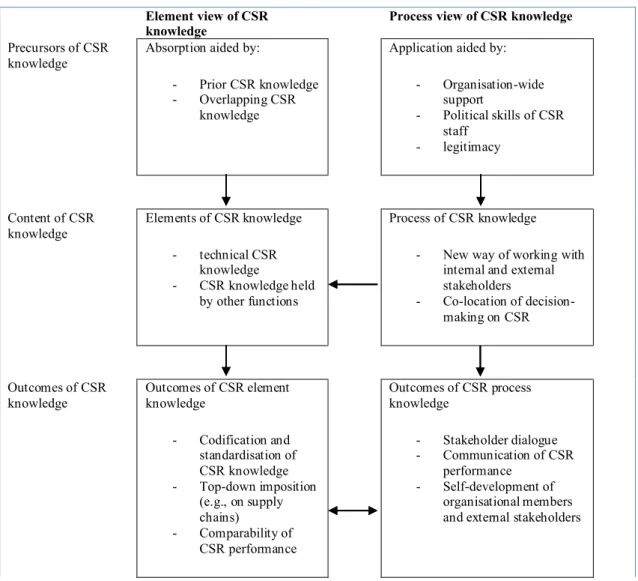
Preuss and Córdoba (2009) differentiates CSR into the two KM perspectives of elements and processes (see Figure 7). This differentiation enables scholars to define elements necessary to create a potentially successful CSR programme, as well as, to highlight activities necessary to connect such a programme to core organizational activities and structures (ibid). Generally, the element view illustrates a number of explicit knowledge organizations need for reference when designing and implementing their CSR strategy. It includes CSR practitioners’ technical knowledge as well as elements of CSR knowledge that exist in other departments such as human resources, external affairs, marketing, or supply chain management. Where internal knowledge of CSR is found to be lacking, an element view of KM will help to identify the gaps to be filled by external experts in CSR. Therefore, the static element view of KM illustrates the significant degrees of CSR knowledge experience in codification and standardization (e.g., Nonaka & Tekeuchi 1995). Codifying explicit knowledge helps to gather, store and disseminate information on CSR which, according to Preuss and Córdoba (2009), allows for greater comparability
across organizations and sectors, which in turn has enabled the development of targets and indicators for key CSR impact areas. Conversely, an emphasis at KM's view of elements will contribute to a compliance-driven approach to CSR (ibid).
Element view of CSR
knowledge Process view of CSR knowledge
Precursors of CSR
knowledge Absorption aided by:
- Prior CSR knowledge - Overlapping CSR
knowledge
Application aided by: - Organisation-wide support - Political skills of CSR staff - legitimacy Content of CSR knowledge Elements of CSR knowledge - technical CSR knowledge - CSR knowledge held by other functions Process of CSR knowledge - New way of working with
internal and external stakeholders
- Co-location of decision-making on CSR
Outcomes of CSR
knowledge Outcomes of CSR element knowledge - Codification and standardisation of CSR knowledge - Top-down imposition (e.g., on supply chains) - Comparability of CSR performance Outcomes of CSR process knowledge - Stakeholder dialogue - Communication of CSR performance - Self-development of organisational members and external stakeholders
Figure 7. The interaction of the element and process views of CSR knowledge Source: Adapted from Preuss and Córdoba (2009)
In comparison, Preuss and Córdoba (2009) contend that the process view of KM stresses the efforts required to generate CSR organizational buy-in. From this viewpoint, a shift to organizational sustainability means a new way of working with key external stakeholders and within the company. In addition, communication flows which combine top-down with bottom-up communication patterns are required. The process view highlights the need for CSR's political skills advocates to generate organizational support to integrate social and environmental externalities into corporate strategy. (ibid.) Identifying, nurturing and fostering communities of practice (Wenger 1998; Hislop 2013) is a key strategy in KM's process-oriented view.
According to Wenger (1998 p. 83), Communities of practice (CoP) is defined as “groups of people who share a concern or a passion for something they do and learn how to do it better as they interact regularly”. The CoP literature closely relates to the practice-based perspective on knowledge, as it assumes that the knowledge people have is embedded in and inseparable from (collectively based) activities that people carry out (Hislop 2013 p. 155). Moreover, the informality of these communities is as a result of social interactions that are a necessary part of the work that people undertake. According to Preuss and Córdoba (2009), such systems could also be a crucial point of entry for CSR matters. Accordingly, CoP participants not only have a pool of common knowledge but also a shared sense of identity and common values that overlap. According to Hislop (2013 p. 159), the simultaneous presence of these elements enables processes of knowledge, as they simplify the communication of knowledge that is inherently sticky (tacit knowledge). Moreover, it can be argued that, first, the presence of these three elements makes it easier to understand the beliefs and principles taken for granted, which underpin tacit knowledge. Second, the presence of these elements is likely to generate and maintain trust-based relationships, creating social conditions conducive to the exchange of information. (ibid.)
The above discussions further points to the questions highlighted by Siltaoja (2014). According to Siltaoja, social change developments present an interesting challenge for CSR and the development of knowledge, and thus posing the following questions: if knowledge about social change and how to address social problems is not shared but remains private, will social change be achieved? Therefore, can social and environmental ills be a corporate responsibility priority if the information on how to solve these problems remains private? (Siltaoja 2014). Siltaoja argues that well-managed stakeholder relationships both allow knowledge development and generate knowledge about specific challenges to sustainability. He, however, posits that CSR makes strategic knowledge use even more stakeholder-dependent by managing and reacting to various stakeholder groups’ expectations (Siltaoja 2014). Conversely, Maon, Lindgreen and Swaen (2010) claim that, while CSR is often an important strategic strategy for the organization, few systematic models examine the transition of current strategic strategies, organizational culture and practices to a CSR context. Therefore, this study contributes to the debate by examining the management of CSR knowledge in two mining companies in Zambia.
2.4.4. The role of communication
This section’s main aim is to review, study and synthesize the current CSR communication literature to provide insights into how organizations can more efficiently communicate their CSR activities (Du, Bhattacharya & Sen 2010). It should be noted that some ideas in this section are developed from Takala’s (2016 P. 49-57) thesis work (e.g., the stakeholder awareness and engagement in CSR, message content, and message channels sections).
Based on the discussions of the previous sections, it is clear that businesses are increasingly using CSR activities to put their corporate brand in the minds of consumers and other stakeholders, such as their annual reports (Sweeney & Coughlan 2008) and websites (Maignan & Ralston 2002). Among other factors, the CSR disclosure and reports provide organizations with a good reputation in today's increasingly competitive global market. Literature review has shown that, the manner in which the corporation applies its ethical principles and values to its operations and how they are disseminated and communicated through the corporate network impacts the relationships with them all (shareholders and other creditors, consumers, vendors, staff or the wider community). (Guadamillas-Gómez1, Donate-Manzanares & Škerlavaj 2010). Accordingly, previous studies with real stakeholders showed that knowledge among external and internal stakeholders of a company's CSR activities is typically low, thereby constituting a major drawback in the company's pursuit to gain strategic benefits from its CSR activities (Bhattacharya et al. 2008; Du et al. 2007; Sen et al. 2006). Nevertheless, recent studies have shown that, communicating about social activities does not always benefit the communicating organization, particularly because communication with CSR can trigger scepticism and cynicism among stakeholders (Lindgreen & Swaen 2010). This study aims to show that some form of communication of CSR expertise is essential for sustained performance of the company.
Allen and Craig (2016) describe communication as more than a tool to create a favourable corporate image, in order to gain or maintain credibility. It is the means of creating and disseminating sustainability-related CSR programmes within companies and among their key stakeholders (i.e., states, societies, rivals, supply chains, and employees). (ibid.) In line with corporate culture, the results of Brunton, Eweje and Taskin (2017) highlight the need not only to connect with internal stakeholders using preferred approaches, but also