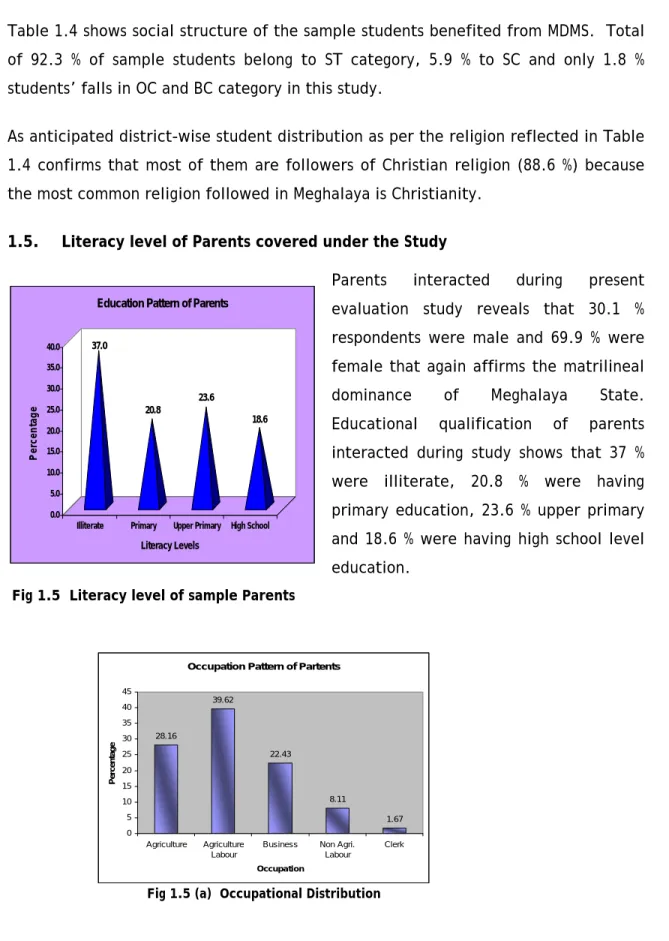
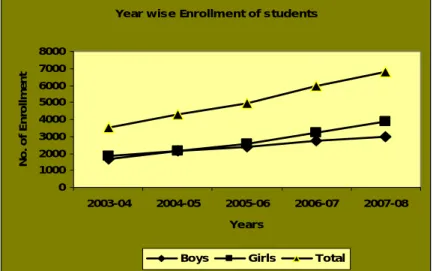
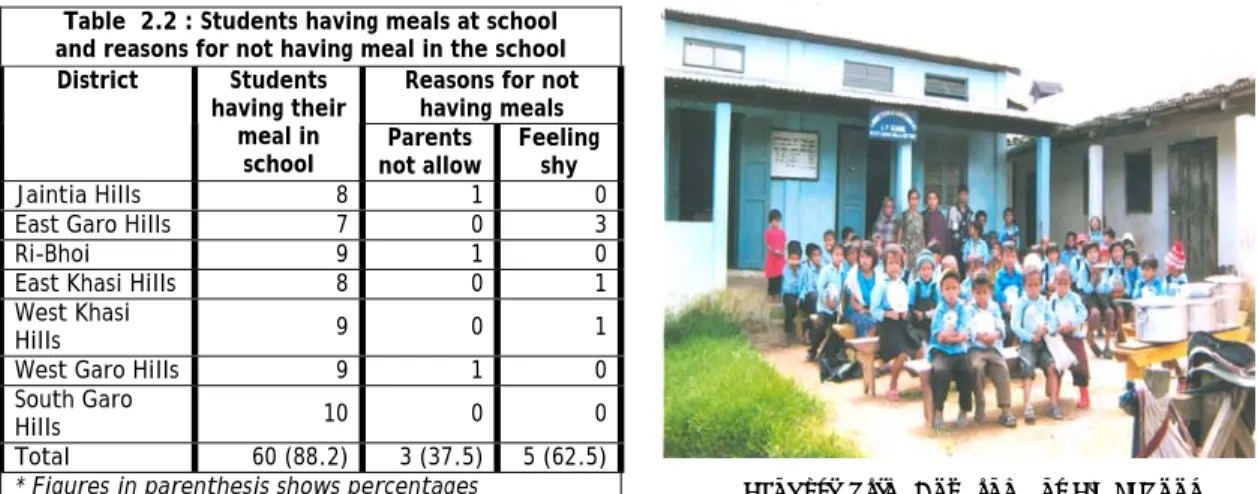
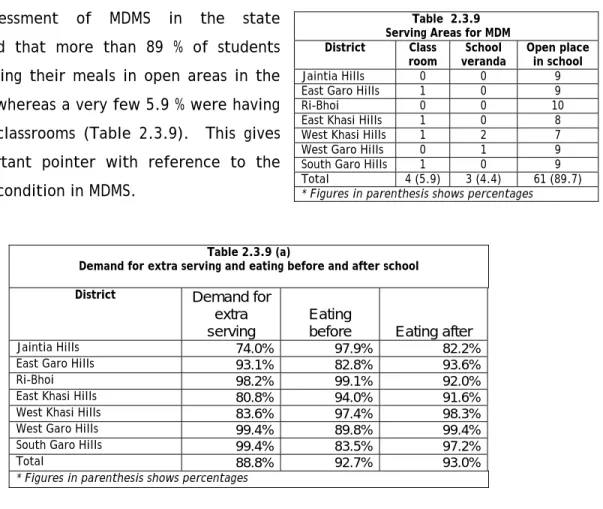
EVALUATION STUDY ON
MID DAY MEAL PROGRAMME IN MEGHALAYA
Sponsored by
Directorate of Programme Implementation & Evaluation
Government of Meghalaya
Manju Singh
Niharranjan Mishra
COUNCIL FOR SOCIAL DEVELOPMENT
Southern Regional Centre, Hyderabad – 500 030
Evaluation Study on
Mid Day Meal Programme in Meghalaya
Sponsored by
Directorate of Programme Implementation & Evaluation
Government of Meghalaya
Manju Singh
Niharranjan Mishra
COUNCIL FOR SOCIAL DEVELOPMENT
Southern Regional Centre, Rajendranagar
HYDERABAD – 500 030
Telephone: 040 24016395, Telefax: 040 24001958
Email: [email protected]
www.csdhyderabad.org
C O N T E N T S
ACKNOWLEDGEMENTS LIST OF TABLES AND FIGURES
EXECUTIVE SUMMARY i – x
Section - I INTRODUCTION 1 – 12
1 India’s Response 1
2 Genesis of the Mid Day Meal Programme 3
3 Mid Day Meal in the State of Meghalaya 5
4 Scope and Objectives of the Evaluation Study 10
Section – II RESEARCH METHODOLOGY 13 – 18
1 Sampling Procedure 13
2 Data Collection 16
3 Data Analysis 16
4 Timeline 17
Section – III MAIN OBSERVATIONS 19 – 56
1 Perception of the Sample Profile of the Present Study
1.1 District Wise Shift of the School 19
1.2 Year of Commencement 20
1.3 Gender, Age and Study Level, Distribution of
Sample Students 21
1.4 Caste-wise and Religion-wise Distribution of
Sample Students 21
1.5 Literacy level of Parents covered under the
Study 22
1.6 Distribution of Monthly Income of the Family 23 2. Performance of MDMS : Some Observations
2.1 Effect of MDMS on Enrollment, Attendance
and Span of Attention 24
2.2 Meals as an Incentive 26
2.3 Quality and Acceptance of MDMS 27
2.4 Supply of Ration 34
2.5 Basic Cooking and Storage 42
2.6 Drinking Water Facilities and Health Support 48
2.7 Monitoring 50
2.8 Contribution of Stakeholders /
Peoples Participation 52
2.9 Social Inclusion 54
2.10 Relating MDM Performance with
Infrastructure Index 54
Section – IV CONSTRAINTS AND FUTURE DIRECTIONS 57 – 69
1 Constraints and Bottlenecks 58
2 Future Directions 63
References 70
Annexure – I : List of MDM Centres covered under present study Annexure – II : List of Wholesalers interacted during study
ACKNOWLEDGEMENTS
The Council for Social Development, Southern Regional Centre, Hyderabad is grateful to the Government of Meghalaya for entrusting the evaluation study of Mid Day Meal Programme in Meghalaya. The Centre is particularly thankful to Shri Ajay Tiwari, Director,
Programme Implementation and Evaluation, Meghalaya, Shillong and Shri S. Lyngdoh, Deputy Director for their continuous encouragement and support.
Sincere thanks are due to all the officials of Department of Elementary and Mass Education, Government of Meghalaya, especially to the district and block level officials without whose cooperation and willingness to provide us the necessary information, the study would not have become a success.
The entire study was carried out under the able leadership of Dr. K.S. Bhat, our former Regional Director. He had been giving continuous and valuable guidance right from the stage of conceiving the proposal to the stage of presenting the draft report. Our present Regional Director Dr. A.C Kutty Krishnan Nambiar is also supportive enough to produce this report.
Dr. Niharranjan Mishra, Assistant Professor who had the major responsibility of conducting field work and survey has done commendable work. He has completed the assignment in extremely unfamiliar surroundings. The Centre is all in appreciation for his hard and sincere work. The members of research team toiled hard in the field, during survey, they worked overtime at odd hours and gave invaluable assistance in report production.
The expert support from Shri Shailendra Bisht for analysis and interpretation of the data during evaluation study is praise worthy.
Last but not the least, the Council is grateful to all the stakeholders of MDMS in Meghalaya including students, teachers, and parents, members of management committees and suppliers who have given their whole hearted support to evaluation team. Their contribution and perception is proved immensely useful in visualizing present status of MDMS and for future pathways of MDMS in Meghalaya. The project could not have been completed in the present form if the respondents were not generous and humane enough to spare their invaluable time to give responses to the questionnaire and other valuable information relevant to the study. They deserve special gratitude and respect. Special mention need to be made here of Mr. K. Sanjiva Rao for his efficient
administrative support during study period. Mr. P. Kumar, Mr. B Ramesh and Ms. A. Jyotsna for helping in data processing. Sincere thanks to Ms. K. Mahalakshmi for
her continuous and uninterrupted support for report presentation.
July 2010 Manju Singh Hyderabad
LIST OF TABLES
S. No. Table
No. Title of the Table Page No.
Section – I
1 1.1 Block and District wise description of sample MDM centers 11 Section – II
2 1.1 Infrastructure Development Index 14 Section - III
3 1.1 Shift of the School 19
4 1.2 Year of commencement 20
5 1.3 Gender, Age and Study Level Distribution 21
6 1.4 Caste-wise and Religion-wise Distribution 21
7 1.6 Distribution of Monthly Income of the Family 23
8 2.1 Effect of MDMS on enrollment, attendance and span of attention
(opinion) 24
9 2.1.1 Year-wise Enrollment of Students 24
10 2.1.2 Percentage increase in Total Enrollment 25
11 2.2 Students having meals at school
and reasons for not having meal in the school
26
12 2.2.1 Parents Opinion: MDM a motivation for attending school 27
13 2.3 Level of satisfaction with MDMS Functioning 27
14 2.3.2 Parents’ satisfaction : Regarding increased performance and quality
of food 29
15 2.3.3 Amount of Food Served Per Child 29
16 2.3.4 Appearance, Taste, Smell and Texture of Food 30
17 2.3.5 Overall Acceptance of the meal 32
18 2.3.6 Frequency of receiving cooked meals 32
19 2.3.7 Reasons of not eating MDM 33
20 2.3.8 Preference & Dishes liked by the students 33
21 2.3.9 Serving Areas for MDM 34
22 2.3.9 (a) Demand for extra serving and eating before and after school 34
23 2.4 Type of MDM provided in Schools 35
24 2.4.1 Frequency, Regularity and Reasons for irregularity of supply of
ration 38
25 2.4.2 Frequency of receiving the supply as per the fixed norms by
Government 39
26 2.4.3 Pre-information regarding delay of Supply of Ration 39
27 2.4.4 Action taken by the MDM In charge in case of Delay in supply of
ration 40
28 2.4.5 Quality of ration received and Checking the Quality by MDM Centres 41
29 2.4.6 Reasons for returning back the supply of Ration and Action taken in
the case of non-availability of cooked food 42
S. No. Table
No. Title of the Table Page No.
31 2.5.1 Alternative options for storage 43
32 2.5.2 Hygienic condition of cooking area 44
33 2.5.3 Arrangement of the Serving Plates 45
34 2.5.4 Process of utilizing the left over food at MDM Centre 45
35 2.5.5 Responsibility of washing plates and utensils 46
36 2.5.6 Responsibility of utensils wash and availability of wash area 47
37 2.5.6 (a) Process of cleaning Plates 47
38 2.5.7 Hygienic condition of cooking area and MDM Distribution 48
39 2.5.8 Inspection of ration before cooking 48
40 2.6 Availability of Health Support 48
41 2.6.1 Drinking water facilities and regularity of supply 49
42 2.6.1 (a) Source of drinking water 49
43 2.7 Inspection of higher authorities and stated reasons for not visiting 50
44 2.8 Menu Planning 52
45 2.8 (a) Students’ involvement in Menu Planning 52
46 2.8 (b) Complaints / Suggestions extended the betterment of MDM 53
47 2.8 (c) People's Participation 53
LIST OF FIGURES
S.
No. Figure No. Title of the Figure Page No.
1 1.2 Year of Commencement 20 2 1.5 Literacy level of sample Parents 22 3 1.5 (a) Occupational Distribution 22 4 1.6 Caste wise distribution 23 5 1.6 (a) Religion wise Distribution 23 6 2.1.1 Year-wise enrollment of Students 25 7 2.2.1 Parents motivation levels for attending schools 27 8 2.3.2 Parents Opinion: Regularity of Meal 29 9 2.3.4 Appearance, Taste, Smell and Texture of Food 31 10 2.5 Cooking shed availability 44 11 2.6 Complaints / Suggestion extended the betterment of MDM 53
Evaluation Study on Mid Day Meal Programme in Meghalaya Executive Summary
EXECUTIVE SUMMARY
MDMS Scheme was initiated on the basis of the philosophy that "when children have to sit in class with empty stomachs, they cannot focus on learning”. The scheme is important for improving enrolment, attendance and retention of primary school children, while simultaneously improving their nutritional status. Mid Day Meal Scheme had proved to be an effective means to check high dropout rates of children from economically weaker sections, while also addressing their nutritional needs.
Nutrition Support to Primary Education popularly referred to as Mid Day Meal programme (MDM) is considered as a means of promoting improved enrolment, school attendance and retention. MDM seeks to provide for each school child roughly a third of the daily nutrient requirement in the form of a hot fresh cooked meal. It is sometimes argued that in the case of children of poor households, the school meal may become a substitute rather than a supplement for the home meal. It is important to note that it is not merely the long-term effects of the school meal on the nutritional status but its Short-Term Effects on better attention, memory and learning that is important. There are several published reports based on well-conducted studies
pointing to these beneficial short-term effects of the school meal on learning ability. A hungry child is a poor learner lacking in concentration. A mid day meal is an
important instrument for combating classroom hunger and promoting better learning. Many children reach school with an empty stomach in the morning, since a good early morning breakfast is not a part of the household routine. Under these circumstances it is important to acknowledge the Short Term Effects of MDM on learning. MDM could thus be a means for not only promoting school enrollment but also better learning in schools. With children from all castes and communities eating together, it is also instrumental in bringing about better social integration.
MDM could serve the important purpose of improving school enrollment and attendance especially girls thus contributing to gender equality. With MDM, it will be easier for parents to persuade their children to go to school and for teachers to retain children in the classrooms. It could foster sound social behavior among children and dispel feelings of difference between various castes.
Evaluation Study on Mid Day Meal Programme in Meghalaya Executive Summary
MDM can also contribute to gender equality by reducing the gender gap in education by boosting female attendance in school.
Most importantly MDM could trigger all round development of the entire school system- leading to better infrastructures in schools, better teaching facilities, a School Health Service and community involvement. Even now, after a long span of implementation of MDMS in Meghalaya, State is not able to fully resolve the problem of the children dropping out of primary schools. Poor enrolment and high school dropout rate are attributed to poor socio-economic conditions, child labour, lack of motivation and poor nutrition status of the children.
Present evaluation study on MDM programme in Meghalaya is carried out to assess the performance of the programme in the entire state. The main aim is to understand the constrains and bottlenecks in implementing the programme and to suggest policy
measures for improvement in the functioning of the programme on the basis of in-depth observations. A comprehensive sample of seventy MDM centers from all seven
districts of Meghalaya was exhaustively studied in the current evaluation study. Two blocks from each of seven districts were included to cover whole state. Assuming
that the level of infrastructure would also affect the efficacy of MDM differently in different blocks of Meghalaya, selection of blocks was made on the basis of Infrastructure Development Index (IDI). IDI was calculated on the basis of NSS 2001 data for all the blocks at village level.
This study was based on intensive fieldwork approach. The data collection was carried out in two phases. In the first phase, secondary data was collected that facilitated finalization of the sample MDM centers and strengthen our idea and arguments over MDMS programme in Meghalaya. In the second and final phase, primary data was collected from all stakeholders - officials in various implementing institutions, students, management committees, teachers, parents, SHGs, etc. Primary data was collected using some tools like citizen report card, case study, interview, focused group interview, observation (participant and non-participant) and some PRA techniques. Some structured questionnaires were also used at the time of data collection. During the collection of the data some important aspects like enrolment, attendance and dropouts; delivery systems; infrastructural availability; social policy
Evaluation Study on Mid Day Meal Programme in Meghalaya Executive Summary
and state services were also focused. Information in respect of occupation of the parents/guardians, distance of the residence from the school, socio economic profile of the beneficiaries were also obtained. Further descriptive and inferential statistics used for in-depth analysis and in order to ascertain the degree of relationship of
selected variables in the study. Quantitative data is analyzed using SPSS and SAS software.
Here, it is worth mentioning that data collection was assigned to a team of experienced sincere and motivated researchers. Orientation was given to research team to administer the tools efficiently. Role play was held to understand the whole process of researching in field. Questions were asked in a non-suggestive manner that neither did nor provide any lead. Wherever possible, data were triangulated by repeating the same question to different stakeholders, to minimize errors in data collection. The program executing authorities were also taken into confidence. They were explained that the exercise was being conducted to improve implementation of the MDMS and not to find mistakes or scapegoats. Government officials and community stakeholders were involved during the survey exercise to get their cooperation, suggestions, and guidance.
The opinions and observations of all stakeholders including administrative officers, management committee, students, and parents reflects that MDM scheme has improve the status of primary education by enhancement of enrolment and attendance in some way. The response regarding the increase in span of attention after implementation of MDM was found marginal. Year wise record of the enrollment number based on the data provided by each MDM Centre also confirms this observation.
It was shared that in Meghalaya overall MDM had proved as an instrument in increasing enrollment in sample MDM Centres. As per the latest DISE data, the drop-out rate at primary level has come down to less than 10% which is commendable. The ultimate goal is, of course, to bring it down to 0% and the Education Department is striving in that direction. Reasons inferred form the discussions with the teachers and managing Committees for not having regular meal were that in some cases parents were not allowing them to eat and many, especially girl students, were feeling hesitant to have food in the schools. In most of the cases parents have feeling that
Evaluation Study on Mid Day Meal Programme in Meghalaya Executive Summary
overall MDM has proved as a motivating force for children to attend the school quite regularly. The larger part of the SMC’s was more or less satisfied with the Scheme but they expressed their dissatisfaction regarding the way of functioning of MDMS in the State. Teachers had argued that MDMS had disturbed their teaching schedules.
During interrogation while evaluation, various aspects of MDM like the frequency of meals served, the quality of food and the impact of MDM on children attendance and performance were tried to assess in the present study. Very few parents expressed their satisfaction over quality of food. Although they have strong feeling that it had improved their children performance and influenced their attendance. But majority of parents shared that it is not being served all five days in a week. Regarding the serving quantity except two centers in Ri bhoi and Jaintia almost all are serving less quantity than the prescribed norm. Next observation indicates some level of relief for the implementing officials that the quality of food was found of “fair” quality in most of the MDM Centres in the State. Reaffirming the previous feeling it was reflected that in majority of the MDM Centres in all the districts of State, students showed fair level of acceptance of cooked meal. Students regarding frequency of getting cooked meal, shared that a very few Centers were providing cooked meal regularly. Additional queries regarding giving preference for menu and preference of dishes revealed that most of the students being a non-vegetarian were fond of non-vegetarian dishes. Another observation made during study was that the amount served was less than sufficient for students. The revelation regarding serving area confirmed that most of the students have their meal in open space that gives important pointer with reference to hygienic condition in MDMS in the state. Almost all the sampled mid day meal centers were found serving cooked meal but two centers were observed distributing dry ration. The reason for distributing dry ration given by Head, SMC was that the money received was not enough to provide good quality food. They found it quite difficult to arrange cook and provide a good quality of food in this given amount. Otherwise if they involve teachers in cooking it would disturb teaching schedule so it was felt better to give only dry ration to the students.
Evaluation Study on Mid Day Meal Programme in Meghalaya Executive Summary
Regarding the supply of ration, the record verification in the field confirmed an important fact that there was lack of proper coordination among all the stakeholders- starting from the top, from FCI delivery to the bottom at the level of schools. It took
lot of time to reach supply of ration from FCI to school door. It may be due to non-receipt of transportation cost by wholesalers for three and a half years with
effect from 2003-04. Wholesalers found it impossible to keep on paying for the transportation of MDM food grain from their pocket for long periods without getting reimbursement in time.
Another important problem, most of the school authorities raised on the insufficient conversion money provided under MDMS. They argued that because of very less amount of conversion money it is difficult to manage cooking regularly. The study confirmed another serious fact that most of the MDM centre authorities are not aware about the amount of conversion money and ration. Sometimes they were receiving ration once in 3 months and conversion money once in a year. Another issue was revealed by management committees that government is not providing ration for pre primary students. They were providing ration only for primary schools as SMC cannot differentiate while distributing meal as they did not feel ethical to give meals only to seniors. Because of this reason most of them disclosed that schools were not able to provide food for all the five days. Inquiring about the hands-on action for delay in supply of ration, most of the members of management committees shared that they did not make any arrangement. It was also told that among the reasons behind the returning back of supply was the recommendation of MDM Committees to return back the ration and less quantity of ration.
About proper storage facilities in their centers, it was observed during the assessment in the state that a very few MDM centers were having this facility. Only government schools were managing to have this facility with government financial support in all the districts. Those MDM centers where there were no proper facilities for storage of ration, most of them stored their ration in their offices and classrooms. Over fifty percentage sampled centers were found to have hygienic and clean cooking shed although it is important to point out here that all the cooking sheds were not functional, as some of them were built recently in the beginning of year 2008. Nearly all were using fuel wood for cooking MDM meals. Regarding fuel arrangement it was
Evaluation Study on Mid Day Meal Programme in Meghalaya Executive Summary
also observed that in some schools even students were contributing in the collection of wood from near by forest areas and more interestingly it was stated that in some schools each student was bringing one piece each per day for cooking.
One of the objectives of MDMS is to take care of health of school going children. This assessment disclosed that a very few MDM centers were having weighing machine
in their stock. Those few who were having weighing machine with them were mostly Government and Missionary schools. Enquiring about health check up facility being provided by school managing committees, facts captured was not very encouraging. In similar way, nutritional medicine, which are supposed to be distributed among school children as per the MDMS guideline, it was found that only very few of total sample MDM centers were distributing nutritional medicine in reality. During assessment of drinking water facility in this evaluation study, it was observed that more than 50 % of centers covered in the study were having adequate drinking water facility in their schools.
Assessment of the monitoring mechanism of MDMS in the state revealed that majority of centers had been inspected. Some school authorities expressed their dissatisfaction regarding monitoring of MDM as it was mostly limited to only road side schools. Team was also told that officials from block level like Deputy Inspectors, Sub-Inspectors, Block Resource Coordinators, and Cluster Resource Coordinators had visited schools yearly once but their focus was not “only” the MDMS.
Another important observation made in the study that Government had not able to assess precisely the impact of the programme in terms of increase in enrolment, attendance and retention levels of children. No data has been collected from schools disclosing any definite pattern in enrolment, attendance and retention levels of children over the years for the main purpose of monitoring of the MDMS in the state. Otherwise also unless scientific design like randomization control trial is not adopted for evaluation and monitoring, it cannot be concluded that only because of MDMS performance has improved or specific objectives have been attained.
Evaluation Study on Mid Day Meal Programme in Meghalaya Executive Summary
State-level and District-level Steering-cum-Monitoring Committees have by and large been held as stipulated in the guidelines although the frequency of field level inspections is definitely not as per desired frequency despite instructions
issued from time to time to the District level and the Sub-Divisional level authorities/ functionaries.
The general assumption that performance of any programme may be influenced by the availability of the infrastructure facilities in the specific area is also found some what true in the case pf performance of MDM in Meghalaya. The level of Infrastructure Development Index and MDM Performance Index was observed associated in some of the cases. This confirms that monitoring, accessibility and approach might be instrumental in enhancement of MDM performance in the area.
Thus present evaluation study reinforced many of the observations reflected in the earlier studies carried out in various other states in India. This strongly advocates for the improvement in the planning as well as in the process monitoring.
• There exist several bottlenecks in the implementation of Mid Day Meal Scheme. Major gaps in processing of the scheme includes lack of awareness regarding vision behind the scheme among all the stakeholders including teachers and parents has led to shortfalls in realizing the objectives of the MDM. Majority of stakeholders feel that since MDM is provided free of cost, there was no point in raising their voice regarding the pitfalls in implementation. Insufficient resources and infrastructure to provide good quality food was also revealed by majority of the stakeholders. Absence of systematic process monitoring for delivering Mid day meal and absence of community participation, loss of teaching hours due to supervision of MDM by teachers and so on were observed. SMCs also complained of delays in release of funds and the low rate of conversion cost per head. Misuse of ration for other than providing meal i.e., to replace worn out kitchen utensils, compensate transportation expenses, were also reported in certain schools indicating lack of infrastructure to run the MDM scheme. Additionally, it was shared that there is no dedicated officer exclusively to look after this scheme at the District level and, as a result, this greatly hampered the effective implementation and monitoring of
Evaluation Study on Mid Day Meal Programme in Meghalaya Executive Summary
this important flagship scheme of the Govt. of India. This is one of the reasons why they were not able to implement the programme with complete sense of accountability.
The findings from this study strongly recommend “Process Monitoring” and “Improvement in Planning” for scaling up the exercise to improve performance in all the schools in the state. It includes Comprehensive, periodical and systematic orientation to sensitize all stakeholder including the policy makers, implementers, teachers, center level officials and community people to make them understand this scheme well. This would help them to become more efficient and active partner of the programme that will certainly enhance its performance.
Sufficient financial resources should be provided per head conversion cost budget was felt very low. Thus it is recommended that it should be linked with specially designed price index that should take care of commodities used for preparation of the MDM. Adequate infrastructure viz. provisions of kitchen sheds, kitchen devices and facility of drinking water should be ensured in all schools. The State government needs to strengthen the internal controls as well as the inspection and monitoring mechanism at all levels. Accountability for maintenance of records at various levels should be prescribed and monitored. It is recommended to limit teachers’ involvement in the programme to supervision activities. Decentralization of power among SMC members is recommended. More powers are asked to be delegated to Head teacher as far as management of MDMS is concerned. Delivery of the food grain should be regular, direct and convenient to the centers. Uniform implementing mechanism for delivery of ration at door steps of schools is suggested in all the districts. Having sensed the genuine problem of in managing supply in time in schools, it is suggested that funds should be provided in advance to the implementing agencies through the state nodal officer for the transportation of food grains. To enhance the performance level of MDMS, there should be some modalities to rise per child budget with systematic mechanism of process monitoring this will help in smooth running of the programme. It is also suggested to implement the scheme with alternative approach of partnership with NGO’s and local self help groups. It could be resolved by sharing the burden with corporate world as the Corporate Social responsibility. Linkage with poverty alleviation programmes in rural and urban areas, adequate support of the Union
Evaluation Study on Mid Day Meal Programme in Meghalaya Executive Summary
Ministry of Health and the state Health Departments for the school health programme and support from the Department of Women and Child Development for nutrition education is also recommended for managing resources.
The state government should vigorously coordinate with the Ministry to ensure that the data on enrolment, attendance and retention flows from the school level to state level in a transparent manner with records of compilation maintained at each level i.e. school level, district level and state level. Periodical checks should be arranged to crosscheck the data for accuracy. It should provide for analysis of feed back received and take remedial action, when required. Outcome indicators should be prescribe to measure and report on improvements in education, health and nutrition. It should use the data received from the states for such an evaluation. Extensive use of the computerized MIS (CMIS) net for monitoring purposes. External agencies should be involved in monitoring and supervision to ensure greater accountability. Elected representatives may also be involved in supervision. Accountability issue is a major facet in good governance. Specific dedicated departmental arrangement is suggested to assign the sole responsibility of MDMS. This would encourage sense of ownership among the actors who play major role in the execution. Fostering stronger community participation through Parent-Teacher Association (PTA), and such other units of the school system in the implementation of the programme could help in improving its performance. MDM could also be used as a platform to strength school health programme through ensuring healthy environment in schools such as environmental sanitation, provision of safe drinking water and routine medical checkups.
In response to the difficulties of ‘on-site feeding’ alternative approaches for delivering an appropriately-timed and high quality, consistent ration are developed in other parts of India. Different models are referred here for perusal of planners : a) The schools model, which have become strong partners with the Government to run the MDMP (e.g. Gujarat), b)The NGOs model like Naandi and ISKCON. These institutions however, bank on funding to provide the meals, c) The Government private sector partnership model, e.g. TATAs and Wipros, d) Women empowerment model e.g Tamil Nadu. These models are suggested to have more efficient systems for the delivery of meals to school children. Government has to work out their logistics and choose the model / models most suited for their State.
Evaluation Study on Mid Day Meal Programme in Meghalaya Executive Summary
In brief it could be believed that this programme had shown the way to social transformation by encouraging children from different backgrounds to sit and eat together, and therefore its role in bringing together diverse social groups was important. It emphasizes the right to quality food and schooling, diverse groups eating together and learning and building a smarter and healthier India. It also revolve around a few overlapping issues like Responsibilities (of regulatory authorities), Rights (of children), Nutrition (for health), Quality (for the value chain elements involved) and Development (overall attainment of vision i.e., future for the Indian Child and Country.
The evaluation team has high expectations that Government of Meghalaya would have serious effort for improve performance of MDMS in their State by giving serious thought to this evaluation report. Appropriate level of attention is sought for proper orientation of stakeholder, perfect and periodical monitoring, mid course corrections, encouraging people’ participation, adopting appropriate model of execution and alternative resource mobilization as these are the major actors linked with the improvement in the performance of MDMS.
The present evaluation study has tried to focus on the given assignment of evaluating the actual performance of the MDMS. It aimed to understand its process of implementation and its impact on beneficiaries in Meghalaya within a short span of six months. Although we were able to fathom the magnitudes of financial and administrative process and benefits perceived by the stakeholders at the local level,
there are many aspects that remained untouched in current evaluation study. The scope of this study could be expanded to ascertain administrative and financial
efficiencies (or the lack of it) and other aspects in much more detail. A separate and contextual study may be conducted to understand these aspects. In fact, a much larger study at the state level could be conducted that not only includes aspects not covered in this study, but also widens the sample size of schools, and stakeholders to get a much broader and representative picture of Meghalaya’s MDM scheme on various dimensions.
Evaluation Study on Mid Day Meal Programme in Meghalaya Section - I Introduction
Section – I
INTRODUCTION
Hunger, we feel sometimes, is the worst tribulation of being poor. Not knowing where the next meal is coming from day after day is a fear not many of us reading this have experienced. But, unfortunately millions do, everyday.
For parents, nothing brings them down to their knees like a hungry child at home, who refuse to drink water again and again for breakfast, for lunch and for dinner. It is no surprise then that the number of malnourished and starving children in India is
more than that in Sub-Saharan Africa.
1. INDIA’S RESPONSE
The challenge for us in the country has been to ensure fewer and fewer children go to bed hungry. The Supreme Court of India in one of its landmark decisions, linked a feeding programme to the government's quality education programme. This was to encourage poor families to enroll their children in government schools and thereby enable them to guarantee at least one square meal a day. Called as MDMS, all State Governments in the country have to ensure that every child coming to a government school gets one wholesome meal for lunch on school days.
Logistically, the problem was tackled through government schools in India that educate 60 per cent of the country’s children, most of them being from below poverty-line background (the family earns less than Rs 700 a month). With parents (often single) going off for wage labour early in the morning, the children usually come to school hungry because kitchen fires at home are only lit in the evenings after the father or the mother brings home the daily wage.
To address, the Government of India, in its wisdom, launched the MDMS. It was designed to provide every child enrolled in a government school, nutritiously
cooked afternoon meal every day. The meal not only fights hunger, it brings a hungry child’s attention back to the lessons, and it also encourages out-of-school children to get enrolled so that they can at least be assured of one wholesome meal every day.
Evaluation Study on Mid Day Meal Programme in Meghalaya Section - I Introduction The MDMS is a well-intentioned programme. Government of India has attempted to address the fundamental problems of health, education, and overall development of
children in the country by implementing programme all over the country. It provides children with at least one nutritionally adequate meal a day. This
program is known to lead to higher attention spans, better concentration, and improved class performance. School meal program also provides parents with a strong incentive to send children to school, thereby encouraging enrollment and reducing absenteeism and dropout rates. It supports health, nutrition, and education goals and consequently will have a multi-pronged impact on a nation’s overall social and economic development.
There is also evidence to suggest that apart from enhancing school attendance and
child nutrition, mid day meals have an important social value and foster equality. As children learn to sit together and share a common meal, one can expect some
erosion of caste prejudices and class inequality. Moreover, cultural traditions and social structures often mean that girls are much more affected by hunger than boys. Thus the mid day meal programme can also reduce the gender gap in education, since it enhances female school attendance.
Mid day meal has also helped the poor families that, engulfed in poverty, hunger and starvation striving hard to have one square meal a day, can not even think of sending their children to schools. The poor households such as those headed by widows or landless labourers value that assurance of a free lunch every day for their children. The contribution of mid-day meals to food security and child nutrition seems to be particularly crucial in tribal areas where hunger is endemic (Dreze and Goyal, 2003). School feeding Programme is a direct approach to improve the nutritional status of the children who are in the stage of rapid development requiring special nutritional requirement (Mishra, 2002; Dogra and Dogra, 2003). Highlighting the importance of MDM programme Saxena (2003) claimed that it has lowered the widespread incidence of malnutrition primarily among children of poor families and to increase their access to education. Shiva Kumar (2003) says that mid day meal helps the malnourished and well nourished children to overcome short term hunger and thereby increase their concentration and learning inside the classroom. It not only takes care of the dietary
Evaluation Study on Mid Day Meal Programme in Meghalaya Section - I Introduction gap but can also be effective in ensuring that short-term hunger does not inhibit their capacity to learn (Mathew, 2003) This programme has created a very congenial atmosphere for education, health growth and overall well-being of the poor and needy children (Dhananjayan, 2003; Kanam, 2003). According to Shiva Kumar (2003), in poor countries like India school feeding programmes serve as an incentive for parents to enroll their children. They ensure higher attendance and reduce dropout rates. These programmes increase the possibility of retaining children in school for a longer period during day and thereby increasing the learning opportunities for them. According to Saihjee Aarti (2003), in recent survey, almost all schools (95%) in Tamil Nadu reported that noon meal programme has helped in increasing enrollment and retention of girls. Kameshwari’s (2003) study reflects that mid day meal has brought a sharp increase in school enrollment and attendance rates across all the states and more importantly narrowing the gender gaps in school attendance rates. Dreze and Goyal (2003) says that mid day meal programme has helped in undermining caste prejudices by creating an atmosphere of seating together and sharing meal together in school. Shiv Kumar (2003) says that school feeding programme serve as a very effective mechanism for strengthening the socialization process. It helps to break the caste and class barriers. The study done by Dreze and Goyal (2003) reveals that MDM provides an excellent opportunity foe female employment in rural areas and liberating working women from the burden of having to feed the children at home during the day.
Supreme Court of India has even passed an order in 2001 instructing all the states in the country to provide the midday meal to all government school children. But the implementation of the programme has run into rough weather.
2. GENESIS OF THE MID DAY MEAL PROGRAMME
Introduction of mid day meal scheme (MDMS) in India occurred several decades ago. It was the then Madras Corporation which first developed a school lunch programme way back in 1925. However, it was about 50 years later that such a scheme was given any serious attention at the national level. In the year 1974, the National Policy on
Children declared that country’s children were its supreme human resource. This policy enjoined the state to ensure full physical and mental development of
Evaluation Study on Mid Day Meal Programme in Meghalaya Section - I Introduction children. By the mid 1980s three States viz. Gujarat, Kerala and Tamilnadu and the UT of Pondicherry had universalized a cooked Mid Day Meal Programme with their own resources for children studying at the primary stage. Mid Day Meal was also being provided to children in Tribal Areas in some States like Madhya Pradesh and Orissa. By 1990-91 the number of States implementing the mid day meal programme on a large scale basis with their own resources had increased to twelve, namely, Goa, Gujarat, Kerala, Madhya Pradesh, Maharashtra, Meghalaya, Mizoram, Nagaland, Sikkim, Tamil Nadu, Tripura and Uttar Pradesh. In another three States, namely Karnataka, Orissa and West Bengal, the programme was being implemented with State resources in combination with international assistance. Two more States, namely Andhra Pradesh and Rajasthan, were implementing the programme entirely with international assistance.
Later, The National Program of Nutritional Support to Primary Education, commonly known as the Mid-Day Meal Scheme (MDMS), was launched in India in August 1995. The MDMS covered all students in primary schools run or funded by the Government throughout the country. Initially the MDMS provided 3 kilograms of food grain per student per month. On 28 November 2001, the Supreme Court directed state governments to introduce cooked mid-day meals in all government and government-assisted primary schools within six months (see legal action section for further details). This landmark order was one of the first achievements of the right to food campaign. The order was followed by organized public pressure for the introduction of cooked mid-day meals in primary schools, e.g. in the form of a countrywide "day of action on mid-day meals" in April 2002.
In response to this pressure, and the Court orders, all state governments have initiated mid-day meal programmes. Today, with more than 100 million children covered, India’s mid-day meal programme is by far the largest school feeding and nutrition programme in the world.
The quality of mid-day meals, however, varies a great deal between different states. Some states, notably in Southern India, have reasonably good mid-day meal programmes. Others initially introduced ramshackle mid-day meals on a shoestring
Evaluation Study on Mid Day Meal Programme in Meghalaya Section - I Introduction budget, mainly to appease the Supreme Court. The campaign focuses not only on the implementation of Supreme Court orders but also on quality issues.
Under this scheme the central government provides 100 grams food grain (wheat or rice) per child per school day, free of charge, and Rs. 1.00 per student per day toward cooking conversion costs. The State Government also contributes Rs.1.00 per student per day toward cooking conversion charges. This share was Rs 0.50 earlier but was increased to Rs. 1.00 from the Financial Year 2006-07.
The MDMS is supposed to provide a minimum of 300 calories and 8–12 grams of
protein per child per school day, for a minimum of 200 days annually. The infrastructure for the MDMS is supposed to be developed by the state
government from funds available under other schemes.
The MDMS is also being used to support administration of six monthly doses of de-worming medication and Vitamin A supplementation, weekly doses of iron and folic acid supplements, and other micronutrients depending on common deficiencies found in the local area.
3. MID DAY MEAL IN THE STATE OF MEGHALAYA
The National Programme for Nutritional Support to Primary Education (NP-NSPE) commonly known as the Mid Day Meal Scheme has been implemented in the State of Meghalaya since 1995 by providing uncooked rice to primary school children @ 3 Kg. per child per month. As per directive of the Supreme Court vide its order dated 28th November 2001, all state governments including the Government of Meghalaya were directed to implement the Mid Day Meal Scheme by providing every child in Government and Government aided lower primary schools with a cooked Mid Day Meal. The cost of conversion of food grains into hot cooked meals has to be met jointly by the Government of India @ Rs. 1.80 p. per child per day and the State Government @ Re. 0.20 p. per child per day for lower primary schools and @ Rs.2.30 per child per day by Government of India and @ Re.0.20 p. by the State Government for upper primary schools. As it stands now, cooked Mid Day Meal has been provided
Evaluation Study on Mid Day Meal Programme in Meghalaya Section - I Introduction
Government of India provides food grain free of cost through Food Corporation of India (FCI). The Government of India also reimburses the cost of transportation of rice @ Rs. 50/- per quintal, which has been subsequently revised to @ Rs. 100/- per quintal. The transportation cost is initially paid by the District Rural Development Agencies (DRDA) of the respective District (Till 2007 and now DC is taking care of
this) and reimbursed by the Government of India. In compliance with the orders of
the Supreme Court of India, the State Government has taken steps to provide cooked meals for 10 months in a year to all the Government and Government aided primary schools and EGS centers. Government issued Notification No. EDN.130/93/837, Dated 29-11-2002 directing school Managing Committees of all Government and Government aided schools to implement provision of cooked Mid-Day Meal to all school children. Similar instructions have been issued by the Directorate of
Elementary and Mass Education, vide No. DEME/GB/Misc/MDM/4/2002/60, dated: 10-12-2002 for providing cooked meals with required calories and proteins
Evaluation Study on Mid Day Meal Programme in Meghalaya Section - I Introduction 3.1. Flow of Food grains
Food grains are issued by F.C.I. to wholesalers based on allocation made by the concerned Deputy Commissioner (Supply). The wholesalers issued the food grains to the schools based on the enrolment of children as confirmed by the Deputy Inspectors of Schools. There are five FCI godowns in the State.
Food grains are lifted by the wholesalers / Government nominees and transported to the schools. The FCI as well as the Government nominees have sufficient storage facilities for food grains. At the school level, the School Managing Committees are responsible for storage and custody of food grains. The total number of wholesalers who have been listed as nominees for MDMS for the State is mentioned below.
Flow of Grain
Sl.
No. Districts Wholesalers No. of
1 East Khasi Hills 26
2 Ri-Bhoi 6
3 West Khasi Hills 5 4 Jaintia Hills 7
5 East Garo Hills 6
6 West Garo Hills 21
7 South Garo Hills 11
Location of FCI Godowns
1 East Khasi Hills - Shillong 2 Ri-Bhoi - Khanapara
3 Jaintia Hills - Khliehtyrshi (Jowai) 4 East Garo Hills - Williamnagar 5 West Garo Hills - Tura
Government of India (FCI)
Approved Wholesalers
Fair Price Dealers
(Except Khasi and EastGaro)
School Managing Committee (SMC)
Evaluation Study on Mid Day Meal Programme in Meghalaya Section - I Introduction 3.2. Flow of Funds
Directorate of Elementary and Mass Education, Meghalaya is the nodal agency to implement the MDMS.
Following Types of Funds are available under MDMS programme in Meghalaya:
• Conversion cost @ Rs.2 per child per day for 210 days in a year.
• Kitchen devices @ Rs.2500/- per school and @ RS.2000/- per EGS Centre. The
Government of India has also provided fund for procuring kitchen devices to 1450 schools @ Rs.5000/- per school. Kitchen devices have been sanctioned for 468 Upper Primary Schools in EBBs.
• Management, Monitoring and Evaluation – Funds have been provided to the
Deputy Inspector of Schools and DIETs for Monitoring the Scheme. Third Party Evaluation has been entrusted to SRC NEHU. Report is being awaited.
Govt. of Meghalaya
Directorate of Elementary and Mass Education
Deputy Commissioner (District Level)
Deputy Inspector of School
School Managing Committee Government of India
Evaluation Study on Mid Day Meal Programme in Meghalaya Section - I Introduction
• The Government of India has provided funds for construction of Kitchen
sheds @ Rs. 60,000/- per school for 2539 Government LP Schools. Funds have been released to all Government Primary Schools for construction of Kitchen sheds and the work is in progress. Sanction for construction of kitchen sheds to 468 UPS in EBBs has just been received from the Government of India.
• Transport subsidy Till recently the transport cost to the wholesalers is paid by the District Rural Development Agencies on production of the bills by the respective wholesalers. But during the years, viz. 2004-05, 2005-06, 2006-07, many Districts have not received transport subsidy. In the previous years the DRDAs used to send their requirement directly to the Government of India. Presently, the Directorate of Elementary and Mass Education, as the State Transport Nodal Agency of Mid Day Meal Scheme, have taken up the responsibility of compiling the requirements of transportation charges for lifting of food grains of all the Districts and forwarding the same to the Government of India for sanction.
Funds made available under Mid Day Meal Scheme Amount Sanction
Year
Govt. of India State Amount Released to Districts
2004-05 (Conversion Cost) Rs.543.89 lakhs Rs.135.00 lakhs Rs.7,52,91,900/- Rs. 687.78 lakhs
(Conversion Cost) Rs.135.00 lakhs Rs.8,63,10,752/- 2005-06
Rs.12.38 lakhs (MME) - Rs.11,78,000/- Rs.659.73 lakhs
(Conversion Cost) Rs.150.00 lakhs Rs.8,63,57,072/- Rs.72.48 lakhs
(Cooking Devices) - Rs.72,48,000/-
2006-07
Rs.34.46 lakhs (MME) - Rs.12,36,600/- Rs.2372.31 lakhs
(Conversion Cost) Rs. 263.60 lakhs Rs.2635.90 lakhs Rs. 23.650 lakhs +Unspent
Balance of Rs.22.09 lakhs
(MME) - Rs.22.09 Lakhs
Rs.1523.40 lakhs
(Kitchen Sheds) - Rs.1523.40 lakhs
Rs.95.88 lakhs
(Conversion cost in EBBS) Rs.8.34 lakhs Rs.104.22 lakhs Rs.23.40 lakhs
(Kitchen devices in EBBs) - Rs.23.40 lakhs
2007-08
Rs.280.80 lakhs
(Kitchen sheds in EBBS) - Rs.280.80 lakhs
Evaluation Study on Mid Day Meal Programme in Meghalaya Section - I Introduction The amount under the Head “Management, Monitoring and Evaluation” was spent on School Level expenses, management / supervision, training, internal / external evaluation and external monitoring evaluation. The Government of India has sanctioned a sum of Rs. 23.65 lakhs (including Rs. 2.00 lakhs for EBBs) for 2007-08
and the same has been released by the State Finance Department on the 31st March 2008.
System for procuring cooking ingredient :
The School Managing Committees follow the cost of the menu for cooking ingredients in respect of fuel, condiments, oil etc., as prescribed by the Government of India as follows :
Primary School Upper Primary School
Pulses - 0.75 p Pulses Vegetables including leafy
- 0.75 p Vegetables including leafy - 0.60 p Oil & Fat - 0.60 p Oil & Fat - 0.25 p Salt & Condiments - 0.25 p Salt & Condiments - 0.15 p Fuel - 0.25 p Fuel
- 0.25 p Labour - 0.50 p Labour - 0.50 p
Total - Rs. 2.00 Total - Rs. 2.50
4.
Scope and Objectives of the Evaluation Study
The scope of the present study is to take up the evaluation of Mid Day Meal Scheme in the entire state of Meghalaya implemented by the Directorate of Elementary and Mass Education, Government of Meghalaya. The study is to be completed in six months timeframe mid of February to mid of August 2009.
The main objectives of the evaluation study are:
• To assess the performance of the programme.
• To examine monitoring mechanism and the extent of involvement and
contribution of various stakeholders at different levels in implementation of the programme in the state.
Evaluation Study on Mid Day Meal Programme in Meghalaya Section - I Introduction
• To find out the constraints and bottlenecks in the proper implementation of
the programme.
• To suggest policy measures to improve the functioning of the programme.
To achieve this, the study has focused on the actual performance of the MDMS and also aimed at understanding its process of implementation and its impact on
beneficiaries in Meghalaya. For the purpose of study, sample MDM centers (Table 1.1) selected from all the seven districts of the State.
Table 1.1
Block and District wise description of sample MDM centers District Code Name of District Name of Block
Rongram 01 West Garo Hills
Dadenggiri Songsak 02 East Garo Hills
Samanda Baghmara 03 South Garo Hills
Rongara Nongstoin 04 West Khasi Hills
Mairang Umsning 05 Ri Bhoi
Umling Mawphlang 06 East Khasi Hills
Mylliem Khliehriat 07 Jaintia Hills
Evaluation Study on Mid Day Meal Programme in Meghalaya Section - I Introduction
Evaluation Study on Mid Day Meal Programme in Meghalaya Section - II Research Methodology
Section – II
RESEARCH METHODOLOGY
Present evaluation study on MDM programme in Meghalaya is carried out to assess the performance of the programme in the entire state. The main aim is to understand constrains and bottlenecks in implementing the programme and to suggest policy
measures for improvement in the functioning of the programme on the basis of in-depth observations.
1. SAMPLING PROCEDURE
A comprehensive sample of seventy MDM centers from all seven districts of
Meghalaya was exhaustively studied in the current evaluation study. Two blocks from each of seven districts were included to cover whole state.
It is generally assumed that performance of any Government / Non-Government initiative may be influenced by the availability of the infrastructure facilities in the specific area. There are always possibilities that the execution of the programme may be affected by various amenities available in the particular village like transportation facilities, total number of existing post offices, no of available telephones, no of schools and colleges, hospitals, banks, drinking water, power supply etc. It is always assumed that these factors may help increase the accessibility of people hence enhance the performance of the programme. Following this idea, it is assumed that level of infrastructure would also affect the efficacy of MDM differently in different blocks of Meghalaya. In the process of selection of blocks, Infrastructure Development Index (IDI) was calculated for all the blocks at village level on the basis of NSS 2001 data.
The census data for each village is available from the government of India in digital format. Accordingly, a primary requirement was to combine all the village level census data (collected by the Government of India) at the block and the district level. Given the volume of data, the aggregation task for all the villages in
Evaluation Study on Mid Day Meal Programme in Meghalaya Section - II Research Methodology
Meghalaya on about 21 different measures was executed using Statistical Analysis Software (SAS 9.1).
Principle Component Analysis (PCA) is used to calculate weights for accessibility index. In this procedure, the eigenvectors corresponding to the first principal component are taken as weights. This is based on the rationale that the first principal component accounts for the maximum variance.
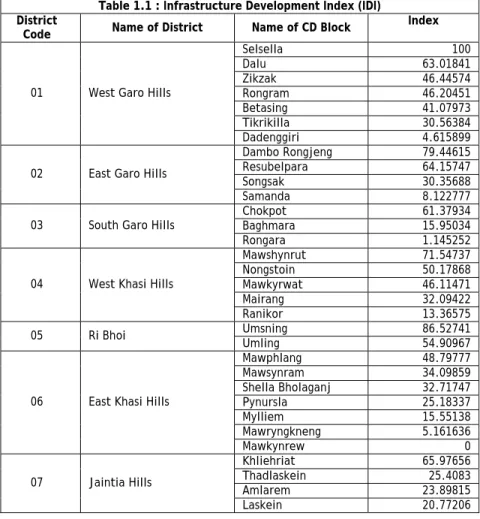
The index values also helped us in selecting the sample blocks for the study and also to see the influence of the systemic and individual level variables related to accessibility on the uptake of various government services and facilities. Table below reflects the calculated index scores of all the blocks of all seven districts of the state. Index scores are re-scaled 0 -100.
Table 1.1 : Infrastructure Development Index (IDI) District
Code Name of District Name of CD Block Index
Selsella 100 Dalu 63.01841 Zikzak 46.44574 Rongram 46.20451 Betasing 41.07973 Tikrikilla 30.56384
01 West Garo Hills
Dadenggiri 4.615899
Dambo Rongjeng 79.44615
Resubelpara 64.15747
Songsak 30.35688
02 East Garo Hills
Samanda 8.122777
Chokpot 61.37934
Baghmara 15.95034
03 South Garo Hills
Rongara 1.145252
Mawshynrut 71.54737
Nongstoin 50.17868
Mawkyrwat 46.11471
Mairang 32.09422
04 West Khasi Hills
Ranikor 13.36575 Umsning 86.52741 05 Ri Bhoi Umling 54.90967 Mawphlang 48.79777 Mawsynram 34.09859 Shella Bholaganj 32.71747 Pynursla 25.18337 Mylliem 15.55138 Mawryngkneng 5.161636
06 East Khasi Hills
Mawkynrew 0 Khliehriat 65.97656 Thadlaskein 25.4083 Amlarem 23.89815 07 Jaintia Hills Laskein 20.77206
Evaluation Study on Mid Day Meal Programme in Meghalaya Section - II Research Methodology
On the basis of IDI scores, two blocks from each of the seven districts was included in the study. Table below shows the details about all the MDM centers covered in the present evaluation study. Two blocks from each district were selected – one having high level of infrastructure and another having lower level of infrastructure. From each block five MDM centers were chosen randomly (Annexure No. I). From each of the sample MDM centers, approximately 10 percent students on roll in schools or 20 students (which ever is more) were interviewed for the study. Besides students, ten percent parents were also interrogated. Proportionate sampling method is used for the selection of sample students and parents.
Flow Chart: Sampling Procedure
Meghalaya
7 Districts
14 Blocks
2 Blocks from each District (7 x 2)
10 percent Sample Students from each Sample MDM Centers
70 MDM Centers
5 MDM centers from each Block (14x5)
10 percent Sample Parents from each Sample MDM Centers
Evaluation Study on Mid Day Meal Programme in Meghalaya Section - II Research Methodology
2. DATA COLLECTION
This study was based on intensive fieldwork approach. The data collection was carried out in two phases. In the first phase, secondary data was collected that facilitated finalization of the sample MDM centers and strengthen our idea and arguments over MDMS programme in Meghalaya. After the orientation programme of the research team in the second and final phase, primary data was collected from all stakeholders - officials in various implementing institutions, students, management committees, teachers, parents, SHGs, etc. Primary data was collected using some tools like citizen report card, case study, interview, focused group interview, observation (participant and non-participant) and some PRA techniques. Some structured questionnaires were also used at the time of data collection. During the collection of the data some important aspects like enrolment, attendance and dropouts; delivery systems; infrastructural availability; social policy and state services were also focused. Information in respect of occupation of the parents/guardians, distance of the residence from the school, socio economic profile of the beneficiaries were also obtained.
3. DATA ANALYSIS
Infrastructure Development Index was calculated for assessing the level of infrastructure of all the blocks of Meghalaya before selection of blocks in each district (Village Data, Census of India 2001). The census data for each village is available from the government of India in digital format. Accordingly, a primary requirement was to combine all the village level census data (collected by the Government of India) at the block and the district level. Given the volume of data, the aggregation task for all the villages in Meghalaya on about 21 different measures was executed using Statistical Analysis Software (SAS 9.1).
Principal Component Analysis (PCA) was used to calculate weights for accessibility index. The index values had helped us in selecting the sample blocks for the study and also to see the influence of the systemic and individual level variables related to accessibility on the uptake of the various government services and facilities.
Evaluation Study on Mid Day Meal Programme in Meghalaya Section - II Research Methodology
Further descriptive and inferential statistics used for in-depth analysis and in order to ascertain the degree of relationship of selected variables in the study. Quantitative data is analyzed using SPSS and SAS software.
4. TIMELINE
Sl. No.
Activities / tasks Months
1. Preliminary Work and Review of literature February 0.5 2. Construction of research tools, pre-testing,
pilot survey and finalization
Feb-March 1.5
3. Data Collection Feb-March 1.5
4. Data Processing & Data Analysis April-May 01 5. Drafting the report May-June 01 6. Finalization of the report July-Aug 01
Total Period 06
Scoping and School Selection:
Field visits to two nearby villages helped define the scope of the study and identify the key issues faced by primary schools and stakeholders. Seventy Lower primary and upper primary government run or aided schools were selected from all seven districts of Meghalaya. Two blocks from each district (one developed
and another not so developed) were selected in the sample on the basis of Infrastructure Development Index. Seventy mid day meal centers from 14 blocks (5 schools each block) were studied covering rural urban centers randomly.
Survey Instruments
A mix of participatory observation tools including Citizen Report Card (CRC) for assessing social accountability were used in this study. PRA techniques were used to gather information regarding execution of MDMS-flow of funds and grains while the CRC was used to generate citizen satisfaction scores on the management and delivery
PROCESS
Methodology: This evaluation study broadly
contained the following steps:
• Project scoping through discussions with stakeholder and village visits
• Developing, field testing, and finalizing survey instruments;
• Conducting the actual surveys
• Collecting secondary data
• Analyzing data
• Finalizing report following the consultations with stakeholders.
Evaluation Study on Mid Day Meal Programme in Meghalaya Section - II Research Methodology
of the MDMS in schools. School children and their parents were surveyed for this purpose. Other stakeholders like teachers, wholesalers, administrative officials were also engaged to collect relevant information. Separate questionnaires specially designed for the survey covering all aspects of the MDMS were used to gather both quantitative and qualitative data through detailed semi-structured interviews.
After the MDM centers were selected, visits to all selected schools were conducted to observe implementation of MDMS. Head of Management Committees, teachers, students, parents and suppliers were
interviewed for collection of primary data. From each of the sample MDM centers, approximately 10 percent students on-roll in schools or 20 students, whichever is more, were interviewed for the study. Apart from students, ten percent parents of the enrolled students from each MDM center were also interviewed. Proportionate
simple random sampling method is used for the selection of sample students and parents. Data collection was assigned to a team of experienced sincere and motivated researchers. Orientation was given to research team to administer the tools efficiently. Role play was held to understand the whole process of researching in field. Questions were asked in a non-suggestive manner that did not provide any lead. Wherever possible, data were triangulated by repeating the same question to different stakeholders, to minimize errors in data collection. The program executing authorities were also taken into confidence. They were explained that the exercise was being conducted to improve implementation of the MDMS and not to find mistakes or scapegoats. Government officials and community stakeholders were involved during the survey exercise to get their cooperation, suggestions, and guidance.
Finalizing Report
Recommendations that emerged from the analysis and discussions were documented and presented to the funding authority i.e. Government of Meghalaya, The state government is expected to currently deliberating over the findings from this study and is considering scaling up the exercise to improve performance in all the schools in the state.
The Citizen Report Card is a
commonly used tool for participatory impact evaluation. The CRC is a survey instrument that taps information on users’ awareness, access to, and satisfaction with publicly provided services.
It contains information about the key constraints the poor face in assessing public services, their views about the quality of services, and their experiences in interacting with public officials.
Evaluation Study on Mid Day Meal Programme in Meghalaya Section – III Main Observations
Section – III
MAIN OBSERVATIONS
Present evaluation study reflects the opinions and observations of all stakeholders including Administrative Officers, Management Committee, Students and Parents. To begin with, understanding the profile of sample end unit of observation, it would be appropriate to describe about the sample studied in this present evaluation. 1. PERCEPTION OF THE SAMPLE PROFILE OF THE PRESENT STUDY
This part of the report highlights brief sample profile of MDM Centres, students and parents were interacted during present evaluation study. Seventy MDM Centres were visited during the study from all seven districts of Meghalaya. From each district 10 MDM Centres were studied. In all a total of 1503 students selected from all MDM Centres covered from all seven districts were interacted for the assessment of MDMS. Similarly other stakeholder- 1100 parents were also interviewed for understanding their views regarding the performance of MDMS in Meghalaya.
1.1 District Wise Shift of the School
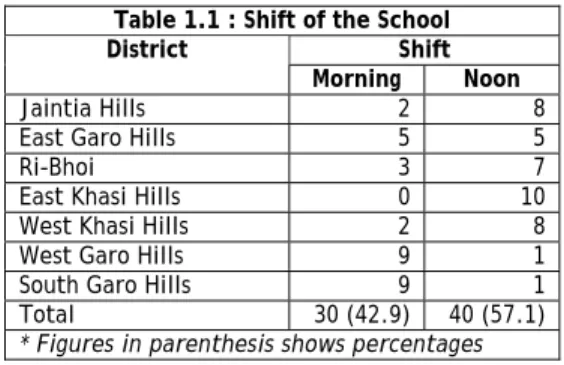
The sample of MDM Centres covered during present evaluation study constitutes 43 % schools having morning shifts, 57 % having
noon shifts and 53.1 % both the shifts (Table 1.1). The timings of morning shift were
from 6.30 A.M to 11.00 a.m. and of noon shift from 9.30 a.m. to 3.00 p.m.
Table 1.1 : Shift of the School Shift District
Morning Noon
Jaintia Hills 2 8
East Garo Hills 5 5
Ri-Bhoi 3 7
East Khasi Hills 0 10
West Khasi Hills 2 8
West Garo Hills 9 1
South Garo Hills 9 1
Total 30 (42.9) 40 (57.1)
Evaluation Study on Mid Day Meal Programme in Meghalaya Section – III Main Observations
1.2. Year of Commencement
Table 1.2 : Year of commencement District
1996 2000 2001 2002 2003 2004 2005 2006 2007 2008
Jaintia Hills 0 0 0 2 3 2 2 0 1 0
East Garo Hills 0 0 1 2 0 1 2 0 1 3
Ri-Bhoi 0 0 0 2 2 0 3 1 0 2
East Khasi Hills 1 0 0 0 1 1 4 0 0 3
West Khasi Hills 0 0 0 3 2 2 2 0 0 1 West Garo Hills 0 1 0 3 2 0 0 0 1 3 South Garo Hills 2 0 0 1 2 0 0 1 2 2 Total 3 (4.3) (1.4) 1 (1.4) 1 (18.6) 13 (17.1) 12 (8.6) 6 (18.6) 13 (2.8) 2 (7.1) 5 (20.0) 14
* Figures in parenthesis shows percentages
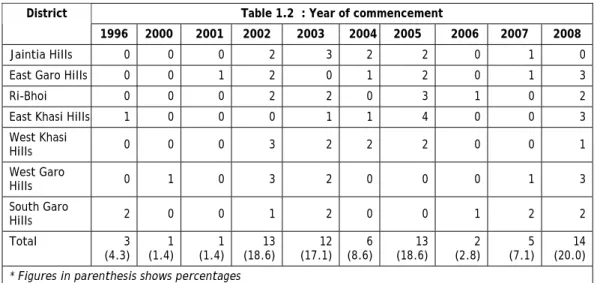
Information regarding year of commencement of MDMS confirms that majority of the Centres have started the programme in their schools from 2002 and afterwards whereas only four schools were running this programme before year 2002.
Year of Commencement 2 3 2 2 1 1 2 1 2 1 3 2 2 3 1 0 2 1 1 1 4 3 3 2 2 2 1 1 3 2 1 3 2 1 2 1 2 2 0 2 4 6 8 10 12 14 16 1996 2000 2001 2002 2003 2004 2005 2006 2007 2008 Year No . o f Cen tres
Jaintia Hills East Garo Hills Ri-Bhoi East Khasi Hills
West Khasi Hills West Garo Hills South Garo Hills
Fig 1.2 : Year of Commencement
Present study had focused on 1503 student in total to gauze their views regarding performance of the MDMS in the state of Meghalaya. Looking at the sample students
Evaluation Study on Mid Day Meal Programme in Meghalaya Section – III Main Observations
This female domination confirms the typical distinctive nature of Meghalaya society in India. More number of girl students was interacted than boy students.
1.3. Gender, Age and Study Level, Distribution of Sample Students
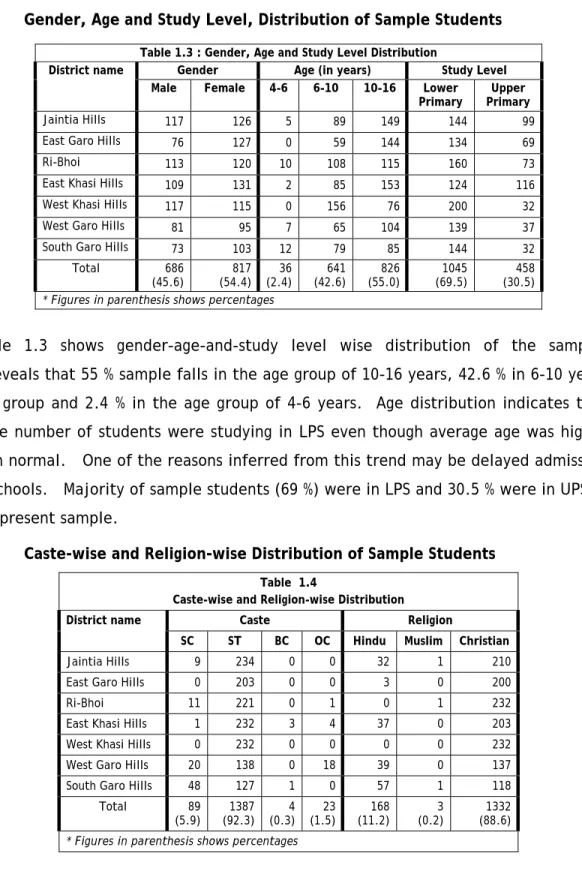
Table 1.3 shows gender-age-and-study level wise distribution of the sample. It reveals that 55 % sample falls in the age group of 10-16 years, 42.6 % in 6-10 years
age group and 2.4 % in the age group of 4-6 years. Age distribution indicates that more number of students were studying in LPS even though average age was higher than normal. One of the reasons inferred from this trend may be delayed admission in schools. Majority of sample students (69 %) were in LPS and 30.5 % were in UPS in the present sample.
1.4. Caste-wise and Religion-wise Distribut