Disjunctive Decomposition for Two-Stage Stochastic
Mixed-Binary Programs with Random Recourse
Lewis Ntaimo
Department of Industrial and Systems Engineering, Texas A&M University, 3131 TAMU, College Station, TX 77843, USA, [email protected]
Abstract
This paper introduces disjunctive decomposition for two-stage mixed 0-1 sto-chastic integer programs (SIPs) with random recourse. Disjunctive decomposition allows for cutting planes based on disjunctive programming to be generated for each scenario subproblem under a temporal decomposition setting of the SIP problem. A new class of valid inequalities for mixed 0-1 SIP with random recourse is pre-sented. In particular, valid inequalities that allow for sharing cut coefficients among scenario subproblems for SIP with random recourse but deterministic technology matrix and righthand side vector are obtained. The valid inequalities are used to derive a disjunctive decomposition method whose derivation has been motivated by real-life stochastic server location problems with random recourse, which find many applications in operations research. Computational results with large-scale instances to demonstrate the potential of the method are reported.
Keywords: Set convexification, cutting plane, random recourse, disjunctive de-composition, stochastic programming
1
Introduction
Stochastic integer programming (SIP) is a branch of stochastic programming that deals with stochastic programs in which the decision variables involve integrality requirements. By inheriting the properties of stochastic linear programs and integer programs, SIP is among the most challenging classes of optimization problems. In two-stage SIP with recourse, the first-stage decisions have to be made in the face of future uncertainty in the problem data, while the recourse decisions are determined in the second-stage based on the realization of the random outcomes. Recourse decisions allow for taking corrective action after a random event has taken place. In this paper we consider the following two-stage SIP problem:
SIP1: Min x∈X∩Bn1c
>x+E[f(˜ω, x)], (1)
where c is a known vector in <n1, X ⊆ <n1 is a convex polyhedral set, B ⊂ <n1 is
the subset of binary vectors, and ˜ω is a multi-variate discrete random variable with a realization (scenario) ω with probability of occurrence pω and sample space Ω. For any
ω ∈Ω, f(ω, x) = Min q(ω)>y(ω) s.t.W(ω)y(ω)≥r(ω)−T(ω)x y(ω)∈ Bnz × <n2−nz + . (2)
Problem (2) is referred to as the second-stage (scenario) subproblem and f(ω, x) as the recourse function. In this problem q(ω) is a vector in <n2, r(ω) is a vector in <m2, and
W(ω) and T(ω) are matrices in <m2×n2 and <m2×n1, respectively. We consider instances
of SIP1 under the following assumptions: (A1) Ω is a finite set; (A2) X is a closed set which includes the constraints 0 ≤ x ≤ 1 and is given as X = {x ∈ <n1
+ | Ax ≥ b};
(A3) subproblem (2) is dual feasible for all ω ∈Ω; and (A4) for all (ω, x) ∈X∩ B ×Ω,
f(ω, x) < ∞. Assumption (A4) requires that subproblem (2) remains feasible for all (ω, x) ∈ X∩ B ×Ω, a property referred to as relatively complete recourse in stochastic programming. The matrices T(ω) and W(ω) are referred to in the literature as the technology matrix and recourse matrix, respectively. If T(ω) = T for all ω ∈ Ω, SIP1 is said to have fixed tenders. Similarly, if W(ω) = W for all ω, the problem is said to havefixed recourse. In this paper we consider SIP1 underrandom recourse, where W(ω) is allowed to vary with ω.
Due to assumption (A1), problem (1-2) can also be formulated as a large-scale problem in extensive form (EF) as follows:
EF: Min x∈X∩Bn1 c >x+X ω∈Ω pωq(ω)>y(ω) s.t.T(ω)x +W(ω)y(ω)≥r(ω), ∀ω∈Ω y(ω)∈ Bnz × <n2−nz + , ∀ω ∈Ω. (3)
Direct mixed-integer programming (MIP) solvers such as CPLEX (ILOG, 2003) can be applied directly to problem EF. However, due to the large-scale nature of the problem coupled with the integrality requirements on the decision variables, this approach is generally hopeless. Therefore, this calls for novel decomposition methods that exploit the special structure inherent in the problem formulation. Note that when the second-stage has continuous variables only, the recourse function is a well-behaved piecewise linear and convex function of the first-stage variables. Benders’ decomposition (Benders, 1962) is applicable in this case. However, when integrality requirements are imposed on second-stage variables, the problem becomes computationally challenging. The recourse function is now lower semicontinuous with respect to the first-variables (Blair and Jeroslow, 1982), and is generally nonconvex (Schultz, 1993).
This paper introduces disjunctive decomposition for mixed 0-1 SIP with random recourse. In particular, valid inequalities based on disjunctive programming are derived for SIP1. These cuts are used in a cutting plane method, which allows for scenario subproblems to share some cut coefficients when SIP1 has random recourse but deter-ministic technology matrix and righthand side vector. This work has been motivated by need for algorithms for this class of problems. The remainder of this paper is organized as follows. The next section reviews closely related work. In Section 3 theoretical results for set convexification for two-stage SIP withrandom recourse are derived using results from disjunctive programming. The theoretical results are applied to a cutting plane setting for SIP1 in Section 4 and extended to the special case of deterministic technology matrix and righthand side vector in Section 5. A disjunctive decomposition algorithm for SIP1 is presented in Section 6. Computational results on the application of the algorithm to
several SSLPR instances are reported in Section 7. The paper ends with some concluding remarks in Section 8.
2
Related Work
To date very few optimum-seeking algorithms have been developed for SIP, and many of these algorithms assume thefixed recourse property. The reader is referred to surveys on algorithms for SIP (Schultz et al., 1996, Klein Haneveld and van der Vlerk, 1999, Sen, 2003) and to textbooks on stochastic programming (Birge and Louveaux, 1997, Ruszczyn-ski and Shapiro, 2003). However, certain applications such as capacity acquisition and assignment under uncertainty (Ahmed and Garcia, 2003, e.g), require random recourse. The branch-and-bound algorithm of Ahmed et al. (2004) and the cutting-plane based algorithm of (Carøe and Tind, 1997, Carøe, 1998) allow for SIP problems with random recourse. The algorithm derived by Ahmed et al. (2004) requires general first-stage and pure integer second-stage variables. This method uses a transformed space in which tender variables (χ = T x) are used to partition the problem using a hyperrectangular partitioning process. The method by Carøe and Tind (1997) and Carøe (1998) uses disjunctive programming to derive cutting-planes under the EF (problem 3) setting and requires continuous first-stage and mixed-binary second-stage decision variables. An extension of the method for SIP with pure binary first-stage and mixed-binary second-stage decision variables is also proposed.
Disjunctive decomposition (D2) (Sen et al., 2002, Sen and Higle, 2005) takes
advan-tage of the ideas from disjunctive programming (Balas, 1975, Blair and Jeroslow, 1978, Sherali and Shetty, 1980) and reverse convex programming (Sen and Sherali, 1987) to provide a rather general setting for the study of the convex hull of feasible points of SIP problems under the two-stage setting. Sen and Higle (2005) develop a cutting-plane-based approximation of the feasible set of the second-stage problem (2) under the fixed
recourse property. TheD2 approach provides a mechanism for transforming cuts derived
for one instance of the second-stage problem into cuts that are valid for other scenario instances. Implementation and computational experience with theD2 method on solving
large-scale instances from the literature is reported in a dissertation by Ntaimo (2004) and in Ntaimo and Sen (2005).
One motivating application for this work is the stochastic server location problem with random recourse (SSLPR), which has many real-life applications in operations research. SSLPR deals with the optimal location of a limited number of ‘servers’ with limited capacity of some resource under uncertainty regarding potential future ‘client’ resource
demand and availability after the servers are located. Constraints include budgetary requirements on the total server location costs and the requirement that each client be served by servers from specific locations. A world-wide problem that has raised a lot of attention in recent years is wildfires. Fighting wildfires is very challenging and costs about a billion dollars annually in the US alone (NIFC, 2006), not to mention the huge costs associated with the destruction of homes and vegetation. The problem of firefighting resource (e.g. dozers, fire engines, airtankers, crews) management for wildfire
initial attack (Donovan and Rideout, 2003, e.g.) leads to SSLPR (Lee, 2006). In this particular SSLPR decisions regarding firefighting resource deployment to bases (‘server’ locations) are made in the first stage while decisions regarding the dispatch of resources to wildfires (‘clients’) are made in the second stage. Uncertainty stems from stochastic wildfire occurrence and dynamic fire behavior, which depend on landscape, fuels and weather conditions. The random recourse property in these models is due to the fact that recourse decisions regarding firefighting resource dispatch from bases to wildfires in the second stage, must adapt to scenarios (fire location and fire behavior). Thus instances of these models are generally difficult to solve and require decomposition methods for mixed 0-1 SIP with random recourse.
Closely related to SSLPR is the SSLP with fixed recourse studied by Ntaimo and Sen (2005). The SSLP was motivated by the implementation of networks consisting of high speed optical fiber cables, and high speed optical switches which are very capital intensive. Telecommunications service providers are usually unsure of customer demand and under these circumstances network design models lead to SSLPs. In the SSLP, future client demand levels are assumed to be known and only client availability is unknown and is modeled as a Bernoulli random variable. However, in reality clients may not know there future demand with certainty. So this leads to SSLPR, which is amenable to the solution method introduced in this paper. Other applications of SSLPs include the facility location problem for immobile servers with continuous stochastic demands (Wang et al., 2003), and server location under uncertain demand for the deployment of mobile switching centers in telecommunication networks (Riis et al., 2004). Wang et al. (2003) present several models and provide heuristics for their solutions, while (Riis et al., 2004) uses the stochastic programming approach and apply a dual decomposition procedure to solve scenario subproblems by means of branch-and-cut.
3
Set Convexification for SIP with Random Recourse
To set the ground for the ideas developed in this paper, first some key results from disjunctive programming are restated. Consider disjunctive sets of the form
S =∪h∈HSh (4)
where H is a finite index set, and the setsSh are polyhedral sets represented as
Sh ={y|Ghy≥rh, y ≥0}. (5) Then a convex relaxation of a non-convex set can be stated through a collection of valid inequalities defined as follows:
DEFINITION 3.1. An inequality π>y ≥π
0 is said to be a valid inequality for the set
S if S ⊆ {y|π>y≥π
0}.
A crucial theoretical result in disjunctive programming is the disjunctive cut principle. By lettingGhj denote thejthcolumn vector of the matrixGh, the disjunctive cut principle can be stated as follows:
THEOREM 3.2. Let S and Sh be defined as in (4) and (5), respectively. If λh ≥0 for all h∈H, then X j {Max h∈H λ > hGhj}yj ≥Min h∈H λ > hrh (6)
is a valid inequality for S. Conversely, suppose that π>y≥ π
0 is a valid inequality, and
H∗ ={h∈H | S
h 6=∅}. There exists nonnegative multipliers {λh}h∈H∗ such that
πj ≥ Max h∈H∗ λ > hGhj, and π0 ≤ Min h∈H∗ λ > hrh. (7)
The forward part of this theorem is due to Balas (1975) while the reverse part is due to Blair and Jeroslow (1978). A variety of relaxations of a mixed-integer program can be obtained by using the above characterization of valid inequalities for the disjunctive set
S.
Let us now begin with an approximation of the convex hull of feasible integer points for problem (2). Note that the constraints in (2) vary with the first-stage decisionx and the scenario ω. Let H be a finite index set and let the sets {Sh(ω, x)}h∈H be polyhedral sets represented as
Sh(ω, x) = {y(ω)∈ <n+2 |Wh(ω)y(ω)≥rh(ω, x)},
where rh(ω) includes r(w)−T(w)x. The disjunctive representation of the set depends on (ω, x)∈X×Ω, and can be expressed as
S(ω, x) = ∪h∈HSh(ω, x). (8) A convex relaxation of the non-convex set (8) can be represented by a collection of valid inequalities of the form π>(ω)y(ω) ≥ π
0(ω, x). Using Theorem 3.2, we obtain the
following result for SIP1.
THEOREM 3.3. Consider SIP1 as stated in (1). Let Y(ω, x) = {y(ω)| W(ω)y(ω)≥
r(ω)−T(ω)x, y(ω)∈ {0,1}nz×<n2−nz
+ }for(ω, x)∈X×Ω. Suppose that{Ch(ω), dh(ω)}h∈H,
is a finite collection of appropriately dimensioned matrices and vectors such that for all
(ω, x) ∈ X × Ω, Y(ω, x) ⊆ ∪h∈H{y(ω) ∈ <n+2 | Ch(ω)y(ω) ≥ dh(ω)}. Let Sh(ω, x) =
{y(ω) ∈ <n2
+ | W(ω)y(ω) ≥ r(ω)−T(ω)x, Ch(ω)y(ω) ≥ dh(ω)} 6= ∅, and let S(ω, x) =
∪h∈HSh(ω, x). Then there exists π(ω) ∈ <n2 and π0 : X × Ω → < such that for all
(ω, x)∈X×Ω, π(ω)>y(ω)≥π
0(ω, x) is a valid inequality for S(ω, x).
Proof. Let Ghj(ω) denote the vector obtained by concatenating Wj(ω) with Chj(ω), and let r>
h(ω, x) denote the vector obtained by concatenating [r(ω) − T(ω)x]> with
dh(ω)>. SinceSh(ω, x) is non-empty for all h∈H, Theorem 3.2 ensures the existence of nonnegative vectors {λh(ω)}h∈H such that
πj(ω)≥Max h∈H λh(ω) >G hj(ω); π0(ω, x)≤Min h∈H λh(ω) >r h(ω, x).
Since y(ω)≥0, for all (ω, x)∈X×Ω we have π(ω)>y(ω)≥X j Max h∈H λh(ω) >G hj(ω)yj(ω) and thus π(ω)>y(ω)≥λ h(ω)>Gh(ω)y(ω) ≥λh(ω)>rh(ω, x) ∀h∈H ⇒π(ω)>y(ω)≥Min h∈H λh(ω) >r h(ω, x) Therefore, it follows that π(ω)>y(ω)≥π
0(ω, x)
Since both π(ω) and π0(ω, x) depend on ω, the advantage of Theorem 3.3 is to allow
for the generation of valid inequalities for each (ω, x) differently. This allows for cutting off noninteger solutions for all scenarios simultaneously. However, since Ω can be large in general, generating these valid inequalities for all ω ∈ Ω can be a daunting task in terms of both computation and computer memory for storing the cuts. Thus the use of parallel/distributed computing platforms as well as a further exploitation of the problem structure can be considered. Due to the increase in computational power and the emerging distributed middleware platforms (Linderoth and Wright, 2003, e.g.), Theorem 3.3 can be used with potential savings in computation time.
REMARK 3.4. It should be pointed out that Theorem 3.3 is a more general form of the common-cut-coefficients (C3) theorem (Sen and Higle, 2005) for SIP with fixed recourse. Unlike here where we generate valid inequalities in they(ω)-space, Carøe and Tind (1997) and Carøe (1998) derive a similar theorem but for generating cuts in the (x, y(ω))-space based on the extensive formulation (3). Thus the method developed in this paper is different from that of Carøe and Tind (1997) and Carøe (1998).
COROLLARY 3.5. Let H,{Sh(ω, x)}h∈H and S(ω, x) be defined as in Theorem 3.3.
Suppose π(ω)>y(ω) ≥ π
0(ω, x) is a valid inequality for S(ω, x). Then for h ∈ H there
exists vectors (¯νh(ω),γ¯h(ω))∈ <n1+1 such that
π0(ω, x)≤Min
h∈H {ν¯h(ω)−γ¯h(ω)
>x}.
Proof. Sinceπ(ω)>y(ω)≥π
0(ω, x) is a valid inequality forS(ω, x), Theorem 3.2 ensures
that there existsλh(ω)≥0, h∈H such that
π0(ω, x)≤Min
h∈H λh(ω)
>r
h(ω, x),
where rh(ω, x) is obtained by concatenating [r(ω)−T(ω)x] with dh(ω). Hence
λh(ω)>rh(ω, x) = ¯νh(ω)−γ¯h(ω)>x, where
¯
νh(ω) =λh(ω)>[r(ω);dh(ω)] and ¯γh(ω) =λh(ω)>[T(ω); 0] and the result follows.
It should be observed that the function π0(ω, .) is a piecewise linear concave function
onX. Hence, lower bound approximations from the subproblems would be non-convex in general. This requires the convexification ofπ0(ω, x) for eachω∈Ω (Sen and Higle, 2005)
using a strategy from reverse convex programming in which disjunctive programming is used to provide facets of the convex hull of reverse convex sets (Sen and Sherali, 1987).
4
Cutting Plane Generation Setting
Let us now consider the cutting plane generation setting for the scenario subproblems in a stage-wise (temporal) decomposition of SIP1. Let xk denote the first-stage solution at some iteration k of the algorithm. For k = 1 the problem is initialized with W1(ω) =
W(ω), r1(ω) =r(ω), andT1(ω) = T(ω). Thus the subproblem LP relaxations are of the
form f1 c(ω, x) = Min q(ω)>y(ω) s.t. W(ω)y(ω)≥r(ω)−T(ω)x y(ω)∈ <n2 +. By letting ρk
c(ω, xk) = rk(ω)− Tk(ω)xk in iteration k, the scenario subproblem LP relaxations take the following form:
fck(ω, xk) = Min q(ω)>y(ω) s.t. Wk(ω)y(ω)≥ρk c(ω, xk) y(ω)∈ <n2 +. (9) Then the cutting planes of the πk(ω)>y(ω)≥ π
c(ω, xk) are added to the subproblem at iterationkif the solutionyk(ω) yields a noninteger solution. Otherwise, no cut is added to the subproblem. The sequential addition of the cutting planes refines the approximation of the convex hull of integer solutions. Therefore, for each ω ∈ Ω the vector πk(ω) is appended to the matrixWk−1(ω), and the cut coefficients identified by (νh(ω), γh(ω)) are
appended to ¡rk−1(ω), Tk−1(ω)¢.
Let yk(ω) ∈ argmin{q(ω)>y | Wk(ω)y(ω) ≥ ρk
c(ω, xk), y(ω) ∈ <n+2} for ω ∈ Ω.
Also, let ¯yk
j(ω), j = 1, ..., nz, denote the optimal values assigned to integer variables in yk. If ¯yk
j(ω), j = 1, ..., nz, are integer for all ω, then no update is necessary, and
Wk+1(ω) = Wk(ω), rk+1(ω) = rk(ω), and Tk+1(ω) =Tk(ω). Otherwise, the subproblem LP relaxations yield non-integer optimal solutions. Let j(k, ω) denote an index j, for which ¯yk
j(ω) is non-integer for some ω ∈ Ω. To eliminate this non-integer solution, a disjunction of the following form is used:
Sk(ω, xk) =S0,j(k,ω)(xk, ω)∪ S1,j(k,ω)(ω, xk) where S0,j(k,ω)(ω, xk) = © y∈ <n2 + |Wk(ω)y(ω)≥rk(ω)−Tk(ω)xk (10a) −yj(k,ω)(ω)≥ −by¯j(k,ω)c ª (10b)
and
S1,j(k,ω)(ω, xk) ={y∈ <n+2 |Wk(ω)y(ω)≥rk(ω)−Tk(ω)xk (11a)
yj(k,ω)(ω)≥ dy¯j(k,ω)e}. (11b)
The variableyj(k,ω)(ω) is referred to as thedisjunction variable for iterationkand scenario
ω. Note that since the integer restrictions are binary, the righthand side of (10b) is 0, and that of (11b) is 1.
Letλ0,1(ω) denote the vector of multipliers associated with (10a), andλ0,2(ω) denote
the scalar multiplier associated with (10b). Let λ1,1(ω) and λ1,2(ω) be similarly defined
for (11a) and (11b), respectively. Also, define
Ik j(ω) =
½
1, if j =j(k, ω) 0, otherwise.
Then the following LP can be used to generate the cut coefficients πk(ω) for ω ∈ Ω in iteration k: Max π0(ω)−y¯k(ω)>π(ω) s.t. πj(ω)−λ0,1(ω)>Wjk(ω) +Ijk(ω)λ0,2(ω)≥0, ∀j πj(ω)−λ1,1(ω)>Wjk(ω)−Ijk(ω)λ1,2(ω)≥0, ∀j −π0(ω) +λ0,1(ω)>ρkc(ω, xk)−λ0,2(ω)by¯j(k)c ≥0 −π0(ω) +λ>1,1(ω)ρkc(ω, xk) +λ1,2(ω)dy¯j(k)e ≥0 −1≤πj(ω)≤1, ∀j −1≤π0(ω)≤1 λ0,1(ω), λ0,2(ω), λ1,1(ω), λ1,2(ω)≥0. (12)
The validity of the cut coefficientsπ(ω) generated by problem (12) follows from Theorem 3.2. Theorem 3.3 allows us to independently generate cut coefficients for each scenario
ω ∈ Ω. On the contrary, under the fixed recourse property the C3 Theorem (Sen and
Higle, 2005) allows for the formulation of a simple recourse stochastic version of problem 12, which is solved only once per iteration to generate the cut coefficients for all ω∈Ω. Since the disjunction used for cut formation has H ={0,1}, the epigraph ofπ0(ω, x)
is a union of two polyhedral sets. Therefore, the convex hull approximation πc(ω, .) of
π0(ω, .) can be represented as
πc(ω, x) = Max
i∈I {νi(ω)−γi(ω)
>x}, (ω, x)∈X×Ω,
of the convex hull of the epigraph of π0(ω, .), denoted PXk(ω) and defined as follows: PXk(ω) =©σ0(ω)∈ <, σ(ω)∈ <n1, δ(ω)∈ < | ∀h∈H, ∃ τh ∈ <m1, τ0h ∈ < σ0(ω)≥τ0h ∀h∈H X h∈H τ0h = 1 σj(ω)≥τh>Aj +τ0h¯γhjk (ω) ∀h∈H, j = 1, ..., n1 δ(ω)≤τ> h b+τ0hν¯hk(ω) ∀h ∈H τh ≥0, τ0h ≥0, ∀h ∈H ª . To obtainπk
c(ω, x), the following parameters are derived from an optimal solution of (12) to update Pk X(ω): ¯ νk 0(ω) = λ>0,1rk(ω)−λ0,2by¯j(k,ω)(ω)c, ¯ ν1k(ω) =λ>1,1rk(ω) +λ1,2dy¯j(k,ω)(ω)e, and [¯γhk(ω)]> =λh,>1Tk(ω), ∀h∈H. Then to approximate πk
0(ω, x) the following LP is solved:
Max δ(ω)−σ0(ω)−(xk)>σ(ω)
s.t. (σ0(ω), σ(ω), δ(ω))∈ PXk(ω).
(13) Since π0(ω, x) is scenario dependent, the convexification is done for each ω ∈ Ω.
With an optimal solution to (13), (σk
0(ω), σk(ω), δk(ω)), we obtain νk(ω) = δ k(ω) σk 0(ω) and γk(ω) = σk(ω) σk
0(ω). These coefficients define π
k
c(ω, x) = νk(ω)−(γk(ω))>x and are used to update the vector rk+1(ω) = [rk(ω), νk(ω)], and matrix Tk+1(ω) = [(Tk(ω))>;γk(ω)]>.
Similarly, the solution πk(ω) to (12) for each ω ∈ Ω is used to update the constraint matrix, Wk+1(ω) = [(Wk(ω))>;πk(ω)]>.
5
SIP with Deterministic Technology Matrix and
Righthand Side Vector
Based on the application at hand, SIP1 may have some special structure that can be exploited. For our interest, we consider SIP1 with deterministic technology matrix
T(ω) = T and righthand side vectorr(ω) =r, for all ω∈Ω, and derive valid inequalities that take advantage of this property. Under this setting, problem (1) becomes:
SIP2: Min x∈X∩Bn1c
where for any ω∈Ω, f(ω, x) = Min q(ω)>y, s.t.W(ω)y(ω)≥r−T x y(ω)∈ Bnz × <n2−nz + . (15) The subproblem LP relaxations take the form
fc(ω, x) = Min q(ω)>y(ω)
s.t. W(ω)y(ω)≥ρc(ω, x)
y(ω)∈ <n2
+,
(16) where ρc(ω, x) = r−T x. Note that ρc(ω, x) is now independent ofω for all ω∈Ω.
As developed in the previous section, we would like to generate and add cutting planes of the formπ(ω)>y≥π
c(ω, x) if the subproblem LP solution ¯y(ω) is noninteger. Let j(ω) denote an index for which ¯yj(ω)(ω) is noninteger for some ω∈Ω, and define
Ij =
½
1, if j =j(ω) 0, otherwise.
To eliminate ¯yj(ω)(ω), a disjunction of the following form is used:
S(ω, x) =S0,j(ω)(x, ω)∪ S1,j(ω)(ω, x) where S0,j(ω)(ω, x) = © y(ω)∈ <n2 + |W(ω)y(ω)≥r−T x (17a) −yj(ω)(ω)≥ −by¯j(ω)(ω)c ª (17b) and S1,j(ω)(ω, x){y(ω)∈ <+n2 |W(ω)y(ω)≥r−T x (18a) yj(ω)(ω)≥ dy¯j(ω)(ω)e}. (18b)
Let $ ∈ Ω be a scenario on which the disjunction is based. Such a scenario will be referred to as the disjunction scenario. Then using (17) and (18) we get the following LP for generating coefficients π($) for$:
Max π0($)−y¯($)>π($) s.t. πj($)−λ0,1($)>Wj($) +Ijλ0,2($)≥0, ∀j πj($)−λ1,1($)>Wj($)−Ijλ1,2($)≥0, ∀j −π0($) +λ0,1($)>ρc($, x)−λ0,2($)by¯j($)c ≥0 −π0($) +λ1,1($)>ρc($, x) +λ1,2($)dy¯j($)e ≥0 −1≤πj($)≤1, ∀j −1≤π0($)≤1 λ0,1($), λ0,2($), λ1,1($), λ1,2($)≥0. (19)
Using the solution to (19) we obtainπ0($, x) via Corollary 3.5 to get the valid inequality
π($)>y($)≥π
THEOREM 5.1. Consider problem SIP2 stated in (14) with random recourse ma-trix W(ω) but deterministic T(ω) = T and r(ω) = r, for all ω ∈ Ω. Suppose that
π($)>y($) ≥ π
0($, x) is a valid inequality for S($, x) 6=∅ for $ ∈ Ω generated using
(π($), π0($)) from an optimal solution to problem (19). If for ω ∈ Ω, ω 6= $, the
problem Min y¯(ω)>π(ω) s.t. πj(ω)−λ0,1(ω)>Wj(ω) +Ijλ0,2(ω)≥0, ∀j πj(ω)−λ1,1(ω)>Wj(ω)−Ijλ1,2(ω)≥0, ∀j λ0,1(ω)>ρc(ω, x)−λ0,2(ω)by¯j(ω)c ≥π0($) λ1,1(ω)>ρc(ω, x) +λ1,2(ω)dy¯j(ω)e ≥π0($) −1≤πj(ω)≤1, ∀j λ0,1(ω), λ0,2(ω), λ1,1(ω), λ1,2(ω)≥0. (20) is feasible, thenπ(ω)>y(ω)≥π 0($, x)is valid forS(ω, x)6=∅. If π0($, x)−π(ω)>y(ω)> 0, then π(ω)>y(ω)≥π
0($, x) cuts off the point y¯(ω).
Proof. Since ρc(ω, x) = ρc($, x) forω ∈Ω,π0(ω) should satisfy
−π0(ω) +λ0,1(ω)>ρc(ω, x)−λ0,2(ω)by¯jc ≥0
−π0(ω) +λ1,1(ω)>ρc(ω, x) +λ1,2(ω)dy¯je ≥0
−1≤π0(ω)≤1
λ0,1(ω), λ0,2(ω), λ1,1(ω), λ1,2(ω)≥0
for allω ∈Ω. Therefore, if forω ∈Ω, ω 6=$ we fixπ0(ω) in (19) with the corresponding
value obtained for $, and can find coefficients π(ω) and multipliers (λ0,1(ω), λ0,2(ω),
λ1,1(ω),λ1,2(ω)) satisfying
πj(ω)−λ0,1(ω)>Wj(ω) +Ij(ω)λ0,2(ω)≥0, ∀j
πj(ω)−λ1,1(ω)>Wj(ω)−Ij(ω)λ1,2(ω)≥0, ∀j
−1≤πj(ω)≤1, ∀j
then the result follows.
Theorem 5.1 ensures that with both a translation and rotation, valid inequalities derived for one pair ($, x) may be used to derive valid inequalities for another pair (ω, x). Note that since π0($, x) is fixed for all ω ∈ Ω, ω 6=$ for which π(ω)>y(ω) ≥π0($, x)
is a valid inequality, the convexification πc($, x) of π0($, x) is obtained only once and
used for the other scenarios. This sharply differs from the convexification under SIP1, where the convexification is done for each scenario ω ∈Ω.
Observe that Theorem 5.1 allows for each scenario to determine its own multipliers (λ0,1(ω), λ0,2(ω), λ1,1(ω), λ1,2(ω)) while fixing π0(ω) to π0($). By imposing further
THEOREM 5.2. Consider problem SIP2 as stated in (14) with random recourse matrix
W(ω) but T(ω) = T, and r(ω) = r for all ω ∈ Ω. Suppose that π($)>y($) ≥π
0($, x)
is a valid inequality for S($, x)6= ∅ for $ ∈ Ω generated using (π($), π0($), λ0,1($),
λ0,2($), λ1,1($), λ1,2($)), the solution to problem (12). If for ω ∈ Ω, ω 6= $, the
problem Min y¯(ω)>π(ω) s.t. πj(ω)≥λ0,1($)>Wj(ω)−Ijλ0,2($), ∀j πj(ω)≥λ1,1($)>Wj(ω) +Ijλ1,2($), ∀j −1≤πj(ω)≤1, ∀j (23) is feasible, thenπ(ω)>y(ω)≥π 0($, x)is valid forS(ω, x)6=∅. If π0($, x)−π(ω)>y(ω)> 0, then π(ω)>y(ω0)≥π
0($, x) cuts off the point y¯(ω).
Proof. Since ρc(ω, x) = ρc($, x) for all ω∈Ω, π0(ω) should satisfy
−π0(ω) +λ0,1(ω)>ρc(ω, x)−λ0,2(ω)by¯jc ≥0
−π0($) +λ1,1(ω)>ρc(ω, x) +λ1,2(ω)dy¯je ≥0
−1≤π0(ω)≤1
for allω ∈Ω. Therefore, if forω ∈Ω, ω6=$we fix (π0(ω), λ0,1(ω), λ0,2(ω), λ1,1(ω), λ1,2(ω))
in (12) with the corresponding values obtained for $, and can find coefficients π(ω) satisfying
πj(ω)−λ0,1($)>Wj(ω) +Ijλ0,2($)≥0, ∀j
πj(ω)−λ1,1($)>Wj(ω)−Ijλ1,2($)≥0, ∀j
−1≤πj(ω)≤1, ∀j
then the result follows.
Even though Theorems 5.1 and 5.2 do not provide a guarantee on the quality of the cuts, they allow for generating cuts using smaller cut generation LPs than in the case of SIP1. Furthermore, since the convexification πc($, x) of π0($, x) has to be carried
out only once for the scenarios sharing π0($, x), this reduces the effort and computer
memory for computing and storing the data associated with πc($, x). In the case of SIP1, however, the convexification has to be carried out separately for each ω ∈Ω.
In the algorithmic context for Theorems 5.1 and 5.2, in iteration k = 1 the problem is initialized with W1(ω) =W(ω), r1 =r, and T1 =T, and ρ1
c(ω, x1) =r−T x1, for all
ω ∈Ω. By lettingρk
c(ω, xk) = rk(ω)−Tk(ω)xk in iterationk > 1, we allow forTkand rk to depend on ω. However, as a consequence of Theorems 5.1 and 5.2, when generating a cut for some ω ∈ Ω based on another scenario $ ∈ Ω, $ 6= ω, it is necessary that
ρk
c(ω, xk) = ρkc($, xk). Also, in Theorems 5.1 and 5.2 the disjunction variable index in iteration k, j(k), is determined by the disjunction scenario. Thus we lose the flexibility of having each scenario determine its own disjunction variable as in Theorem 3.3. Next we give a disjunctive decomposition algorithm for SIP1 and SIP2.
6
A Disjunctive Decomposition Algorithm
We first consider a disjunctive decomposition algorithm for SIP1 based on Theorem 3.3 and then provide a modification for SIP2 based on Theorems 5.1 and 5.2. At the k-th iteration of the algorithm we consider the following LP relaxation of the original problem:
Min x∈X∩Bn1c >x+E[fk c(˜ω, x)], (26) where for ω∈Ω, fck(ω, x) = Min q(ω)>y(ω), s.t.Wk(ω)y(ω)≥ρk c(ω, x) y(ω)∈ <n2 +. (27) Adopting a Benders’ decomposition (Benders, 1962) setting, let the master program be defined as follows:
Min x∈X∩Bn1c
>x+Fk(x)
(28) where Fk(·) is a piecewise linear approximation ofE[f(˜ω, x)] in the k-th iteration. Note that Fk(x) is convex while E[f(˜ω, x)] is not. Then an algorithm for SIP with random recourse can be stated as follows:
D2-R Algorithm:
Step 0. Initialization.
Set k ← 1, V1 ← ∞, v1 ← −∞, ² > 0, W1(ω) ← W(ω), T1(ω) ← T(ω), and
r1(ω) = r(ω), for allω ∈Ω.
Step 1. Solve LP Relaxation.
Solve LP relaxation (26) (e.g. use the L-shaped method (Van Slyke and Wets, 1969)) to get x1 ∈ X ∩ B. Set v
1 to the optimal value of (26). If {yk(ω)}ω∈Ω satisfy the
integer restrictions, Vk+1 ← Min{c>xk +E[f(xk,ω˜)], Vk}, set incumbent solution
x∗
² ←x1 and go to Step 5. Otherwise, go to Step 3. Step 2. Solve Subproblem LPs.
For each ω ∈ Ω, use the matrix Wk(ω) and righthand side vector rk(ω)−Tk(ω)xk to solve (27). If {yk(ω)}
ω∈Ω satisfy the integer restrictions, Vk+1 ← Min{c>xk+
E[f(xk,ω˜)], V
k}. Set incumbent solution x∗² ←xk if Vk+1 is updated and go to Step
5.
Step 3. Solve Scenario Cut Generation LPs and Perform Updates.
(a)Choose a disjunction variablej(k, ω) for eachω ∈Ω such that ¯y(ω) is noninteger. Formulate and solve (12) to obtain πk(ω). Define Wk+1(ω) = [(Wk(ω))>;πk(ω)]>.
(b) Use the multipliers (λk
0,1(ω), λk0,2(ω), λk1,1(ω), λk1,2(ω)) and the value ¯yj(k)(ω)
ob-tained in (a) to form and solve (13) for each outcome ω ∈ Ω. The solution defines νk(ω) and γk(ω) which are used to update rk+1(ω) = [rk(ω), νk(ω)] and
Step 4. Update and Solve Subproblem LPs.
For eachω ∈Ω solve (27) usingWk+1(ω) andrk+1(ω)−Tk+1(ω)xk. Ifyk(ω) satisfies the integer restrictions for all ω ∈ Ω, Vk+1 ← Min{c>xk+E[f(ω, xk)], Vk} and set incumbent solution x∗
² ←xk if Vk is updated. Otherwise, Vk+1 ←Vk. Step 5. Update and Solve the Master Problem.
Update the approximationFkvia Benders’ decomposition using the dual multipliers from the most recently solved subproblem for eachω ∈Ω. Letxk+1 ∈argmin{c>x+
Fk+1(x)|x ∈X}, and let v
k+1 denote the optimal value of the master problem. If
Vk+1−vk+1 ≤ ², stop and declare x∗² ²-optimal. Otherwise, k ← k+ 1 and repeat from Step 2.
Selection of the disjunction variable in Step 3(a) for a given ω∈Ω can be done using a heuristic. For example, one can always select the first fractional component of ¯yk(ω), or the largest fractional component. Also note that we avoid computing the upper bound
Vk since it requires the solution of all scenario subproblem MIPs. However, it may be necessary to compute Vk in Step 2 at some iteration k when the first stage solution xk stabilizes (stops changing). At this point, one can also generate the optimality cut for binary first stage SIP proposed by Laporte and Louveaux (1993) to add to the master program. Now turning to SIP2 (deterministic matrix T and vector r), we can modify Step 0 and Step 3 of the D2-R algorithm by applying Theorems 5.1 and 5.2 as follows:
Modification of Step 0 and Step 3 for SIP2: Step 0. Initialization.
Set k ←1,V1 ← ∞, v1 ← −∞, ² >0, W1(ω)←W(ω),T1(ω)←T, andr1(ω) = r,
for all ω∈Ω.
Step 3. Solve Scenario Cut Generation LPs and Perform Updates.
(a) Choose a disjunction scenario$∈Ω and disjunction indexj(k). Formulate and solve (19) to obtain πk($) and πk
0($). Define Wk+1($) = [(Wk($))>;πk($)]>.
(b) Use the multipliers (λk
0,1($), λk0,2($), λk1,1($), λk1,2($)) and the value ¯yj(k)($)
obtained in Step 3(a) to form and solve (13). The solution defines νk($) and γk($) which are used to updaterk+1($) = [rk($),νk($)] andTk+1($) = [(Tk($))>;γk($)]>. (c) For each ω ∈ Ω\$ such that ¯yj(k)(ω) is noninteger and ρkc(ω, xk) =ρkc($, xk), use the solution obtained in Step 3(a) to form and solve (20) (or (23)) to obtain
πk(ω). Define Wk+1(ω) = [(Wk(ω))>;πk(ω)]> and use νk($) and γk($) obtained in Step 3(b) to define rk+1(ω) = [rk(ω),νk($)] andTk+1(ω) = [(Tk(ω))>;γk($)]>.
If an initial solution x1 is known at initialization, Step 1 of the D2-R algorithms can
be skipped and one can simply go to Step 2 of the algorithm and avoid solving the LP relaxation (26). In the modified Step 3 one can generate a cut for a given scenario if
ρk
c(ω, xk) = ρkc($, xk) using Theorem 3.3 as in the original step. A heuristic can be employed to determine the disjunction scenario $ and the disjunction variable index
j(k) in Step 3. For example,$ can be chosen as the scenario with the largest number of fractional components in ¯y, whilej(k) can be chosen as the index with the largest number of fractional components among all the scenarios. A variety of implementation options can be considered to improve the computation time of the algorithm. For example, the implementer can use different procedures for initiating and terminating the generation of cuts. Different normalizations for the cut generation LPs (12), (19),(20) and (23) can also be considered. One can also incorporate rounding and lifting to strengthen the cuts as described in (Balas et al., 1993) and (Balas et al., 1996).
A few comments on the theoretical (finite) convergence of the algorithm are now in order. Balas (1979) has shown that one can recover the closure of the convex hull (clconv) for sets with the facial property. For example, a mixed 0-1 integer program is a facial disjunctive program. In our case we are dealing with the mixed 0-1 sets clconv(S(ω, x)) for all ω ∈ Ω. Recovering clconv(S(ω, x)) (if necessary) can be achieved by generating a sequence of convex hulls recursively for each disjunction variable j = 1, ..., nz. Thus finite convergence of the algorithm can be obtained under assumptions (A1-A4) if the algorithm identifies extreme point solutions of problem (12) (or problems (20) and (23)) and further conditions on xk described in the next paragraph are satisfied.
Note that since Ω is finite, there are finitely many inequalities in (12), (20) and (23). Also, xk ∈ X ∩ B are finite, leading to finitely many polyhedra of the form in (12), (20) and (23) from which cut coefficients are drawn. These cut coefficients are by assumption extreme points of the polyhedra. Consequently, after finitely many iterations, all necessary extreme points, and thus all necessary cuts, will have been generated for each disjunction variable. Hence in finitely many iterations all valid inequalities for any scenario subproblem IP can be generated as a result of the facial property of the scenario subproblem. It should also be pointed out that since for any xk ∈ vert(X) or xk ∈ Bn1,
πc(ω, xk) = π0(ω, xk), after a finite number of iterations fck(ω, xk) = f(ω, xk) for all
ω ∈ Ω. From a practical point of view, however, finiteness of the algorithm should be viewed as a desirable property and not a measure of how the algorithm will perform in practice.
7
Application
The proposed method was implemented and a applied to the stochastic server location problem with random recourse (SSLPR). The aim was to study the computational performance of the method relative to a state-of-the-art direct solver applied to the extensive form (EF) of the problem. Next we give a generic model formulation of SSLPR, describe problem instance generation, and then present the computational results.
7.1
Stochastic Server Location Problem with Random Recourse
SSLPR deals with the optimal location of a limited number of ‘servers’ with limited capacity of some resource under uncertainty regarding potential future ‘client’ resource
server location costs in the first stage plus the expected future costs minus the expected revenue from serving the clients in the second stage. Several motivating applications for SSLPR are described in Section 1. Assuming linear objective costs (or revenue), SSLPR can be formulated as follows:
Sets:
I: set of potential server locations.
J: set of potential future clients.
Z: set of server zones.
Ω: set of all possible scenarios. Decision Variables:
xi: takes a value of 1 if a server is located at site i, and 0 otherwise.
yω
ij: takes a value of 1 if client j is served by a server at site iunder scenario ω∈Ω, and 0 otherwise.
yω
i0: continuous variable representing unsatisfied client demand by server at site i
under scenario ω ∈Ω. Problem Data:
ci: cost of locating a server at site i.
τi: capacity of Server at site i.
u: upper bound on the total number of servers that can be located.
wz: minimum number of servers to be located in zone z ∈ Z.
Iz: subset of server locations that belong to zone z.
gij: revenue from client j being served by server at site i.
gi0: penalty (overflow cost) for unsatisfied demand due to server at site i.
dω
ij: client j resource demand from server at sitei under scenario ω ∈Ω.
rj(ω): takes a value of 1 if clientj is present under scenario ω ∈Ω, and 0 otherwise.
pω: probability of occurrence of scenario ω ∈Ω. Model: Min X i∈I cixi− X ω∈Ω pωf(x, ω) (29a) s.t. X i∈I xi ≤u (29b) X i∈Iz xi ≥wz, ∀z ∈ Z (29c) xi ∈ {0,1}, ∀i∈ I, (29d)
where for any x satisfying the constraints (29b-29d) and scenario outcomeω ∈Ω, f(x, ω) = Min X i∈I X j∈J (−qij)yijω + X i∈I gi0yiω0 (30a) s.t. X j∈J dω ijyωij −yiω0 ≤τixi, ∀i∈ I (30b) X i∈I yijω =rj(ω), ∀j ∈ J (30c) yijω ∈ {0,1}, ∀i∈ I, j ∈ J (30d) yω i0 ≥0, ∀i∈ I. (30e)
The objective (29a) is to maximize expected profit from providing some limited resource to the clients. Constraint (29b) limits the number of available servers that can be located to u. The zonal requirements are given by constraint (29c) and enforce the requirement that at least a specified number of servers wz be located in a given zone
z ∈ Z. Constraints (29d) are the binary restrictions on the server location decision variables. In the second stage, constraints (30b) dictate that a server installed at site
i can serve only up to its capacity τi. The continuous variable yi0 accommodate any
overflows that cannot be served due to limitations in server capacity. These overflows result in a loss of revenue at a rate of qi0 but for cases in which there is sufficient server
capacity, the overflows are zero due to the high penalty costs. The requirement that each available client be served by only one server is given by constraints (30c). Binary restrictions on the tactical decision variables are given by constraints (30d), while the nonnegativity restrictions on the overflow variables are given by constraints (30e).
Note that valid inequalities or specialized cuts can also be derived for SSLPR a priori to strengthen the LP relaxation of the model. These inequalities can be derived based on simple polyhedral considerations or using minimal (or lifted) cover inequalities. For example, since a client j can only be assigned to a server that has been located at site i, then for a givenω ∈Ω the simple constraintsxi−yωij+yjω0 ≥0,∀i∈ I, ∀j ∈ J, are valid
for SSLPR. Such constraints tighten the LP relaxation of the model. However, the total number of these constraints may be very large in general leading to larger problem sizes. It should also be seen that SSLPR formulation (29-30) has random recourse, deterministic technology matrix, and random righthand side vector. If future client availability is assumed to be known (e.g. via client-server contracts), then SSLPR has deterministic righthand side vector, that is, rj(ω) = rj = 1,∀j ∈ J,∀ω ∈ Ω. Thus SSLPR has the same form as SIP2 and thus the disjunctive cuts for SIP2 derived in Section 5 are applicable to this special case of SSLPR.
7.2
Instance Generation
Several instances of SSLPR with random recourse but deterministic technology matrix and righthand side vector were randomly generated. The instances are available online on the author’s website at http://ise.tamu.edu/people/faculty/Ntaimo and will also be
made available on the SIP library (SIPLIB). The instances were generated as follows. The maximum number of servers (m) was arbitrarily fixed at 5 and 10, respectively, while the server capacities (τi’s) were arbitrarily set at 2000 units for all servers. The maximum number of servers to be located (u) was set at the value of m. No zonal constraints were included. The number of clients (n) was arbitrarily fixed at 50 and 100, respectively, and all clients were assumed to be available for future service. Server location costs (ci’s) were generated from the uniform distribution U(7.5×105,1×106), while client-server
per unit revenue (qij’s) were fixed at one per unit of demand.
To generate random client-server demands, the ratio of the total server capacity to the total average client demand ( ¯d) for each instance,φ=Pmi=1τi/d¯, was first computed. Then client-server demands were generated from U(0, µ), where µ was fixed at a value such thatφ≈2. This was done through experimentation by varying the values forµuntil
φ≈2. The ratio φ provides a measure of instance difficult and was fixed at φ≈2 for all the instances to allow for sufficient server capacity to satisfy all client demand. In general, decreasing φ towards one results in instances that are more difficult to solve since total server capacity may not be sufficient to satisfy overall client demand. Overflow (penalty) costs were arbitrarily set at 2×10⁶, which was high enough for the range of objective
cost values considered. The number of scenarios (S = |Ω|) was set at 5, 10, 25, 50 and 100, and all the scenarios were assumed to have equal probability of occurrence. Three replications were made for each instance size to account for variability in the instance data as well as guard against pathological cases. Finally, different initial random seeds were used in generating each instance’s problem data to allow for independence among the instances.
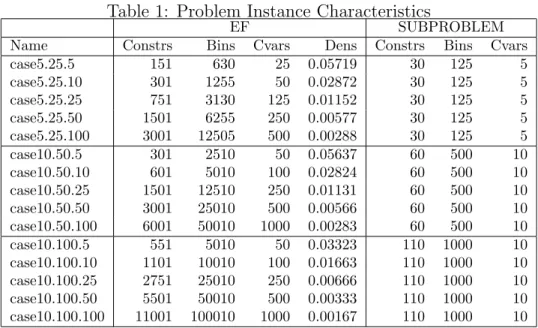
Table 1 gives the problem characteristics. The naming convention used for all the instances is ‘casem.n.S.a’, where m is the potential number of servers, n is the number of clients, S is the number of scenarios, and a is the replication number. The columns in the table are as follows: ‘Constrs’ is the number of constraints, ‘Bins’ is the number of binary decision variables, ‘Cvars’ is the number of continuous decision variables, and ‘Dens’ is the density of the constraint matrix in the extensive form (EF) formulation.
7.3
Computational Results
The D2-R algorithm was implemented using the CPLEX 9.0 Callable Library (ILOG,
2003) in Microsoft Visual C++ 6.0 and applied to then SSLPR instances. In the current implementation of the algorithm, cuts are generated and added to the subproblems until the first-stage decision stabilized. Then the subproblems are solved to integer optimality and an optimality cut by Laporte and Louveaux (1993) generated and added to master program. CPLEX MIP and LP solvers were used to solve the subproblem MIPs and LPs. All the computational experiments were conducted on a DELL Optiplex GX620 with a Pentium D processor running at 3.0GHz with 3.5GB RAM. The instances were run to optimality or stopped when a CPU time limit of 3600 seconds (one hour) was reached.
D2-R stopping tolerance was set at ²= 0.005.
Table 1: Problem Instance Characteristics
EF SUBPROBLEM
Name Constrs Bins Cvars Dens Constrs Bins Cvars
case5.25.5 151 630 25 0.05719 30 125 5 case5.25.10 301 1255 50 0.02872 30 125 5 case5.25.25 751 3130 125 0.01152 30 125 5 case5.25.50 1501 6255 250 0.00577 30 125 5 case5.25.100 3001 12505 500 0.00288 30 125 5 case10.50.5 301 2510 50 0.05637 60 500 10 case10.50.10 601 5010 100 0.02824 60 500 10 case10.50.25 1501 12510 250 0.01131 60 500 10 case10.50.50 3001 25010 500 0.00566 60 500 10 case10.50.100 6001 50010 1000 0.00283 60 500 10 case10.100.5 551 5010 50 0.03323 110 1000 10 case10.100.10 1101 10010 100 0.01663 110 1000 10 case10.100.25 2751 25010 250 0.00666 110 1000 10 case10.100.50 5501 50010 500 0.00333 110 1000 10 case10.100.100 11001 100010 1000 0.00167 110 1000 10
benchmark for comparison. The following CPLEX MIP solver settings were used and provided better results than the default values: set mip emphasis 1 (emphasizes looking for feasible solutions), set mip strategy start 4 (uses barrier at the root), and branching priority order on x. Also, due to the large size of the instances, CPLEX node files were used to prevent CPLEX from running out of memory prematurely.
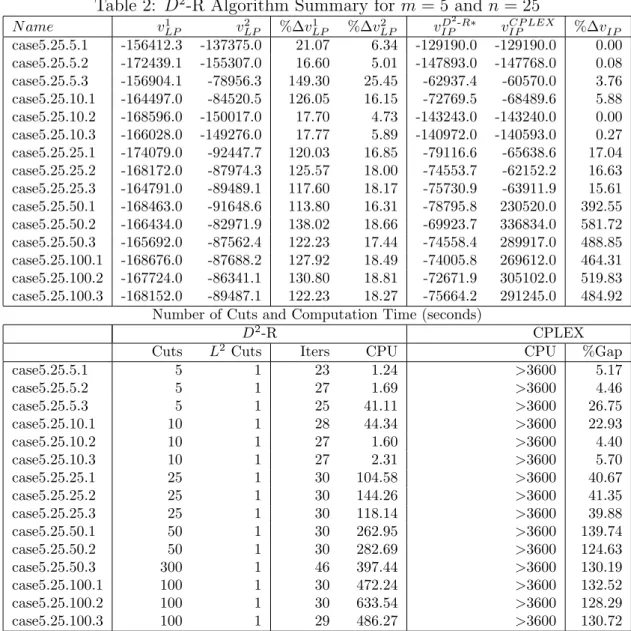
Table 2 gives a summary of the results for instances with m = 5 and n = 25. The columns of the table are as follows: Name is the instance name; v1
LP is the optimal objective value for the LP relaxation; v2
LP is the optimal objective value for the LP relaxation with IP master program (binary restrictions on x enforced); %∆v1
LP is the percentage difference between the best found SIP objective value andv1
LP; %∆vLP2 is the percentage difference between the best found SIP objective value and v2
LP; vD
2-R
IP is the best SIP objective value found by theD2-R algorithm;vCP LEX
IP ’ is the best SIP objective value found by the CPLEX MIP solver applied to EF; and %∆vIP’ is the percentage difference betweenvD2-R
IP andvCP LEXIP . The parameters %∆vLP1 , %∆vLP2 , and %∆vIP are defined as follows: %∆v1 LP = 100(vD 2-R IP −v1LP)/vD 2-R IP ; %∆vLP2 = 100(vD 2-R IP −v2LP)/vD 2-R IP ; and %∆vIP = 100(vCP LEX IP −vD 2-R IP )/|vD 2-R
IP |, where |.| denotes the absolute value. Note that value of %∆vIP >0 means that theD2-R algorithm obtained a better solution value
than the CPLEX MIP solver within the time limit of one hour.
As can be seen in Table 2,the D2-R algorithm solved all the instances to optimality
while CPLEX could not. CPLEX only managed to solve two of the smaller instances but was unable to close the optimality gap. As indicated by the last column of the table, CPLEX performance deteriorates as the instance size increases, an indication of increasing problem difficult. However, the performance of the D2-R algorithm is
fairly linear with the number of scenarios, a desirable property for the algorithm. It is interesting to observe that these instances have very large LP gaps (v1
LP) in general. However, the correspondingv2
Table 2: D2-R Algorithm Summary for m = 5 andn = 25 N ame v1 LP v2LP %∆vLP1 %∆vLP2 vD 2-R∗ IP vIPCP LEX %∆vIP case5.25.5.1 -156412.3 -137375.0 21.07 6.34 -129190.0 -129190.0 0.00 case5.25.5.2 -172439.1 -155307.0 16.60 5.01 -147893.0 -147768.0 0.08 case5.25.5.3 -156904.1 -78956.3 149.30 25.45 -62937.4 -60570.0 3.76 case5.25.10.1 -164497.0 -84520.5 126.05 16.15 -72769.5 -68489.6 5.88 case5.25.10.2 -168596.0 -150017.0 17.70 4.73 -143243.0 -143240.0 0.00 case5.25.10.3 -166028.0 -149276.0 17.77 5.89 -140972.0 -140593.0 0.27 case5.25.25.1 -174079.0 -92447.7 120.03 16.85 -79116.6 -65638.6 17.04 case5.25.25.2 -168172.0 -87974.3 125.57 18.00 -74553.7 -62152.2 16.63 case5.25.25.3 -164791.0 -89489.1 117.60 18.17 -75730.9 -63911.9 15.61 case5.25.50.1 -168463.0 -91648.6 113.80 16.31 -78795.8 230520.0 392.55 case5.25.50.2 -166434.0 -82971.9 138.02 18.66 -69923.7 336834.0 581.72 case5.25.50.3 -165692.0 -87562.4 122.23 17.44 -74558.4 289917.0 488.85 case5.25.100.1 -168676.0 -87688.2 127.92 18.49 -74005.8 269612.0 464.31 case5.25.100.2 -167724.0 -86341.1 130.80 18.81 -72671.9 305102.0 519.83 case5.25.100.3 -168152.0 -89487.1 122.23 18.27 -75664.2 291245.0 484.92
Number of Cuts and Computation Time (seconds)
D2-R CPLEX
Cuts L2 Cuts Iters CPU CPU %Gap
case5.25.5.1 5 1 23 1.24 >3600 5.17 case5.25.5.2 5 1 27 1.69 >3600 4.46 case5.25.5.3 5 1 25 41.11 >3600 26.75 case5.25.10.1 10 1 28 44.34 >3600 22.93 case5.25.10.2 10 1 27 1.60 >3600 4.40 case5.25.10.3 10 1 27 2.31 >3600 5.70 case5.25.25.1 25 1 30 104.58 >3600 40.67 case5.25.25.2 25 1 30 144.26 >3600 41.35 case5.25.25.3 25 1 30 118.14 >3600 39.88 case5.25.50.1 50 1 30 262.95 >3600 139.74 case5.25.50.2 50 1 30 282.69 >3600 124.63 case5.25.50.3 300 1 46 397.44 >3600 130.19 case5.25.100.1 100 1 30 472.24 >3600 132.52 case5.25.100.2 100 1 30 633.54 >3600 128.29 case5.25.100.3 100 1 29 486.27 >3600 130.72 ∗ optimality reached.