The Effectiveness of Creative Writing in Language
Learning:
A Comparative Study between Bangla Medium and English Medium Elementary Level
Thesis
Submitted to the Department of English and Humanities
of BRAC University
Submitted By
Nushrat Akhter
ID: 11363013
MA in English
I would like to express my gratitude towards my supervisor, Ms. Shenin Ziauddin for her
valuable advices, guidance, and time in this research. Without her understanding and assistance,
the present study would not have been completed. I would also like to thank Dr. Firdous Azim,
the Chairperson of ENH Department and all faculty members. I am deeply grateful to the
teachers and students who were the participants of this study. Finally, my warmest gratitude goes
to my parents and my friends for their care, encouragement and support. The success of this
dissertation is dedicated to my parents.
Table of Contents
Page Chapter 1: Introduction
1.1.Research Topic
1
1.2.Limitation of the study
3
1.3The Summary of this Dissertation
3
Chapter 2: Literature Review
2.1.Language Skills
5
2.2.Reason for Teaching Writing
6
2.3.Approaches to Writing
7
2.3.1. Product-oriented Approach
8
2.3.2. Process-oriented Approach
9
2.3.3. Genre Approaches
10
2.3.4. Creative Writing
10
2.4. Teaching Techniques used in Creative Writing Class
11
2.5. Effectiveness of Creative Writing for Learners
13
2.6. Learner’s Characteristics
15
Chapter 3: Research Methodology
3.1.Background Information
16
3.2.Participants and Settings
17
3.3.Nature of the Research
17
3.3.1. Primary Research 3.3.2. Quantitative Research 3.3.3. Qualitative Research
3.4.Research Design
19
3.4.1. Procedure
3.4.2. Research Instruments for Collecting Data 3.4.2.1. Questionnaire
3.4.2.2. Classroom Observation Chapter 4: Findings and Analysis
4.1. Finding from the Questionnaire
22
4.1.1. Results of Question 1 4.1.2. Results of Question 2 4.1.3. Results of Question 4 4.1.4. Results of Question 5 4.1.5. Results of Question 6
4.1.6. Results of Question 7
4.2. Results of the Classroom Observation
30
Chapter 5: Recommendations
32
Chapter 6: Conclusion
34
References
36
Writing is one of the productive skills which sometime seems difficult to acquire to the
learners. There are many approaches to teach writing. Creative writing is one approach of
teaching writing which has become more familiar in recent era. In our country many schools of
Bangla and English medium are implementing this approach now-a-days to teach writing in the
elementary level. This aim of this study is to find out the effectiveness of creative writing in
language leanring. Moreover, I want to make a comparison between Bangla and English
medium. In order to conduct this research I have taken interviews of 40 students from both
medium. The findings showed that students of both medium like Creative writing classes and it
influences their language learning. Therefore, it can be said that Creative writing can be used as
an effective language learning tool.
1 Chapter I
Introduction
This chapter outlines the background of the study. This also includes the limitations of the study.
1.1.Research Topic:
Writing is one of the language skills which is considered a powerful mode of
communication. Like speech, writing helps to produce the language. It is considered that learners can express their thoughts through writing in an organized way. When we write we go through a mental process which is more complex. We have to think, organize the idea, write, revise and edit to get a perfect writing and thus we can concentrate on language use more precisely. However, writing is considered much more difficult language skill to learn like speaking rather than listening and reading. Most of the learners need more time in acquiring writing skill successfully.
There are a number of different approaches to teaching writing which focus on the writing from different perspectives. Among these approaches product and process oriented approaches are used extensively in teaching writing skill. However, there are Genre approaches which have gained popularity last ten years. Creative writing is another approach to teaching writing which is used in most of the English Language classrooms in recent times.
Creative writing is a form of writing that expresses feelings, thoughts or ideas in an imaginative way. It provides the learners new ways to play with the language. Creative writing enhances not only the writing skills of the learners but also it helps learners to improve all the
2
language skills. Most of the cases in school young children are not expected to write themselves in a systematic manner as adult learners do. They are exposed to different types of writing activities which are more structured and designed by their teachers. But it is assumed that these young learners have a vast array of experiences and knowledge which they have observed around them and so it is claimed that they should be allocated with lots of literacy works. Moreover, as they get an opportunity to play with language through creative writing, the more they will play, the more they will learn about the language and the more they learn, the more they will get the confidence to play with language. Thus these young children will be able to enhance their language skills.
In the schools of Bangladesh, both Bangla medium and English medium, writing skill has been given much more importance than other three skills; i.e. listening, speaking and reading. Young learners are involved in different types of writing activities to enhance the writing skill. They are exposed to text writing, copying from the board, filling worksheets or books etc. Schools which follow the foreign curriculum claim that their students do creative writing and they have individual class to practice creative writing. There, they write on selected topics given by teachers. Teachers provide main ideas and key words to the students and help them in
producing their work. The main purpose of practicing these types of writing is to prepare the students to produce any kind of writing on given topics in examinations. However, the schools which follow the National Curriculum provide their students some particular topics as a syllabus and prepare them to write on those given topics so that they can reproduce the same in
examinations. They have limited topics for practicing in each class whereas in English medium school teachers choose the topics from real life events where students are supposed to share own experiences.
3
Now-a-days, syllabus designers of National Curriculum have given emphasis on free writing where students are able to produce their own writing using their creativity.
Both Bangla and English medium claim that they are focusing on students’ creativity in learning English language. Therefore they are utilizing creative writing as a language tool. Here, I am interested to know that how much these creative writing activities are helpful for the
students of these two different curriculums of our country in language learning. Moreover, I want to make a comparison between the way of teaching creative writing and its effectiveness of English medium and Bangla medium.
1.2. Limitation of the study:
Due to time constraint it was not possible to conduct survey from many schools in Dhaka city. Moreover, it was difficult to contact with the schools outside Dhaka city in this short period of time. In addition, during the research time the teachers were busy with examinations so it was difficult to conduct this research work. If these constraints were removed, a better research could have been carried out.
1.3. The Summary of this Dissertation:
Chapter: 1- Introduction
This chapter contains the research topic and of this study. This also includes the limitations of the study.
Chapter: 2- Literature Review
This chapter includes literature review. It discusses different types of language skills, importance of teaching writing, different approaches of teaching writing, creative writing,
4
different types of creative writing, and teaching techniques of creative writing. This chapter also includes the effectiveness of creative writing and learners’ characteristics which are helpful in successful language learning. The views and opinions of other researchers are also included in this chapter.
Chapter: 3- Research Methodology
The methodology that has been used to conduct this research is described in this chapter.
Chapter: 4- Findings and Analysis
This part of this study includes the findings of this study. The researcher has also discussed the findings on the basis of literature review in this chapter.
Chapter: 5- Recommendations
In this chapter there are some recommendations on the basis of the findings.
Chapter: 6- Conclusion
5
Chapter II
Literature Review
In this chapter, relevant literature and theoretical framework of the study have been presented. This chapter begins with a discussion on different types of language skills. Definition of creative writing and its effectiveness are discussed in detail in this section.
2.1. Language Skills
Each language has four basic skills: listening, reading, writing and speaking. These are often divided into two types: receptive skills and productive skills. According to Harmer, reading and listening are known as Receptive skills, skills where meaning is extracted from the discourse and the term, Productive skills, is used for speaking and writing, skills where students actually have to produce language themselves. All these four skills are equally important and these are interrelated in a language learning environment. In his book “The Practice of English Language Teaching,” Harmer stated that it makes little sense to talk about skills in isolation because in a real conversation, we are bound to listen as well as speak. Eli Hinkle points out, “in meaningful communication, people employ incremental language skills not in isolation, but in tandem” (Harmer 2011: 265). Therefore, in real life, it is not easy to separate these four skills, as most language skills are preceded or followed by a different skill. However, traditionally the teaching guidelines for the skills of language do separate the skills. The main reason for this is to organize learning activities into some order, and to assist teachers in deciding the aim of their lessons and the way to do it.
6
Most students of English find it easier to master receptive skills, such as understanding grammar, reading English text, and listening to spoken English, than productive skills, speaking and writing. This does not mean that speaking and writing are more difficult to them. It is simply because in English Language classroom, students are mostly exposed to target language items through grammatical drills, reading comprehension, and listening to tapes or teachers without students being drilled in how to express their ideas both in writing and speaking.
Writing is a difficult skill for many learners as it involves more than putting sentences together in language that is grammatically correct and appropriate. When we speak we have the audience present and we always get immediate feedback from the listeners. However, writing is not always for the audience present and hence we have to get in right first time in writing (Hadfield, 2008). In case of writing, it demands clear and comprehensive message as there is no direct interaction between writer and readers. Through writing we express our thoughts and ideas in an organized way and to make a successful writing we go through a mental process. When we write we first combine our ideas and thoughts and then arrange them in the form of sentences and organize the sentences into a cohesive text. This mental process of writing arises some sub-skills like- drafting, organizing, editing, revising, etc. Therefore, often it seems that language learners face more difficulty to cope up writing skill than other three.
2.2. Reasons for Teaching Writing
According to Lindsay and Paul (2006), writing is a part of the language learning process. There are various purposes to write. For instance, we write to practice the language, to reinforce the language, to help memorization, etc. Therefore, in the classroom learners are involved to different writing activities to develop their writing skills as part of the process of language learning.
7
In his book, “How to Teach English,” Harmer utters some reasons for teaching writing to students of English language which include reinforcement, language development, learning style and most importantly, writing as a skill.
Reinforcement: Writing has always been used as a means of reinforcing language that has been taught. Teacher often ask the students to write sentences using recently learnt aspect of language, such as grammatical aspect, paragraph or text construction. Learners often find it useful to write sentences using ‘new’ language after they have learnt it.
Language development: When writing, students have to go through a long mental process in order to construct proper written texts. In this case they have to focus on accurate language use. This helps them in language development.
Learning style: Writing can be considered as a learning style for some learners.
Writing as a skill: The most important reason for teaching writing is that writing itself is a basic language skill. To learn a language students have to have this skill alike the other three: listening, speaking and reading. Students have to know how write letters, how to put reports together, etc. They are required to know some of writing’s special conventions such as, punctuation, paragraph construction etc.
2.3. Approaches to writing
As one of the four language skills (listening, speaking, reading and writing) writing has always formed part of the syllabus in the teaching of English. There are different ways to
approach writing in the classroom. The best practice in any situation will depend on many factors such as the type of students, the text type being studied, the school system etc.
8
According to Harmer, there are a number of different approaches to the practice of writing skills in the classroom but to choose the appropriate approach for the students, teachers have to decide whether they want the students to focus on the process of writing more than its product, whether they want them to study different written genres or whether they want to encourage writing using their creativity. Among different types of approaches, over the last 20 years the process and product approaches are more dominant of teaching writing in the ESL classroom. The product approach focuses on the construction of the end-product of writing rather than the process of writing itself. On the contrary, process approach of writing pays attention to the various stages that any piece of writing goes through. However, according to Chris Tribble (1996: 37-57), in the last ten years, genre approaches have gained adherent (Badger & White 2000: 153). Another approach to writing that has been dominating in the ESL classroom for recent few years is creative writing. Creative writing suggests imaginative tasks such as writing poetry, stories and plays which promotes effective learning through self-discovery. (Harmer)
2.3.1. Product-oriented Approach
Product-oriented approaches to writing largely concern the forms of the written products that students compose. Harmer, in his book “The Practice of English Language Teaching,” says, “When concentrating on the product, we (teacher) are only interested in the aim of a task and in the end product.” According to Gabrielatos (2002), a product approach is a traditional approach in which students are encouraged to mimic a model text which is usually presented and analyzed at an early stage. For instance, in a typical product approach-oriented classroom, students are supplied with a standard sample of text and they are expected to follow the standard to construct a new piece of writing.
9
According to Pincas (1982), this approach focuses on linguistic knowledge as well as the appropriate use of vocabulary, syntax and cohesive devices. Product-oriented approach
comprises of four stages: familiarization, controlled writing, guided writing and free writing. The first stage, familiarization, aims to make learners aware of certain features of a particular text. In the next two stages, controlled and guided writing, learner’s practice of the highlighted features and learn how to organize the ideas until they are ready for the free writing section. The free writing stage is the end product of the learning process when students use their writing skills, structures and vocabulary that they have been taught to produce the product. Through this section they show that they can do as fluent and competent users of the language.
2.3.2. Process-oriented Approach
Process-oriented approaches concern the process of how ideas are developed and formulated in writing. Harmer states, “a process approach asks students to consider the
procedure of putting together a good piece of work.” In this approach writing is considered as a process through which meaning is created by following a number of stages. According to Tribble (1996), process approaches stress “….writing activates which move learners from the generation of ideas and the collection of data through to the ‘publication’ of a finished text.” (Badger 2000)
In process approaches writing predominantly deals with linguistic skill, such as planning and drafting rather than linguistic knowledge, for instance, knowledge about grammar and text structure, etc. A process-oriented approach can have any number of stages with different views that writers go through in producing a piece of writing, though a typical model is identified which include four stages: prewriting, composing or drafting, revising, editing and finally producing a finished version (Tribble 1996). In reality the writing process is more complex than
10
this. These various stages of writing are done in a recursive way. It means that the writer loop backwards and move forwards between these various stages. For example, after doing some editing or revising writers may feel to go back to pre-writing phase and think again and then may edit bits of the writing as he draft it.
2.3.3. Genre Approaches
Genre represents the norms of different kinds of writing. Genre approach is one of the most recent approaches to teaching writing. When teachers concentrate on genre, students study texts in the genre in which they are going to be writing before they get on their own work. For example, if the students are asked to write business letter, first the teacher will show them a typical model of such business letter and then they will start to compose their own. (Harmer)
Genre approaches have lots of common with product approach and can be recognized as an extension of product approaches. Alike product approaches, genre approaches consider writing as predominantly linguistic but they believe that writing varies with the social context in which it is produced (Badger 2000). Therefore, students who are writing within a certain genre need to consider a number of different factors which influence that particular genre such as the subject matter, the conventions and style of the genre as well as the relationships between the writer and the audience.
2.3.4. Creative Writing
Harmer affirmed creative writing as a term which implies “imaginative tasks, such as writing poetry, stories and plays.” Creative writing normally refers to the production of texts which have an aesthetic rather than a purely informative, instrumental or pragmatic purpose. Most of the time, such texts take the form of poems or stories, though they are not confined to
11
these genres. Letters, journal entries, blogs, essays, travelogues, etc. can also be defined as creative writing. Creative writing texts have a great deal with intuition, imagination and personal memories (Maley, 2009). In the words of distinguished novelist Ernest J. Gaines, creative
writing is “imaginative writing. ... Though the creative writer draws from factual sources, sociology, psychology, politics, religion, etc., ... he should use all of that information imaginatively—never factually” (Gaines, n.d.).
In an interview, Vishnu S. Rai, a well-known name in Nepalese ELT, claimed creative writing as an art which can be taught. He added that as people are helped to learn different arts and crafts such as painting, drawing or music, more suitably they can be helped to learn the creative writing art. Moreover, he emphasized on two aspects of creative writing; these are-
i) to be a creative writer and get published, etc., and ii) to use creative writing in the classroom
According to him, the people who do creative writing in the classroom, the primary purpose is to help the learners develop their language skills without stress and with fun.
2.4. Teaching Techniques used in Creative Writing Class
In his article, “Teaching Creative Writing,” the writer suggested some way of teaching story writing. According to him, while students are writing it should be enjoyable. Students should have opportunities to choose their own subjects and methods of writing as the goal of creative writing is to develop children’s cognitive and communication skills. Moreover, he suggested that before starting their writing, students should be reinforced to have an idea of each type of creative writing. For instance, he talked about story writing that many students do not have the sense of what story is. However, according to him, a sense of what a story is can be
12
reinforced at the beginning of the discussion and if the students are led in a helpful way in these discussions, they may began to see similarities and differences between books of different writing styles and contents. As a result, they will begin to form an idea of the forms and structures that stories generally follow.
He also suggested that teachers should give feedback after the ending of the session or class. Moreover, if the teacher give the opportunity to the students to read each other’s work and give feedback that will be helpful for both reader and writer. In this case, their peers comment will be more attended than the teacher’s. However, he suggested that this interaction of students in giving feedback needs to be monitored and modeled by the teacher.
13 2.5. Effectiveness of Creative Writing for Learners
In his article, “Teaching Creative Writing in an ESL Context,” Kenny uttered four major factors for using creative writing in language learning classroom. These are:
i) Freedom of Expression: According to Kenny, most writing classes focus on
grammatical structure and correct form. There is less concentration on utilizing the creativity of the students. As a result, it can “lead to dissonance and low motivational levels” as well as “leave little room for the cultivation of views, opinions and ideas.” However, he thinks that creative writing activities have a direct connection to the learners’ imaginations as these are allowing the learners to explore their “interests and ideas in a spontaneous. Immediate and personal way.”
ii) The use of the imagination: Kenny claimed that promoting the use of the imagination, the implementation of creative approaches, activities and tasks play a vital role in the development as a human being. If the teachers help the students to access their creative mind and promote self-expression, it will raise the students’ motivational levels as well as encourage them in good learning habits.
iii) Emotional response: According to Kenny, the major difference between creative writing and factual writing is creative writing can ignite an emotional response in learners and facilitating an emotional response can have a beneficial effect on learning.
iv) Connecting the known to the unknown: Creative writing can link pre-existing knowledge with new ideas and unfamiliar linguistic structures.
14
Vishnu S. Rai utters:
“Creative writing is fun. Creative writing breaks the monotony of the class. It brings fresh air in the classroom. It helps students to learn language with fun. The most important thing is that it boosts their morale. It gives them confidence that they can write poems and stories in English. The same is true with the teachers. Once they are exposed to creative writing activities, their self-confidence soars up.” (Kumar, 2012)
According to Alan Maley (2009), some benefits of creative writing for learners are:
• Creative writing aids language development at all levels, such as grammatical, vocabulary, phonology and discourse.
• It fosters “playfulness” which encourages learners to take risks with the language, to explore it without fear of reproof.
• Creative writing put emphasis on the right side of the brain, with a focus on feelings, physical sensations, intuition and musicality.
• Creative writing tends to develop self-confidence and self-esteem among learners.
• Creative writing leads to a corresponding growth in positive motivation.
• Creative writing feeds into more creative reading. By getting the process of creating the text, learners come to instinctively understand how such texts work, and this make them easier to read.
15 2.6. Learner’s Characteristics
Learners have some individual characteristics which may affect their success in second language acquisition. Many researchers have found different factors of learners which are responsible in successful language learning. Some of these are:
1. Learner’s aims and purposes in learning the language: Some learners aim for accuracy and others aim for communicative effectiveness. Different aims and purposes will produce different outcomes in second language acquisition.
2. Exposer to the language: Learners need to expose the language. Some, many learners use very formal language while communicating and some are very informal in using the language.
3. Learner’s age: Learner’s age is a great factor in language learning process. 4. Motivation: It is need to measure that whether the learners are motivated towards
learning the language or not.
5. Personality: Personality traits such as
success in learning a second language.
6. Language aptitude: Aptitude is a special ability for language learning, a combination of lingu istic, memory, and auditory ability.
7. Learning styles and strategies: Learners vary tremendously in their preferred ‘style’, or approach to learning second languages (whether concrete, analytical, synthesizing,
communicative or authority-based). Some learners want clear rules and others are content with ambiguity. Learners can succeed using very different approaches in different social
16
Chapter III
Research Methodology
This part of the study will discuss the methodology that has been used to conduct the study in detail.
3.1. Background information
As mentioned above, creative writing is as an approach of writing where students can get the opportunity to write using their creativity. This type of writing not only enhances learners’ creativity but also helps in language development at all levels. In Bangladesh, now-a-days creative writing is familiar in both National and International curriculum. Schools which follow international curriculum have supplementary class for creative to improve learners’ writing skills through fun and imagination. In recent times National curriculum also realizes the effectiveness of creative writing and therefore, they have incorporated different types of creative writing activities. However, it can be said that the learners of Bangla medium are hardly benefitted from these activities and the object of utilizing creative writing is almost not fulfilled in this case. The aim of this paper is to investigate the effectiveness of creative writing in learning language as well as this paper will make a comparison between the way of teaching creative writing in Bangla and English medium. To conduct this study both quantitative and qualitative methods are used. Students of both medium have been given a same questionnaire to find out how much they have achieved through the activities of creative writing. In addition, to differentiate between the way of teaching creative in Bangla and English medium the researcher has observed creative writing classes of both medium.
17
Therefore, my research questions are:
i) How much is creative writing effective for English language learning for the students?
ii) What are the differences between Bangla and English medium in teaching techniques of creative writing?
3.2. Participants and Settings
The subjects participating in this study are consisting of 40 elementary students studying in different classes from class one to class five. Among these students 20 students are from Bangla medium who are taught in National Curriculum of Bangladesh. All of them are familiar with four language skills: listening, reading, writing and speaking. They have practiced different kinds of creative writing in their classes such as essay writing, picture describing, story writing, and letter writing etc. which are usually prescribed in their syllabus. However, they take ideas from different composition books to make their piece of writing better so that they can get good marks. In order to get good marks they usually memorize their piece of writing though they all know that they should practice writing themselves which will help them to learn English language more precisely. They know memorization will not help them in language learning but as their teachers always emphasis on accuracy of grammatical forms they are compelled to do the memorization.
Other 20 students are from English medium who are taught in International Curriculum. They have supplement class for Creative Writing once in a week. They write themselves on the topics selected by the teachers. They have also practiced different kinds of creative writing such as essay writing, letter writing, picture describing and story writing etc. They always write using
18
their own ideas. However, their teachers also help them in understanding the topics. All of them are also familiar with four language skills.
As both of the groups, Bangla and English medium are familiar with creative writing they have their own perspective towards this kind of writing and it will help the study in finding the answer of the research questions. Moreover, they are from different classes of elementary level which will make the study more consistent.
3.3. Nature of the Research
This part describes the nature of the research.
3.3.1. Primary Research
The research is a primary research. Primary researches refer to those where the data is collected from direct sources rather than from secondary sources to obtain original information (Brown 1988). In this study the data has been collected from two groups of students who are learning a same language in different context.
3.3.2. Quantitative Research
Quantitative researches are those where numerical data is used in order to analyze the gathered information. According to Aliaga and Gunderson (2000):
Quantitative research is ‘explaining phenomena by collecting numerical data that are analyzed using mathematically based methods (in particular statistics)’.
Quantitative data contains closed ended information such as that found on attitude behavior and performance instruments. In this study the students have been given a questionnaire to find out
19
the effectiveness of creative writing in language learning and this questionnaire has been derived and analyzed in terms of numerical data. This is why the research falls under quantitative
category.
3.3.3. Qualitative Research
The qualitative approach is a way to gain insights through discovering meanings by improving our comprehension of the whole. It explores the richness, depth, and complexity of phenomena. This type of research analyzes data from direct fieldwork observations, in-depth, open-ended interviews, and written documents. According to Mackey (2005), qualitative research refers to the research that is based on descriptive data that does not usually deal with statistical procedures. The careful and detailed description is required in terms of qualitative research rather than measurements, ratings and scores. This type of research is often process-oriented or open-ended. It follows an inductive process that begins with few perceived notions and so “qualitative researchers tend to approach the research context with the purpose of observing whatever may be present there, and letting further questions emerge from the context” (Mackey, 2005). Here, the researcher has observed creative writing classes of both Bangla and English medium in order to gather detail information about the way of teaching creative writing.
3.4. Research Design
This part discuss about the research design in details.
3.4.1. Procedure
In order to find out the effectiveness of creative writing activities towards English
20
20 participants were from Bangla medium and rest 20 students were from English medium. All of them were from elementary level. The data were collected following the proper procedure with the permission of the Principal and respective class teachers. At the beginning of the data collection, the researcher made it clear to the students that it was a voluntary work and the data will be used for research purpose. Moreover, as all the participants were from elementary level, the researcher explained each questions to them so that they can response correctly. Then the researcher herself distributed the questionnaires and was present there in order to help the participants for further explanation. Both groups had been given same time to fill up the questionnaire.
The second part of data collection was observing creative writing classes of both Bangla and English medium. The researcher observed two classes respectively from Bangla and English medium.
3.4.2. Research Instruments for Collecting Data
Two data collection instruments were administered in this study; a questionnaire and classroom observation. Questionnaire provides quantitative data and classroom observation provides qualitative data for the study.
3.4.2.1. Questionnaire
“Questionnaires are any written instruments that present respondents with a series of questions or statements to which they are to react either by writing out their answers or selecting from among existing answers” (Brown, 2001, p.6). It is the easiest way of collecting quantitative data and it provides the researcher with a huge amount of data from a large number of subjects in the cheapest and fastest way. There are types of questionnaire questions: close-ended and
open-21
ended questions. Open-ended questions allow the participants to express their opinions in a free-flowing manner. On the other hand, close-ended questions are the structure questions which require the subject to mark responses, to check agreements or disagreements, or to select among a number of alternatives. Questionnaire that has been used in this research has only close-ended questions. The different segments of the Questionnaire focus on the number of creative writing classes, students’ views about their creative writing classes and the teaching techniques that are used in creative writing classes.
There are altogether 8 questions among which some are multiple choice type questions and some are Dichotomous questions. Dichotomous questions are those where respondents are asked to answer in “yes” or “no”.
3.4.2.2. Classroom Observation
Classroom Observation is a process by which the researcher sits in on one or more class sessions, records the teacher’s teaching practices and student actions, and then meets with the teacher to discuss the observations. Classroom observation provides great amount information. Through observing the classroom the researcher can get a firsthand experience of the activities performed in the classroom. The main aim of this classroom observation was to have closer look at the activities done in creative writing classes and also to find how students perform in these activities.
22 Chapter IV
Findings and Analysis
This part of the research will discuss, analyze and interpret the results obtaining from the questionnaire and classroom observations.
4.1. Finding from the Questionnaire
As mentioned in the previous chapter, a questionnaire is used to find out the effectiveness of creative writing in English language learning for the students.
4.1.1. Results of Question 1
Among Bangla medium students, 80% students responded “no” in question.1 which means they do not have supplement class for practicing writing in English class. However, 20% students responded ‘yes’ which indicates that they have supplement classes for writing. On the other hand, among English medium students, 100% students responded “yes” in the same question which shows that all English medium schools have supplement class for practicing writing in English class.
4.1.2. Results of Question 2
In question 2, learners are asked to put tick mark on which types of creative writing they have practiced in their class. Table 4.1 shows the result of this question. Here, 100% participants of both Bangla and English medium responded that they have practiced story writing and
composition writing in their writing classes. However, none of the participants put tick mark on poetry which shows that in their wiring classes they never practice poetry writing.
23
Table 4.1. Response to Question No. 2
Types Participants of Bangla
medium Participants of English medium Story 20 20 Poetry 0 0 Picture describing 5 20 Composition 20 20 Personal Letter 20 15
Moreover, 100% students of English medium responded that they had picture describing type of writing whereas 25% students of Bangla medium put tick mark on this type of writing. In case of personal letter writing only 15 students of English medium responded positively while 20 students of Bangla medium responded positively.
The following graph represents Table 4.1.
Graph 4.1: Response to Question no 2
0 5 10 15 20 25
Story Poetry Picture
Describing Composition Personal Letter
Bangla Medium English Medium
24 4.1.3. Results of Question 4
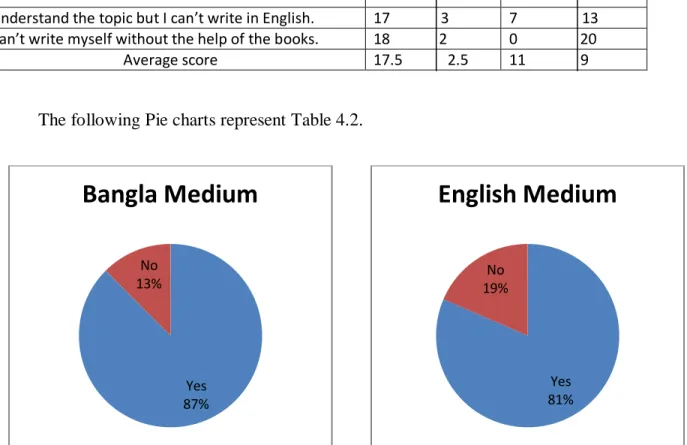
Table 4.2 shows the results of facing problems while writing from the students’
perspectives. It shows that 100% (20) students of both Bangla and English medium face problem in terms of organizing the data while writing. However, 100% students of English medium responded negatively towards the last problem. 90% students of Bangla medium are found that they cannot write themselves without the help of the books.
Table 4.2: Response to Question No. 4
The following Pie charts represent Table 4.2.
Graph 4.2: Response to Question no 4
Yes 87% No 13%
Bangla Medium
Yes 81% No 19%English Medium
Bangla Medium English MediumProblems Yes No Yes No
I know what I have to write but I can’t organize the
idea. 20 0 20 0
I am concern about grammatical errors. 15 5 17 3 I understand the topic but I can’t write in English. 17 3 7 13 I can’t write myself without the help of the books. 18 2 0 20
25
Here, it can be seen that 87% students of Bangla medium are facing problems while writing. However, in case of English medium it seems that the percentage is less, 81%.
4.1.4. Results of Question 5
This set of questions was about the students’ view of creative writing class. The results derived have been showed in the following table and graph.
Table 4.3: Response to Question No. 5
Bangla Medium English Medium Questions Yes No Yes No
I enjoy the creative writing class. 12 8 15 5
I think this writing class helps me in learning English Language. 17 3 18 2
I feel we should have more creative writing classes. 18 2 20 0
I think I can write confidently in any given topic. 5 15 16 4
I think we should give the chance to select the topic. 17 3 18 2
Average score 13.8 6.2 17.4 2.6
Graph 4.3: Response to Question no 5
Yes 85% No 15%
Bangla Medium
Yes 87% No 13%English Medium
26
In the above table, it can be seen that in case of Bangla medium, except 4th
question, in all other questions students responded to ‘yes’ that suggests that students enjoy their creative writing class and this type of class is helpful for them and therefore they recommended to have more creative writing classes per week. However, the low score in the 4th question implied that the students of Bangla medium do not have the confidence to write on any given topic as they are dependent on books for writing.
In case of English medium, maximum students answered to ‘yes’ which suggests that they are highly motivated towards creative writing. They responded that they enjoyed their creative writing class and therefore they suggested having more classes.
From the pie charts of Graph 4.3, it can be seen that students of both Bangla and English medium are highly motivated towards having creative writing classes. It also suggests that creative writing activities help them in English language learning.
4.1.5. Results of Question 6
The set of questions was about the way of teaching in the creative writing classes. Here students were asked to respond to the teaching techniques which were used by their teachers.
27
Table 4.4: Response to Question No. 6
Bangla Medium English Medium Yes No Yes No
My teacher chooses the topics for us. 16 4 18 2
My teacher explains the topics at the beginning of the class. 11 9 18 2
My teacher helps us to organize our idea. 7 13 16 4
My teacher writes for us on the board. 16 4 15 5
My teacher helps me in getting new words. 12 8 17 3
My teacher always encourages me to write myself. 17 3 20 0
My teacher always makes me alert about errors. 13 7 9 11
Average Score 13.14 6.86 16.14 3.86
Here, from the table 4.4, it can be seen that in case of Bangla medium, except 3rd question, all other have highly scored to “yes”. It means that according to the students’
perspective, their teacher plays an important role in their creative writing class. Though students in creative writing class should be given freedom to write themselves, here teacher played the dominating role on their writing. In the 3rd question, maximum students responded negative and one of the reasons for this result may be that students have books to help them. Therefore, teacher does not help them in organizing the idea.
In case of English medium, except 7th question, in all other questions students have responded positive. It means that their writing class is also dominated by the teachers. However, in question no.6, 100% students responded that their teacher encouraged them to write
themselves. So it can be assumed that as they are in elementary level they need teacher’s help but sometime they should be given freedom to express their opinion. Otherwise, they will become dependent on their teacher and in future they would be not able to write themselves.
28
The following Pie charts represent the average score of Table 4.4.
Graph 4.4: Response to Question no 6
Here, the pie chart of Bangla medium is showing that in average 68% students responded positively to the questions whereas the average in the pie chart of English medium is 81%. The average of Bangla medium scored less not because that students were free to write themselves but the reason is that they had other material such as, books to help them. Moreover, the students of Bangla medium have the tendency to memories all types of writings. On the other hand, in English medium, teacher plays an important role in their writing class not only because they are the students of elementary level but also because of the time limit.
4.1.6. Results of Question 7
The aim of this question is to find out whether the students have a strong connection with the creative world or they just practiced in the classroom context.
Yes 81% No 19%
English Medium
Yes 68% No 32%Bangla Medium
29
Table 4.4: Response to Question No. 7
Time Duration Bangla Medium English Medium
Response Percentage Response Percentage
Everyday 2 10% 6 30%
During holidays 5 25% 8 40%
Sometime 3 15% 4 20%
Very often 10 50% 2 10%
From the above table, it can be seen that 50% students of Bangla medium do not have the habit of reading fictional books in English. It can be assumed that students of Bangla medium are less connected to the creative world of English. On the other hand, 40% students of English medium responded that they read fictional books during holidays. However, the percentage of reading fictional books everyday is less, only 30%. It shows that though they are from English medium background, their relation with the creative world of English language is very poor. The above data has been showed in the following graph.
0 2 4 6 8 10 12
Everyday During holidays Sometime Very often
Bangla Medium English Medium
30 4.2. Results of the Classroom Observation
In the previous chapter it is mentioned that the aim of classroom observation is to have a closer look at the creative writing classes both in Bangla and English medium and to investigate the authentic response of the students towards creative writing activities.
Here, the researcher observed altogether eight classes. While observing classes of Bangla medium, the researcher found that all the teachers followed some similar ways of teaching. For instance, after entering the classroom the teacher started to write on the board. He wrote the topic name on the board and then asked some students to tell something about that topic. After that, the teacher discussed the topic with the students and then he asked them to write on that topic. In every class teachers gave word limits which may have a bad effect on their writing fluently. The researcher also observed that in every class students were allowed to take help from their books or notes. While students are writing, the teachers monitored the class and helped the students in case of difficulty. Most of the students were busy to copy from the books. Some were taking help from their friends or trying to copy from others. There were very few students who were asking questions to their teachers. It seemed that they were not achieving anything from these classes rather they were doing what they were asked to do. However, in one class the researcher found that the teacher started his lesson quite differently. At beginning of the class, the teacher did elicitation which grabbed the attention of the students. Then, gradually she started to discuss the topic and she tried to involve her students in the discussion. After that, she introduced the topic and asked students to write on that topic. The researcher observed that the students of this class had more interest to write rather than the other three.
31
The researchers also observed four creative writing classes of English medium. There, she found all the teachers followed same teaching techniques though they were teaching in different schools. She observed that after entering the classroom the teachers first had the greetings with their students. Then they did elicitation where they asked different questions to the students in order to grab their attention and also to refresh their knowledge. After that the teachers introduced the topic and wrote on the board. Then they discussed how to write on that topic and wrote some key words related to the topic on the board. Then the students started to write on. Some students asked their teachers for help and tried to make their own sentences in a different way. Other tried to make sentences with the key words given on the board. Here, students were also facing some limitations. They were asked to write 12 sentences on the given topic. Among these four classes, the researcher found that in two classes after introducing the topic the teachers were writing 12 sentences on the board and asked students to copy them. In these two classes students were busy in copying the sentences rather thinking themselves for writing new sentences. However, in other two classes, where students were writing themselves, the researcher observed that they were enjoying the class. They kept their teachers busy with asking questions, new words and made a competition to write better than others.
32 Chapter V
Recommendations
This chapter of the study presents recommendations based on the findings. This section provides some suggestions for both Bangla and English medium how the teachers can make their creative writing class more interactive and interesting so that it can make an effective role in language learning for the learners.
Though it is claimed in both Bangla and English medium that the teachers are teaching their students to write creatively, from the findings of this study it can be seen that students are not getting the actual opportunities to use their own creativity. Students should give the
opportunity to choose the topic themselves and use their own way of writing. They should not be asked to follow books rather they should encourage to write themselves. It can be seen in the findings, that though poetry is considered as more creative activity, students of both medium have not practiced it in their creative writing class rather they have practiced a lot on
composition writing. However, creative writing classes should give preference to those activities which develop the learners’ cognitive level. As in one class it is not possible to teach every type of creative writing so in each week there should be more than two classes for practicing creative writing.
Teachers who teach creative writing should be more creative themselves. Their first motive should be making the class more attractive. From the classroom observation session, the researcher has an idea that most of the teachers are still following the traditional way of teaching. But it should be changed. They should think how they could make their class more interesting and effective. As in creative writing class students will write themselves, teachers should
33
encourage them not to follow the books. Moreover, teachers should first give an idea of each type of creative writing before starting the class. They should arrange a session where students can get chance to comment on their peers’ work. Therefore, teachers should study and think a lot how to make their classes more effective.
34 Chapter VI
Conclusion
The aim of this study is to explore the effectiveness of creative writing for English language learning in both Bangla and English medium and make a comparison between the ways of teaching of both medium.
It can be seen from the results of this study that students of both medium are motivated having creative writing classes. They are interested to write themselves using their creativity rather following the teachers’ instructions. Moreover, their response towards creative writing suggests that teachers should give them more opportunities to practice different type of writing. From the findings it can be also seen that English medium students are more confident than Bangla medium students in case of writing. The reasons behind this is English medium students do not follow any books or do not memories their writing whereas Bangla medium students are traditionally used to in memorizing any kind of writing. Therefore, the students of Bangla medium are always anxious about the grammar and writing themselves without the help of the books. Teachers’ ways of teaching is also responsible for this type of situation. If the teacher encourages his students to write themselves as well as explores their creativity during the classroom context, students will be able to have high confidence level.
However, the researcher’s view is if the students get opportunities to use their creativity, surely they will be able to write creatively and to do so the teachers should be more creative. They should study the modern methods and should adopt them for their own classes. They should think about their students rather than completing the syllabus. Therefore it can be stated
35
that creative writing can be an effective language tool which helps the learners in developing both cognitive and communicative skills.
36
Reference
Beck, H. (2012). Teaching Creative Writing.Palgrave Macmillan. Retrieved from
Creative Writing For the ESL Student. In eslpartyland.com. Retrieved from
Essex, C. (1997). Teaching Creative Writing in the Elementary School.In readingrockets.org.
Retrieved fro
Harmer, J. (1998). How to Teach English: An introduction to the practice of English language
teaching. Edinburgh Gate, Harlow, Essex CM20 2JE, England: Addison Wesley
Longman Limited.
Gillespie, A. (2013) Creative writing in the classroom: five tips for teachers. In theguardian.com.
Retrieved fro
Harmer, J. (2001). The Practice Of English Language Teaching. Edinburgh Gate, Harlow, Essex CM20 2JE, England: Addison Wesley Longman Limited.
Kumar, S. (2012). ‘Creative writing brings fresh air in the classroom’ An Interview with Vishnu Singh Rai. Retrieved from http://neltachoutari.wordpress.com/2012/12/01/creative-writing-brings-fresh-air-in-the-classroom-an-interview-with-vishnu-singh-rai/.
Lightbown, P. M. & Spada, N. (1999). How Languages are Learned. Great Clarendon Street, Oxford: Oxford University Press.
Lindskoog, K. A. (1989). Creative Writing: For People who Can’t Not Write. Zondervan Publishing House. Retrieved from
http://books.google.com.bd/books?id=Swg7ursax6QC&printsec=frontcover&source=gbs _ge_summary_r&cad=0#v=onepage&q&f=false.
Mackey, A. & Gass, S. M. (2005). Second language research: methodology and design. New Jersey: Routledge.
MacLusky, J. & Cox, R. (2011). McGraw-Hill International. In books.google.com. Retrieved from
Maley, A. (2009). Creative writing for language laeraners (and teachers). In teachingenglish.org.uk. Retrieved from
37
Malhotra N. K. (2006). Questionnaire design and scale development. In R. Grover & M. Vriens (Eds.), The Handbook of Marketing Research: Uses, Misuses, and Future Advances (pp. 176 – 202). Newbury Park, CA: Sage Publications Inc.
Morley, D. (2007). The Cambridge Introduction to Creative Writing. Cambridge University Press. Retrieved from
Overview of Learner Characteristics.In Carla.umn.edu. Retrieved from http://www.carla.umn.edu/learnerlanguage/ind_diff.html. Perabo, S. (1998). University of Arkansas Press. Retrieved from
38 Appendix
Questionnaire for Students
This research is being done as a requirement for the completion of a post graduation degree (MA in English). You can choose more than one if it is required.
1. Do you have a supplement class for practicing writing in English class?
o Yes
o No
2. Which types of writing have you practiced in your writing class? Put a tick. • Story
• Poetry
• Picture describing • Composition • Personal letter
3. Please, mention some topics (at least four) that you have done recently in your writing class. _____________________________________________________________________________________ _____________________________________________________________________________________ 4. Please response to the following problems if you face while writing.
Yes No
I know what I have to write but I can’t organize the idea. I am concern about grammatical errors.
I understand the topic but I can’t write in English. I can’t write myself without the help of the books.
5. Please rate whether you agree with following statements about your creative writing class.
Yes No
I enjoy the creative writing class.
39
I feel we should have more creative writing classes I think I can write confidently in any given topic. I think we should give the chance to select the topic.
6. Please rate the following statements about your teacher’s way of teaching.
Always Sometimes Never
My teacher chooses the topics for us.
My teacher explains the topics at the beginning of the class. My teacher helps us to organize our idea.
My teacher writes for us on the board. My teacher helps me in getting new words.
My teacher always encourages me to write myself. My teacher always makes me alert about errors.
7. How often do you read fictional (story, novel, poem) books?
o Everyday o During holidays o Sometime o Very often