Pension reform, institutional investors’ growth
and stock market development
in the developing countries:
does it function?
Aneta Hryckiewicz
NATIONAL BANK OF POLAND
WORKING PAPER
Design: Oliwka s.c.
Layout and print: NBP Printshop
Published by:
National Bank of Poland
Education and Publishing Department 00-919 Warszawa, 11/21 Świętokrzyska Street phone: +48 22 653 23 35, fax +48 22 653 13 21
© Copyright by the National Bank of Poland, 2009
Aneta Hryckiewicz – Chair of International Banking and Finance, Johann Wolfgang Goethe University, House of Finance, Grueneburgplatz 1, 60323 Frankfurt am Main, Germany, Kozminsky University, 57/59 Jagiellońska St., 03-301 Warsaw, Poland, [email protected]
Contents
Contents
Abstract . . . . 5
Non-technical summary . . . . 6
1 . Introduction . . . . 7
2. Structure of the financial markets
in the developing countries . . . .10
2.1. The recent changes in the financial development of the developing countries . . . 10
2.2. Institutional investors and local stock markets in the developing countries . . . .12
. Literature review – institutional growth
and stock market development
. . . .1
3.1. Growth of institutional assets and stock market development . . . 13
3.2. Institutional investors, corporate governance and stock market development . . . .14
3.3. Pension reform, institutional investors’ growth and stock market development . . . .15
4 . Data and methodology . . . . 18
4.1. Data . . . 18
4.2. Methodology . . . 18
5. The determinants of stock market development
in the developing countries . . . .20
5.1. The conditional information set . . . 20
5.2. Determinants of stock market development in the developing countries . . . 21
5.3. Institutional growth and stock market development in the developing countries . . . 23
5.4. Stock market development and the pension reform . . . 26
5.5. Robustness check. . . 28
6 . Conclusions . . . . 0
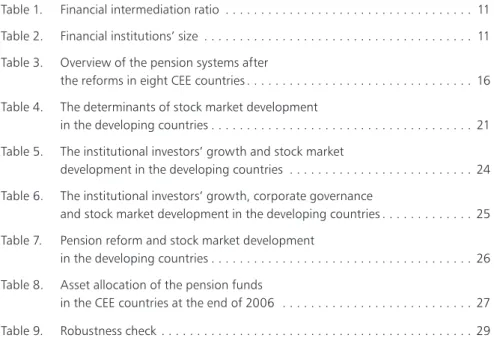
List of Tables
List of Tables
Table 1. Financial intermediation ratio . . . 11 Table 2. Financial institutions’ size . . . 11 Table 3. Overview of the pension systems after
the reforms in eight CEE countries . . . 16 Table 4. The determinants of stock market development
in the developing countries . . . 21 Table 5. The institutional investors’ growth and stock market
development in the developing countries . . . 24 Table 6. The institutional investors’ growth, corporate governance
and stock market development in the developing countries . . . 25 Table 7. Pension reform and stock market development
in the developing countries . . . 26 Table 8. Asset allocation of the pension funds
in the CEE countries at the end of 2006 . . . 27 Table 9. Robustness check . . . 29
Abstract
Abstract
In this paper, we evaluate an empirical link between recent institutional assets’ growth, institutional behaviour and stock market performance in the developing countries. Using the GMM technique on the panel of eight Central and Eastern European (CEE) developing countries over the period of 1995-2006, our results indicate that institutional development exerts a robust and significant impact on the securities markets’ growth in the developing countries. In particular, we find that institutional investors contribute to the greater activity of the emerging capital markets and this effect is a result of higher demand for the local securities induced by these institutions. In addition, in countries where the institutional investors actively participate in the corporate governance, their presence possibly reduces the cost of capital for firms and also positively influences the stock market capitalization. Our findings suggest that the pension reform has contributed significantly to the institutional development and stock market growth in the CEE countries.
Keywords: capital market development; capital market reforms; financial structure; institutional investors; pension reform
Non-technical summary
Non-technical summary
There has been a dramatic increase in the number of institutional investors in the financial structures of developing countries. The total assets of solely pension funds have risen in the emerging countries by more than 140 percent between 2000 and 2006, accounting for 1,050 billion of USD in 2006. The assets of the mutual funds have increased by an even higher percentage, with much of this growth achieved in the past two to three years (IMF, 2008).
Although the primary function of these institutions is to provide sustainable and affordable income for old age, the recent work suggests that the spillovers on the financial system are significant. In particular, the theoretical and empirical evidence based on the experience of the advanced countries has documented the beneficial role of institutional investors in supporting the development of the securities markets and related infrastructure in these economies (Bodie, 1995; Blommestein, 1996; Davis, 2000; Velury and Jenkins, 2006).
Given the beneficial role of these institutions for the financial development of the advanced countries and the importance of well-developed financial markets for financial stability and economic growth, the recent growth of institutional investors in the emerging countries also raises the question of the role of these institutions in the financial systems of these economies.
For almost one decade, the developing countries have tried to spur the development of their local capital markets. However, despite the initiated macroeconomic and financial reforms, the performance of the securities markets has remained relatively weak for most of the time. In this paper, we evaluate an empirical link between recent institutional assets’ growth, institutional behaviour and stock market performance in the developing countries.
Using the GMM technique on the panel of eight Central and Eastern European (CEE) developing countries over the period of 1994-2006, our results indicate that institutional development exerts a robust and significant impact on the securities markets’ growth in the developing countries. In particular, we find that institutional investors contribute to the greater activity of the emerging capital markets and this effect is a result of higher demand for the local securities induced by these institutions. In addition, in countries where the in-stitutional investors actively participate in the corporate governance, their presence possibly reduces the cost of capital for firms and also positively influences the stock market capitali-zation. Our findings suggest that the pension reform has contributed significantly to the institutional development and stock market growth in the CEE countries. However, we find that magnitude of these effects depends on the pension scheme a country relies upon.
Introduction
1
1
Introduction
There has been a dramatic increase in the number of institutional investors in the financial structures of developing countries. The total assets of solely pension funds have risen in the emerging countries by more than 140 percent between 2000 and 2006, accounting for 1,050 billion of USD in 2006. The assets of the mutual funds have increased by an even higher percentage, with much of this growth achieved in the past two to three years (IMF, 2008).
Although the primary function of these institutions is to provide sustainable and affordable income for old age, the recent work suggests that the spillovers on the financial system are significant. In particular, the theoretical and empirical evidence based on the experience of the advanced countries has documented the beneficial role of institutional investors in supporting the development of the securities markets and related infrastructure in these economies (Bodie, 1995; Blommestein, 1996; Davis, 2000; Velury and Jenkins, 2006).
Given the beneficial role of these institutions for the financial development of the advanced countries and the importance of well-developed financial markets for financial stability and economic growth, the recent growth of institutional investors in the emerging countries also raises the question of the role of these institutions in the financial systems of these economies. The answer to this question seems to be highly relevant from the perspective of policymakers. Should institutional growth significantly contribute to the development of the securities markets in these countries, regulators can spur the growth of the capital markets in the developing economies by adopting the regulations and reforms that help to attract institutional investors.
Therefore, with our study we wish to, for the first time, examine the role and the behavior of institutional investors in emerging economies. Specifically, we would like to look at whether and how the recent growth of institutional investors can help emerging countries to support the growth of their local securities markets.
From the academic perspective, our study contributes significantly to the ongoing debate about the determinants of successful stock market development in emerging countries. For a long time, the academic literature and policymakers have been concerned about the poor performance of the developing capital markets. There has been no clear view of why, despite the numerous reforms initiated in the developing countries, the capital markets of these countries remained for a relatively long time period highly illiquid and segmented. One array of studies attributes a weak performance of the developing securities markets to the inaccurate assessment of the reforms formulated at the beginning of the transition. These studies claim that the financial markets might not respond uniformly to the reforms as had initially been assumed. One reason for this might be that the valuation of the reforms was based on cross-country studies that have neglected countries’ unobserved characteristics. This limitation could contribute to the inaccurate valuation of the results and thus assessment of the reform agenda (Collier et al., 2000). Other studies document that the reforms have significantly contributed to the improvement of the capital markets’ fundamentals in the developing countries; however, the weak performance of the emerging securities markets was probably the result of a missing piece in the reform
Introduction
1
agenda (Gozzi et al., 2006). The results of these studies on how to revise the reform agenda to spur the growth of developing securities markets are very inconclusive and have left the policymakers without clear guidance.
There are also a few studies claiming that developing countries will not be able to create local securities markets at all. For example, Eichengreen and Hausmann (1999) claim that the emerging countries are not able to develop the domestic bond markets on their own because they suffer from “original sin.” This “original sin” refers to a country’s inability to borrow abroad in its own currency and/or to take on long-term debt in its domestic currency, possibly because of unfavorable macroeconomic and fiscal history of these countries. Collier et al. (2000) argue that the developing countries cannot develop their markets because the domestic corporations prefer to cross-list in countries with high regulatory standards, possibly because of lower cost of financing for them. However, Claessens et al. (2002a) claim that even if the fundamentals of the emerging markets improve, some developing countries will still not be able to develop their local stock markets because the improvement at the same time triggers the migration of domestic capital to international stock exchanges.
The recent growth of several developing countries’ capital markets call for the renewed assessment of financial reforms in these countries.1 In addition, the dramatic increase of the
number of institutional investors in the financial systems of the emerging markets creates a great baseline for testing the role of these institutions in the recent development of emerging capital markets and thus for reestablishing the set of determinants of successful stock market growth in emerging economies. Most of the empirical and theoretical studies have particularly neglected a beneficial role that the institutional investors may play in the financial development.
To assess an empirical link between the recent growth of institutional investors in the emerging economies and stock market performance in these countries, we use a GMM panel technique on the sample of eight CEE developing economies: Poland, the Czech Republic, Slovakia, Slovenia, Hungary and three Baltic states within the period of 1995-2006. In our opinion, these countries constitute a great testing ground on this relationship because despite the fact that they started their transition process under similar macroeconomic and institutional environments and that all of them had to develop their financial markets from scratch, the current size and structure of their domestic financial systems differ significantly between these economies. Moreover, although all these countries have experienced a dramatic growth of their institutional sectors recently, its speed and specifics has varied importantly between them. Finally, the capital markets of several CEE countries have experienced one of the most significant growth among the European markets in the last years.
Consistent with the cross-sectional studies, our results suggest that reforms of macroeconomic fundamentals, financial liberalization, better corporate governance mechanisms and well-developed banking sectors are inevitable and have spurred the development of the securities markets in the developing countries. Second, we find that the recent dramatic growth of the institutional investors in the developing countries significantly contributes to the development of the securities markets in these countries. This result is consistent with Black (2000), who argues that as long as the developing countries do not develop the appropriate domestic institutional structure and “core capital markets
1 In several emerging economies, one can observe the recent significant growth of the capital markets.
For example, in 2008, the Warsaw Stock Exchange was the second most active IPO market in Europe, following the London Stock Exchange. In addition, in terms of market capitalization and turnover, the
stock exchanges of the transition countries started to successfully compete with those of the developed countries.
Introduction
1
institutions”, they will not be able to develop their local securities markets. Therefore, our findings seem to suggest that a poor institutional structure was responsible for the weak performance of the capital markets over the last decade.
Specifically, we find that greater “bias” of the institutional investors’ portfolios towards long-term assets and their high investment volume, as compared to those of individual investors, trigger the demand for securities in the developing countries. As a result, the equities markets are becoming more active, and the bond markets are deepening. Moreover, the results also suggest that in countries where the institutional investors actively participate in corporate governance, their presence possibly reduces the cost of capital for firms and positively influences stock market capitalization. Finally, our regression analyses indicate that pension reform has significantly contributed to the development of the institutional structures of the developing countries as well as to the growth of the securities markets in these countries. We also find that the magnitude of the effect of pension reform on stock market development is stronger in countries with mandatory contributions than in those with other pension schemes.
The rest of the paper is organized as follows. Section 2 analyzes and discusses the recent changes in the financial development of the transition countries. Section 3 reviews the literature on the link between the institutional development and stock market growth and develops the hypotheses. Section 4 describes the data for the empirical analyses and the methodology applied. Section 5 presents the results, and Section 6 concludes.
Structure of the financial markets in the developing countries
2
2
Structure of the financial markets
in the developing countries
The institutional building and development of the financial markets turned out to be one of the hardest tasks that policymakers have had to face to in transforming the economies of the CEE countries. All transition countries have had to create their financial sectors entirely from scratch. This section discusses how the financial markets have evolved in the eight transition countries over the last twenty years as well as their recent changes in the developmental process. Specifically, it analyzes the recent growth of institutional investors and its impact on the financial structure of the CEE developing countries.
2 .1 . The recent changes in the financial development of the developing
countries
Besides the impressive achievement of creating financial infrastructure for market economies, most financial markets outside the banking industry have remained for a very long time almost nonexistent. The first boost to the development of the non-banking financial institutions in the CEE financial structures came with the introduction of pension reforms. In addition, the accession of the CEE countries to the EU has created a regulatory infrastructure that has begun to support the development of these non-banking institutions.
Table 1 presents the importance and the development of the financial intermediaries in the financial structure as well as relative to the size of the economies of eight CEE countries.
As one can see, the banking sector was the only financial industry that had been experiencing a significant growth for a long time. It almost completely dominated the domestic financial sectors. Only recently has the appearance of the financial institutions outside the banking sector seemed to change this situation. The share of banks in financial intermediation has started to decline. In contrast, the share of financial intermediation undertaken by non-banking institutions has risen rapidly in all analyzed transition countries. On average, the ratio of assets of the institutional investors to the assets of the entire financial sectors of all eight economies amounted to 4 percent in 1995 and 8 percent in 2000, whereas in 2006 it was already 15 percent. The strongest increase in institutionalization has occurred in the countries with the mandatory pension systems (the exception is, however, Latvia). In contrast, the same growth in the institutional assets occurred in the G-7 countries, but it has happened after thirty years (Davis and Steil, 2001).
The size of institutional investors has correspondingly risen relative to GDP much more than that of banks. Although the banking sector still dominates in the economy, assets of the institutional investors have been increasing since 2001 at more rapid pace than that of banks.
Structure of the financial markets in the developing countries
2
Table 1. Financial intermediation ratio
(intermediated claims as a proportion of the total) and size indicator of the financial intermediary sector (intermediated claims as proportion of GDP)*
Size of the sector as a proportion
of financial assets
Size of the sector as
a proportion of GDP 1995 1998 2001 2003 2006 1995 1998 2001 2003 2006 Slovakia 1.00 0.93 0.88 0.80 0.77 0.97 1.01 0.91 0.81 0.86 Czech Republic 0.88 0.89 0.78 0.74 0.73 1.26 1.21 1.06 0.98 0.97 Hungary 0.94 0.86 0.78 0.76 0.66 0.69 0.69 0.63 0.73 0.93 Poland 0.95 0.91 0.84 0.75 0.67 0.44 0.53 0.60 0.58 0.64 Estonia 0.90 0.78 0.78 0.86 0.76 0.36 0.53 0.63 0.74 1.16 Latvia 0.87 0.90 0.91 0.91 0.90 0.30 0.42 0.66 0.89 1.41 Lithuania 0.74 0.69 0.71 0.70 0.71 0.26 0.24 0.32 0.39 0.72 Slovenia n.a. 0.78 0.71 0.72 0.72 0.62 0.67 0.81 0.87 1.14 Average 0.90 0.84 0.80 0.78 0.74 0.61 0.66 0.70 0.75 0.98 Institutional investor’s sector Slovakia 0.03 0.06 0.08 0.11 0.18 0.03 0.06 0.08 0.11 0.20 Czech Republic 0.12 0.09 0.11 0.15 0.15 0.17 0.13 0.15 0.19 0.20 Hungary 0.03 0.08 0.14 0.17 0.20 0.05 0.09 0.14 0.17 0.29 Poland 0.04 0.06 0.15 0.22 0.32 0.02 0.04 0.11 0.17 0.31 Estonia 0.03 0.07 0.06 0.10 0.12 0.01 0.04 0.05 0.08 0.18 Latvia 0.03 0.05 0.04 0.03 0.03 0.01 0.02 0.03 0.03 0.05 Lithuania 0.02 0.06 0.05 0.05 0.06 0.01 0.02 0.02 0.03 0.06
Slovenia n.a. n.a. 0.17 0.14 0.16 n.a. n.a. 0.19 0.17 0.26
Average 0.04 0.07 0.10 0.12 0.15 0.04 0.06 0.10 0.12 0.19
Sources: National flow-of-funds balance sheet data, national banks and OECD Institutional Investors Book (2008).
*Intermediated Claims are defined as total claims in an economy which are held by financial intermediaries such as banks and institutional investors.
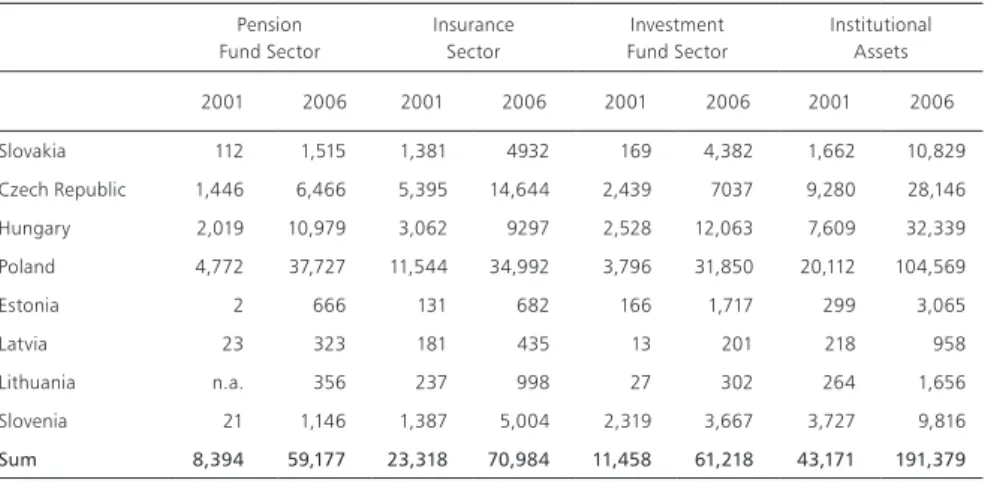
Concerning the size of the institutional sector in absolute terms as well as the growth of the individual institutions, the pension funds have grown faster than other types of institutional investors over the long-term. Table 2 illustrates the size of the individual institutional investors of the eight CEE countries.
Table 2. Financial institutions’ size (in mln USD)
Pension Fund Sector Insurance Sector Investment Fund Sector Institutional Assets 2001 2006 2001 2006 2001 2006 2001 2006 Slovakia 112 1,515 1,381 4932 169 4,382 1,662 10,829 Czech Republic 1,446 6,466 5,395 14,644 2,439 7037 9,280 28,146 Hungary 2,019 10,979 3,062 9297 2,528 12,063 7,609 32,339 Poland 4,772 37,727 11,544 34,992 3,796 31,850 20,112 104,569 Estonia 2 666 131 682 166 1,717 299 3,065 Latvia 23 323 181 435 13 201 218 958 Lithuania n.a. 356 237 998 27 302 264 1,656 Slovenia 21 1,146 1,387 5,004 2,319 3,667 3,727 9,816 Sum 8,94 59,177 2,18 70,984 11,458 61,218 4,171 191,79
Sources: National flow-of-funds balance sheet data, national banks, national banks and OECD Institutional Investors Book
Structure of the financial markets in the developing countries
2
Institutional assets have grown from 43 billion to almost 200 billion USD in all eight CEE countries during 2001-2006. One can notice that from all groups of institutional investors, the pension fund industry has experienced the most dramatic growth in all CEE countries, although recently at the slower pace than at the beginning of 2000. The insurance sector has also experienced a sharp growth in assets, but its recent development is the poorest of all groups of the institutional investors. Finally, as far as the investment industry is concerned, all CEE countries have been experiencing dramatic growth in the investment funds’ assets since 2001. Their assets grew from 11.5 billion USD in 2001 to 61.22 billion USD in 2006. The highest growth has occurred again in countries with the mandatory pension schemes.
2.2. Institutional investors and local stock markets in the developing
countries
The increase of the institutional investors’ asset base also makes these institutions important participants of the local capital markets. At the end of 2006, the participation of the institutional investors exceeded 20 percent of the local stock market capitalization in countries such as Poland or Hungary, compared with well below 10 percent at the beginning of 2000. In addition, the turnover generated by these institutions on the local stock markets substantially increased in several CEE countries and already exceeded that of individuals and foreign investors. As a result, institutional investors are becoming important shareholders of the local companies. Additionally, the high volume of investment as well as characteristics of the emerging capital markets as low liquidity and concentrated ownership have also recently encouraged institutional investors to actively participate in corporate governance in these countries. In particular, the pension funds have begun to abandon their passive shareholder role and are becoming more active in the governance of their corporate holdings.
Literature review – institutional growth and stock market development
3
Literature review – institutional growth
and stock market development
This section reviews the literature on the role of institutional investors in the financial development. In particular, it focuses on how their development may support the growth of the local securities markets.
3.1. Growth of institutional assets and stock market development
There exist two views of how the institutional growth may promote the development of the local securities markets. The first view is associated with the development of institutional investors’ assets per se in the domestic economies and an increased demand for the local securities. The second view is more qualitative and refers to the contribution of the institutional investors to the reduction of information asymmetries in the economy as a consequence of better corporate governance and greater market transparency. In addition, the experience of several developed countries supported by the academic theoretical and empirical studies has shown that institutional development results in the development and improvement of market infrastructure needed for efficient functioning of local capital markets.
The first view of the positive impact of institutional investors on stock market growth attributes the effect to the structure of the balance sheet of these institutions. Unlike other financial intermediaries, institutional investors have the long-term nature of the liabilities.2 These characteristics of the institutional investors have important implications for the financial market development. First, these institutions have a natural advantage over banks in financing long-term projects, and their investment strategies are therefore more biased toward long-term bonds and equity markets (Catalan et al., 2000). Additionally, the development of the institutional investors is likely to stimulate a liquidity effect, which may further impact the development of the local capital markets. The liquidity effect is related to the rebalancing of the households and corporate portfolios, who shift their holdings from illiquid assets as real-estate or non-traded instruments into liquid ones such as deposits, open-ended mutual funds or traded securities (Davis, 1995). Thus, the increased demand for local securities as well as a large volume of institutional investment should spur both the activity and liquidity of the local securities markets. In addition, the increased investment of the institutional investors should also reduce the cost of capital for firms and positively affect the market capitalization as a result of greater efficiency of capital markets.
Second, the longer time horizon of institutional investments, as compared to that of individuals, reduces the “term premium” leading to the reduction of cost of capital for firms (Walker and Lefort, 2002). Additionally, the institutional investors’ ability to pool funds and their professional management further decreases the equity premium, which also reduces the cost of capital (Walker and Lefort, 2002). The decline of the cost of capital makes
2 This results from the fact that depositors or other investors cannot run or withdraw their money suddenly
and on a large scale. They can only be liquidated in the long run upon occurrence of a particular event (e.g., death or disability) or retirement of beneficiary (either as a lump sum i annuity).
Literature review – institutional growth and stock market development
3
external financing cheaper for firms, allowing more companies to finance their investments through the capital markets. This should have a positive impact on the domestic stock market capitalization.
3.2. Institutional investors, corporate governance and stock market
development
The second view of institutional influence on stock markets’ growth is related to the contribution of institutional investors to the improvement of corporate governance mechanisms and capital market infrastructure.
The financial development literature has shown that a well-developed corporate governance structure will inevitably spur the growth of securities markets. It has been documented that the improvement of corporate governance mechanisms is positively correlated with a lower cost of capital for firms, a higher return on equity and a greater efficiency of the capital markets (La Porta et al., 2000, 2002; Morck et al., 1988; Doidge et al., 2004).
The academic studies have documented that institutional investors may significantly contribute to the improvement of the domestic corporate governance standards, since as opposed to other investors they can overcome the free rider problem and thus undertake monitoring or other costly activities (Grossmann and Hart, 1980; Shleifer and Vishny, 1986).
One set of studies has shown that institutional investors are very careful monitors of firms they invest in and actively intervene when needed. For example, Del Guercio and Hawkins (1999) show that pension funds are very effective in promoting changes in a company’s business policies, organization or governance. Gillan and Starks (2000) and recently Kahan and Rock (2006) find similar results for investment funds and hedge funds. Harzell and Starks (2003) find evidence suggesting that institutional investors are successful in monitoring of executive compensation. Bushee (1998) documents that firms with higher institutional ownership are less likely to manipulate their earnings and that institutions overall serve a monitoring role in reducing pressures for managers’ myopic behavior. Interestingly, Parrino et al. (2002) provide evidence that institutional investors contribute to changes even without active participation in the corporate governance. They find that disposal of their investment in an associated firm triggers the changes in this firm.
Additionally, increasing institutional ownership might also promote better accounting standards and contribute to greater market transparency. The literature documents that financial statements of corporations are important sources of information upon which institutional investors make their decisions (Potter, 1992; El-Gazzar, 1998). Chung et al. (2002) and Velury and Jenkins (2006) show that in firms with high institutional ownership, the accounting techniques aimed at income-smoothing are less likely and reported earnings are more reliable. Kane and Velury (2004) document that institutional investors can successfully influence management to self-monitor better and to produce a higher quality of audits. As a result, they find that firms with higher institutional ownership have better audit quality and thus better reported earnings.
The institutional investors might also improve the regulatory infrastructure by influencing the decisions of policymakers. Their representatives usually have access to the regulatory bodies. Since the institutional investors are minority shareholders collectively holding the majority of a firm, they may influence decisions with regard to corporate law
Literature review – institutional growth and stock market development
3
and minority shareholder protection. The role of the pension funds as government lobbyists has been well-documented by the experience of many countries.3
Finally, the experience of the developed countries and recent theoretical and empirical academic studies document that institutional investors might help countries develop the necessary capital market infrastructure. In turn, the capital markets may work more efficiently decreasing hereby the transaction costs and enhancing more investment. For example, Davis (2000) relates that the growth of institutional investors in the U.K. and U.S. in the early 90s resulted in the development of trading desks for large securities firms and institutional investors. Also, the trend towards the electronic order books in the major stock exchanges seems to be a result of institutional development (Blommestein, 1996). Benos and Croughly (1996) document that the development of specialized wholesale markets as London’s SEAQ International also has its roots in institutional development. As a result, the activity of the securities market in the U.K. has increased dramatically compared with other major European stock exchanges. Bodie (1995) finds that the need for pension funds to hedge against the losses exposure has contributed to the evolution of zero and coupon bonds and index futures in the advanced countries. Similarly, the immunization and indexation strategies of the pension funds have stimulated the development of the markets for index and future options in the U.S. and Canada (Bodie, 1990; Davis, 1995). Empirically, Claessens et al. (2006) show that improvement in capital market infrastructure, which came with the introduction of electronic trading is positively associated with the reduction of transaction costs and an increase of domestic stock market capitalization and turnover. Schmiedel (2001) shows that better market transparency and adoption of automated trading systems positively influence the efficiency of the stock markets hereby reducing the transaction costs.
3.3. Pension reform, institutional investors’ growth and stock market
development
At the beginning of the 1990s, theoretical literature as well as analytical studies, particularly those made by the IMF and the World Bank, started to point out the role of pension reform on stock market development. It has been argued that the shift from the PAYG pension system into a funded one might help developing countries create their institutional structure and spur the growth of local securities markets. The intuition behind it was to make savings mandatory and, by mobilizing and allocating these savings in the private sector, to contribute to the development of new financial institutions, simultaneously spurring the growth of local capital markets. In addition, savings managed by private funds, as opposed to public funds, could be kept away from political control and manipulation and thus could be less biased towards various distortions. Although, the World Bank Report (1994) distinguishes several types of the funded pension schemes, it strongly recommends that developing countries introduce a three-pillar system on defined contribution nature with a privately-managed mandatory participation within the second pillar.
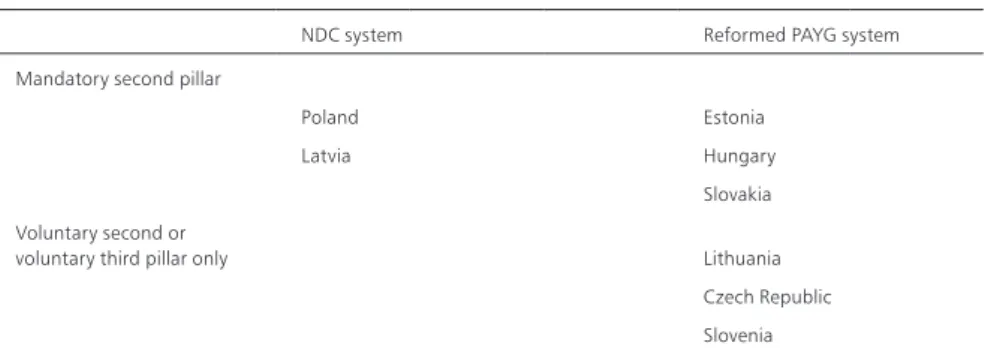
Following the World Bank recommendation, several countries have decided to reform their social security systems and switch from PAYG into a funded one. At the same time, many of them have adopted variants of the retirement systems recommended by the World Bank. Table 3 presents the overview of the pension systems in eight CEE countries.
3 For the influential role of the pension funds in various countries, see for example: “Pension body targets
directors”, Financial Times, June 27, 2003 for Japan; “Power of the individual”, Financial Times, October 22, 2001 for Europe; Hill et al. (1999) or Walker and Lefort (2002) for Argentina and Chile, respectively.
Literature review – institutional growth and stock market development
3
Table 3. Overview of the pension systems after the reforms in eight CEE countries
NDC system Reformed PAYG system
Mandatory second pillar
Poland Estonia
Latvia Hungary
Slovakia
Voluntary second or
voluntary third pillar only Lithuania
Czech Republic
Slovenia Source: Allianz Global Investors 2007.
Although many research studies report the dramatic growth of pension funds’ assets after the pension reform, evidence on the role of the pension funds in the development of the stock markets is mixed. Several studies also question the predominant role of the mandatory pension scheme over other types of funded social security systems in the development of the capital markets.
Already in 1993, Uthoff stated that despite the dramatic growth of the pension funds’ assets in Chile after the pension reform, it is hard to find any direct casual link between this reform and the country’s stock market development. He argues that although the Chilean stock market developed rapidly since the mid-1980s, this growth occurred during a period of high and stable GDP growth rates and large capital inflows. He showed that despite the reform, the growth of the Chilean equity market was not out of line with the development of other emerging capital markets.
In addition, the recent reports of the financial organizations such as the World Bank (2006) and IMF (2004) indicate the unrealized projections of the pension reforms. World Bank (2006), in its report summarizing the impacts of the multi-pillar reforms, notices that most capital markets have not developed significantly as a result of multi-pillar pension reform but that even the financial sector and capital market regulation have improved. The report concludes that the equity markets are influenced by many unrelated factors other than a potential pool of funds.
The IMF (2004) also presents evidence supporting the view that the accumulation of the sizable pension assets as a result of pension reform does not guarantee the development of the capital markets in the developing countries.
Davis (2002) argues that one of the reasons for the weak effect of pension reform on capital market development might be the restrictive regulations on the investment and asset allocation imposed on the pension fund industry in most of the developing countries. Theoretically, if the pension funds are not allowed to invest in the equity markets, the impact of the growth of the pension funds’ assets on the securities market will be very weak, if there is any impact. Moreover, in case these restrictions explicitly or implicitly obligate the pension funds to invest in the government bonds, which are repaid from taxation, there might be no benefit to capital formation, and the funded plans may at the macroeconomic level be virtually equivalent to the PAYG system (Davis, 2002). Additionally, the ineffective allocation of capital may further hinder the development of the financial markets and thus economic growth. On the other hand, relaxing the restrictions on the foreign portfolio might weaken the effect of pension reform on the development of the local securities markets. It might also have an additional negative effect. The higher degree of the pension funds’ participation in foreign markets may also trigger such behavior by
Literature review – institutional growth and stock market development
3
other investors and companies. Since the pension funds are subject to various transparency rules, these could reduce the costs of obtaining information for other investors and increase the migration of domestic capital into foreign stock exchanges.
Data and methodology
4
4
Data and methodology
This section describes our dataset and the econometric method that we use to empirically assess the strength of the impact of institutional investors’ development on stock market growth in the developing countries as well as the channel through which the institutional investors contribute to this growth.
4 .1 . Data
We are interested in the effect of the recent development of institutional investors on domestic stock market growth. The dataset consists of a panel of observations for eight transition market economies: Poland, the Czech Republic, Slovakia, Latvia, Lithuania, Slovenia and Hungary and three Baltic states for the period of 1995-2006. We use three measures of stock market development: stock market capitalization as a proxy for the development of stock markets, the value of stock traded as a proxy for the activity of the stock markets, and finally the total value of bonds outstanding (public and private) as a proxy for bond market depth. All these variables are measured in relation to GDP. The data come from World Bank Development Indicators and the Bank for International Settlement for bond markets data. All of these measures have been widely used in the empirical financial development literature (Levine and Zervos, 1998; Rousseau and Wachtel, 2000; Beck et al., 2000).
Regarding the size of the non-banking institutional sector, we define institutional investors’ assets as a sum of the assets of pension funds, insurance companies (both life and non-life) and investment funds measured at the end of the year for each economy during the period of 1995-2006. We scale this variable against the total financial assets of the economy. However, since the correlation between the growth of institutional investors and the development of securities markets may simply be the consequence of price movements, we follow Impavido et al. (2003) and define total financial assets of the economy as a sum of stock market capitalization and the value of total bonds outstanding and M2. This ratio would enable us to capture the importance of institutional investors relative to total financial assets in the economy. Most data on institutional investors’ assets come from the OECD Institutional Investors Book (2008) database and are complemented, particularly for the first years by the national sources.
4 .2 . Methodology
To analyze the impact of the recent development of the institutional investors on capital market growth in the developing countries, we use the recently developed dynamic panel data GMM technique to address potential endogeneity in the data. At the same time, it enables us to take advantage of the heterogeneity of the data by introducing the dummy variables for the time and country effects and controlling for the effects of those omitted variables that are specific either to individual country or to each time period.
Data and methodology
4
Taking the above into consideration, we are interested in the following specification:
yi,t – yi,t-1 = (α – 1) yi,t-1+ β' X i,t + δi + γ i +ε i,t (1)
where yi,t – yi,t-1 is the difference in either stock market capitalization relative to GDP, the value of stock traded relative to GDP or the bond market depth relative to GDP; X i,t is a set of explanatory variables, including our measure for institutional investors’ development in relation to the domestic financial assets; δ captures unobserved country-specific effects;
γ i represents time-specific effects; and ε i,t is an error term. The subscripts i and t represent country and time period, respectively.
We use the Arrelano-Bond (1991) GMM difference estimator to eliminate the country-specific effect, which is likely to be correlated with the explanatory variables. Since, by construction, the lagged difference of the dependent variable is correlated with the error term, the potential endogeneity of the explanatory variables X requires the use of instruments. The GMM difference estimator uses the lagged levels of explanatory variables as instruments under the conditions that: (a) the error term is not serially correlated, and (b) the explanatory variables are weakly exogenous (i.e., the explanatory variables are assumed to be correlated with the future realizations of the error term). Arellano and Bond (1991) use the following moment conditions to calculate the difference estimator:
E [yi,t-s (ε i,t – ε i,t-1)] = 0 for s≥ 2; t=3, …T. (2)
E [yi,t-s (ε i,t – ε i,t-1)] = 0 for s≥2; t=3,… T. (3)
Using these moment conditions, Arellano and Bond propose a two-step GMM estimator. However, the Monte Carlo estimations have shown that in cases with a small sample size, the two-step standard errors of the GMM estimator tend to be downward biased, affecting the appropriateness of the results. Thus, Arellano and Bond (1991) recommend the application of the one-step regression, which provides the most reliable estimates for the small dimension of the panel. For this reason, we rely on the results from the first-step estimation; however, we correct them for heteroskedasticity.
The determinants of stock market development in the developing countries
5
5
The determinants of stock market
development in the developing countries
This section examines the empirical relationship between the recent growth of institutional investors, the role of these institutions in the domestic financial systems and stock market performance in the developing countries. It also assesses the impact of pension reform on the development of institutional structure and stock markets in the developing countries.
5 .1 . The conditioning information set
There is a huge body of theoretical and empirical literature examining the determinants of stock market development. In particular, these contributions have documented that sound macroeconomic fundamentals, improvement in regulatory and supervisory structure, a higher level of banking development and greater financial openness can spur the development of local securities markets.4
Consistent with this literature, we control for these effects in our standard set of conditioning variables. To control for macroeconomic stability, we include in our analyses inflation rate (log) and the ratio of government balance to GDP (the negative numbers indicate the budget deficit). Huybens and Smith (1999) theoretically and Boyd et al. (2001) empirically show that higher levels of inflation are associated with smaller, less active and less efficient stock markets. Additionally, Barro (1991) shows that greater government consumption has a negative impact on capital formation, possibly because of the taxation of the economy. La Porta et al. (1997, 1998) show that countries with greater legal protection have better developed capital markets. However, Pistor et al. (2000) extend the analysis of La Porta et al., referring to the problems of transition countries. Additionally, several studies highlight the importance of appropriate regulations aimed at creating the proper legal and regulatory framework for the development of capital markets (Claessens et al., 2006; Schmiedel, 2001; Domowitz et al., 2001). Consistent with this literature, we use two variables that control for corporate governance environment: a) the law and order index as a proxy for the quality of law and its enforcement in a country and b) the stock market integrity index. The first index is reported by the International Country Risk Guide and ranges from zero to six, with the higher numbers indicating better shareholders’ rights and more effective enforcement. The second variable is a stock market integrity index developed by Pistor et al. (2000).5 The index ranges from 0 to 6, with higher scores representing greater integrity. Additionally, a large body of studies highlights the impact of financial liberalization and the inevitable role of foreign investors in spurring the growth of the emerging capital markets. Consistent with Lane and Milesi-Feretti (2001) and IMF (2001) we use in our regression the sum of the absolute values of portfolio foreign investment assets and portfolio foreign investment liabilities in relation to GDP as a proxy for the international transaction openness. We retrieved this measure from the International Financial Statistics.
4 For a great literature overview, see Levine (2003).
5 The index captures the rules whose primary purpose is to ensure the integrity of the capital markets.
It includes such aspects as self-dealing and insider rules, provisions on independence of a shareholder register, the existence and formal independence of an agency charged with supervising the stock
The determinants of stock market development in the developing countries
5
In addition, we use the investment freedom index as a proxy for the general openness of a country to foreign investment. The index stems from the Heritage Economic Freedom
and ranges from zero to ten, with higher numbers indicating lower foreign investment restrictions. Brenton et al. (1999) show that a higher investment freedom index is correlated with higher FDI inflow, which in turn positively affects stock market growth (Claessens et al., 2002b). Levine and Zervos (1998) and Beck et al. (2000) show that countries with well-developed banking sectors tend to have more efficient and better functioning stock markets. We include the value of bank deposits to GDP to control for the size of the local banking markets. For the robustness check, we also use the ratio of the banks’ liabilities to GDP as an alternative measure of the banking sector’s size. However, the results of the regressions do not change, so we do not report it here. Finally, consistent with La Porta et al. (1997) and Rajan and Zingales (2003) who show that countries with higher incomes also tend to have deeper and better functioning capital markets, we include GDP per capita as a measure of countries’ overall economic development.
5.2. Determinants of stock market development in the developing
countries
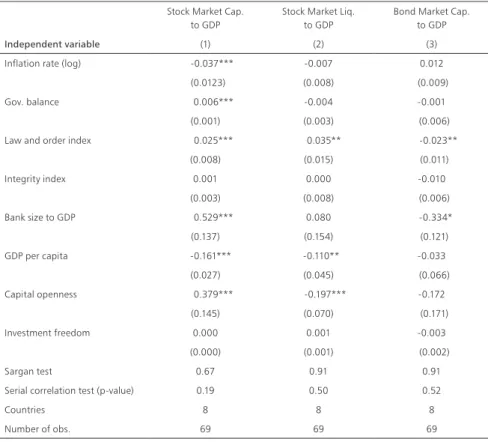
In Table 4, we present the Arellano-Bond regression results for the determinants of stock and bond market development in the emerging countries.
Table 4. The determinants of stock market development in the developing countries
Stock Market Cap.
to GDP
Stock Market Liq.
to GDP
Bond Market Cap. to GDP
Independent variable (1) (2) (3)
Inflation rate (log) -0.037*** -0.007 0.012
(0.0123) (0.008) (0.009)
Gov. balance 0.006*** -0.004 -0.001
(0.001) (0.003) (0.006)
Law and order index 0.025*** 0.035** -0.023**
(0.008) (0.015) (0.011) Integrity index 0.001 0.000 -0.010 (0.003) (0.008) (0.006) Bank size to GDP 0.529*** 0.080 -0.334* (0.137) (0.154) (0.121) GDP per capita -0.161*** -0.110** -0.033 (0.027) (0.045) (0.066) Capital openness 0.379*** -0.197*** -0.172 (0.145) (0.070) (0.171) Investment freedom 0.000 0.001 -0.003 (0.000) (0.001) (0.002) Sargan test 0.67 0.91 0.91
Serial correlation test (p-value) 0.19 0.50 0.52
Countries 8 8 8
Number of obs. 69 69 69
The table shows one-step estimates from Arellano-Bond regressions with the robust standard errors for a panel of 8 CEE countries between 1995 and 2006. All three regressions also contain time dummies and country dummies that are not reported here. The
null hypothesis of the Sargan test is that the instruments used are not correlated with the residuals. The null hypothesis of the serial correlation test is that the errors in the first-difference regression exhibit no serial correlation. Failure to reject the null hy -potheses of both tests supports our model.
***,**,* mean significance at one, five and ten percent, respectively
The determinants of stock market development in the developing countries
5
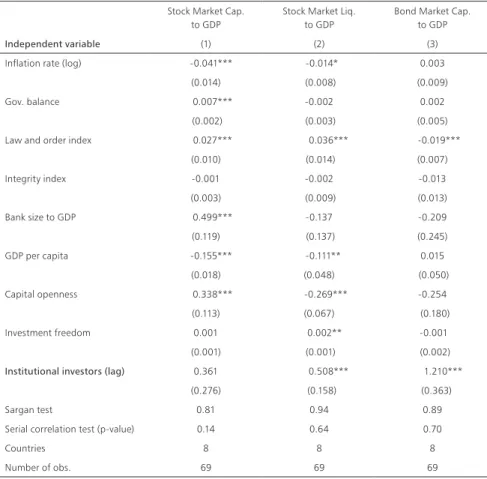
In the (1) specification, we use stock market capitalization to GDP as a proxy for the stock market development, and in specification (2), the stock value traded to GDP, conditioning on the discussed control variables. In specification (3), we look at the determinants of bond market development proxied by the bond market capitalization to GDP and regressing them upon the same set of the regressors as in the specification (1) and (2). In all specifications, the p-values for the Sargan test and the serial correlation test indicate the appropriateness of our instruments and the lack of serial correlation in the error term, ε.
In specification (1), the results support previous academic findings. Most of our control variables appear in the regression as being highly statistically significant. First, consistent with other studies, both variables measuring the macroeconomic stability of a country are significant at the one percent level. While inflation is negatively correlated with stock market development, the higher budget surplus seems to positively affect stock market capitalization. The effects are also economically large. Second, also consistent with previous studies, the shareholder environment is positively associated with stock market development; however, only the law and order variable is statistically significant. The result indicates that the improvement in the enforcement of shareholders’ rights encourages investment in equities and thus spurs the development of domestic stock markets. The variable measuring the capital market regulations has an expected positive sign but is insignificant. Third, consistent with the financial liberalization literature, the coefficient of the variable measuring the capital openness is positive and statistically significant. The result supports previous findings that the openness of the financial markets probably reduces the cost of capital, making external financing cheaper and thus available to a greater number of firms. In addition, the variable measuring the size of the banking sector is positively correlated with stock market development and appears in the regression as statistically significant. Consistent with other studies, the result indicates that the well-developed banking sectors are necessary for the development of the capital markets. The effect is also economically significant. Finally, the income per capita variable appears in the regression as highly significant, however surprisingly with the negative coefficient. This might be due to the different effects of the privatization processes, which in some CEE countries did not turn out to be successful.
The results present a slightly different picture when a stock market activity enters the regression as a dependent variable. None of the macroeconomic variables is statistically significant. Specifically, the insignificance effect of the inflation on stock market activity might be a result of the non-linear relation (Huybens and Smith, 1999; Boyd and Smith, 1998). We also observe a non-significant effect of government consumption on stock market activity. This might be a result of high participation of foreign investors in the local stock markets and thus an insignificant influence of the local taxation on foreign capital investment. Similar to specification (1), the law and order variable appears in the regression with the positive sign and is highly significant. The variable measuring the financial liberalization provides interesting implications. Unlike specification (1), the capital account openness appears in the regression with a negative sign. This finding indicates that since the openness of the capital markets may reduce the cost of external finance for firms, it may negatively affect the activity of the capital markets due to the outflow of domestic investment abroad. This finding is consistent with Claessens et al. (2006), who find that financial liberalization and openness of the capital markets might also lead to migration of capital trading activity to international stock exchanges. Interestingly, the variable measuring the size of the banking market appears in the specification (2) as insignificant. This is possibly because of the passive role of banks in promoting the integrity of the capital markets. Finally, income per capita appears again in the regression as highly significant and with the negative sign.
The determinants of stock market development in the developing countries
5
Specification (3) shows the results of the determinants of successful bond market development. Only two out of eight variables appear in the regression as statistically significant: the law and order index, and the size of the banking sector. The first one appears as highly statistically significant, but the coefficient shows a negative sign. This result might be due to the extensive financing of budget deficits by issuing government securities in the CEE countries at the beginning of the transition. As a result, in many of these economies the public bond markets experienced a dramatic growth. The second variable measuring the size of the banking sector also appears as highly significant with the negative sign. The result suggests that the banking sectors of the CEE countries seem to compete with the bond markets for the savings of population.
5.3. Institutional growth and stock market development in the
developing countries
Consistent with the discussed literature, in this section, we assess an empirical link between the growth of institutional assets and stock market development in the developing countries. Table 5 presents the results for three specifications: stock market capitalization (1), stock market activity (2) and bond market development (3). In all specifications, the
p-values for the Sargan test and the serial correlation test indicate the appropriateness of our instruments and the lack of serial correlation in the error term, ε.
In general, the results provide economically and statistically significant evidence on the positive effect of institutional development in the developing countries and stock market growth in those countries. More specifically, the findings support the view that a higher demand for securities, as a result of institutional investors’ development, affects the growth of securities markets, making the equities markets more active and the debt markets deeper. Both effects are also economically significant. For example, an increase of the institutional asset size relative to the financial sector’s assets by one percentage point increases stock market activity by 0.51 percent and bond market capitalization by 1.2 percent. The larger effect of institutional investors’ growth on bond market development can be explained by the structure of their portfolio, which has been more biased towards the government bonds. The results, however, do not support the view that institutional growth affects stock market capitalization in developing countries. It is possible, due to the relatively short history of institutional presence in the domestic CEE financial systems. Since the greater participation of the institutional investors in the local stock markets could be immediately reflected in more active securities markets, the increase of stock market depth is an effect of the greater financing of corporate investment through the capital markets. This in turn has been shown to be associated with the improvement of market fundamentals and the reduction of cost of capital for firms; note that these are long-term processes. Hence, we would expect that even if the institutional growth does not affect the stock market capitalization in the short run, as it is in our case, it may still exert a high and positive influence in the long run.
The inclusion of institutional assets into specification (2) results in a change of two estimates, as compared to the results from the previous regression (from Table 4): the investment freedom index and the inflation rate become significant. The positive sign of the variable measuring investment restrictions suggests that lower restrictions attract the inflow of FDI, positively affecting stock market development. The result is consistent with Claessens et al. (2002b), who find a positive association between the level of a country’s FDI and its stock market development. The negative sign of the inflation variable suggests that inflation hampers the activity of the capital markets, probably by imposing higher transaction costs on institutional investors. In specification (3), the inclusion of the institutional investors’ assets results in the loss of the significance of the variable measuring
The determinants of stock market development in the developing countries
5
the size of the domestic banking sector. This result might suggest that the effect of institutional assets’ growth on stock market development is independent from the financial structure of a country. The result is consistent with findings by Impavido et al. (2003).
Table 5. The institutional investors’ growth and stock market development in the developing countries
The table shows one-step estimates from Arellano-Bond regressions with the robust standard errors for a panel of 8 CEE countries between 1995 and 2006. All three regressions also contain time dummies and country dummies that are not reported here. The ratio of institutional investors’ assets to the domestic financial assets is included in the regression as a
one-year lag. The null hypothesis of the Sargan test is that the instruments used are not correlated with the residuals. The null
hypothesis of the serial correlation test is that the errors in the first-difference regression exhibit no serial correlation. Failure to reject the null hypotheses of both tests supports our model.
Stock Market Cap.
to GDP
Stock Market Liq.
to GDP
Bond Market Cap. to GDP
Independent variable (1) (2) (3)
Inflation rate (log) -0.041*** -0.014* 0.003
(0.014) (0.008) (0.009)
Gov. balance 0.007*** -0.002 0.002
(0.002) (0.003) (0.005)
Law and order index 0.027*** 0.036*** -0.019***
(0.010) (0.014) (0.007) Integrity index -0.001 -0.002 -0.013 (0.003) (0.009) (0.013) Bank size to GDP 0.499*** -0.137 -0.209 (0.119) (0.137) (0.245) GDP per capita -0.155*** -0.111** 0.015 (0.018) (0.048) (0.050) Capital openness 0.338*** -0.269*** -0.254 (0.113) (0.067) (0.180) Investment freedom 0.001 0.002** -0.001 (0.001) (0.001) (0.002)
Institutional investors (lag) 0.361 0.508*** 1.210***
(0.276) (0.158) (0.363)
Sargan test 0.81 0.94 0.89
Serial correlation test (p-value) 0.14 0.64 0.70
Countries 8 8 8
Number of obs. 69 69 69
***,**,* mean significance at one, five and ten percent, respectively t-statistics based on robust standard errors in the parenthesis
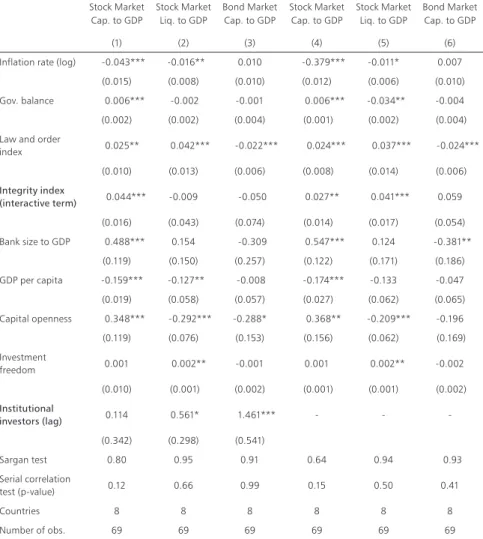
To test the second view of the financial literature, that institutional investors’ development affects stock market growth through the improvement of corporate governance environment and the greater integrity of the capital markets, we include into our analysis an interactive term as a two-year lag of the institutional investors’ assets with our integrity index at time t. Table 6 presents the results.
In the first three specifications, we keep the institutional investors’ assets as one of our independent variables; in specifications (4)-(6), we exclude this variable from our regressions. This allows us to better distinguish the sources through which the institutional investors affect stock market growth. The rest of the conditioning variables remain the same as in the previous regressions.
The determinants of stock market development in the developing countries
5
Table 6. The institutional investors’ growth, corporate governance and stock market development in the developing countries
The table shows one-step estimates from Arellano-Bond regressions with the robust standard errors for a panel of 8 CEE countries between 1995 and 2006. All three regressions also contain time dummies and country dummies that are not reported here. The regressions (1)-(6) include an interactive term defined as a two-year lag of institutional investors assets*capital market integrity index at time t. The ratio of institutional investors’ assets to the domestic financial assets is included in the regression as a one-year lag. The regressions on specifications (4)-(6) exclude the institutional assets as independent variable.
The null hypothesis of the Sargan test is that the instruments used are not correlated with the residuals. The null hypothesis of
the serial correlation test is that the errors in the first-difference regression exhibit no serial correlation. Failure to reject the null hypotheses of both tests supports our model.
Stock Market Cap. to GDP Stock Market Liq. to GDP Bond Market Cap. to GDP Stock Market Cap. to GDP Stock Market Liq. to GDP Bond Market Cap. to GDP (1) (2) (3) (4) (5) (6)
Inflation rate (log) -0.043*** -0.016** 0.010 -0.379*** -0.011* 0.007
(0.015) (0.008) (0.010) (0.012) (0.006) (0.010)
Gov. balance 0.006*** -0.002 -0.001 0.006*** -0.034** -0.004
(0.002) (0.002) (0.004) (0.001) (0.002) (0.004)
Law and order
index 0.025** 0.042*** -0.022*** 0.024*** 0.037*** -0.024*** (0.010) (0.013) (0.006) (0.008) (0.014) (0.006) Integrity index (interactive term) 0.044*** -0.009 -0.050 0.027** 0.041*** 0.059 (0.016) (0.043) (0.074) (0.014) (0.017) (0.054) Bank size to GDP 0.488*** 0.154 -0.309 0.547*** 0.124 -0.381** (0.119) (0.150) (0.257) (0.122) (0.171) (0.186) GDP per capita -0.159*** -0.127** -0.008 -0.174*** -0.133 -0.047 (0.019) (0.058) (0.057) (0.027) (0.062) (0.065) Capital openness 0.348*** -0.292*** -0.288* 0.368** -0.209*** -0.196 (0.119) (0.076) (0.153) (0.156) (0.062) (0.169) Investment freedom 0.001 0.002** -0.001 0.001 0.002** -0.002 (0.010) (0.001) (0.002) (0.001) (0.001) (0.002) Institutional investors (lag) 0.114 0.561* 1.461*** - - -(0.342) (0.298) (0.541) Sargan test 0.80 0.95 0.91 0.64 0.94 0.93 Serial correlation test (p-value) 0.12 0.66 0.99 0.15 0.50 0.41 Countries 8 8 8 8 8 8 Number of obs. 69 69 69 69 69 69
***,**,* mean significance at one, five and ten percent, respectively t-statistics based on robust standard errors in the parenthesis
Consistent with the discussed literature, the regression estimates of specification (1) show that institutional investors’ asset growth indirectly affect the development of the capital markets by improving corporate governance practices and increasing transparency. The interactive variable appears in the regression as positively correlated with stock market capitalization, and it is highly significant. However, the measure of institutional investors’ assets in the regression is still insignificant. This result may confirm the findings from our previous regression. The growth of the institutional investors’ assets per se does not increase stock market capitalization in the short run, yet the activism of the institutional investors contributing to better corporate governance practices and their preservation may reduce the cost of capital for firms positively affecting the stock market development in these countries. Interesting, however, is the result of specification (2). The interactive variable appears in the regression as highly insignificant once we control for the growth of
The determinants of stock market development in the developing countries
5
institutional investors’ assets. The coefficient of the institutional variable is still statistically significant. However, once we exclude the assets of institutional investors from our analysis, the coefficient of the interactive variable is highly statistically significant ((specification (5)). These findings suggest that institutional investors’ development indeed helps the developing countries improve their corporate governance practices and transparency of the markets, spurring the growth of the CEE countries’ securities markets. However, the higher activity of the stock market is primarily driven by a high demand for securities stemming from the institutional assets’ growth. The results of the specification (3) seem to support previous findings. They suggest that the bond market development in the developing countries is an effect of higher demand for securities induced by the growth of institutional investors in the domestic financial structures of developing countries.
5.4. Stock market development and the pension reform
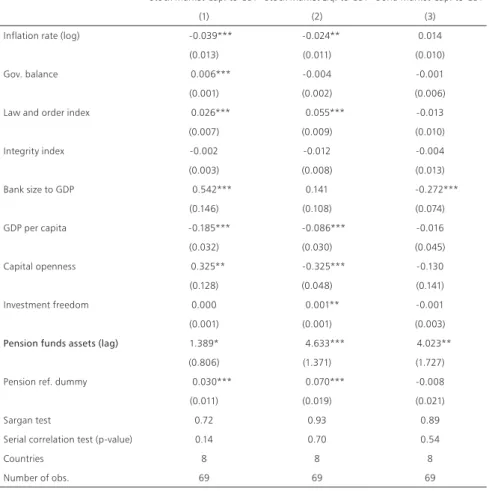
Specifications (1), (2) and (3) of Table 7 present the empirical evidence on the impact of pension reform on capital market development in the developing countries.
Table 7. Pension reform and stock market development in the developing countries
The table shows one-step estimates from Arellano-Bond regressions with the robust standard errors for a panel of 8 CEE countries between 1995 and 2006. All regressions also contain time dummies and country dummies that are not reported here. The ratio of the pension funds asset to the total financial assets included in regressions (1)-(3) is defined as a one-year lag.
The null hypothesis of the Sargan test is that the instruments used are not correlated with the residuals. The null hypothesis of
the serial correlation test is that the errors in the first-difference regression exhibit no serial correlation. Failure to reject the null hypotheses of both tests supports our model.
Stock Market Cap. to GDP Stock Market Liq. to GDP Bond Market Cap. to GDP
(1) (2) (3)
Inflation rate (log) -0.039*** -0.024** 0.014
(0.013) (0.011) (0.010)
Gov. balance 0.006*** -0.004 -0.001
(0.001) (0.002) (0.006)
Law and order index 0.026*** 0.055*** -0.013
(0.007) (0.009) (0.010) Integrity index -0.002 -0.012 -0.004 (0.003) (0.008) (0.013) Bank size to GDP 0.542*** 0.141 -0.272*** (0.146) (0.108) (0.074) GDP per capita -0.185*** -0.086*** -0.016 (0.032) (0.030) (0.045) Capital openness 0.325** -0.325*** -0.130 (0.128) (0.048) (0.141) Investment freedom 0.000 0.001** -0.001 (0.001) (0.001) (0.003)
Pension funds assets (lag) 1.389* 4.633*** 4.023**
(0.806) (1.371) (1.727)
Pension ref. dummy 0.030*** 0.070*** -0.008
(0.011) (0.019) (0.021)
Sargan test 0.72 0.93 0.89
Serial correlation test (p-value) 0.14 0.70 0.54
Countries 8 8 8
The determinants of stock market development in the developing countries
5
Again, in all specifications, the p-values for the Sargan test and the serial correlation test indicate the appropriateness of our instruments and the lack of serial correlation in the error term ε.
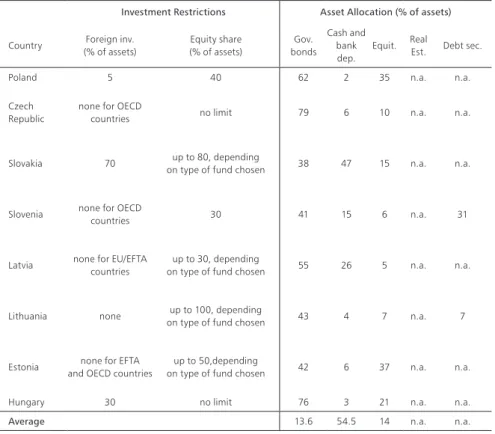
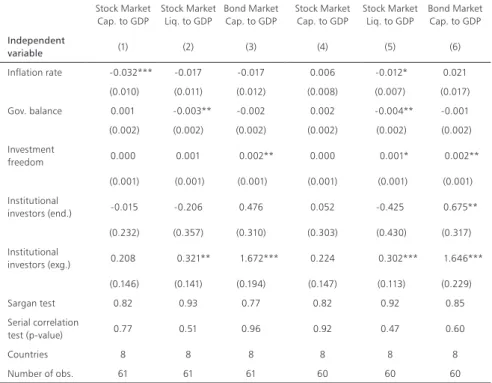
In general, the results provide economically and statistically significant evidence for the positive effect of pension reform in CEE countries on stock market development in those countries. The findings also seem to suggest that much of the effect of institutional development on stock market growth, which we found in the previous section, has been achieved due to pension reform. Moreover, the results do not seem to support the view that quantitative limits on pension funds’ investment in CEE countries, at least in their current form, hamper the impact of pension funds’ growth on stock market development. In fact, when we look at Table 8, we see that the pension funds in the CEE countries are allocated to equities at levels significantly below their allowed limit.
Table 8. Asset allocation of the pension funds in the CEE countries at the end of 2006
Investment Restrictions Asset Allocation (% of assets)
Country (% of assets)Foreign inv. Equity share (% of assets) bondsGov.
Cash and bank dep.
Equit. Real Est. Debt sec.
Poland 5 40 62 2 35 n.a. n.a.
Czech
Republic none for OECD countries no limit 79 6 10 n.a. n.a.
Slovakia 70 on type of fund chosenup to 80, depending 38 47 15 n.a. n.a.
Slovenia none for OECD countries 30 41 15 6 n.a. 31
Latvia none for EU/EFTA countries on type of fund chosenup to 30, depending 55 26 5 n.a. n.a.
Lithuania none on type of fund chosenup to 100, depending 43 4 7 n.a. 7
Estonia and OECD countriesnone for EFTA on type of fund chosenup to 50,depending 42 6 37 n.a. n.a.
Hungary 30 no limit 76 3 21 n.a. n.a.
Average 13.6 54.5 14 n.a. n.a.
For example, at the end of 2006 the pension funds in Slovakia allocated 15 percent of their assets to equities, although the regulations allowed 80 percent of their portfolios to be invested in equities. This result is consistent with various theoretical studies that find that the investment limits in the CEE countries are not overly restrictive and therefore should not hamper the development of the local capital markets (Yermo, 2003).
More specifically, the empirical results show that pension funds exert an economically large and positive influence on all measures of stock market development: stock market capitalization, stock market activity and bond market depth. Both effects are also statistically significant. For example, the increase of pension funds’ assets relative to domestic financial assets by one percent increases stock market liquidity by almost five percent and bond market capitalization by four percent. The latter finding is also consistent with theoretical studies that report the positive influence of reform and pension assets’ growth on the