Applying Model Checking in Java Verification
Klaus Havelund1 and Jens Ulrik Skakkebæk21 NASA Ames Research Center, Recom Technologies, Moffett Field, CA, USA [email protected], http://ase.arc.nasa.gov/havelund 2 Computer Systems Laboratory, Stanford University, Stanford, CA 94305, USA
[email protected], http://verify.stanford.edu/jus
Abstract. This paper presents our experiences in applying the Java PathFinder(Jpf), a recently developedJavatoPromelatranslator, in the search for synchronization bugs in a Chinese Chess game server application written inJava. We give an overview ofJpfand the subset of Javathat it supports and describe an initial effort to abstract and analyze the game server. Finally, we evaluate the results of the effort.
1 Introduction
Model checking has increasingly gained acceptance within hardware [15, 1] and protocol verification [13] as an additional means to discovering bugs. However, verifying programs is different from verifying hardware or protocols: the state space is often much bigger and the relationships harder to understand because of asynchronous behavior and a more complicated underlying semantics. The size and complexity of software pushes current formal verification technology beyond its limits. It is therefore likely that effective application of model checking to software verification will be a debugging process where smaller, selected parts of the software is model checked. The process will draw on multiple abstraction and verification techniques under user guidance, and is currently not well understood. In order to investigate the challenges that software poses for model checking, we have applied the Java PathFinder (Jpf) [12], a recently developed Java
to Promelatranslator, in the analysis of a game server application written in
Java[8].Promelais the modeling language of theSpinmodel checker [13]. We performed the abstractions by hand and translated the simplifiedJavaprogram toPromelausingJpf. Although the example is not big (16 classes and about 1400 LOC), it is still non-trivial and is not written with formal verification in mind. In the process, we developed a suspicion of a deadlock bug in the software which was confirmed usingSpin.Spin also produced an even simpler error scenario than we had found ourselves.
Few attempts have been made to automatically model check programs writ-ten in real programming languages. The most recent attempt to model check software that we are aware of is the one reported in [2], which also tries to model checkJavaprograms by mapping intoPromela. This work does, however, not handle exceptions, nor polymorphism (passing, e.g., an object of a subclass of
a classC to a method requiring aC object as parameter). The work in [3] de-fines a translator from a concurrent extension of a very limited subset of C++ to Promela. The drawback of this solution is that the concurrency extensions are not broadly used by C++ programmers. Corbett [4] describes a theory of translatingJavato a transition model, making use of static pointer analysis to aidvirtual coarsening, which reduces the size of the model.
The VeriSoft tool [7] is a an exhaustive state-space exploration tool for de-tecting synchronization errors between processes. As a major advantage, it also verifies the actual code. However, since the visited states are not stored in the verification process, each time a new branch of possible execution is verified it has to rerun from the beginning, making it less efficient. Furthermore, each pro-cess is treated as a black box and properties have to be specified at the propro-cess interfaces. In contrast, model checking allows for more efficient verification (since states are saved along the way) and for specifying internal process properties, but requires more abstraction. It is still unclear which has the most advantages. Data flow analysis has been applied to verify limited properties of concurrent programs, including Java[16]. These methods are useful for ruling out certain behaviors of the concurrent system but are much less precise than model check-ing. However, as we will argue later, they can potentially be useful in identifying problem areas for verification by state space exploration methods.
TheJpftool is introduced in Section 2 and the application to the game server is described in Section 3. We evaluate the results in Section 4 and conclude with a discussion in Section 5.
2 The
Java PathFinder
Jpf[12] is a translator that automatically translates a non-trivial subset ofJava
intoPromela, the modeling language of theSpinverification system [13].Jpf
allows a programmer to annotate his Javaprogram with assertions and verify them using the Spin model checker. In addition, deadlocks can be identified. Assertions are specified as calls of methods defined in a special class (theVerify
class), all of whose methods are static.
A significant subset of Java is supported by Jpf: dynamic creation of ob-jects with data and methods, static variables and static methods, class inheri-tance, threads and synchronization primitives for modeling monitors (synchro-nized statements, and the wait and notify methods), exceptions, thread in-terrupts, and most of the standard programming language constructs such as assignment statements, conditional statements and loops. However, the transla-tor is still a prototype and misses some features, such as packages, overloading, method overriding, recursion, strings, floating point numbers, some thread op-erations like suspend and resume, and some control constructs, such as the
continue statement. In addition, arrays are not objects as they are in Java, but are modeled using Promela’s own arrays to obtain efficient verification. Finally, the libraries are not translated. Note that many of these features can
be avoided by small modifications to the input code, and we expect the current version of Jpfto be useful on a large class of software. The game server appli-cation described in Section 3 fits in the currently translated subset ofJavawith a few modifications.
We shall illustrate Jpf with a small, but non-trivial, example. The exam-ple is inspired by one of five concurrency bugs that were found in an effort by NASA Ames to verify, usingSpin, an operating system implemented in a multi-threaded version of Common Lispfor theDeep–Space 1spacecraft [11]. The operating system is one component of NASA’s Remote Agent [17], an experi-mental artificial intelligence based spacecraft control system architecture. The bug, found before launch, is concerned with lock releasing on a data structure shared between several threads.
2.1 The Lock Releasing Problem Cast intoJava
The Main Code The operating system is responsible for executing tasks on board the space craft. A task may for example be to run a camera. A task may lock properties (states to be maintained) in a lock tablebefore executing, releasing these locks after execution. For example, one such property may be to “keep the thrusting low” during camera operation. For various reasons tasks may, however, get interruptedduring their execution, and the particular focus here will be on whether all locks always get released in that case.
Figure 1 shows theTask class. Its constructor (the method with the same name as the class) takes three arguments: alock tabletwhich contains the locks, a propertyp(here just an integer) to be locked before the activity is executed, and the activity ato be executed by the task. An Activityobject is required to provide an activity() method which when executed will perform a given task. Note that this is the way thatJavasupports higher order methods taking methods as arguments, and thatJpfhandles this.
The run method of the Task class specifies the behavior of the task; this method has to be part of anyThreadsubclass. The behavior is programmed using
Java’stry-catch-finallyexception construct, which executes the locking and then the activity, unless an exception is thrown. This exception will be caught locally if it is aLockException, or thrown further out. In any case, thefinally
clause is always executed, releasing the lock.
Figure 1 furthermore shows the Java class LockTable, which models the table of all locks. It provides an array mapping each property (here a number between 0 and 2) into the task that locks it, or null otherwise. The method
locklocks a property to a particular task, throwing an exception if the property has already been locked. The release method releases the lock again. These methods are defined as synchronized to obtain mutual safe access to the table when executed. ALockTableobject will then work as a monitor, only allowing one thread to operate in it, that is: call its methods, at any time.
A Test Environment Typically an exception is thrown explicitly within a thread using thethrow(e)statement, whereeis an exception object (a normal
class Task extends Thread{ LockTable t; int p; Activity a;
public Task(LockTable t,int p,Activity a){ this.t = t; this.p = p; this.a = a; this.start();
}
public void run(){
try {t.lock(p,this);a.activity();} catch (LockException e) {} finally {t.release(p);}; } } class LockTable{
Task[] table = new Task[3];
public synchronized void lock(int property,Task task) throws LockException{
if (table[property] != null){
LockException e = new LockException(); throw(e);
};
table[property] = task; }
public synchronized void release(int property){ table[property] = null;
} }
Fig. 1.Task Execution and Lock Table
object of an exception class which may include data and methods). Alterna-tively, one thread S may throw a ThreadDeath exception in another thread T
by executing T.stop(). This is exactly what theDaemontask shown in Figure 2 does. The daemon together with the Main class with the main method, that starts all threads, constitute an environmentthat we set up to debug the task releasing. The daemon will be started to run in parallel with the task, and will eventually stop the task, but at an unspecified point in time. The task is started with the property 1 and some activity not detailed here. Theassertstatement is “executed” after the termination of the task (thejoin method waits for the termination). The assertion states that the property is no longer locked. The as-sert statement is expressed as a call to the static methodassertin theVerify
class Verify{
public static void assert(boolean b){} }
Since this method is static it can be called directly on the class without making an object instance first. It takes a Boolean argument, the validity of which will be checked. The body of this method is of no real importance for the verifica-tion since only the call of this method will be translated into a corresponding
Promela assert statement. A meaningful body, like raising an exception for example, could be useful during normal testing though, but it would not be translated intoPromela.
One can consider other kinds ofVerifymethods, in general methods corre-sponding to the operators inLtl, the linear temporal logic ofSpin. Since these methods can be called wherever statements can occur, this kind of logic repre-sents what could be called anembedded temporal logic. As an example, one could consider statements of the form:Verify.eventually(year == 2000)occurring in the code. The major advantage of this approach is that we do not need to change theJavalanguage, and we do not need to parse special comments.Java
itself is used as the specification language. Note, that at this point, only the
assertmethod is supported. class Daemon extends Thread{
Task task;
public Daemon(Task task){ this.task = task; this.start(); }
public void run(){ task.stop(); }
}
class Main{
public static void main(String[] args){ LockTable table = new LockTable(); Activity activity = new Activity(); Task task = new Task(table,1,activity); Daemon daemon = new Daemon(task); try {task.join();} catch (InterruptedException e) {}; Verify.assert(table.table[1] == null); } } Fig. 2.Environment
The Error Trace When running the Spin model checker on the generated
Promela program, the assertion is found to be violated, and the error trace illustrates the kind of bug that was identified in the Remote Agent. The error highlighted is the following. Although the main activity of the task is protected by atry ... finallyconstruct such that the lock releasing will occur in case of an interrupt (stop), the finally construct itself is not protected the same way. That is, if the task is stopped when within thefinallyconstruct, e.g. just before the lock releasing, the releasing never gets executed. The generated error trace exhibits exactly this behavior. This has been called the “unwind-protect” problem in LISP, obviously also present in Java, and is causing a real bug as illustrated here.
2.2 Translation to Promela
This section shortly describes the translation of Java into Promela. A more detailed description of the translation can be found in [12].
Classes and ObjectsEach class definition in Javaintroduces data variables and methods. When an object of that class is created with the new method, the Java Virtual Machine lays out a new data area on the heap for the data variables. Since Promeladoes not have a dynamic heap, a different solution has to be adopted. For each class an integer indexed array of some fixed static size is declared, where each entry is a record (typedefin Promela) containing the variables of the class. Hence, each entry represents one object of that class. A pointer always points to the next free “object” in the array. An object reference is a pair (c, i), where c is the class and i is the index of the object in the corresponding array (the pair is represented as the integerc∗100+i). Inheritance is simply modeled by text inclusion: if a classBextends (inherits from) a classA, then each entry in theBarray will containA’s variables as well asB’s variables. MethodsJavamethod definitions are simply translated into macro definitions parameterized with an object reference – the object on which the method is called. That is, a Promela program is allowed to contain macro definitions, which are expanded out where called. For example, when a thread calls a method on an object, it “calls” the macro with the object identifier as parameter. The drawback with macros is their lack of local variables. Hence,Javamethod local variables have to be translated to global variables (within the calling thread), prefixed with their origin (class and method). Promelahas recently been ex-tended with inline procedures (motivated by some of our work presented in [11]), and these could be used instead, although it would not make a difference in the principles.
ThreadsThreads inJavaare naturally translated toPromelaprocesses. That is, any class being defined as extending the Thread class, such as Task and
Daemon in the example, is translated to a proctype. The body of the process is the translation of the body of the runmethod. The main program (the main
method) will be translated into an init clause inPromela, which itself is a special process.
Object Synchronization Java supports mutually exclusive access to objects via synchronized methods. That is, if a thread calls a synchronized method on an object, then no other thread can call synchronized methods on the same object as long as the first thread has not terminated its call. We model this by introducing aLOCK field in the data area of each object, hence in particular in each entry of the array representing the LockTable objects. This field will either be null if no thread has locked the object, or it will be equal to the process identification of the thread (Promelaprocess) that locks it (via a call to a synchronized method). Some of the macros generated from our example, modeling locking, unlocking and synchronization, are shown in Figure 3.
The macroLockTable releaseis the translation of thereleasemethod in the LockTable class. It executes the body of the method (a statement) with
#define LockTable_release(obj,property) synchronized(obj,LockTable_set_table(obj,property,null)) #define synchronized(obj,stmt) if :: get_LOCK(obj) == this -> stmt :: else -> lock(obj);
try(stmt) unless {d_finally(unlock(obj))} fi
#define lock(obj) #define unlock(obj)
atomic{ set_LOCK(obj,null)
get_LOCK(obj) == null -> set_LOCK(obj,this)}
Fig. 3.Synchronization Macros
synchronized access to the object. Thesynchronizedmacro executes the state-ment directly if the lock is already owned by the thread (equal to this), and otherwise it locks the object and executes the statement, finally releasing the lock after use. Thelockmacro sets the lock to thisas soon as it gets available (equals null– note that expressions in Promelaare blocking as long as they evaluate to false).
Exceptions One of the major capabilities of the translator is that it handles exceptions. Java exceptions are complicated when considering all the situations that may arise, such as method returns in the middle of try constructs, the
finallyconstruct, interrupts (which are exceptions thrown from one thread to another) of threads that have called thewaitmethod, and the fact that objects have to be unlocked when an exception is thrown out of a synchronized method.
Promela’s unless construct seems related to an exception construct, except for the fact that it works “outside in” instead of “inside out”, the latter being the case for Java’s tryconstruct. That is, suppose a Java program contains two nestedtryconstructs as indicated in the left part of Figure 4.
try{ {
try{S1} catch (E x){S2} S1 unless {catch(exn_E,x,S2)}
} }
catch (E y){S3} unless {catch(exn_E,x,S3} Fig. 4.Exceptions inJava(left) andPromela(right)
If S1 throws an exception object of class E, then this exception should be caught by the innercatch statement, andS2should be executed. On the right hand side of the figure is a simplified version of how we model exceptions in
construct, the outermost catch would be matched, andS3would be executed. Gerard Holzmann, the designer ofSpin, implemented a-J(J forJava) option giving the needed “inside out” semantics. Now, in the data area for a thread, in addition to the LOCK variable mentioned earlier, there is also an exception variable EXN. Throwing an exception, which is itself an object, is now modeled by setting the EXNvariable to contain the exception object reference, and this will then trigger theunlessstatements. Even with addition of the-Joption to
Spin, the translation is quite elaborate.
3 A Game Server Application
To investigate the practical usefulness of Jpf, we have applied Jpf in partial verification of a game server for Chinese Chess, developed by An Nguyen at Stanford University. The code is an older and simpler version of the code that is currently running. It was used for 3 weeks and was not written with formal verification in mind. The code was later rewritten because it was unstable and deadlocked too frequently.
Compared to industrial applications, the server code is fairly small: it consists of 11Javaclasses of about 800 LOC in total. The client code is another 5 classes and 600 LOC. The code of each thread and method in the game server is not very complicated. The complexity stems from the communication interaction between multiple types of threads.
As expected, even though it is relatively small, the state size still drastically exceeds the limits of any model checker. It is possible that the example is man-ageable by tools like Verisoft [7]. This is, however, besides the point: we are using the application to investigate the limits and trade-offs for model checking, as well as studying viable approaches to abstraction.
3.1 Overview of the Code
The overall code is divided into server side code and client side code. The client code consists of Java Applets that are used to display the game boards, the game pieces, and to relay the user commands to the game server. There is no direct communication between players. All communication between players is done via the server.
The multiple players and game boards are naturally handled by a multi-threaded Java architecture in the server code. Although the client side code in effect is also multi-threaded to handle multiple requests from the user, the multi-threading is hidden in the browser application and each individual Applet is written as sequential code. We focus on the server code and leave verification of the multi-threaded user-interface code to future work.
Threads The thread structure is illustrated in Figure 5. At any point in time several game boards can be active, each served by a ServerBoard thread. For
each participant of a game there is a Connection thread to handle the com-munication between the ServerBoard and the network connection associated with the player. EachServerBoard can have multiple Connections associated with it (2 players and multiple observers). Inter-board communication mes-sages are stored in a FIFO queue ServerObjectQueue and handled by the
ServerObjectHandler thread.ServerBoard threads are the only producers of messages, andServerObjectHandleris the only consumer.
Server is the main thread. It handles initialization and contains the main data structures of the server. Finally, there are two kinds of “vulture” threads for cleaning up global data structures that become obsolete when players log out: Server has an associated ServerVulture thread, and each ServerBoard
thread has an associatedConnectionVulture.
Server
Handler ServerObject
Connection Connection Connection Connection ServerBoard ServerBoard
#0 #1
ServerObjectQueue
#0 #1 #2 #3
Server Socket
Fig. 5.A simplified illustration of the system. The boxes with rounded edges denote threads, the square boxes denote non-thread objects. For simplicity, we have not shown the vulture threads. In this example,ServerBoard0 has three players associated with it,ServerBoard1 has one. The arrows indicate the communication patterns between the different threads.
CommandsA player has a predefined set of commands that can be sent via the network to the server. When a command arrives, it is stored in a separate FIFO queue in the associated ServerBoard. The ServerBoardthread then processes the commands one at a time.
The commands can be grouped into three classes: game commands, admin-istration commands, and communication commands. Game commands are used to move the pieces around the board and to stop a game. Administration com-mands are used to create new boards, move between them, and log out. Finally, communication commands are used to communicate between the players, either to a few (“whisper”) or to a larger crowd (“broadcast”). There are 12 different commands.
Each time a move is made, the other players in the game are notified by the
ServerBoardbroadcasting the information to itsConnections.
When a player creates boards, moves between boards, leaves the game, or sends out a global broadcast, the command is read by theServerBoardand then stored in ServerObjectQueue for processing byServerObjectHandler, which processes the commands one at a time. ServerObjectHandler handles global broadcasts by calling local broadcast commands in each of the ServerBoard
threads.
3.2 Abstraction
We focussed on abstracting out a synchronization and communication “skele-ton” and removed game code that was not important for detecting synchro-nization errors. In the process, we formed an idea of a potential deadlock in the code by studying the order in which threads obtained locks and accessed shared data. However, we were not positive that the deadlock was present until it was demonstrated by the model checker. Subsequently, we therefore targeted the abstractions at demonstrating this bug.
Focused on demonstrating the potential deadlock, we manually cut away big chunks of the program by interleaved application of static slicing and over- and under-approximations, known as the “meat-axe” technique in [11].
Static Slicing Given a marking of a statement in the program, static slicing techniques [18] will produce the subset of the program that corresponds to the cone-of-influence. Inforwardslicing, the output is the part of the program that is potentially influenced by the marked statement. Inbackward slicing, the out-put is the part of the program that potentially can influence the values of the variables at the statement of interest.
We used forward slicing to remove the part of code that was potentially irrelevant to the verification task. The relevant code was all the code that was not directly game related. We marked irrelevant variables, methods, and classes, and used this as a guidance to (manually) forward-slice the program from the unmarked variables. For example, the Boardclass contains the data structures related to the Chinese Chess board and the positions of the pieces and was removed; methods related to communication with the player process were also removed; and fields containing a player’s role in the game were likewise removed. Of the 11 server code classes, two of them could be removed fully.
We did not use backward slicing in the abstraction. The deadlock scenario that we were interested in was caused by thread interaction. Marking a particular statement involved in the deadlock scenario would clearly have given a slice that was too large/imprecise for our purpose.
Over-Approximations Over-approximations are obtained from the original program by introduction of non-determinism in the control flow such that the abstracted model will exhibit more behaviors than the original program. Over-approximations are sound in the sense that when checking safety properties, if
no bugs are found in the abstracted model, no bugs exist in the original program. Counter examples, on the other hand, are not necessarily true counter examples in the original model.
Over-approximations were used many times in the abstraction of the game server code. We illustrate this with two examples. First, it was useful to abstract the control conditions marked in the slicing process. For instance:
if (...something game related...) then {...server.broadcast(...);...} was changed to
if (nondet.flag) then {...server.broadcast(...);...}
wherenondet.flagis a flag in a new classNonDetthat is non-deterministically set and reset by the model checker in all possible interleavings with other threads. Second, we abstracted the types of messages that the threads pass around to a few. The messages are encoded in strings, where the first characters of the string contains the command, e.g., “/broadcast”, “/open”, and “/join”.
ServerBoard and ServerObjectHandler determine the type of messages by looking at this string prefix. Typically, this is done in a nested if-then-else struc-ture:
if (line.startswith("/broadcast") then {...}
else if (line.startswith("/talk") then {...board.processCommand(...);...} else if (line.startswith("/whisper") then {...board.broadcast(...);...} else {...}
We abstracted the message strings into a record with a type and a value. From code inspection, we found 3 commands that were related to the concurrency behavior we were interested in pursuing and mapped the message type into something equivalent to an enumerated type with valuesbroadcast,open,join, and other. The latter was introduced by us to capture the remaining types of commands. The nested control structure was then modified to be
if (line.type=broadcast) then {...} else if (line.type=other) then {...
if (nondet.flag) then board.processCommand(...); else board.broadcast(...);
} else {...}
where non-determinism was introduced to model all possible behaviors of exter-nal events associated with the commands mapping toother.
This last abstraction is a form of abstract interpretation [5] where the user decides which behavior to keep in the collapsed code.
Under-ApproximationsUnder-approximations are obtained by removing code (and state that it depends on) from the program, with the effect of reducing the
possible behaviors of the original program. Under-approximations may not be sound for safety properties, since the code that is removed could be causing bugs in the original program – bugs that are not caught when verifying the abstract model. However, when checking safety properties, if a bug is found in the under-approximation, it will also be present in the original model. Under-approximation is a very useful technique when narrowing the search space to a particular part of the code.
We used under-approximations many times in the game server verification. First, we ignored some exceptions of the program, including the exception dling. In the part of the server code that we were interested in, the exception han-dling was of little importance. Second, initially we limited the number of threads to two ServerBoard threads and two Connection threads; and the number of messages from the players to consider were limited to 3. Third, we inserted 3-4 extra synchronization points to sequentialize the thread behaviors. This limited the number of possible interleavings thatSpinhad to consider and more quickly guided it towards the deadlock scenario.
3.3 Verification
We combined the abstracted Java classes into a file, translated it using the
Jpf, and tried to run it through Spin. It took several more cycles of abstrac-tion before the model was sufficiently manageable forSpinto find the deadlock bug. We inserted Jpfprint statements in appropriate places in theJavacode. This information made it easy to interpretSpin’s Message Sequence Chart [13] description of the counter example scenario.
The bug we confirmed was a deadlock caused by cyclic waits between a number of threads. It involved only three threads to cause the deadlock. Using
Spinwe were able to find an unknown and significantly simpler deadlock scenario with two threads. We will present this simpler example below.
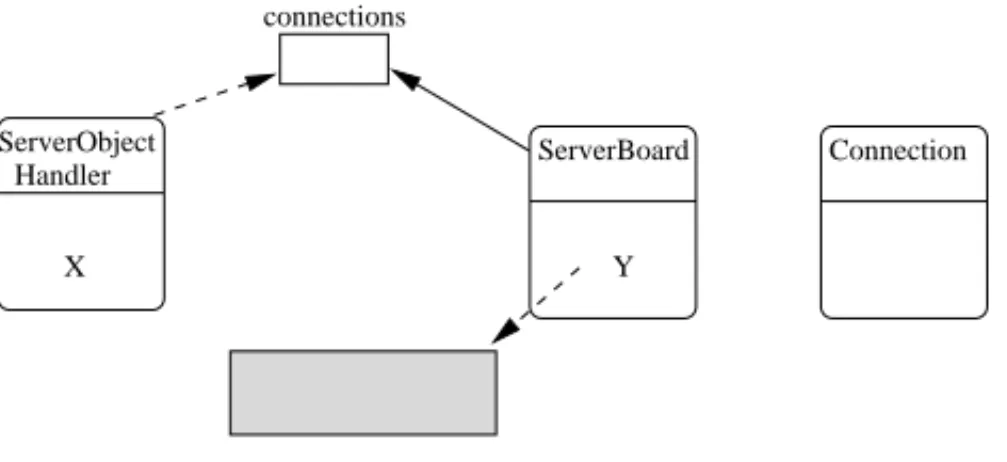
The deadlock may occur when theServerObjectQueuebecomes full. It hap-pens when a ServerBoard processes incoming messages from itsConnections, while theServerObjectHandlerwants to broadcast a message to the same con-nections.
The deadlock, illustrated in Figure 6, may arise as follows: TheServerBoard
thread has obtained exclusive access to its connections by locking theconnections
vector, which stores references to the connections. Next, it goes through a loop where it processes the incoming connection messages, one at a time. Some of the messages must be processed by ServerObjectHandler and the ServerBoard
thread will therefore want to put these messages in the ServerObjectQueue. However, if the queue runs full in this process it will busy-wait on the queue, while holding the lock onconnections.
If the ServerObjectHandleris simultaneously processing a command that causes a broadcast of a message to the connections of theServerBoardthread, it
Handler ServerObject ServerObjectQueue X connections ServerBoard Connection Y
Fig. 6. Deadlock scenario: ServerBoard waits for a free slot in the queue, and ServerObjectHandlerwaits for the lock onconnectionsto be released. Dashed lines indicates wait, the solid line indicates the lock that has been obtained. X and Y are the messages waiting to be processed.
will try to obtain the lock onconnectionsby asynchronize. However, the lock will never be released byServerBoardand a cyclic wait has been established.
Note that the deadlock is caused by a simultaneous wait on a Java lock, using thesynchronizedstatement, and a busy wait on the queue. The code for enqueueing and dequeueing was written by the developer himself and is not part of the Java Virtual Machine (JVM).
4 Evaluation
The analysis itself took a month till the bug was confirmed. However, during this period much time was used on understanding the code and improving Jpf to translate the subset ofJavathat the game server covers. In future applications of theJpf, this will be reduced significantly. At present, we have not yet completed the verification of all parts of the code. More effort would be required to fully verify the code.
Static slicing and abstract interpretation [5] turned out to be useful, but did not produce sufficiently small models. Under-approximations were necessary to narrow down the search space to focus on the bugs that we were interested in finding. This confirms the experiences from the Remote Agent analysis [11]. In general, user guidance was crucial for identifying parts of the code were the techniques could be applied.
Concerning theJpftechnology itself, current model checkers, includingSpin, have been constructed with hardware and protocols in mind and require static memory allocation. That is, they do not support the dynamic nature of object oriented software, more specifically the new C(...) construct which generates an object from a classC.Jpfcurrently generates statically sized globalPromela
arrays that hold the state of the objects, causing wasted memory when only few objects are allocated while the arrays are initialized to hold a larger number. In addition to wasted memory, a second problem with this array solution is the
intricate name resolution machinery required to search for the right array when looking up variables. This is caused by the class subtyping in Java (polymor-phism), where the class of an object cannot be statically decided. Consider for example a method taking a C object as parameter. It can be applied to any object of any subclass ofC. As a consequence, variable lookups consist of condi-tional expressions searching through the subclasses. In an early version of Jpf
this in fact caused a code blow up that made the C compiler gcc fail on the C code thatSpingenerates from the resultingPromelaprogram. A related issue is the lack of variables local to “methods” inPromela. Macros have no concept of locality, leading to further machinery in the translation of variables local to
Javamethods.
Jpf does not handle all of Java, major substantial omissions being recur-sion, strings and floating point numbers, and perhaps most importantly: the
Javalibraries. Recursion requires more elaborated modeling of the Java Virtual Machine, for example in terms of a call stack, which however will be costly. Al-ternativelyPromela’s process concept can be used to model recursive methods, but this solution appears to be time inefficient. It was tried, but undocumented, in the work described in [11]. The translation of Java exceptions is quite so-phisticated, handling all the special circumstances possible. Gerard Holzmann helped in providing a new semantics ofPromela’s unlessconstruct, but even in that case the translation is “clever”.Jpfis currently being improved to trans-late a bigger subset ofJava, and to handle an extension of theVerifyclass with linear temporal logic operators.
The translation does not cater for garbage collection. Normally garbage col-lection (or the lack thereof) is hidden from the programmer, and should not effect the functionality of a program. However, the effectiveness of the verifi-cation may be improved by regarding states with garbage equivalent to states without garbage. Garbage collection seems absolutely non-trivial to handle.
5 Discussion and Future Work
Successful application of model checking in program verification will involve an iterative process of abstraction and verification and will draw on multiple tech-niques for abstracting manageable models from the original program. The sheer size and complexity of the software-under-verification pushes current verifica-tion technology to its limits and the goal of the abstracverifica-tion process is to fit parts of the verification problem within boundaries of feasible verification. In order to make model checking of programs scalable, program abstraction needs to be better understood, and supported with automated tools. Below we will briefly discuss issues relevant to a future verification environment.
Static Analysis Static analysis such as data flow analysis [16] can be used to identify potential problem areas. The techniques must be able to recognize complex dependencies such as deadlocks involving cyclic wait on data as well as locks (as our example illustrated). In general, automated guidance is crucial to
guide the effort to certain parts of the software that is potentially buggy. Under-approximations (such as partial evaluation [14] and other program specialization techniques [10]) remove behaviors from the original model. The verification en-gineer must apply these cautiously in order not to remove behavior that could lead to bug scenarios.
User Guided Abstractions by Code Annotation User-interaction, poten-tially aided by heuristics, is crucial for effective application of the abstraction techniques. Code annotations are a potential means of capturing the higher-level understanding of the programmer at the time of development and could provide hints to the abstraction tool. For instance, the game server code could contain information that would guide an abstraction tool to understand the strings that are being passed around as actual message types. Alternatively, predefined cod-ing styles in the form of design patterns could be recognized by an abstraction tool. It is also possible that automatic abstraction techniques suggested by Graf and Saidi [9], extended with string pattern matching, could be applied to deter-mine the enumeration type.
LibrariesOne of the decisions to make in the abstraction process is deciding the boundaries of the program to be verified and how to model its environment. For the game server, the obvious boundaries were the network interface. However, in other cases the correctness properties may be specified in terms of the client applications. In this case, the network needs to be modeled also. An effective verification environment needs pre-written environment models of commonly used libraries. The game server code, for instance, uses the JavaVector class. By studying the JVM specification we were able to write simple stubs that modeled the class sufficiently for our use. In general, such environment modules must be predefined to save the verification engineer time and effort.
Compositional ApproachesAn alternative solution to dealing with scalability is compositional model checking [6], where only smaller portions of code are verified at a time, assuming properties about the “rest of the code”, and where the results are then composed to deduce the correctness of larger portions of code. This approach is not problem free though since composing proofs is non-trivial and often requires iteration as does induction proofs (no silver bullet around). A practical solution is so-called unit testing where a class or a small collection of classes are tested by putting them in parallel with an aggressive environment. The Remote Agent analysis presented in Section 3 is an example of this. It’s likely that model checking at least can play an important role in program verification at this level.
AcknowledgmentsThe authors wish to acknowledge the following persons at NASA Ames for their contributions in terms of ideas and support: Tom Press-burger, Mike Lowry, John Penix and Willem Visser. At Stanford we would like to thank David Dill for discussions and comments. The second author is sponsored by NASA contract number NAG2-891: An Integrated Environment for Efficient Formal Design and Verification.
References
1. J. R. Burch, E. M. Clarke, K. L. McMillan, and D. L. Dill. Sequential circuit ver-ification using symbolic model checking. In27th ACM/IEEE Design Automation Conference, 1990.
2. R. Iosif C. Demartini and R. Sisto. Modeling and Validation of Java Multithreading Applications using SPIN. In G. Holzmann, E. Najm, and A. Serhrouchni, editors, Proceedings of the 4th SPIN workshop, Paris, France, November 1998.
3. T. Cattel. Modeling and Verification of sC++ Applications. In Proceedings of the Tools and Algorithms for the Construction and Analysis of Systems, Lisbon, Portugal, LNCS 1384, April 1998.
4. J. C. Corbett. Constructing Compact Models of Concurrent Java Programs. In Proceedings of the ACM Sigsoft Symposium on Software Testing and Analysis, Clearwater Beach, Florida., March 1998.
5. P. Cousot and R. Cousot. Abstract interpretation: A unified lattice model for static analysis of programs by construction or approximation of fixpoints. ACM Symposium on Principles of Programming Languages, pages 238–252, 1977. 6. W. de Roever, H. Langmaack, and A. Pnueli (Eds.).Compositionality: The
Signif-icant Difference, International Symposium, COMPOS’97, Bad Malente, Germany. LNCS 1536. Springer-Verlag, September 1997.
7. P. Godefroid. Model checking for programming languages using Verisoft. InACM Symposium on Principles of Programming Languages, pages 174–186, Paris, Jan-uary 1997.
8. J. Gosling, B. Joy, and G. Steele. The Java Language Specification. The Java Series. A-W, 1996.
9. S. Graf and H. Saidi. Construction of abstract state graphs with PVS. In O. Grum-berg, editor,CAV. Springer-Verlag, June 1997.
10. J. Hatcliff, M. Dwyer, S. Laubach, and D. Schmidt. Stating static analysis using abstraction-based program specialization, 1998.
11. K. Havelund, M. Lowry, and J. Penix. Formal Analysis of a Space Craft Controller using SPIN. In G. Holzmann, E. Najm, and A. Serhrouchni, editors,Proceedings of the 4th SPIN workshop, Paris, France, November 1998.
12. K. Havelund and T. Pressburger. Model Checking Java Programs using Java PathFinder. NASA Ames Research Center. To appear in theInternational Journal on Software Tools for Technology Transfer (STTT), 1999.
13. Gerard Holzmann. The Design and Validation of Computer Protocols. Prentice Hall, 1991.
14. N. D. Jones, editor. Special Issue on Partial Evaluation, 1993 (Journal of Func-tional Programming, vol. 3, no. 4). Cambridge University Press, 1993.
15. K.L. McMillan. Symbolic Model Checking: An Approach to the State Explosion Problem. Kluwer Academic Publishers, 1993.
16. G. Naumovich, G.S. Avrunin, and L.A. Clarke. Data flow analysis for checking properties of concurrent java programs. Technical Report 98-22, Computer Science Department, University of Massachusetts at Amherst, April 1998.
17. B. Pell, E. Gat, R. Keesing, N. Muscettola, and B. Smith. Plan Execution for Au-tonomous Spacecrafts. InProceedings of the 1997 International Joint Conference on Artificial Intelligence, 1997.
18. F. Tip. A survey of program slicing techniques.Journal of Programming Languages, 3(3):121–189, 1995.