CREATING ENVIRONMENTALLY ORIENTED ONLINE
LEARNING COMMUNITIES: THE CASE OF ELEMENTARY
SCHOOLS IN GREECE
Konstantinos Karampelas
2
ndModel Experimental Primary School of Rhodes
Sarantis Karvounidis
1
stModel Experimental Primary School of Rhodes
Greece
Abstract
This study examines the possibility of an Online Learning Community (OLC) of primary school classes to promote environmental literacy. The community was composed of four primary school classes in Greece, on the E-twinning platform. The community members would carry out common activities focusing on constructing knowledge on environmental concepts and issues and developing skills required to approach problem solving on environmental challenges. Through a qualitative approach, based on the activity theory, it was concluded that to an extent environmental literacy was promoted, learners respected the potential of the OLC. However barriers emerged.
Introduction
The expansion of the Internet and Information and Communication Technologies (ICT) has caused drastic changes in foundational aspects, functions and concepts of current societies. Communication, ideas exchange, socialization and learning have been exposed to new norms. A concept that is being renegotiated is the community. The definition of a community
nowadays emphasizes mostly in common identity, characteristics, shared values and practices of its members. The region factor has less significance now. Online communities are gaining grounds, as groups of people with common believes, who work together towards common aims in the context of the World Wide Web and the opportunities it offers for communication and cooperation (Pallof & Pratt, 2007).
Education is under reform too. Modern technology has introduced new concepts, new practices and new fields in learning. An example is the
development distant education forms, through which people and schools from different regions work together in order to fulfill learning purposes.
Information can now be disseminated across different regions, opening new opportunities as well as demands in learning, in terms of subject, approach and pedagogy. Pupils have access to new kinds of resources. They are both
assisted and expected to learn through new ways unknown before.
Thanks to the rapid development of ICT, wide range of new possibilities has emerged in education and other kinds of services. Within the context of the new learning environments, a new kind of communities emerges. This is the
Online Learning Communities. Thanks to OLC there is room for cooperation among schools, exchange of practices and ideas. If this is to be achieved though, community members, including pupils, need to adopt new roles and understand the benefits OLC offer in contrast to traditional classroom restricted practices (Pallof & Pratt, 2007).
However, research shows that this is not easily applied in classrooms. There are challenges that emerge generally when implementing new practice as well as particularly in learning communities (Fullan, 2007; Pallof & Pratt, 2007). Within this context, this study was planned. Its’ main purpose is to examine the benefits and risks of developing OLC in order to promote learning. More specifically, the subject of the OLC was environmental education.
Online Learning Communities
Many theories have been developed concerning about OLCs (Lock, 2002). Developing Online Learning Communities
When establishing an online community, it is important to identify its’ basic mission and goal. These values have to be shared by all members. These are guidelines for all activities that will be completed within it. They have to be nurtured, justified and spread, so that all members acknowledge, understand, appreciate and respect the role of this OLC, which may otherwise lack sustainability (Lock, 2002; Fullan, 2007). OLC survival depends on
communication, collaboration, interaction, participation, instructional delivery and instructional context. For that reason, it is necessary to focus on student-centered practices (Lock, 2002).
OLC gives room for new practices that can familiarize pupils with modern means of communication, as current society demands. Moreover, pupils can meet new people, new places, new cultures and new ideas. Through this, pupils engage in learning contexts outside classrooms, which helps broadening conceptual knowledge and skills. Therefore, pupils and teachers need to be open to new ideas, collaborate and share information. They should be familiar with means of online communication and interaction. They should be self-motivated and self-disciplined. They should understand that learning could take place outside traditional classrooms and teaching schemes. Finally, they should have access to Internet and means of ICT (Pallof & Pratt, 2007). OLC in Environmental Education
The growing concern about environmental issues over the last decades has had a great impact on education. Environmental Education emphasizes on
investigating the environment holistically through cross-disciplinary and problem-solving approaches. Primary schools pupils need to understand the holistic view of the environment, develop critical thinking skills to identify environmental risks and concerns, look for resources, express ideas, plan and evaluate plans. The ultimate goal of environmental education is environmental literacy, which Roth (1992, p. 17) has defined as ‘the capacity to perceive and interpret the relative health of environmental systems and take the appropriate
actions to maintain, restore and improve the health of those systems’. This definition emphasizes on problem solving (Roth, 1992, UNESCO, 2014). An OLC can provide a social context for environmental learning. This way, learning moves beyond traditional teaching and addresses to environmental topics that call for action. Learners will be members of a large group, aiming to work out real-life environmental problems. This assists knowledge
construction and helps learners adopt environmentally friendly attitudes. So, OLC can be very useful in Environmental Education (Robelia, Greenhow, & Burton,, 2011). Environmental Education can assist OLC creation too. According to Heimrich and Ardoin (2008), it can be a context for knowledge, attitudes, skills that form behaviors and behavioral change expected. These help the establishment and function of and OLC (Pallof & Pratt, 2007; Robelia et al., 2011).
Challenges of implementing OLC
As with any new learning practice, when implementing OLC in schools, success is not guaranteed. The school context works under certain rules, functions, ideas and structures, which form the school culture. If the new practice does not fit in this culture, it may not be effective (Fullan, 2007). In terms of ideas, as already mentioned, teachers and learners need to share the belief and vision that the OLC helps learning. They should also have the needed knowledge to participate. This knowledge could be about computers and the World Wide Web, or it may be linked other kinds of skills, such as interpersonal (Shrivastava, 1999).
The school context should assist too. Innovative learning practices may face challenges deriving from the structures of the school or the education system. These could be legal or bureaucratic. Another challenge could be the lack of the necessary equipment and tools in schools. Time can also be restricting, since usually, the new duties that teachers undertake when applying learning practices, such as management of OLC, are being added to previous ones. All these issues are likely to prevent an OLC from working effectively and achieving learning goals (Shrivastava, 1999; Fullan, 2007)
Evaluating OLC
The OLC serves as context to learn, change by acting, use means and
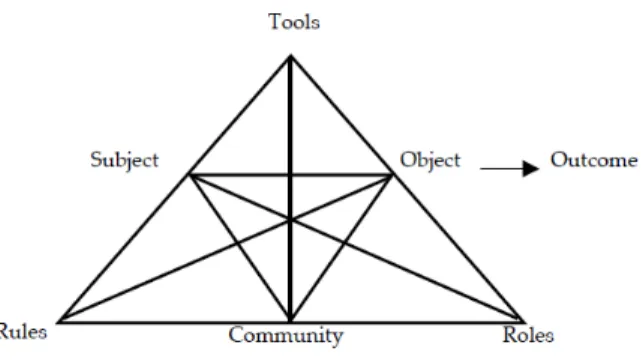
transform aims into outcomes. Within it people engage in learning activities. An approach to evaluating OLC is activity theory (Hew & Chueng, 2003). Activity theory was introduced by Engestrom (1987), as a cross-disciplinary framework to examine learning processes, through the interaction of their components: tools, subject, rules, community, roles, object or outcome. Activity theory helps teachers evaluate an OLC holistically. The subject would be a community member, such as a learner or educator. The subject will use tools, follow rules set by a context -community, which has charged the subject with roles, in order to construct knowledge, develop skills, which are the desired object or the outcome. The relationships between these
processes can be complicated. Evaluation through the activity theory focuses on selecting an appropriate triad of processes (Engestrom, 1987; Hew & Cheung, 2003).
In the light of the aim of this study, the most appropriate triad is the subject-object-community, which according to research can give insights about participants, the way they interact, the knowledge and skills they gain, as well as the compatibility of the OLC functions with the community-school context. Collaboration and interaction is evaluated through the messages that
participants exchange or upload and their content (Henri, 1992).
Knowledge construction is approached through different stages. The first stage includes exchange of information and ideas. The second includes evaluation of this information and testing for inconsistencies. The third includes
negotiation of meanings. The fourth includes proposition for modification and re-statement of information. The fifth and final stage includes the construction of knowledge (Kannuka & Anderson, 1998; Hew & Cheung, 2003).
Figure 1: The processes of an activity
Figure 1. The processes of an activity. (Source: Engestrom, 1987, p. 78).
Skills are also approached in five different stages. The first includes simple exchange of information. The second includes analysis and connection to or identification of a greater problem, issue or challenge. The third includes interference, deduction and reduction. The fourth includes judgments and opinions about comments and any interference made to them. Finally the fifth stage includes suggestion of solutions or action plans (Hew & Cheung, 2003).
The Project
There are many portals to build OLC focused on environmental education in primary schools. Selection requires attention (Pallof & Pratt, 2007).
Selecting the Appropriate Platform to Form the OLC: E-twinning For the particular research, the E-twinning platform, also known as the community for schools in Europe was selected (E-Twinning, 2014). It aims to bring different schools and pupils together. Since its establishment in 2005,
the portal has accommodated more than 230.000 projects from more than 5.400 schools, across Europe. E twinning was selected due to its popularity and in European Primary Schools, which make it accessible and attractive. Establishing a community in e-twinning follows a specific procedure.
Teachers, first have to register. Afterwards, they have to fill in a form with the aims of the project, its’ rational, indicative timetable, the activities it involves. After the approval by the portal managing group, it is published in the portal, inviting other teachers and schools to express interest. As soon as teachers are found, the project starts. The teachers along with the pupils form the OLC, which is managed by the teachers who founded it. During the project, all groups carry out common activities and upload to the platform evidence, projects, comments and findings (E-Twinning, 2014).
The OLC of the Project
The project of the OLC, called ‘Planet sending SOS’, aimed to promote environmental literacy. It was designed by one school. Three other teachers responded. The OLC included four primary school classes, of totally 82 pupils, aged 10-12, and four teachers from schools of different islands of Greece. All teachers had access to the Internet in their classroom. All schools had a computer lab. Schools followed the legal requirements of the School Management and Function Act (1998) to justify the projects’ importance, pedagogical potential and assurance of no risk for children. Overall, all teachers and schools had the same basic means to participate in the OLC. These activities were common for all schools. All activities were done during school hours. It was thought to be more convenient that way. Usually, teachers and pupils would devote three to five hours every week for the OLC projects. Interaction was mostly asynchronous. However, there were some synchronous activities, through videoconferencing.
Pupils would first introduce themselves. Afterwards, groups of members would gather information on the environmental wealth of their region, and upload it in the platform. Through projects pupils should learn about concepts such as ‘ecosystem’, ‘flora’, ‘fauna’, ‘diversity’, ‘pollution’, ‘food chains’, ‘food webs’ and ‘recycling’. They would be asked to include them in comments and messages. Later on, they would carry out and upload new projects about environmental challenges and issues of each region. This would include description, identification of causes, impacts and suggested solutions. Comments and ideas about these would follow, in order to construct clear understanding about these problems, the uniqueness of each environmental region, the necessity of its’ preservation and actions needed. Through these activities, learners would approach environmental literacy (Henri, 1992; Heimrich & Ardoin, 2008; Robelia et al., 2011; UNESCO, 2014). Forming Research Questions
The study aims to evaluate the effectiveness of an OLC focusing on promoting environmental literacy in primary school pupils. To define effectiveness, it is important to identify if learners became more familiar with concepts relevant
to the environment, environmental risks and challenges (Roth, 1992; Robelia et al., 2011; UNESCO, 2014). Learners must also demonstrate they have developed skills, as critical thinking and problem-solving (Hew & Cheung, 2003). There are five stage scales, which precise acquisition of knowledge (Heimirich & Ardoin, 2008) and skills (Henri, 1992).
Additionally, it should be identified, if learners engaged themselves in the roles that an OLC requires. Learners should be motivated and disciplined to the activities carried out within the OLC and realize its benefits and learning goal. Learners may not understand the pedagogical role of the OLC and treat it as an amusement activity. This may end in no discipline and commitment. Through their work they have to prove that they know that they are members of a group, with a specific goal, which in this case is to identify and negotiate environmental issues (Henri, 1992; Pallof & Pratt, 2007).
Research has shown that such interventions might face challenges. Challenges may arise because the school equipment may not be sufficient, or because generally the school climate and context may not be assistive. In this case, the benefits of the OLC may be jeopardized (Lock, 2002; Pallof & Pratt, 2007). The activity theory approach was selected to give insights to the activity of the OLC emphasizing on three processes-factors: object-goals, subject learners and the community-school context (Engestrom, 1987; Hew & Cheung, 2003). The evaluation is negotiated through the following three research questions:
1. Did the learners become environmentally literate? (Objects factor) 2. Did the learners understand the importance of OLC? (Subject factor) 3. Did challenges arise? (Community-context factor)
Methodology
Selection of the appropriate methodology depends highly on its focus and the aims. This study is of qualitative nature. It aims to examine human behaviors in relation to a specific context and not to use data to test a specific
hypothesis, as the quantitative research does (Bell, 2001; Cohen, Manion, & Morrison, 2011).
Data for research may come from interviews, questionnaires, observation, biographies or any kind of notes. For the particular project, data may derive from interviews, observations and pieces of work, projects, texts or messages produced by the pupils (Bell, 2001).
Observations focused on teaching interventions and videoconferencing that took place, paying attention on pupils’ comments on environmental concepts, ideas, messages, their ideas about the OLC and its’ benefits.
Data to answer the first research question came from observations, pupils projects and from interviews in replies to questions such as: What kind of environmental problems are there? What kind of solutions do you suggest?, which reflect knowledge, skills and environmental literacy achieved
(Heimrich & Ardoin, 2008; Hew & Cheung, 2003; UNESCO, 2014). Through these it is possible to identify the level of knowledge and skills construction achieved, which reveal significant evidence about environmental literacy (Kannuka & Anderson, 1998; Hew & Cheung, 2003).
Data to answer the second research question, came from observation, from pupils projects or messages, which will reveal about communication (Henri, 1992) and from interviews in replies to questions, such as: What would you like to do more in an e-twinning program? What do you think pupils should do when they participate in such a program?, which reflect learners’ perception about OLC (Shirastava, 1999; Lock, 2002; Pallof & Pratt, 2007).
To answer the third research question, data came mostly from observations, which give insights about the progress of OLC in relation to school functions and structure (School Management and Function Act, 1998; Fullan, 2007).
Findings
Findings were overall encouraging. However, there were concerning points.
1st Question: “Did the Learners Become Environmentally Literate?”
As far as the first research question is concerned, data that came from interviews, observations and pupils’ projects, can justify that pupils actually learnt more about the environment, its’ characteristics, and issues.
Firstly, pupils showed that they have enriched their vocabulary of concepts about environmental topics. By the end of the course they have well learned to use terms, unknown or unclear to them before, such as ecosystem, diversity, pollution, and recycling. These new terms were existent in pupils’ messages and projects. Secondly, they were able to search for resources about a
particular environment, or a specific problem. However, learners struggled analyzing these resources and linking them to the concepts they learned. For example, some learners when reading about risks of the environmental wealth, they did not easily understand the exact meaning. This prevented partly modification of information and construction of further complex
environmental knowledge (Henri, 1992; Roth, 1992; Heimrich & Ardoin, 2008; Robelia et al., 2011; UNESCO, 2014).
Apart from knowledge, learners showed that they improved their skills. There was improvement in exchanging information and ideas, as well as locating to a greater problem. Improvement was not so impressive though in deduction. As a result, judgments, comments and suggestions for plans frequently needed revision, as they were losing focus (Henri, 1992; Hew & Cheung, 2003). So learners became more environmentally literate, as they learnt new concepts and developed skills but there is room for improvement (UNESCO, 2014). With regards to the activity theory, approach the object factor of the activity seems to be satisfied to an extent (Engestrom, 1987).
2nd Question: “Did the Learners Understand the Importance Of OLC?” Findings have showed that learners understood the importance and
significance of the OLC they were involved, to a large extent.
Firstly, learners disciplined to the tasks that had to be done. Any duties and assignments set to them were completed satisfactorily and in time. Messages were uploaded frequently, which shows healthy communication (Henry, 1992). It was very common for learners to show enthusiasm when any kind of assignment was set for them. This kind of commitment is important for the proper function of the OLC (Kannuka & Anderson, 1998; Shirastava, 1999; Lock, 2002; Hew & Cheung, 2003).
Secondly, learners showed that they understood that the OLC can help them socialize with other learners of different places. Many of them expressed, ‘”In it [the e-twining program] ,we met other children and learnt about the place where they live”,justifying that they can see benefits (Pallof & Pratt, 2007). However, it is unclear from the learners’ sayings that all of them had
understood the learning goals. Approximately half of the learners mentioned that the program can help them learn about environment and environmental concerns. The rest did not seem to have understood that, and when answering what the role of the community was, there were replies such as “amusing.” This shows lack of understanding of the learning potential of the OLC and of the fact that learning can happen outside the traditional class (Lock, 2002; Fullan, 2007).
So the importance of the OLC and participation in it was understood by the learners, even partly. With regards to the activity theory approach, the subject of the activity seems to be work properly to an extent too (Engestrom, 1987).
3rd Question: “Did Challenges Arise?”
As observations and interviews of the pupils have shown, even though the study was planned and carried out effectively, challenges were not missing. The first, and perhaps the most important, challenge was relevant to the technical infrastructure of the schools. Each school had a computer lab with a reasonable number of units able to accommodate the students. However, in all schools, frequently there were plenty of activities that depended on the lab. Therefore, many times, the tasks for the community had to be carried out in the classroom, where there was only one computer. This reduced the
participation of learners in the online processes and the interaction (Lock, 2002).
There were also bureaucratic barriers to overcome. Since learners were young, there was a series of procedures done to justify the pedagogical role of this community and the fact that there is no risk for the children. This had to be done for the project generally, and for individual teaching interventions too,
such as those involving teleconferencing. Certainly, many of these issues were dealt through careful planning, which took into consideration the legal context in which the schools work. Still this was demanding and time consuming. Lastly, there were time restraints, as teachers and pupils had other duties too. The legal and functional context, of the School Function and Management Act (1998) may allow the function of OLCs but do not fully support them.
In short, the school climate caused challenges. It is encouraging that there was no problem from the side of the teachers to respond to the needs of the OLC and motivate learners to participate (Shirastava, 1999; Fullan, 2007).
Overall, with regards to the activity theory approach, the community-context factor of the activity seems to be partially assisting (Engestrom, 1987).
Conclusions
This research aimed to evaluate the potential of an OLC to promote environmental literacy to primary school learners. It composed of Greek primary school classes, which carried out common projects aiming to construct knowledge about the environment and develop skills towards environmental problem solving. These are basic dimensions of environmental literacy (UNESCO, 2014). OLC are known to assist in these aims (Pallof & Pratt, 2007). The e-Twinning network was selected as the most appropriate platform for that purpose (E-twinning, 2014).
Research, though, has shown that implementation of new learning patterns does not automatically guarantee positive results. In relation to that, the OLCs are effective under specific conditions. Learners’ reactions, as well as the school climate may bring on challenges (Lock, 1992; Fullan, 2007).
On the basis of the above, this qualitative research was planned. Through the approach of the activity theory (Engestrom, 1987), three research questions were formed: (a) Did the learners become environmentally literate? (b)) Did the learners understand the importance of OLC? (c)) Did challenges arise? Data were gathered through interviews, observations and pupils’ messages and projects. The findings, with regards to the activity theory approach, show that the goals-objects were attained to an extent. The learners-subjects have responded effectively in general. However, the assistance offered by wider school context-community, was limited in some cases (Engestrom, 1987; Hew & Cheung, 2003). In conclusion, the OLC was able to promote environmental literacy to primary school pupils. Certainly, there is room for improvement. These findings agree with the ones of relevant literature (Robelia et al., 2011). Before generalizing these conclusions though, it is important to point out specific limitations. This study focused on one case of an OLC, composed by four classes of Greek schools, for one year. Generalizing would require comparison with the findings of other similar studies (Cohen, Manion, & Morrison, 2011).
References
Bell, J. (2001). Doing your research project (3rd ed.). Buckingham, Philadelphia: Open University.
Cohen, L., Manion, L., & Morrison, K. (2011). Research methods in education (7th ed.). London: Routledge / Falmer.
E-Twinning, (January 2014). The community of teachers for Europe. General Guidelines. Retrieved 2 February 2015 from http://www.etwinning.net/ Engestrom, Y. (1987). Learning by understanding: An activity theoretical
approach to developmental research. Helsinki: Orienta-Konsultit. Henri, F. (1992). Computer conferencing and content analysis. In A.R. Kaye
(Ed.), Collaborative learning through computer conferencing: The Najaden papers (pp.117-136). Berlin: Springer-Verlag.
Hew, K. F., & Cheung, W. S., (2003). Models to evaluate online learning communities in asynchronous discussion forums. Australian Journal of Educational Technology, 19(3), 241-259.
Kanuka, H., & Anderson, T. (1998). On-line social interchange, discord and knowledge construction. Journal of Distance Education, 13(1), 57-74. Lock, J., (2002). Laying the groundwork for the development of learning
communities within online courses. Quarterly Review of Distance Education, 3(4), 295-308.
Pallof, R., & Pratt, K. (2007). Building online learning communities: Effective strategies for the virtual classroom. San Francisco: Jossey Bass.
Robelia, B. A., Greenhow, C., & Burton, L., (2011) Environmental learning in online social networks: Adopting environmentally responsible behaviors, Environmental Education Research, 17(4), 553-575.
Roth, C. E. (1992). Environmental literacy: Its roots, evolution, and
directions in the 1990s. Columbus, OH: ERIC Clearinghouse on Science, Mathematics and Environmental Education.
Shrivastava, P., (1999). Management classes as online learning communities. Journal of Management Education, 23(6), 691-702.
School Management and Function Act (1998), Presidential Charter 201/1998. Greek Ministry of Education and Religious Affairs.
UNESCO, (2014). Shaping the future we want. UN Decade of Education for Sustainable Development (2005-2014). Paris: United Nations
Educational, Scientific and Cultural Organization. Konstantinos Karampelas,
Sarantis Karvounidis,