IMMUNE SYSTEMS AND VARIABLE
SELECTION TECHNIQUES FOR
CREDIT SCORING
A thesis submitted in fulfilment of the requirements for
the degree of Doctor of Philosophy
Kevin Leung Kan Hing
B.Bus (Business Information Systems)(Honours)
B.Bus (Business Information Systems)
School of Business Information Technology
Business Portfolio
RMIT University
CANDIDATE’S CERTIFICATION
I certify that except where due acknowledgement has been made, the work is that of the author alone; the work has not been submitted previously, in whole or in part, to qualify for any other academic award; the content of the thesis is the result of work which has been carried out since the official commencement date of the approved research program; and, any editorial work, paid or unpaid, carried out by a third party is acknowledged.
Signed:
Name:
ACKNOWLEDGEMENTS
A PhD thesis is a project that requires the assistance of many people. My completion of this project would not have been possible without the guidance of my supervisors. First and fore-most, I would like to express my deepest gratitude to my senior supervisor, Dr France Cheong, for motivating me to undertake a PhD and for his invaluable guidance and support during the period of my candidature. Dr France Cheong was a mentor to me and not only did he advise and guide me through my lengthy journey, but he also trained me to have the necessary teaching skills to be ready to enter the world of academia. I am also grateful to my second supervisor, Dr Christopher Cheong, for his patience, friendship and moral support.
Sincere thanks go to RMIT University, especially to Professor Brian Corbitt, for the financial support provided through the Australian Postgraduate Award, RMIT Business Portfolio Post-graduate Research scholarship, and funding for publishing papers and attending conferences. Professor Brian Corbitt ensured that I was provided with all the necessary resources that were required. Without such support, I would not have been able to carry out this research.
I would also like to take this opportunity to thank my parents, Maurice and Roseline Leung, for supporting my educational goals, encouraging and motivating me, and for their unconditional love and prayers.
I need to thank all of the professors and staff members from my school for the nice working environment. A special thank-you goes to Mr Patrick Poppins for his involvement in getting me in touch with the corporate world. I also need to acknowledge other professors, Professor Timothy Fry and Professor Richard Heaney, both from the School of Economics, Finance and Marketing, for their useful support and advice.
I would like to thank Mr Sean O’Farrell and Mr Robert Tissington for sharing their practical experience and knowledge with me. The meetings and discussions we had on numerous occa-sions were both interesting and fruitful.
I must not forget all of my research colleagues for helping me through this arduous journey. Their precious advice, constant cheering and friendship are deeply valued by me. Special thanks go to Hui Chung Liang, Marie-Anne Cam, Hasniza Mohd Taib, Ju-Ai Ng, and Joerg Paschke.
I am also grateful to Irwin Tse, Patrice Hung, Kenny How, Didier Ng, Jean-Yann Ng, Deanie Tang, Sandra Liong, Binesh Seetanah, Patrice Hau, and Rakibul Hasan Syed for their encour-agement and for believing in me.
Finally, I would like to thank my editor, Julia Farrell, and all the anonymous reviewers of the various papers which have been produced as part of this research. Their useful comments helped in improving the quality of this thesis. I am also grateful to all my other friends and family members, and finally to God, who makes everything possible.
DEDICATION
This work is dedicated to my grandmother, Popo Leung Kan Hing, who passed away in 2007 while I was doing my PhD, and to my parents, Maurice and Roseline Leung Kan Hing. Without their patience, understanding, support, and above all love, the completion of this work would not have been possible.
CREDITS
The following papers were written as part of the research of this thesis:
1. Leung, K., Cheong, F., Cheong, C., O’Farrell, S. & Tissington, R. (2008), ‘Building a Scorecard in Practice’, Proceedings of the 7th International Conference on Computational Intelligence in Economics and Finance, Taiwan, 5-7 December 2008.
2. Leung, K., Cheong, F., Cheong, C., O’Farrell, S. & Tissington, R. (2008), ‘A Comparison of Variable Selection Techniques for Credit Scoring’, Proceedings of the 7th International Conference on Computational Intelligence in Economics and Finance, Taiwan, 5-7 De-cember 2008.
3. Leung, K., Cheong, F., Cheong, C., O’Farrell, S. & Tissington, R. (2008), ‘Developing a Scorecard using a Simple Artificial Immune System (SAIS) Algorithm and a Real-World Unbalanced Dataset’, Proceedings of the 7th International Conference on Computational Intelligence in Economics and Finance, Taiwan, 5-7 December 2008.
4. Leung, K., Cheong, F. & Cheong, C. (2007), ‘Consumer Credit Scoring using an Artifi-cial Immune System Algorithm’, Proceedings of 2007 IEEE Congress on Evolutionary Computation (CEC2007), Singapore, 25-28 September 2007.
5. Leung, K., Cheong, F. & Cheong, C. (2007). ‘Generating Compact Classifier Systems using a Simple Artificial Immune System’, IEEE Transactions on Systems, Man and Cybernetics, Part B, Vol. 37, no. 5, pp. 1344-1356.
6. Leung, K. & Cheong, F. (2006), ‘A Simple Artificial Immune System (SAIS) for Generat-ing Classifier Systems’, in A. Sattar & B. H. Kang (eds.), AI 2006: Advances in Artificial Intelligence, Springer-Verlag, Berlin Heidelberg, Vol. 4304, pp. 151-60.
TABLE OF CONTENTS
List of Figures xii
List of Tables xiv
ABSTRACT 2 1 INTRODUCTION 4 1.1 Background . . . 4 1.2 Motivation . . . 5 1.3 Significance of Research . . . 7 1.4 Methodology . . . 8
1.5 Aims and Scope of Thesis . . . 9
1.6 Contributions . . . 9
1.7 Outline of Thesis . . . 10
2 LITERATURE REVIEW 12 2.1 Introduction . . . 12
2.2 Credit Scoring . . . 13
2.2.1 An Overview of Credit Scoring . . . 14
2.2.2 History of Credit Scoring . . . 15
2.2.3 Advantages and Limitations of Credit Scoring . . . 17
2.3 Credit Scoring Models . . . 19
2.3.1 How Credit Scoring Models Work . . . 21
2.3.2 Credit Scoring Models Development . . . 22
2.4 Credit Scoring Techniques . . . 23
2.4.1 Statistical Techniques . . . 25
2.4.1.2 Logistic Regression . . . 26
2.4.2 Intelligent Systems / Artificial Intelligence Techniques . . . 27
2.4.2.1 Artificial Neural Networks . . . 28
2.4.2.2 Genetic Algorithms . . . 30
2.4.2.3 Artificial Immune Systems . . . 32
2.4.2.3.1 Background Information . . . 32 2.4.2.3.2 AIS Classifiers . . . 37 2.4.2.3.3 Discussion . . . 44 2.4.3 Other Techniques . . . 46 2.4.3.1 K-Nearest Neighbours . . . 46 2.4.3.2 Mathematical Programming . . . 47 2.4.3.3 Decision Trees . . . 48
2.4.3.4 Support Vector Machines . . . 50
2.4.4 Discussion . . . 51 2.5 Variable Selection . . . 54 2.5.1 Pairwise Correlation . . . 56 2.5.2 Stepwise Selection . . . 57 2.5.3 Factor Analysis . . . 59 2.5.4 Variable Clustering . . . 60
2.5.5 Partial Least Squares . . . 61
2.5.6 Discussion . . . 62
2.6 Performance Measures . . . 64
2.6.1 Percent Correctly Classified . . . 65
2.6.2 Sensitivity, Specificity and Precision . . . 66
2.6.3 Kappa Statistic . . . . 68
2.6.4 Receiver Operating Characteristics Curves . . . 69
2.6.5 Discussion . . . 71
2.7 Summary . . . 72
3 BUILDING A PRACTICAL CREDIT SCORECARD 74 3.1 Introduction . . . 74
3.2 Data Cleaning . . . 75
3.3 Data Discretisation . . . 79
3.4 Variable Selection . . . 82
3.6 Model Development and Validation . . . 87
3.7 Model Approval . . . 90
3.8 Discussion . . . 91
3.9 Summary . . . 91
4 BUILDING AN ARTIFICIAL IMMUNE SYSTEM CLASSIFIER 93 4.1 Introduction . . . 93
4.2 Simple Artificial Immune System . . . 94
4.2.1 Algorithm . . . 94
4.2.2 Implementation . . . 99
4.2.2.1 Minimum Distance Classification Method . . . 99
4.2.2.2 Discriminant Analysis Classification Method . . . 100
4.2.2.3 Polynomial Classification Method . . . 102
4.3 Experimentation and Results . . . 104
4.3.1 Experimental Procedure . . . 105
4.3.2 Experiments . . . 106
4.3.3 A Further Experiment . . . 110
4.3.4 Discussion . . . 112
4.4 Summary . . . 113
5 SIMPLE ARTIFICIAL IMMUNE SYSTEM FOR CREDIT SCORING 116 5.1 Introduction . . . 116
5.2 SAIS Scorecard . . . 117
5.2.1 Data Preprocessing . . . 118
5.2.2 Experimental Procedure . . . 119
5.2.3 Performance Measure . . . 121
5.3 Data Analysis and Results . . . 122
5.3.1 Experiment 1 . . . 122 5.3.1.1 Australian Dataset . . . 122 5.3.1.2 German Dataset . . . 127 5.3.1.3 Thomas Dataset . . . 131 5.3.1.4 Discussion . . . 134 5.3.2 Experiment 2 . . . 135 5.3.3 Discussion . . . 137 5.4 Summary . . . 139
6 VARIABLE SELECTION FOR CREDIT SCORING 141
6.1 Introduction . . . 141
6.2 Methodology . . . 142
6.2.1 Variable Selection Techniques . . . 142
6.2.1.1 Stepwise Regression . . . 142
6.2.1.2 Factor Analysis . . . 143
6.2.1.3 Variable Clustering . . . 145
6.2.1.4 Partial Least Squares . . . 146
6.2.2 Classification Techniques . . . 147
6.2.2.1 Logistic Regression . . . 147
6.2.2.2 Simple Artificial Immune System . . . 147
6.2.2.3 Artificial Immune Recognition System . . . 148
6.3 Data Analysis and Results . . . 149
6.3.1 Stepwise Regression . . . 149
6.3.2 Factor Analysis . . . 149
6.3.3 Variable Clustering . . . 156
6.3.4 Partial Least Squares . . . 159
6.3.5 Scorecard Performance . . . 160
6.4 Summary . . . 162
7 CONCLUSION 163 7.1 Introduction . . . 163
7.2 Thesis Summary . . . 163
7.3 Research Aims and Contributions Revisited . . . 165
7.4 Limitations of the Research . . . 166
7.5 Suggestions for Future Research . . . 166
7.5.1 Improving SAIS . . . 167
7.5.2 Behavioural and Profit Scoring . . . 168
7.5.3 Extensions to Other Contexts . . . 168
References 169 A Confusion Matrix 190 A.1 SAIS . . . 190
LIST OF FIGURES
2.1 Business intelligence tools . . . 14
2.2 KDD processes . . . 23
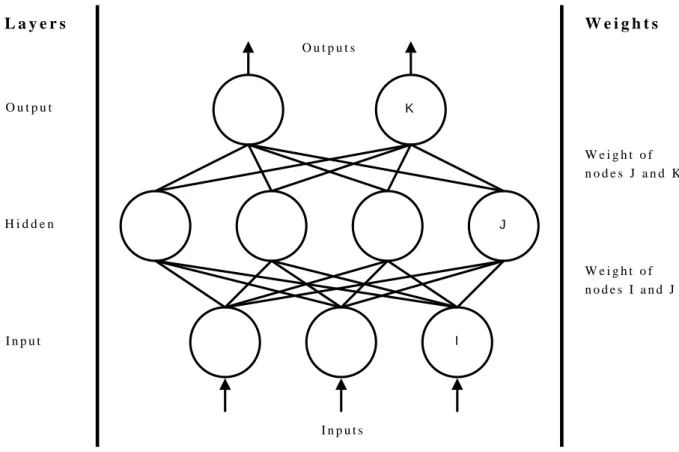
2.3 Feed-forward three-layer ANN . . . 29
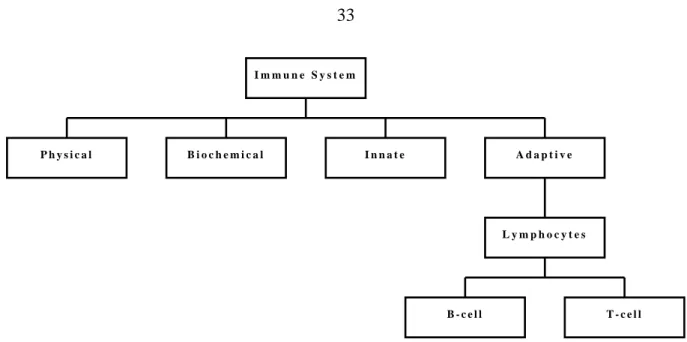
2.4 Defence layer of immune system . . . 33
2.5 Primary and secondary response . . . 35
2.6 Antibody-antigen binding . . . 37
2.7 CLONALG algorithm . . . 39
2.8 Optimisation problems found in traditional AIS . . . 45
2.9 Decision tree . . . 49
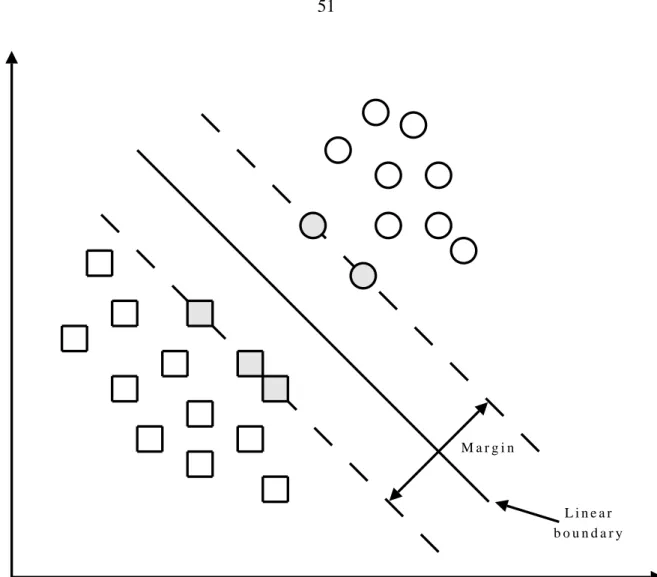
2.10 Classification of two classes using SVM . . . 51
2.11 Variable clustering . . . 60
2.12 Confusion matrix . . . 65
2.13 Examples of several ROC Curves . . . 70
3.1 Reject inference . . . 85
3.2 Samples generation . . . 87
4.1 Comparison of traditional AIS versus SAIS . . . 96
4.2 Evolution process of SAIS using a 3-D structure . . . 98
4.3 SAIS minimum distance classification method . . . 101
4.4 Cut-off values . . . 102
4.5 Sorting of attributes for use in polynomial function . . . 103
4.6 Partitioning of dataset (10-fold cross-validation) . . . 107
4.7 Convergence speed of SAIS . . . 108
5.1 ROC graph for Australian dataset . . . 126
5.3 ROC graph for Thomas dataset . . . 134 5.4 ROC graph for German evenly distributed dataset . . . 136 5.5 ROC graph for Thomas evenly distributed dataset . . . 138
LIST OF TABLES
2.1 Comparison of classification accuracy of different credit scoring techniques . . 53
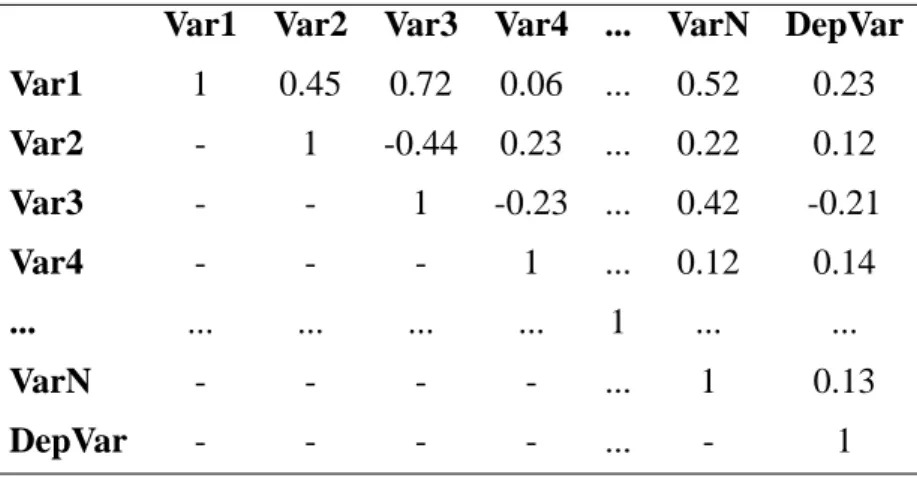
2.2 Correlation matrix . . . 57
2.3 Example of confusion matrix . . . 66
2.4 Kappa statistic — Strength of agreement . . . . 68
3.1 Variables in raw dataset . . . 76
3.2 Variables in clean dataset . . . 81
3.3 Stepwise regression results . . . 84
3.4 FICO scale . . . 89
3.5 FICO score . . . 90
4.1 Key terms and concepts of SAIS . . . 95
4.2 Datasets used for experiments . . . 105
4.3 System parameters of SAIS . . . 105
4.4 Average number of iterations for each dataset . . . 106
4.5 Comparison of performance of SAIS using different classification techniques . 109 4.6 Comparison of CPU time of SAIS . . . 109
4.7 Comparison of performance of SAIS on missing attributes datasets . . . 111
4.8 Comparison of classification performance of SAIS and other classifiers . . . 114
5.1 Datasets used for experiments . . . 118
5.2 Attributes used for experiments . . . 119
5.3 Results for Australian dataset . . . 123
5.4 Kruskal-Wallis results for Australian dataset . . . 124
5.5 Kolmogorov-Smirnov results for PCC performance measure . . . 125
5.6 Comparative results for Australian dataset — Statlog project . . . 128
5.8 Average confusion matrix LWL on German dataset . . . 129
5.9 Confusion matrix of a conservative classifier (logistic regression) . . . 130
5.10 Cost matrix for German dataset . . . 130
5.11 Cost results for German dataset . . . 131
5.12 Comparative cost results for German dataset — Statlog project . . . 132
5.13 Results for Thomas dataset . . . 133
5.14 Results for German evenly distributed dataset . . . 135
5.15 Results for Thomas evenly distributed dataset . . . 137
6.1 KMO interpretation guidelines . . . 143
6.2 Kaiser-Meyer-Olkin and Bartlett’s test . . . 150
6.3 Jarque-Bera results . . . 151
6.4 Factor analysis results — rotated factor matrix . . . 154
6.5 Composite variables . . . 156
6.6 Variable clustering results . . . 157
6.7 PLS results . . . 159
6.8 Gini coefficient . . . 160
A.1 Confusion matrix of SAIS . . . 190
A.2 Confusion matrix for scorecards . . . 192
IMMUNE SYSTEMS AND VARIABLE
SELECTION TECHNIQUES FOR
Most lending institutions are aware of the importance of having a well-performing credit scor-ing model or scorecard and know that, in order to remain competitive in the credit industry, it is necessary for them to continuously improve their scorecards. This is because better scorecards result in substantial monetary savings that can be stated in terms of millions of dollars. Thus, there has been increasing interest in the application of new classifiers in credit scoring from both practitioners and researchers in the last few decades. Most of the recent work in this field has focused on the use of new and innovative techniques to classify applicants as either ‘credit-worthy’ or ‘non-credit-‘credit-worthy’, with the aim of improving the performance of scorecards.
In this thesis, we investigate the suitability of intelligent systems or artificial intelligence tech-niques for credit scoring. In particular, intelligent systems that use immunological metaphors are examined and used to build a learning and evolutionary classification algorithm. Our model, named Simple Artificial Immune System (SAIS), is based on the concepts of the natural immune system. The model uses applicants’ credit details to classify them as either ‘credit-worthy’ or ‘non-credit-worthy’.
As part of the model development, we also investigate several techniques for selecting variables or attributes from the applicants’ credit details to improve the classification accuracy of our model. Variable selection is important as choosing the best set of variables can have a signif-icant effect on the performance of scorecards. Interestingly, our results demonstrate that the traditional stepwise regression variable selection technique seems to perform better than many of the more recent techniques.
A further contribution offered by this thesis is a detailed description of the scorecard develop-ment process. A detailed explanation of this process is not readily available in the literature and our description of the process is based on our own experiences and discussions with industry
credit risk practitioners.
We evaluate our model on the basis of both publicly available datasets as well as a very large set of real-world consumer credit scoring data obtained from a leading Australian bank. The evaluation results reveal that our model is a competitive classifier and is appropriate for devel-oping scorecards which require a class decision as an outcome. Another conclusion reached is one confirmed by the existing literature, that even though more sophisticated scorecard de-velopment techniques, including artificial immune system procedures and SAIS, perform well compared to the traditional statistical methods, their performances are not statistically signifi-cantly different from the statistical methods. As with other intelligent systems techniques such as Artificial Immune Recognition System, SAIS is not explicitly designed to develop practical credit scoring models which require the generation of a score that represents the degree of con-fidence that an applicant will belong to a particular group. However, it is comparable to other intelligent systems techniques which are outperformed by statistical techniques for generating practical scorecards.
Our final remark on this research is that even though SAIS does not seem to be quite suitable for developing practical scorecards, which need to generate scores, we still believe that there is room for improvement and that the natural immune system of the body has a number of avenues yet to be explored which could assist with the development of practical scorecards.
INTRODUCTION
This chapter introduces the research undertaken by examining the topic area and its significance to financial institutions. It also describes the motivations for the research and provides a brief discussion of the way this research was conducted. Finally, this chapter provides a high-level summary of the organisation of this thesis.
1.1
Background
In the last few decades, there has been a significant increase in the use of credit risk assessment tools by major banks and financial institutions around the globe. Indeed, credit risk models have been given unprecedented significance by the surprising pronouncements of the new Basel II Accord (Altman 2002), which has allowed banks to base their capital requirement on their own internal credit risk rating systems, given that these systems are predictive and reliable. This is one of the key factors that has driven banks, in particular, and financial institutions worldwide to place much emphasis and effort on either developing new or modifying existing credit risk rating systems in recent years.
In this thesis, our main interest is on credit scoring, which forms part of the credit risk rating system. As the objective of credit scoring is to determine whether or not to grant credit to an applicant, credit scoring consists of a typical classification problem. In this particular case, it is a binary classification problem which aims at grouping applicants as either ‘credit-worthy (good)’ or ‘non-credit-worthy (bad)’.
experience. They inspect the specifics of each applicant, including the details of their socio-demographic status, economic conditions and their intentions, and decide whether to accept or reject the application (Baesens 2003). However, with the increase in the number of credit applications and the limited number of credit experts available, financial institutions need to find a way of automating this process. With developments in technology and emergence of machine learning algorithms, new credit scoring models or scorecards, which can automate the processing of applicant details to produce a score representing the applicant’s creditworthiness, are being developed. These new scorecards have proved to be a viable solution to the increase in credit applications and lack of credit experts.
Many machine learning algorithms have been suggested in the literature for developing these new scorecards. Mitchell (1997) has defined machine learning as:
‘The field of machine learning is concerned with the question of how to construct
computer programs that automatically improve with experience.’
Machine learning is a multi-disciplinary field of research that provides a variety of induction algorithms with the objective of acquiring knowledge by learning patterns from data (Baesens 2003). One of the most commonly used tasks in machine learning is classification and it is often referred to as supervised learning since the dependent variables can be identified and can be used to guide the learning process.
Although there are many different machine learning techniques that are appropriate for building scorecards, there is no consensus on which technique is the best or most suitable. In this thesis, we examine a machine learning technique called artificial immune system in an attempt to build a better-performing scorecard.
1.2
Motivation
Our motivation is based on the fact that there is a need to develop better scorecards due to the huge savings that can be made as a result of well-performing scorecards and the high costs involved in classifying applicants wrongly. The development of a typical scorecard usually consists of six main steps, namely:
1. data cleaning;
3. variable selection;
4. samples generation;
5. model development and validation; and
6. model approval.
While all these steps are fundamental in developing well-performing scorecards, the ‘variable selection’ and ‘model development and validation’ steps are of particular interest to this re-search. We believe that in these two steps lies much scope for improving the performance of credit scoring models.
In regard to the ‘variable selection’ step, it has been found in the literature that the use of new and more predictive variables could yield significant improvements in the performance of scorecards. Unfortunately, few studies have examined the use of variable selection techniques in credit scoring. We are of the opinion that this is so because:
• most credit scoring studies make use of benchmark datasets, which contain few variables and clean data;
• those studies that make use of real-world datasets only utilise clean datasets, and as such variable selection is not a requirement; and
• large, real-world credit scoring datasets, containing many variables, are hard to obtain.
Therefore, some of the work in this research involves the application of several variable selec-tion techniques — which have proved to be successful in many other fields — in the context of credit scoring in order to improve scorecard performance.
The ‘model development and validation’ step is related to the implementation of a classifier to discriminate between applicants as either ‘good’ or ‘bad’, and the better the classifier, the better will be the performance of the scorecard. Our main research focus is ‘model develop-ment and validation’ since we intend to build a new classifier. We are motivated to use the artificial immune system as a classification technique in developing a scorecard. While the artificial immune system has been successfully applied in many different areas including data analysis (Neal 2002, Timmis, Neal & Hunt 2000), robotic control (Ishiguro, Ichikawa, Shibat
& Uchikawa 1998), scheduling (Engin & Doyen 2004), network intrusion detection (Kim & Bentley 1998), machine learning (Dasgupta & Forrest 1996, Hunt & Cooke 1995), and classi-fication (Watkins 2001), its use in the field of credit scoring is fairly limited. The only study found which involves artificial immune systems and credit scoring revealed that the artificial immune system model that was developed recorded the best performance of any single classi-fier used on a credit scoring dataset (Watkins, Timmis & Boggess 2004). The application of the artificial immune system as a classifier in this field is therefore a promising area for further research and is investigated in this thesis.
1.3
Significance of Research
This research is important for three main reasons. Firstly, financial organisations can perhaps begin the process of creating new scorecards, based on machine learning techniques such as the artificial immune system, to enhance scorecard performance. Based on our discussions with credit risk practitioners, most big financial institutions have their own research and development units which are investigating the use of new classification techniques including machine learn-ing. This thesis can certainly offer them some insight into the applicability of artificial immune systems in the development of a practical scorecard, and these new credit scoring models can complement existing ones. In addition, the results generated can be used by these institutions to assess their existing scorecards.
Secondly, of particular interest to credit risk practitioners reviewing this research are the out-comes of the different variable selection techniques when applied to the raw set of real-world credit scoring data. Most financial institutions are currently using only one common type of variable selection technique (stepwise regression analysis); thus the results obtained in this thesis can provide them with more information about the different abilities of other variable selection methods. These methods could potentially replace and/or complement existing tech-niques.
Finally, this research can also be of value to researchers in the field of intelligent systems as this research proposes a new artificial immune system model which addresses some of the problems, such as population control mechanism and optimisation problems, found in traditional artificial immune system classifiers. The design of our model can be of theoretical significance for those who intend to improve artificial immune system classifiers as the ideas, implementations and
results of our model can be used as the basis for further improvements.
1.4
Methodology
The main steps taken to conduct this research are as follows.
• An investigation of the development of a practical scorecard is first made. We believe that it is important to know how a typical scorecard is built in practice before making use of artificial immune algorithms as the main classification method for credit scoring. It is also our belief that this exploration will contribute significantly to the body of knowledge since we cannot find any studies that explain the entire process of scorecard development from start to finish as carried out in practice. Most studies deal only with the classification techniques for developing a scorecard.
• Even though the ‘variable selection’ step is usually performed prior to the ‘model de-velopment and validation’ step, we have decided to develop an artificial immune system classifier first. This is because we would like to check the validity of our classifier on benchmark and clean datasets containing only the most relevant variables. In so doing, the classification model will be isolated from any noise that results from a large number of variables, and hence the discriminatory performance of the classifier can be robustly and reliably tested.
A new artificial immune system will, therefore, be designed and implemented as a clas-sifier. During this phase of the research, the focus will be mainly on the classifica-tion/predictive ability of the classifier. In addition, its computational complexity will be examined in order to determine whether it is costly to run, scalable and fast.
• The application of the new artificial immune system classifier in credit scoring is then examined. This is done by comparing its performance against other machine learning methods and the most common statistical techniques used in credit scoring.
• Several variable selection techniques are then investigated with the aim of improving scorecard performance. Here, we try to identify which variable selection methods are most reliable and efficient by applying them to a raw real-world credit scoring dataset obtained from one of the major Australian banks.
• Finally, an attempt to develop practical scorecards by using our artificial immune system classifier and different variable selection techniques will be made.
1.5
Aims and Scope of Thesis
Two major areas of the scorecard development process were identified as having much capacity for improving credit scoring models. These are the application of 1) better classifiers and 2) variable selection techniques. However, the application of an artificial immune system for de-veloping scorecards as well as the use of other variable selection techniques, other than stepwise regression, in credit scoring are quite limited as indicated by the scarcity of published materials in these two areas in the current literature. In the pursuit of our investigation into improving the performance of credit scoring models, we aim to explore the suitability of a new artificial immune system and several variable selection methods for credit scoring.
1.6
Contributions
In our examination into the development of better performing scorecards, this thesis makes several contributions in three distinct areas:
1. explanation of the entire process of scorecard development as is done in practice;
2. design and implementation of an artificial immune system classifier for use in credit scor-ing; and
3. analysis of variable selection techniques in credit scoring.
In regard to the development of a practical scorecard, the current literature only provides ex-planations on some of the processes of scorecard development. In this thesis, we explain the entire process of the development of a practical scorecard. Our approach to this topic is a result of our meetings and discussions with credit risk practitioners. We believe that our contribution in this area will bridge the gap between the practical aspects of scorecard development and the theoretical points present in the current credit scoring literature.
As for the development and implementation of an artificial immune system classifier for credit scoring, there seems to be limited research dedicated to the use of artificial immune systems in credit scoring. Our contribution in this area includes:
• design of a simple artificial immune system classifier that is easy to use and that has competitive classification/predictive abilities as well as linear computational complexity;
• application of our new model in the context of credit scoring.
Although there have been several classifiers which are based on artificial immune system algo-rithms, the design of our model uses a different approach and the originality of our contribution stems from several facts.
• By using a single B-cell to represent the whole classifier, we ensure that optimisations are performed globally rather than locally. In so doing, no B-cells are lost during the evolution process.
• There is no need for any population control mechanism as is the case for other artificial immune system classifiers.
Finally, in relation to variable selection techniques in credit scoring, even though it has been ad-vocated that new and better predictor variables lead to better scorecards, variable selection tech-niques have been conservatively used for credit scoring. Our contribution in this area includes the investigation of four common variable selection methods that could be used by financial institutions for selecting the most relevant set of predictor variables.
1.7
Outline of Thesis
The remainder of the thesis consists of five parts.
• The first part consists of Chapter 2 and presents the current state of knowledge regard-ing credit scorregard-ing, artificial immune systems, and variable selection. Some of the most commonly used measures of performance that are used in the field of credit scoring are reviewed.
• The second part includes Chapter 3 and explains the entire process of practical scorecard development. A practical scorecard is also developed by using a large set of raw real-world credit scoring data obtained from one of the leading Australian banks. To the best of our knowledge, such a study has not been conducted in this field before.
• The third part includes Chapters 4 and 5 and is related to the design and implementa-tion of a new artificial immune system classifier for use in the development of a credit scoring model. Both balanced1and unbalanced2datasets are experimented upon and
sev-1Balanced datasets are those in which the proportion of classes is nearly equal.
2Unbalanced datasets are those in which the proportion of classes is not equal. An example of an unbalanced
eral performance measures are used to assess the performance of our new classifier as a scorecard.
• The fourth part of this thesis consists of Chapter 6 and outlines the examination of vari-ous popular variable selection techniques that could be used in credit scoring. In addition, an investigation is conducted of the use of these variable selection techniques in conjunc-tion with the new classifier (refer to Chapters 4 and 5) to build practical scorecards.
• The fifth and last part of the thesis includes Chapter 7 and is dedicated to the conclusion, and a discussion of the limitations of this research and future work.
The thesis also contains two appendices:
• Appendix A contains the confusion matrix for our artificial immune system model as both a classifier and a scorecard.
LITERATURE REVIEW
2.1
Introduction
Credit scoring is one of the earliest financial risk management tools developed (Thomas, Edel-man & Crook 2002) and it is now an important part of the financial corporate world. This chapter provides an overview of credit scoring by first giving a full description of credit scor-ing, followed by an outline of its history along with its advantages and limitations. Once the field of credit scoring has been discussed, an explanation of the steps used in the development of credit scoring models or scorecards is provided.
This chapter also provides a discussion of various techniques for developing scorecards. While many other methods are presented in the current literature, only those based on traditional sta-tistical as well as intelligent systems — including machine learning — methods are discussed. One intelligent systems technique, which is of particular interest to this research, involves the artificial immune system, which is based on the concepts of the natural immune system.
It is also important to reduce the number of variables used by scorecards by finding the most compact set of variables that are relevant to the model. Thus, several variable selection tech-niques are discussed in Section 2.5.
Given that real-world credit scoring datasets are very often unbalanced datasets, the ‘percent correctly classified’ measure, which is one of the most commonly used measures of perfor-mance, is usually not adequate to assess the performance of scorecards and classifiers. There-fore, several other measures of performance, which are more resistant to unbalanced datasets,
are discussed in Section 2.6.
2.2
Credit Scoring
Credit scoring is one of the most successful operations research techniques in finance and bank-ing (Thomas et al. 2002). As its name implies, operations research involves ‘research on opera-tions’, that is how to conduct and coordinate the operations or activities within an organisation. Moreover, it is concerned with the development and application of models that may help in solving managerial problems and decision making, and is also known as managerial science (Hillier & Lieberman 2005).
Credit scoring is also referred to as a business intelligence application (Olszak & Ziemba 2006). Business intelligence is a data-driven decision support system that combines data gathering, data storage and data analysis to provide input into decision processes, with the aim of increasing the competitive advantage of a business (Reinschmidt & Francoise 2000). The term business intelligence was first used in the 1990s by the Gartner group as a term to describe concepts and methods used to improve business decision making by using fact-based support (Negash & Gray 2008). It involves business processes such as reporting, forecasting and prediction, and trend analysis, to name a few, and by 2005 artificial intelligence as well as powerful ana-lytical capabilities were included in business intelligence systems (Turban, Aronson, Liang & Sharda 2007).
Business intelligence systems have been used by a wide range of users from financial experts, to salespersons, up to board members (Rasmussen, Goldy & Solli 2002). Many significant and positive business effects are obtained when the capabilities offered by business intelligence systems are applied to various sectors such as the trading, insurance, telecommunication, man-ufacturing and financial sectors (Olszak & Ziemba 2006). Some of these business effects are:
• analysis that supports cross-selling and upselling;
• customer segmentation and profiling;
• analysis of parameters importance;
• survival time analysis;
• credit scoring;
• fraud detection;
• logistics optimisations; and
• forecasting of strategic business processes development.
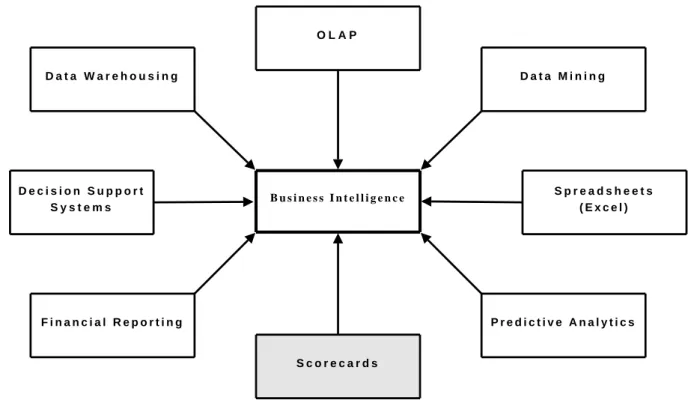
Figure 2.1 shows the various tools, techniques and capabilities of business intelligence, with our main focus being scorecards (credit scoring tool), which is in the shaded rectangle.
B u s i n e s s I n t e l l i g e n c e D a t a W a r e h o u s i n g D e c i s i o n S u p p o r t S y s t e m s O L A P F i n a n c i a l R e p o r t i n g S c o r e c a r d s S p r e a d s h e e t s ( E x c e l ) P r e d i c t i v e A n a l y t i c s D a t a M i n i n g
Figure 2.1: Business intelligence tools (adapted from Turban et al. (2007))
The remainder of this section provides some background information relevant to a deeper un-derstanding of this research study. It reviews the literature to examine state of the art credit scoring.
2.2.1
An Overview of Credit Scoring
Credit scoring is a process whereby information about a credit applicant is converted into num-bers that are added together to form a score (Lewis 1992). This score is a measure of the risk
associated with the applicant concerned and allows any lending institution to classify applicants into two groups: 1) ‘good’, which consists of those who are credit-worthy and who are likely to repay their financial obligation; and 2) ‘bad’, which involves those who are non-credit-worthy and whose application for credit should be rejected due to a high probability of them defaulting on their financial obligation.
Since the objective of credit scoring is to choose between two actions — grant or refuse credit to ‘good’ and ‘bad’ applicants respectively — credit scoring is a typical classification problem. Classification is a commonly encountered decision making task in business. Categorising an object into a predefined group or class based on a number of observed attributes related to an object is a classification problem (Zhang 2000).
Credit scoring makes use of statistical techniques to evaluate the credit risk of applicants using historical data. Indeed, the strength of credit scoring models is based on a sound methodology and empirically derived data, which usually contain a list of criteria that provides the most pre-dictive information on whether an applicant will be high- (‘bad’) or low-risk (‘good’). Each criterion, in turn, has a range of attributes with associated scores, and the higher the scores, the more likely the applicant is to be low-risk.
For credit scoring to work effectively, one main assumption must be satisfied. This assumption is known as ceteris paribus, which means ‘the future is like the past’. Since credit scoring is based on historical data, it assumes that the type of people who did not meet their financial obli-gations in the past will remain the same and will not be able to meet their financial obliobli-gations in the future.
There are two types of credit evaluation utilised during the lending process in banks and other credit granting organisations. One is to make decisions on new credit applications; the other is to supervise existing applicants, including whether or not to increase their credit limits. The tools that aid the first type of decision are called credit scoring, while the ones that assist the second type of decision are called behavioural scoring.
2.2.2
History of Credit Scoring
It is believed that humans started borrowing and repaying once they were able to verbally com-municate. The first recorded case of credit comes from ancient Babylon. In their book, Thomas
et al. (2002) reported that Lewis (1992) recorded the following inscription on a stone tablet dated to around 2000 BC:
‘Two shekels of silver have been borrowed by Mas-Schamach, the son of
Adadri-meni, from the Sun priestess Amat-Schamach, the daughter of Warad-Enlil. He will pay the Sun-God’s interest. At the time of harvest, he will pay back the sum and the interest upon it.’
This leads to the conclusion that during this time farmers were already dealing with credit by borrowing at planting time and paying back at harvest time.
While the history of credit dates from some 5000 years back, the history of credit scoring is only around 50 years old as it originated during World War II. Financial organisations were experiencing difficulties in credit management since credit analysts had to serve in the mili-tary resulting in a shortage of people with credit expertise. To resolve this issue, firms made the credit analysts write down the rules of thumb they used to make credit decisions (Johnson 1992) and these rules were then used by non-experts as a type of decision support tool.
Credit scoring only really started to come into prominence when it was developed by Fair and Isaac in the 1960s, and the credit risk modelling literature has grown extensively since the seminal work of both Altman (1968) and Merton (1974). Since the 1960s, credit scoring has played a vital role in the phenomenal growth of consumer credit, especially for credit cards. The arrival of credit cards made banks and financial institutions realise the importance of credit scoring. The increasing number of people applying for credit cards per day made it impossible for lending organisations, in both economic and manpower terms, to do anything but automate the process of decision lending. These organisations found that credit scoring is a better and more accurate predictor than any subjective assessments made by human experts (Churchill, Nevin & Watson 1997, Rosenberg & Gleit 1994).
As such, credit scoring was widely accepted in the United States of America in the early 1980s and the United Kingdom in the early 1990s. The number of credit card owners has increased rapidly in Australia. According to the Reserve Bank of Australia, the number of credit card ac-counts has increased by 110% from 6.5 million in 1994 to 13.7 million in 2007 (Reserve Bank of Australia 2007). As for the number of credit card transactions, it has increased by 496% from 18 million in 1994 to 108 million in 2007. However, as consumer credit increases at an extraordinary rate, so too have consumer bankruptcies. According to the Australian
Govern-ment (2007), the number of customers, including both business and non-business, who filed for bankruptcy increased by 13.2% from June 2006 to June 2007.
The success of credit scoring in the allocation of credit cards meant that banks started using scoring for other products like personal loans, and it is only recently that scoring has been used for home and business loans. At present, the emphasis of credit scoring is to change its objec-tives from minimising the probability of default of an applicant to maximising the profit that could be generated from that applicant. However, this transition to profit scoring implies many challenges in that classifying customers into ‘profitable’ and ‘non-profitable’ groups might not be an easy task since profit is highly dependent on many factors which, in turn, might not be easily accessible. For instance, profit is dependent on the economic conditions of a customer and thus it becomes even more important to include extra economic variables in profit scoring than was the case in credit scoring. Moreover, since profit is a function of the amount of time a customer borrows from a lending institution, it is imperative to include the attrition rates for the implementation of profit scoring (Thomas 2000).
Given the difficulties in the calculation of profit and loss and given the number of assumptions that are required for a profit assessment, the switch from credit to profit scoring has not been very prominent. This is probably why credit scoring is still very much in use today in the industry.
2.2.3
Advantages and Limitations of Credit Scoring
Credit scoring is changing the way financial institutions grant credit and more credit issuers are entering the market using credit scoring. It encourages lending because not only does it pro-vide these institutions with a tool to make more accurate predictions to support credit scoring decisions, it also results in fewer errors due to the automation of much of the credit evaluation process used for applications.
There are a number of reasons for implementing credit scoring models beyond the issue of their accuracy. According to Jacky Jamieson, vice-chairman of the Finance, Credit and International Business Corporation and director of the international division of the Credit Department, credit scoring can improve performance by streamlining the credit evaluation process and, thereby, al-lowing credit professionals to focus more on exception accounts, applications whose scores are near the cut-off value and more difficult cases, while becoming more customer service–oriented
towards both internal and external customers (Schaeffer 2000).
Another significant advantage of credit scoring is that because it automates the process of de-cision lending, credit dede-cisions are made much more quickly. This time-saving results in cost savings for the bank since the cost of credit analysis is greatly reduced. In this regard, Muolo (1995) stated that the cost per loan of a commercially available credit scoring model averages US$1.50-10 per loan, depending on volume. While this value was obtained some 10 years ago, it could be even less now with the advances in technology. The automation process also bene-fits the customers since they are able to know the outcomes of their applications more quickly. According to a study by the Business Banking Board, credit scoring has reduced the small-business loan approval process from two weeks to about 12.5 hours (Allen 1995).
Credit scoring also reduces the effects of personal attitudes and human prejudices on credit de-cisions. This fairness is crucial in view of the anti-discrimination and equal opportunity laws related to credit granting (Galitz 1983). Moreover, changes in both internal and external credit policies can easily and quickly be incorporated into the credit scoring model, in contrast to the lengthy meetings and paperwork required if credit granting were undertaken manually.
The potential benefits from a successful implementation of credit scoring are huge. For a ma-jor financial institution, even a fraction of a percent increase in credit scoring accuracy is a significant accomplishment and could be worth millions of dollars due to the sheer volume of lending (West 2000). However, the use of credit scoring is potentially something of a double-edge sword too: it can be both beneficial and detrimental. While the use of credit scoring can improve customer service by reducing the amount of time needed to evaluate the applicant, it can also reduce the amount of interaction and communication between the banks and their cus-tomers, resulting in the creation of a negative image of the banks from the customer perspective (Matsatsinis 2002).
Another limitation of credit scoring is that while credit scoring models are good at handling quantitative features, qualitative ones, which might be important predictors in the credit lending decision, are not easy to explain (Henley 1995). Furthermore, the dataset has to contain a rich sample of both well- and poor-performing applicants. A question that needs to be considered is: ‘What proportion of good and bad should there be in the sample?’
Last, but not least, credit scoring is heavily dependent on its main assumption: that the future is like the past. In today’s changing credit climate due to economic conditions, legislation and credit controls, and consumer perceptions about borrowing, this assumption is not completely valid (Thomas, Edelman & Crook 2004). Hence, there is a need to make slight adjustments and to re-estimate the credit scoring models frequently. However, although there are many unsolved problems in connection to credit scoring, empiricism has shown that credit scoring models are very robust in most actual lending situations (Thomas 2000).
2.3
Credit Scoring Models
It is believed that past performance does not guarantee future results, but in the world of credit decisions, history often proves to be a reliable indicator. As previously mentioned, credit scor-ing models or scorecards are built usscor-ing historical data. This data can be obtained from several sources, with the two most commonly used sources being information from application forms and information held by external credit agencies such as the credit bureau (Boonyanunta 2005).
Examples of information that are obtained from the application form are:
• age of applicant;
• number of dependants;
• marital status;
• number of years at current address;
• employment type;
• income; and
• estimated assets and liabilities.
Examples of information that are obtained from external credit agencies are:
• number of times applicant has defaulted on a loan;
• number of loan applications that were submitted during the last 12 months;
• number of fraud warnings.
Although the information used for credit risk assessment comes from various sources, most scorecards utilise information related to the 5Cs of credit (Thomas 2000, de Lucia 1993):
1. character — assessment of borrower’s history, reputation and managerial experience in his/her career or business;
2. capital — financial strength of borrower;
3. collateral — assessment of the assets promised to the lender if borrower defaults;
4. capacity — repaying ability of borrower; and
5. condition — factors that may significantly affect the repaying ability of borrower.
Credit scoring models make use of this information to compute the credit score of applicants. According to Fair Isaac and Company, the payment history of applicants accounts for approxi-mately 35% of the credit score. The payment history of applicants reflects the various accounts, credit cards, and loans that the applicants may have. Thirty percent of the credit score is at-tributed to the amount of money that applicants owe; 10% of the score falls under a category which Fair Isaac call ‘new credit’. This category reflects factors such as the number of new credit accounts of applicants, and the greater the number of new accounts, the more poorly this reflects on the credit score. Fifteen percent of the score measures the length of an applicant’s credit history under Fair Issac’s system and, finally, approximately 10% of the credit score evaluates the type of credit an applicant has and whether it is a ‘healthy mix’. The five afore-mentioned factors are just a few among many and they each usually contain several predictor variables which represent them.
There has been an ongoing debate in regards to the wisdom of using statistically derived credit scoring models, as opposed to using the judgement of credit analysts, to evaluate credit ap-plications. Lending institutions argue that scorecards provide a consistent way of evaluating applicants and that a credit score is superior to the decision of credit analysts, who are given too much discretion which, in turn, results in problems such as bias. Others argue that the credit denial ratio has not changed much since the implementation of the credit score and that the discriminatory decisions made by credit analysts were simply replaced by a more subtle form of discrimination that is built into a scorecard.
Many empirical studies (Alexander 1989, Edmister 1988) have been undertaken in order to determine whether a statistical credit scoring model can be expected to outperform credit an-alysts. Most of these studies examine applicants whose loans were approved by a scorecard and compare this to applicants who received loans when a credit analyst had overridden a rec-ommendation of rejection by the credit scoring model. The results of the majority of these studies indicate that there is increasing evidence to suggest that the use of credit scoring models can be very effective in evaluating credit applicants. Some of these studies have found that the delinquency rates were seven times greater for decisions made by credit analysts than for recommendations based on the scorecard, while others found that the incorporation of both approaches into making a decision can be effective in improving credit loss accuracy.
2.3.1
How Credit Scoring Models Work
A simple credit scoring model assigns weights to some numerical measures of the relevant items of applicant information to obtain a numerically weighted sum or score, which represents an estimate of the probability or risk that an outcome will occur. A prespecified cut-off value determines whether or not the value of the obtained score warrants granting credit to the appli-cant. The foundation of a simple credit scoring model can be described as shown in Equation 2.1: y= n X i=1 wixi (2.1)
wherey is the credit score, xis the independent (predictor) variable, w is the weight of each variable andnis the number of variables.
Credit scoring is the process of generating a value foryaccording toxfor every applicant. This is a two-step process:
1. Scorecard development
Historical data onnapplicants with their known risk classes are entered into the formula (Equation 2.1) to enable a determination of the weights of the predictor variables.
2. Scorecard use/prediction
2.3.2
Credit Scoring Models Development
In practice, the development of a typical scorecard is a lengthy process which usually involves many steps: 1) data cleaning, 2) data discretisation, 3) variable selection, 4) samples genera-tion, 5) model development and validagenera-tion, and 6) model approval. These steps are discussed in greater detail in Chapter 3.
These processes are very similar to those found in the Knowledge Discovery in Data (KDD). KDD is concerned with the development of methods for extracting knowledge from data and is defined as (Fayyad, Piatetsky-Shapiro, Smyth & Uthurusamy 1996):
‘...the non-trivial process of identifying valid, novel, potentially useful, and
ulti-mately understandable patterns in data.’
The KDD process is an iterative one, involving numerous steps with many decisions to be made by the user. While a practical view of the process of KDD is provided in the literature (Brachman & Anand 1996), here we briefly outline some of its basic steps as shown in Figure 2.2.
In the data preprocessing phase, the data is selected and cleaned. Basic operations include re-moving noise and outliers where appropriate, deciding on strategies for handling missing data, and selecting the most useful set of variables to represent the data. In the development of a scorecard, the first four steps — data cleaning, data discretisation, variable selection and sam-ples generation — correlate to this phase of KDD.
The preprocessed data are then used as input to the data mining phase. There are two distinct purposes of this phase. The first is to predict the future behaviour of some entities. Regression and classification are two of the most popular predictive data mining tasks and are often referred to as supervised learning. The other purpose of the data mining phase is to identify patterns and relationships within the data and this is known as descriptive data mining. In credit scoring, we are only interested in predictive data mining since applicants need to be classified as either ‘credit-worthy’ or ‘non-credit-worthy’. The model development and validation processes are categorised as part of this KDD phase.
The final step of KDD is to post-process the knowledge or patterns extracted from the previ-ous phase. This knowledge can be used directly or incorporated into other systems for further
D a t a p r e p r o c e s s i n g D a t a s e l e c t i o n D a t a c l e a n i n g O u t l i e r r e m o v a l M i s s i n g v a l u e V a r i a b l e s e l e c t i o n D a t a m i n i n g R e g r e s s i o n C l a s s i f i c a t i o n C l u s t e r i n g S e q u e n c e a n a l y s i s D e p e n d e n c e a n a l y s i s P o s t - p r o c e s s i n g V e r i f i c a t i o n K n o w l e d g e v i s u a l i s a t i o n P r e d i c t i v e d a t a m i n i n g D e s c r i p t i v e d a t a m i n i n g P h a s e K D D P r o c e s s S c o r e c a r d D e v e l o p m e n t P r o c e s s D a t a c l e a n i n g D a t a d i s c r e t i s a t i o n V a r i a b l e s e l e c t i o n S a m p l e s g e n e r a t i o n M o d e l d e v e l o p m e n t a n d v a l i d a t i o n M o d e l a p p r o v a l
Figure 2.2: KDD processes (adapted from Baesens (2003))
analysis. For example, the credit scoring knowledge extracted can be used for behavioural scoring. As mentioned previously, behavioural scoring is about supervising existing credit ap-plicants and the knowledge extracted from credit scoring can be used to determine whether the credit limits of the existing credit applicants should be increased or not. Moreover, the post-processing phase also includes checking and/or verifying previously known or extracted knowledge (Fayyad, Piatetsky-Shapiro & Smyth 1996). The scorecard approval process is part of this KDD phase.
2.4
Credit Scoring Techniques
In credit scoring, human intuition has often been challenged and surpassed by mathematical models. These models can be built using statistical methods and machine learning systems. Historically, discriminant analysis and linear regression have been the most widely used
tech-niques for building scorecards. However, advances in computing have allowed other techtech-niques to be adopted. In the 1980s, logistic regression and linear programming, the two primary meth-ods for scorecard building, were introduced (Thomas 2000).
The need for a safer evaluation of credit approvals led to the implementation of sophisticated scorecards in credit approval assessment and, more recently, many institutions have begun ex-ploring the use of intelligent systems techniques, such as expert systems and artificial neural networks. Other techniques, such as genetic algorithms and k-nearest neighbour, have been tried without much success. These have not become popular because, although their forecasting abilities in relation to applicant classification can perhaps equal those of traditional statistical models, they do not seem to offer any additional business advantages (Lucas 2001). Artificial neural networks, for instance, are commonly considered as black-box techniques without logic or rule explanation, such that the resulting solution is not easily interpretable. K-nearest neigh-bour, on the other hand, requires major systems investment since the search for the k closest neighbour is very computationally intensive.
A more recent form of intelligent systems technique, known as artificial immune system, is rapidly emerging. It is based on natural immune system principles and it offers strong and robust information processing capabilities for solving complex problems. Even though artifi-cial immune systems have been used in the area of pattern recognition and classification, there has only been a single case where it has been applied to credit scoring processes (Watkins et al. 2004). Watkins et al. (2004) found that their artificial immune system model, known as Artificial Immune Recognition System, exhibited the best performance of any single classifier used on the Australian credit dataset, which can be obtained from the University of California Irvine (Blake & Merz 1998).
A discussion of the aforementioned techniques is presented next. The statistical techniques — discriminant analysis and logistic regression — are presented first in Section 2.4.1, followed by intelligent systems/artificial intelligence techniques, which include artificial neural networks, genetic algorithms, and artificial immune systems. Finally, other credit scoring techniques (k-nearest neighbour, mathematical programming, decision tree, and support vector machine) are discussed in Section 2.4.3.
2.4.1
Statistical Techniques
As previously stated, statistical techniques have been widely used in the field of credit scoring. They are still being used by most financial institutions for building scorecards because they are simple and yet robust. Two of the most commonly used methods are discriminant analysis and logistic regression. They are appropriate techniques when the dependent attribute is a cat-egorical attribute, as is the case for credit scoring where the dependent attribute consists of two groups or classifications, ‘good’ or ‘bad’.
2.4.1.1 Discriminant Analysis
Discriminant analysis is usually used to classify observations into two or more mutually exclu-sive groups by using the information provided by a set of predictor attributes. When only two groups are involved, this technique is referred to as two-group discriminant analysis; however, when there are three or more groups, it is called multiple discriminant analysis (Hair, Black, Babin, Anderson & Tatham 2006). It should be noted that while only the two-group discrimi-nant analysis is used in this research, for the sake of brevity, the term discrimidiscrimi-nant analysis is used throughout. It takes the form of:
y=c+
n X
i=1
wixi (2.2)
whereyis the discriminant score, cis a constant,wis the weight of each attribute andxis the independent attribute. Discrimination is achieved by multiplying each independent attribute by its corresponding weight and adding these products and the constant together.
The final decision function of discriminant analysis is determined by a cut-off score. That score represents the dividing point used to classify observations into their groups based on the value of y. It is calculated by averaging the group means or centroids, which are in turn obtained by averaging the discriminant scores of all the observations within a particular group (Hair et al. 2006).
Even though discriminant analysis has been reported to be one of the most commonly used data mining techniques for classification problems, one of its significant limitations is that indepen-dent attributes which are of a categorical nature cannot be handled properly. Another important restriction is its dependence on a relatively equal distribution of group membership.
Discrim-inant analysis also assumes that the predictor variables follow a normal distribution1 and have
linear as well as homoscedastic2 relationships. Due to the categorical nature of the credit data
and the fact that the covariance matrices3of the ‘credit-worthy’ and ‘non-credit-worthy’ classes
are not likely to be equal, the use of discriminant analysis for credit scoring has often been criticised (West 2000). However, it was found that the predictive performance of discriminant analysis, when applied to the context of credit scoring, was superior to that of artificial neural networks, genetic algorithms and decision trees (Yobas, Crook & Ross 2000).
2.4.1.2 Logistic Regression
Logistic regression has emerged as the most suitable technique when the dependent attribute is binary and the independent attributes are continuous, categorical or both. Since the outcome of credit scoring is binary, i.e. to either grant or refuse applicants credit, logistic regression is probably the most suitable statistical approach for credit scoring. In fact, based on our discus-sion with several credit analysts of a leading Australian bank, logistic regresdiscus-sion was found to be the main technique used by most financial institutions for credit scoring. It is designed to predict the probability of an event (for example, granting credit) occurring and assumes that the log likelihood ratio (odds) is linear. Logistic regression takes the form of:
log y 1−y =c+ n X i=1 wixi (2.3)
wherey is the probability of classification outcome, c is a constant, w is the weight of each attribute andxis the independent attribute.
Based on Equation 2.3, the value ofy can be generated. Since a probability can have a value between 0 and 1, a cut-off point, for example 0.5, is required to classify an applicant as either ‘good’ or ‘bad’.
Unlike other statistical models, logistic regression can suit various kinds of distribution func-tions, such as Poisson and normal (Press & Wilson 1978), and as such does not require some of the assumptions necessary for discriminant analysis (i.e. normal distribution, linear and ho-1A normal distribution is a purely theoretical continuous probability distribution in which the scores of the
variables are clustered around the mean in a symmetrical pattern known as the bell-shape or normal curve.
2A set of data is said to be homoscedastic if the variance of the error terms appears constant over a range of
predictor variables.
moscedastic relationships between the dependent and independent variables). Therefore, one might expect logistic regression to perform better compared to discriminant analysis given its stronger theoretical justification. However, it has been found that logistic regression is as ef-ficient as linear discriminant analysis but not more so (Harrell & Lee 1985). One of the most detailed published analyses compared the performance of various methods including discrim-inant analysis, logistic regression, mathematical programming methods and smoothing non-parametric methods on credit scoring (Hand & Henley 1997, Henley 1995). From the results of their experiments, it was concluded that there is no overall ‘best’ method and that what is best depends on the type of problem, for example, in relation to data structure, characteristics used or objective of the classification. For instance, neural networks are better suited to situations where there is a poor understanding of the data structure while regression and tree-based methods are more applicable to situations where reasons must be given for any decisions reached.
2.4.2
Intelligent Systems / Artificial Intelligence Techniques
Over the years, biology has provided a rich source of inspiration for many different compu-tational problems. Many different intelligent information processing systems have been con-structed based on biological metaphors. These systems can be classified as: brain-nervous systems (e.g. artificial neural networks); genetic systems (e.g. genetic algorithms); and im-mune systems (e.g. artificial imim-mune systems).
The applications of these intelligent systems techniques are now attracting increasing interest in the business literature. In the past few decades, there has been a growing interest in the fields of artificial neural networks and genetic algorithms, which are good examples of successful applications of biological metaphors to devise solutions to computational problems. There is now also increasing interest in the use of the natural immune system as a metaphor for solving complex problems. These intelligent systems have quickly evolved from an academic notion into proven and highly marketable products since they are able to provide reliable ways of ob-taining solutions to a variety of problems that often cannot be dealt with by traditional methods (Goonatilake & Treleaven 1995). In fact, a 1997 report by the Stamford, Connecticut–based Gartner Group described these intelligent systems as being at the top of the five key technolo-gies that will clearly have a major impact across a wide range of industries within the next five to 10 years (Metaxiotis & Psarras 2004).
such as credit scoring due to five key intelligent systems features, which have made them partic-ularly attractive for finding solutions to such problems. These five key features are (Goonatilake & Treleaven 1995):
• Learning: The ability to learn decisions and tasks from historical data and/or previous examples. This is the most important feature of intelligent systems.
• Adaptation: The ability to adapt to the changing environment such as policy changes, new government regulations or changes in economic conditions.
• Flexibility: The ability to make decisions and perform tasks even in the presence of in-complete and unreliable data.
• Explanation: The ability to explain how the decisions were reached. In some cases, due to legal or organisational reasons, it is compulsory to provide explanations of how decisions have been made.
• Discovery: The ability to discover new processes or relationships that were previously unknown.
It should, however, be noted that not all intelligent systems techniques exhibit all of these five features. As such, each technique has its own strengths and weaknesses and thus cannot be used as a general-purpose tool for every type of problem. An assessment of these techniques (artificial neural networks, genetic algorithms and artificial immune systems) will be made in the following sections.
2.4.2.1 Artificial Neural Networks
Artificial neural networks (ANNs) are inspired by the functionality of the nerve cells in the brain. After being dismissed in the 1970s, interest in ANNs was revived in the 1980s as a result of advances in computer technology. Moreover, with improvements in our understanding of how the brain and the mind work, the 1990s was declared to be the ‘Decade of the Brain’ by the US Government, leading to an increase in the application of ANNs. In many financial decision making instances, ANNs can supplement or take the place of traditional statistical approaches (Chatterjee 2000).
ANNs attempt to model the operation of biological neural systems, which are made of sim-ple, tightly interconnected processing elements called neurons. The interconnections are made