Analele ştiinţifice ale Universităţii “Al. I. Cuza” Iaşi Tomul LVI, fasc. 2, s. II a. Biologie vegetală, 2010
IMPROVED TECHNIQUES FOR OBTAING VOLATILE OILS CONCERNING THEIR QUANTITATIVE AND QUALITATIVE ANALYSIS FROM LAMIACEAE
TAXONS
DOINA ATOFANI*, MARIA-MAGDALENA ZAMFIRACHE*, ANCA-RALUCA
ANDRO*, IRINA BOZ*, MAGDA COISIN*, CLAUDIA PĂDURARIU*
Abstract: The conventional methods for obtaining volatile oils have some disadvantages because of the large amount of plant material consumed needed, long time for extraction, high energy expense and it is the possible transformation of some volatile compounds also. Nowadays, many research teams try to find new extraction methods for volatile oils so that they can obtain as much as possible precise results. We tried to make a theoretical comparative study using our results obtained with the most common method for volatile oil isolation, hydrodistillation, which is used in our laboratory and the results from the literature, obtained with other extraction methods.
Key words: microdistillation, hydrodistillation, microwave - assisted hydrodistillation, micro - steam distillation - solid - phase microextraction, volatile oil, Lamiaceae
Introduction
Many scientists, being aware of the medicinal properties of the plants, are interested in studying as many plants as possible to obtain important results regarding their therapeutical properties. If the results are very precise, they can be used in pharmaceutical industry. For obtaining very precise results, the methods must be very certain.
We tried to make a theoretical comparative study using our results obtained with the most common method for volatile oil isolation, hydrodistillation, which is used in our laboratory and the results from the literature, obtained with other extraction methods. We used hydrodistillation on some plants from Lamiaceae family.
Lamiaceae family includes many species that are very important for medicine,
cosmetic and food industry. Their volatile oils with their chemical compounds have a very important role in medicine.
Material and methods
Our results were obtained with the Clevenger - type apparatus and the results from the literature were obtained with the following methods: microdistillation, microwave -assisted hydrodistillation and micro - steam distillation - solid - phase microextraction.
We used for the extraction the following plants: Ocimum basilicum L., Mentha pulegium L. and Thymus pulegioides L.
For the analysis of volatile compounds we used gas chromatographic - mass spectrometric analysis.
Results and discussions
Hydrodistillation (fig. 1, Pl. I) is the most common method for volatile oil extraction. This method is described in the European Pharmacopoeia 2005 [7]. Hydrodistillation is made with the Clevenger type apparatus, that we have in our laboratory. Hydrodistillation is a method that implies the plant material being boiled in water, using a fire source from below the vessel. The volatile material is carried away in the steam through some tubes and then is cool. The volatile oil is then removed from the top of the hydrosol.
Many research teams think that this method is not so good, because it is not certain that the compounds cannot be destroyed by heat during the process. Hydrodistillation needs a large amount of plant material and the time for extraction is quite long (around 3 hours). Because of the long time for extraction, the energy consumption is quite high.
Microwave – assisted hydrodistillation (fig. 2, Pl. I) is another method for volatile oil extraction.
In the Canadian Patent 987.993, April 27, 1976, Heitkamp et al. describes a microwave induced migration of flavor and aroma constituents towards the surface in plant tissues such as tobacco or tea was used. There was no mention of enhanced extraction of components into an extractant: the microwave dose and amounts of solvent were too low for this to have occurred.
Additionally, Craveiro et al., in 1989, discuss the production of volatile material from plant material exposed to microwave energy in an air stream.
In this method the plant material is placed in a Clevenger – type apparatus. The Clevenger is heated inside a microwave oven for a short period of time to extract the volatile oil. Heat is produced by microwave energy. The sample reaches its boiling point very rapidly, leading to a very short extraction or distillation time. It is possible also to achieve distillation with the indigenous water of the fresh plant material.
Micro-steam distillation-solid-phase microextraction is another method for volatile oil extraction. This method includes two stages: first one is the solid – phase microextraction and the second one is hydrodistillation of the oil. This method proved to be simple, sensitive, rapid, solvent-less, and non-toxic technique for volatile constituents analysis at the microscale level. [7]
This method is usually useful for analytical determination instead for the preparation of the volatile oil. It’s a very fast method, the extraction time is very short (around 15 – 60 minutes) and it must be used a smal amount of plant material. The volatile compounds from the hydrodistillation are taken on the solid – phase microextraction instead of being transported in a solvent. So, for this method the solvents are not used.
Microdistillation (fig. 3, Pl. I) is a microscale capillary technique used for qualitative and quantitative determination of volatiles from small amounts of plant material. A small plant amount is necessary for the extraction and the time necessary for obtaining the volatile compounds is very short.
We tried to compare our results with the results from the literature because we intend to work simultaneous using these methods on the species that we are interested. We found some differences between the methods for the same plant, but these differences can be discussed through different aspects, also. In the future we intend to make all the extraction simultaneously at the same plant, but using all the methods that we had presented in this paper.
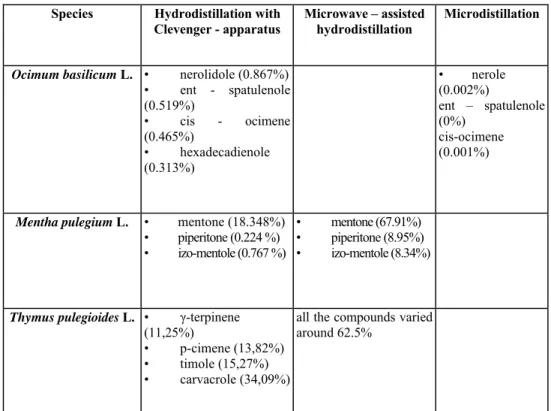
From the results that we had found, we can see that hydrodistillation using a Clevenger type apparatus is the one that has the best results. So, even if it is a very common method, the results are better than the ones obtained using other methods. This is the case for Ocimum basilicum L. where hydrodistillation with Clevenger - type apparatus is better
than microdistillation.
In Mentha pulegium L. better results have been obtained with the microwave
-assisted hydrodistillation than hydrodistillation with Clevenger - type apparatus. In this case, the results are very high for microwave - assisted hydrodistillation.
For Thymus pulegioides L. is the same situation: the results obtained from
microwave - assisted hydrodistillation show a higher concentration than the compounds obtained with the hydrodistillation with Clevenger - type apparatus.
We did not find results for micro-steam distillation - solid - phase microextraction for our plants.
Conclusions
As we can see from the extractions obtained, the results are quite different, depending of the plant and of the extraction method (tab. I).
For Ocimum basilicum L., hydrodistillation with Clevenger - type apparatus has
better values than microdistillation.
For Mentha pulegium L. and Thymus pulegioides L. the volatile compounds obtained
with the microwave - assisted hydrodistillation are higher than the compounds obtained with hydrodistillation with Clevenger - type apparatus.
Acknowledgements
This work was supported by the European Social Fund in Romania, under the responsibility of the Managing Authority for the Sectoral Operational Programme for Human Resources Development 2007-2013 [grant POSDRU/88/ 1.5/S/47646], by program
The project IDEI Cod CNCSIS 2100, Theme 1040/2009 - „Complex study on phyllosphere of some plant species from Botanical garden Iasi”
This investigation was supported by Program “Developing the innovation capacity and improving the impact of research through post-doctoral programmes POSDRU/89/1.5/S/49944” and project IDEI Cod CNCSIS 2100, Tema 1040/2009.
2. BICCHI C, D'AMATO A., NANO G.M. AND FRATTINI C, 2002 - Improved method for the analysis of small amounts of essential oils by microdistillation followed by capillary gas chromatography, Journal of Chromatography A Volume 279, January: 409 - 416
3. CRAVEIRO et al., 1989 - Flavour and Fragrance Journal, 4: 43 - 44
4. KATAOKA H., LORD H. L., PAWLISZYN J., 2000 - Applications of solid-phase microextraction in food analysis, Journal of Chromatography A., June; 880 (1-2): 35 - 62
5. KURKCUOGLU M., SARGIN N., AND BASER K. H. C, 2003 - Composition of volatiles obtained from spices by microdistillation, Chemistry of Natural Compounds, Vol. 39, No. 4
6. MOŞTEANU D., MICLĂUŞ S., BÂRSAN G., 2007 - Research regarding obtaining volatile oils from native plants in microwave assisted vacuum systems, 17th European Symposium on Computer Aided Process Engineering, Elsevier B.V.
7. ÖZEK G., DEMIRCI F., ÖZEK T., TABANCA N., WEDGE D. E., KHAN S. I., HÜSNÜ K., BAŞER C, DURAN A., HAMZAOGLU E., 2010 - Gas chromatographic - mass spectrometric analysis of volatiles obtained by four different techniques from Salvia rosifolia Sm. and evaluation for biological activity, Journal of Cromatography A, 1217: 741 - 748
8. TABANCA N., DEMIRCI B., TURNER J. L., POUNDERS C, DEMIRCI F., BAŞER K. H., WEDGE D. E., 2010 - Microdistillation and analysis of volatiles from eight ornamental Salvia taxa, Nat. Prod. Commun., September 5 (9)
9. ZAMFIRACHE M. - M., TOMA C, DUCA M., DUNCA S., OLTEANU Z., ŞTEFAN M., GALEŞ R. C., PĂDURARIU C., 2008 - A comparative study regarding the morphology and anatomy of the vegetative apparatus in two Ocimum basilicum L. breeds, Analele Ştiinţifice ale Universităţii “Al. I. Cuza” Iaşi, Tomul LIV, fasc. 2, s. II a., Biologie vegetală,: 38 - 47
10. http://web.tn.refer.org
11. http://www.labx.com
Explanation of the plates Plate I
Fig. 1 - Clevenger type apparatus;
Fig. 2 - Microwave - assisted hydrodistillation (http://web.tn.refer.org); Fig. 3 - Microdistillation apparatus (http://www.labx.com).
Plate II
Table 1 - Comparative results between our extraction method (Clevenger type apparatus) and extraction methods from literature
DOINA ATOFANI and colabs. PLATE I
Fig. 1
Fig. 2
DOINA ATOFANI and colabs. PLATE II Table 1
Species Hydrodistillation with
Clevenger - apparatus
Microwave – assisted hydrodistillation
Microdistillation
Ocimum basilicum L. • nerolidole (0.867%)
• ent - spatulenole (0.519%) • cis - ocimene (0.465%) • hexadecadienole (0.313%) • nerole (0.002%) ent – spatulenole (0%) cis-ocimene (0.001%)
Mentha pulegium L. • mentone (18.348%)
• piperitone (0.224 %)
• izo-mentole (0.767 %)
• mentone (67.91%)
• piperitone (8.95%)
• izo-mentole (8.34%)
Thymus pulegioides L. • γ-terpinene (11,25%)
• p-cimene (13,82%)
• timole (15,27%)
• carvacrole (34,09%)
all the compounds varied around 62.5%