Development of Mobile Water Treatment
Package System for Emergency Water Supply
Young Kyu Park, Ju-Suk An, Jiyoung Park, and Hyun Je Oh
Korea Institute of Civil Engineering and Building Technology (KICT), 283, Goyangdae-Ro, Ilsanseo-Gu, Goyang-Si, Gyeonggi-Do, 411-712, Korea
Email: {ykpark, jusuk, pjy237, hjoh}@kict.re.kr
Abstract—Mobile water treatment package system comprises an alternative for stable emergency water supply in response to various situations. This study is aimed at developing technologies to ensure mobility by simplifying process configuration and realizing modularization of various process technologies. Based on the various combinations of unit processes, they were presented according to each treatment process, indicating the possibility of achieving the water quality objectives. Water treatment unit processes were established by setting water quality objectives. Four kinds of water treatment process combinations were proposed based on the classification of water treatment unit process into pre-treatment or primary treatment (filtration using PCF, MF, RO), and post-treatment (filtration process using AC and disinfection process using UV). Each process combination was made to ensure the processing capacity of 30 m3/day. In addition, a mobile water treatment package system was manufactured using two 20ft containers compliant with IOS standards for increased mobility. In this study, the removal efficiency and power consumption of each process combination was assessed by installing a mobile water treatment package system. Based on the operation results of the mobile water treatment package system, reviews are being made on advancing the module to maximize performance of the mobile water treatment package system.
Index Terms—mobile, natural disaster, water treatment package, emergency
I. INTRODUCTION
A. Purpose of Study
The Korean Government implemented a special disaster region declaration program to effectively restore large-scale damages caused by long-term flooding of over 10 days in parts of the Gyeongnam region due to heavy rainfall from August 4 to August 11 in 2002. [1] When examining the special disaster region declaration status up until now, it was found that damage due to Typhoon ‘Ewiniar’ and heavy rainfall from July 9 to 29, 2006 was the longest. During this period, basic social facilities were unable to execute their roles. [2]
Property damage from natural disasters in Korea increased each year from KRW 298.8 billion in 2010 to KRW 794.2 billion in 2011 and KRW 1.0892 trillion in 2012. Damage from typhoon was the largest followed by
Manuscript received March 20, 2015; revised August 3, 2015.
flooding and snowstorm. The damage from flooding was the largest in January and February, from snowstorm in March and December, and from flooding and typhoon between June and September. The damage from flooding was most often followed by damage from typhoon.
Moreover, there were 23,180 cases of water service interruptions for 65,131 hours for an average of 2.8 hours per case in 2009 according to the Korean Ministry of Environment. Since the interruption of water service to industrial complexes can result in great economic loss, the supply of emergency water is essential until the water service is restored. As such, there is a need for the development of a mobile water treatment system to supply the emergency water in the case of the unforeseen water service interruption during an emergency situation such as flooding, earthquake, drought, and nuclear power plant failure. [3]
This study developed a mobile water treatment package to supply the emergency water and evaluated the performance and energy efficiency by combining different water treatment processes. It reviewed the combination of processes according to the water source in order to quickly respond to the emergency situation propose the appropriate measures for development of the mobile water treatment package to supply the emergency water.
B. Scopre of Study
The technologies developed in Korea are specific to the water environment in Korea and are mostly limited to the surface water. There can be many different types of water sources in other countries, and the water treatment package system using alternative water resources other than the surface water is needed in the areas where the water is in shortage.
Moreover, as the recent climate change has been increasing the energy cost, the energy saving technology is essential in water treatment also. Since the conventional water treatment technologies were developed to better treat the water without consideration to energy consumption, this study intended to develop a package system that applies the new and renewable energy that can be obtained locally.
As mentioned above, the existing water treatment processes applied in Korea are the plant types specific to the region and thus have no movability or variability. The water treatment plants in Korea are mostly large facilities located near the metropolitan water services and centrally
operated to ensure the economy of scale. However, the water services run by metropolitan cities and local municipalities did not meet the demand for emergency water service at the times of recent natural disasters caused by climate change, and many local residents suffered from shortage of drinking water. That left many experts to reconsider the water service system. The recent great earthquake in Japan, that shutdown the water treatment plants and forced many Tokyo residents suffer from lack of drinking water, particularly shows the need for development of demand specific water treatment technology to seamlessly supply the water in the disaster areas.
For that, the development of a regionally specific mobile water treatment package system to supply the emergency water by coping with changed water quality is needed. Accordingly, this study intends to develop and practically apply a small scale mobile water treatment package system which can satisfy the water quality level needed by consumers in any region by packaging each process.
II. STUDY METHOD
A. Application Scope
The dictionary definition of calamity disaster is the damage caused by a catastrophe such as earthquake, typhoon, flooding, drought, tsunami, fire, and infectious disease. A disaster is the catastrophe or hazard that is the direct cause of damage. A disaster can be divided into the natural disaster such as typhoon, flooding, lightening, heavy wind, storm, snowstorm, tsunami, etc. and the man-made disaster such as fire, collapse, traffic accident, chemical / biological / radiological accident, electric accident, gas accident, etc. Although the natural disasters occur less often and cause fewer human casualties than the man-made disasters, they incur more property losses and are greatly increasing each year. Moreover, they take longer period to recover from and more often require emergency supply of water since it causes shutdown of infrastructures such as the water treatment facilities. Therefore, the developed mobile water treatment package mostly targeted for natural disasters and particularly considered the typhoon, flood, drought and snowstorm occurring often in Korea.
B. Analysis of Properties of Applicable Water Source and Deduction of Applied Process
The existing water treatment technologies specifically reflect the situation in Korea and thus are limited to be applied as the water treatment system for various water sources and purposes in other countries. The water treatment plant-centric technologies are conservative and passive in that they just respond to simple operation condition changes rather than proactive response to environmental changes. To solve such problems, this study packages each water treatment process specifically for the water quality condition and purpose in each region so that it can be designed and constructed specifically for the region. The differentiating factors of the developed
packages include the standardization to suit the characteristics of the process to optimize the capability of the unit process and coding the combination of unit processes to maximize the treatment efficiency.
The exiting mobile water treatment technologies for supply emergency water were limited to the membrane processes using the foreign-made membrane modules and not widely distributed because of poor economic efficiency due to the excessive power consumption on the field. To solve such problems, this project intends to modularize and package various process technologies to simplify the overall process and ensure portability. It also actively uses the new and renewable energy that is locally available to develop a low-energy mobile water treatment package system. For that purpose, this study plans to apply the 3D design technique in module design of each unit process to minimize the error that can be generated during the design and fabrication of each process and develop the system that yields the highest efficiency.
The water treatment system to supply the emergency water must use the local water source and supply the water quality suitable for local usage. Although the villages where the water service is not available can use the community waterworks or small scale water supply, they generally use the underground water and valley water utilizing the spring water, well, personal tube well as well as the personal waterworks, surface water and stream water. As the water sources that the emergency water treatment system is expected to be similar, this study reviews the quality properties of the stream water and underground water as examples. Since the emergency water is generally supplied to disaster sufferers in time of emergency, it is likely that it will be mostly used for water for living for cleaning and laundry, cleaning water for bathrooms, and drinking water. For water supply to industrial complexes, the general purpose would be cooling water except for the ultrapure water needed by the semiconductor and other processes. The quality of emergency water should be set to the heavy water standard for the bathroom cleaning water and industrial water (cooling water, etc.) and drinking water standard from the water for living and drinking water.
To develop the mobile water treatment system for domestic usage, the treatment processes suitable for pollutant characteristics of domestic water sources were reviewed, and the applicable process were identified as shown in Table I.
The raw water was categorized into the high turbidity (valley water), high turbidity + organic/inorganic substance (seawater), and high turbidity + algae + organic/inorganic substance (underground water and steam water-flooded water). The unit processes for water treatment were presented for each water category and purpose of water usage.
As regards the production of drinking water, it is important to assess membrane technologies in relation to water-borne contaminants. The pore size of ultrafiltration (UF) membranes is small enough to ensure high log-removal of all kinds of microbiological hazards such as Cryptosporidia, Giardia and total bacterial counts. [4]
TABLE I. RESPONSE PROCESS BY RAW WATER PROPERTY
Category Turbidity Pre-treatment Primarytreatment Post-treatment Disinfection
I(Turbidity) >10NTU CoagulationAdsorption MF/UFPCF - UV/Cl2 <10NTU CoagulationAdsorption MF/UF - UV/Cl2
II(Turbidity + organic/inorganic)
>10NTU CoagulationAdsorption MF/UFPCFAOP NF/ROAC UV/Cl2
<10NTU CoagulationAdsorption MF/UFAOP NF/ROAC UV/Cl2
III(Turbidity + algae+ organic/inorganic)
<10NTU CoagulationAdsorption MF/UFPCFAOP NF/ROAC UV/Cl2
<10NTU CoagulationAdsorption MF/UFAOP NF/ROAC UV/Cl2
* PCF : Pore Control Fiber Filter * UV : Ultraviolet
* AC : Activated Carbon
* AOP : Advanced Oxidation Process
C. Operation and Maintenance
A mobile water treatment system must be quickly transported to the destination and have the simple operation and maintenance. Since the 20ft container used for this study is packed with the unit processes, the energy supply unit and equipment for maintenance and backwashing/washing of the system need to be transported in another truck. The power grid in the target area is attained by reviewing the energy consumption to operate the feed pump to supply the raw water, chemical pump for cohesion, and membrane filtering operation with MF/RO.
Figure 1. Unit process combination for mobile water treatment
D. Fabriction, Installation and Operaion
A prototype of the mobile water treatment package system was fabricated and installed in the G Water Intake Station in P City and has been operating for performance test and to seek the appropriate operation mode in time of emergency. Since the treatment of various raw waters is essential to stably supply the purified water under different situations, the water treatment unit processes were deployed to meet water quality target according to the pollutant characteristics and water quality factors of the water source. For the water treatment unit process, the processes were categorized into main processing (PCF, MF, RO), and post-processing (filtering using AC and sterilization using UV), and 4 combinations to meet the water quality target were presented as shown in Fig. 1. Each process combination was designed to have the processing capacity of 30 m3/day.
The main advantage of membrane processes is to treat water without chemicals. In addition, membrane can be built in a modular form for easy adaptation of process scale. The system was developed as a prototype to develop the modularized water treatment package in the future. The study of whether the water can be purified without chemical was conducted to make sure that it can be used as the emergency water.
The intake equipment such as the water supply tank was assumed to be installed in a separate container or outside space. To solve the problem of having to mount each unit process when the enhanced mobile water treatment package prototype was implemented, the measures to reduce the size of the package while maintaining the performance were sought. The container housed the unit process purifying the water while the water supply tank, maintenance equipment and intake equipment were installed in another container or an outside space. For the fiber filter, 120 m3/day capacity equipment was reduced 50 m3/day and interfaced with MF and other backwashing equipment (chemical tank and pump, etc.)to minimize the subsidiary equipment. The submerged MF, which is the main process, consisted of 4 modules with the target capacity of 72 m3/day. Since the Reverse osmosis (RO) process takes up the largest space, it was designed for the highest recovery factor (67% - 17% for each module) possible, and the 8-inch module was placed in the back of the container. The designed capacity was 36 m3/day.
E. Performance Maximization and Module
Enhancement of Mobile Water Treatment Package Systmem
Based on the operation result of the mobile water treatment package system installed in the G Water Intake Station in P City, the measures to enhancing the module are being reviewed to maximize the system performance. To maximize the performance and enhance the module, the cassette type water treatment package system is reviewed. It is a small scale water treatment system that Microfiltration (MF) is also claimed to have these
properties, but some doubts have recently arisen with respect to bacterial retention by these membranes. [5] Substantial virus removal can be attained with UF membranes since the size of viruses is in the range of 30– 300 nm.
Nanofiltration (NF) and Reverse Osmosis (RO) can
be used to remove inorganic contaminants from water. Most NF membranes are effective in removing bivalent ions (typical retention >90%), but RO membranes are required for monovalent ions. [6]
The developments in the membrane technology field during the last decades resulted in a significant decrease of membrane costs and energy requirement. [7]
can process various types of raw water by having multiple units spaced equally in a box like a container so that the unit processes can be combined. The unit process of mobile water treatment package system suitable to the raw local water type can be inserted so that the system can be combined in different sets to supply the water to the water outage area or remote area where the water service is not established or the drinking water is not properly supplied. It has the design capacity of 1.5 m3/hr which is suitable for 100 people during normal time or 2,200 people in minimum supply during a disaster. Its patent is pending, and the design is being reviewed to fabricate the cassette type water treatment package system.
III. RESULTS AND DISCUSSION
This study developed a mobile water treatment system in which the units are connected as shown in Fig. 2.
Figure 2. Mobile water treatment package pilot plant
TABLE II. WATER QUALITY ANALYSIS OF PILOT PLANT
Raw Water MF PCF MF +AC PCF+AC MF+RO PCF+RO
Turbidity 13 0.07 0.1 0.07 0.1 0 0 COD_Cr (mg/L) 6.0 5.2 5.2 4.0 4.1 0.0 0.0 TN (mg/L) 5.33 4.80 4.91 1.55 1.81 0.22 0.27 NH3-N (mg/L) 1.71 1.42 1.48 0.04 0.17 0.00 0.00 NO3-N (mg/L) 2.34 2.14 2.26 1.09 1.29 0.00 0.00 TP (mg/L) 0.19 0.19 0.19 0.16 0.17 0.12 0.12 DOC (mg/L) 2.11 1.53 1.77 1.33 1.41 0.25 0.29
A. Operation of Mobile Water Treatment Package System
The quality of raw water and purified water is analyzed to determine the operating condition for each process and compare the results.
In Table II, the MF and PCF were very effective in removing turbidity. Around 99% removal of turbidity was observed by the PCF and MF For high turbidity water, the MF was more efficient than the PCF. AC was effective in removing COD and T-N while RO was effective in removing COD, TN, NH3-N, TP, and DOC. B. Measures to Supply Power and Maintain the Mobile
Water Treatment Package System
The power measuring system was installed in the G Water Intake Station in P City to measure and analyze the power consumption by each process. Measures to use new and renewable energy (solar energy, etc.) and maintenance will be established by monitoring the power consumption of each process to analyze the power consumption of the minimum process suitable to the raw water type. The Table III shows the power consumption of the minimum process stably satisfying the drinking water quality level after measuring and analyzing the power consumption of each process (based on 1 m³/hr water production)
TABLE III. AVERAGE POWER CONSUMPTION BY PROCESS
Process (Water Production of 1 m³/hr) Average Power Consumption (kWh) PCF + A/C + UV 0.318
PCF + RO + UV 2.109 MF + A/C + UV 0.996 MF + RO + UV 2.824
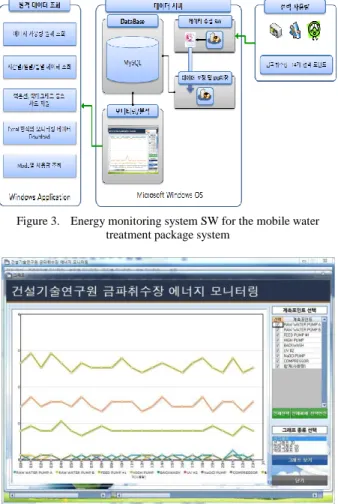
This study developed the energy monitoring system in which the units are connected as shown in Fig. 3, Fig. 4.
Figure 3. Energy monitoring system SW for the mobile water treatment package system
Figure 4. Energy monitoring system for each mobile water treatment system process
IV. CONCLUSION
1) A mobile water treatment package system to supply the emergency water after a disaster was developed. The analysis of treatment efficiency and power consumption of each process combination indicated that the stream water could be purified to generate the emergency water without the need for chemicals and the system can be utilized in various conditions with different combinations. 2) The unit processes can be selectively combined for the mobile water treatment package prototype according to the raw water properties. They can be automatically selected and operated. The measurement and analysis of power consumption by each process can be used for fabricating the power unit (diesel or gasoline fuel module to generate power, photovoltaic module, etc.) for self-generation in the future.
3) In the future, the water treatment system will be modularized so that the processes can be selectively applied according to the water source in the specific space. The system is judged to be applied for small scale water supplies as well as for emergency use.
ACKNOWLEDGMENT
This research was supported by Korea Ministry of Environment as “The Eco-Innovation Project (Global Top Project)”. (GT-SWS-11-01-008-0)
This research was supported by a grant from a Strategic Research Project (20150124-1-1) funded by Korea Institute of Civil Engineering and Building Technology.
REFERENCES
[1] W. Y. Jung and D. H. Hwang, “Feasibility study on the designation of a special disaster area by considering the climate extreme value,” Journal of the Korean Society of Hazard Mitigation, vol. 12, no. 5, pp. 135-141, 2012.
[2] K. H. Oh, W. Y. Jung, and M. K. Park, “A study on the declaration criteria of special disaster zone of the man-made disaster,” Journal of National Institute for Disaster Prevention, vol. 9, no. 2, pp. 142-145, 2007.
[3] Y. H. Lee, “Study on emergency water supply alternatives in cut off water supply-prone island area,” M.S. thesis, Dept. Environmental Engineering., Kyungpook National University., Kyungpook, Korea, 2013.
[4] K. Hagen, “Removal of particles, bacteria and parasites with ultrafiltration for drinking water treatment,” Desalination, vol. 119, no. 1-3, pp. 85–91, 1998.
[5] Y. Wang, F. Hammes, N. Boon, and T. Egli, “Quantification of the filterability of freshwater bacteria through sterile 0.45, 0.22 and 0.1 mm pore size filters and shape-dependent enrichment of filterable bacterial communities,” Environmental Science & Technology, vol. 41 –7086, 2007.
[6] M. Peter-Varbanets, C. Zurbrugg, C. Swartz, and W. Pronk, “Decentralized systems for portable water and the potential of membrane technology,” Water Research, vol. 43, pp. 245-265, 2009.
[7] S. Churchhouse, “Membrane bioreactors hit the big time –from lab to full scale application,” in Proc. 3rd Aachen Meeting on Membrane Technology, Aachen, 2000, pp. 11–17.
Young Kyu Park was born on August 28, 1980 in Daegu, Korea. Raised in Masan, Pusan, Daejeon, he received the B.Sc. degree
(Civil & Environmental Engineering) in
2009, the M.Sc. degree (Environmental Engineering) from Woosong University, in Daejeon, Korea, in 2011.
He has worked as a researcher at Environmental and Plant Engineering Research Institute Korea Institute of Civil Engineering and Building Technology (KICT) from 2011. He has developed multi-purpose small-scale water treatment package system with the support of the Korean Ministry of Environment as a part of “Global Top Technology Development Project”.
Ju Suk An received his B.A. in environmental engineering from Yonsei University, Seoul, Korea in 2010. He received his M.A. in environmental engineering from Yonsei University, Seoul, Korea in 2012. Now, he is present a researcher in Korea Institute of Construction Technology (KICT), Goyang-si, Korea. Ju Suk An is a researcher at Korea Institute of Construction Technology (KICT), Korea. He was born on August 20, 1985, in Inchon, Korea. His early research focused on water chemistry and water treatment process using membrane; his current interests and research is water treatment package system for emergency.
Jiyoung Park was born on July 28, 1986 in Daejeon, Korea. she received the B. En. degree in Environmental engineering in 2009, the M. En. Degree in environmental engineering from University of Science and Technology, in Daejeon, Korea, in 2013.
She has worked as researcher at Environmental and Plant Engineering research Institute Division in Korea Institute of Civil Engineering and Building Technology from 2014. She has Developed multi-purpose small-scale water treatment package system with the support of the Korean Ministry of Environment as part of “Global Top Technology Development Project”
Hyun Je Oh received BS in Civil Engineering from Yonsei University in 1984 and MS in Environmental Engineering from Yonsei University in 1986. He then received PhD from Yonsei University with research in water supply and wastewater (dissertation: Optimization of Ozone/AOP, Activated Carbon and Membrane Filtering Process Using Ground Factor of Raw Water Quality Properties) in 2012. Currently, he is a senior researcher at Environmental Plant Research Center at KICT has been carrying out numerous researches. The projects include “Construction and Environmental Assessment on Site of Large Capacity Pilot Plant for MD/PRO Compound Desalination”
Waterworks Research Institutes Conference, Water Management Policy Study Group at the National Assembly, and Deliberation Committee at Korea Environment Corporation. He is currently serving as the Vice Chairman of Korean Society of Water and Wastewater and Seoul Construction Technology Deliberation Committee.
, pp. 7080