arXiv:hep-ph/9904360v2 4 Jun 1999
hep-ph/9904360 LMU-99-07 PAR-LPTHE-99-17
April 1999
CP
Asymmetries in
Bd
→
D
∗+D
∗−and
Bs
→
D
s∗+D
s∗−Decays:
P
-wave Dilution, Penguin and Rescattering Effects
Xuan-Yem Pham1
Laboratoire de Physique Th´eorique et Hautes Energies, Universit´es Pierre et Marie Curie (Paris 6) et Denis Diderot (Paris 7), Unit´e associ´ee au CNRS, UMR 7589, France
Zhi-zhong Xing 2
Sektion Physik, Universit¨at M¨unchen, Theresienstrasse 37A, D-80333 M¨unchen, Germany
Abstract
Determination of theCP-violating parameters sin 2β and sin 2β′
is shown to be pos-sible from Bd0 vs ¯Bd0 → D∗+ D∗− and Bs0 vs ¯Bs0 → D∗+ s D ∗−
s decays without doing the angular analysis. The P-wave dilution factors of these two asymmetries are found to be 0.89 and 0.90, respectively, using the factorization approximation and heavy quark symmetry. The penguin-induced corrections amount to about 2% and 3% in the cor-responding Bd and Bs channels. Final-state rescattering effects could be handled by detecting the neutral modesBd0 and ¯Bd0→D∗0¯
D∗0
.
1 Postal address: LPTHE tour 16/1er´etage, Universit´e Pierre et Marie Curie, BP 126, 4 Place Jussieu,
F-75252 Paris CEDEX 05, France; Electronic address: [email protected]
1
The study of B-meson decays appears to offer a unique opportunity to measure the quark mixing parameters, to investigate the nonperturbative confinement forces, and in particular to probe the origin of CP violation. Recently the CDF Collaboration [1] has reported an updated direct measurement of theCP-violating parameter sin 2β inB0d vs ¯Bd0 → J/ψKS decays, where β = arg −V ∗ tbVtd V∗ cbVcd ! (1) is known as an inner angle of the Cabibbo-Kobayashi-Maskawa (CKM) unitarity triangle. The preliminary result sin 2β = 0.79+0−0..4144 (stat + syst) is consistent with the standard-model prediction. If the CDF measurement is confirmed, CP violation of the magnitude sin 2β should also be seen in B0
d vs ¯Bd0 → D+D − , D∗+ D− , D+D∗− and D∗+ D∗− decays [2, 3], whose branching ratios are all expected to be of order 10−4
. Indeed the decay channel B0
d →
D∗+ D∗−
has just been observed by the CLEO Collaboration [4]. The measured branching ratioB(D∗+
D∗−
) = [6.2+4−2..09(stat)±1.0 (syst)]×10 −4
is in agreement with the standard-model expectation. Further measurements of such decay modes will soon be available in the first-round experiments of KEK and SLAC B-meson factories as well as at other high-luminosity hadron machines.
A comparison between the value of sin 2β to be determined from Bd → D
∗+ D∗−
and that already measured in Bd → J/ψKS is no doubt important, as it may cross-check the
consistency of the standard-model predictions. Towards this goal, a special attention has to be paid to possible uncertainties associated with the CP asymmetry in Bd → D∗+D∗−.
One kind of uncertainty comes from the penguin contamination, as the weak phase of the penguin amplitude is quite different from that of the tree-level amplitude. In contrast, the CP asymmetry in the “gold-plated” modes B0
d vs ¯Bd0 → J/ψKS is essentially free from the
penguin-induced uncertainty, since the relevant tree-level and penguin amplitudes almost have the same CKM phases. Another kind of uncertainty arises from the P-wave dilution, because the final state D∗+
D∗−
is composed of both the CP-even (S- and D-wave) and the CP-odd (P-wave) configurations. Of course an analysis of the angular distributions of B0
d
vs ¯B0
d → D
∗+ D∗−
transitions allows us to distinguish between the CP-even and CP-odd contributions [5]. In this work we point out that the direct measurement of β can be made in Bd → D
∗+ D∗−
decays without doing the angular analysis. Taking the P-wave dilution and the penguin contamination into account, one may write the characteristic measurable of indirect CP violation in Bd →D∗+D∗− as follows 3:
∆d = Im V∗ tbVtd VtbVtd∗ · hD∗+ D∗− |Heff|B¯d0i hD∗+ D∗− |Heff|Bd0i ! = ζd(1−ξd) sin 2β , (2)
where ζd and ξd represent the P-wave dilution factor and the penguin-induced correction,
respectively. We shall calculate both effects with the help of the effective weak Hamiltonian 3TheCP violation induced solely byBd- ¯0B0
d mixing, like ǫK in theK0- ¯K0 mixing system, is expected to be negligibly small (of order 10−3 or smaller [6]) in the standard model.
and the factorization approximation. Possible final-state rescattering effects inBd→D∗+D∗−
decays will also be discussed.
A similar analysis will be made forCP violation in the decay modesB0
s vs ¯Bs0 →D
∗+
s D
∗−
s .
The preliminary signals of these transitions have been observed [7]. They are useful to extract the CP-violating phase
β′ = arg −V ∗ tbVts V∗ cbVcs ! , (3) whose magnitude is negligibly small (of order 1◦
or smaller [8]) in the standard model. The associated CP asymmetry ∆s, analogous to ∆d defined in Eq. (2), reads as
∆s = Im V∗ tbVts VtbVts∗ · hD∗+ s D ∗− s |Heff|B¯s0i hD∗+ s D ∗− s |Heff|Bs0i ! = ζs(1−ξs) sin 2β ′ , (4) where ζs and ξs denote the P-wave dilution factor and the penguin-induced correction,
re-spectively. Under SU(3) invariance ζs = ζd holds. We shall see later on that ζd ≈ ζs ≈ 0.9,
while the magnitudes of ξd and ξs are only at the percent level.
2
Without loss of generality the amplitude of B0d or ¯Bd0 decay into D
∗+ D∗−
can be written as a sum of three terms, i.e., the S-D- andP-wave components [9]:
hD∗+ D∗− |Heff|Bd0i = a (ǫ+·ǫ−) + b m2 D∗ (p0 ·ǫ+)(p0·ǫ−) +i c m2 D∗ (ǫαβγδǫ+αǫ−βp+γp0δ), hD∗+ D∗− |Heff|B¯d0i = ¯a (ǫ+·ǫ−) + ¯b m2 D∗ (p0 ·ǫ+)(p0·ǫ−) −i ¯c m2 D∗ (ǫαβγδǫ+αǫ−βp+γp0δ), (5)
where ǫ± denotes the polarization of D ∗±
; p0 and p± stand respectively for the momenta of Bd and D∗± mesons; (a, b, c) and (¯a,¯b,c) are complex scalars. To calculate these scalars¯
we neglect effects from the annihilation-type quark diagrams which are anticipated to have significant form-factor suppression. In this case the effective weak Hamiltonian responsible for Bd→D
∗+ D∗−
decays can simply be written as [10] 4
Heff = GF √ 2 " (VcbV ∗ cd) 2 X i=1 (ciQci)−(VtbV ∗ td) 10 X i=3 (ciQi) # + h.c. , (6)
where ci (for i= 1,· · ·,10) are the Wilson coefficients, and
Qc
1 = ( ¯dαcβ)V−A(¯cβbα)V−A ,
4Here we assume the top-quark dominance in the penguin loops and neglect the small strong phases induced
Qc2 = ( ¯dc)V−A(¯cb)V−A, Q3 = ( ¯db)V−A(¯cc)V−A, Q4 = ( ¯dαbβ)V−A(¯cβcα)V−A , Q5 = ( ¯db)V−A(¯cc)V+A ,
Q6 = ( ¯dαbβ)V−A(¯cβcα)V+A, (7) as well as Q7 = Q5, Q8 = Q6, Q9 = Q3 and Q10 = Q4. Here Q3,· · ·, Q6 denote the
QCD-induced penguin operators, andQ7,· · ·, Q10stand for the electroweak penguin operators. The
factorization approximation allows us to single out a common hadronic matrix element from hD∗+
D∗−
|Heff|Bd0i and another one from hD
∗+ D∗− |Heff|B¯0di: M = G√F 2hD ∗+ |(¯cd)V−A|0ihD ∗− |(¯bc)V−A|Bd0i, ¯ M = G√F 2hD ∗− |( ¯dc)V−A|0ihD ∗+ |(¯cb)V−A|B¯ 0 di. (8)
In this approach it should be noted that the relevant Wilson coefficients and the hadronic matrix elements need be evaluated in the same renormalization scheme and at the same energy scale [10]. Furthermore, we follow the standard procedure of Ref. [12] to decompose M and
¯
M in terms of three form factorsABD∗
1 (q2),ABD ∗
2 (q2) andVBD ∗
(q2). Then the scalars (a, b, c)
and (¯a,¯b,c) are found to be¯
(a, b, c) = √GF 2 χ(˜a, ˜b, c)˜ , (¯a, ¯b, c) =¯ √GF 2 χ ∗ (˜a, ˜b, ˜c), (9) where χ = (V∗ cbVcd)cx−(V ∗ tbVtd)(cy +cz) (10) with cx = ¯c2+ ¯ c1 3 , cy = ¯c4+ ¯ c3 3 , cz = ¯c10+ ¯ c9 3 ; (11) and ˜ a = mD∗fD∗(mB+mD∗)A BD∗ 1 (m2D∗), ˜ b = −2m3D∗fD∗ ABD∗ 2 (m2D∗) mB+mD∗ , ˜ c = −2m3D∗fD∗ VBD∗ (m2 D∗) mB+mD∗ . (12)
Note that in Eq. (11) the effective Wilson coefficients ¯ci are independent of the energy scale
and the renormalization scheme [10]. It is clear that cx, cy and cz stand for the tree-level,
gluonic penguin and electroweak penguin contributions, respectively. Taking the top-quark mass mt = 174 GeV and the strong coupling constant αs(mb) = 0.21, one finds cx = 1.045,
cy =−0.031 and cz =−0.0014 [13]. Note also that the form factors in Eq. (12) are related
to one another in the heavy quark symmetry [14]. The q2 dependence of the form factors,
given by the common slope of the universal Isgur–Wise function, allows us to extrapolate fromq2
max = (mB−mD∗)2 to q2 =m2D∗. Then we get VBD∗(m2D∗) = A BD∗ 2 (m2D∗) = (mB+mD∗)2 mB(mB+ 2mD∗) ABD1 ∗(m2D∗). (13)
Therefore the ratios ˜b/˜a= ˜c/˜a depend only upon the meson masses mB and mD∗.
Now let us determine the ζd and ξd parameters in the CP-violating quantity ∆d defined
in Eq. (2). For this purpose we sum over the polarizations of D∗+
andD∗−
mesons [9]. After a lengthy but straightforward calculation, we arrive at
X (pol) hD∗+ D∗− |Heff|B¯d0i hD∗+ D∗− |Heff|Bd0i ! = (2 +κ 2)(¯aa∗ ) + (κ2 −1)2(¯bb∗ ) +κ(κ2 −1)(¯ab∗ + ¯ba∗ )−2(κ2−1)(¯cc∗ ) (2 +κ2)|a|2+ (κ2 −1)2|b|2 + 2κ(κ2−1)Re(ab∗ ) + 2(κ2−1)|c|2 = χ ∗ χ · (2 +κ2)˜a2+ (κ2−1)2˜b2+ 2κ(κ2−1)˜a˜b−2(κ2−1)˜c2 (2 +κ2)˜a2+ (κ2−1)2˜b2 + 2κ(κ2−1)˜a˜b+ 2(κ2−1)˜c2 , (14)
where κ= (p+·p−)/m2D∗ = (m2B−2m2D∗)/(2m2D∗). As a result, we obtain
ζd = m3 B−3mBm2D∗+ 10m3D∗ m3 B+mBm2D∗ + 2m3D∗ , (15) and ξd = cy +cz cx · cos 2β cosβ · VtbVtd VcbVcd . (16)
It is remarkable that the result obtained in Eq. (15) for theP-wave dilution factorζdrelies only
on the heavy quark symmetry. Therefore the value of ζd is independent of specific models
for the form factors. To estimate the penguin-induced correction (i.e., the ξd parameter),
|(VtbVtd)/(VcbVcd)|= 1 andβ = 26
◦
are typically taken. The former is favored by current data on quark mixing [15], and the latter is consistent with sin 2β = 0.79 observed by the CDF Collaboration [1]. Then we find
ζd = 0.89,
ξd = −0.021. (17)
This result indicates that the penguin contamination in ∆d is negligibly small, while the
ForB0
s vs ¯Bs0 →D
∗+
s D
∗−
s decays, theζsandξsparameters appearing in theCP asymmetry
∆s can be evaluated in the same way. The relevant results are obtained, through the discrete
transformation from dtos (the so-called U-spin reflection) in the above formulas, as follows:
ζs = m3 Bs −3mBsm 2 D∗ s + 10m 3 D∗ s m3 Bs +mBsm 2 D∗ s + 2m 3 D∗ s , (18) and ξs = cy+cz cx · cos 2β′ cosβ′ · VtbVts VcbVcs . (19)
For illustration, we typically take |(VtbVts)/(VcbVcs)|= 1 and β
′
= 0.5◦
to calculate the value of ξs. We obtain
ζs = 0.90,
ξs = −0.031. (20)
Indeed ζs = ζd is expected to hold exactly under SU(3) symmetry. The result in Eq. (20),
similar to that in Eq. (17) forBd→D
∗+ D∗−
modes, implies that in ∆s the penguin
contam-ination is negligibly small but the P-wave dilution is significant.
3
Now we proceed to discuss possible final-state rescattering effects in Bd → D∗+ D∗− decays, which were not taken into account in the above analysis. The ∆B = +1 and ∆B =−1 parts of Heff in Eq. (6) have the isospin structures |1/2,+1/2i and |1/2,−1/2i, respectively.
They generally govern the transitions B+
u → D ∗+¯ D∗0 , B0 d → D ∗+ D∗− , B0 d → D ∗0¯ D∗0 and their charge-conjugate processes. The final state of each decay mode can be in eitherI = 1 or I = 0 isospin configuration, therefore rescattering effects are possibly present. We find that the isospin relations [2, 16]
hD∗+¯ D∗0 |Heff|Bu+i = A1 , hD∗+ D∗− |Heff|Bd0i = 1 2(A1+A0), hD∗0¯ D∗0 |Heff|Bd0i = 1 2(A1−A0), (21)
where A1 and A0 are the I = 1 and I = 0 isospin amplitudes, hold separately for three
transition amplitudes with the same helicity (λ = −1, 0 or +1). The same isospin relations can be obtained for B−
u →D ∗− D∗0 , ¯B0 d →D ∗+ D∗− and ¯B0 d→ D ∗0¯ D∗0
decays in terms of the corresponding isospin amplitudes ¯A1 and ¯A0.
To calculate the magnitudes of A1, A0 and ¯A1 and ¯A0, we assume again that transition
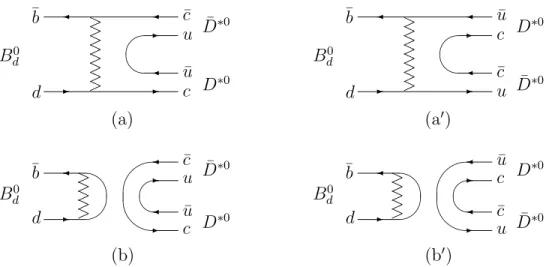
amplitudes from the annihilation-type quark diagrams are negligible due to their strong form-factor suppression 5. This implies thatB0
d →D
∗0 ¯ D∗0
and its charge-conjugate process, which occur only through the quark diagrams illustrated in Fig. 1, would be forbidden if there
5For example, hadronic matrix elements of the type
hD∗+D∗−|(¯cc)
V−A|0ih0|(¯bd)V−A|Bd0i depend on the annihilation form factor Fann
+ (m2B) ∼ 1/m2B [17] and the mass difference of two final-state mesons in a constituent U(2,2) quark model [18].
¯b d B0 d ¯ c c u ¯ u D∗0 ¯ D∗0 ✗ ✖ ✛ ✲ ✛ ✲ ✲ ✛ > > > > > > > > (a) ¯ b d B0 d ¯ u u c ¯ c ¯ D∗0 D∗0 ✗ ✖ ✛ ✲ ✛ ✲ ✲ ✛ > > > > > > > > (a′ ) ✘ ✙ ✓ ✒ ✬ ✫ ✛ ✲ ✛ ✲ ✲ ✛ > > > > > B0 d ¯b d ¯ c c u ¯ u ¯ D∗0 D∗0 (b) ✘ ✙ ✓ ✒ ✬ ✫ ✛ ✲ ✛ ✲ ✲ ✛ > > > > > B0 d ¯ b d ¯ u u c ¯ c D∗0 ¯ D∗0 (b′ ) Figure 1: Tree-level (a, a′
) and penguin (b, b′
) quark diagrams responsible forB0
d →D
∗0¯ D∗0
. were no final-state rescattering. In other words, A1 = A0 and ¯A1 = ¯A0 would hold, if the
rescattering effect were absent. Following this argument we make use of the factorization approximation to calculateA1 (or ¯A1) andA0 (or ¯A0), and account for final-state interactions
at the hadron level by incorporating the elastic rescattering phases δ1 and δ0 [19]. We then
arrive at the factorized isospin amplitudes as follows: A1 = χMeiδ1 , A0 = χMeiδ0 ; (22) and ¯ A1 = χ ∗ ¯ M eiδ1 , ¯ A0 = χ ∗ ¯ M eiδ0 , (23) where M and ¯M are given in Eq. (8). One can see that |A0| = |A1| and |A¯0| = |A¯1| hold
in this factorization approach. It becomes clear that the transitions Bd →D
∗0¯ D∗0
would be forbidden, if there were no final-state rescattering effects (i.e., if δ0 =δ1). As a consequence,
one obtains hD∗+ D∗− |Heff|B0di = χ Mcos δ1−δ0 2 e i(δ1+δ0)/2 , hD∗+D∗−|Heff|B¯0di = χ ∗ ¯ Mcosδ1−δ0 2 e i(δ1+δ0)/2 ; (24) and hD∗0¯ D∗0
|Heff|Bd0i = iχ Msin
δ1−δ0 2 e i(δ1+δ0)/2 , hD∗0¯ D∗0 |Heff|B¯d0i = iχ ∗ ¯ Msinδ1−δ0 2 e i(δ1+δ0)/2 . (25) We see that the isospin phases can be cancelled out in the ratio of two charge-conjugate decay amplitudes, thus the previous results of ζd, ξd and ∆d are unchanged even in the presence
of final-state rescattering effects. Of course this conclusion depends on the factorization hypothesis used above. Whether it is valid or not can be checked, once the relevant branching ratios are measured. For example, Eqs. (24) and (25) lead to two experimentally testable relations among the branching ratios of three correlative decay modes:
|hD∗+ D∗− |Heff|Bd0i|2 + |hD ∗0 ¯ D∗0 |Heff|Bd0i|2 = |hD ∗+¯ D∗0 |Heff|Bu+i|2 , |hD∗+ D∗− |Heff|B¯d0i|2 + |hD ∗0 ¯ D∗0 |Heff|B¯d0i|2 = |hD ∗− D∗0 |Heff|B − ui|2 . (26)
It can easily be shown that |M|2 =|M¯|2 will hold, if one sums over the polarizations of two
final-state vector mesons. In this case, the two (rectangular) triangle relations in Eq. (26) are congruent with each other.
It is worth remarking that the detection of Bd → D∗0D¯∗0 transitions will be crucial:
(a) if their branching ratios in comparison with those of Bd → D
∗+ D∗−
are too small to be observed, then the final-state rescattering effects should be negligible (δ1 −δ0 ≈ 0) and
the naive factorization approach might work well; (b) if their branching ratios are more or less comparable with those of Bd→ D
∗+ D∗−
, then a quantitative isospin analysis should be available, allowing us to extract the isospin phase differences through Eq. (21). In case (b), a measurement of CP violation of the magnitude sin 2β in B0
d vs ¯Bd0 →D ∗0¯ D∗0 decays should be quite likely. For B0
s and ¯Bs0 decays into the D
∗+
s D
∗−
s state the similar isospin analysis does not exist.
The SU(3) symmetry between Bd →D∗+D∗− and Bs → D∗s+D
∗−
s channels, however, allows
one to conjecture possible final-state interactions in the latter. As one has seen in Eqs. (15) and (18), the SU(3) breaking effect is indeed rather small and even negligible.
4
We have calculated the indirect CP asymmetries (∆d and ∆s) in Bd→D∗+D∗− andBs →Ds∗+D
∗−
s decay modes. It has been shown that a quite clean determination of the CP
-violating parameters sin 2β and sin 2β′
, with no help of the angular analysis, is in practice possible. The penguin contamination in either ∆d or ∆s is negligibly small. The P-wave
dilution factors of ∆d and ∆s (i.e., ζd and ζs) are found to be 0.89 and 0.90, respectively, in
the factorization approximation and heavy quark symmetry.
Asζddoes not deviate too much from unity, a largeCP asymmetry inBd0 vs ¯Bd0 →D
∗+ D∗− transitions is expected within the standard model. If the penguin-induced correction to the indirect CP violation in Bd0 vs ¯Bd0 →D+D
−
is also negligible, then a comparison between the CP asymmetries in D+D−
and D∗+ D∗−
modes allows us to directly determine the P-wave dilution factor, i.e.,
ζd =
∆d(D∗+D∗−)
∆d(D+D−)
. (27) Of course such a measurement is very useful, in order to check the theoretical value of ζd
obtained in Eq. (15).
Although theCP asymmetry ∆sis expected to be vanishingly small in the standard model
(because of the smallness of β′
), its magnitude could significantly be enhanced if there were new physics inB0
not violate unitarity of the CKM matrix and has insignificant effects on the penguin channels of the decay modes under discussion [6]. It may introduce an additional CP-violating phase into B0
d- ¯Bd0 orBs0- ¯Bs0 mixing. In this case the overall mixing phases of two systems become
V∗ tbVtd VtbVtd∗ =⇒ V ∗ tbVtd VtbVtd∗ eiφNP , V∗ tbVts VtbVts∗ =⇒ V ∗ tbVts VtbVts∗ eiφ′NP , (28) in which φNP and φ ′
NP denote the CP-violating phases induced by new physics. The weak
phases that can be extracted from the CP asymmetries ∆d and ∆s turn out to be
β =⇒ β + φNP 2 , β′ =⇒ β′ + φ ′ NP 2 , (29)
respectively. To distinguish β and β′
from the phase combinations in Eq. (29), one has to study the CP asymmetries in some other neutral B-meson decays [8].
In conclusion, we point out that the CP-violating parameters in Bd → D
∗+ D∗− and Bs →D ∗+ s D ∗−
s decays can be determined without measuring their angular distributions. The
approach advocated here may be complementary to the angular analysis considered in the literature. Hopefully both will soon be confronted with the data fromB-meson factories.
References
[1] CDF Collaboration, Report No. CDF/PUB/BOTTOM/CDF/4855 (5-Feb-1999). [2] A.I. Sanda and Z.Z. Xing, Phys. Rev. D56 (1997) 341.
[3] For a review, see: The BABAR Physics Book, edited by P.F. Harrison and H.R. Quinn, Report No. SLAC-R-504 (1998).
[4] CLEO Collaboration, M. Artuso et al., Phys. Rev. Lett. 82 (1999) 3020.
[5] I. Dunietz, H.R. Quinn, A. Snyder, W. Toki, and H.J. Lipkin, Phys. Rev. D 43 (1991) 2193; G. Kramer and W.F. Palmer, Phys. Rev. D 45 (1992) 193; R. Aleksan, A. Le Yaouanc, L. Oliver, O. P´ene, and J.C. Raynal, Phys. Lett. B 317 (1993) 173.
[6] A.I. Sanda and Z.Z. Xing, Phys. Rev. D56 (1997) 6866. [7] R. Barate, hep-ex/9812003; and references therein. [8] Z.Z. Xing, Phys. Lett. B 443 (1998) 365.
[9] G. Valencia, Phys. Rev. D 39 (1989) 3339.
[10] G. Buchalla, A.J. Buras, and M.E. Lautenbacher, Rev. Mod. Phys. 68 (1996) 1125. [11] M. Bander, D. Silverman, and A. Soni, Phys. Rev. Lett. 43 (1979) 242.
[12] M. Bauer, B. Stech, and M. Wirbel, Z. Phys. C 34 (1987) 103. [13] N.G. Deshpande and X.G. He, Phys. Lett. B 336 (1994) 471.
[14] See, e.g., Q. Ho-Kim and X.Y. Pham,Elementary Particles and their Interactions: Concepts and Phenomena, Springer (Berlin, Heidelberg, 1998).
[15] Particle Data Group, C. Caso et al., Eur. Phys. J. C3 (1998) 1.
[16] These isospin relations are the same as those of D → KK¯ decays: X.Y. Pham, Phys. Lett. B 193 (1987) 331; Z.Z. Xing, Phys. Rev. D 55 (1997) 196.
[17] G.P. Lepage and S.J. Brodsky, Phys. Lett. B 87 (1979) 359.
[18] J. Bernab´eu and C. Jarlskog, Z. Phys. C8(1981) 233; Z.Z. Xing, Phys. Rev. D53(1996) 2847.
[19] A similar treatment can be found, e.g., in: N.G. Deshpande and C.O. Dib, Phys. Lett. B 319 (1993) 313; M. Neubert, Phys. Lett. B 424 (1998) 152.