A DELIBERATE INTEGRATION OF INFORMATION
TECHNOLOGY INTO THE CLASSROOM
Duane Fairfax, Kevin Huggins, Bryan Goda
This paper was completed and submitted in partial fulfillment of the Master Teacher Program, a 2-year faculty professional development program conducted by the Center for Teaching Excellence, United States Military Academy, West Point, NY, 2007.
A Deliberate Integration of Information Technology in the
Classroom
Abstract
The Information Age has revolutionized the way students learn in the classroom. The United States Military Academy (USMA) emphasizes the importance of Information Technology (IT) through an academy-wide IT specific goal. This goal supports the USMA’s mission of producing Army Officers who can respond effectively to technological changes in the defense of our
nation.
Courses augmented with IT can be daunting for cadets who lack the experience and confidence level to succeed in the course. As a result, these types of courses are avoided by cadets if at all possible. This is not an option for an aspiring officer who will lead the soldiers of tomorrow on a digitized battlefield. Since 1990, cadets have been issued a computer which has played a central role in bringing the power of IT to all graduates of the Military Academy. Integration of IT in the curriculum begins early with every cadet receiving a laptop computer. An integrated
software package is included to support any course of instruction. Cadets receive two courses in IT, one in their freshman year and one in their junior year. The freshman course teaches the cadet the basic functionality of the laptop, a basic programming language, and creating a basic website. The junior course builds on the freshman course by teaching the cadets to create an advanced website, design and build a network, manage a database, and create an information system.
IT plays a central role in several overlap courses between engineering and the humanities in such areas as information warfare, terrorism, and the legal aspects of intellectual property rights. What makes this approach unique is the methodical diffusion of IT into course design which removes the barrier between learning and the implementation of IT as an academic multiplier. An academy-wide committee consisting of 12 members is responsible for examining collected data to see how well the Military Academy is meeting its IT goal. This data comes from a variety of sources such as end of course surveys, graduate surveys, commander’s surveys and interviews, advisory boards, recent graduate seminars, and rotating faculty. The data helps to assess both IT outcomes and objectives. The proposed approach empowers cadets to embrace technology and leverage its benefits and not classify it as a learning impediment. Ultimately, this concept will allow cadets to design, implement, and maintain critical information systems utilized in the Army.
Introduction
The ubiquitous use of Information Technology (IT) has forever changed business practices in industry as well as national defense. The 2001 attacks on the World Trade Center and the Pentagon accelerated the use of IT by government agencies and the Department of Defense. Various types of IT currently in use range from wireless devices used to take a suspect’s photo for identification purposes to reconnaissance robots employed by the U.S. Army in the Global
War on Terrorism (GWOT). The GWOT precipitated an undeniable demand for leaders with a broad IT skill set.
The USMA academic curriculum focuses on what cadets need to know in order to effectively lead our nation’s army in the years to come. The academy’s IT concept challenges, inspires, and develops cadets into Army officers that can respond effectively to technological changes and implement IT in the defense of our nation. The USMA is unique among universities in that the
academic curriculum is derived from the U.S. Army’s needs.1
The challenge presented is educating cadets that are not Engineering, Computer Science or IT majors. One of the academy’s academic goals is to ensure that all non-engineering majors take a 3-course engineering sequence that will provide the intellectual foundation for developing fundamental skills in problem solving using IT as an instrument to enhance the efficiency of the engineering design process. The department challenge is inspiring and motivating non-majors to learn and embrace IT as a critical tool for solving problems and achieving goals.
This paper explores a deterministic approach for integrating IT in a course in a manner that will increase students’ confidence levels in courses utilizing IT. A survey conducted by the Educause Center for Applied Research (ECAR) in 2004 revealed that 46% of students preferred limited or no use of technology in a classroom setting. This population largely included non-engineering majors and underclassmen. The ECAR study contributed the non-preference for IT to negative experiences with IT, perceived skill level with IT and faculty’s ability to properly use it
effectively in the classroom.2 The overarching idea of this paper is to correlate the importance of
effectively planning for the diffusion of IT into a course versus a hasty deployment that produces numerous IT barriers that stifles the learning process. The proposed framework will highlight the relevance of course design, lesson development, and assessment as it directly relates to increasing students’ confidence level so that IT is not a deterrence to the learning environment thereby enhancing learning and improving academic performance
Related Work
IT applications have become one of the most prominent tools for enhancing classroom instruction. Chickering and Ehrmann encouraged the use of IT ranging from better
communication between faculty and students to active learning techniques to engage students in the classroom. They noted that some technologies may be better than others and should be consistent with the American Association for Higher Education Seven Principles for Good Practice in Undergraduate Education. The principles:
- Encourage Contact Between Students and Faculty
- Develop Reciprocity and Cooperation Among Students
- Use Active Learning Techniques
- Give Prompt Feedback
- Emphasize Time On Task
- Communicate High Expectations
They also noted that these technologies must be consistently employed in concert with
pedagogical methods in order to leverage its full potential to facilitate learning.3
Shyamal et. al. implemented an active learning method via an interactive technology called the Classroom Performance System (CPS). The purpose of CPS was to reinforce the learning
process by providing real time feedback to students and instructors. Instructors were able to pose questions to the students and allow them to answer anonymously via a handheld remote. CPS responded by displaying the results in a histogram with the correct answers highlighted. The authors’ assessment unexpectedly revealed that the students’ performance expectations had declined since the beginning of the semester and they were less confident in their skills. The active learning techniques combined with the interactive technology put more responsibility on
the instructors and students to come to class better prepared.4 The technology encouraged
passive learning by the students guessing the answer and listening to the discussion of the correct choice.
IT Integration Framework
The goal of the integration approach is two-fold. First, we want to improve student learning by enhancing the learning environment with IT. The introduction of IT to any course can be disastrous for the instructor and students if not properly prepared. When employed effectively however, IT can provide unique educational opportunities for instructors and enhance the cognitive and technical skills for students. Second, prepare students for future courses that employ IT by increasing confidence in CS/IT skills and improving academic performance. Academic curriculums are fundamentally designed to build upon skills gained from previous courses. Student success in those courses basically depends on their academic fortitude, self confidence, and effective teaching. This approach will concentrate on the latter by suggesting an approach that deliberately integrates IT into the classroom which negates impacts that stifles student learning.
We propose a four step IT integration framework as a guide for all IT into course work. This approach provides not only a deterministic model for adding technology to courses but also includes an assessment vehicle that measures the effect of technology on students’ confidence and their grades. We will use a required IT course, IT305 – Theory and Practice of IT Systems, as an example to better illustrate our framework. Accordingly, before discussing the model, we will give a description of this course.
Every junior non-engineering majoring cadet takes a course entitled IT305, Theory and Practice of Military IT Systems. Cadets learn about Information Technology principles and practices for acquiring, communicating, managing, and defending information, and how the Army
accomplishes these tasks to achieve Information Dominance. Cadets study several aspects of the military IT infrastructure and learn the Information Technology concepts and techniques that facilitate their success as an Army officer and inspire life-long learning in the IT domain. IT305 emphasizes hands-on learning -- cadets complete numerous in-class exercises and labs as well as four team projects, two exams, and a final. Given this backdrop, we now introduce our 4-step integration framework.
Step 1. Pre-courseIT Impact Analysis
This initial step strives to determine the potential impact that the introduction of IT will have on students. If students have a weak background and/or a low confidence with IT, then IT
integration should be different from a group of students whose background and confidence is higher. The challenge was finding a consistent, quantifiable measure. To accomplish this, we developed an IT impact analysis factor (IAF), which is a weighted average comprised of the students’ confidence level and their combined average of previous IT related courses.
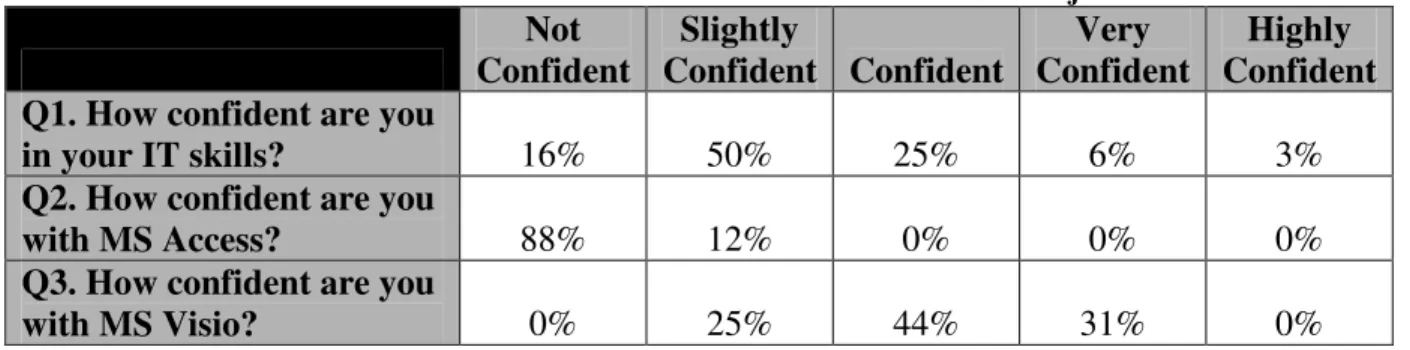
We use a pre-course survey to determine incoming students’ confidence score with IT. For IT305, the questions addressed their confidence level in IT skills and familiarity with Microsoft Access and Visio. A Likert scale, from one to five, was used to determine a raw score of students in each category. Table I shows the percentage of students who fell within each
confidence interval, C, per questions, Q. We let PQC equal the percentage of students in a
confidence interval per question.
Table 1 - Distribution of Confidence Levels for Non-CS/IT Majors. Not Confident Slightly Confident Confident Very Confident Highly Confident Q1. How confident are you
in your IT skills? 16% 50% 25% 6% 3%
Q2. How confident are you
with MS Access? 88% 12% 0% 0% 0%
Q3. How confident are you
with MS Visio? 0% 25% 44% 31% 0%
The confidence score is defined as the average confidence interval for all questions with an associated range of one to five. The average confidence interval for each question was attained
by multiplying the PQC by the corresponding confidence interval and subsequently taking the
average of the sum. We then calculated the initial confidence score by averaging the average confidence interval for each question. This provided us with an initial IT confidence score. The second part of the IAF comes from prerequisite IT related courses or prerequisite score. At the USMA, all cadets take a freshman IT course. Since this is the only IT-related
prerequisite, we only used this course. We took the average grade from are incoming group of students. We used the IAF as a guide to predict the effect of IT in the classroom.
Step 2. Lesson Development
Lesson development is tied to Academic Learning Objectives (ALOs). Often there are Enabling Learning Objectives (ELOs) that support ALOs. Normally when a course director is designing a course, he/she arrays lessons in a way that accomplishes both ELOs and ALOs. At the USMA, for each ELO/ALO there is a three-step process for implementing lessons to accomplish learning objectives: Introduction, familiarization and execution.
In IT305, the introduction is usually a set of lectures coupled with demonstrations by the
instructor. The familiarization step normally consists of in-class exercises augmented with event driven homework and additional instruction. This gives students an opportunity to have a hands-on experience under the guidance and support of the instructor. Finally, we accomplish the execution step through a major graded project.
With the impact assessment in-hand, one can make the necessary adjustments to lessons. Based on our IT analysis from step 1, if the IAF fell within an acceptable quadrant, we could adjust the time spent on the introduction and/or familiarization (see Table 2). The y-axis represents the confidence scale and the x-axis indicates the grade scale. If the class’ average ranged from an F-D, regardless of the confidence score, the introduction phase would be extended.
Table 2 - IT Lesson Deployment Plan (given IT Impact Analysis)
In the case of IT305, the actual IAF fell into red quadrant so we increased the time used to introduce students with IT-intensive topics. This allowed the cadets to ease into the topic better than if we would have used the normal amount of time. Similarly, if the IAF fell within the amber quadrant, it would have indicated to the instructor that he could reduce the amount of time on the introduction and spend more time on the familiarization phase. Like most surveys and other predictors of future performance, we use this as only a guide. Instructors are not required to change their course based on these results.
Step 4. Post-course IT Impact Analysis
At the end of the course, we survey the students again and repeat the IT impact analysis, with one slight change. Instead of considering the average of all prerequisite IT courses, we only calculate the current IT course. As a result, the IT impact analysis compares cadets’ past IT academic performance to the current course. The post-course analysis serves as an analysis tool to gauge how changes at the beginning of the course effect cadet perception and performance at the end of the course.
IT305 has adopted the Academy level IT goal of “Graduates understand and apply information technology concepts to acquire, manage, communicate and defend information, solve problems, and adapt to technological change.” as its course goal. IT305 also adopted the five Academy level IT outcomes as its outcomes. The course structure of IT305 parallels the Academy level IT goal very well. The course has four modules: (1) Acquire information, (2) Communicate information, (3) Manage information, and (4) Defend information. In addition, IT305 exposes cadets to numerous IT systems (including military systems, sensors, and communications), applications and technologies, many of which the cadets must demonstrate a basic level of competence in.
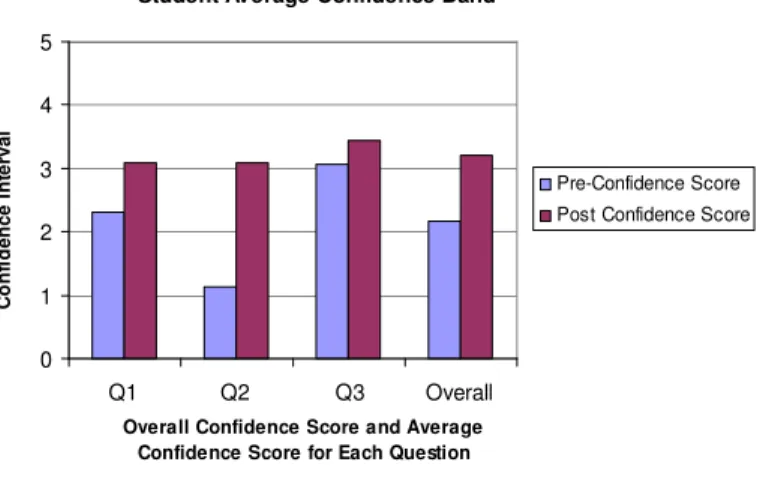
To assess how information technology affect student learning, we sampled a population of n=32 which is approximately two out of 32 sections. As illustrated by (figure 1), the pre-course survey revealed on average that students were slightly confident in their CS/IT skills. In comparison, the post-course survey showed an increase in confidence across all survey questions. The overall average confidence score increased from 2.17 to 3.21 which yielded a 21% increase in the
students’ CS/IT confidence level.
Student Average Confidence Band
0 1 2 3 4 5 Q1 Q2 Q3 Overall
Overall Confidence Score and Average Confidence Score for Each Question
C o n fi d e n c e I n te rv a l Pre-Confidence Score Post Confidence Score
Figure 1 - Pre and Post Confidence Scores for IT305
In addition to the confidence increase, the prerequisite score increased 3% which roughly translates to the average grade increasing by one letter grade.
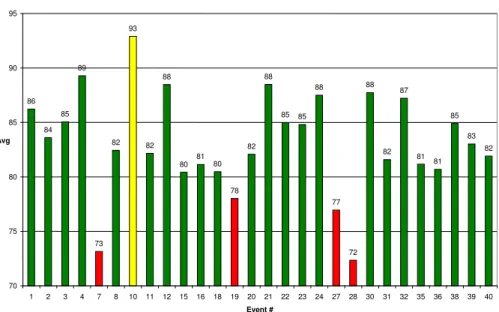
To assess how information technology affects student learning, a variety of assessment tools are utilized. At the lowest level, embedded indicators are used as a direct measurement tool to assess attainment of outcomes. During the last academic year, 794 cadets took IT305, most of whom were junior non-engineering majors. ABET has stated that course grades are not a sufficient measure tool for attainment of outcomes, so embedded indicators were used to evaluate how well cadets were doing. When examining cadet performance on these indicators, one interpretation of the course averages is that any indicator average of above 90% exceeded course expectations, an indicator average of below 80% did not meet course expectations, and all remaining indicator averages (in the range 80-90%) met course expectations.
An example outcome chart (figure 2) measures performance on the outcome, The Ways in Which IT Systems Function. IT305 concepts related to the ways that IT systems function include advanced and dynamic HTML, local area networking, relational database design and implementation, and information assurance principles and techniques. Cadet performance in this domain was generally good. The concept of network protocols presented challenges (the lower scoring areas), and that course material is being reviewed and revised over the summer. Scores are recorded in excel spreadsheets. Since a spreadsheet is used to total the exam scores, the by product is that individual performance on certain test areas provide a direct assessment with little additional overhead.
Figure 2 - The ways in which IT Systems Function
The next level of assessment is at the end of course survey. An integrated system has been developed (scheduling, grades, rosters) that includes questions from various levels (Academy, program, course). This integrated system streamlines data collection and allows for the easy merging of data at the desired level. The end result is there is very little overhead on the individual instructor to collect this data, so instructors can concentrate on teaching and grading. A center for the collection of assessment data has been created at the academy level. Incoming freshmen and outgoing seniors fill out extensive surveys on their overall educational experience. The data collected by the center marks the end of the assessment of outcome attainment. The center continues the collection of data after graduation by sending out surveys to recent graduates and their commanders in order to analyze the data from those questions that either explicitly or implicitly address achievement of the IT Goal. This data is used to assess the attainment of objectives. Those questions that explicitly addressed the IT Goal were:
How confident are you in your (the graduate’s) ability to:
The Ways IT Systems Function -- IT305 Embedded Indicators
86 84 85 89 73 82 93 82 88 80 81 80 78 82 88 85 85 88 77 72 88 82 87 81 81 85 83 82 70 75 80 85 90 95 1 2 3 4 7 8 10 11 12 15 16 18 19 20 21 22 23 24 27 28 30 31 32 35 36 38 39 40 Event # Avg
• Use the Army's advanced technology
• Use computers on the job
Those questions that implicitly addressed the IT Goal were:
• Learn new aspects of your position on the job
• Devise creative solutions to complex problems
• Use mathematics to solve complex problems
• Solve basic real-world engineering problems
• Undertake advanced graduate study
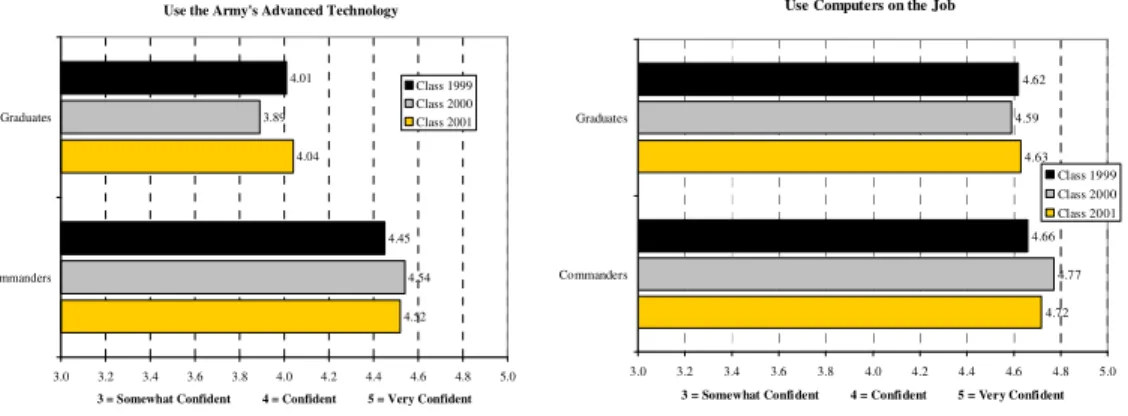
The data from the explicit questions were graphed and are shown in figure 3. It is interesting to note that for all three classes surveyed, the graduates assessed their ability to use the Army’s advanced technology significantly lower than the assessments provided by their commanders. There was no significant difference in the assessment of graduates’ ability to use computers on the job.
Use the Army's Advanced Technology
4.01 4.45 3.89 4.54 4.04 4.52 3.0 3.2 3.4 3.6 3.8 4.0 4.2 4.4 4.6 4.8 5.0 Graduates Commanders
3 = Somewhat Confident 4 = Confident 5 = Very Confident Class 1999 Class 2000 Class 2001
Use Computers on the Job
4.62 4.66 4.59 4.77 4.63 4.72 3.0 3.2 3.4 3.6 3.8 4.0 4.2 4.4 4.6 4.8 5.0 Graduates Commanders
3 = Somewhat Confident 4 = Confident 5 = Very Confident Class 1999 Class 2000 Class 2001
Figure 3. Commander/Graduate Data from Explicit IT Goal Questions
The purpose of using multiple assessment tools is to give the best overall picture on the
attainment of outcomes and objectives. This is a clear link between the initial course design all the way to what graduates can do several years after graduation.
Conclusion
This paper has presented a learning model for integrating technology into a classroom in a manner that improves cadets’ academic performance and confidence level in IT related courses. Assessing student performance is an ongoing process, with the goal of constant improvement. Using a multi-layered data collection process provides a better picture of what a student experiences in his education program.
Bibliography
1. United States Military Academy, Educating Future Army Officers for a Changing World, 2003. (at http://www.dean.usma.edu/support/aad/efaocw.pdf)
2. Educause Center for Applied Research. ECAR Study of Students and Information Technology, 2004. 3. Chickering, Author W., Ehrmann Stephen C., “Implementing the Seven Principles: Technology as Lever. American Association for Higher Education, 2005.
4. Shyamal, Mitra et. al, “An Assessment of the Effectiveness of Interactive Technology in an Introductory Programming Course for Non-Majors”, 35th ASEE/IEEE Frontiers in Education Conference, Indianapolis Indiana, 19-22 October 2005.
5. Siau, Keng et. al, “Use of a Classroom Response System to Enhance Classroom Interactivity”, IEEE Transactions on Eduction, vol. 49, no. 3, 2003.
6. Agarwarl, Ritu and Tanniru, Mohan, “Assimilating a New Technology: A Strategy and Assessment”, Proceedings of the ACM SIGCPR conference on Compute r personnel research, May 1992.
7. Divaharan, Shanti, “A Framework for Analysing Effectived IT Integration into Classrooms by Teachers 8. Benbunan-Fich, Raqeul, “Improving Education and Training with IT”, Communication of the ACM, vol. 45, no. 6, June 2002.
9. Eichorn, Dean, “Impediments to the Integrated Use of Computers in the Classroom”, CHI 98 conference summary on Human factors in computing systems, ACM Press, April 1998