Hypergraph-based Dynamic Load Balancing for Adaptive Scientific
Computations
Umit V. Catalyurek
†, Erik G. Boman
∗, Karen D. Devine
∗, Doruk Bozda˘g
†, Robert Heaphy
∗,
and Lee Ann Riesen
∗†
Ohio State University
∗Sandia National Laboratories
Dept. of Biomedical Informatics
Discrete Algorithms and Math. Dept.
Dept. of Electrical & Computer Eng.
Albuquerque, NM 87185-1318, USA
Columbus, OH 43210, USA
{egboman,kddevin}@sandia.gov
{umit,bozdagd}@bmi.osu.edu
{rheaphy,lafisk}@sandia.gov
Abstract
Adaptive scientific computations require that periodic repartitioning (load balancing) occur dynamically to main-tain load balance. Hypergraph partitioning is a successful model for minimizing communication volume in scientific computations, and partitioning software for the static case is widely available. In this paper, we present a new hy-pergraph model for the dynamic case, where we minimize the sum of communication in the application plus the mi-gration cost to move data, thereby reducing total execution time. The new model can be solved using hypergraph par-titioning with fixed vertices. We describe an implementa-tion of a parallel multilevel repartiimplementa-tioning algorithm within the Zoltan load-balancing toolkit, which to our knowledge is the first code for dynamic load balancing based on hy-pergraph partitioning. Finally, we present experimental re-sults that demonstrate the effectiveness of our approach on a Linux cluster with up to 64 processors. Our new algorithm compares favorably to the widely used ParMETIS partition-ing software in terms of quality, and would have reduced total execution time in most of our test cases.
∗Sandia is a multiprogram laboratory operated by Sandia
Corpora-tion, a Lockheed Martin Company, for the United States Department of Energy’s National Nuclear Security Administration under Contract DE-AC04-94AL85000. This work was supported by the NNSA’s ASC pro-gram and by the DOE Office of Science through the CSCAPES SciDAC institute.
†Supported by Sandia contract PO283793 and US Department of
En-ergy under Award Number ED-FC02-06ER25775. 1-4244-0910-1/07/$20.00 c2007 IEEE.
1
Introduction
Dynamic load balancing is an important feature in paral-lel adaptive computations [7]. Even if the original problem is well balanced, e.g., by using graph or hypergraph parti-tioning, the computation may become unbalanced over time due to the dynamic changes. A classic example is simula-tion based on adaptive mesh refinement, in which the com-putational mesh changes between time steps. The difference is often small, but over time, the cumulative change in the mesh becomes significant. An application may therefore periodically re-balance, that is, move data among proces-sors to improve the load balance. This process is known as dynamic load balancing or repartitioning and is a well stud-ied problem [7, 8, 11, 25, 27, 28, 30, 33, 34]. It has multiple objectives with complicated trade-offs among them:
1. good load balance in the new data distribution; 2. low communication cost within the application (as
given by the new distribution);
3. low data migration cost to move data from the old to the new distribution; and
4. short repartitioning time.
Much of the early work in load balancing focused on diffusive methods [7, 17, 26, 33], where overloaded proces-sors give work to neighboring procesproces-sors that have lower than average loads. A quite different approach is to parti-tion the new problem “from scratch” without accounting for existing partition assignments, and then try to remap parti-tions to minimize the migration cost [25, 28]. These two strategies have very different properties. Diffusive schemes are fast and have low migration cost, but may incur high communication volume. Scratch-remap schemes give low
communication volume but are slower and often have high migration cost.
Dynamic load balancing schemes should be designed such that the compromise between these extreme choices can be tweaked by the application developer. In [27], Schloegel et al. introduced a parallel adaptive reparti-tioning scheme based on the multilevel graph partireparti-tioning paradigm. In their work, relative importance of migration time against communication time is set using a user-given parameter, and it is taken into account in the refinement phase of the multilevel scheme. Aykanat et al. [1] proposed a graph-based repartitioning model,RM model, where the original computational graph is augmented with new ver-tices and edges to account for migration cost. Then the graph is repartitioned using graph partitioning with fixed vertices using a serial toolRM-METISthat they developed by modifying the graph partitioning tool METIS [19]. Al-though these approaches attempt to minimize both commu-nication and migration costs, their applicability is limited to problems with symmetric, bi-directional dependencies. In a concurrent work, Cambazoglu and Aykanat [4] have recently proposed a hypergraph-partitioning based model for the adaptive screen partitioning problem in the context of image-space-parallel direct volume rendering of unstruc-tured grids. However, in that application, communication occurs only for data replication (migration); hence, their model accounts only for migration cost.
In this work, our approach is to directly minimize the total execution time. We use the common model [27]
ttot=α(tcomp+tcomm) +tmig+trepart,
wheretcomp and tcomm denote computation and
commu-nication times within the application, respectively, tmig is
the data migration time, and trepart is the repartitioning
time. The parameterαindicates how many iterations (e.g., time steps in a simulation) the application performs between every load-balance operation. Since the goal of load bal-ancing is to minimize the communication cost while main-taining well-balanced computational loads, we can safely assume that computation will be balanced and hence drop tcomp term. The repartitioning time is typically
signifi-cantly smaller than α(tcomp+tcomm) due to fast
state-of-the-art repartitioners, so we also ignoretrepart. Thus, the
objective of our model is to minimizeαtcomm+tmig.
This work has two main contributions:
• We present a new hypergraph model for repartition-ing where we minimize the sum of total communica-tion volume in the applicacommunica-tion plus the migracommunica-tion cost to move data. Hypergraphs accurately model the ac-tual communication cost and have greater applicabil-ity than graph models (e.g., hypergraphs can represent non-symmetric and/or non-square systems) [5].
Fur-thermore, directly incorporating both the communica-tion and migracommunica-tion costs into a single hypergraph/graph model is more suitable to successful multilevel parti-tioning than accounting for migration costs only in re-finement (see Section 2 for details).
• We present a new parallel repartitioning tool based on hypergraph partitioning with fixed vertices. Although serial hypergraph partitioners with fixed-vertex parti-tioning exist (PaToH [6]), to the best of our knowledge our tool (Zoltan [2]) is the first parallel hypergraph par-titioner with this feature.
The rest of the paper is organized as follows. Section 2 contains some preliminaries about hypergraph partitioning and multilevel partitioning. The details of the proposed hypergraph model for repartitioning are presented in Sec-tion 3. SecSec-tion 4 describes the algorithm for parallel hyper-graph partitioning with fixed vertices. Experimental eval-uation of the proposed approach is presented in Section 5. Finally, Section 6 contains our conclusions.
2
Preliminaries
The static partitioning problem is often modeled as graph or hypergraph partitioning, where vertices represent the computational load associated with data and the edges (hy-peredges) represent data dependencies. The edges (hy-peredges) that span more than one partition (so-called cut edges) incur communication cost. We use the hypergraph model because it more accurately reflects communication volume and cost and has greater applicability than graph models [5, 14].
2.1
Hypergraph Partitioning
A hypergraph H = (V, N) is defined by a set of ver-tices V and a set of nets (hyperedges) N among those vertices, where each net nj ∈ N is a non-empty subset
of vertices. Non-negative weights (wi) and costs (cj) can
be assigned to the vertices (vi ∈ V) and nets (nj ∈ N)
of the hypergraph, respectively. P = {V1, V2, . . . , Vk}
is called a k-way partition of H if each part is a non-empty, pairwise-disjoint subset of V and the union of all Vp, p= 1,2, . . . , k,is equal to V. A partition is said to be balancedif
Wp ≤Wavg(1 +)forp= 1,2, . . . , k, (1)
where part weight Wp=Pvi∈Vpwi is the sum of the
ver-tex weights of part Vp, Wavg = Pvi∈V wi
/k is the weight of each part under perfect load balance, and is a predetermined maximum imbalance allowed.
In a partition, a net that has at least one vertex in a part is said to connect to that part. Theconnectivity λj(H, P) of
a net nj denotes the number of parts connected by nj for
a given partition P of H. A net nj is said to becutif it
connects more than one part (i.e.,λj>1).
There are various ways of defining the cut-size cuts(H, P) of a partition P of hypergraph H [24]. The relevant one for our context is known as connectivity-1 (or k-1) cut, defined as follows:
cuts(H, P) = X nj∈N
cj(λj−1) (2)
The hypergraph partitioning problem [24] can then be defined as the task of dividing a hypergraph into k parts such that the cut-size (Eq. 2) is minimized while the balance criterion (Eq. 1) is maintained.
2.2
Multilevel Partitioning
Although graph and hypergraph partitioning are NP-hard [13, 24], algorithms based on multilevel paradigms [3, 16, 21] have been shown to quickly compute good par-titions in practice for both graphs [15, 20, 32] and hy-pergraphs [6, 22]. Recently the multilevel partitioning paradigm has been adopted by parallel graph [23, 32], and hypergraph [9, 29] partitioners.
In multilevel partitioning, instead of directly partitioning the original large hypergraph (graph), a hierarchy of smaller hypergraphs (graphs) that approximate the original is gener-ated during thecoarseningphase. The smallest hypergraph (graph) is partitioned in thecoarse partitioningphase. In therefinementphase, the coarse partition is projected back to the larger hypergraphs (graphs) in the hierarchy and im-proved using a local optimization method.
3
A New Hypergraph Model for Dynamic
Load Balancing
Dynamic load balancing (repartitioning) is difficult be-cause there are multiple objectives that often conflict. Thus, some algorithms focus on minimizing communication cost while others focus on migration cost. We propose a novel unified model that combines both communication cost and migration cost. We then minimize the composite objective directly using hypergraph partitioning.
First consider the computational structure of an adap-tive application in more detail. A typical adapadap-tive applica-tion, e.g., time-stepping numerical methods with adaptive meshes, performs a sequence of iterations. Between each iteration the structure of the problem (computation) may change slightly, but usually not much. After a certain num-ber of iterations, a load balancer is called to rebalance the
workloads. The required data is then moved (migrated) be-tween parts to establish the new partitioning, and the com-putation continues.
We call the period between two subsequent load balanc-ings anepochof the application. A single epoch may con-sist of one or more iterations of the computation in the ap-plication. Let the number of iterations in epochj beαj.
It is possible to model the computational structure and dependencies of each epoch using a computational hyper-graph [5]. Since each epoch contains computations of the same type, but the structure may change, a differ-ent hypergraph is needed to represdiffer-ent each epoch. Let Hj= (Vj, Ej) be the hypergraph that models the jth
epoch of the application.
We assume the following procedure. Load balancing of the first epoch is achieved by partitioning the first epoch hy-pergraphH1 using a static partitioner. At the end of epoch 1, we need to decide how to redistribute the data and com-putation for epoch 2. The cost should be the sum of the communication cost for H2, with the new data distribu-tion, scaled by α2 (since epoch 2 will have α2 iterations) plus the migration cost for moving data between the two distributions. This principle holds for Hj at every epoch j, j >1. We assume that the hypergraph Hj describing the task-data dependencies of the computations of epoch j is known at the end of epoch j −1. As described be-low, we construct arepartitioning hypergraphby augment-ing epoch j’s hypergraph Hj with additional vertices and
nets to model data migration cost. With these additions, dy-namic load balancing (repartitioning) reduces to hypergraph partitioning with fixed vertices. After this repartitioning, the resulting partition can be decoded easily to infer the data-migration pattern and cost.
We propose a newrepartitioning hypergraph model. The repartitioning hypergraphH¯j for epochj is constructed by
augmenting epochj’s hypergraph Hj withk new vertices
and |Vj| new hyperedges to model the migration cost. In ¯
Hj we keep the vertex weights intact, but we scale each
net’s cost (representing communication) by αj. We add
one newpartition vertexui, with zero weight, for each
par-tition i, i = 1,2, . . . , k. Thus, the vertices in H¯j are Vj∪ {ui|i = 1,2, . . . , k}. For each vertex v ∈ Vj, we
add amigrationnet between v and ui if v is assigned to
partitioniat the end of epochj−1. This migration net rep-resents the data that needs to be migrated for moving vertex v to a different partition; therefore, its cost is set to the size of the data associated withv.
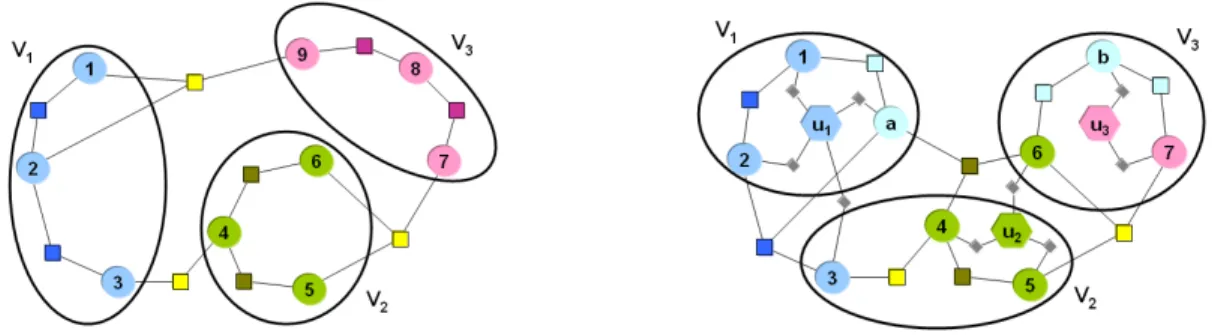
Figure 1 illustrates a sample hypergraphHj−1for epoch
j−1, and a repartitioning hypergraph for epoch j. Our model does not require distinguishing between the two types of vertices and nets; however, for clarity in this fig-ure, we represent computation vertices with circles and par-tition vertices ui with hexagons. Similarly, nets modeling
Figure 1. (left) A sample hypergraph for epoch j−1; (right) repartitioning hypergraph for epoch j with a sample partitioning.
communication during computation are represented with squares, and migration nets modeling data that must be mi-grated if a vertex assignment changes are represented with diamonds. At epochj−1 there are nine vertices with, say, unit weights partitioned into three parts with a perfect load balance. There are three cut nets representing data that need to be communicated between three parts. Assuming the cost of each net is one, the total communication volume (Eq. 2) is three, since each cut net has a connectivity of two. In other words, each iteration of epochj−1incurs a commu-nication cost of three.
In epochj of Figure 1 (right), the computational struc-ture is changed: vertices 8 and 9 are removed, and new ver-ticesaandb are added. The repartitioning hypergraphH¯j
shown reflects these changes. Additionally, there are three partition verticesu1,u2 andu3. The seven old vertices of
Hj−1are connected, via migration nets, to the partition ver-tices for the partitions to which they were assigned in epoch j−1. Similarly, new vertices a and b are connected to the partition vertices associated with the partition they were created.
We now have a new repartitioning hypergraphH¯j that
encodes both communication cost and migration cost. By using this novel repartitioning hypergraph with a crucial constraint — vertexui must be assigned, or fixed, to
parti-tion i — the repartitioning problem reduces to hypergraph partitioning withfixedvertices. In Section 4, we describe how partitioning with fixed vertices can be achieved in a parallel multilevel hypergraph partitioning framework.
LetP ={V1, V2, . . . , Vk}be a valid partitioning for this
problem. We decode the result as follows. If a vertexv is assigned to partitionVp in epoch j−1 and to partition Vq
in epoch j, where p 6=q, then the migration net between v and up is cut with connectivity 2, since up is fixed in
Vp. Hence this migration net will contribute its cost, size of
the data associated withv, to the cut-size (Eq. 2) accurately modeling the migration cost of vertexv’s data. Recall that cost of a communication net is size of the data item that will
be communicated during computation scaled by the number of iterations. If a communication net with connectivityλis cut, it contributes(λ−1)times its cost to the total cut-size accounting the true communication volume incurred by this net in the computation phase [5]. Thus our repartitioning hypergraph accurately models the sum of communication during computation phase plus migration cost due to moved data.
In Figure 1, assume that the example epoch j has, say, five iterations, i.e. αj = 5. Then the cost of each
com-munication net is five. Further assume that each vertex has size three; i.e. the migration cost of each vertex, hence the cost of each migration net, is three. In this example, ver-tices 3 and 6 are moved to partitions V2 and V3, respec-tively. Thus, the migration nets connecting them to their previous parts are now cut with connectivity of two. To-tal migration cost is then 2×3×(2−1) = 6. Further-more, communication nets {2,3, a} and {5,6,7} are cut with connectivity of two, as is net{4,6, a}with connectiv-ity of three. They represent a total communication volume of 2×5×(2−1) + 1×5×(3−1) = 20, resulting in a total cost of 26 for epochj.
4
Parallel Multilevel Hypergraph
Partition-ing with Fixed Vertices
Another contribution of our work is the development of a new technique for parallel hypergraph partitioning with fixed vertices. As described in Section 2, hyper-graph partitioning is NP-hard but can be effectively (ap-proximately) solved in practice using multilevel heuristic approaches. Multilevel hypergraph partitioning algorithms can be adapted to handle fixed vertices [6]. Here we de-scribe our technique for parallel multilevel hypergraph par-titioning with fixed vertices. Our implementation is based on the parallel hypergraph partitioner in Zoltan [9].
The main idea of partitioning with fixed vertices is to make sure that the fixed partition constraint of each
ver-tex is maintained during phases of multilevel partitioning. We will first describe how this works assuming that we are using a direct k-way multilevel paradigm. Later we will briefly discuss how this is handled when a recursive bisec-tion approach is used.
4.1
Coarsening Phase
The goal of the coarsening phase is to approximate the original hypergraph via a succession of smaller graphs. This process terminates when the coarse hyper-graph is small enough (e.g., it has less than 2k vertices) or when the last coarsening step fails to reduce the hyper-graph size by a threshold (typically 10%). In this work we employ a method based on mergingsimilar pairs of ver-tices. We adopted a method calledinner-product matching
(IPM), that was initially developed in PaToH [5] (where it was called heavy-connectivity matching), and later adopted by hMETIS [18] and Mondriaan [31]. The greedy first-choice method is used to match pairs of vertices.
Conceptually, the parallel implementation of IPM works in rounds where in each round, each processor selects a sub-set of vertices as candidate vertices that will be matched in that round. The candidate vertices are sent to all processors. Then all processors concurrently contribute the computa-tion of theirbestmatch for those candidates. Matching is fi-nalized by selecting a global best match for each candidate. Zoltan uses a two-dimensional data distribution; hence, the actual inner workings of IPM are somewhat complicated. Since a detailed description is not needed to explain the ex-tension for handling fixed vertices, we have omitted those details. Readers may refer to [9] for more details.
During the coarsening, we do not allow two vertices to match if they are fixed to different partitions. Thus, there are three possible scenarios: 1) two matched vertices are fixed to the same partition, 2) only one of the matched vertices is fixed to a partition, or 3) both are not fixed to any partitions (free vertices). For cases 1 and 2, the resulting coarse vertex is fixed to the part in which either of its constituent vertices was fixed; for case 3, the resulting coarse vertex is free. By constraining matching in this way, we ensure that the fixed vertex information appropriately propagates to coarser hypergraphs, and coarser hypergraphs truly approximate the finer hypergraphs and their constraints.
In order to efficiently implement this restriction, we allow each processor to concurrently compute all match scores of possible matches, including infeasible ones (due to the matching constraint), but at the end when the best lo-cal match for each candidate is selected we select a match that obeys the matching constraint. We have observed that this scheme only adds an insignificant overhead to the unre-stricted IPM matching.
4.2
Coarse Partitioning Phase
The goal of this phase is to construct an initial solution using the coarsest hypergraph available. When coarsen-ing stops, if the coarsest hypergraph is small enough (i.e., if coarsening did not terminate early due to unsuccessful coarsening) we replicate it on every processor and each pro-cessor runs a randomized greedy hypergraph growing algo-rithm to compute a different partitioning into k partitions. If the coarsest hypergraph is not small enough, then each processor contributes computation of an initial partitioning using a localized version of the greedy hypergraph algo-rithm. In either case, we ensure that fixed coarse vertices are assigned to their respective partitions.
4.3
Refinement Phase
The refinement phase takes a partition assignment, projects it to finer hypergraphs and improves it using a lo-cal optimization method. Our code is based on a lolo-calized version of the successful Fiduccia–Mattheyses [12] method, as described in [9]. The algorithm performs multiple pass-pairs and in each pass, each vertex is considered to move to another part to reduce cut cost. As in coarse partitioning, the modification to handle fixed vertices is quite straight-forward. We do not allow fixed vertices to be moved out of their fixed partition.
4.4
Handling Fixed Vertices in Recursive
Bisection
Achieving k-way partitioning via recursive bisection (repeated subdivision of parts into two parts) can be ex-tended easily to accommodate fixed vertices. For example, in the first bisection of recursive bisection, the fixed vertex information of each vertex can be updated as follows: ver-tices that are originally fixed to partitions1≤p≤k/2, are fixed to partition 1, and vertices originally fixed to partitions k/2< p≤k are fixed to partition 2. The partitioning algo-rithm with fixed vertices then can be executed without any modifications. This scheme is recursively applied in each bisection. Zoltan uses this recursive bisection approach.
5
Results
Our repartitioning code is based on the hypergraph parti-tioner in the Zoltan toolkit [10, 9], which is freely available from the Zoltan web site1. The code is written in C and uses MPI for communication. We ran our tests on a Linux cluster that has 64 dual-processor Opteron 250 nodes inter-connected via an Infiniband network.
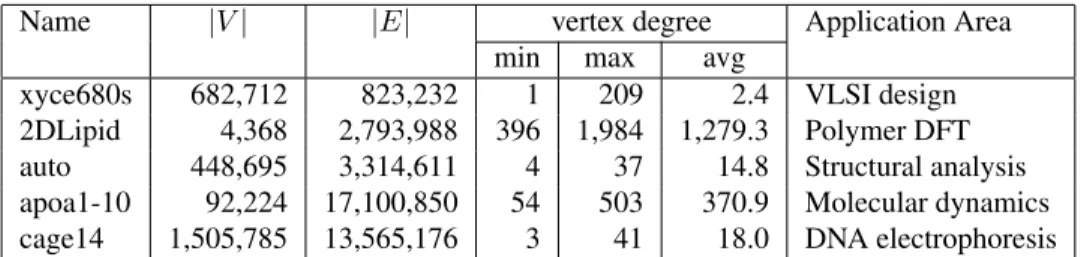
Name |V| |E| vertex degree Application Area min max avg
xyce680s 682,712 823,232 1 209 2.4 VLSI design 2DLipid 4,368 2,793,988 396 1,984 1,279.3 Polymer DFT auto 448,695 3,314,611 4 37 14.8 Structural analysis apoa1-10 92,224 17,100,850 54 503 370.9 Molecular dynamics cage14 1,505,785 13,565,176 3 41 18.0 DNA electrophoresis
Table 1. Properties of the test datasets; |V| and |E| are the numbers of vertices and graph edges, respectively.
Due to the difficulty of obtaining data from real-world adaptive simulations, we present results from synthetic dy-namic data. The base cases were obtained from real ap-plications, as shown in Table 1. All these problems are structurally symmetric, and can be accurately represented as both graphs and hypergraphs. (We expect our hypergraph approach to have a clear advantage for non-symmetric prob-lems.)
We used two different methods to generate synthetic dy-namic data. The first method represents biased random per-turbations that change the structure of the data. In this method, we randomly select a certain fraction of vertices in the original data and delete them along with the incident edges. At each iteration, we delete a different subset of ver-tices from the original data. Therefore, we simulate dynam-ically changing data that can both lose and gain vertices and edges. The results presented in this section correspond to the case where half of the partitions lose or gain 25% of the total number of vertices at each iteration.
The second method we used to generate synthetic data simulates adaptive mesh refinement. Starting with the initial data, we randomly select a certain fraction of the partitions at each iteration. Then, the sub-domain corresponding to selected partitions performs a simulated mesh refinement, where each vertex increases both its weight and its size by a constant factor. In the results displayed in this section, 10% of the partitions are selected at each iteration and the weight and size of each vertex in these partitions are randomly in-creased to between 1.5 and 7.5 of their original value.
We tested several other configurations by varying the fraction of vertices lost or gained and the factor that scales the size and weight of vertices. The results we obtained in these experiments were similar to the ones presented in this section.
We compare four different algorithms:
1. Zoltan-repart: Our new method implemented within the Zoltan hypergraph partitioner,
2. Zoltan-scratch: Zoltan hypergraph partitioning from scratch.
3. ParMETIS-repart: ParMETIS graph repartitioning us-ing theAdaptiveRepartoption.
4. ParMETIS-scratch: ParMETIS graph partitioning from scratch (Partkway).
We used ParMETIS version 3.1 in these experiments. For the scratch methods, we used a maximal matching heuristic in Zoltan to map partition numbers to reduce migration cost. We do not expect the partition-from-scratch methods to be competitive for dynamic problems, but include them as a useful baseline.
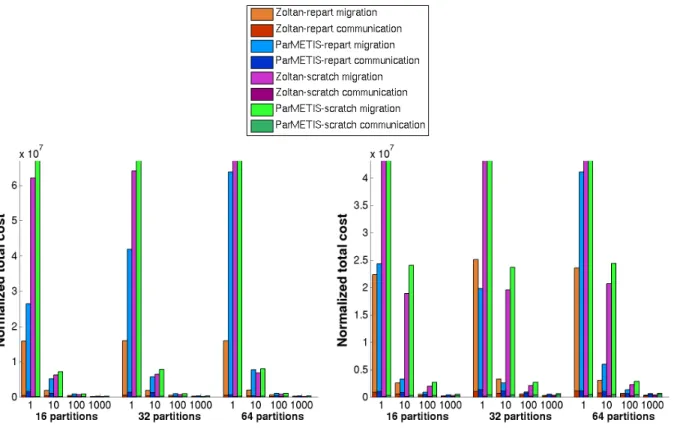
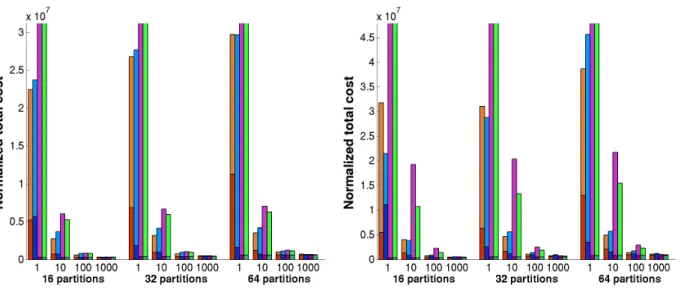
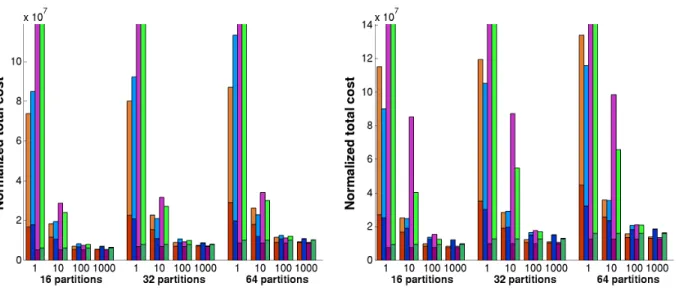
In Figures 2 through 6, experimental results for total cost while varying the number of processors andαare pre-sented. In our experiments we varied the number of proces-sors (partitions) between 16 and 64, and αfrom 1 to 1000. (Our α corresponds to the ITR parameter in ParMETIS.) We report the average results over a sequence of 20 trials for each experiment. For each configuration, there are four bars representing total cost for Zoltan-repart, ParMETIS-repart, Zoltan-scratch and ParMETIS-scratch, from left to right re-spectively. Total cost in each bar is normalized by α and consists of two components: communication (bottom) and migration (top) costs. In order to improve the readability of the charts, we limited the y-axis forα= 1where total costs for Zoltan-scratch and ParMETIS-scratch were much larger than the costs for Zoltan-repart and ParMETIS-repart.
The results show that in the majority of the test cases, our new hypergraph repartitioning method Zoltan-repart outper-forms ParMETIS-repart in terms of minimizing the total cost. Since minimizing the migration cost is a more deeply integrated objective starting from coarsening, Zoltan-repart trades off communication cost better than ParMETIS-repart to minimize the total cost. This is more clearly seen for small α values where minimizing migration cost is as important as minimizing the communication cost. As α grows, migration cost decreases relative to communication cost and the problem essentially reduces to minimizing the communication cost alone. Due to increased emphasis on communication volume, the partitioners find smaller com-munication cost with increasingα.
Figure 2. Normalized total cost (communication volume + (migration volume)/α) for xyce680s with (a) perturbed data structures and (b) perturbed weights. Each group of four bars represents results for Zoltan-repart, ParMETIS-repart, Zoltan-scratch and ParMETIS-scratch, from left to right respectively.
Figure 3. Normalized total cost (communication volume + (migration volume)/α) for 2DLipid with (a) perturbed data structures and (b) perturbed weights. Each group of four bars represents results for Zoltan-repart, ParMETIS-repart, Zoltan-scratch and ParMETIS-scratch, from left to right respectively.
Similar observations can be made when compar-ing Zoltan-repart against Zoltan-scratch and
ParMETIS-scratch. Since the sole objective in Zoltan-scratch and ParMETIS-scratch is to minimize communication cost, the
Figure 4. Normalized total cost (communication volume + (migration volume)/α) for auto dataset with (a) perturbed data structures and (b) perturbed weights. Each group of four bars represents results for Zoltan-repart, ParMETIS-repart, Zoltan-scratch and ParMETIS-scratch, from left to right respectively.
Figure 5. Normalized total cost (communication volume + (migration volume)/α) for apoa1-10 with (a) perturbed data structures and (b) perturbed weights. Each group of four bars represents results for Zoltan-repart, ParMETIS-repart, Zoltan-scratch and ParMETIS-scratch, from left to right respectively.
migration cost is extremely large, especially for small α. The total cost using Zoltan-scratch and ParMETIS-scratch is comparable to Zoltan-repart only whenαis greater than 100. For larger values of α, the objective of minimizing the communication cost dominates; however, Zoltan-repart still performs as well as the scratch methods to minimize the total cost.
When using ParMETIS-repart, migration cost increases noticeably compared to communication cost with
increas-ing number of partitions (processors). On the other hand, with Zoltan-repart, the increase in migration cost is kept small at the expense of a modest increase in communica-tion cost. Consequently, Zoltan-repart achieves a better bal-ance between communication and migration costs; hence, the total cost gets better compared to ParMETIS-repart as the number of partitions increases. This shows that Zoltan-repart is superior in minimizing the total cost objective as well as in scalability of the solution quality compared to
Figure 6. Normalized total cost (communication volume + (migration volume)/α) for cage14 with (a) perturbed data structures and (b) perturbed weights. Each group of four bars represents results for Zoltan-repart, ParMETIS-repart, Zoltan-scratch and ParMETIS-scratch, from left to right respectively.
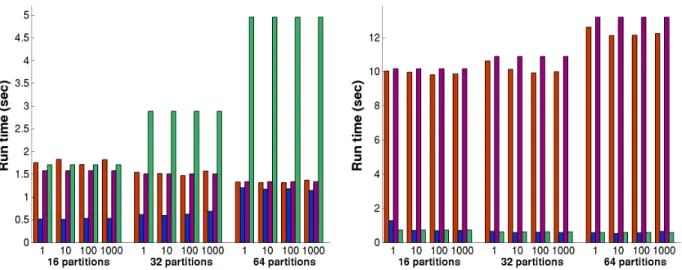
Figure 7. Run time with perturbed data structure for xyce680s. Each group of four bars represents results for Zoltan-repart, ParMETIS-Zoltan-repart, Zoltan-scratch and ParMETIS-scratch, from left to right respec-tively.
ParMETIS-repart.
Run times of the tested partitioners while changing the data’s structure are given in Figures 7 and 8. Results for changing vertex weights and sizes are omitted since they were similar to the ones presented here. As shown in the figures, Zoltan-repart is at least as fast as ParMETIS-repart on the sparse dataset xyce680s. For the dense 2DLipid data, although graph partitioning approaches run faster for small number of partitions, their execution times in-crease and become comparable to that of hypergraph par-titioning approaches as the number of partitions increases. For medium-dense graphs (e.g., auto, cage14, apoa1-10), Zoltan-repart is significantly slower than ParMETIS-repart. Here, we present run time results for only the auto data. The results for cage14 and apoa1-10 were very similar to that of auto, displaying 10 to 15 times faster execution for graph-based approaches compared to hypergraph-graph-based ones. We plan to improve this performance by using local heuristics in Zoltan-repart to reduce global communication (e.g., us-ing local IPM instead of global IPM).
6
Conclusions
We have presented a new approach to dynamic load bal-ancing based on a single hypergraph model that incorpo-rates both communication volume in the application and data migration cost. Our experiments, using data from a wide range of application areas, show that our method produces partitions that give similar or lower cost than the adaptive repartitioning scheme in ParMETIS. Our code generally required longer time than ParMETIS but that is mostly due to the greater richness of the hypergraph model.
Figure 8. Run time with perturbed data structure for (a) 2DLipid and (b) auto. Each group of four bars represents results for Zoltan-repart, ParMETIS-repart, Zoltan-scratch and ParMETIS-scratch, from left to right respectively.
The full benefit of hypergraph partitioning is realized on unsymmetric and non-square problems that cannot be rep-resented easily with graph models. To provide compari-sions with graph repartitioners, we did not test such prob-lems here, but they have been studied elsewhere [5, 9]. The experiments showed that our implementation is scalable.
Our approach uses a single user-defined parameter α to trade between communication cost and migration cost. Experiments show that our method works particularly well when migration cost is more important, but without com-promising quality when communication cost is more impor-tant. Therefore, we recommend our algorithm as a universal method for dynamic load balancing. The best choice of α will depend on the application, and can be estimated. Rea-sonable values are in the range1−1000.
In future work, we will test our algorithm and implemen-tation on real adaptive applications. We will also attempt to speed up our algorithm by exploiting locality given by the data distribution. We believe the implementation can be made to run faster without reducing quality. However, since the application run time is often far greater than the partitioning time, this enhancement may not be important in practice.
Acknowledgments
We thank Bruce Hendrickson and Vitus Leung for their contributions to the Zoltan project.
References
[1] C. Aykanat, B. B. Cambazoglu, F. Findik, and T. Kurc. Adaptive decomposition and remapping algorithms for object-space-parallel direct volume rendering of unstruc-tured grids.Journal of Parallel and Distributed Computing, 67(1):77–99, Jan 2007.
[2] E. Boman, K. Devine, L. A. Fisk, R. Heaphy, B. Hen-drickson, C. Vaughan, U. Catalyurek, D. Bozdag, and W. Mitchell. Zoltan 2.0: Data Management Services for Parallel Applications; User’s Guide. Sandia Na-tional Laboratories, Albuquerque, NM, 2006. Tech. Re-port SAND2006-2958http://www.cs.sandia.gov/
Zoltan/ug html/ug.html.
[3] T. N. Bui and C. Jones. A heuristic for reducing fill-in sparse matrix factorization. InProc. 6th SIAM Conf. Parallel Processing for Scientific Computing, pages 445–452. SIAM, 1993.
[4] B. B. Cambazoglu and C. Aykanat. Hypergraph-partitioning-based remapping models for image-space-parallel direct vol-ume rendering of unstructured grids. IEEE Transactions on Parallel and Distributed Systems, 18(1):3–16, Jan 2007. [5] U. V. C¸ ataly¨urek and C. Aykanat. Hypergraph-partitioning
based decomposition for parallel sparse-matrix vector mul-tiplication. IEEE Transactions on Parallel and Distributed Systems, 10(7):673–693, 1999.
[6] U. V. C¸ ataly¨urek and C. Aykanat. PaToH: A Multilevel Hy-pergraph Partitioning Tool, Version 3.0. Bilkent Univer-sity, Department of Computer Engineering, Ankara, 06533 Turkey. PaToH is available athttp://bmi.osu.edu/
[7] G. Cybenko. Dynamic load balancing for distributed mem-ory multiprocessors. J. Parallel Distrib. Comput., 7:279– 301, 1989.
[8] H. deCougny, K. Devine, J. Flaherty, R. Loy, C. Ozturan, and M. Shephard. Load balancing for the parallel adaptive solution of partial differential equations.Appl. Numer. Math., 16:157–182, 1994.
[9] K. Devine, E. Boman, R. Heaphy, R. Bisseling, and U. Catalyurek. Parallel hypergraph partitioning for scientific computing. InProc. of 20th International Parallel and Dis-tributed Processing Symposium (IPDPS’06). IEEE, 2006. [10] K. Devine, E. Boman, R. Heaphy, B. Hendrickson, and
C. Vaughan. Zoltan data management services for parallel dynamic applications. Computing in Science and Engineer-ing, 4(2):90–97, 2002.
[11] P. Diniz, S. Plimpton, B. Hendrickson, and R. Leland. Par-allel algorithms for dynamically partitioning unstructured grids. InProc. 7th SIAM Conf. Parallel Processing for Sci-entific Computing, pages 615–620. SIAM, 1995.
[12] C. M. Fiduccia and R. M. Mattheyses. A linear-time heuristic for improving network partitions. InProc. 19th IEEE Design Automation Conf., pages 175–181, 1982.
[13] M. R. Garey and D. S. Johnson.Computers and Intractabil-ity. W.H. Freeman and Co., New York, New York, 1979. [14] B. Hendrickson and T. G. Kolda. Graph partitioning models
for parallel computing. Parallel Computing, 26:1519–1534, 2000.
[15] B. Hendrickson and R. Leland.The Chaco user’s guide, ver-sion 2.0. Sandia National Laboratories, Alburquerque, NM, 87185, 1995.
[16] B. Hendrickson and R. Leland. A multilevel algorithm for partitioning graphs. InProc. Supercomputing ’95. ACM, De-cember 1995.
[17] Y. F. Hu, R. J. Blake, and D. R. Emerson. An optimal mi-gration algorithm for dynamic load balancing.Concurrency: Practice and Experience, 10:467 – 483, 1998.
[18] G. Karypis, R. Aggarwal, V. Kumar, and S. Shekhar. Mul-tilevel hypergraph partitioning: application in VLSI domain. InProc. 34th Design Automation Conf., pages 526 – 529. ACM, 1997.
[19] G. Karypis and V. Kumar. METIS 3.0: Unstructured graph partitioning and sparse matrix ordering system. Technical Report 97-061, Dept. Computer Science, University of Min-nesota, 1997.http://www.cs.umn.edu/˜metis.
[20] G. Karypis and V. Kumar. MeTiS A Software Package for Partitioning Unstructured Graphs, Partitioning Meshes, and Computing Fill-Reducing Orderings of Sparse Matrices Ver-sion 4.0. University of Minnesota, Department of Comp. Sci. and Eng., Army HPC Research Center, Minneapolis, 1998. [21] G. Karypis and V. Kumar. A fast and high quality multilevel
scheme for partitioning irregular graphs. SIAM Journal on Scientific Computing, 20(1), 1999.
[22] G. Karypis, V. Kumar, R. Aggarwal, and S. Shekhar.hMeTiS A Hypergraph Partitioning Package Version 1.0.1. Uni-versity of Minnesota, Department of Comp. Sci. and Eng., Army HPC Research Center, Minneapolis, 1998.
[23] G. Karypis, K. Schloegel, and V. Kumar. Parmetis: Parallel graph partitioning and sparse matrix ordering library, version 3.1. Technical report, Dept. Computer Science, University of Minnesota, 2003.http://www-users.cs.umn.edu/
∼karypis/metis/parmetis/download.html.
[24] T. Lengauer. Combinatorial Algorithms for Integrated Cir-cuit Layout. Willey–Teubner, Chichester, U.K., 1990. [25] L. Oliker and R. Biswas. PLUM: Parallel load balancing for
adaptive unstructured mesh es.J. Parallel Distrib. Comput., 51(2):150–177, 1998.
[26] K. Schloegel, G. Karypis, and V. Kumar. Multilevel diffusion algorithms for repartitioning of adaptive meshes.J. Parallel Distrib. Comput., 47(2):109–124, 1997.
[27] K. Schloegel, G. Karypis, and V. Kumar. A unified algorithm for load-balancing adaptive scientific simulations. InProc. Supercomputing, Dallas, 2000.
[28] K. Schloegel, G. Karypis, and V. Kumar. Wavefront diffusion and LMSR: Algorithms for dynamic repartitioning of adap-tive meshes.IEEE Trans. Parallel Distrib. Syst., 12(5):451– 466, 2001.
[29] A. Trifunovic and W. J. Knottenbelt. Parkway 2.0: A par-allel multilevel hypergraph partitioning tool. InProc. 19th International Symposium on Computer and Information Sci-ences (ISCIS 2004), volume 3280 ofLNCS, pages 789–800. Springer, 2004.
[30] R. Van Driessche and D. Roose. Dynamic load balancing with a spectral bisection algorithm for the constrained graph partitioning problem. InHigh-Performance Computing and Networking, number 919 in Lecture Notes in Computer Sci-ence, pages 392–397. Springer, 1995. Proc. Int’l Conf. and Exhibition, Milan, Italy, May 1995.
[31] B. Vastenhouw and R. H. Bisseling. A two-dimensional data distribution method for parallel sparse matrix-vector multi-plication.SIAM Review, 47(1):67–95, 2005.
[32] C. Walshaw. The Parallel JOSTLE Library User’s Guide, Version 3.0. University of Greenwich, London, UK, 2002. [33] C. Walshaw, M. Cross, and M. Everett. Parallel dynamic
graph-partitioning for adaptive unstructured meshes. J. Par. Dist. Comput., 47(2):102–108, 1997.
[34] R. Williams. Performance of dynamic load balancing al-gorithms for unstructured mesh calculations. Concurrency, 3:457–481, October 1991.