COMMUNITY
DEVELOPMENT
Working Paper
FEDERAL RESERVE BANK OF SAN FRANCISCO
101 Market Street
Strengthening Financial Education in California:
Expanding Personal Finance Training among Youth
Justina Cross
Goldman School of Public Policy, UC Berkeley
May 2010
Working Paper 2010-02
http://frbsf.org/community
Strengthening Financial Education in California:
Expanding Personal Finance Training among Youth
Justina Cross
Goldman School of Public Policy, University of California Berkeley
May 2010
The views and conclusions in this paper are solely those of the author, and do not necessarily represent the views of the Federal Reserve Bank of San Francisco or the Federal Reserve System.
Executive Summary ... 1
Introduction ... 2
The Need for Financial Education ... 3
Efficacy of Youth Financial Education Programs ... 5
Policy Context ... 7
National and State Approaches to Financial Education ... 7
California’s Need for Financial Preparedness ... 10
Part I: Changing California’s Education Curriculum ... 11
Education Funding in California... 11
Legislative Mandates for Education Requirements ... 12
Administrative Approaches to Adding or Changing Curriculum ... 14
Part II: History of Financial Education Legislation in California ... 16
Part III: Current Approaches by Various U.S. States ... 18
Case Studies ... 19
Implications for California ... 26
Part IV: Financial Education Integration and Implementation Strategies ... 30
Exploration of Strategy Alternatives ... 31
Alternatives for Further Research ... 35
Recommended Strategy ... 36
Conclusion ... 38
Bibliography ... 39
Laura Choi May 2010 Federal Reserve Bank of San Francisco
From executive meetings in corporate boardrooms to family discussions around the kitchen table, the economic recession has caused all of us to reconsider our financial situations. As individuals face greater economic uncertainty and fewer financial safety nets, the core principles of personal financial management, such as budgeting and saving, have become more important than ever. Yet Americans from all socioeconomic backgrounds struggle to master basic financial concepts, suggesting the need for widespread financial education.
One approach for delivering financial education is to utilize the public school system and introduce personal finance concepts to youth in the classroom. The adoption of financial education mandates at the state level has increased in recent years, and 44 states currently have financial education requirements. However, despite multiple legislative attempts and a strong advocate base, California is one of the few states that has been unable to pass a mandate for financial education. California is the most populous state in the Federal Reserve’s Twelfth District and represents the largest
economy of any state in the nation—thus, while the need for financial education is clear, the policy challenges, budgetary implications, and implementation issues are not yet well understood.
Recognizing the research gap in this area, and the growing importance of educating and equipping individuals to make sound financial decisions, the Community Development Department of the Federal Reserve Bank of San Francisco (FRBSF) commissioned this study to explore the feasibility of passing a financial education mandate in California. Specifically, we sought to understand the key barriers related to passing a mandate in California and to identify strategies to implement financial education in the current environment, despite the absence of a state mandate.
We are pleased to present “Strengthening Financial Education in California: Expanding Personal Finance Training among Youth,” by Justina Cross (Goldman School of Public Policy, University of California Berkeley). Cross explores multiple options for expanding personal finance training among youth in California, including statewide legislation or education code changes for financial education, professional development and training for teachers on personal finance concepts, and school district adoption of financial preparedness curriculum. At the FRBSF, we intend to take the report’s findings and explore how we can help to facilitate stakeholder discussions in the area of teacher training and continue to support the field of financial education through ongoing research and strategic partnerships. But we also believe this report has much broader relevance to the
community, and provides important information for educators, advocates, and policymakers in their efforts to promote widespread financial education for youth in California.
E
XECUTIVES
UMMARYThe recent economic recession has heightened the awareness of policymakers that many individuals lack understanding of critical finance concepts, making them vulnerable to the complex products and services available in the financial marketplace. Poor financial choices affect an individual’s economic wellbeing and can lead to negative effects in wealth accumulation, housing, employment opportunities, and educational attainment. Policymakers in many states have turned to financial education programs to equip young people with the tools to make better financial choices.
California is one of only six states that has not adopted requirements for youth financial education programming in schools. The state faces many barriers to implementing financial education, including: a shrinking state budget, declining expenditures for education, extensive and inefficient processes for determining and reimbursing legislative mandates, prior
gubernatorial vetoes on similar legislation, and no clear procedure for regularly updating education standards. Although barriers exist, California can take steps forward to ensure that its youth are equipped with the knowledge and ability to make better choices in today’s
financial marketplace.
This working paper explores three options for expanding personal finance training among youth in California:
Statewide legislation or education code changes for financial education,
Professional development and training for teachers on personal finance concepts, and School district adoption of financial
preparedness curriculum.
R
ECOMMENDATIONSLegislation has been targeted as a promising strategy for youth financial education, but the
current political and economic climate requires a different approach. This paper ultimately recommends shifting the strategy away from requiring financial education through legislation or changes to the educational code. Instead, California should focus first on implementation strategies that builds political support and demonstrates success at the district level. Two strategies should be pursued before attempting legislation:
Provide professional development and training for teachers on personal finance concepts, and
Incentivize school district adoption of financial preparedness curriculum.
The strategies are complementary and decision makers should consider implementing them concurrently. Providing professional
development to teachers can take a variety of forms at the state or district level and allows for partnerships with nonprofits and other entities to deliver appropriate training. Additionally, encouraging administrators of teaching
programs in universities to add personal finance concepts to curriculum could help teachers gain familiarity with financial education before they teach it in the classroom.
California’s school districts have local control over curriculum, thus working with districts to adopt financial education is a good strategy for expanding youth financial capability. San Diego Unified School District can serve as a model for other districts; it has already developed curriculum and modified education standards to include financial education.
While this paper suggests implementing short-term recommendations, decision makers should not lose sight of statewide adoption of financial education. Laying the groundwork first can help to cultivate relationships that will make legislative or administrative changes easier in the future.
I
NTRODUCTIONThe recent subprime crisis—coupled with a growth in the use of credit and alternative financial services such as payday loans—provide strong evidence that American consumers are having difficulty navigating their personal finances and the complex choices they face in the financial marketplace. Four in ten Americans admit that they are living beyond their means primarily because of their misuse and misunderstanding of credit, and less than half of high school seniors are able to pass a financial literacy test.1
This lack of financial knowledge has troubling implications, particularly in today’s financial
marketplace. The continually evolving nature of financial products and services makes choices about how to spend, save, and invest more difficult for families and individuals. Policymakers are
recognizing the need to shore up consumer protection in the financial marketplace, especially since financial decisions have significant implications for personal and financial wellbeing, affecting important outcomes such as personal debt, wealth accumulation, housing, employment
opportunities and higher education. The long-term repercussions of limited financial knowledge can affect an individual for a lifetime.
One potential tool for improving the financial decisions of consumers is financial education. Financial education is broadly defined as the process by which individuals attain knowledge and skills about financial products and services, and learn to plan for short-term and long-term goals.2 Financial education is designed to help people make better-informed choices in the financial marketplace. Over the last fifteen years, the number of financial programs has grown exponentially, and includes everything from short classes run by nonprofits to intensive one-on-one coaching. However, even with this proliferation of programs and delivery mechanisms, behavior remains hard to change, particularly when people develop feelings about money and ways to manage it early in their lives.
A key question confronting policy-makers is how to deliver financial education to youth, to ensure that the foundation for prudent financial decisions is laid early on. Certainly, financial education is not a panacea, and equipping citizens with the knowledge and tools to evaluate financial decisions should work in tandem with better regulation of the financial services industry. Nevertheless, given that the financial sector is likely to remain a complex and competitive marketplace, there is a strong argument for ensuring that consumers are equipped to navigate that marketplace successfully. This working paper focuses on strategies for expanding financial education for youth in California. The paper proceeds as follows. First, the paper looks at the need for financial education, particularly among American youth. Next, the paper examines the landscape of California and the need for financial education among the state’s residents as well as some of the barriers facing the state in adopting a comprehensive financial education policy for youth. In addition, the paper reviews unsuccessful California legislation to expand financial education in schools. The penultimate section
1
U.S. Department of the Treasury, Office of Financial Education (2002). Integrating financial education into school
curricula. Washington, DC. Retrieved from www.treasury.gov/ofe. 1. Mandell, L. (2008). The financial literacy of
young American adults: Results of the 2008 national Jump$tart coalition survey of high school and college
students. Jump$tart Coalition. Washington, D.C.
2 U.S. Financial Literacy & Education Commission. (2006). Taking ownership of the future: The national strategy for
reveals implications for California from a series of case studies on states that have comprehensive financial education policies. Lastly, the paper presents a number of strategy options to expand financial education among youth in California and makes recommendations about potential next steps.
T
HEN
EED FORF
INANCIALE
DUCATIONIn recent years, the push for statewide financial education policies has intensified. Both the complexity of financial products and the recognition that consumers lack critical skills and knowledge to make financial decisions have initiated the trend toward state financial education policies.
COMPLEX FINANCIAL PRODUCTS
The landscape of financial products and services is complicated and rapidly changing. Through advances in technology and innovation, more products and services are available to consumers and investors. Financial institutions have also become more efficient at communicating with, and delivering services to, consumers through the Internet and other timesaving technological
innovations. Faced with this abundance of options, consumers increasingly need tools to help them make wise choices.
One example of this is the home mortgage market. Loan products designed to assist homeowners have proliferated and grown in complexity. Until recently, the industry standard for home loans was a 30-year fixed rate mortgage (FRM). However, “exotic” mortgage products, such as interest-only loans or adjustable rate mortgages, quickly eclipsed the plain vanilla 30 year mortgage, shifting risk to the consumer. These innovations in mortgage products required consumers to assess their short- and long-term ability to repay and, as evidenced by the recent mortgage crisis, many were unable to do so. In today’s market, citizens confront more choices about handling finances than ever before and face steep consequences for poor financial decisions.
In addition to technological changes and product innovations, access to credit has become easier for consumers, and as a result, institutions providing credit have proliferated. Pay day lenders and check cashing institutions did not exist as an option for consumers until just over a decade ago. Payday lenders originate $8 to $14 billion in loans annually through over 100,000 outlets across the country.3 Arguably, these check cashers exist precisely because people do not choose to access traditional banks. Users might be on ChexSystems,4 have bad debt to income ratios, have bad credit, or have no access to a bank in their neighborhood. Thus, these fringe financial institutions fill a gap in financial services. However, these institutions are regulated less than traditional banks, and have less
accountability to create products that work for consumers.
3 Sawyer, N., & Temkin, K. (2004). Analysis of Alternative Financial Service Providers. Washington, D.C: Fannie Mae
Foundation and the Urban Institute.
4
Financial institutions are the members of ChexSystems network, a central clearinghouse of information on
mishandled checking and savings accounts. Users listed on ChexSystems may have a harder time opening an
account because financial institutions use the database to assess the risk of opening new accounts. ChexSystems,
A GROWING CRISIS AMONG AMERICAN YOUTH
The complexity of the financial marketplace and increased access to credit are only half the story; it is also important to understand financial decision-making by youth in today’s marketplace. American youth lack knowledge about personal finances such as saving, investing, spending, and debt. The Jump$tart Coalition’s test of financial skills and knowledge revealed that high school seniors on average answered less than fifty percent of financial competency questions correctly.5 Since the first test administration in 1997, the average score has fallen by ten percent indicating that students graduating from high school, regardless of their exposure to financial concepts, do not have an adequate understanding of savings, investing, and money management.6 The findings suggest that youth are ill equipped to make major financial decisions over their lifetime.
At the same time, youth have tremendous purchasing power. In 2006, youth ages 12- to 19-years-old cumulatively spent $179 billion with an average individual weekly expenditure of $102.7 Moreover, about half of all teenagers in the U.S. receive an allowance; an average of $50 a week.8 Teenagers and younger children influence both their own purchases and those of their family tremendously, thus their knowledge of money management and consumer protection can help or hurt their financial wellbeing before entering adulthood.
Not only do young people have immense purchasing power, they are also taking on more financial obligations than ever before. Take as an example college-bound young adults, a small segment of the youth population, but a group increasingly burdened by financial obligations. Average student loan debt for undergraduates rose from $12,750 to $23,200 over a twelve-year period from 1994 to 2008; a 45 percent increase in average college debt.9 Additionally, for college students, median credit card debt increased from $946 to $1,645 from 2004 to 2009.10 Taking on consumer debt on top of educational loans early in life can create significant financial burden, particularly when financial obligations are misunderstood and lead to poor credit scores and severe debt accumulation. Youth also tend to have overly optimistic ideas about their financial capability and future financial position. Most teens believe they will be financially solvent in the future and earning “plenty of money.” According to a Charles Schwab Teens & Money Survey, boys expected to earn $173,000,
5
Mandell, L. (2008). The financial literacy of young American adults: Results of the 2008 national Jump$tart
coalition survey of high school and college students. Jump$tart Coalition. Washington, D.C.
The Project on Student Debt (2010). Quick facts about student debt. Retrieved from
http://projectonstudentdebt.org/files/File/Debt_Facts_and_Sources.pdf
6 Ibid. 8. 7
Gale, D. (2007, Feb 1). Purchasing power of kids and teens: Restaurants need to recognize the influence and
consumer strength of young customers. Restaurants & Institutions. Retrieved from
http://www.rimag.com/article/374736‐Purchasing_Power_of_Kids_and_Teens.php
8 Casanova, D. (2004). Downtown and the Youth Market. Let’s Talk Business, 94. Center for Community Economic
Development, University of Wisconsin‐Extension. Retrieved from
http://www.uwex.edu/ces/CCED/downtowns/ltb/lets/0406LTB.pdf
9 The Project on Student Debt (2010). Quick facts about student debt. Retrieved from
http://projectonstudentdebt.org/files/File/Debt_Facts_and_Sources.pdf
10 Sallie Mae (2009). How undergraduate students use credit cards. Retrieved from
http://www.salliemae.com/NR/rdonlyres/0BD600F1‐9377‐46EA‐AB1F‐6061FC763246/ 10744/
and girls expected to earn about $114,000 on average.11 However, the median household income in the U.S. is $50,303.12 Although it is understandable that teens might incorrectly predict their future incomes, such evidence suggests that youth may not fully appreciate the challenges of earning and managing their money.
Teens form ideas about managing their money early in life through the influence of family and peers. Youth learn financial behaviors through participation, observation, and direct instruction.13
Although families greatly influence children’s knowledge about personal finance, families cannot be expected to teach children all aspects of financial decision-making, particularly given the constantly evolving financial marketplace. This suggests that there is an important role for more formalized training in financial education that could help to ensure that all youth have at least a basic
understanding of financial concepts.
E
FFICACY OFY
OUTHF
INANCIALE
DUCATIONP
ROGRAMSEssential to directing California’s financial education strategy is whether youth make better decisions when equipped with personal finance knowledge and skills. Research points to a correlation between learned abilities and increased market participation and improved financial behavior.14 Furthermore, a growing body of research shows positive effects of youth financial education, although these findings are far from conclusive and much more research is needed to tease out the relationship between financial education and consumer behavior.
YOUTH FINANCIAL EDUCATION PROGRAM RESEARCH
One of the first studies on the effectiveness of youth financial education showed that students demonstrated increased knowledge and confidence and had a higher savings rate after completing the High School Financial Planning Program (HSFPP), and these outcomes persisted three months after completion of the program.15 Hogarth, Hilgert and Beverly (2003) found that financial
education positively affects consumer behavior.16 Additionally, a longitudinal study of Visa’s Practical
Money Skills for Life program (2005) showed that teenagers who had taken the course were more likely to budget, less likely to buy something they did not need, and had greater money management knowledge than their peers who had not taken the course.17 A 2007 evaluation of the FDIC’s Money
Smart program found similar results; positive changes in the savings rates and amount of debt at six
11
Charles Schwab, Inc. (2007). Teens & money survey: Insights into money attitudes, behaviors and concerns of
teens. Retrieved from http://www.aboutschwab.com/community/financial‐literacy/teensand‐ money.html
12 U.S. Census Bureau (2009, Sept 10). Income, poverty and health insurance coverage in the United States: 2008.
Retrieved from http://www.census.gov/Press‐Release/www/releases/archives/income_wealth/014227.html
13
Rettig, K.D., & Mortenson, M. (1986). Household production of financial management competencies. In R.
Deacon & W. Huffman (Eds.), Human Resources Research 1887‐1987. Ames, IA: Iowa State University. 137‐45. 137.
14 Cole, S., & Shastry, G. K. (2009). Smart Money: The effect of education, cognitive ability, and financial literacy on
financial market participation. Working Paper, Harvard Business School. Retrieved from
http://www.hbs.edu/research/pdf/09‐071.pdf. 31.
15 Boyce, L., & S. Danes (1998). Evaluation of the NEFE high school financial planning program 1997‐1998.
Greenwood Village, CO: National Endowment for Financial Education.
16
Hilgert, M. A., Hogarth, J. M., & Beverly S.G. (2003) Household financial management: The connection between
knowledge and behavior. Federal Reserve Bulletin, 89 (7), 309‐322.
17 VISA. (2005). Practical Money Skills for Life longitudinal survey: March 2004–January 2005. Retrieved from
and twelve months after completing the program.18 A nine-month study in 2008 analyzed responses from nearly 600 youth, ages 13-18, at Boys & Girls Clubs across the U.S. to understand the efficacy of the Money Matters: Make it CountSM program. Study participants reported they were more likely to
open both checking and savings accounts if they had learned about managing both types of accounts.19 However, studies like Peng, et al. (2007) showed no relationship between financial education in high school and investment knowledge.20
Some research has found that financial education works best when students are motivated to learn the information, such as a student learning about their credit score before they apply for a credit card or car loan. Mandell and Klein (2007) found that lack of motivation to learn the material correlated with low financial literacy scores.21 Attendees of a convening hosted by New America Foundation and Citi Foundation asserted that financial education must be relevant to the needs of a diverse group of students. Attendees suggested that in order for financial education to be effective it needed to have direct application to students’ lives.22 This indicates that programs need to ensure that students understand how the financial knowledge will be useful for them now and in the future. Researchers could help to close the knowledge gap regarding assessment measures and evaluation of the effect of youth financial education programs on future financial decisions. Additionally, more research is needed regarding the effectiveness of youth financial education in schools, particularly identifying types of programs that increase students’ financial knowledge and skills.
STATE MANDATED FINANCIAL EDUCATION RESEARCH
State education mandates are often the first strategy advocates pursue to enact personal financial literacy training for youth. Many believe schools to be effective delivery mechanisms because they reach so many youth and the classroom environment emphasizes learning. Additionally, mandates can be an effective way to enforce requirements and ensure local accountability. However, research is inconclusive about the effectiveness of mandated financial education. Four studies show different results. First, Mandell (2004) found no positive effect from states that required consumer education when compared to states that had no such requirement.23
In contrast, Bernheim, Garrett and Maki (1997) looked at both consumer and personal finance mandates and concluded that mandates increase exposure to financial concepts and subsequently
18 Federal Deposit Insurance Corporation (2007). A longitudinal evaluation of the intermediate‐term impact of the
Money Smart financial education curriculum upon consumers’behavior and confidence. Retrieved from
http://www.fdic.gov/consumers/consumer/moneysmart/pubs/ms070424.pdf
19
57 percent compared to 44 percent opened a savings account; 36 percent compared to 28 percent opened
checking accounts. Charles Schwab (2009, Jan 27). Report from Boys & Girls Clubs of America and Charles Schwab
Foundation shows increased knowledge among teens leads to positive behavioral change. Retrieved from
http://www.businesswire.com/portal/site/schwab/index.jsp?ndmViewId=news_view&ndmConfigId=1016332&ne wsId=20090127005745&newsLang=en
20 Peng, T.
, Bartholomae, S., Fox, J., & Cravener, G. (2007). The impact of personal finance education delivered in
high school and college courses. Journal of Family and Economic Issues, 28(2), 265‐284.
21 Mandell, L., & Klein, L. S. (2007). Motivation and financial literacy. Financial Services Review, 16, 106‐116. 22 Lopez‐ Fernandini, A., & Murrell, K. (2008). The effectiveness of youth financial education. New American
Foundation & Citi Foundation. Retrieved from
http://www.newamerica.net/publications/policy/effectiveness_youth_financial_education_1
23 Mandell, L. (2004). Financial literacy: Are we improving? Results of the 2004 national Jump$tart survey.
increase the individual’s savings and wealth accumulation later in life.24 The margin for error is high with Bernheim, Garrett and Maki’s data because participants self-reported exposure to consumer finance curriculum, often long after attending the school program, and the researchers corroborated those answers with undependable records of schools offering consumer finance. In general, survey participants have a harder time remembering events the further they occur in the past.25 Participants also tend align their answers with responses seen to be socially desirable;26 in this case, individuals may have over-reported their strong savings habits.
Cole and Shastry (2007) found that financial education mandates did not increase financial market participation among students.27 They suggest that outside factors such as rapid economic growth accounted for the positive effects that Bernheim, Garrett and Maki originally found. Finally, Tennyson and Nguyen (2001) examined the issue of mandates and found that on average a state mandate does not relate to students’ test scores in personal finance.28 However, mandated courses, when compared to testing or integration into standards, positively correlate with student knowledge of personal finance. Tennyson and Nguyen’s promising findings point to dedicated financial literacy courses as being more effective than testing or curriculum standards. It is important to note that their study does not account for the length of time a mandate had been in place, which could dramatically affect the results; presumably the longer a program has been in operation, the more effective it will be at training youth.
Researchers could help to close the knowledge gap regarding the effectiveness of school-based financial education programs and the effect on future financial decisions. Developing assessment measures that can be used across different programs and generating more research on program efficacy can help practitioners draw better conclusions about their work and design better programs.
P
OLICYC
ONTEXTDespite the lack of conclusive evidence about the effectiveness of youth financial education programs, there is growing attention from decision makers at all levels of government about the importance of improving financial knowledge. Many government agencies at the state and federal level have launched new initiatives with the goal of increasing financial decision-making skills.
N
ATIONAL ANDS
TATEA
PPROACHES TOF
INANCIALE
DUCATIONAccording to the Government Accountability Office (GAO) report “The Federal Government’s Role in Improving Financial Literacy,” approximately 20 federal agencies operate 30 financial literacy-related programs and more agencies partner with non-governmental organizations to
24
Bernheim, B.D., Garrett, D.M., and Maki, D.M. (1997). Education and saving: The long‐term effects of high school
financial curriculum mandates. Retrieved from http://www.sciencedirect.com/science/article/B6V76‐42VM8HM‐
5/2/5e6a4d08e173ffa2f469ffc2f45d23a1. 462.
25 Groves, R., Fowler, F., Couper, M., Lepkowski, J., Singer, E., & Tourangeau, R. (2009). Survey methodology. New
York, NY: Wiley. 221.
26 Ibid. 168.
27 Cole, S., & Shastry, G. K. (2007). If you are so smart, why aren't you rich? The effects of cognitive ability,
education, and financial literacy on financial market participation. Working Paper, Harvard Business School and
Harvard Economics Department.
28 Tennyson, S., & Nguyen, C. (2001). State Curriculum Mandates and Student Knowlege of Personal Finance.
improve financial skills and knowledge of citizens.29 Released in 2004, the report recommends that the federal government should be a leader in financial literacy and use its influence to establish it as a national priority.30 As the federal government takes a leadership role in financial literacy, more coordination across agencies is needed to streamline efforts and minimize duplication of efforts. The GAO report, coupled with the increased recognition of consumer vulnerability in the financial services marketplace, has prompted several federal initiatives in the area of financial education. In particular, the U.S. Department of the Treasury and the President’s Advisory Council on Financial Education have worked to develop a national awareness about the benefits of financial education and synthesize federal efforts in this area.
Over the last ten years, the U.S. Department of the Treasury has increased efforts to improve financial literacy among Americans and created the Office of Financial Education (OFE). In 2002, the Treasury’s report “Integrating Financial Education into School Curricula” suggested that the most effective delivery mechanism for youth financial education is through math and reading courses in school.31 In 2003, Congress passed an act to establish the Financial Literacy and
Education Commission (FLEC), hosted by the Treasury, to develop a national financial education strategy and to coordinate interagency efforts. FLEC includes members from 20 federal agencies including: Department of Education, Federal Deposit Insurance Corporation, and the Federal Reserve Board.32 FLEC released a strategy report in 2006, which included recommendations for both youth and adult financial literacy training.
FLEC emphasized three major approaches to K-12 financial education: (1) curriculum integration, (2) teacher training, and (3) outside-the-classroom learning. The FLEC report suggests that financial concepts should be integrated into existing curricula since stand-alone financial literacy courses are unrealistic given other required courses in a student’s schedule, as well as budget constraints.33 Secondly, the strategy emphasizes teacher training, support through professional development, and access to relevant materials as critical in facilitating learning of personal finance concepts.34 Lastly, the Commission recommended that financial literacy knowledge and skills be reinforced through non-traditional venues, such as after-school care or summer camps.35 FLEC will release a revised strategy in 2010, yet it is likely that K-12 financial education will remain a key focus of the commission’s recommendations.
In addition to the work in Treasury, The President’s Advisory Council on Financial Literacy, housed in the executive branch of government, is another federal entity involved with financial
preparedness. Since 2008, one of the roles of the Council has been to launch and promote the
29
Government Accountability Office. (2004). The Federal Government's Role in Improving Financial Literacy.
Washington, DC. Retrieved from http://www.gao.gov/highlights/d0593sphigh.pdf. 3.
30 Ibid. 5.
31 U.S. Department of the Treasury, Office of Financial Education (2002). Integrating financial education into school
curricula. Washington, DC. Retrieved from www.treasury.gov/ofe. iii.
32 U.S. Financial Literacy & Education Commission. (2006). Taking ownership of the future: The national strategy for
financial literacy. Washington, DC. Retrieved from www.treasury.gov/ofe.
33
U.S. Financial Literacy & Education Commission. (2006). Taking ownership of the future: The national strategy for
financial literacy. Washington, DC. Retrieved from www.treasury.gov/ofe. 83.
34 Ibid. 88. 35
National Financial Literacy Challenge, a competition for high school seniors that tests their
knowledge of personal finance concepts.36 One of the major recommendations of the Council is to incorporate financial education in the classroom:
The United States Congress or state legislatures should mandate financial education in all schools for students in grades Kindergarten through 12. For those schools without access to curricula, encourage the adoption of “Money Math: Lessons for Life,” a ready-to-use, middle-school curriculum created by the Department of the Treasury and endorsed by the Council.37
The Council recommends that the legislative branches of government at the state or local level should create laws requiring financial education in schools, yet the Council itself does not have authority to create such a mandate.
Within U.S. Congress, a few bills do seek to boost financial education for youth, yet all the current bills stop short of mandating financial education in K-12 schools. Current legislation includes the Financial and Economic Literacy Improvement Act of 2009, S. 638 (H.R.1645), which would allow state education agencies or nonprofits to receive grant money for financial literacy programs and activities. The bill would also develop a clearinghouse for financial literacy information accessible through the Department of Education website. The Young Adults Financial Literacy Act, H.R. 3147 (2009), would provide competitive grants to institutions to support research, implementation and evaluation of financial education programs. The Financial Literacy for Youth Act, H.R. 3037 (2009), comes closest to requiring financial education by establishing a pilot program that would provide ten state or local education agencies with grant money to develop financial literacy programs in
elementary and secondary schools. However, none of these bills have yet been voted into law. Despite these bills, it is not clear whether federal legislation is the right approach. While federal legislation would allow for national action regarding financial literacy, it would also provide a more rigid framework for adopting it. For example, federal proposals for financial education generally must be implemented uniformly across each state, which does not allow states much flexibility to invent solutions to meet the needs of its particular population. Additionally, schools already face federal requirements set forth by No Child Left Behind (NCLB); teachers feel pressed for time in the classroom to meet NCLB requirements and test students. Imposing more requirements without providing resources and building support among teachers and school district officials may limit the effectiveness of additional programming.
In the absence of federal legislation, states have taken disparate approaches to financial education for youth. The majority of U.S. states set requirements for financial literacy in schools. In total, 44 states include personal finance in curriculum standards through a variety of methods.38 However, states with personal finance education requirements often have vastly different visions for implementing and enforcing the requirements. (See Appendix 3 for a map of state financial education requirements). Of those 44 states, 34 require implementation of personal education
36 President's Advisory Council on Financial Literacy. (2008). 2008 Annual Report to the President. Washington, DC.
Retreived from http://www.ustreas.gov/offices/domestic‐finance/financial‐institution/fin‐
education/docs/PACFL_ANNUAL_REPORT_1‐16‐09.pdf. 16.
37 Ibid. 14.
38 Council for Economic Education (2009). Report Card: Survey of the States: Economic, Personal Finance &
standards by school districts, meaning states hold districts accountable for meeting the standards. Just fifteen states require offering a separate high school course in financial literacy to students; thirteen states require students to take a course in order to receive a high school diploma.39 Some states have implemented financial literacy administratively through a Board of Education decision rather than through formal legislation.
C
ALIFORNIA’
SN
EED FORF
INANCIALP
REPAREDNESSIn California, youth financial education has long been part of the legislative agenda, and nearly every year a state legislator introduces a bill to that effect. To date, however, California remains one of the six states without any sort of financial education policy in place.
The lack of a statewide mandate for financial education does not suggest that the need for financial literacy in California is smaller than in other states. Unemployment in California remains high in 2010, over 12 percent,40 calling for those without jobs to draw on savings, borrow and utilize
unemployment benefits to meet basic living expenses. Yet savings in the state are low: approximately 29 percent of California households have insufficient savings and wealth to survive at the poverty level for three months if family members stopped receiving any income.41 Moreover, residents carry high levels of debt; California’s median credit card debt is $3,142, compared with a national average of $2,960.42 California has also been extremely hard hit by the foreclosure crisis, driven by high rates of subprime lending during the housing boom. Taken together, these statistics paint a gloomy picture of Californians’ financial wellbeing, and draw attention to the need for improving financial knowledge and skills. However, while the piqued interest in financial education has corresponded to increased numbers of financial education programs, it has not led to a distinct coordinated effort from the state to improve the financial skills and knowledge of its residents. (See Appendix 4 for a sample of primary activities by financial education organizations and agencies in California). Given that too many California youth lack personal financial management expertise, how should policymakers move forward to equip them with skills necessary to evaluate financial options and make decisions? Is it possible, particularly given the state’s large fiscal deficit, to pass a state level financial education policy? The purpose of this working paper is to address these questions, focusing on financial education for children 5-18 years old. More specifically, the report draws on qualitative interviews with a wide variety of state experts, practitioners, and advocates to explore:
What are the key barriers related to passing a state mandate for financial education in California and what is the optimal approach to overcoming them?
What is the most efficient strategy to gain support for a financial education mandate prior to introducing a new bill in the state legislature?
39 Council for Economic Education (2009). Report Card: Survey of the States: Economic, Personal Finance &
Entrepreneurship Education in our Nation’s Schools in 2009. 15.
40 U.S. Bureau of Labor Statistics (2010). Regional and State Unemployment, 2009 Annual Average Summary.
Retrieved from http://www.bls.gov/news.release/srgune.nr0.htm
41
CFED (2009). Asset poverty profile: California. CFED 2009‐10 Assets & Opportunity Scorecard. Retrieved from
http://scorecard.cfed.org/downloads/pdfs/assetPoverty/california.pdf
42 CFED (2009). Median credit card debt. CFED 2009‐2010 Assets & Opportunity Scorecard. Retrieved from
If a mandate is not possible in California, what is the most efficient strategy for implementing financial education outside of schools?
Using these questions as a frame, the report evaluates various options for California and suggests some steps towards achieving the goal of equipping the state’s youth with personal financial skills and knowledge.Additionally, this report illuminates lessons that may translate to other states working to implement financial literacy.
P
ARTI:
C
HANGINGC
ALIFORNIA’
SE
DUCATIONC
URRICULUMCalifornia educates one in eight public school students in the U.S.,43 thus any curriculum changes require careful consideration because of the widespread impact on students and the potential cost increases to the education budget. With 6.2 million students in California’s education system, the state’s school age population surpasses the next largest state’s school-aged population (Texas) by nearly 2 million students.44
Once heralded as having the best school system in the nation, education spending in California has declined over time. For the past ten years, California has spent less per pupil than the national average (See Appendix 1 for a comparison of California’s per pupil spending over time). Limited education funding means that financial education programming would have to compete with other programs for dollars; all programs, including core academic subjects, face scarce resources that have declined over time.
In order to evaluate the potential for requiring school districts to incorporate financial education into K-12 curriculum, it is useful to review funding sources for education as well as the political processes that can be used to revise curriculum at the statewide level.
E
DUCATIONF
UNDING INC
ALIFORNIAThe state contributes the majority of funding for California public education, and state leadership controls funding for each of the state’s 1,000 districts.45 Other states typically use local tax dollars to fund school districts, and priorities are often determined at the local level. California shifted from local to state control of school district funding to help equalize monies available to districts after the passage of Proposition 13 in 1978. Proposition 13 decreased property tax revenue available to the state, which, in turn, greatly reduced state education funding. In 1979, voter-approved Proposition 4 also affected California’s education funding; it prevented the state from mandating district activities without reimbursing them for the costs associated with the activities. The last major educational funding reform happened in 1988 when voters passed Proposition 98, modified by Proposition 111,
43 EdSource (2009). California K–12 education system. Retrieved from
http://www.edsource.org/sys_overview.html
44
Education Data Partnership (2008). Comparing California. Retrieved from http://www.ed‐
data.k12.ca.us/Articles/article.asp?title=California%20comparison
45 EdSource (2009). California K–12 education system: Schools, districts, and the state. Retrieved from
which guaranteed a minimum funding for education by setting a funding “floor.”46
California’s Proposition 98 primarily funds public education; revenue generated from Proposition 98 provides approximately three-fourths of all public funding for kindergarten through community college. The remaining quarter of California’s public education funding comes from
non-Proposition 98 state general funds, federal funds, special funds, lottery revenue, and some fee revenue. Despite its importance as a funding source for education, Proposition 98 provides unpredictable levels of funding from year to year, particularly during an economic downturn,
because the state uses its discretion in funding school districts from this pot of money from one year to the next. To provide an example of how this works, in the 1999-00 school year, the state was flush with revenue and added an extra $1.8 billion to school spending. In contrast, for the 2004-05 school year, the state chose to suspend the Proposition 98 minimum funding floor.47
The current budget crisis has affected education spending in California even further. The final Budget Act of 2009 reduced Proposition 98 funding to $49.1 billion; a $9 billion cut compared to the original Budget Act of 2008. Additionally, the budget package included 2009-10 spending at $50.4 billion; an $8 billion cut compared to the original 2008 figure.48 Cash-strapped state and school district budgets make it more challenging to implement new programs; this has direct implications for the feasibility of financial education in California’s schools because in a severe budget shortage, legislators and administrators will not choose to fund new programs.
L
EGISLATIVEM
ANDATES FORE
DUCATIONR
EQUIREMENTSSince many look to mandating youth financial education as a solution to California’s financial skills gap, it is important to understand the mandate system. Mandates are any state sanctioned
requirement on local jurisdictions, such as school districts, and are used not only in the area of education, but also in health, housing and emergency services.
In California, Proposition 4 requires that mandates must be reimbursed from the state coffers if they put the cost burden on local jurisdictions to carry out the activity. In contrast, voter approved measures, local requested requirements, and federal requirements are all exempt from
reimbursement from the state.49 The implications of the current mandate system are significant; the Legislative Analyst’s Office (LAO) estimates that the 50 education mandates result in over $200 million in reimbursements each year (K-12 institutions must carry out 36 of the 50 mandates).50 The cost jumps to $400 million annually when accounting for the pending science course requirement. The Commission on State Mandates (CSM) has the legal authority to determine what qualifies as a mandate, thereby requiring reimbursement. Gubernatorial appointees from the public, local
46
Legislative Analyst’s Office (2009). 2009‐10 budget analysis series: Proposition 98 education programs. Retrieved
from http://www.lao.ca.gov/analysis_2009/education/ed_anl09.pdf. 5.
47 Legislative Analyst’s Office (2009). 2009‐10 budget analysis series: Proposition 98 education programs. Retrieved
from http://www.lao.ca.gov/analysis_2009/education/ed_anl09.pdf. 5.
48 O'Connell, J. (2009, August 28). 2009 budget act and related legislation. Sacramento, CA: California Department
of Education. Retrieved from http://www.cde.ca.gov/nr/el/le/2009budgetact.asp
49
Legislative Analyst's Office (2006, December). What is a mandate: An overview. Sacramento, CA. Retrieved from
http://www.lao.ca.gov/laoapp/PubDetails.aspx?id=1534
50 Legislative Analyst’s Office (2010). Education mandates: Overhauling a broken system. Retrieved from
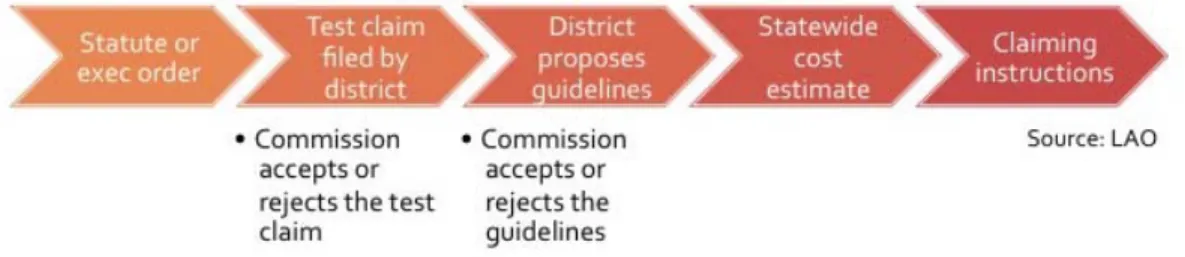
government officials and heads of various state departments comprise the CSM. Once the legislative body refers a law to the CSM for review, the mandate process takes about five years to complete. Each step in the process is typically a cumbersome exercise. Once an executive order is issued by the governor or a bill is passed into law by the legislature, districts or other local education authorities (LEAs) can file a test claim, the first claim filed with CSM asserting a statute creates costs to perform the mandated activity. The CSM reviews the test claim and if accepted, the district or LEAs
proposes guidelines to meet the mandate. If the CSM accepts the guidelines, the state completes a cost estimate and issues claiming instructions. (See Figure 1 for a simplified version of the mandate approval process).
Figure 1. California State Mandate Approval Process51
The LAO labels the education mandate system in California “broken” because the current mandate process results in many unintended consequences.52 First, costs to execute the mandated activity often exceed estimated amounts; thus, California has a large backlog of mandate reimbursements owed to school districts. Deferred payment from the state places the burden on school districts to comply with the mandate regardless of receiving funding.
Second, the reimbursement system poses another systemic problem; districts charge disparate amounts for the same services and are not held accountable to keep spending under control. The reimbursement system provides little incentive to carry out the mandates efficiently and the effectiveness of implementing the mandated activities are often unknown.
Lastly, mandate claims by districts to the state have increased significantly over the last decade. (See Appendix 2 for a chart showing increasing cost of claims over time). The price tags of claims and California’s outstanding mandate obligations related to K-12 activities have increased and created unpredictable spending for the state. Additionally, the state has deferred payments creating a large backlog of reimbursements owed by the state for K-12 activities. In 2009-10, the outstanding obligation was approximately $3.2 billion, up from $2.5 billion in 2007-08.53 As a solution to curbing mandate expenditures, the Governor’s 2010-11 budget proposal suspends all but three K-14
mandates to save the state money.54
51
Legislative Analyst’s Office (2010). Education mandates: Overhauling a broken system. Retrieved from
http://www.lao.ca.gov/laoapp/PubDetails.aspx?id=2193. 6.
52 Ibid. 3. 53
Legislative Analyst’s Office (2010). Education mandates: Overhauling a broken system. Retrieved from
http://www.lao.ca.gov/laoapp/PubDetails.aspx?id=2193. 9.
54 Legislative Analyst’s Office (2010). Education mandates: Overhauling a broken system. Retrieved from
Interestingly, very few of the 36 mandates relate to curriculum revisions. Most mandates are administrative requirements such as notification for truancy and physical education reports.55 The only ones that add to California’s education standards are the high school exit exam and science graduation requirements.56 The science graduation requirement expands the number of science classes needed in order to graduate from one to two classes, and thus resulted in an extra expense to the state costing approximately $200 million annually.57 The science requirement was determined to be a mandate because it increased the number of classes students needed to graduate.
If the mandate process were not complicated enough, it is possible to design bills that circumvent the mandate reimbursement requirement. For example, in the case of the science education mandate, legislators could have worded the statute differently so it was clear that schools could utilize existing science classes to count toward the graduation requirement.58 In other words, the state could have instructed districts to meet the science requirement without increasing the number of courses schools needed to offer in science. With this adjustment, the state would not need to reimburse for the additional science course requirement. Alternatively, legislators try to design bills in order to avoid entering the mandate determination process altogether.59 For example, a bill could provide an incentive to a school district to provide an activity without requiring them to carry out that activity and thus, the activity would not be mandated or eligible for reimbursement.
California’s complicated mandate system has implications for state level financial education policy. Pursuing an education mandate for new financial education programming in schools could be a slow process, even after legislation passes. Additionally, the current mandate system does not reward efficient delivery of programs. Finally, if the mandate process is circumvented and no
reimbursement is needed, smaller school districts in particular may find it difficult to provide financial education without any funding support for materials or teacher training. Given these complications, a state mandate for youth financial education may not be the best approach for equipping California’s youth with financial decision-making skills in the short-term.
A
DMINISTRATIVEA
PPROACHES TOA
DDING ORC
HANGINGC
URRICULUMCalifornia can achieve curriculum changes administratively rather than legislatively. In California, the Curriculum Development and Supplemental Commission (Curriculum Commission) revises and approves curriculum frameworks, which are narratives about the standards, although they do not have the authority to change the standards directly.60 The frameworks provide guidance to districts and teachers about what concepts to address in the classroom. In addition, the Curriculum
Commission approves K-8 textbooks used in classrooms statewide. It is comprised of two
legislators, a government appointee, thirteen individuals appointed by the Board of Education, and two other appointed members.
55
Ibid. 7.
56 Ibid. 21,24.
57 Legislative Analyst’s Office (2010). Education mandates: Overhauling a broken system. Retrieved from
http://www.lao.ca.gov/laoapp/PubDetails.aspx?id=2193. 16.
58 Soland, J., personal communication, February 26, 2010. 59 Ibid. 6.
60 In California, unlike many states, neither the state legislature nor the state Department of Education (CDE) have the authority to change education standards.
Currently financial preparedness concepts appear in three disciplines: math, health, and history-social studies. Four history-history-social science standards reference financial preparedness concepts, as do four math standards. Additionally, most grade levels get some discussion of financial preparedness through the health framework related to consumer products and services.61 For example, the California education code states that the legislature intends to create requirements to ensure that young people understand the importance of “financial planning and preparation.”62 This same section of the code also acknowledges the free financial education curriculum available to teachers designed by financial institutions and suggests that the Superintendent of Public Instruction will make these materials available.
Another education code section states:
51284. After January 1, 2003, and concurrently with, but not prior to, the next revision of textbooks or curriculum frameworks in the social sciences, health, and mathematics curricula, the State Board of Education shall ensure that these academic areas integrate components of human growth, human development, and human contribution to society, across the life course, and also financial preparedness.
With this code in place, the most recent review of the history-social studies framework considered financial education. Under the purview of the Curriculum Commission, the K-12 history-social studies curriculum framework committee recommended offering financial literacy as a stand-alone 9th grade course, and integrating some financial education into economics classes in 12th grade (which is a California graduation requirement). The 9th grade elective course in personal finance would provide skills to prepare students for “the economic realities and responsibilities of adults in our society.”63 Additionally, the newly revised framework proposes financial preparedness as
essential to the goals of the economics curriculum. The statement yet to be adopted reads: “Students should be able to apply the [economic] principles that they learn and the economic tools of analysis to make informed personal, social, and political decisions.”64 These suggested changes to the framework would help to expand financial education among youth by making it explicit to teachers and educators that they are responsible for covering curriculum that aligns with this framework. However, the process of adopting the new framework has been placed on hold until 2014 due to budget cuts.
The Commission revises the frameworks for each subject every few years. The revision process helps to add new skills that prepare California’s youth for future success. Critical to increasing financial literacy among youth in a school setting is building relationships with members of the Curriculum Commission and revising curriculum frameworks.
61
K. Cruz, personal communication, March 16, 2010.
62 K. Cruz, personal communication, March 10, 2010.
63 California Curriculum Commission (2009). History–social science framework field review draft. Chapter 5: course
descriptions for grades nine through twelve. Retrieved from http://www.cde.ca.gov/ci/hs/cf. 273.
64 “History–Social Science Framework Field Review Draft. Chapter 2: Goals and Curriculum Strands”
http://www.cde.ca.gov/ci/hs/cf. 24.