COPYRIGHT AND CITATION CONSIDERATIONS FOR THIS THESIS/ DISSERTATION
o Attribution — You must give appropriate credit, provide a link to the license, and indicate if changes were made. You may do so in any reasonable manner, but not in any way that suggests the licensor endorses you or your use.
o NonCommercial — You may not use the material for commercial purposes.
o ShareAlike — If you remix, transform, or build upon the material, you must distribute your contributions under the same license as the original.
How to cite this thesis
Surname, Initial(s). (2012). Title of the thesis or dissertation (Doctoral Thesis / Master’s Dissertation). Johannesburg: University of Johannesburg. Available from:
Development of Binderless Ultra-Tough Titanium Carbonitride (TiCN)
using Spark Plasma Sintering Technique
by
OJO JEREMIAH AKINRIBIDE 217093790
ARTICLE BASED THESIS
Submitted in partial fulfillment of the requirements for the award of the degree
DOCTOR OF PHILOSOPHY In the
Department of Metallurgical Engineering
School of Mining, Metallurgy and Chemical Engineering
FACULTY OF ENGINEERING AND THE BUILT ENVIRONMENT
UNIVERSITY OF JOHANNESBURG
SUPERVISOR: PROF. P.A. OLUBAMBI
SUPERVISOR: PROF. SIMON RINGER
CO-SUPERVISOR: DR. O.O. AJIBOLA
ii
DECLARATION BY CANDIDATE
“I hereby declare that the thesis submitted for the Degree Doctor of Philosophy, at University of Johannesburg, is my own original work and has not been submitted previously to any other institution of higher education. I further declare that all sources cited or quoted are indicated and acknowledged by means of comprehensive list of references”.
31-10-2019 --- ---
iii
DEDICATION
This study is dedicated to the glory of God for His awesome power, unsearchable knowledge, and majesty, which is reach in mercy and favor throughout this programme for making it a complete testimony.
iv
ACKNOWLEDGEMENTS
Completing a PhD is certainly a joint collaborative task and throughout this long journey; you need your dedicated companionship. Along these lines, this investigation would not have been done without the help of some extraordinary individuals.
I would like to offer my profound appreciation to my supervisors Prof. Peter Apata Olubambi and Prof. Simon. P. Ringer for giving me the opportunity to pursue my dreams and visions as a PhD student. My special thanks to them for their untiring assistance, unrestrained inspiration, direction and being a decent companion in the course of recent years. It was a great opportunity and privilege to work with these great icons and they have been a source of motivation for me all along. I would like to appreciate my main supervisor Prof. Peter Apata Olubambi for the all counsels and observations in my academic and private lives during this program.
I would like to recognize my Co. Supervisor Dr. Olawale Olanrewaju Ajibola for his present all through the period. My special acknowledgment goes to Dr. Babatunde Abiodun Obadele who guided me on this intricate path, explicitly at the beginning of my candidature at University of Johannesburg and up to University of Sydney. I have learnt several aptitudes from you to finish this work and I significantly value you for our endless ponderings and continually being accessible to exchange thoughts/ideas. Much appreciative to you with my entire being that you were a decent companion all through this work. I would also like to express gratitude toward Dr. O. D Ogundare, Mrs. F.O Yusuf, Mrs. O.A. Komolafe and Dr. S.O.O Olusunle from Engineering Materials Development Institute, Nigeria for making the study leave available for me to pursue my dreams. An exceptional thank should likewise be given to Mehdi Eizadjou from Microscopy and microanalysis (ACMM) at the University of Sydney for his unrelenting support during the experimentation and result analysis.
I would like to also extend my appreciation to the scientific, technical and administrative help from the staff and students of Centre for Nanoengineering and Tribocorrosion at the University of Johannesburg South Africa. A special thank you to the technical assistance: permit me to list the names in my order: Mr. Ayeleru Olusola Olaitan, Dr. Aribo Sunday, Mr. Olukayode Akinwamide, Mr. Ayodele Olusoji Oluremi, Dr. Oluwasegun Eso Falodun, Dr. Samuel Ranti Oke, Ms. Nicolene Mekgwe, and Miss Mosima Maja and the team from Australian Center for Microscopy and Microanalysis (ACMM) at the University of Sydney.
v
A special thank you to the technical assistance: permit me to list the names in my order, Dr. Matthew Foley, Dr. Vijay Bhatia, Dr. Keita Nomoto, Dr. Anna Ceguerra, Mr. Jacob Bynes, Ms. Huma Bilal and Dr. Magnus Garbrecht. It wouldn't be conceivable to complete this work without your assistance and support.
I am exceptionally grateful to the National Research Foundation (NRF) South Africa for the "NRF Free Standing Doctoral Scholarship Award" for this program.
Completing this PhD would have been unthinkable without continuous help of my dearest wife, Omowunmi Sadiat Akinribide and my children; Praise Oluwadarasimi Akinribide and Paul Ayomide Akinribide. It is my most noteworthy delight to thank and recognize you for all your psychological and enthusiastic help all through these a long time I have been away from home.
Last but definitely not the least, I am extremely thankful to my biological brother and sisters for their eagerness, passion, advise and assurance they given to me over these years from extremely far away Nigeria: my late father, Pa Adegbeyeni Ebenezer Akinribide whose legacy has been working for me all this while; and my mother Mrs. Florence Olawanle Akinribide who invested all her time and love to raise me to be what I am presently; and my ever present brother Mr. Adekunle Akinribide who have never ceased to help me with his love, generosity and extremely valuable advices.
vi
ABSTRACT
Binderless ultra–tough titanium carbonitride (TiCN) was successfully consolidated by spark plasma sintering. The impact of blending and milling parameters on the formation of titanium carbonitride from milled titanium nitride, graphite and multiwalled carbon nanotube (MWCNTs) admixture were investigated. The effect of wet milling and dry milling on the phases and morphology of the developed composites were also studied. The morphology, microstructure and the chemical composition of as – received powders, admilled powders and the sintered compact were characterized by using energy dispersive X -ray spectroscopy (EDS), X--ray diffractometer, and scanning electron microscopy respectively. The varying compositions of the ad-milled powders were sintered at 100 oC/min (heating rate), 10 mins (holding time), 50 MPa sintering pressure and 2000 oC (sintering temperature). Vickers hardness test, fracture toughness and modulus of elasticity were carried out on the sintered sample to evaluate the mechanical properties. The sintered TiN-based composites were completely formed without cracks, however with very fewer pores, an indication of a good metallurgical bonding quality achieved at the composite grain boundary interface. The structure of the grains has completely transformed to bimodal grains within the composites at 1 wt.% graphite in TiN for 40 h of milling, and subsequent composites developed was based on the result obtained at 1 wt.% graphite in TiN for 24 and 40 h of milling at different compositions. Much increment was observed in microindentation hardness and fracture toughness values of the sintered compact as the percentage graphite increased. The results show that grain size of the sintered sample decreases as the percentage composition of graphite/MWCNTs particles and milling time increases. Based on the results of the analysis, it was concluded that the incorporation of graphite/MWCNTs enhances the microstructures which ultimately are crucial to the mechanical behaviour of the sintered compacts.
vii TABLE OF CONTENT DECLARATION BY CANDIDATE ... ii DEDICATION ... iii ACKNOWLEDGEMENT ... iv ABSTRACT ... v TABLE OF CONTENTS ... vi
LIST OF FIGURES... vii
LIST OF TABLES ... viii
LIST OF ABBREVIATIONS ... ix CHAPTER ONE ... 15 1.0 INTRODUCTION ... 15 1.1 MOTIVATION ... 15 1.3 RESEARCH PROBLEM ... 20 1.4 RESEARCH QUESTIONS ... 21
1.5 AIM AND OBJECTIVES ... 22
1.6 JUSTIFICATION OF THE RESEARCH ... 22
1.7 STRUCTURE OF THE THESIS ... 23
CHAPTER TWO... 29
PAPER ONE ... Error! Bookmark not defined. 2.0 LITERATURE REVIEW ... 29
2.1 SINTERING OF BINDERLESS TIN AND TICN-BASED CERMET FOR TOUGHNESS APPLICATIONS: PROCESSING TECHNIQUES AND MECHANICAL PROPERTIES; A REVIEW... 29
viii
2.1.1. Introduction ... 31
2.1.2 Structural formation ... 32
2.1.2.2. Titanium Carbonitride (TiCN) ... 35
2.1.3 Applications of TiN and TiCN... 37
2.1.4 Limitations and challenges of TiN and TiCN ... 38
2.1.5 Processing Techniques ... 39
2.1.5.1 Factors contributing to an improved sintering kinetics of spark plasma sintering... 40
2.1.6 Binderless ... 41
2.1.7 Previous research work on binderless titanium nitride and titanium carbonitride... 42
subjected to sintering techniques ... 42
2.1.7 Perception, cost–effectiveness and engineering benefits of binderless titanium carbonitride and titanium nitrides ... 61
2.1.8 Summary ... 62
2.1.9 Conclusion ... 63
REFERENCES ... 63
CHAPTER THREE ... 77
3.0 Materials processing and characterization ... 77
3.1 INVESTIGATION PUBLISHED FROM THIS STUDY ... 77
3.1.1 Synopsis ... 77
3.1.2 Summary of the published articles ... 78
3.1.3 The published articles... 82
Paper two: Mechano-chemical synthesis and characterization of Ti (C, N)-Powder from TiN- MWCNTs /Graphite... 85
ix
Abstract ... 85
1.0 INTRODUCTION... 86
2.0 MATERIALS AND METHODS ... 87
2.1 Materials... 87
2.0 Methods... 87
2.1 Mixing and milling ... 87
2.3 Samples characterization... 88
3.1 X-ray diffractogram of as–received and ad-mixed/milled powders ... 90
3.2 Morphology of as received and the milled powders ... 97
3.3 TEM illustration of the milled powders ... 104
4.0 Conclusions... 107
Acknowledgements... 108
References ... 108
Paper three: Microstructural and phase evolution of spark plasma sintering of graphitized Ti (C0.9N0.1) composites ... 112
Status: Published in International Journal of Refractory metal and Hard Materials, DOI: https://doi.org/10.1016/j.ijrmhm.2018.09.013 ... 112
Abstract ... 112
1. Introduction... 112
2. Experimental procedure ... 114
3. Results and Discussion... 116
3.1. XRD analysis of as-received powder and admixed powders ... 116
x
3.3. Sintered density and microhardness ... 119
3.3. SEM analysis ... 120
3.4 Grain size ... 121
3.5. Fracture toughness and fractography... 122
4. Conclusion ... 124
Acknowledgements... 124
References... 125
Paper four: The role of graphite addition on spark plasma sintered titanium nitride ... 127
Status: Manuscript under review in Alloys and compound Journal ... 127
Abstract ... 127
1. Introduction ... 127
2. Experimental ... 129
3. Results and discussion ... 131
3.1 SEM and phase analysis of as-received powders ... 131
3.2 SEM and XRD analysis of the milled powders ... 132
3.3 Densification behaviours and microhardness values ... 134
3.4. SEM and phase analysis of the sintered composites ... 138
3.5 TEM/EDS mapping of the milled powder ... 142
3.6 Fracture toughness of the sintered composites ... 144
4. Conclusion ... 144
Acknowledgements... 145
xi
Paper five: Microstructural analysis of TiN-Graphite composites prepared by spark plasma
sintering ... 152
Status: Manuscript submitted to Journal of materials and design. ... 152
Abstract ... 152
1.0 Introduction... 152
2.0 Methodology ... 155
2.1 Materials and methods ... 155
3.0 Results and discussion... 156
3.1 High energy ball milling impacts on the particle size distribution of the powders .. 156
3.2 The effect of milling/processing time on the phase analysis of the powders ... 158
3.3 The effect of milling/processing time on the phase analysis of the sintered compacts 160 3.4 Effect of milling time on the Raman spectroscopy of titanium nitride + graphite composite powders ... 163
3.5 Particle size evoltuion of as-received and milled powders ... 165
3.6 Electron backscattered diffraction (EBSD) and Transmission electron microscope (TEM) ... 170
3.7 Mechanical properties of the sintered compacts... 177
4. Conclusion ... 178
Acknowledgement ... 179
References... 179
CHAPTER FOUR ... 184
1.0 DISCUSSION OF QUERIES RAISED ON THE PUBLISHED ARTICLES ... 184
xii
4.2 Argument for Research Originality and Contributions to Knowledge ... 184
4.2.1 Characterization of newly developed binderless titanium carbonitride using Spark ... 185
Plasma Sintering Technique ... 185
4.2.2 Microstructural and Phase Evolution of Consolidated Titanium Matrix ... 186
Composite... 186
4.2.3 Mechanical behavior of titanium nitride matrix reinforced with MWCNTs/Graphite ... 189
4.3 CONCLUSION ... 193
4.4 Recommendation ... 195
LIST OF ABBREVIATION
PM: Powder metallurgy
CMCs: Ceramic matrix composites
TiN: Titanium nitride
TiCN: Titanium carbonitride
MWCNTs: Multiwalled carbon nanotubes
HP: Hot pressing
HIP: Hot isostatic pressing
SPS: Spark plasma sintering
TMCs: Titanium matrix composites
xiii
XRD: X-ray diffraction
TEM: Transmission electron microscope
EBSD: Electron backscattered diffraction
Cp-TiN: Commercial purity titanium nitride
Cp-Gr: Commercial purity graphite
Cp-MWCNTs Commercial purity multiwalled
carbonanotubes
FCC: Face center cubic
BCC: Body centered cubic
HCP: Hexagonal closed pack
PSD: Particle size distribution
TiC: Titanium carbide
EDX: Energy dispersive X-ray spectroscopy
HV: Vickers hardness
μm: Microns
min(s): Minute(s)
wt.%: Weight per cent
H: Hour(s)
oC: Degrees celsius
GPa: Gigapascals
LOW CTE Low temperature coefficient of thermal
Expansion
xiv
iG Initial grain size
t sintering time
15
CHAPTER ONE
1.0
INTRODUCTION
1.1
MOTIVATION
Researchers all over the globe at various international gatherings have acknowledged improvement in engineering materials’ properties as one of the greatest unrelenting problem confronting worldwide technological development and growth. Researchers and engineers at various industries are wary for new materials and enhanced procedures to apply in emerging new discoveries; in this manner sustaining competitive edge and still expanding the net profits (Obadele, 2014). Different industrial/technological applications of any engineering component in any punitive environments depend solely on the improvement of material safe and dependable working conditions. For instance, the brittleness and wear nature of materials in high speed cutting tools environment, the extreme harsh environmental conditions in space, the high temperature in thermal energy station and stability present the technical problem from proceeding on these identified technologies (Farag, 2008)
The requests for quality control measure on each part of materials to be utilized in numerous overwhelming designing division are exceptionally stringent and are basic to their protection and proficient use (Cui et al., 2003). Mechanical properties such as brittleness, toughness, hardness and modulus of elasticity as well as tribological and corrosion performance of materials are crucial (Cui et al., 2003) in the ongoing advancement in the world of science, engineering and technology. Due to some physical, chemical and mechanical behaviors of some ceramic and as well as the electrical properties of most metals, titanium nitride/carbide has a broad application in some environments.
The two identified materials (i.e. TiN, TiC) have high melting temperature of more than 3000 oC, high hardness, low density and low coefficient of friction when compared with metals. These ceramics have been broadly utilized in wear-resistance and super-hard high-speed cutting tools industries. Besides, different attributes of TiN, TiC and TiCN such as excellent t hermal
16
conductivity, low neutron absorption cross section and high electrical conductivity have pulled in many research works for utilizing the materials in high demanding applications like high speed cuttings, aerospace industries, car engines and in some defense/military sector. Notwithstanding, these applications have been constrained considering the exertion of production process, poor fracture toughness and low sinter ability of TiN, TiC and the TiCN. Due to its high melting point, low coefficient of diffusion and solid covalent bond, it is usually hard for monolithic TiN and TiC to consolidate as a single material through a conventional sintering technique. The process of fabrication of these ceramics must be done under a very high and extreme sintering temperature in other to promote or enhanced densification. For example, TiN and TiC ceramics should attain proper densification when metallic or ceramic sinter additives are added to it in aggregate proportions. Some research findings have reported on the dispersion of ceramics reinforcements such as TiB2, SiC, and B2C into matrix of TiN (Namini et al., 2018). For example, reinforcing titanium carbonitride (TiC0.9N0.1) with graphite can ultimately improve the phase evolution and mechanical properties of the sintered composites (Akinribide et al., 2019).
In any case there have been little or no revealed investigations on the wear properties of titanium nitride reinforced with graphite and multiwalled carbon nanotubes composite. The TiN matrix as typical ceramic materials, has some phenomenal properties such as, good resistance to wear and corrosion, high level of fracture toughness and strength, excellent adhesive strength for metallic surface coating and good biomedical applications. TiN-graphite and TiN-Graphite-MWCNTs have not been reported in the literatures, particularly the ultra-tough, corrosion, wear and tribological properties under various conditions.
Furthermore, improvement in the development of titanium graphite and titanium nitride-graphite-MWCNTs composites will likewise contribute to the ultra-tough properties of the developed composites to be applied in wear and corrosion conditions. Investigating the likelihood of strengthening and toughening titanium nitride reinforced by graphite and MWCNTs can considerably upgrade the wear behavior of titanium alloys. Graphite and MWCNTs have good wear, self-lubricating and mechanical properties that would help shaped a dense microstructure and solid adhesion with titanium nitride matrix. The present investigation aims at understanding the impact of graphite and multiwalled carbon nanotubes add itions on the microstructures,
17
densification, phase analysis and grain size of titanium nitridegraphite and titaniumgraphite -MWCNTs composites.
1.2
BACKGROUND OF THE RESEARCH
Generally, materials used in engineering applications are sub-divided or grouped into different fundamental classifications; ferrous metals and non-ferrous metals, composite alloys, ceramics /and glasses and polymers. Among these classes, metals and their composite alloys just as polymers are broadly utilized as reinforcing or structural materials. Besides, ceramics materials have drawn in some significant consideration in the field of materials science in the recent years (Marlo and milma, 2000), (Pierson, 2012), (Qiao etal., 2013), (Lengauer,1998) and (Szikora,1998). Ceramic have high values of hardness, higher melting points, maintenance of strength at high temperature, good compressive strength, high oxidation and resistance to corrosion, high elastic modulus, high wear and resistance to abrasion and reasonable level of refractoriness compared to metals and polymers. The level of development in materials innovation has empowered ceramicist s to begin the design and application of basic ceramic materials for different field of engineering practices like aviation industries, automobile and defense. Considering the essential material classes, contingent materials are being established, which join the valuable properties of (metals, ceramic, and polymers to achieved unrivaled combination of property known as composites. Contingent upon the major proximity of (metal, ceramics, and polymer as matrix materials, the composites are referred to as metal matrix composites (MMC), ceramic matrix composites (CMC) and polymer matrix composites (PMC), separately.
The meaning of “ceramic’' is gotten from the Greek word "KERAMIKOS", which means potter's earth. Ceramics can be regarded as high temperature, organic and inorganic materials with good refractoriness. Ceramics are generally regarded as oxides like alumina (Al2O3), zirconia (ZrO2) etc and non- oxides ceramic materials like silicon carbide, titanium diboride, titanium nitride etc. Special intermetallic compounds like arsenides, antimonides, phosphides and the aluminides are as well be referred to as ceramics materials. Based on the specific areas of applications, ceramics can also belong to two major categories known as the traditional and advanced ceramics materials (Ezis et al., 1998), (Gupta, 2013) and (Gupta, 2012).
18
The type of ceramics derived from naturally occurring materials are known as the traditional ceramics; examples of such ceramics are sand, clay, quartz and so on. This type of ceramic finds its usefulness in glassware, granite and earthware. The recent progress achieved in advance materials innovation has empowered researchers and the engineers to structure and construct ceramic matrix for applications in the fields, for example, aviation, military sector, automobile industry and electronic industry. High technology ceramic materials can be produced through the materials – property relationship which is mainly dependent on the composition as well as the microstructural integrity of the materials in other to obtain the required properties through the principle of science and technology. These kind of ceramics are usually made from carbide. ( silicon carbide, titanium carbide), oxides like alumina and nitride as in silicon nitrides (Si3N4), and titanium nitrides (TiN) are utilized in particular applications as high speed cutting tools, abrasives, electronic tools, high temperature superconductors, automotive industries (Ezis et al., 1998).
Based on the recent advancement in ceramic technology, over 50 percent increase in some mechanical properties like yield and ultimate tensile strength is now obtainable, this is far better than the traditional ceramic technology. Engineering ceramic production process are intended to modify the material property (control on synthesis and microstructure) with an intention of accomplish the required property condition. A very good ceramic materials with optimum properties can be used for structural applications is subjected to mechanical loading (Andrievski, 1997).
A densely packed and structured ceramic materials applied at elevated temperature above 3000 oC are generally regarded as the Ultra-high temperature ceramic composite (UHTCs). Group III to group XII transition elements in the periodic table contains carbides, nitrides and borides of transition element which belong to non-oxides ultra-high temperature ceramic. Metal borides, carbides and nitrides are significant instances of typical non-oxide UHTCs, which are of great attention for diverse high temperature practices. The transition borides is one of the basic ceramics that are likely used as ceramic materials for some tribological and high temperature applications, due to their low thermal expansion, high melting temperature (~ 3000 °C), high elastic modulus (~ 500 GPa), good abrasion area, wear, creep and resistance to corrosion, significant chemical stability, high hardness (> 20 GPa) with metal-like that has a high thermal conductivity of (60-120 W/mK) and electrical conductivity (~ 107 S/m) (Rafaja et al., 2012) and (Akinribide et al., 2019).
19
The highest modulus of elasticity observed in titanium nitride ceramic materials makes it a good candidate materials with strength to withstand contact damage. From all these symbolic properties, we can affirm that titanium nitride is a potential materials for different innovative applications, as high-speed cutting tools, hypersonic aviation vehicles, automobile industries etc. Nonetheless, in spite of these auspicious properties the more extensive application of monolithic nitride of titanium are impartially constrained because of high costs of machining at very little/low fracture toughness, poor sinterability, bad resistance to thermal shock, and extremely high growth of grains at elevated temperature (Kuwahara et al., 2001). A typical high temperature intermetallic, for example, transition metals like silicides (MoSi2, TiSi2, and Ti5Si3) have likewise drawn the attention of most researchers in the field of UHTCs for use at temperature above 1000 °C because of their high melting point, low density and improved resistance to oxidation high temperatures (Murthy et al., 2006).
Most of the engineering ceramics are often subjected to high temperature conditions. In this manner, it is extremely important to evaluate the stability of this ceramics at high-temperature, particularly the oxidation properties of the ceramics as this is a significant property to be discussed (Akinribide et al., 2019), (Zhang et al., 2016), (Khumtong and Sakdanuphab, 2015) and (Saikia and Kakati, 2013). It could be infer that, ceramics such as zirconia diboride, titanium nitride, titanium carbide and titanium diboride can be utilized in high temperature environment unlike other ceramic materials like borides, which is applicable in high hardness with low density applications.
Throughout the years, it has been understood that an ideal mixture of high toughness and environmental stability alongside high hardness and ultimate tensile strength is required for most of the present nitrides. Nevertheless, a single crystal of nitrides is not ideal for every application. In this way, composites of ceramics are investigated to produce some intricate shaped components. The significant classes of this ceramic composites could be in form of whisker, fibre and particle reinforced composites. Among these classes of ceramic composite, the particle reinforced composites give the best reinforcement to composite which offer the most financially stable and cheap to develop materials with improved and ideal mixture of mechanical properties. A few refractory intermetallic compounds such as Ni3Al, MoSi2, Ni3Al, FeAl, and Ti5Si3 can be utilized as alternatives for composites/ceramics utilized for high temperature applications at 1000 °C.
20
Additionally, this mixture of compounds are lower in density, which diminishes the net weight of the part. A great deal of work has been reported on MoSi2 with few examinations on titanium silicides, which have much lower densities than molybdenum disilicate (Kwiecinka and Peterson, 2004), (Murthy et al., 2006).
Based on the discussion above, obviously nitrides are utilized for high temperature applications. Their properties explicitly rely upon the microstructure, which is controlled through the choice of as-received powders and the conditions of sintering. This discussion in this chapter mirrors that broad research has been invested into the utilization of optimized additives used for sintering and sintering environmental conditions to improve the sinterability and mechanical properties of monolithic nitrides. Concerning the sintering route, a few sintering production routes like hot pressing, hot isostatic pressing, microwave sintering, pressure and pressureless assisted sintering, and spark plasma sintering are renowned to be utilized for densification of nitrides, It has been talked about, how high temperature ceramic products are petulant to the microstructural phase and/or additive substance for sintering. The property prerequisites for a useful and long service life of high-speed cutting tools are examined, among which is the drill bits proficiency which is one of the significant factors in cutting tools materials for shaping. In this section proper discussion is being made on how ceramic are designed as a typical drill bits and other cutting tools. An evaluated structure with a reasonable plan can assist one with achieving better cutting tools properties. This section is finalized with the list of some unresolved issues just as future point of view for the improvement of nitrides as high temperature ceramics and high-speed cutting tools.
1.3
RESEARCH PROBLEM
The development of ceramic matrix composites using spark plasma sintering as a modern consolidation technique present a noteworthy practical task and remains to a great extent a notable areas of research attention. One of the primary goals of powder consolidation through a spark plasma sintering processing technique involves suitable integration of ceramic / metal powders of choice into the metal or ceramic matrix. A remarkable and basic step along this line is the suitable milling of the ceramic powders earlier before compacting the powder into solid composites. Whenever at least two powders are combined to deliver a feedstock for spark plasma sintering, a blend of phases and properties could be gotten. The powders bonding with the plasma wall could
21
result in development of undesirable phases which could be harmful to the parts/components being developed. After choice of suitable powder classification, blending of the powders are done to produce the admixed feedstock powder. Unsuitable blending parameters of the different powders may prompt inhomogeneity of the resulting feedstock powder (Obadele, 2014). Consequently, the capacity to form well dispersed and homogenized powders as feedstock for spark plasma sintering synthesized composites is critical.
The pressure used during the compaction of powders before sintering possesses another area of challenge. The need for appropriate sintering parameters should be cautiously taken into consideration to deliver crack and porefree composite samples. Additionally, poor metallurgical interaction and adhesion between the ad milled powders offers another problem; it could be due to intermetallics which are unfavorable to the developed composites. Controlling the processing parameters during sintering can be utilized to deliver sintered composites with homogeneous particle size distribution alongside the infusion of undissolved particles and furthermore lead to the formation of intermetallic that are unfavorable to the performance of the sintered composites.
Proferring solutions to the varying technical issues with developing a binderless TiCN with enhanced properties requires determination of the optimum parameters for the milled powder and spark plasma sintering processing parameters that would promote good densification, improved hardness and fracture toughness as well as enhanced tribological properties.
1.4
RESEARCH QUESTIONS
The following questions are the basic nubs that give the motivation for this project:
❖ Why the decisions of titanium nitride alloys materials for high temperature applications in high speed cutting tool industries?
❖ What are the major restrictions to the process of strengthening titanium nitride composites via dispersion strengthening mechanism?
❖ How does suitable decision of process parameters determine the physical and mechanical properties of reinforced titanium nitride composites?
❖ What are the potential reinforcements or result of various weight percent of Graphite/ MWCNTs on their diffusion in titanium nitride matrix composites and how might it be
22
done, what amount is required for titanium nitride alloy to improve its microstructure and mechanical properties of the CMCs?
1.5
AIM AND OBJECTIVES
The current research fundamentally aims to develop a binderless ultra – tough titanium carbonitride composite using TiN-matrix and graphite/MWCNTs as reinforcements and enhance the microstructure and mechanical property of TiN by means of spark plasma sintering with graphite and multiwalled carbon nanotube. The aim of this investigation would be valuable for the high-performance components for cutting tools industries and potential applications in aerospace and other manufacturing fields. The aim would be accomplished through the following accompanying objectives:
❖ Synthesise and characterize titanium nitride (TiN), multiwalled carbon nanotube (MWCNTs) and graphite nano powders.
❖ Examine the sintering behavior for obtaining a highly dense Nano-structural material of TiN with MWCNTs and Graphite by optimization using sintering parameters.
❖ Examine microstructural interactions and phase change of the synthesized composites.
❖ Analyse the mechanical properties of TiN-MWCNTs-Graphite in terms of fracture toughness and hardness on the sintered nanocomposites using Nano-indentation techniques
❖ Study the mechanical and thermal characterization of sintered nanocomposite.
1.6 Justification of the research
A few research work/ studies have been reported generally on titanium nitride-based alloys, for example, TiN-TiC, TiC-WC-Cr3C3, Cp-TiN. Binderless nanostructured TiC; review on bulk nanoceramic, nanocomposites, and Ti (C, N)- based +N/(C+N), etc. Nevertheless, few or no research investigations have been found on MWCNTs/Graphite addition in titanium nitride matrix as reported by (Qiao et al., 2013). Furthermore, there is no literature available on binderless behaviour of the TiN-based composites (Akinribide et al., 2019). The excellent properties of titanium nitride matrix, such as the toughness, hardness, coating behaviors, has been investigated
23
1.
Structure of the Thesis
An overall overview to this research study, the motivation of the project, the project aims, and objectives are clearly displayed in Chapter One of this thesis. Chapter Two encompasses the literature review of the essential philosophies and published proceedings and ongoing work in relation to this research. A collection of five (5) articles from the investigation of this research work published or submitted to peer-reviewed reputable ISI journal is contained in Chapter Three. This chapter comprises of abstract of the articles demonstrating how they identify with each other and the replicate version of the articles as they are fully represented in the journals. The papers are consecutively masterminded to comprehensibly achieve the goals of the study.
Article I presented a review on sintered titanium nitride and titanium carbonitride -based cermet. The paper describes TiN and TiCN-based composites as remarkable class of metallic alloys and Cermets showing outstanding combination of hardness, high temperature strength and surface stability in tribology, corrosive or oxidative environments. Therefore, this cermet plays an important role in cutting tools and other high-temperature applications. Nonetheless, the cermets suffer some setback in the toughness functionality, required in cutting tools especially at high temperatures. Many researchers have worked on enhancing the hardness and toughness behaviors of TiCN by using metallic binders to modify the toughness properties.
Article II of this thesis give a succinct and well detailed reports on the mechano-chemical synthesis and characterization of Ti(C, N)-powder from TiN- MWCNTs / Graphite, with a clear view to provide pertinent information about the impact of blending and milling parameters on the formation of titanium carbonitride Ti(C, N) from titanium nitride (TiN), graphite and multiwalled carbon nanotube (MWCNT) of which the process of milling could be effectively accomplished. Article III reported the microstructural and phase evolution of spark plasma sintering of graphitized Ti (C0. 9N0. 1) composites. The manuscript provides some salient information on the influence of graphite reinforcement on the grain size, the multiple phases involved and as well as the ultrafine graphite addition on the particle grain sizes, multiple phases and the ultrafine Ti (C0. 9N0. 1) synthesized by the use of spark plasma sintering, from the result we observed that the presence of graphite in the matrix increase the porosity content at high weight percent in the sintered Ti (C0. 9N0. 1) cermet and invariably reduced the sinterability of the composite.
24
Article IV presents further investigation on the role of graphite addition on spark plasma sintered titanium nitride. Composites of titanium nitride reinforced with graphite were synthesized using spark plasma sintering at 2000 ℃. The effect of graphite addition on the microstructure, sintering parameters, relative density, and mechanical properties of TiN ceramics matrix were examined. The investigation was performed on TiN powder with varying graphite content for 8 h using an energy ball milling equipment.
The effect of milling time on Particle size distribution, densification and Raman spectroscopy of spark plasma sintered Titanium nitride + Graphite composite is presented in Article V. The concept about the mode of dispersion of the constituent materials inside the milling vial was discussed to assist the conception of the milling process, thus exposed fundamental information about enhancing the milling optimizing parameters and give concise decisions on processing parameters.
Complete research publication on titanium nitride matrix composite strengthened with graphite and multi-walled carbon nanotubes were carried out by spark plasma sintering. Different percentage compositions of each reinforcement was homogeneously dispersed into the matrix of Titanium nitride by high energy ball processing equipment and ball milling containing solution. The effect of energy introduced to the milled powder within the process of dispersion was quantified and proper optimization was performed to improve the dispersion techniques used in dispersing multiwalled carbon nanotubes and graphite in the TiN matrix framework. The dispersion processing parameters impact on the sp2 i.e C-C hybridization network in graphite and MWCNTs, resultant microstructures and mechanical properties of composites were investigated in the Article V of this research work;
Article I: O.J. Akinribide, B.A. Obadele, S.O. Akinwamide,H. Bilal, O. O. Ajibola, M. Eizadjou, S.P. Ringer and P.A. Olubambi, 2019.Sintering of binderless TiN and TiCN-based cermet for toughness applications: Processing techniques and Mechanical properties; A review (Published in ceramic International https://doi.org/10.1016/j.ceramint.2019.07.191.
Article II: O. J. Akinribide, B. A. Obadele, G. N. Mekgwe, O. O. Ajibola, S.O. Akinwamide, K. Nomoto, S.P. Ringer and P. A. Olubambi, 2019. Mechano-chemical synthesis
25
and characterization of Ti (C, N)-Powder from TiN- MWCNTs /Graphite, Journal of particulate science and technology. (Published) https://doi.org/10.1080/02726351.2019.1637625.
Article III: Ojo Jeremiah Akinribide, Gadifele Nicolene Mekgwe, BabatundeAbiodun Obadele, Olawale Olarewaju Ajibola, Samuel Olukayode Akinwamide, Peter Apata Olubambi ,2019. Microstructural and phase evolution of spark plasma sintering of graphitized Ti (C0.9N0.1) composites, International Journal of Refractory Metals & Hard Materials 78 (2019) 164–169). Published.
https://doi.org/10.1016/j.ijrmhm.2018.09.013
Article IV: O. J. Akinribide, B. A. Obadele, O. O. Ajibola, S.O. Akinwamide, K. Nomoto, M. Eizadjou, S.P. Ringer and P. A. Olubambi, 2019. The role of graphite addition on spark plasma sintered titanium nitride. Journals of Alloys and compounds (Under review).
Article V: O. J. Akinribide, B. A. Obadele, O. O. Ajibola, S.O. Akinwamide, K. Nomoto, M. Eizadjou, S.P. Ringer and P. A. Olubambi, 2019. Microstructural analysis of TiN-Graphite composites prepared by spark plasma sintering. (Submitted for publication in Materials and Design).
Conf. paper: Ojo Jeremiah Akinribide, Gadifele Nicolene Mekgwe, Olawale Olarewaju Ajibola, Babatunde Abiodun Obadele, Samuel Olukayode Akinwamide, Peter Apata Olubambi. Studies on Mechanical properties of Graphite reinforced Ti (Cx, N1-x) using Nanoindentation techniques. Published in Procedia Manufacturing, volume 30, 2019, Pages 604-610. (https://creativecommons.org/licenses/by -nc-nd/4.0/)
Conf. paper: Ojo Jeremiah Akinribide, Gadifele Nicolene Mekgwe, Olawale Olarewaju Ajibola, Babatunde Abiodun Obadele, Samuel Olukayode Akinwamide, Eso Oluwasegun Falodun, Peter Apata Olubambi. Mechanical properties of ultrafine
26
graphite –Ti (C0.9, N0.1) solid solutions fabricated via spark plasma sintering. Published in Procedia Manufacturing, volume 30, 2019, Pages 411-418.
(https://creativecommons.org/licenses/by-nc-nd/4.0/)
The concluding remark documented from the experimental results of this investigation and recommended facts for imminent work are presented in Chapter Four of this thesis. This Chapter outlines and combines Papers I to IV and give contentions for the originality and commitment devoted to the investigation on current information about TiCN usefulness to powder metallurgy and spark plasma sintering of difficult to sinter ceramic materials. Finally, a thorough and concise list of all referenced materials is given in this thesis.
A comprehensive lists of research paper published in international conferences are thereby presented under the appendix section of this thesis.
Reference
[1] B. A. Obadele, "Tribocorrosion mechanisms in laser deposited titanium-based smart composite coatings," 2014.
[2] M. Farag, "Quantitative methods of materials substitution: application to automotive components," Materials & Design, vol. 29, no. 2, pp. 374-380, 2008.
[3] Z. Cui, H. Man, F. Cheng, and T. Yue, "Cavitation erosion–corrosion characteristics of laser surface modified NiTi shape memory alloy," Surface and Coatings Technology, vol. 162, no. 2-3, pp. 147-153, 2003.
[4] Y. Fu, J. Wei, and A. W. Batchelor, "Some considerations on the mitigation of fretting damage by the application of surface-modification technologies," Journal of Materials Processing Technology, vol. 99, no. 1-3, pp. 231-245, 2000.
[5] A. S. Namini, M. Azadbeh, and M. S. Asl, "Effects of in-situ formed TiB whiskers on microstructure and mechanical properties of spark plasma sintered Ti-B^ sub 4^ C and Ti-TiB^ sub 2^ composites," Scientia Iranica. Transaction B, Mechanical Engineering, vol. 25, no. 2, pp. 762-771, 2018.
[6] O. J. Akinribide, G. N. Mekgwe, B. A. Obadele, O. O. Ajibola, S. O. Akinwamide, and P. A. Olubambi, "Microstructural and phase evolution of spark plasma sintering of graphitized Ti
27
(C0. 9N0. 1) composites," International Journal of Refractory Metals and Hard Materials, vol. 78, pp. 164-169, 2019.
[7] M. Marlo and V. Milman, "Density-functional study of bulk and surface properties of titanium nitride using different exchange-correlation functionals," Physical Review B, vol. 62, no. 4, p. 2899, 2000.
[8] H. O. Pierson, Handbook of carbon, graphite, diamonds and fullerenes: processing, properties and applications. William Andrew, 2012.
[9] L. Deng et al., "Coefficient of thermal expansion of carbon nanotubes measured by Raman spectroscopy," Applied Physics Letters, vol. 104, no. 5, p. 051907, 2014.
[10] Z. Qiao, J. Räthel, L.-M. Berger, and M. Herrmann, "Investigation of binderless WC–TiC– Cr3C2 hard materials prepared by spark plasma sintering (SPS)," International Journal of Refractory Metals and Hard Materials, vol. 38, pp. 7-14, 2013.
[11] W. Lengauer, "Properties of bulk δ-TiN1-x prepared by nitrogen diffusion into titanium metal,"Journal of alloys and compounds, vol. 186, no. 2, pp. 293-307, 1992.
[12] R. Andrievski, "Physical-mechanical properties of nanostructured titanium nitride," Nanostructured Materials, vol. 9, no. 1-8, pp. 607-610, 1997.
[13] D. Rafaja et al., "Interface phenomena in (super) hard nitride nanocomposites: from coatings to bulk materials," Chemical Society Reviews, vol. 41, no. 15, pp. 5081-5101, 2012. [14] H. Kuwahara, N. Mazaki, M. Takahashi, T. Watanabe, X. Yang, and T. Aizawa, "Mechanical properties of bulk sintered titanium nitride ceramics," Materials Science and Engineering: A, vol. 319, pp. 687-691, 2001.
[15] O. J. Akinribide, G. N. Mekgwe, O. O. Ajibola, B. A. Obadele, S. O. Akinwamide, and P. A. Olubambi, "Studies on Mechanical properties of Graphite reinforced Ti (Cx, N1-x) using Nanoindentation techniques," Procedia Manufacturing, vol. 30, pp. 604-610, 2019.
[16] J. Zhang, T. Chen, X. Li, Y. Liu, Y. Liu, and H. Yang, "Investigation of localized surface plasmon resonance of TiN nanoparticles in TiN x O y thin films," Optical Materials Express, vol. 6, no. 7, pp. 2422-2433, 2016.
[17] T. Khumtong and R. Sakdanuphab, "The effects of O2: N2 gas ratios on structural, optical, electrical properties of TiOxNy thin film deposited by reactive DC magnetron sputtering," in Key Engineering Materials, 2015, vol. 659, pp. 540-544: Trans Tech Publ.
28
[18] P. Saikia and B. Kakati, "Effect of process parameters on properties of argon–nitrogen plasma for titanium nitride film deposition," Journal of Vacuum Science & Technology A: Vacuum, Surfaces, and Films, vol. 31, no. 6, p. 061307, 2013.
[19] B. Kwiecińska and H. Petersen, "Graphite, semi-graphite, natural coke, and natural char classification—ICCP system," International Journal of Coal Geology, vol. 57, no. 2, pp. 99-116, 2004.
[20] H. Li, Q. Feng, L. Ou, S. Long, M. Cui, and X. Weng, "Study on washability of microcrystal graphite using float–sink tests," International Journal of Mining Science and Technology, vol. 23, no. 6, pp.
[21] A. Ezis, S. K. Samanta, and K. Subramanian, "Ceramic cutting tool formed from Si3 N4-Y2 O3-SiO. sub," ed: Google Patents, 1983.
[22] E. D. Whitney, Ceramic cutting tools: materials, development and performance. William Andrew, 2012.
[23] N. GUPTA, "Development of TiB2-Ti based homogeneous/bilayered functionally graded armor materials and ZrB2-SiC-TiSi2 composites using spark plasma sintering," INDIAN INSTITUTE OF TECHNOLOGY KANPUR, 2013.
[24] N. Gupta, A. Mukhopadhyay, K. Pavani, and B. Basu, "Spark plasma sintering of novel ZrB2–SiC–TiSi2 composites with better mechanical properties," Materials Science and Engineering: A, vol. 534, pp. 111-118, 2012.
29
CHAPTER TWO
ARTICLE ONE
2.0
LITERATURE REVIEW
2.1
SINTERING OF BINDERLESS TIN AND TICN-BASED CERMET
FOR TOUGHNESS APPLICATIONS: PROCESSING TECHNIQUES
AND MECHANICAL PROPERTIES; A REVIEW
Ceramics International, https://doi.org/10.1016/j.ceramint.2019.07.191 Abstract
This paper presents a review on sintered titanium nitride and titanium carbonitride-based cermets. TiN and TiCN based composites are remarkable class of cermets showing outstanding combination of hardness, high temperature strength and surface stability in tribology, corrosive or oxidative environments. These cermets play important roles in cutting tools and other high-temperature applications. Nonetheless, the cermets suffer some setback in toughness functionality required in cutting tools especially at high temperatures. Many researchers have worked on enhancing the hardness and toughness behaviours of TiCN using metallic binders to modify the toughness properties. The only achievement obtained was an improvement in high hardness with low toughness. This review is needed to evaluate the trends of achievement and development in the enhancement of optimum combination of hardness and toughness required in cutting tools applications. Additionally, it forecasts the essentiality of developing binderless phase TiCN with ultra-toughness that will significantly solve the deficiencies in high temperature application of TiCN as cutting tools.
31
2.1.1. Introduction
Engineering materials with improved properties have been identified by researchers at various international gatherings as perhaps the most pressing issue facing global technological development [1]. Manufacturers and engineers are on guard for new materials and improved processes to use in developing better products, thus maintaining competitive edge and eventually increasing profit margin. Cermets based on titanium carbonitride (TiCN) attract the att ention of researchers due to their high hardness at high temperature, thermal conductivity, chemical, thermal and wear resistances and low friction coefficient when compared to metallic materials [2]. They have been successfully applied to new developments in the field of cutting tools and surface finishing processes as compared to WC–Co hard metals, ensuring excellent chip size, tolerance control and dimensional accuracy of the work piece.
Conventional materials are being replaced progressively by metal carbides and metal nitrides in numerous applications, particularly in ceramic application, high speed cutting tools, electrochemical devices, biomedical applications and ecological remediation. Likewise, a few imperative classes of materials such as composites have been consolidated with nanoparticles, transition metal carbides and nitrides to form an improved nanocomposite ceramic material. Recently, nanoparticles reinforced materials with various geometrical shapes and morphological structure have fascinated the desire of most research scholars due to their various interesting properties such as high toughness, low density, large surface area, good ionic and electrical conductivity and high thermal conductivity [3-8]. In the past, various production techniques have been used to synthesize metal carbides and nitrides, among these techniques, solid -state reaction methods have been considered as the most eco-friendly and economical methods. Another salient benefit of this methodology is that, the results of the synthesized composites are regularly crystalline [9]. The transition elements of these metal carbides and nitrides have unrivalled properties such as high resistance to wear and deformation [10, 11], high melting point [11] and good catalytic properties to some composites when compared to other un-alloyed oxides of metals [11, 12]. For instance, hafnium, zirconium, titanium and silicon carbides have been utilized in various ceramic application because of its wear resistance and high melting points [13].
In high speed cutting tools application, many researchers have succeeded in working in the areas of improving the hardness and toughness properties of TiCN, but the only breakthrough recorded
32
was high hardness and low toughness with the use of metallic binders to improve the toughness properties. Due to some unavoidable limitations attributed to these metallic binders in various applications, titanium based alloys reinforced with metals as add itive tend to fail continuously in any service conditions [14]. The pertinent question on “why ultra-toughness in cermet without metal binders” has been addressed in the work of Demirsyi et al. [15] and Huang et al. [16]. However, WC is not completely binderless in nature because of some inherent binder located at the tungsten phase. This drives us to tailor the review of this article on titanium nitride/titanium carbonitride without addition of binders. Titanium nitride/titanium carbonitride are chosen in this review because of the intrinsic relevance of titanium in high speed cutting tools and other alien application areas.
2.1.2 Structural formation 2.1.2.1 Titanium nitride (TiN)
Conventionally, hard materials made from transition metal nitrides are generally useful for surface coating in cutting tool industries. Decrease in titanium dioxide ore, known as ‘rutile’, could lead to formation of titanium nitrides.
2TiO2+N2+4C 2TiN+4CO …Eqn 1
2TiCl4+H2+2NH3 2TiN+8HCl …Eqn 2
Large homogenous form of mono nitride and nitrides such as sodium nitride (Na3N) are found with various stoichiometry. For instance, nitrogen atom in titanium nitride in the interstitial site can conveniently be substituted by carbon atom or the oxygen atom in TiN0.1 and TiN0.5 phases respectively, leading to individual atom (C, N, O) in titanium ad shown in Fig. 1. Titanium nitride are very stable at temperature less than 1300 ℃ as shown in Fig. 2.
33
Figure 1. Crystal structure of Titanium Nitride (TiN) [17] (This crystal structure of titanium nitride was designed using VESTA software)
34
Figure 1. Titanium Nitride (TiN) Phase diagram. Reproduced through approval of [18, 19] Several works have been reported on the oxidation of TiN powders, TiN films and the dense bodies. For instance, parabolic trend of curve was observed as temperature rises to 500 ℃ [20]. Riedel and Ralf [20] reported an increase in the mechanical properties and thermal/electrical conductivity of titanium nitride and titanium carbide when both are applied as a ceramic matrix in any composite. Titanium nitride according to waters et al. [21] is a ceramic material with melting temperature above 3000 ℃ and high hardness of 21 GPa compared with nitrides in group IV-B of the periodic table as presented in Table 1.
Table 1. Various properties of nitrides (reproduced with approval of [18, 19]) and significant properties and values of their nitrides in periodic group.
35
2.1.2.2. Titanium Carbonitride (TiCN)
Carbon nitride of titanium known as TiCN, is well known as the most outstanding monoxide of ceramic materials because of its high hardness, high melting point, high thermal conductivity, chemical stability and high strength even at elevated temperature. TiCN is generally recognized as cutting tools materials of interest due to its wear resistance capabilities and in the fabrication of advanced engineering ceramic composites or refractory materials [22-24]. There is widespread particulate distribution in titanium carbonitride cermet which could either be as a result of carbon or nitrogen atom in the interstitial site. The octahedral lattice site is haphazardly taken over by carbon and nitrogen atoms.
Unlike TiN and TiC, the cubic structural classification of TiCN is still face-center cubic which fall within the space group of fm-3m in crystallographic form [24-26]. The interstitial site placement of either carbon or nitrogen atoms in TiCN is quiet puzzling according to George Levi [27]. From Fig. 3, we may define the TiCN structure as absolutely disordered in structure.
Some elements in periodic table groups
IV (B) V (B) VI (B) III (A) IV (A) Ti Zr Hf V Nb Cr Mo B Al Si
Elements Ti Zr Hf V Nb Cr Mo B Al Si
Melting Point (K) 3220 3150 3130 2619 2846 2013 2223 3300 2523 2173 Microhardness
bulk sample (GPa)
21 15 17 15 14 11 17 33 12 17 Crystallographic structure FCC FCC Cubic FCC FCC HCP/ FCC Cubic /HCP HCP Dominant type of bond
Metallic bonding Covalent bonding NB: FCC is face-centred cubic. And HCP is hexagonal-close packed
36
Figure 2. Crystal structure of the modelled TiCN. Reproduced with approval of [18, 19].
In order to ascertain the structure of TiCN, models of three different arrangement of atoms must be generated according to Wyckoff site principles, 4a (000) and 4b (1/21/21/2). This is quite different from FCC crystal structure for pure TiN and TiC in which the Ti atoms take the position of 4a (000) and that of nitrogen and carbon atoms occupies 4b (1/21/21/2) Wyckoff position [26], this structural prearrangement can best be described as the first model (Model A). We expect the complete solubility of TiN and TiC to form TiCN structure from the theory of phase diagram of TiN-TIC in Fig. 4 [19].
37
Figure 4. Complex phase diagram for the formation (Ti–C–N) ternary system. Reproduced through approval of [18, 19]
In this regard, the formation of TiCN could be substitution mechanism where nitrogen atoms take the position of carbon atoms [18], resulting in orderly titanium atoms arrangement while N and C atoms are disorderly. In this case, the second model (Model B) will follow 4a-(000)-Wyckoff position for pure Ti atom and 4b (1/21/21/2) position for N and C atoms. To compensate for vacancy in the second models generated, there is need to conserve the stoichiometry ratio of carbon and nitrogen atom in form of Ti (Cx, Ny) as x + y <1, the third model known as Mod el C was generated.
2.1.3 Applications of TiN and TiCN
Recently, researchers are studying the development of both titanium nitride and titanium carbonitride and their various application areas in engineering service conditions. TiCN and TiN are both ultra-high temperature ceramic (UHTC) composite materials and as such have been comprehensively utilized as ceramic materials in cutting tools industries, in semiconductor transistors for gate electrode, as coatings for wear resistance purpose in aggressive environment, as optic devices, crucibles in the refractory, low-barrier Schottky diode and as good element in the
38
furnace. Titanium carbonitride is replacing high carbon steel for machining because of its high strength at high temperature. TiCN because of its damage tolerance when undergoing shipping, can be used as facing brake discs, turning cold – extruded shaft, grooving of gear box lay shaft, facing on vertical lathe and jobbing machining in high speed tool industries [28-31].
2.1.4 Limitations and challenges of TiN and TiCN
Titanium nitride and titanium carbonitride as members of ultra-high temperature ceramic/cermet materials are known for their stability in their stoichiometry coefficient range. For example, the ratio of titanium to carbon and nitrogen atom [32-34], (Ti: C: N) determines their significant properties [35-37]. However, from literature survey, it was reported that the synthesis of titanium carbide or nitride come in the form of single phase have proven difficult due to the stoichiometry ratio of Ti/C, N/Ti and C/N/Ti. The melting point of these composites depend solely on the stoichiometry arrangement of these elements [38-41]. There is possibility of controlling the following properties via the stoichiometry altering of properties like high thermal or electrical conductivity, good chemical inertness and stability, good corrosion and wear resistance. It is on record that these prevalent properties of TiN/TiCN has been utilized in crucibles for molten metals, as furnace refractory linings, cutting tools and hypersonic vehicles. Poor fracture toughness and insufficient oxidation resistance are some of the drawbacks of TiN/ TiCN in any application areas. Because of large porosity, solid covalent bonding, impurity at the oxide surface, and poor self-diffusion coefficient arising from both the powder and the sintered compact of TiN and TiCN, it is very difficult to sinter a completely dense TiN ceramic/TiCN cermet respectively without additions of binders (either metallic or ceramic) at the reinforcing phase. Moreover, crucial factors like prolong time of sintering could also degenerate the growth of grains and increase the particle size. This indirectly could also reduce the properties and overall efficiency of the sintered product [42-47]. In any case, improving the synthesis route for producing TiN and TiCN composite is very crucial and properties like ultimate tensile strength, modulus of elasticity, fracture toughness and resistance to oxidation needs urgent research attention. Regardless of numerous properties of metallic binders added to TiN/TiCN composites to improve its properties in the literature, TiN/TiCN is still brittle, and this brittleness may reduce its utilization in some basic applications specifically in high speed cutting tools environment and aviation industries.
39
2.1.5 Processing Techniques
The processing techniques for producing titanium nitrides and titanium carbonitride profoundly rely upon the behaviour and the inherent properties of the reinforcement and the major matrix itself. Some other relevant factors to be considered during the processing techniques are; particle size, surface areas covered, percentage purity of the materials and the microstructural integrity or the morphology of the components involved. All together they create an influence on the properties and the processing of the composites [34]. The overall properties of the TiN and TiCN composites can be modified during the milling and sintering processes, which are mostly controlled by designing the steps involved in the synthetic phases and the slope properties. Likewise, it is an imperative issue to investigate the processing techniques involved in the production of TiN/TiCN -based ceramic materials thoroughly. Such investigation may give rise to a clear indulgent on the use of TiN/TiCN in many applications and prospective properties of the end products. Processing routes for TiN /TiCN are characterized on similar pattern used for TiC because they belong to the same ultra-high temperature ceramic groups. Several scholars have reported different processing routes for Ultra high temperature ceramic materials (UHTCMs). The processing routes available are laser cladding, ion beam analysis, explosive synthesis, reactive milling, and layers of atomic deposition method with combustion synthesis [48, 49]
Another conventional method used for sintering ultra-high temperature ceramic/cermet materials through powder metallurgy technique are hot pressing (HP), hot iso-static pressing (HIP), self-propagating high-temperature synthesis (SHS), spark plasma sintering (SPS), Pseudo heat iso-static pressing (PHIP), Quasi iso–iso-static press (QIP) and reaction induced spark plasma sintering (RISPS).
TiCN-based cermet is a promising material for some modern applications, for example, semi-finishing and semi-finishing work [50, 51]. In any case, their lower wear resistance confines their further applications like in high speed cutting industries. Because of increase in the level of its hardness and lack of a flexible metallic binder phase contrasted with the whole cermet, a surface layer with much of carbides phase shaped in nitride environment could lead to an improved cutting processes, thus are alluded to as wear - resistance layers [52-54]. Ultra–high temperature cemented carbides are generally utilized in different applications, e.g., as instruments for cutting of metals, as well as drilling of rock, due to their intrinsic properties such as resistance to wear and high level of
40
hardness [55]. Ordinarily, cermet containing carbides fundamentally comprise titanium carbides, tungsten carbides and potentially titanium-tungsten carbide-based cermet or hard materials and has little amount of metallic binders such as nickel, cobalt, iron molybdenum and so on [55, 56]. The region that constitute the binding phase expedite the sintering procedure and builds the durability of the material. In this way, the more the binding phase the more is the hardness and which further results in decrease in the rate of corrosion and resistance to wear as well [56].
2.1.5.1 Factors contributing to an improved sintering kinetics of spark plasma sintering
➢ Diffusion kinetics in spark plasma sintering is mainly enhanced by the utilization of mechanical pressure and the pores are easily removed, consequently enhancing the rate of sintering compared to other conventional sintering techniques. It is generally known that applied pressure has a way of improving the densification of any composites sample by plastic yielding [57].
➢ High current generation of approximately 20,000 A with heating rate observed in spark plasma sintering are due to high pulse source of power [58, 59]. Research has shown that achieving a significant densification of any sintered product in SPS needs some application of pulse direct current which is crucial for fast densification [60].
➢ Considering the powder that are not conductive in nature, the SPS system need enough transfer of heat from the Joules dies or direct heating of the conductive powders. Recent investigation by Basu et al. [61] reveals that the production of nanocrystalline Al2O3 composites from the as-received powders needs high level of heating rate for optimum densification.
➢ Research has also shown that direct current pulse improves the percentage densification of titanium carbonitride. This direct pulse current is the most acceptable conditions for spark plasma sintering in order to achieve good densification compared to other conventional sintering.
The pulse direct current is directly released on the graphite mould and this enables difficult materials to be sintered within short period of time at lower sintering temperature, compare with other sintering techniques [62, 63]. Spark plasma sintering have three major mechanisms of operation; (1) the sample and the heating resistance of the graphite dies, (2) the pulse voltage and (3) Uniaxial force or pressure applied. Wang et al [64] study the sintering of pure titanium
41
carbonitride by SPS [65]. Grazo et al. [58] also reported SPS of TiN nanostructured powders without binders [58, 66]. Several other conventional techniques of sintering have been utilized in sintering TiN powders by [67-70] and [67, 71].
2.1.6 Binderless
The concept of binderless system in any ceramic or hard materials like titanium carbonitride (TiCN) and tungsten carbide (WC) are utilized in applications that requires high quality tensile strength, very high melting points above 3200 °C, and resistance to wear properties. Specifically, binderless of WC presents remarkable resistance to wear contrasted with titanium carbonitride and several others according to [72, 73]. The astounding resistance to wear in binderless carbide system make its useful and relevant in some manufacturing industries like high speed cutting tool, etc. [74, 75]. Binderless system in hard materials are ordinarily hard to sinter and it is difficult to produce any bulk samples through convention means, for example, hot pressing [1]. Because of the exceptional integration of some properties like toughness, moderate hardness and strength established during the production of cemented carbides, binders are specifically useful in cutting, mining and shaping tools, and high resistance parts to wear and deformation applications. On the other hand, there are two established phase that constitute cemented carbides. They are the hard phase which is otherwise known as the primary phase and the binding phase otherwise known as the ferrous metal or metallic binder phase. The binding phase could be significantly different when compared with carbide phase in terms of hardness, oxidation and corrosion attack. Furthermore, corrosion problems may start from the binding phase due to limitations of each binder used in any composites. Due to degradation of the binder phase in some corrosive environment, binderless carbides/cermet have progressively replaced the conventional cemented carbide in the industries. There are two distinct division of binderless; the first part is the high purity carbides like (Niobium, Titanium, Tungsten and Tantalum) carbides [56, 76, 77]; the second part of the binderless is the one that contain tungsten carbide phase and together with metal carbide transition or the metal carbonitride transition phase of the binders. Examples of research work reported in these groups are WC-TiC [78], WC-TiC – TaC [79], WC-VC [80], WC (Ti, W) (C, N) [81] and WC-Mo2C [79, 82, 83]. Among the binderless carbides, WC-MoxC binderless carbides have great combination property and higher performance rate [79, 84, 85]. Cardinal et al., [86] considered properties and structural behaviour of (TiC–TiN)-based cermets and their utilization in the high-speed tool
![Figure 2. Crystal structure of the modelled TiCN. Reproduced with approval of [18, 19]](https://thumb-us.123doks.com/thumbv2/123dok_us/1408006.2688475/37.918.191.715.160.797/figure-crystal-structure-modelled-ticn-reproduced-approval.webp)

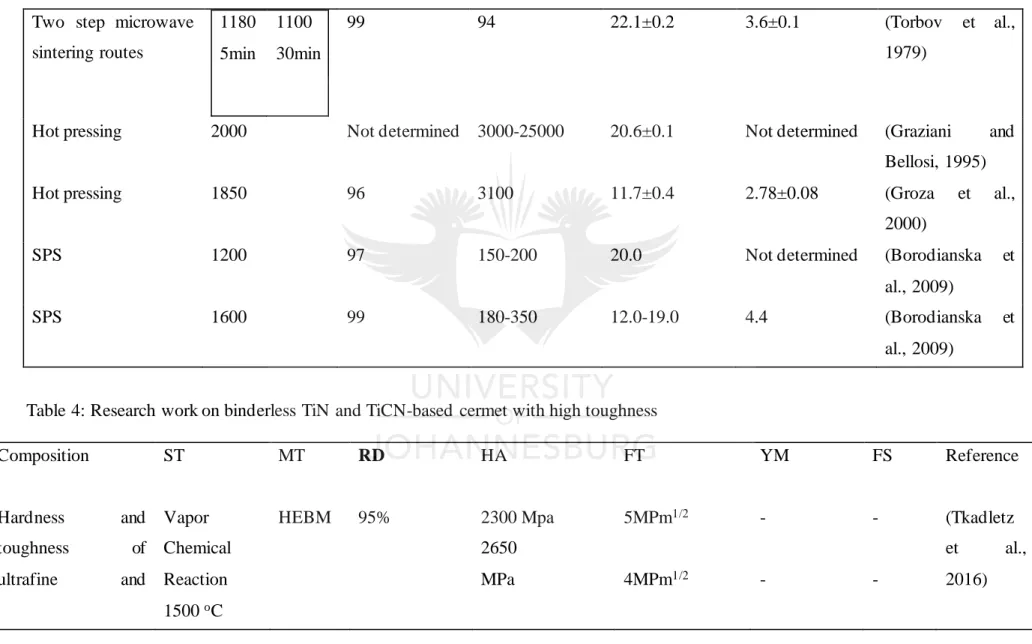
![Figure 9. XRD patterns of titanium nitride powders subjected to different milling times without adding binders; (a) Cp-TiN, (b) TiN-1 h (c) TiN–4 h (d) TiN-10 h (e) TiN–40 h (reproduced with permission [100])](https://thumb-us.123doks.com/thumbv2/123dok_us/1408006.2688475/48.918.117.750.146.891/figure-patterns-titanium-nitride-subjected-different-reproduced-permission.webp)
![Figure 3. XRD patterns of sintered titanium nitride subjected to different milling times without adding binders; (a) Cp-TiN, (b) TiN-1 h (c) TiN – 4 h (d) TiN-10 h (e) TiN – 40 h [100]](https://thumb-us.123doks.com/thumbv2/123dok_us/1408006.2688475/50.918.109.768.111.992/figure-patterns-sintered-titanium-nitride-subjected-different-milling.webp)
![Figure 11. Scanning electron microscopy of Titanium nitride powders with different milling times for (a) Cp-TiN, (b) TiN-1 h (c) TiN – 4 h (d) TiN-10 h (e) TiN – 40 h [100]](https://thumb-us.123doks.com/thumbv2/123dok_us/1408006.2688475/51.918.116.708.104.775/figure-scanning-electron-microscopy-titanium-nitride-powders-different.webp)