This is the author’s version of a work that was submitted/accepted for
pub-lication in the following source:
Hall, David
,
McCool, Chris
,
Dayoub, Feras
,
Sunderhauf, Niko
, &
Upcroft,
Ben
(2015)
Evaluation of features for leaf classification in challenging conditions. In
IEEE Winter Conference on Applications of Computer Vision (WACV
2015), 6-9 January 2015, Big Island, Hawaii, USA.
This file was downloaded from:
http://eprints.qut.edu.au/78723/
c
Copyright 2015 IEEE
Personal use of this material is permitted. Permission from IEEE must be
obtained for all other uses, in any current or future media, including
reprint-ing/republishing this material for advertising or promotional purposes,
cre-ating new collective works, for resale or redistribution to servers or lists, or
reuse of any copyrighted component of this work in other works.
Notice:
Changes introduced as a result of publishing processes such as
copy-editing and formatting may not be reflected in this document. For a
definitive version of this work, please refer to the published source:
Evaluation of Features for Leaf Classification in Challenging Conditions
David Hall
Chris McCool
Feras Dayoub
Niko S¨underhauf
Ben Upcroft
ARC Centre of Excellence for Robotic Vision
Queensland University of Technology, 2 George St., Brisbane, Australia
[email protected]Abstract
Fine-grained leaf classification has concentrated on the use of traditional shape and statistical features to classify ideal images. In this paper we evaluate the effectiveness of traditional hand-crafted features and propose the use of deep convolutional neural network (ConvNet) features. We introduce a range of condition variations to explore the ro-bustness of these features, including: translation, scaling, rotation, shading and occlusion. Evaluations on the Flavia dataset demonstrate that in ideal imaging conditions, com-bining traditional and ConvNet features yields state-of-the-art performance with an average accuracy of97.3%±0.6% compared to traditional features which obtain an average accuracy of91.2%±1.6%. Further experiments show that this combined classification approach consistently outper-forms the best set of traditional features by an average of 5.7%for all of the evaluated condition variations.
1. Introduction
Fine-grained image classification has received consider-able attention in the past five years. The fine-grained image classification problem is often described as being able to perform species level classification, that is to tell the differ-ence between an Elm tree and a Pine tree.
An area of particular interest for fine-grained image clas-sification is leaf clasclas-sification. There have been recent inter-national competitions which have examined this topic, for instance the recent ImageCLEF challenge for plant clas-sification (including leaf images) [11]. As well as this, leaf classification has several exciting practical applications such as in agriculture. In the agricultural setting, being able to distinguish between weeds and crop is of considerable in-terest as it allows for selective spraying [25] and allows for mapping of weed and crop distributions. Such an approach requires autonomous operation and means that the images will be captured in challenging environments. These chal-lenging environments can have different effects on the ap-pearance of a leaf such as the shape, colour and texture as
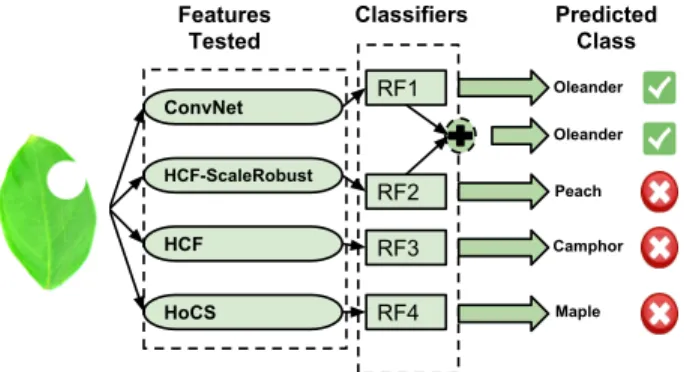
ConvNet HCF-ScaleRobust HCF HoCS RF1 RF2 RF3 RF4 Features Tested Classifiers Oleander Peach Camphor Maple Oleander Predicted Class
Figure 1: An overview of the experiments conducted in this paper. We introduce a variety of condition variations to the test dataset, like the occlusion shown on the leaf above. Sev-eral features are extracted from these altered images and passed through the random forest (RF) classifiers that were trained on perfect images. We compare the variability of the different tested systems and one of their combinations.
well as changes due to viewpoint and occlusion.
Much of the research for leaf classification has concen-trated on the use of traditional hand-crafted features for im-ages taken in ideal conditions. Several databases have been proposed [26, 15] all of which consist of well aligned im-ages taken in controlled conditions with few defects and of-ten without a way to reproduce the experiments. The most often used features are hand-crafted features (in the fol-lowing abbreviated as HCFs) that capture shape informa-tion [15, 17] or both shape and statistical informainforma-tion [8]. To date, limited work has been conducted on the use of learnt features such as those trained using deep convolu-tional neural networks (ConvNets) [16, 14, 10].
In this work, we examine the robustness of commonly used features for fine-grained leaf classification under chal-lenging conditions. An extensive set of evaluations is per-formed by introducing a variety of condition variations such as: translation, scaling, rotation, shading and occlusion. We apply this evaluation to traditional HCFs as well the
re-cently proposed ConvNet features [10]. An overview of our testing procedure is shown in Figure 1. Empirical evalua-tion shows that the ConvNet features outperform the tradi-tional HCFs and that their combination yields state-of-the-art performance with an average accuracy of97.3%±0.6% compared to91.2%±1.6%for the HCFs.
Two major contributions are made in this paper for leaf classification:
1. We examine the robustness of a range of features to a variety of condition variations including: translation, scaling, rotation, occlusion and shadowing.
2. We demonstrate that combining ConvNet features and HCFs leads to a robust state-of-the-art leaf classifi-cation system which has an average absolute perfor-mance improvement of5.7%compared to the best per-forming HCF-based system.
The rest of the paper is organised as follows. In Sec-tion 2, we discuss related work in the field. SecSec-tion 3 gives an overview for the approach used in this work. In Section 4 we present the experimental set-up and results for the var-ious experiments conducted. Finally we draw conclusions and discuss future work in Section 5.
2. Related Work
Automatic leaf classification from imagery has been an active field of research since 1999. A range of hand-crafted features have been proposed to solve this problem rang-ing from shape-based features [26, 17, 2, 12, 18, 4, 19, 15] through to the use of statistical texture features [8] and even their spectral reflectance properties [20, 21].
Much of the work conducted on leaf classification makes use of shape features. Hand-crafted shape features such as the size, roundness, and convexity of the leaf have been used by several authors [26, 17, 2, 12, 18, 4]. Recently, more advanced shape features have also been proposed such as the triangular representation of Mouine et al. [19] and the histogram-based features of the well known LeafSnap1
application of Kumar et al. [15]. Kumar et al. proposed a shape feature that measures the intersection between the segmented leaf and discs of varying sizes that were applied across the image. The different responses in terms of area of intersection and scale of the disc were then used to form a histogram of curvature scales (HoCS). This approach was designed to be robust to translations and rotations.
Other features for classification have come from the spectral properties of the leaves or from combining shape and statistical information. In [20, 21], the authors demon-strated that plant species could be classified by using hyper-spectral images of their leaves. However, this preliminary
1http://leafsnap.com/
Figure 2: Examples of different leaf species from the Flavia Dataset [26].
work has concentrated on differentiating a particular crop and weeds and so relatively few classes had to be classified; in [20] six species were classified and in [21] eight species were classified.
Work in 2014 by Haug et al. [8] combined shape and statistical features to distinguish between three different classes of plants in an agricultural application. In contrast to most of the aforementioned work that relies on clean, stan-dardized top-down images of single leaves or plants, Haug et al. demonstrated their system in a realistic setting, clas-sifying complete, and sometimes overlapping, plants in the field. Unfortunately the authors evaluated on an in-house dataset that is not publicly available.
All of the aforementioned work use manually engineered features. However, a recent trend in the field of object recognition has been to learn features using deep convo-lutional networks (ConvNets). The most prominent exam-ple of this trend is the annualImageNet Large Scale Visual Recognition Challengewhere for the past two years many of the participants have used ConvNet features [23].
Convolutional networks themselves are not a new ap-proach and were proposed by LeCun et al. in 1989 [16] to recognize hand-written digits. However, their popular-ity has risen recently due to algorithmic improvements such as dropout and so called rectified linear units [9, 3] and the availability of computational resources (including GPUs to perform parallel computation) that are needed to train these models. Several research groups have shown that ConvNets outperform more classical approaches for object classification or detection that are based on hand-crafted features [14, 24, 5, 6, 22].
Despite the proclaimed success of the above mentioned features, leaf classification has often been applied to highly controlled images such as those shown in Figure 2. In this work, we aim to test the robustness of some hand-crafted and ConvNet features for leaf classification under varying conditions. This will be done systematically introducing variations to the leaf images. These variations will simu-late some of the conditions which are encountered when the imaging conditions are not well controlled.
3. Systems Examined
We analyse a range of features and how well they per-form when condition variations are introduced. The fea-tures include: ConvNet feafea-tures, HoCS, and HCFs com-monly used within the literature for leaf classification. To ensure the focus of this analysis is on the features being used and not the classifiers, we keep the classifier constant by always using a random forest classifier. While improve-ments in accuracy may be achieved using other classifiers, this shall not be examined within this work. We also inves-tigate the effectiveness of combining ConvNet features with the more commonly used HCFs.
3.1. Deep Convolutional Neural Network (ConvNet)
To analyse the effectiveness of ConvNet features, we utilise the pre-trained ConvNet framework called Caffe [10]. We follow the idea of Razavian et al. [22], who showed that combining the features from the ConvNet with simple classifiers is highly competitive or even superior to classical approaches in a variety of recognition and detec-tion benchmarks. The network provided by Caffe is trained using 1.2 million images and comprises of five convolu-tional, three max pooling and two fully connected layers from which potential features can be obtained. Empirically, we found that the last two fully connected layers (layers fc6 and fc7) performed best with little difference between them. Given this, we chose to use layer fc7 for our exper-iments and the classification system will be referred to asConvNet.
3.2. Histograms of Curvature over Scale (HoCS)
HoCS features used for our analysis are extracted using the same method as described in [15]. This comprises of using discs at25different scales around the contour of the leaf in order to describe the shape of the leaf by measur-ing the percentage of the discs occupied by leaf pixels. As [15] gives no indication as to which scales were used, we use discs with radius (r) values ofr= [5,6,7, . . . ,30] pix-els2. The classification system using HoCS features will bereferred to asHoCS.
3.3. Hand Crafted Features (HCFs)
In order to analyse more commonly used hand crafted features for plant classification, the shape and statistical fea-tures described in [8] were used. These feafea-tures are summa-rized in Table 1. The classification system using all of these features will be referred to as HCF. In [8] the statistical features were calculated using the NDVI vegetative index image, we approximate this by using the normalized exces-sive green (NExG) vegetative index image [7]. This is done as the images used within the experiments do not contain
2Source code can be found athttp://tinyurl.com/AGR-QUT
Feature Scale Robust
Perimeter (length of contour) No Area (number of pixels covered by leaf) No
length of skeleton No
Compactness (area / perimeter2) Yes Solidity (area / area of convex hull) Yes
Convexity (perimeter ) Yes
length of skeleton/perimeter Yes minimum of leaf pixel intensities Yes maximum of leaf pixel intensities Yes range of leaf pixel intensities Yes mean of leaf pixel intensities Yes median of leaf pixel intensities Yes standard deviation of leaf pixel intensities Yes kurtosis of leaf pixel intensities Yes skewness of leaf pixel intensities Yes Table 1: Hand-crafted shape and statistical features used for analysis, as well as whether feature was considered scale robust or not.
the near infrared (NIR) information required to generate a NDVI vegetative index image.
We note that many shape and statistical features are in-herently robust to scale. As such, we create another HCF classification system known as HCF-ScaleRobust. This uses the features marked as scale robust in Table 1.
To test if some classification benefit can be gained through combining ConvNet features and commonly used HCFs, we propose a new classification systemCombined. Further details as to how this system is used for classifica-tion are given in Secclassifica-tion 3.4. We believe this system will be particularly interesting in the presence of condition vari-ations as we believe that the ConvNet features, which have not seen all of these potential variations, do not have the innate robustness that the hand-crafted features have.
3.4. Classifiers
To compare the performance of different feature types, we use a random forest classifier for all the features exam-ined. Random forests are a technique which was introduced in [1], and consists of generating a large quantity of deci-sion trees. Decideci-sion trees are a series of boolean statements regarding values of certain features which give a classifica-tion based on the results of said boolean statements [1].
We optimise the parameters of the random forest by choosing the maximum depth and number of trees which optimises performance on the validation set, see Section 4 for details on the validation set. The possible values for maximum depth (D) were D = [5,10,15], as well as the option for there being no maximum depth. The pos-sible number of trees (T) in the random forests isT =
HCF-ScaleRobust.
We combine the ConvNet features with the HCFs to form a Combined classifier. This is achieved by com-bining the probability scores given by both ConvNetand
HCF-ScaleRobustvia the sum rule [13]. The class which has the highest score after this summation is then taken to be the best match.
4. Experimental Results
We conduct experiments using the Flavia dataset [26]. This consists of 1,907 leaf images of32 species with at least50images per species and at most77images. Exper-iments are performed using a protocol which ensures that the leaf classification systems are optimised on data that is independent of the final evaluation set. Using the original images, we determine a baseline accuracy for each feature type described in Section 3. We then perform tests on mod-ified versions of the images to simulate various real-word conditions. This allows us to evaluate the robustness of the different features to condition variations such as translation, scaling, rotation, shading, and occlusion. In order to allow for translations and rotations of the leaves without losing parts of the leaf, each leaf image from the Flavia dataset was given a white border such that it doubled the image’s size.
When extracting features from the images, both the HoCS and the hand-crafted shape features require a seg-mentation step in order to accurately describe the shape of the leaves. To ensure that the experiments focus more on the effectiveness of the different feature types and not on the accuracy of the segmentation, perfect segmentation is as-sumed to be true. This segmentation is performed using the segmentation method designed to be used with this dataset which is described in [26].
4.1. Evaluation Protocol
To test the classification systems, we define 10 random splits of the data3. Each split contains a trainset,
valida-tionset andevaluationset. The train set is used to derive the classifier whose hyper parameters are optimised on the validation set. Since there are 10 splits, we take the best average performance over the 10 splits. Using the trained classifier with optimised parameters, the final system per-formance is then obtained on the evaluation set. The val-idation and evaluation sets both have 10samples for each species of leaf, the remaining images are allocated to the train set. When training the classifiers, we make use of the original images only to properly evaluate the effect of the condition variations.
As a performance metric, we use the rank-1 identifi-cation rate (Accuracy). This measure reflects the rate at
3Our protocols can be found athttp://tinyurl.com/AGR-QUT
which the species of interest is the best match (rank-N iden-tification refers to how often the species of interest is in the N best matches) and is given byAccuracy= Nc
Nt ×100%
where Nc is the number of correct matches (the correct
species was the best match),Ntis the total number of test
samples, and Accuracy is given in terms of percentage. This accuracy is attained for each of the tenevaluationsets and then the average of these ten accuracies (A) is used for¯ evaluation and comparison of different classification sys-tems.
Standard deviation (σ) was also calculated across the 10 validationand evaluation sets. This is calculated by σ= s 1 N N P i=1
(Ai−A)¯ 2whereAiis the accuracy of theith
split. When displaying results visually, standard deviations are not shown on graphs to reduce clutter.
4.2. Baseline Results
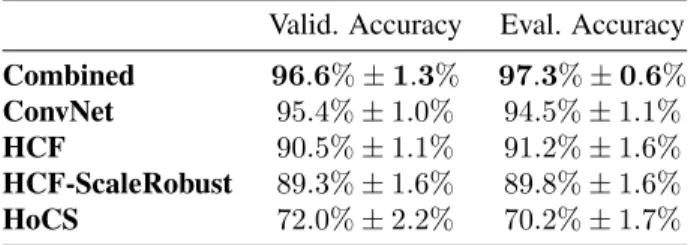
Baseline classification accuracy for the different fea-tures was obtained using the original set of images from the Flavia dataset. The results, in Table 2, show that the ConvNet features provide a considerable performance im-provement over the previously proposed features. It can be seen that the HoCS features provide the worst perfor-mance with an absolute difference of 17.3% when com-pared to HCF-ScaleRobust. The results of HCF and
HCF-ScaleRobustare also seen to be slightly worse than the best system from the original Flavia dataset tests which achieved94%classification accuracy [26]. Finally, the use of theCombinedsystem, produced the best baseline clas-sification accuracy.
Valid. Accuracy Eval. Accuracy
Combined 96.6%±1.3% 97.3%±0.6%
ConvNet 95.4%±1.0% 94.5%±1.1%
HCF 90.5%±1.1% 91.2%±1.6%
HCF-ScaleRobust 89.3%±1.6% 89.8%±1.6%
HoCS 72.0%±2.2% 70.2%±1.7%
Table 2: The baseline rank-1 identification rate (accuracy) for five systems including: Combined, ConvNet, HCF,
HCF-ScaleRobust, andHoCS. In bold is the best perform-ing system.
4.3. Condition Variations
To test the robustness of each classification system de-scribed in Section 3, we simulate real-world conditions by introducing a set of condition variations to the data. These condition variations are introduced in a structured manner to ensure we can measure the impact of each condition. We examine five different forms of condition variations: trans-lations, scaling, rotations, shading and occlusions. To the
(a) (b) (c)
Figure 3: Simulated real-world condition on original Flavia dataset images: (a) original leaf image, (b) shaded leaf im-age with40%average V decrease, (c) occlusion leaf image with a5%occlusion.
best of our knowledge, this is the first time that such a de-tailed analysis has been conducted for leaf classification.
4.3.1 Translation Analysis
In the Flavia dataset our classifier is trained on, the leaves typically appear centered in the images. However, when capturing images in real-world scenarios, the precise po-sition of a leaf will not be stable. To simulate this vari-ability in positioning, we translate the leaves of the evalu-ation images horizontally (th) and vertically (tv)
indepen-dently. The translations,thandtv, are applied as a
percent-age of the original impercent-age size (before the white borders are added) to a maximum of50%thatth= [10,20, . . . ,50]and
tv= [10,20, . . . ,50].
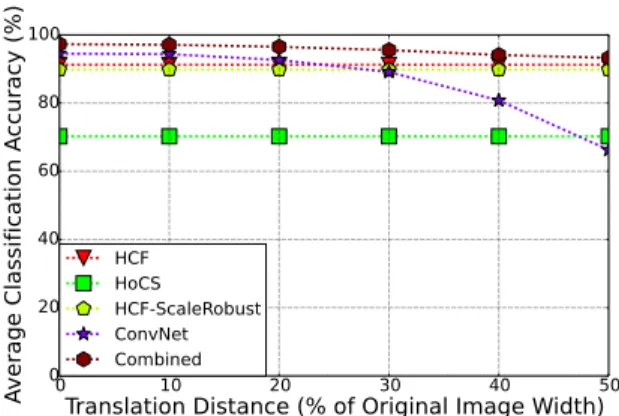
Since HCF,HoCS, and HCF-ScaleRobust are calcu-lated on an already segmented leaf, they are totally in-variant to the original position of that leaf in the image. The performance of these features therefore remains sta-ble at their baseline performance. The translation test was mainly conducted to measure the stability of theConvNet
system, which is not inherently invariant to translations of object of interest within its input image. However, as can be seen in Figure 4, ConvNet remains fairly stable until 30% translation is reached and its performance de-grades below the accuracy ofHCFandHCF-ScaleRobust. The initial stability is provided by the pooling layers con-tained within the ConvNet architecture. Extra robustness to translational variation is achieved byCombined which combinesConvNetandHCF-ScaleRobustand remains the best classification system throughout.
4.3.2 Scaling Analysis
The scale of the observed leaves can vary significantly be-tween the training dataset and the images acquired dur-ing deployment. We therefore want to evaluate the influ-ence of scale changes between training and test data and scale the leaves within the evaluation images to a
percent-ages= [90,80, . . . ,40]of the original image size.
After testing, we found that, as expected, the scale robust subset of the hand-crafted features were robust to when the scale of the leaf image is altered as this was the purpose for
0
Translation Distance (% of Original Image Width)
10 20 30 40 50 0 20 40 60 80 100Av
era
ge
Cl
assi
fic
ati
on
Ac
cu
rac
y (
%)
HCF HoCS HCF-ScaleRobust ConvNet CombinedFigure 4: Average classification accuracy across ten test-ing sets forHCF,HoCS,HCF-ScaleRobust,ConvNetand
Combined systems when subjected to horizontal transla-tion 40 50 60 70 80 90 100
Leaf Shrinking Quantity (% of Training Leaf Size)
0 20 40 60 80 100Av
era
ge
Cl
assi
fic
ati
on
Ac
cu
rac
y (
%)
HCF HoCS HCF-ScaleRobust ConvNet CombinedFigure 5: Average classification accuracy across ten test-ing sets forHCF,HoCS,HCF-ScaleRobust,ConvNetand
Combinedsystems when subjected to scaling
which they were designed. In comparison to this, however, the ConvNet, HoCS, and hand-crafted features were not.
In Figure 5, it can be seen that the performance of the
ConvNet,HCFandHoCSsystems degrades considerably when the scale changes. The difference in robustness be-tweenHCF andHCF-ScaleRobustshows the significant negative impact to scaling robustness that the three non-scale robust features withinHCFhave. HCFis shown to have lower classification accuracy thanHCF-ScaleRobust
after only a10%decrease in leaf size.
Similar to the translation test above, we observed
ConvNetto remain relatively stable for scale changes up to 20% and this can be explained by the invariance introduced by the pooling layers. Despite the considerable degrada-tion in performance ofConvNetfor larger scale changes, theCombinedsystem still has stable performance and pro-vides the best overall accuracy up to a50%decrease in leaf size.
0 50
Image Rotation (Degrees)
100 150 200 250 300 350 0 20 40 60 80 100Av
era
ge
Cl
assi
fic
ati
on
Ac
cu
rac
y (
%)
HCF HoCS HCF-ScaleRobust ConvNet CombinedFigure 6: Average classification accuracy across ten test-ing sets forHCF,HoCS,HCF-ScaleRobust,ConvNetand
Combinedsystems when subjected to rotation
4.3.3 Rotation Analysis
Rotation is simulated as the orientation of a leaf cannot be guaranteed in real-world scenarios. To examine the impact of rotation we use a coarse set of rotations consisting of 30◦rotations such that the set of rotations examined isd= [30◦,60◦,90◦, . . . ,330◦].
From the results of the classification tests on these ro-tated images, which are summarized in Figure 6, it can be seen that the hand-crafted and HoCS features are robust to rotations. As with translation, this is because they are designed to work using a segmented image that will not change with rotation. By contrast, the ConvNet features are not robust to rotations with performance dropping as low as 38%. ConvNets are not designed to be rotation invariant and therefore fail under this condition. Despite this instability, the highest performance over most rotation levels is given by theCombinedsystem. Also it can be seen thatHoCS, while stable, performs considerably worse thanCombined,
HCForHCF-ScaleRobust.
Finally, it is noticed there is cyclic performance degrada-tion between0◦,90◦,180◦, and270◦. We attribute this to the fact the when rotating the images between these points interpolation is required leading to minor degradation in performance for all of the systems.
4.3.4 Shading Analysis
While images for the training set can be collected under controlled conditions, it is much harder to control the illu-mination conditions in real world applications. To examine the potential effect of different illumination conditions be-tween training and test set, an artificial shading effect was applied to the leaf pixels within each image. To produce this shading effect, we decrease the intensity value (V) of each of the leaf pixels in HSV color space by a normally distributed random percentage value with a standard devi-ation of10%. For the tests we vary the mean percentage
0
Average % Decrease in Pixel Intensity
10 20 30 40 50 60 0 20 40 60 80 100Av
era
ge
Cl
assi
fic
ati
on
Ac
cu
rac
y (
%)
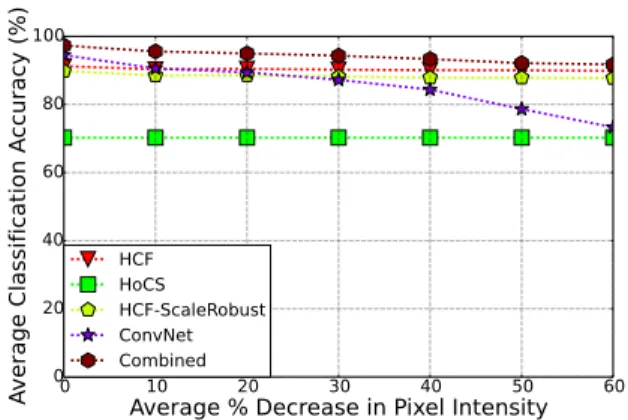
HCF HoCS HCF-ScaleRobust ConvNet CombinedFigure 7: Average classification accuracy across ten test-ing sets forHCF,HoCS,HCF-ScaleRobust,ConvNetand
Combinedsystems when subjected to shading valuesvµ= [10,20, . . . ,60].
Figure 7 shows that the various features coped well with the induced changes in illumination. The statistical features withinHCFare calculated on normalized colour values and are therefore not affected by a simple uniform change in illumination brightness. We expect to see worse results when inducing non-uniform changes across different color changes, that might be caused by a non-perfect white bal-ance during testing. A purely shape feature asHoCSis of course not affected by shading, as long as the necessary pre-segmentation is still perfect. Since the features used by ConvNetare calculated on the raw pixel color values, they are not invariant to changes in illumination and we can observe a slight degradation of performance in Figure 7 .
Again, Combined was seen to have the highest, and
HoCSthe lowest, classification accuracy across all tests. It should be noted, that while all feature systems were seen to cope fairly well with this uniform illumination change, we would expect a different result if localized shad-ing were to occur. We leave this open for future work but surmise that it would likely detrimentally affect the statis-tical HCFs and cause a decrease in accuracy for theHCF,
HCF-ScaleRobustandCombinedsystems.
4.3.5 Occlusion Analysis
Occlusions of leaves can occur for many reasons including damage to the leaf or, occlusion by other leaves of the same or different neighbouring plants. To generate such occlu-sion effects, we remove a part of the leaf in the image by artificially overlaying a white disk of varying diameter onto the leaf. Given that a leaf within an image has areaAleafwe
place the centre of the disk randomly on the leaf. The area of the disk is chosen to bep= [5,10,15, . . . ,30]percent of Aleaf. An example of this process is given in Figure 3c.
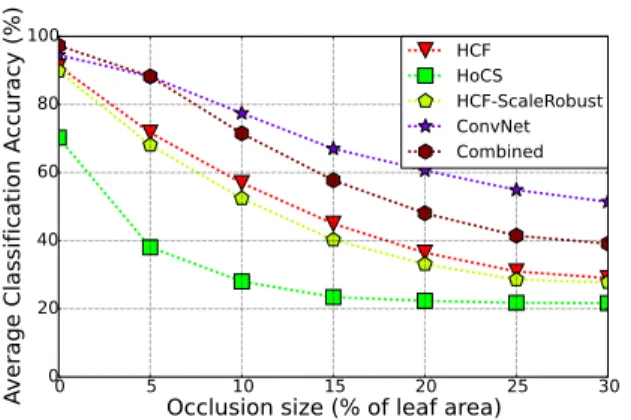
From Figure 8 it can be seen that the none of the tested features are robust to occlusion. However, the ConvNet
fea-0 5
Occlusion size (% of leaf area)
10 15 20 25 30 0 20 40 60 80 100Av
era
ge
Cl
assi
fic
ati
on
Ac
cu
rac
y (
%)
HCF HoCS HCF-ScaleRobust ConvNet CombinedFigure 8: Average classification accuracy across ten test-ing sets forHCF,HoCS,HCF-ScaleRobust,ConvNetand
Combinedsystems when subjected to occlusions
tures are least degraded and exhibit the best overall perfor-mance. TheCombinedsystem provides consistent perfor-mance which is worse than theConvNetsystem but consid-erably better than theHCF,HoCS orHCF-ScaleRobust
systems. It can also be seen that again,HoCSprovides the lowest classification accuracy over all tests.
4.4. Summary of Results
Several observations can be made as to the robustness of different classification systems for the purpose of leaf classification.
• ConvNet gives better baseline accuracy than HCF,
HCF-ScaleRobustandHoCS.
• Combinedshows greater robustness thanConvNetfor all tests except occlusion tests.
• None of the tested features are robust to occlusions, butConvNetcopes best with such disturbances.
• Removing the three scale variant features withinHCF
gives vast improvement to scaling robustness without major loss in overall accuracy in other circumstances.
• ConvNethas low robustness to translation and shading and no robustness to rotations.
• Combinedoutperforms the best performing HCF sys-tem (HCF-ScaleRobust) by5.7%averaged across all tests.
• While stable to all conditions except scaling and oc-clusion,HoCS[15] performs worst out of all classifi-cation systems.
From these observations it becomes apparent that the main weakness of the traditional hand crafted features is that they are susceptible to occlusions. Part of the reason
thatHCF,HCF-ScaleRobust,HoCSandCombined per-formed well under other types of condition variations is be-cause they rely on a perfect segmentation of the leaf from the background. In real-world applications, perfect segmen-tation is not always possible which will lead to a significant change of the shape properties (as simulated by our occlu-sion test), but also of the statistical features based on nor-malized color.
ConvNeton the other hand has exhibited a mild invari-ance to reasonable shape changes such as occlusions. It also reaches the best baseline performance of all tested single systems. Related work in the computer vision community, especially on the ILSRVC benchmarks [23] has demon-strated that ConvNet-based systems are very well able to perform object detection and classificationwithouthaving to perform a foreground-background segmentation first. We therefore expect ConvNet systems to perform well when trained and tested with natural backgrounds in an applica-tion for the real world. Extensive tests of this hypothesis are left for future work. Furthermore, the lacking invariance of ConvNet features against rotation can be overcome by in-cluding rotated leafs in the training set. We tested this in an additional experiment and could observe that the rotation influence on theConvNetsystem was completely removed and it remained stable at its baseline performance.
5. Conclusion and Future work
We have presented an extensive evaluation of features for leaf classification under a variety of condition variations such as translation, scaling, rotation, shading and occlusion. We empirically demonstrated that combining ConvNet and HCF features leads to a state-of-the-art leaf classifica-tion system (Combined). For ideal conditions, this Com-binedapproach yields state-of-the-art performance with an average accuracy of97.3%±0.6%compared to traditional features which obtain an average accuracy of91.2%±1.6%. Furthermore, for the range of condition variations exam-ined, this system consistently outperforms the best HCF system (HCF-ScaleRobust) on average by5.7%.
There are several possible directions for future work. First we want to explore how ConvNet features perform on images of leaves and complete plants taken under real-world conditions with natural background. This re-quires training the classifier using features from a va-riety of images collected under application-like condi-tions, e.g. for agricultural applications. Creating such a large realistic training dataset would also help the commu-nity and foster future work on plant classification in the wild. Since our tests showed that combiningConvNetand
HCF-ScaleRobust into the Combined system led to the best overall performance, future work should also explore how different complementary features can be combined in a more beneficial way than proposed here.
Acknowledgements
This work has been supported by the Department of Agriculture Fisheries and Forestry (DAFF) of the Queens-land government through the Strategic Investment in Farm Robotics (SIFR) at QUT.
References
[1] L. Breiman. Random forests.Machine learning, 45(1):5–32, 2001.
[2] S. Cho, D. Lee, and J. Jeong. Automation and emerg-ing technologies: Weed–plant discrimination by machine vi-sion and artificial neural network. Biosystems Engineering, 83(3):275–280, 2002.
[3] G. E. Dahl, T. N. Sainath, and G. E. Hinton. Improving deep neural networks for LVCSR using rectified linear units and dropout. InIEEE International Conference on Acous-tics, Speech and Signal Processing, pages 8609–8613. IEEE, 2013.
[4] F.-M. De Rainville, A. Durand, F.-A. Fortin, K. Tanguy, X. Maldague, B. Panneton, and M.-J. Simard. Bayesian clas-sification and unsupervised learning for isolating weeds in row crops. Pattern Analysis and Applications, pages 1–14, 2012.
[5] J. Donahue, Y. Jia, O. Vinyals, J. Hoffman, N. Zhang, E. Tzeng, and T. Darrell. Decaf: A deep convolutional acti-vation feature for generic visual recognition. arXiv preprint arXiv:1310.1531, 2013.
[6] R. Girshick, J. Donahue, T. Darrell, and J. Malik. Rich fea-ture hierarchies for accurate object detection and semantic segmentation.arXiv preprint arXiv:1311.2524, 2013. [7] J. M. Guerrero, G. Pajares, M. Montalvo, J. Romeo, and
M. Guijarro. Support vector machines for crop/weeds iden-tification in maize fields. Expert Systems with Applications, 39(12):11149–11155, 2012.
[8] S. Haug, A. Michaels, P. Biber, and J. Ostermann. Plant classification system for crop/weed discrimination without segmentation. InIEEE Winter Conference on Applications of Computer Vision, 2014.
[9] G. E. Hinton, N. Srivastava, A. Krizhevsky, I. Sutskever, and R. R. Salakhutdinov. Improving neural networks by pre-venting co-adaptation of feature detectors. arXiv preprint arXiv:1207.0580, 2012.
[10] Y. Jia. Caffe: An open source convolutional architecture for fast feature embedding. http://caffe.berkeleyvision.org, 2013.
[11] A. Joly, H. M¨uller, H. Go¨eau, H. Glotin, C. Spampinato, A. Rauber, P. Bonnet, W.-P. Vellinga, and B. Fisher. Life-clef 2014: multimedia life species identification challenges. InProceedings of CLEF 2014, 2014.
[12] S. Kiani. Discriminating the corn plants from the weeds by using artificial neural networks. International Journal of Natural & Engineering Sciences, 6(3), 2012.
[13] J. Kittler, M. Hatef, R. Duin, and J. Matas. On Combining Classifiers. IEEE Transactions on Pattern Analysis and Ma-chine Intelligence, 20:226–239, 1998.
[14] A. Krizhevsky, I. Sutskever, and G. E. Hinton. Imagenet classification with deep convolutional neural networks. In F. Pereira, C. Burges, L. Bottou, and K. Weinberger, edi-tors,Advances in Neural Information Processing Systems 25, pages 1097–1105. Curran Associates, Inc., 2012.
[15] N. Kumar, P. N. Belhumeur, A. Biswas, D. W. Jacobs, W. J. Kress, I. C. Lopez, and J. V. Soares. Leafsnap: A com-puter vision system for automatic plant species identifica-tion. In Computer Vision–ECCV 2012, pages 502–516. Springer, 2012.
[16] Y. LeCun, B. Boser, J. S. Denker, D. Henderson, R. E. Howard, W. Hubbard, and L. D. Jackel. Backpropagation applied to handwritten zip code recognition. Neural compu-tation, 1(4):541–551, 1989.
[17] W. S. Lee, D. Slaughter, and D. Giles. Robotic weed con-trol system for tomatoes. Precision Agriculture, 1(1):95– 113, 1999.
[18] C. Lin.A support vector machine embedded weed identifica-tion system. PhD thesis, University of Illinois, 2009. [19] S. Mouine, I. Yahiaoui, and A. Verroust-Blondet. A
shape-based approach for leaf classification using multiscaletrian-gular representation. InProceedings of the 3rd ACM Confer-ence on International ConferConfer-ence on Multimedia Retrieval, ICMR ’13, pages 127–134, New York, NY, USA, 2013. ACM.
[20] H. Okamoto, T. Murata, T. Kataoka, and S.-I. HATA. Plant classification for weed detection using hyperspectral imag-ing with wavelet analysis. Weed Biology and Management, 7(1):31–37, 2007.
[21] A. Piron, V. Leemans, F. Lebeau, and M.-F. Destain. Im-proving in-row weed detection in multispectral stereoscopic images.Computers and electronics in agriculture, 69(1):73– 79, 2009.
[22] A. S. Razavian, H. Azizpour, J. Sullivan, and S. Carls-son. CNN features off-the-shelf: an astounding baseline for recognition.arXiv preprint arXiv:1403.6382, 2014. [23] O. Russakovsky, J. Deng, H. Su, J. Krause, S. Satheesh,
S. Ma, Z. Huang, A. Karpathy, A. Khosla, M. Bernstein, A. C. Berg, and L. Fei-Fei. Imagenet large scale visual recog-nition challenge.arXiv preprint arXiv:1409.0575, 2014. [24] P. Sermanet, D. Eigen, X. Zhang, M. Mathieu, R. Fergus,
and Y. LeCun. Overfeat: Integrated recognition, localization and detection using convolutional networks. arXiv preprint arXiv:1312.6229, 2013.
[25] D. Slaughter, D. Giles, and D. Downey. Autonomous robotic weed control systems: A review.Computers and electronics in agriculture, 61(1):63–78, 2008.
[26] S. G. Wu, F. S. Bao, E. Y. Xu, Y.-X. Wang, Y.-F. Chang, and Q.-L. Xiang. A Leaf Recognition Algorithm for Plant Classification Using Probabilistic Neural Network. InIEEE International Symposium on Signal Processing and Informa-tion Technology, pages 1–6, 2007.
![Figure 2: Examples of different leaf species from the Flavia Dataset [26].](https://thumb-us.123doks.com/thumbv2/123dok_us/1367774.2683156/3.918.491.788.102.212/figure-examples-different-leaf-species-flavia-dataset.webp)