Secure Payment Architectures and Other
Applications of Trusted Computing
Shane Balfe Technical Report RHUL–MA–2009–10 20 February 2009
Royal Holloway
University of London
Department of Mathematics Royal Holloway, University of LondonEgham, Surrey TW20 0EX, England
Secure Payment Architectures and Other
Applications of Trusted Computing
Shane Balfe
Thesis submitted to the University of London for the degree of Doctor of Philosophy
Information Security Group Department of Mathematics Royal Holloway, University of London
Declaration
These doctoral studies were conducted under the supervision of Professor Kenneth G. Paterson. The work presented in this thesis is the result of original research carried out by myself, in collaboration with others, whilst enrolled in the Department of Mathematics as a candidate for the degree of Doctor of Philosophy. This work has not been submitted for any other degree or award in any other university or educational establishment.
Shane Balfe October, 2008
Acknowledgements
My most heartfelt thanks goes to my supervisor, Professor Kenny Paterson, who consistently provided timely and insightful feedback on my work. I am also extremely grateful to all the people in the Information Security Group at Royal Holloway. You have helped me grow as both a researcher and a person. In particular, I would like to thank Amit Lakhani, Eimear Gallery, Hoon Wei Lim, Stephane Lo Presti, Po-Wah Yau and Anish Mohammed. Additionally, I would like to thank Chris Dale for helping to proof-read many of the chapters of this thesis. I would also like to thank my family, for their unwavering support. Finally, I would like to thank the University of London’s distance learning programme; without their financial support and friendly enthusiasm I would not have been able to complete this thesis.
Abstract
This thesis is divided into two distinct parts. The first part of the thesis explores the role Trusted Computing can play in securing Internet-based Card Not Present (CNP) transactions. We highlight how Trusted Platform Module (TPM) enabled Platforms, as are currently available in the marketplace, can be used as adjuncts to CNP enabling protocols, such as SSL and 3-D Secure. As an extension to this, we demonstrate how newer Trusted Computing technologies, such as processor, chipset and operating system extensions, can provide a measured virtualisation layer on top of which emulated EMV (chip and pin) cards can run.
The second part of this thesis looks at how Trusted Computing can be used to add security functionality to a number of computing paradigms. Firstly, we examine how Trusted Computing can be used to provide stable pseudonymous identities on top of which reputation systems can be built for Peer-to-Peer systems. Secondly, we examine the role Trusted Computing can play in protecting mobile agent systems. In this regard, we examine how mechanisms for protecting both agent hosts and mo-bile agents can be achieved by augmenting agent systems with Trusted Computing functionality.
Contents
1 Introduction 16
1.1 Motivation . . . 16
1.2 Organisation of Thesis and Summary of Contributions . . . 18
1.3 Publications . . . 20
1.4 Cryptographic Primitives . . . 20
1.4.1 Hash Functions . . . 21
1.4.2 Message Authentication Codes . . . 21
1.4.3 Symmetric Encryption . . . 22
1.4.4 Asymmetric Encryption . . . 22
1.4.5 Digital Signature . . . 23
1.4.6 Public Key Certificates . . . 23
2 An Overview of Trusted Computing 24 2.1 Introduction . . . 25
2.2 Architecture for a Trusted Platform . . . 26
2.3 Authenticated Boot . . . 26
2.4 TPM Specifications . . . 29
2.4.1 Taking Ownership of the TPM . . . 29
2.4.2 Protected Capabilities and Shielded Locations . . . 31
2.4.3 Integrity Measurement and Storage . . . 31
2.4.4 TPM Keys and Key Usage . . . 33
CONTENTS
2.4.6 TCG Credentials . . . 46
2.5 Trusted PC and Trusted Server Specifications . . . 47
2.6 TNC Specification . . . 48
2.7 Operating System and Processor Support . . . 50
2.8 Summary . . . 52
I Securing Internet-Based CNP Transactions 53 3 Card Payments 54 3.1 Introduction . . . 55
3.2 Card Payment Processing Model . . . 57
3.3 Threats to CNP Transactions . . . 60
3.4 Protocols for Protecting CNP Transactions . . . 64
3.4.1 SSL/TLS . . . 64
3.4.2 SET . . . 67
3.4.3 3-D Secure . . . 69
3.5 EMV . . . 71
3.5.1 Transaction processing . . . 72
3.5.2 EMV Key Usage . . . 75
3.6 Summary . . . 78
4 Trusted Computing and CNP Transactions 79 4.1 Introduction . . . 80
4.2 Related Work . . . 82
4.3 Architectures for Customer Enrolment . . . 83
4.3.1 Enrolment . . . 83
4.3.2 Deciding on an Architecture . . . 84
4.4 Client-Side Certification and Malware . . . 88
4.4.1 Using Physical Presence . . . 89
CONTENTS
4.5 Augmenting Existing Protocols with Trusted Computing . . . 91
4.5.1 SSL Augmentation . . . 92
4.5.2 3-D Secure Integration . . . 93
4.5.3 Security Analysis . . . 96
4.6 Conclusions . . . 97
5 e-EMV: Emulating EMV using Trusted Computing Technologies 99 5.1 Introduction . . . 100
5.2 Related Work . . . 103
5.3 An overview of e-EMV . . . 104
5.3.1 Enrolment . . . 105
5.3.2 Transaction Architecture . . . 108
5.4 Installing and Instantiating an e-EMV card . . . 110
5.4.1 Account Activation . . . 110
5.4.2 Secure Application Delivery . . . 112
5.5 e-EMV in Operation . . . 117
5.5.1 Customer to Merchant Interaction . . . 117
5.5.2 Payment . . . 123
5.5.3 Migration . . . 123
5.6 Security Analysis . . . 124
5.7 Conclusions . . . 126
II Other Applications of Trusted Computing 128 6 Trusted Computing and Peer-to-Peer Systems 129 6.1 Introduction . . . 130
6.2 Overview of Security Issues for P2P Networks . . . 134
6.2.1 Security Issues . . . 135
CONTENTS
6.4 Securing P2P Networks Using Trusted Computing . . . 147
6.4.1 Access Control and Accountability . . . 147
6.4.2 Authenticated Key Establishment and Secure Channels . . . 148
6.5 Two Approaches to Securing P2P Networks Using Trusted Computing153 6.5.1 Securing Unmanaged P2P Networks . . . 154
6.5.2 Securing Commercial P2P Networks . . . 156
6.6 Issues and Open Problems . . . 160
6.6.1 Issues . . . 160
6.6.2 Open Problems . . . 161
6.7 Conclusion . . . 164
7 Protecting Mobile Agent Migration with Trusted Computing 165 7.1 Introduction . . . 166
7.2 Mobile Agent Security . . . 168
7.2.1 Threats To The Host . . . 168
7.2.2 Threats To The Mobile Agent . . . 169
7.2.3 Safeguards for Protecting the Host . . . 169
7.2.4 Safeguards for Protecting the Agent . . . 171
7.2.5 Trusted Computing and Mobile Agents . . . 173
7.3 Protecting Mobile Agent Migration with Trusted Computing . . . . 175
7.3.1 Assumptions . . . 176
7.3.2 Mutual Attestation . . . 178
7.3.3 Sealing . . . 183
7.3.4 Environmental Key Generation . . . 185
7.3.5 Certified Migration . . . 189
7.3.6 Performance . . . 191
7.4 Conclusions . . . 191
8 Summary and Conclusions 193 8.1 Summary . . . 193
CONTENTS
8.2 Directions for Future Work . . . 198
8.2.1 Attestation . . . 198
8.2.2 Business Models and Risk . . . 199
8.2.3 Public Key Infrastructure and Trusted Computing . . . 199
8.2.4 Usability . . . 200
8.3 Conclusions . . . 200
List of Figures
2.1 Simplified Trusted Platform Architecture . . . 27
2.2 Components of Trusted Platform Module . . . 29
2.3 TPM Key Tree Hierarchy . . . 34
2.4 TCG Attestation Protocol [151] . . . 38
2.5 Simplified DAA Protocol . . . 41
2.6 Simplified SKAE Protocol . . . 45
2.7 TCG Credentials and their Relationships [151] . . . 46
2.8 TNC Architecture . . . 49
3.1 Generic model for card processing. . . 58
3.2 SET Message Structure . . . 67
3.3 EMV - Static Data Authentication. . . 75
3.4 EMV - Dynamic Data Authentication. . . 76
4.1 Certificate Enrolment Hierarchy . . . 85
4.2 Card Issuer Controlled Privacy/SKAE CA . . . 86
4.3 Augmenting SSL Authentication . . . 92
4.4 3-D Secure Authentication . . . 94
5.1 Enrolment Procedure. . . 105
5.2 Transaction Architecture for e-EMV Payments. . . 108
5.3 e-EMV Customer-Merchant Interface . . . 117
List of Algorithms
5.1 e-EMV Application Download Set-up Phase . . . 114
5.2 Downloading the e-EMV Application . . . 116
7.1 Pre-Deployment Environmental Key Generation . . . 186
Abbreviations
3-D Secure: 3-Domain SecureAAC: Application Authentication Cryptogram AC: Application Cryptogram
ACS: Access Control Server AFL: Application File Locator AIK: Attestation Identity Key AIP: Application Interchange Profile APWG: Anti-Phishing Working Group AR: Access Requester
ARPC: Authorisation Response Cryptogram ARQC: Authorisation Request Cryptogram ATC: Application Transaction Counter AVS: Address Verification Service BIOS: Basic Input/Output System CA: Certification Authority CCP: Cryptographic Coprocessor
CDA: Combined DDA and application cryptogram generation CL: Camenisch-Lysyanskaya
CMK: Certified Migratable Key CNP: Card Not Present CPU: Central Processing Unit
CSC: Card Security Code
CVM: Cardholder Verification Method
DRTM: Dynamic Root of Trust for Measurement DAA: Direct Anonymous Attestation
DDA: Dynamic Data Authentication DHT: Distributed Hash Table
DPPBM: Deferred Physical Presence Bit Map DRM: Digital Rights Management
DSS: Data Security Standard e-EMV: Emulated EMV
EEPROM: Electrically Erasable Programmable Read-Only Memory EK: Endorsement Key
EKG: Environmental Key Generation
EMSCB: European Multilateral Secure Computing Base EMV: Europay Mastercard Visa
ICC: Integrated Circuit Card IKE: Internet Key Exchange
IMC: Integrity Measurement Collector IMK: Issuer Master Key
IMV: Integrity Measurement Verifier
ISAKMP: Internet Security Association and Key Management Protocol IWG: Infrastructure Work Group
JVM: Java Virtual Machine LPC: Low Pin Count MA: Migration Authority
MAC: Message Authentication Code MK: Migratable Key
MOTO: Mail Order Telephone Order MSA: Migration Selection Authority MVMM: Measured Virtual Machine Monitor NGSCB: Next-Generation Secure Computing Base OIAP: Object-Independent Authorisation Protocol OS: Operating System
OSI: Open Systems Interconnection P2P: Peer-to-Peer
PABP: Payment Application Best Practices PAN: Personal Account Number
PAReq: Payer Authentication Request PARes: Payer Authentication Response PC: Personal Computer
PCI: Payment Card Industry
PCR: Platform Configuration Register PDP: Policy Decision Point
PED: PIN Entry Device PEP: Policy Enforcement Point PGP: Pretty Good Privacy
PIN: Personal Identification Number PKI: Public Key Infrastructure POS: Point of Sale
PS: Process Status
RAM: Random Access Memory ROM: Read Only Memory
RTM: Root of Trust for Measurement RTR: Root of Trust for Reporting RTS: Root of Trust for Storage
SCADS: Stamp Collectors Against Dodgy Sellers SDA: Static Data Authentication
SET: Secure Electronic Transaction SKAE: Subject Key Attestation Evidence SML: Stored Measurement Log
SRK: Storage Root Key SSL: Secure Socket Layer TBB: Trusted Building Block TC: Transaction Certificate TCG: Trusted Computing Group TCP: Transmission Control Protocol TCS: TCG Core Services
TG: Transaction Generator TLS: Transport Layer Security TLV: Tag Length Value
TMAP: Trusted Mobile Agent Platform TNC: Trusted Network Connect TP: Trusted Platform
TPE: Trusted Processing Environment TPM: Trusted Platform Module TTP: Trusted Third Party VbV: Verified by Visa VM: Virtual Machine
Chapter 1
Introduction
Contents
1.1 Motivation . . . 16
1.2 Organisation of Thesis and Summary of Contributions . 18 1.3 Publications . . . 20
1.4 Cryptographic Primitives . . . 20
1.4.1 Hash Functions . . . 21
1.4.2 Message Authentication Codes . . . 21
1.4.3 Symmetric Encryption . . . 22
1.4.4 Asymmetric Encryption . . . 22
1.4.5 Digital Signature . . . 23
1.4.6 Public Key Certificates . . . 23
In this chapter, we provide an overview of the thesis as a whole. We discuss the motivation for our research and describe the contributions of the thesis.
1.1
Motivation
The Trusted Computing Group (TCG) is an industry consortium formed to develop a set of open standards for hardware-enabled Trusted Computing. The TCG’s aim is to establish a more secure computing environment on commodity platforms that can protect data from software attacks [108]. Trusted Computing is based on the
1.1 Motivation
inclusion of a hardware “root of trust” within a platform, that aims to allow users (and third parties) to assess the “trustworthiness” of the devices with which they interact. To achieve this, a Trusted Platform (TP) should be able to reliably gather and provide evidence of its current operating state, or any sub-component thereof. Any divergence from an intended operating state can be reported to interested par-ties, allowing them to make informed decisions as to whether to continue to interact with the platform in question. Trusted Computing, as discussed in this thesis, relates directly to the types of systems proposed by the TCG. Namely, a trusted system is one which will behave in a particular manner for a specific purpose1.
At present, Trusted Platforms, as they are currently deployed in the marketplace, are incapable of providing the rich set of security services described above. The relative absence of additional hardware and software components in the form of new processor designs, new chipsets, new Basic Input/Output Systems (BIOSs) and Operating System (OS) support makes any statement (attestation) made by a current Trusted Platform unreliable. Instead, the current functionality offered by a Trusted Platform is akin to that of a high-end smartcard. Through the use of a Trusted Platform Module (TPM), a small microcontroller attached to a platform’s motherboard, a Trusted Platform can produce random numbers and generate, store and use asymmetric key pairs. As things currently stand, processor, chipset, BIOS and OS support will not be commonplace in the market for several years to come. However, the component-based architecture adopted by the TCG allows the current functionality to be extended over time. Thus, Trusted Computing can currently provide us with a limited, but useful, set of cryptographic functionality which can be extended to provide a more secure operating environment.
Once one accepts that Trusted Computing offers an interesting and powerful set of (near and long-term) security features, the natural question arises: for what
Introduction
purposes can this technology be exploited? This thesis aims to examine this question by taking an in-depth look at a number of application domains whose security could be improved by the inclusion of Trusted Computing technologies. In this respect, this thesis is split into two parts. In the first part we look at card-based electronic payments and examine the problem of Card Not Present (CNP) fraud. We examine how the staged roll out of Trusted Computing technology, beginning with ubiquitous client-side TPMs, can be used to enhance the security of current CNP transactions. In the second part, we examine how the security of Peer-to-Peer (P2P) systems and mobile agent systems can be enhanced by the use of Trusted Computing technologies. We note that this thesis could also have been split into near-term and long-term applications of Trusted Computing. Here aspects of our CNP work and our Peer-to-Peer work fall into the former, whilst the rest of our work falls into the latter.
1.2
Organisation of Thesis and Summary of Contributions
The remainder of this thesis is organised as follows. In Chapter 2, we provide an overview of Trusted Computing. This chapter will act as a primer for the rest of the thesis. In this chapter we will examine the Trusted Platform Module (TPM) in considerable detail and see how it fits into the Trusted Computing paradigm. We will also look at Operating System and chipset support for Trusted Computing in the form of Microsoft’s Next-Generation Secure Computing Base (NGSCB) and La-Grande technology respectively. Here we will examine how processor extensions can be used to provide isolated execution environments in which applications can run, free from external observation. The remaining chapters of this thesis are organised into two parts.
Part I:In Chapter 3, we provide an overview of Internet-based Card Not Present (CNP) transactions. We define a threat model for CNP transactions, as well as
pro-1.2 Organisation of Thesis and Summary of Contributions
viding an overview of the generic four corner model used in card payment systems, before moving on to discuss some of the more significant protocols used for securing CNP transactions. This chapter concludes with an in-depth examination of Eu-ropay Mastercard and Visa (EMV) Integrated Circuit Cards (ICCs) for Point of Sale (PoS) transactions. This chapter will act as background for Chapters 4 and 5. In Chapter 4, we demonstrate how the staged roll out of Trusted Computing technology, beginning with client-side TPMs, can be used to enhance the security of current Internet-based CNP transactions. In Chapter 5, we demonstrate how Trusted Computing technology can be used to emulate EMV for use in Internet-based CNP transactions.
Part II: In Chapter 6, we demonstrate how features of the TCG specifications can be employed to enhance the security of P2P environments. In particular, we show how the TCG protocols for Direct Anonymous Attestation (DAA) can be used to enforce the use of stable, platform-dependent pseudonyms and thus reduce pseudospoofing in P2P networks. Taking this a step further, we show how runs of the DAA protocol can be used to build entity authentication at the level of pseudonyms and can be securely linked to the establishment of secure channels with known endpoints. Chapter 7 is concerned with the issue of mobile agent protection and the benefits that the introduction of Trusted Computing can bring to a mobile agent framework. In particular, we discuss how Trusted Computing technology can be used to support secure agent migration between platforms. We describe a number of options for securely migrating mobile agents between Trusted Computing platforms and compare and contrast the relative merits (and deficiencies) of each approach. We conclude with Chapter 8 in which we provide a summary of the preceding chapters and examine possible extensions to our work.
Introduction
• We propose the use of near-term Trusted Computing technologies as a means of improving the security of Internet-based CNP transactions.
• We propose the use of longer-term Trusted Computing technologies as a means of providing a secure and extensible architecture for Internet-based CNP trans-actions.
• We provide an identity binding service for P2P networks that is resilient to pseudospoofing attacks. We also show how Trusted Computing can be used to bootstrap secure sub-groups within P2P networks.
• We demonstrate how Trusted Computing can provide an underlying security infrastructure for mobile agent systems.
1.3
Publications
This thesis contains material that was previously published with A.D. Lakhani and K.G. Paterson [16, 17], material that was published with K.G. Paterson [18, 20, 21, 22] as well as material that was published with E.M. Gallery [15]. The content of [18], which appeared in abridged form as [21], forms the basis for Chapter 4, the content of [20] forms the basis for Chapter 5. The content of [18] and [20] have evolved significantly since their first publication, updated versions of which can be found in [19] and [22] respectively. The content of [16, 17] form the basis for Chapter 6 and the content of [15] forms the basis for Chapter 7.
1.4
Cryptographic Primitives
In this section we introduce the cryptographic primitives that will be used through-out the remainder of this thesis.
1.4 Cryptographic Primitives
1.4.1 Hash Functions
A hash function is a cryptographic function h() that takes as input a binary string of arbitrary (but finite) bit-length,x, and outputs a string of fixed bit-length,h(x) [86]. A hash function may have the following properties [86]:
• Preimage resistance: For all pre-specified outputs, h(x), for which a corre-sponding input is not known, it is computationally infeasible to find an input,
x0, such thath(x0) =h(x).
• 2nd-Preimage Resistance: Given an input,x, it is computationally
infeasi-ble to find a second input, x0, where x6= x0, such thath(x) =h(x0).
• Collision Resistance: It is computationally infeasible to find any two dis-tinct inputsx and x0 such thath(x) =h(x0).
For the remainder of this thesis we assume that any hash function used will satisfy the three security properties described above.
1.4.2 Message Authentication Codes
Message Authentication Codes (MACs) are a family of functions, hk(),
parame-terised by a secret key k, that provide (symmetric) data-origin authentication and message integrity. MACs have the following properties [86]:
• Ease of Computation: Given a known function,hk(), a key,k, and an input,
x,hk(x) should be easy to compute.
Introduction
• Computation-resistance: Presented with zero or more text-MAC pairs, (xi, hk(xi)), it is computationally infeasible to generate any text-MAC pair,
(x,hk(x)), for any new inputx 6=xi.
For the remainder of this thesis we assume that any MAC algorithm used will satisfy the three properties described above.
1.4.3 Symmetric Encryption
An encryption scheme is said to be symmetric if, given an encryption key and de-cryption key pair (e,d), it is computationally easy to determine e knowing only d
(and vice-versa). Indeed, in many symmetric encryption schemese=d. Standards for symmetric ciphers are discussed in [39].
1.4.4 Asymmetric Encryption
Asymmetric cryptography (also known as public-key cryptography) involves the gen-eration/assignment of two keys, one public,kp, and one private,ks, by/to an entity.
The private key should be kept secret whilst the public key can be freely distributed. In an asymmetric encryption scheme the public key is used to encrypt a message for a given recipient. This encrypted message can only be decrypted by the en-tity possessing the corresponding private key. Standards for asymmetric ciphers are discussed in [39].
1.4 Cryptographic Primitives
1.4.5 Digital Signature
A digital signature mechanism is an asymmetric cryptographic scheme consisting of a private signing procedure (using a private key) and a public verifying procedure (using the corresponding public key). Digital signatures can be used to provide origin authentication, non-repudiation and/or data integrity services. Standards for digital signatures are discussed in [39].
1.4.6 Public Key Certificates
As part of a Public Key Infrastructure (PKI), Certification Authorities (CAs) issue digitally signed credentials which provide a binding between a public key and an identity (amongst other things). X.509 is a widely adopted standard for specifying the format of these public key certificates [70]. The structure of an X.509 v3 public key certificate can be found in [67].
Chapter 2
An Overview of Trusted Computing
Contents
2.1 Introduction . . . 25 2.2 Architecture for a Trusted Platform . . . 26 2.3 Authenticated Boot . . . 26 2.4 TPM Specifications . . . 29
2.4.1 Taking Ownership of the TPM . . . 29 2.4.2 Protected Capabilities and Shielded Locations . . . 31 2.4.3 Integrity Measurement and Storage . . . 31 2.4.4 TPM Keys and Key Usage . . . 33 2.4.5 Reporting and Attestation . . . 37 2.4.6 TCG Credentials . . . 46
2.5 Trusted PC and Trusted Server Specifications . . . 47 2.6 TNC Specification . . . 48 2.7 Operating System and Processor Support . . . 50 2.8 Summary . . . 52
In this chapter, we provide an overview of fundamental Trusted Computing con-cepts and discuss a number of Trusted Computing specifications relevant to our re-search. This chapter acts as a primer for the remainder of this thesis.
2.1 Introduction
2.1
Introduction
Trusted Computing, refers to a collection of interrelated and interoperating technolo-gies, which, when combined, help to establish a more secure operating environment on commodity platforms. A fully-realised trusted computing platform will allow users to reason about the behaviour of a platform, as well as providing standardised mechanisms to protect user private data against software attack [108]. The ratio-nale behind the introduction of Trusted Computing is to provide means for end-users (and third-parties) to derive increased confidence in the platforms with which they interact. However, as trust is perhaps one of the most over-loaded terms in security research, a precise definition of trust is essential to our understanding of Trusted Computing. The definition of trust provided by the TCG centres on the notion of behavioural reputation, that trust is “the expectation that a device will behave in a particular manner for a specific purpose.”1 What this particular manner or specific purpose might be, however, has resulted in a fair amount of criticism; see for exam-ple [5, 6, 10, 126, 127, 118, 128, 137, 168]. In particular, privacy concerns relating to Trusted Platforms were raised in [111]. The extent to which Trusted Comput-ing could be used to enable and enforce Digital Rights Management (DRM), and, more generally, the possible expropriation of platform owner control, where raised in [162, 118]. Finally, Anderson [5] expresses the view that Trusted Computing could be used to support censorship, stifle competition between software vendors, facili-tate software lock-in and hinder the deployment and use of open source software, thereby potentially enabling market monopolisation by select vendors.
Our aim in this thesis is not to become embroiled in a debate over the possi-ble (mis)appropriation of a technology, but to examine Trusted Computing and its beneficial application to a number of computing paradigms. With that in mind, we will now sketch some of the components of a Trusted Platform and the functionality
An Overview of Trusted Computing
they provide.
2.2
Architecture for a Trusted Platform
Trusted Computing as discussed in this chapter, refers to the types of platforms proposed by the Trusted Computing Group (TCG). The current documentation from the TCG encompasses a vast set of specifications ranging from Personal Computer (PC) [148] and server systems [146] to specifications for trusted networking [152] and trusted mobile platforms [155]. However, it is the TCG’s specifications for microcontroller design, in the form of the Trusted Platform Module (TPM), that have perhaps become most synonymous with Trusted Computing [150, 153, 154]. In addition to the TCG specification set, work outside of the TCG looks to develop new processor designs [3, 68] as well as OS support [102, 103] for Trusted Computing.
A Trusted Platform, as defined by Pearson [99], is “a computing platform that has a trusted component, probably in the form of built-in hardware, which it uses to create a foundation of trust for software processes.” Figure 2.1 shows an abstract representation of such a platform. It is perhaps most illustrative to step through an “authenticated boot” process of a Trusted Platform to show how this “trusted component” (and its subcomponents) interact to provide a “trustworthy” system. Where indicated we delay discussion of some of the terminology until later in this chapter.
2.3
Authenticated Boot
Authenticated boot is the process through which a platform’s configuration (state) is reliably captured and stored. Trusted Computing establishes trust in a software
2.3 Authenticated Boot
Figure 2.1: Simplified Trusted Platform Architecture
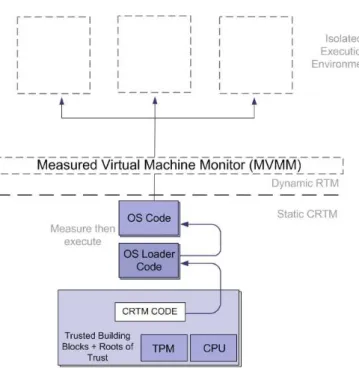
process by measuring and storing representations of a pre-defined set of platform components (typically the POST BIOS, option ROMs, the OS loader and OS) in a platform’s TPM. In this way, an immutable static root of trust (the BIOS) can extend its trust boundary to iteratively incorporate code that does not natively reside within this boundary. In each extension of the trust boundary, the target code is measured and recorded before execution control is transferred. Through this series of controlled handoffs a system can bootstrap larger and more complex software components in an authenticated manner.
In a PC architecture, this process occurs as follows. When powering on a Trusted Platform, a platform’s Root of Trust for Measurement (RTM), in combination with a TPM (see Section 2.4) and their connections to a platform’s motherboard, forms a platform’s Trusted Building Block (TBB). It is the TBB which is responsible for loading a platform’s initial (static) Operating System. Here, the RTM forms an immutable portion of the host platform’s initialisation code that executes upon a
An Overview of Trusted Computing
comprises the executable component of the Root of Trust for Measurement, typically referred to as the Core Root of Trust for Measurement (CRTM) (see Section 2.4.3). This code measures the rest of the BIOS (if present) and stores a representation of the remaining BIOS code in the platform’s TPM. The BIOS also measures and stores a representation of any optional Read-only Memory (ROM) code and the platform’s OS loader code in the TPM. Once measured, the CRTM passes off control to the OS loader, which finally measures and stores a representation of the platform’s base (static) OS. Through this sequence of measuring and executing, a transitive trust chain from the CRTM to the OS is formed. The measurements (as stored in the TPM) that make up this chain can be subsequently compared against known good measurements by either the user of the platform or some interested third party. If a mismatch is detected then the platform has failed to boot into an expected state and remedial action may be taken.
Alternatively, a Trusted Platform can launch a Dynamic-RTM (DRTM), which in turn can launch dynamic operating systems whose configurations are also measured and stored in the platform’s TPM. The concept of a DRTM, as defined by Intel in their LaGrande system architecture [68], refers to a protected isolation domain running on-top of a Measured Virtual Machine Monitor (MVMM). As we will see in Section 2.7, the DRTM, much like the CRTM, is an immutable portion of the platform, but unlike the CRTM does not require a platform reset. The DRTM is responsible for loading dynamic Operating Systems in isolated partitions. These partitions run in parallel to standard OS partitions, without requiring a system reboot, and can be used to run arbitrary code free from observation from other partitions within a single Trusted Platform.
2.4 TPM Specifications
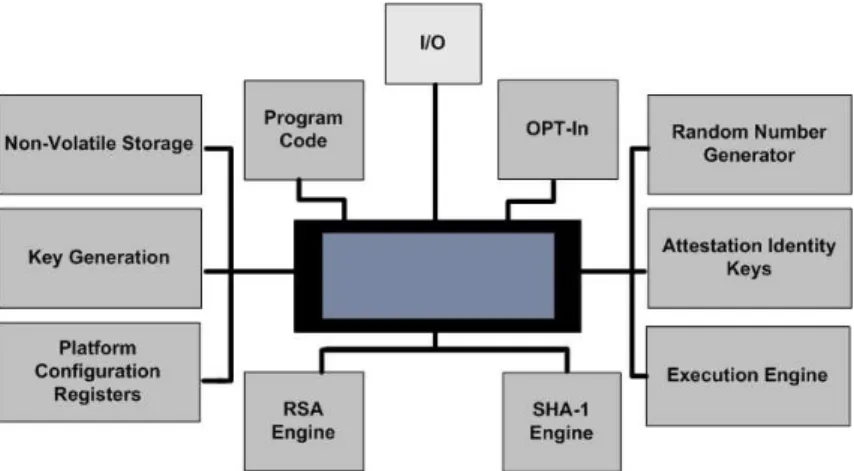
Figure 2.2: Components of Trusted Platform Module
2.4
TPM Specifications
The TPM forms the core of all efforts in Trusted Computing. A TPM (see Figure 2.2) is a microcontroller with Cryptographic Coprocessor (CCP) capabilities that is uniquely bound to a platform’s motherboard. A TPM provides a platform with the following facilities: a number of special purpose registers for recording platform state (current configuration); a means of reporting this state to remote entities; secure volatile and non-volatile memory; random number generation; a SHA-1 [92] hashing engine; and asymmetric key generation, encryption and digital signature capabilities. The TPM specifications have evolved over many years, beginning with version 1.1b and most recently with version 1.2 revision 103 [150, 153, 154].
Before a TPM can be used to provide any of the facilities described above to other processes, a TPM must first be “enabled”, “activated” and “owned”.
2.4.1 Taking Ownership of the TPM
The default delivery state for a new TPM is disabled, inactive and unowned. Be-fore a TPM can become fully operational it must move though a number of states,
An Overview of Trusted Computing
culminating in TPM ownership. In taking ownership of a TPM, certain commands require an assertion of physical presence at a platform before the command will operate. Such operations include: enabling a TPM; activating a TPM; taking own-ership of a TPM; clearing the existing owner of a TPM; temporarily deactivating a TPM and temporarily disabling a TPM. To operate these commands the TPM must obtain “unambiguous assurance” that the operation is authorised by an entity that is physically present at a platform [153]. Examples of such assurance would include “depressing a switch, setting a jumper, depressing a key on the keyboard or some other such action” [153]. When a platform is turned on for the first time, the platform informs the TPM that it is performing a boot process by sending a phys-ical (bus) signal to the TPM. As part of this process the TPM performs a number of self-diagnostic routines to ensure that it is functioning correctly. After this, the TPM performs a start-up sequence which prepares the TPM for operation.
Enabling and Activating: A disabled TPM is unable to execute any com-mands that use TPM resources. At this point a disabled TPM requires a demon-stration of physical presence in order to transition it from a disabled to an enabled state. Much like a disabled TPM, a deactivated TPM also cannot execute commands that use TPM resources. However, an enabled but deactivated TPM can begin the process of taking ownership of a TPM.
Taking Ownership: Taking ownership of a TPM is the process of inserting a secret authorisation value (usually a password) into a TPM shielded location (see Section 2.4.2). This secret value is later used to demonstrate proof of ownership when using certain TPM operations that require “TPM Owner” authorisation. Any entity that can demonstrate knowledge of this shared secret is considered the TPM Owner. As part of the ownership process, the TPM generates a new Storage Root Key (SRK, see Section 2.4.4). Once an owner is established, the addition of a new owner requires the removal of the old owner. This invalidates all information associated with the
2.4 TPM Specifications
old owner, including the SRK and all keys stored under it. Consequently, all data that is protected with TPM keys generated by the old owner will be unrecoverable.
2.4.2 Protected Capabilities and Shielded Locations
The TPM provides a number of internally shielded locations (memory and registers where it is safe to operate on sensitive data) that are only accessible through the use of a set of commands with exclusive permission to access these locations (protected capabilities). Perhaps the most important shielded locations in terms of any discus-sion of Trusted Computing functionality are the Platform Configuration Registers (PCRs), which we will now consider in detail.
2.4.3 Integrity Measurement and Storage
Trusted Computing defines several roots of trust within a TPM. Integrity measure-ment and storage fall under the purview of the Root of Trust for Measuremeasure-ment (RTM) and the Root of Trust for Storage (RTS) respectively. The RTM is a com-puting engine responsible for making intrinsically reliable integrity measurements. By the same token, the RTS is responsible for maintaining an accurate and suffi-ciently detailed record of the events measured by the RTM. The word integrity in this context refers to ensuring that state transitions are accurately reflected in the current platform state.
An integrity measurement as defined in [103] is the cryptographic digest or hash of a platform component that is capable of altering a platform’s integrity (typically a piece of software executing on the platform). For example, an integrity measurement of a program can be calculated by computing a cryptographic digest of a program’s instruction sequence, its initial state (i.e. the executable file) and its input. An
in-An Overview of Trusted Computing
tegrity metric is then a digest of one or more integrity measurements [100]. Integrity metrics are stored in a TPM’s PCRs.
Measurement: Examining the TCG integrity measurement and storage mecha-nisms at a high level, we note two structures of particular importance, namely the aforementioned PCRs and the Stored Measurement Log (SML), alternatively re-ferred to as the event log. A PCR is a 20-byte storage area that acts as a repository for recording integrity altering events within a platform. The SML is responsible for maintaining an ordered database of integrity changing events. Each PCR has responsibility for the maintenance of a cumulative digest of one or more of these events (integrity metrics). The data held in a PCR, in conjunction with the relevant portion of the SML, is used as evidence to attest to a current platform state (see Section 2.4.5).
PCR updates occur by appending the new event to be measured to the existing value contained in the PCR, and taking a SHA-1 hash of this value. This can be expressed as follows:
P CRx := HASH (P CRx k Integrity Measurement)
Here x is the number of the PCR being updated. This operation is commonly referred to as extending the digest. The use of this approach guarantees that re-lated integrity measurements will not be discarded, as the previous register value is incorporated into the new register value. It also ensures that updates to a PCR are not commutative: the order in which events occur and the measured values they contain both affect the value of the stored digest.
PCRs and the SML are intimately related. Without the representative digests contained in PCRs, the record of events maintained by the SML are unreliable (as
2.4 TPM Specifications
there is nothing to stop someone from generating false events in the log). Without the relevant portion of the SML, a PCR digest is devoid of any meaning (as the context from which the digest was generated would be lost). Consistency between the two structures is preserved by the fact that PCRs are maintained internally to the TPM and that PCR extension operations are only permitted via TPM protected capabilities. These PCRs provide evidence of attempted tampering of the log, since the sequence of events tied to a specific PCR can be extracted from the SML, rehashed and compared to the actual value contained in a PCR. Thus, the ability to securely update PCR registers is integral to the trustworthiness of a platform.
The two most important properties abstracted from the brief discussion outlined above are firstly, that atomicity of extensions is ensured, and secondly, that updates are noncommutative.
Storage: Storage, as defined by the TCG, refers to two distinct concepts. The first, which we just covered, refers to the intermediate step between measurement and reporting. The second, which we will discuss in the next section, refers to the protection of keys and data within a TPM. The responsibility for the protection of said keys and other sensitive data within a TPM falls under the oversight of the RTS. In this regard, the RTS maintains a small area of volatile memory used for performing cryptographic operations and storing data.
2.4.4 TPM Keys and Key Usage
A TPM can potentially generate an unlimited number of asymmetric key-pairs. All keys generated by the TPM (with one exception) are arranged in a hierarchy with the SRK at its root (see Figure 2.3). Every node (TPM Key) in the tree has an assigned attribute designation as well as a defined key type. Attribute designations,
An Overview of Trusted Computing
Figure 2.3: TPM Key Tree Hierarchy
as migratable, certified-migratable (see Section 2.4.4.1) or non-migratable. Private keys with either of first two designations are capable of moving from one TPM to another, whilst non-migratable private keys are inextricably bound to a single TPM instance. Only TPM-Keys that have the migratable bit set in their TPM Key Flags data structure are allowed to migrate from a TPM [150]. Key types are used to define which operations a TPM Key is capable of performing. For example, a key could be of signing type or storage type, depending on the designation of its usage.
To add a new key to the hierarchy it must be “wrapped” (encrypted) using an existing storage key in the hierarchy, creating a key “blob”. These blobs are opaque outside of the TPM and may be bound to the platform on which the TPM resides (depending on the attribute designation of the storage wrapping key). If the key is designated non-migratable then blobs may only be decrypted on the platform that created them, as the decryption key will be fixed to a particular TPM. If, however, both the wrapping key and the new key are migratable, then both blob and wrapping
2.4 TPM Specifications
key can be transferred to a different platform.
Within a TPM there are two types of key pair that hold special significance. These are the Endorsement Key pair (EK) and the Attestation Identity Key pairs (AIK). Within a TCG-conformant platform, AIK key pairs act as aliases for the EK key pair and are responsible for attesting to platform states (see Section 2.4.5). AIK key pairs are used because an EK key pair is unique per TPM instance and its use is considered a possible risk to user privacy should the EK public key become connected with personally identifiable information. As there is no prescribed limit on the number of AIK key pairs that can be used within a platform, this provides an anonymity mechanism, whereby a TPM can, for example, use different AIK key pairs each time it attests to platform integrity metrics.
2.4.4.1 Certified Migration
Certified Migration is a new concept introduced in the latest TPM specifications [153]. Certified Migration is an operation that permits the secure transfer of Certi-fied Migratable Keys (CMKs) from one TCG-compliant platform to another. This transfer occurs in such a manner as to allow the new platform full usage of the migrated key. The notion of a migratable key can be subdivided into two categories, a Migratable Key (MK) and a CMK. MKs are keys that, while not bound to a spe-cific TPM, can be transferred to another TPM if appropriate local authorisation is provided. CMKs are similar, insofar as they also require appropriate authorisation in order to migrate. However, their migration is conditional on receiving permission from a relevant external third party called a Migration Selection Authority (MSA) or Migration Authority (MA). An MSA is a third party responsible for approving the migration of a CMK to a specified destination (but does not directly handle the key itself). An MA performs a similar function to that of an MSA; however,
An Overview of Trusted Computing
an MA will act as a temporary storage area for a CMK while the CMK transits to its ultimate destination. Without this approval, the TPM will refuse to release the private CMK for migration.
2.4.4.2 Binding and Sealing
Protected storage functionality uses asymmetric encryption to protect the confiden-tiality of data on a TPM host platform. Protected storage also provides implicit integrity protection for TPM objects. Both data and keys can be associated with a string of 20 bytes of authorisation data before being encrypted. When decryption is requested, the authorisation data must be submitted to the TPM. The submitted authorisation data is then compared to the authorisation data associated with the object, and the object will only be released if the values match.
The notions of binding and sealing are of fundamental importance to Trusted Computing. Binding refers to the encryption of data with a public key for which the corresponding private key is non-migratable from the recipient’s TPM. In this way, only the TPM that manages the non-migratable private key will be capable of decrypting the message. Sealing takes binding one step further. Sealing is the process by which sensitive data can be associated with a set of integrity metrics representing a particular platform configuration, and encrypted. The protected data will only be decrypted and released for use by a TPM when the current state of the platform matches the integrity metrics to which the data is sealed.
Using sealed storage, an end-user can protect their private data by making reve-lation of that data contingent on a platform being in a particular state. For example, a user can seal credit card data to a state that requires a particular banking appli-cation to be running on the platform, and nothing more. The presence of additional memory-resident applications would change the platform state and prevent a sealed
2.4 TPM Specifications
object from being decrypted.
Depending on how one constructs the key used for binding, binding can replicate the TPM’s sealing mechanism. When generating a new non-migratable private key, if we specify a set of platform metrics (as represented by PCR values) that must be present before the private key can be used, any object encrypted with the public binding key will be bound to the state specified at key creation. The only difference between this approach and sealing is that it is a key that is bound to a platform state, whereas with sealing it can be any data object.
2.4.5 Reporting and Attestation
The final root of trust within a Trusted Platform is the Root of Trust for Reporting (RTR). Its function is to faithfully recount information held by the RTS to third parties. The mechanism through which this is achieved is referred to as “binary attestation”. For the remainder of this thesis, we refer to this as simply attestation.
Attestation within the context of Trusted Computing is the mechanism whereby a TPM-enabled platform adduces certain state characteristics that govern a plat-form’s trustworthiness. This evidence is consumed by integrity verifiers that use this evidence, in conjunction with the perceived trustworthiness of the entity perform-ing the attestation, to establish a trust level in the attestperform-ing platform. The TCG attestation protocol is illustrated in Figure 2.4 and outlined below.
1. An external entity requests one or more PCR values.
2. A platform agent culls the SML for the events responsible for generating the requested PCR values.
An Overview of Trusted Computing
Challenger Platform Agent TPM Repository
1. RequestPlatformConfiguration( ) 2. GetEventLog( ) 3. GetSignedPCR( ) 4. SignPCRValue( ) SignedPCR( ) 5. GetPlatFormCredentials( ) PlatformCredentials( ) PlatformConfiguration( ) 6. ValidatePlatformConfiguration( )
Figure 2.4: TCG Attestation Protocol [151]
calling the TPM Quote command. [154].
4. The agent then obtains credentials that vouch for the TPM (see Section 2.4.6). These credentials, along with the relevant portion of the SML and the re-quested signed PCR values, are returned to the requesting entity. We will discuss TCG credentials in greater detail in Section 2.4.6.
5. The requesting entity then examines the credentials, checks signatures and compares a hash of the received SML entries to the attested PCR values. If they match the verifier can gain some assurances as to the state of the attestor’s platform at the time the attestation was made.
However, in order for the values being attested to by a platform to have meaning outside of the confines of a challenger’s platform, it is necessary for the challenger’s platform to first obtain a credential for the AIK key pair (strictly the public com-ponent of this key pair) from a trusted third party recognised by the verifier. How this credential is obtained differs between version 1.1b and version 1.2 of the TCG specifications. Version 1.1b uses what is referred to as the Privacy CA model whilst
2.4 TPM Specifications
version 1.2 introduced an (optional) new model, Direct Anonymous Attestation (DAA), whilst also retaining the Privacy CA model.
2.4.5.1 Privacy CA
The Privacy CA approach is employed as a means of issuing AIK credentials (see Sec-tion 2.4.6) to TPM-enabled platforms. These credentials are in turn used to vouch for the trustworthiness of an attestation originating from a platform. Credential acquisition is achieved as follows:
1. A requesting TPM-enabled platform first generates an AIK key pair and gath-ers all the necessary information for a Privacy CA to examine the platform. This information includes the public component of the newly generated AIK key, as well as various credentials that vouch for the trustworthiness of the TPM-enabled platform (see Section 2.4.6). Once collected, these are sent to the Privacy CA.
2. Provided the credentials presented by a user’s platform can be validated by a Privacy CA, the Privacy CA will generate an X.509 certificate called an AIK credential. A Privacy CA will encrypt the newly created AIK credential with a symmetric key, which in turn is encrypted with the public component of the EK of the requesting platform and returned to the requesting platform.
3. Only the specific requesting platform is capable of “activating” (decrypting) the new AIK credential using its EK private component. Once decrypted, this then allows the AIK private component to be used to generate third-party verifiable signatures over platform integrity metrics (assuming the third-party trusts the Privacy CA which generated this AIK credential).
An Overview of Trusted Computing
Significant concerns were raised over the level of “privacy” afforded by this solu-tion [126]. In this model, the Privacy CA is capable of linking individual AIK public keys to a particular TPM. This is because in order to obtain an AIK credential it is necessary for a TPM to disclose its AIK-EK binding. Another potentially major issue with the Privacy-CA model remains the distinct lack of a business case for setting up and running such a CA.
2.4.5.2 Direct Anonymous Attestation
By contrast to the Privacy CA model, in the DAA approach the issuing authority should not be able to link multiple AIK credentials with a single platform identity. The DAA approach differs from the Privacy CA model in that it does not disclose AIK keys to an issuer, and hence aims to limit the exposure of AIK-EK bindings.
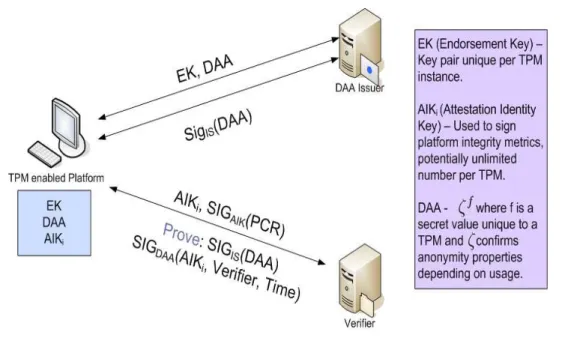
Enrolling a TPM-enabled platform with a DAA issuer occurs when a platform instigates a run of the DAA join protocol, see Figure 2.5. In this protocol, the platform obtains a credential from a trusted third party called a DAA Issuer. In practice, the role of the issuer might be played by the platform manufacturer or by a third party who wishes to offer services exploiting TPM features.
During the join protocol the platform asks to become a member of the group of platforms to which credentials have been issued by that issuer. During this pro-cess, the platform proves that it has knowledge of a specific, TPM-controlled, non-migratable secret value f, and is authenticated to the issuer via its EK credential (see Section 2.4.6). If the issuer accepts in this step, then it provides the platform with a credential in the form of a Camenisch-Lysyanskaya (CL) signature [29] on the secret value f. It is this credential that will later enable the platform to con-vince a verifier that it has previously successfully completed the join protocol with a particular issuer. Note that the issuer does not actually learnf in this process.
2.4 TPM Specifications
Figure 2.5: Simplified DAA Protocol
In order for a platform to obtain a credential for its secret value f, the plat-form must reveal a pseudonym NI of the form ζIf, where ζI is derived from the issuer’s name and is an element of some suitable group. By maintaining a history of pseudonyms that it has seen, the issuer can check if credentials have already been issued to any given TPM. The issuer can also check for rogue platforms at this stage, by testing if NI=ζIf corresponds to anf appearing on a blacklist.
Once the join phase is complete, the TPM (with the help of the platform) can use the DAA-Signing algorithm to prove to any verifier that it has an appropriate issuer credential (in the form of a CL signature), and at the same time, sign a messagem
using the secret valuef as a private key. Here, mis typically the public component of an AIK key pair, but it can also be an arbitrary external 160-bit string [27]. In the former case, the output of the DAA-Signing algorithm amounts to an attestation that the TPM is in possession of a valid issuer credential and has a particular AIK. This gives the verifier a similar assurance concerning that AIK’s linkage to a particular platform to that gained using the Privacy CA approach described above. In turn, this allows any PCR value signed by the particular AIK to be checked as
An Overview of Trusted Computing
being genuine by the verifier. Corresponding to the DAA-Signing algorithm is a DAA-Verify procedure that is executed by the verifier.
In the DAA-Signing protocol, the platform is only identified by a pseudonym. As in the join phase, this pseudonym is of the formNV =ζf, where now the selection of
ζ determines the anonymity properties of the attestation process. The value of the baseζ will typically be chosen by the verifier. In this case, if the verifier fixes on a choice ofζ(derivingζfrom its name, for example), then this will also fix the value of the pseudonymNV used by a particular platform. This will allow all the transactions
involving a particular TPM to be linked. As the secret value f is non-migratable, only the TPM that generated that value should be capable of using it. If a value off
is extracted from the TPM and distributed to other platforms, then the blacklisting approach used during the join phase can be used to detect rogue platforms, provided verifiers have access to the list of compromisedf values. The value of ζ might also be selected at random by the platform for each transaction with the verifier — this would allow the platform’s transactions to become completely unlinkable.
The full cryptographic details of DAA can be found in [27], while the TCG specification [154] contains implementation details.
2.4.5.3 Problems with Attestation
Given the potential difficulty for a verifier to assess if every operating system and ev-ery patch has a desired trusted configuration, verifiers may be forced to concentrate on a limited set of mainstream configurations. In this regard, the current attesta-tion mechanism proposed by the TCG has been criticised for shifting “some of the costs of achieving interoperability onto those who have the least incentive to bear them” [129]. In addition, binary attestation has been noted as having the following deficiencies [65, 120]:
2.4 TPM Specifications
• At present attestation only tells a verifier what version of a particular appli-cation is running. It says nothing about how an appliappli-cation will behave.
• Due to the current nature of patch management, the application of patches may potentially result in a large number of distinct configurations for a single application.
• Revoking a particular version of an application may be difficult, given the non-commutative nature of patching.
• The challenger in an attestation gains exact information about the software configuration of a platform.
To combat some of these perceived inadequacies with binary attestation, the following proposals have been put forward:
Semantic Remote Attestation [65]: In order to separate behaviour-based at-testation from binary atat-testation, semantic remote atat-testation introduces a trusted Java Virtual Machine (JVM) that is capable of attesting various properties of a Java application executing within that JVM (without revealing the code identity of the application). In this approach, software up-to-and-including the JVM must be measured using the binary attestation mechanism outlined in Section 2.4.5. This measured JVM can then be used to attest various properties of code running within it. For example, in the SETI@Home project, a server may wish to test the floating point behaviour of the system by having the JVM run a test suite of floating point number programs. The results of this test suite can be attested to by the JVM and provide assurances of how the system behaves with respect to its handling of such numbers. Unfortunately, there may be a limit on what semantic remote attestation can actually attest to using this approach as an attesting host may be unwilling to run arbitrary code of unknown provenance.
An Overview of Trusted Computing
Property Based Attestation [120]: This approach introduces an additional layer of indirection into the attestation process. Instead of expecting a verifier to deter-mine if a particular state is trustworthy or not, a platform state should be certified (by a trusted third party) as satisfying certain properties. A platform should then be capable of attesting that its current configuration matches such a property, al-lowing a verifier to infer whether a platform is trustworthy or not without knowing which particular software is running. The authors of [120] suggest that this approach could be realised either through a Trusted Attestation Service (similar to the trusted JVM approach of semantic remote attestation) or through modifications to the TPM hardware. Unfortunately, this approach shifts the problems with binary attestation to an entity other than the verifier. Many of the original problems persist, and, as with the Privacy CA, there is yet to emerge a clear business case for an entity to provide such a service. Additionally, exactly what properties can be satisfied using such an approach remains an open question. For the remainder of this thesis, we predominantly concentrate on binary attestation as specified by the TCG. Where indicated we will highlight how these alternative attestation proposals could be used to improve our solutions.
2.4.5.4 Subject Key Attestation Evidence
The Subject Key Attestation Evidence (SKAE) X.509 extension was proposed as a means of coping with difficulties in integrating TPM-controlled keys with stan-dard security protocols [145]. An SKAE X.509 certificate, issued by an SKAE CA, provides a mechanism to allow a verifier to ascertain that an operation involving a private key was performed within a TCG-compliant TPM environment. Once is-sued, an SKAE certificate can be used as an aid to authentication in protocols such as SSL/TLS [42] or IKEv2 [105, 125].
2.4 TPM Specifications
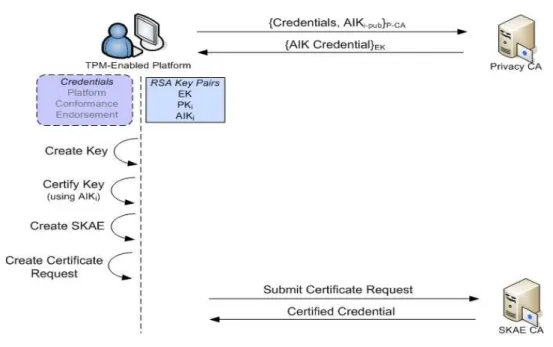
Figure 2.6: Simplified SKAE Protocol
The process of obtaining an SKAE certificate occurs as follows (see Figure 2.6):
1. A user instrusts their TPM to generate a new asymmetric key pair, Ki. In
generating this key, the user specifies mobility, usage and authorisation con-straints for the private portion of Ki.
2. A user’s TPM signs (using the private component of a previously certified AIK key pair), the public component of Ki to produce a TPM Certify Info
structure.
3. A user applies to an SKAE CA for certification of the public component ofKi
by creating a certificate request package incorporating the TPM Certify Info structure.
4. If the SKAE CA is satisfied as to the AIK/public key binding, then an X.509 public-key certificate is issued by the SKAE CA to the platform. Here the certificate not only includes the public portion of Ki which has been
cryp-An Overview of Trusted Computing
relying party to validate this binding.
2.4.6 TCG Credentials
The issue of certification plays an important role in defining what is meant by a Trusted Platform. In this regard there are five interrelated credentials (X.509 certificates) that adduce the existence of a correctly functioning TPM within a platform. These credentials and their relationships are shown in Figure 2.7 and discussed below.
2.5 Trusted PC and Trusted Server Specifications
• Endorsement credential: This credential vouches that a TPM is gen-uine and is issued by whomever generated the EK pair, typically the TPM manufacturer or vendor.
• Conformance credentials: These credentials vouch that the TPM design conforms with established evaluation guidelines as laid out by the TCG. These credentials are issued by entities with sufficient credibility to evaluate a TPM, typically conformance testing facilities.
• Platform credential: This credential provides evidence that a platform contains a TPM and incorporates references to both the endorsement and conformance credentials. This is typically generated by a platform vendor.
• AIK credentials: These credentials are issued per AIK key pair and attest that a particular AIK key pair belongs to a specified TPM, and that the AIK key pair is tied to valid endorsement, platform and conformance credentials. These credentials are issued by Privacy CAs.
• Validation credential: This credential provides signed reference measure-ments (digests of the measured components, such as software, taken during development when the components are believed to be in a stable condition) which can be compared against load-time measurements to assure interested parties that their application is performing as intended. These load-time mea-surements will be signed by AIK private keys.
2.5
Trusted PC and Trusted Server Specifications
Both the Trusted PC [148] and Trusted Server [146] specifications provide generic implementation reference documentation for building Trusted Platforms at the client and server-side respectively.
An Overview of Trusted Computing
The Trusted PC specification deals primarily with instantiating the various ele-ments involved in transitioning a platform from its pre-boot to its post-boot state. Within this transition, various usage constraints are defined for TPM components, such as usage of PCR registers, as well as guidelines for handling option ROMs. The specification also outlines programmatic interfaces to the BIOS, as well as detailing how physical presence can be demonstrated on a TPM-enabled platform.
The Server specification details much of the same functionality as the Trusted PC specification, but introduces a number of new concepts that are of special in-terest in server architectures. In particular, it highlights the distinctions between partitions and platforms. The specification defines a partition as “the hardware and firmware environment, which provides the support for the execution of a single operating system image within a separated trust environment” [146]. A platform is later defined as “the complete package of physical hardware and firmware that a manufacturer produces for a single server product. This may be configured as one or more partitions” [146]. The issue of dynamic reconfiguration is addressed only insofar as stating that the measurement of asynchronous events is the responsibility of the post-boot software environment.
2.6
TNC Specification
The Trusted Network Connect (TNC) specification [152] forms a subclass of the Infrastructure Work Group (IWG) interoperability specification [147], and deals predominantly with enabling the enforcement of operator-controlled policies for end-point security in determining network access.
TNC offers a way of verifying an endpoint’s integrity to ensure that it complies with a particular predefined policy, for example, ensuring that a certain software
2.6 TNC Specification
Figure 2.8: TNC Architecture
state exists on a platform prior to being granted network access, requiring that firmware or software patch updates be installed.
Attestation (as discussed in Section 2.4.5) forms an important focus of the TNC specifications. The process of assaying end-point integrity for compliance with policy occurs in three distinct phases: assessment, isolation and remediation.
The assessment phase primarily involves an Access Requester (AR) wishing to gain access to a restricted network (see Figure 2.8). In this phase, the Integrity Measurement Verifier (IMV) on a Policy Decision Point (PDP) examines the in-tegrity metrics coming from the Inin-tegrity Measurement Collector (IMC) on the AR’s platform and compares them to its network access policies. From this process of reconciliation the PDP informs a Policy Enforcement Point (PEP) of its decision regarding the AR’s access request. The PEP is then responsible for enforcing the PDP’s decision. As an extension to the assessment phase, in the event that the AR has been authenticated but failed the IMV’s integrity-verification procedure, a process of isolation may be instigated whereby the PDP passes instructions to the
An Overview of Trusted Computing
PEP which are then passed to the AR directing it to an isolation network. The final phase, remediation, is where the AR on the isolation network obtains the requisite integrity-related updates that will allow it to satisfy the PDP’s access policy.
2.7
Operating System and Processor Support
Recently the definition of what constitutes Trusted Computing functionality has been revised and extended to incorporate the concepts of new OS design(s) and hardware-enforced isolation. Hardware-enforced software isolation enables the seg-regation of security-critical software and data so that it cannot be observed and/or modified in an unauthorised manner by software executing in parallel execution envi-ronments. Additionally, the presence of isolated execution environments can ensure that any infection that does occur is contained within the execution environment in which the infection happens.
A Trusted OS design will natively support TPM access as well as providing sandboxed execution environments in which applications can run. In this respect, processor and chipset extensions will provide the hardware support for the creation of these protected environments and act as a basis for enforcing application level sandboxing within main memory.
Isolation technologies have evolved from OS-hosted Virtual Machine Monitors (VMMs) [161] through stand-alone VMMs [57] to para-virtualisation techniques [24]. More recent developments in isolation technology, such as Microsoft’s NGSCB OS [102, 103] and the PERSEUS framework [104] running with the L4µ-Kernel2, incor-porate the concept of an isolation layer that can take advantage of initiatives in the domain of processor and chipset extensions described in Intel’s LaGrande [68] and
2.7 Operating System and Processor Support
AMD’s AMD-V [4] initiatives. This allows a platform to be partitioned into one or more isolated execution environments, typically implemented as one or more Virtual Machines (VMs) each of which may be running an individual OS or a virtualised application.
An isolated execution environment, independent of how it is implemented, should provide the following services to hosted software [103]:
• No interference: Ensures that a program is free from interference from entities outside its execution space.
• Trusted path: Ensures the presence of a trusted path between a program and an input device.
• Secure inter-process communication: Enables one program to communicate with another, without compromising the confidentiality and integrity of its own memory locations.
• Non-observation: Ensures that an executing process and the memory locations it is working upon are free from observation by other processes.
An Overview of Trusted Computing
2.8
Summary
In this chapter, we have given an introduction to the basic concepts of Trusted Computing. We discussed the components of Trusted Platforms and provided an overview of the TCG specification set. For the interested reader, introductory texts on Trusted Computing can be found in [88, 100].
Part I
Securing Internet-Based CNP
Transactions
Chapter 3
Card Payments
Contents
3.1 Introduction . . . 55 3.2 Card Payment Processing Model . . . 57 3.3 Threats to CNP Transactions . . . 60 3.4 Protocols for Protecting CNP Transactions . . . 64
3.4.1 SSL/TLS . . . 64 3.4.2 SET . . . 67 3.4.3 3-D Secure . . . 69
3.5 EMV . . . 71
3.5.1 Transaction processing . . . 72 3.5.2 EMV Key Usage . . . 75
3.6 Summary . . . 78
In this chapter we examine the payment model used for card-based transactions both at the Point of Sale (PoS) and for Card Not Present (CNP) transactions. We look at a number of threats intrinsic to CNP transaction processing and examine a number of protocols used to secure CNP transactions. Furthermore we examine the extent to which these protocols address the identified threats. We conclude this chapter with an overview of the Europay-Visa-Mastercard (EMV) standards for use in PoS environments. This chapter acts as a primer for the remainder of Part I.

![Figure 2.4: TCG Attestation Protocol [151]](https://thumb-us.123doks.com/thumbv2/123dok_us/1424672.2690682/39.892.147.695.180.511/figure-tcg-attestation-protocol.webp)
![Figure 2.7: TCG Credentials and their Relationships [151]](https://thumb-us.123doks.com/thumbv2/123dok_us/1424672.2690682/47.892.232.619.502.1064/figure-tcg-credentials-and-their-relationships.webp)