G
R
E
E
N
S
E
A
L
’
S
R
E
P
O
R
T
FEBRUARY 2005
WOOD FINISHES AND STAINS
The overall market for wood finishes -- coatings which, unlike paint,
do not completely mask the wood’s appearance -- has been
grow-ing, along with the demand for environmentally preferable wood
finishes.
The demand for finishes for wood furniture, floors, and fixtures
has increased from 82 million gallons to 100 million gallons over
the last 5 years.
About $2 billion in wood finishes were sold in 2004.
T
his increased demand for wood coatings has been driven by favorable housing markets fueled by low interest rates, the trend toward larger, more expensive homes, and an increase in homeowners improving and redecorating their dwellings, inside and out. At the same time, decorating trends that focus on the warmth and beauty of wood in the form of exposed wood floors, walls, and homefurniture increase the demand for wood finishes as alternatives to paint.
Many of the products used to coat wood around the home have traditionally contained volatile organic solvents and other toxic chemicals that have been linked to poor indoor air quality and possible health impacts. But because of increasing public awareness of indoor air pollution and chemical
toxicity in household and building products, manufacturers of wood coatings are offering many more
products that are low in volatile organic compounds (VOCs) and formulated without aromatic solvents, heavy metals, or cancer-causing chemicals. These products are healthier for the users of these products – namely, workers on new home construction projects and do-it-yourself homeowners – as well as the occupants of buildings where these finishing products have been applied. Wood-finish manufacturers have also stepped up the production of “green” products because of the rising interest among developers in obtaining Leadership in Energy and Environmental Design (LEED) certification for new buildings. Sales of waterborne coatings (including paints and wood finishes) now dominate the national
Wood-finish manu-facturers have also stepped up the
pro-duction of “green” products because of
the rising interest among developers in obtaining
Leader-ship in Energy and Environmental Design (LEED) certification for new
2 Choose Green Report
The Choose Green Report is published for Green Seal Environmental Partners. To become an Environmental Partner, or to receive a copy of this report, contact Green Seal at (202) 872-6400 or [email protected].
Green Seal President and CEO, Arthur B. Weissman, Ph.D.
Researchers and Writers, Kimberly Davis, P.E., Kristen VanHooreweghe and Mary Swanson, The University of Tennessee, Knoxville, Energy, Environment and Resources Center
Design, Cutting Edge Design
Original printed on Green Seal-certified Mohawk Satin Cool White Recycled paper, 30% postconsumer content
This Choose Green Report was pro-duced with assistance from the U.S. Environmental Protection Agency’s Pollution Prevention Division.
Copyright © 2005, Green Seal, Inc. www.greenseal.org
G
REENS
EALENVIRONMENTAL PARTNER
market; in California, waterborne coatings accounted for 83% of sales of architectural coatings in 2001.
This Choose Green Report
focuses on interior and exterior wood finishes used as architectural
A WOOD FINISH:
Protects
wood from
scratches, dirt, and wear
Enhances
wood’s natural
beauty, color, figure pat-
terns, grain, and depth.
Preserves
wood from wa-
ter, oxidation, and the
sun’s ultraviolet rays.
Changes
wood’s
appear-ance by adding color and
hiding defects.
coatings (excluding paint). The report begins with a general description of wood finishes and continues with a discussion of health and environmental concerns associated with the use of these finishes. The report concludes with a description of Green Seal’s criteria for environmentally preferable wood finishes and a list of product recommendations.
What is a
Wood Finish?
A finish is a liquid, paste, or gel that can be spread thinly onto wood. There are two basic types of wood finish: those that form a film or coating on the wood and those that penetrate the wood surface. Film finishes, which cure hard and can be built up in layers, include varnish, shellac, lacquer, water- and latex-based semi-transparent stains, and solid-color stains. Penetrating finishes are oil-based and don’t cure to a hard film. These include oil finishes, such as tung and linseed oil, and oil-based stains.
Wood finishes, rather than paints, are often used to showcase the natural beauty of wood grain, such as on floors and interior trim. Outside, wood finishes are used on decks and siding.
Wood finishes can include a number of components:
• Pigments or dyes are used in wood stains to add color and hide flaws.
• Resin is the natural or synthetic film-forming component of these finishes. (Resins are also called binders, especially when used in stains or paints, because they hold – or bind – the
pigment to the wood surface.) Resins include acrylics, vinyls, alkyds, cellulosics, epoxies, polyurethanes, and oils. The type of resin determines the finish’s hardness, flexibility, and resistance to stains, solvents, and water.
• Solvents and/or thinners are used to maintain the finish in liquid form. Solvents are needed to dissolve resins. Thinners are used to reduce viscosity (thickness) of the
Varnishes.
Technically, all resin-and-solvent mixes are varnishes. Shellac is a spirit varnish—it uses distilled spirits (denatured alcohol) as a solvent, while spar varnish uses a drying-type vegetable oil (typically tung oil) combined with phenolic resin. In today’s common usage, “varnish” means a mix of drying oil and a natural orartificial resin that is cooked (often with an inert-metal catalyst) to make a clear finish that is typically used indoors. Varnish, which cures by chemical reaction (polymerization), is known for good resistance to heat, solvents, and water. Alkyd and polyurethane varnishes, however, may contain high VOCs. Water-based varnishes using polyurethane or acrylic polymers have been developed that emit lower VOCs.
Shellacs.
In its pure form, shellac is a natural resin secreted by the lac insect, found mostly in India and Thailand. Shellac cures as its solvent, alcohol, evaporates. Although it creates a brilliant shine, shellac’s uses are limited because of its susceptibility to damage from liquids and heat. Shellac is useful for touch-ups because it bonds well to most other finishes. Shellac is also used as a sealer and under-coat with lacquer or varnish and polyurethane. It may not be compatible as a sealer under certain polyurethanes, though, because of the natural wax it contains.Lacquers.
Lacquer is a clear finish best suited for accenting wood grain. It dries fast and is very durable. The most common liquid. Some finishes containboth solvents and thinners. Solvent-based coatings typically use organic solvents such as alcohols, ketones, glycol ethers, petroleum distillates (mineral spirits, toluene, xylenes, and naphtha), and turpentine. The solvent in a waterborne coating is usually a glycol ether, and water is used as a thinner. • Various additives
are used, in smaller amounts, to adjust drying time, prevent fungus and mildew growth, act as thickeners, etc. For centuries, varnish (a catch-all term for clear wood finishes) was made from resins collected from natural products such as tree saps or insect secretions and mixed with linseed or other natural oils. To create the final
product, the mixture was thinned with turpentine. More recently, synthetic resins derived from coal tar and petroleum began to replace the natural resins, and petroleum distillates became the most commonly used solvents. The petroleum-based products in the synthetic resins helped increase durability. But, beginning in the 1970s, increased concerns over the impact of certain chemicals on human health and the environment accelerated a trend toward the development of high-solids (lower-VOC) finishes and water-based products. A resurgence in the use of pure oils and shellacs containing natural ingredients marks another recent trend in wood finishes.
This Choose Green Report covers varnishes, shellacs, lacquers, natural oils, water-based wood finishes, and wood stains.
Beginning in the 1970s, increased concerns over the impact of certain chemicals on
hu-man health and the environment accelerated a trend toward the develop-ment of high-solids (lower-VOC) finishes and water-based
products.
type, nitrocellulose lacquer, uses a binder made from a natural polymer, cellulose, which is derived from wood or cotton. Lacquer thinner is a blend of solvents, which may include ketones and esters, alcohols, and fast-evaporating hydrocarbons such as toluene or xylene. Like shellac, lacquer cures by evaporation. Without a clear protective coating, it is easily scratched and susceptible to water damage. Another drawback to lacquer is its typically high solvent content.
Natural oils.
Linseed and tung oils are penetrating finishes that cure by absorbing oxygen from the air, a process that strengthens the finish. Linseed oil is extracted from flax seeds. Boiled linseed oil used in wood finishing has been mixed with chemical additives to hasten the drying time. Tung oil is derived from the nuts of trees that are native to Asia. These oils are durable, water-resistant, and easy to apply but require several coats and are slow-drying. Natural oils that have been heat-treated to increase gloss and hardness and reduce curing time are called polymerized oils.Water-based.
Water-based finishes are actually made up of droplets of solvent-based finish, usually acrylic or polyurethane, and a solvent, usually a glycol ether, with water functioning as a thinner. Water-based finishes cure by coalescing: the droplets of finish move closer together and interlock as the water evaporates. Water-based finishes offer minimal solvent fumes, easy cleanup, and good scuff resistance, but they may raise the wood grain and offer only moderate resistance to water, heat, and solvents.Wood Stains
A wood stain is a finish for wood that contains a dye or pigment. Stains typically impart a semi-transparent or opaque coating and are designed to change the color of a surface without concealing the grain pattern or surface
texture. More and more homeowners, builders, and architects are turning to penetrating stains instead of paints, especially for exterior use. Unlike paints, which form a film on the surface, these stains soak into the wood, accenting
the wood grain rather than hiding it. Stains become part of the wood, which helps to prevent the cracking, peeling, chipping, or blistering that commonly occurs with paints.
Exterior stains.
Exterior stains are used primarily on wood siding, shingles, decks and outdoor structures, and furniture. They are available in latex- and oil-based formulas. Oil-based semi-transparent stains offer the best protection of wood fully exposed to weather; they can also be used on new or weathered wood, or wood previously finished with other penetrating finishes, without extensive surface preparation. If a solid color is desired, latex opaque stains are preferable over oil-based opaque stains, since they are more flexible, have better color retention, and are less prone to mildew. However, extensive surface preparation is required for proper adhesion, and latex stains in general should not be used on structures exposed to direct sunlight.Interior stains.
Interior stains, used for furniture and woodwork, come in either pigmented or dye categories. Both can have an oil, synthetic, or water base. Pigmented stains color the wood with the same type of pigments used in paint. They range in color from almost clear to semi-transparent. They are easily applied with a brush or a rag, and are then wiped off to control the depth of the stain. An oil or polyurethane finish is often mixed with the stain, so the do-it-yourselfer can complete the staining and finishing job in one step.Health and
Environ-mental Concerns
As organic materials in finishes evaporate during the drying/curing process, VOCs are released into the air, affecting indoor and outdoor air quality. The American Lung Association reports that VOCs and their byproducts can produce a number of physical problems, including eye and skin irritation, lung and breathing problems, headaches, nausea, muscle weakness, and liver and kidney damage. VOC levels can be ten times higher indoors than
outdoors, with numbers rising up to 1,000 times higher immediately following application of a new coat of finish. Outside, VOCs released into the atmosphere can combine with each other, or with other substances in the air, to create new chemical compounds, such as ground-level ozone. Ozone is a major component of smog, which causes negative health and environmental impacts when present in high concentrations at ground level.
VOCs are considered air pollutants, and the amount that can be released for a given amount of solids is now regulated in many areas. Regulations that restrict the amount of VOCs in architectural coatings have been enacted federally and in many states, including California, New York, Texas, Massachusetts, New Jersey, and Arizona, with legislation pending in many other states. Legislation controlling VOC content varies around the country, but most U.S. companies are formulating their finishes to comply with California regulations, which allow up to 350 grams per liter (g/L) of VOCs in varnishes and up to 250 g/L of VOCs in stains.
The American Lung Association reports that VOCs and their byproducts can produce a number
of physical prob-lems, including eye and skin irritation, lung and
breath-ing problems, headaches, nausea,
muscle weakness, and liver and kidney damage.
The Environmental Protection Agency’s National Volatile Organic
Compound Emission Standards for Architectural Coatings went into
effect in 1999, under the Clean Air Act.
The EPA determined that architectural coatings account for
9 percent of the VOC emissions from all products.
Unlike paints, which form a film on the surface, these stains soak into
the wood, ac-centing the wood
grain rather than hiding it.
Choose Green Report 5
Water-based Finishes
Another way to decrease air emissions from wood finishes is to change the formulation to awater-based coating. The new water-based products achieve a dramatic improvement over solvent-based finishes in terms of VOC emissions and worker comfort and health. Companies that have successfully switched to
water-based coatings have worked closely with their suppliers to determine the best water-based formula for their specific uses. Other new air-quality regulations
for VOC levels are poised to go into effect around the country, some beginning in January 2005. In many U.S. states, including Delaware, District of Columbia, Maryland, New Jersey, New York, Pennsylvania, and Virginia, the VOC limit for finishes will drop to 350 VOC g/L.
Wood finishes may also contain other toxic ingredients. For example, 1,4-dioxane and acetaldehyde are suspected carcinogens. N-methyl
pyrrolidinone is a reproductive toxin. And aromatic solvents such as toluene and xylene can cause a number of health problems if inhaled. All of these examples are currently reported as ingredients in some wood-finishing products.
Lead, a well-known toxic metal, had been used as a metallic drier in oil and resin varnishes; lead has since been replaced by other metals such as cobalt and zinc. Metals may still be problematic because of their environmental toxicity and persistence. Phthalates, used as plasticizers, are of concern because they may potentially affect human and animal hormone systems. Ozone-depleting compounds, such as the solvent 1,1,1-trichloroethane, have been phased out of most products. Wood finishes that include a preservative, such as a fungicide, must be registered under the Federal Insecticide, Fungicide, and Rodenticide Act.
Lower-VOC Finishes
Over the past few years, regulation under the Clean Air Act and consumer demand for low-VOC finishes have led to the creation of a variety of new products. Many penetrating finishes, such as semi-transparent stains, have low solids content (pigment, oils, polymers) and are being reformulated to meet low-VOC regulations. To meet the low-VOC requirements, these reformulated• Always review the manufacturer's recommendations before
applying any type of wood finish.
• Use proper respirators, ventilation, and protective clothing as
recommended by the finish manufacturer.
finishes may contain higher solids content, reactive diluents, new types of solvents and/or co-solvents, or other non-traditional substituents. These low-VOC requirements favor film-forming formulations over products that penetrate the wood surface, since traditional wood stains were formulated to penetrate the wood, and the new formulations that meet the VOC requirements may not penetrate as well.
Product
Recommendations
In order to recommend specific wood-finish products, Green Seal developed product selection criteria and evaluated wood-finish products currently available on the market. These criteria are based on health and environmental concerns related to the use of wood finishes, a review of existing environmental standards and criteria for paints, stains, and varnishes as well as applicable state and federal VOC regulations, and a survey of product manufacturers. Existing environmental standards and criteria generally limit VOCs and prohibit or limit carcinogens, aromatic solvents, phthalates, heavy metals, reproductive toxins, and ozone-depleting chemicals.We also surveyed wood-finish manufacturers. Survey responses and product data, such as Material Safety Data Sheets (MSDSs), from the companies that participated in the Green Seal survey indicated a number of products available on the U.S. market that met our selection criteria.
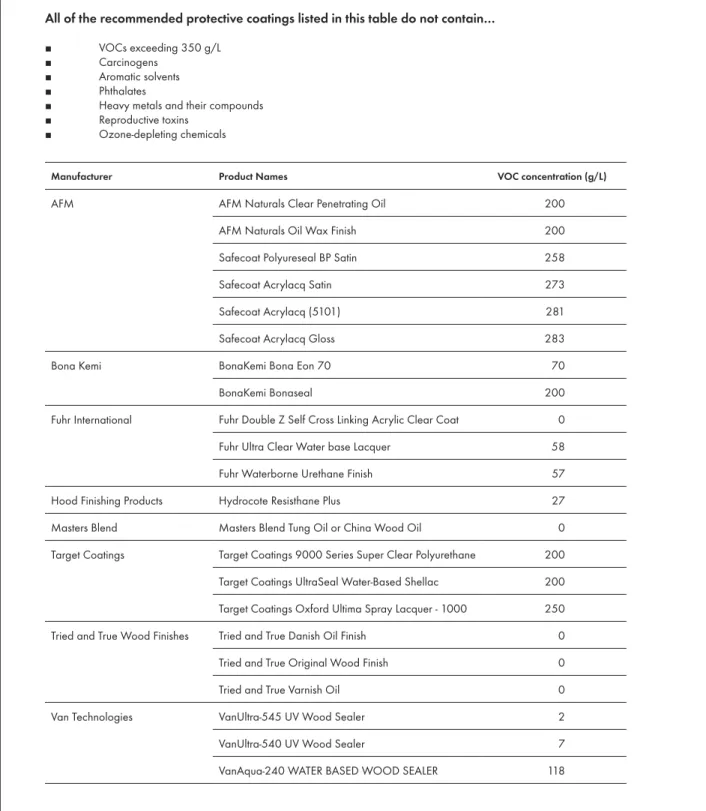
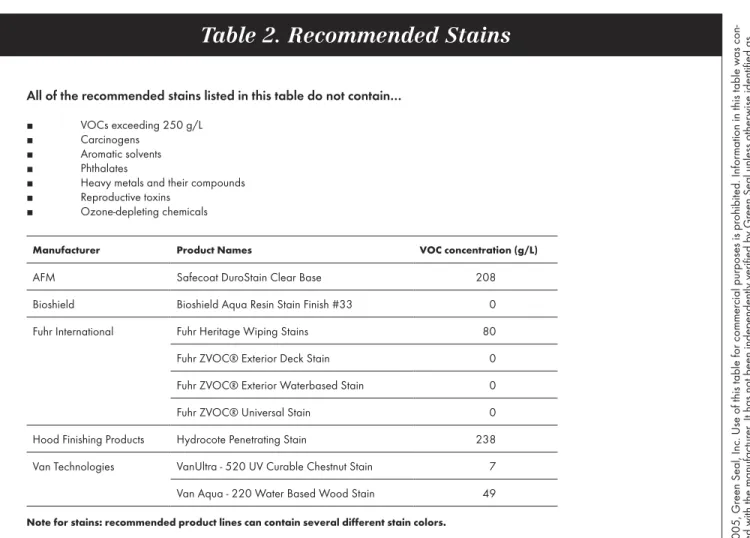
Stains generally contain less VOCs, so the VOC limit is lower for stains than for other finishes. Other than VOC level, the selection criteria were the same and are indicated at the beginning of the tables below. The first table lists recommended interior and exterior wood-finish products (excluding stains). The second table lists recommended interior and exterior wood-stain products. The last table provides contact information for manufacturers with listed products.
The new water-based products achieve a dramatic
improvement over solvent-based finishes in terms of VOC emissions and worker comfort and
6 Choose Green Report
Table 1. Recommended Wood Coatings (Excluding Stains)
All of the recommended protective coatings listed in this table do not contain…
VOCs exceeding 350 g/L
Carcinogens
Aromatic solvents
Phthalates
Heavy metals and their compounds
Reproductive toxins
Ozone-depleting chemicals
Manufacturer Product Names VOC concentration (g/L)
AFM AFM Naturals Clear Penetrating Oil 200
AFM Naturals Oil Wax Finish 200
Safecoat Polyureseal BP Satin 258
Safecoat Acrylacq Satin 273
Safecoat Acrylacq (5101) 281
Safecoat Acrylacq Gloss 283
Bona Kemi BonaKemi Bona Eon 70 70
BonaKemi Bonaseal 200
Fuhr International Fuhr Double Z Self Cross Linking Acrylic Clear Coat 0 Fuhr Ultra Clear Water base Lacquer 58 Fuhr Waterborne Urethane Finish 57 Hood Finishing Products Hydrocote Resisthane Plus 27 Masters Blend Masters Blend Tung Oil or China Wood Oil 0 Target Coatings Target Coatings 9000 Series Super Clear Polyurethane 200 Target Coatings UltraSeal Water-Based Shellac 200 Target Coatings Oxford Ultima Spray Lacquer - 1000 250 Tried and True Wood Finishes Tried and True Danish Oil Finish 0 Tried and True Original Wood Finish 0
Tried and True Varnish Oil 0
Van Technologies VanUltra-545 UV Wood Sealer 2
VanUltra-540 UV Wood Sealer 7
VanAqua-240 WATER BASED WOOD SEALER 118
© 2005, Gr
een Seal, Inc. Use of t
his t
able for commer
cial pur poses is pr ohibit ed. Infor mation in t his t able w as con -fir med wit h t he manuf actur er . It has no t been independentl y v er ified b y Gr
een Seal unless o
ther
wise identified as
Gr
een Seal cer
Choose Green Report 7
Table 2. Recommended Stains
All of the recommended stains listed in this table do not contain…
VOCs exceeding 250 g/L
Carcinogens
Aromatic solvents
Phthalates
Heavy metals and their compounds
Reproductive toxins
Ozone-depleting chemicals
Manufacturer Product Names VOC concentration (g/L)
AFM Safecoat DuroStain Clear Base 208
Bioshield Bioshield Aqua Resin Stain Finish #33 0 Fuhr International Fuhr Heritage Wiping Stains 80 Fuhr ZVOC® Exterior Deck Stain 0 Fuhr ZVOC® Exterior Waterbased Stain 0
Fuhr ZVOC® Universal Stain 0
Hood Finishing Products Hydrocote Penetrating Stain 238 Van Technologies VanUltra - 520 UV Curable Chestnut Stain 7 Van Aqua - 220 Water Based Wood Stain 49 Note for stains: recommended product lines can contain several different stain colors.
© 2005, Gr
een Seal, Inc. Use of t
his t
able for commer
cial pur poses is pr ohibit ed. Infor mation in t his t able w as con -fir med wit h t he manuf actur er . It has no t been independentl y v er ified b y Gr
een Seal unless o
ther
wise identified as
Gr
een Seal cer
1001 CONNECTICUT AVE., NW SUITE 827 WASHINGTON, D.C. 20036 NON-PROFIT ORG. US POSTAGE PAID WASHINGTON, DC PERMIT NO. 5515
I N T H I S I S S U E
—
Recommended
Wood Coating and
Staining Products
— Wood finish components
— Lower VOC finishes
— Water-based finishes
MANUFACTURER CONTACT INFORMATION
AFM 800-239-0321 www.afmsafecoat.com
Bioshield 800-621-2591 www.bioshieldpaint.com
Bona Kemi 800-872-5515 www.bonakemi.com
Fuhr International 800-558-7437 www.fuhrinternational.com Hood Finishing Products 800-229-0934 www.hoodfinishing.com
Masters Blend 860-651-5536 Not available
Target Coatings 800-752-9922 www.targetcoatings.com
Tried and True Wood Finishes 607-387-9280 www.triedandtruewoodfinish.com Van Technologies 218-525-9424 www.vtcoatings.com