Recognition and Path Prediction for
Advanced Driver Assistance Systems
zur Erlangung des akademischen Grades eines
Doktors der Ingenieurwissenschaften
von der KIT-Fakultät für Informatik des Karlsruher Instituts für Technologie (KIT)
genehmigte
Dissertation
von
Andreas Schulz
aus Rastatt
Tag der mündlichen Prüfung: 8. November 2016
Erster Gutachter: Prof. Dr.-Ing. Rainer Stiefelhagen Zweiter Gutachter: Prof. Dr.-Ing. Johann Marius Zöllner
Fortgeschrittene Fahrerassistenzsysteme (FAS) spielen eine sehr wichtige Rolle in zukünf-tigen Fahrzeugen um die Sicherheit für den Fahrer, der Fahrgäste und ungeschützte Ver-kehrsteilnehmer wie Fußgänger und Radfahrer zu erhöhen. Diese Art von Systemen ver-sucht in begrenztem Rahmen, Zusammenstöße in gefährlichen Situationen mit einem unauf-merksamen Fahrer und Fußgänger durch das Auslösen einer automatischen Notbremsung zu vermeiden. Aufgrund der hohen Variabilität an Fußgängerbewegungsmustern werden beste-hende Systeme in einer konservativen Art und Weise konzipiert, um durch eine Restriktion auf beherrschbare Umgebungen mögliche Fehlauslöseraten drastisch zu reduzieren, wie z.B. in Szenarien in denen Fußgänger plötzlich anhalten und dadurch die Situation deeskalieren. Um dieses Problem zu überwinden, stellt eine zuverlässige Fußgängerabsichtserkennung und Pfadvorhersage einen großen Wert dar.
In dieser Arbeit wird die gesamte Ablaufkette eines Stereo-Video basierten Systems zur Intentionsschätzung und Pfadvorhersage von Fußgängern beschrieben, welches in einer spä-teren Funktionsentscheidung für eine automatische Notbremsung verwendet wird.
Im ersten von drei Hauptbestandteilen wird ein Echtzeit-Verfahren vorgeschlagen, das in niedrig aufgelösten Bildern aus komplexen und hoch dynamischen Innerstadt-Szenarien ver-sucht, die Köpfe von Fußgängern zu lokalisieren und deren Pose zu schätzen. Einzelbild-basierte Schätzungen werden aus den Wahrscheinlichkeitsausgaben von acht angelernten Kopfposen-spezifischen Detektoren abgeleitet, die im Bildbereich eines Fußgängerkandida-ten angewendet werden. Weitere Robustheit in der Kopflokalisierung wird durch Hinzunah-me von Stereo-Tiefeninformation erreicht. Darüber hinaus werden die Kopfpositionen und deren Pose über die Zeit durch die Implementierung eines Partikelfilters geglättet.
Für die Intentionsschätzung von Fußgängern wird die Verwendung eines robusten und leis-tungsstarken Ansatzes des Maschinellen Lernens in unterschiedlichen Szenarien untersucht. Dieser Ansatz ist in der Lage, für Zeitreihen von Beobachtungen, die inneren Unterstruktu-ren einer bestimmten Absichtsklasse zu modellieUnterstruktu-ren und zusätzlich die extrinsische Dynamik zwischen unterschiedlichen Absichtsklassen zu erfassen. Das Verfahren integriert bedeutsa-me extrahierte Merkmale aus der Fußgängerdynamik sowie Kontextinformationen mithilfe der menschlichen Kopfpose.
Zum Schluss wird ein Verfahren zur Pfadvorhersage vorgestellt, welches die Prädiktions-schritte eines Filters für multiple Bewegungsmodelle für einen Zeithorizont von ungefähr
rende Pfadprädiktionsfehler um ein signifikantes Maß reduziert werden. Eine Vielzahl von Szenarien wird behandelt, einschließlich seitlich querender oder anhaltender Fußgänger oder Personen, die zunächst entlang des Bürgersteigs gehen aber dann plötzlich in Richtung der Fahrbahn einbiegen.
Advanced driver assistance systems (ADAS) play a very important role in manufacturing fu-ture vehicles to enhance safety for human drivers, passengers and vulnerable road users like pedestrians and cyclists. These systems try to avoid collisions in dangerous situations in-volving an inattentive driver and pedestrian by triggering an autonomous emergency braking. Due to the high variability in pedestrian movement behavior, existing systems are designed in a conservative way by decreasing benefit in order to reduce false activation rates in scenar-ios where pedestrians are suddenly stopping and deescalating the situation. To overcome this problem, a reliable pedestrian intention recognition and path prediction are of great value. This work presents the overall processing chain of a stereo-video based system for pedes-trian intention recognition and path prediction in daily traffic scenarios to be integrated into a function for automatic emergency braking.
As one of three major parts, first, a real-time method is proposed that tries to localize pedes-trian heads and to estimate their poses in low resolution gray value images including complex highly dynamic inner-city scenarios. Single frame based estimates are derived using confi-dence outputs of eight trained head pose classifiers applied at the image region of a pedestrian candidate. Further robustness in head localization is achieved by incorporating stereo depth information. Furthermore, head positions and head poses are tracked over time by imple-menting a particle filter.
For the task of intention recognition, the use of a robust and highly performing machine learning approach is investigated in different scenarios. This approach is able to model the intrinsic sub-structure of a specific intention class while additionally capturing extrinsic dy-namics between different intention classes in time-series. Powerful features are integrated namely pedestrian dynamics by means of estimated lateral and longitudinal velocity compo-nents resulting from a pedestrian detection and tracking system as well as the pedestrian’s awareness of an oncoming vehicle indicated by the human head pose.
Finally, a method for path prediction is developed that controls the prediction steps of a mul-tiple motion-model filter for a time horizon of approximately one second by incorporating the estimated pedestrian intentions. By helping the filter to choose the appropriate motion model, the resulting path prediction error can be reduced by a significant amount. A wide range of scenarios is addressed including lateral crossing or stopping pedestrians or pedes-trians that initially are walking along the sidewalks but then suddenly bend in towards the road.
I would like to thank all those who contributed to this thesis. First of all, my greatest thanks go to my doctoral supervisor Prof. Dr.-Ing. Rainer Stiefelhagen from the Institute for An-thropomatics and Robotics at the Karlsruhe Institute of Technology. His support in both, scientific and administrative issues was the key to the successful conclusion of this thesis. I also would like to thank Prof. Dr.-Ing. Johann Marius Zöllner for taking over responsibility as co-referee.
Dr. Thomas Heger and Dr. Klaus-Günther Fleischer deserve special thanks for giving me the opportunity to work on future innovative products in the field of video-based Advanced Driver Assistance Systems within their groups at the Robert Bosch GmbH in Leonberg. I express my thanks to Prof. Dr. Edgar Seemann, who supported me during the first months of my PhD. His advices built the basic parts of this work.
Further thanks go to my PhD colleagues at the Robert Bosch GmbH Thomas, Johannes, Marc, Susanne, Florian, and Stephan for their valuable inputs during interesting discussions. Many thanks go to Dr. Alexander Schick and PD Dr. Marco Huber for their help with proof reading.
My deepest thanks go to my parents Hildegard Uhrig and Reinhard Schulz. You enabled and encouraged my professional career and supported me during challenging times. I thank my brothers Mathias and Benedikt and my sister Judith for helping me to maintain focus on the successful conclusion of my thesis. At the end, I want to express special thanks to my girlfriend Filomena. You were the daily driver that helped me to keep on track. No matter how difficult the times, I could always count on your love and support.
Ich versichere wahrheitsgemäß, die Dissertation bis auf die dort angegebenen Hilfen selbst-ständig angefertigt, alle benutzten Hilfsmittel vollselbst-ständig und genau angegeben und als kennt-lich gemacht zu haben, was aus Arbeiten anderer und eigenen Veröffentkennt-lichungen unverän-dert oder mit Änderungen entnommen wurde.
1 Introduction 1
1.1 Motivation and Challenges . . . 2
1.2 Contribution . . . 5
1.3 Outline . . . 7
2 Related Literature 9 2.1 Monocular Pedestrian Detection . . . 9
2.2 Stereo-Vision based Object Detection and Tracking . . . 11
2.3 Human Head Localization and Head Pose Estimation on low Resolution Im-ages . . . 12
2.4 Pedestrian Intention Recognition . . . 16
2.5 Pedestrian Path Prediction Systems . . . 19
3 Monocular Pedestrian Head Localization and Head Pose Estimation 23 3.1 Pedestrian Head Pose Estimation in Single Images . . . 24
3.1.1 Feature Extraction for Head Detection and Head Pose Estimation . 25 3.1.2 Machine Learning Algorithms for Head Pose Detectors . . . 29
3.1.3 Multi-class Classification . . . 36
3.1.4 Head Pose Classifier Training Procedure . . . 37
3.1.5 Selection of Head Search Domain . . . 38
3.1.6 Calculation and Normalization of Confidence Values . . . 39
3.1.7 Head Localization and Head Pose Estimation . . . 41
3.2 Head Pose Estimation for Video Sequences . . . 41
3.2.1 General Formulation of Bayesian Tracking . . . 42
3.2.2 Introduction to Particle Filtering . . . 43
3.2.3 Head Position and Head Pose Initialization . . . 46
3.2.4 Particle Filtering for Head Pose Tracking . . . 47
3.3 Datasets . . . 49
3.3.1 The CLEAR Dataset . . . 49
3.3.2 The CAVIAR Dataset . . . 51
3.4 Experiments . . . 53
3.4.1 Experimental Setup . . . 54
3.4.2 Comparison with State-of-the-Art Methods . . . 61
3.4.3 Single-Frame Head Localization and Head Pose Estimation Perfor-mance on Inner-City data . . . 67
3.4.4 Head Pose Tracking Performance in Video-Sequences . . . 70
3.5 Conclusion . . . 80
4 Robust 3D Head pose estimation using stereo vision 83 4.1 Stereo Depth Information for 3D Head Pose Estimation . . . 84
4.2 Combining Head Pose Estimation with Human Body Motion . . . 86
4.3 Head Localization using Stereo Depth Information . . . 87
4.3.1 Head Extraction based on u- and v-Disparity . . . 88
4.3.2 Measurement Model Update . . . 92
4.4 Evaluation Datasets . . . 93
4.4.1 The Bosch Inner-City Stereo Dataset . . . 93
4.4.2 The Daimler Inner-City Stereo Dataset . . . 94
4.5 Experiments . . . 95
4.5.1 Experimental Setup . . . 95
4.5.2 Results on Stereo Head Localization . . . 96
4.5.3 Results on 3D Head Pose Tracking . . . 100
4.6 Conclusion . . . 102
5 Pedestrian Intention Recognition 103 5.1 Latent-Dynamic Conditional Random Fields for Pedestrian Intention Recog-nition . . . 104
5.1.1 Learning the Model Parameters . . . 106
5.1.2 Inference . . . 108
5.1.3 Feature Computation . . . 108
5.2 Evaluation Dataset . . . 109
5.3 Experiments . . . 110
5.3.1 Experimental Setup . . . 110
5.3.2 Results on Pedestrian Intention Recognition . . . 112
5.4 Conclusion . . . 122
6 Pedestrian Path Prediction 123 6.1 A Controlled Interacting Multiple Model Filter for Pedestrian Path Prediction 124 6.1.1 Interacting Multiple Model Filter . . . 124
6.1.2 Dynamical Models . . . 126
6.1.4 Incorporating Pedestrian Intention Recognition using Latent-Dynamic
Conditional Random Fields . . . 128
6.1.5 Pedestrian Path Prediction . . . 129
6.1.6 Features for Pedestrian Intention Recognition . . . 130
6.2 Experiments . . . 130
6.2.1 Experimental Setup . . . 130
6.2.2 Results on Pedestrian Path Prediction . . . 133
6.3 Conclusion . . . 137
1.1 Pedestrian road fatalities within EU . . . 1
1.2 Feature categories for pedestrian intention recognition . . . 3
1.3 Typical brake characteristic curve for AEB systems . . . 4
1.4 System Overview . . . 5
2.1 Headpose coordinate system. . . 12
2.2 Head pose estimation method of [Orozco et al., 2009] . . . 15
2.3 Head pose estimation method of [Siriteerakul et al., 2010] . . . 15
2.4 Pedestrian intention recognition method of [Keller et al., 2011c] . . . 18
2.5 Latent-Dynamic Conditional Random Field model . . . 19
3.1 Overview single frame-based head pose estimation . . . 24
3.2 Haar-like feature variations . . . 25
3.3 Haar-like feature description . . . 26
3.4 Haar-like feature calculation . . . 27
3.5 Local structure feature examples . . . 27
3.6 Modified Census Transform calculation . . . 28
3.7 Illumination invariance for Modified Census Transform . . . 28
3.8 Cascade of boosted classifiers . . . 33
3.9 Head pose estimation sample distribution . . . 38
3.10 Head pose estimation training data . . . 38
3.11 Head search domain selection . . . 39
3.12 Classifier confidence normalization . . . 40
3.13 Overview head pose tracking system . . . 42
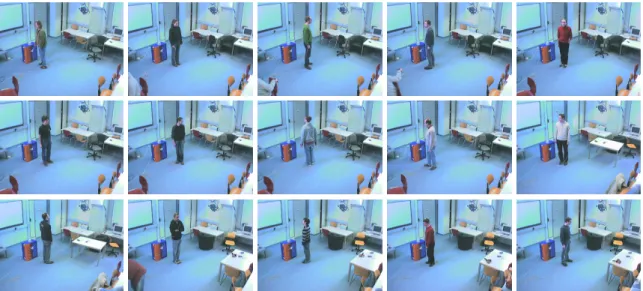
3.14 CLEAR dataset . . . 50
3.15 Head size distribution CLEAR dataset . . . 51
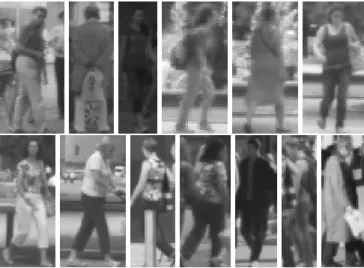
3.16 CAVIAR dataset . . . 52
3.17 Head size distribution CAVIAR dataset . . . 52
3.18 Bosch Inner-City dataset . . . 53
3.19 Head size distribution for Bosch Inner-City dataset . . . 54
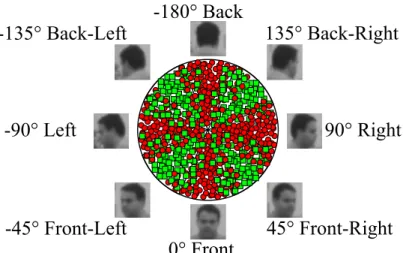
3.20 Mean head pose templates CLEAR dataset . . . 55
3.22 Discrete to continuous head pose space mapping CLEAR dataset . . . 56
3.23 Head pose process noise estimation CAVIAR dataset . . . 57
3.24 Discrete to continuous head pose space mapping CAVIAR . . . 58
3.25 Mean head pose templates Bosch Inner-City dataset . . . 59
3.26 Head pose process noise estimation Bosch Inner-City dataset . . . 59
3.27 Discrete to continuous head pose space mapping for Bosch Inner-City dataset 60 3.28 Mean head pose templates for [Orozco et al., 2009] . . . 61
3.29 Descriptor calculation of [Orozco et al., 2009] . . . 62
3.30 Histogram of oriented Gradients descriptor [Dalal and Triggs, 2005] . . . . 62
3.31 Most discriminative features for method of [Orozco et al., 2009] . . . 63
3.32 Most powerful features for method of [Siriteerakul et al., 2010] one-vs.-one 63 3.33 Most powerful features for method of [Siriteerakul et al., 2010] one-vs.-all . 63 3.34 Most powerful HoG features [Dalal and Triggs, 2005] . . . 64
3.35 Evaluation results state of the art on CLEAR and CAVIAR dataset . . . 65
3.36 Head localization rates single frame-based approach . . . 68
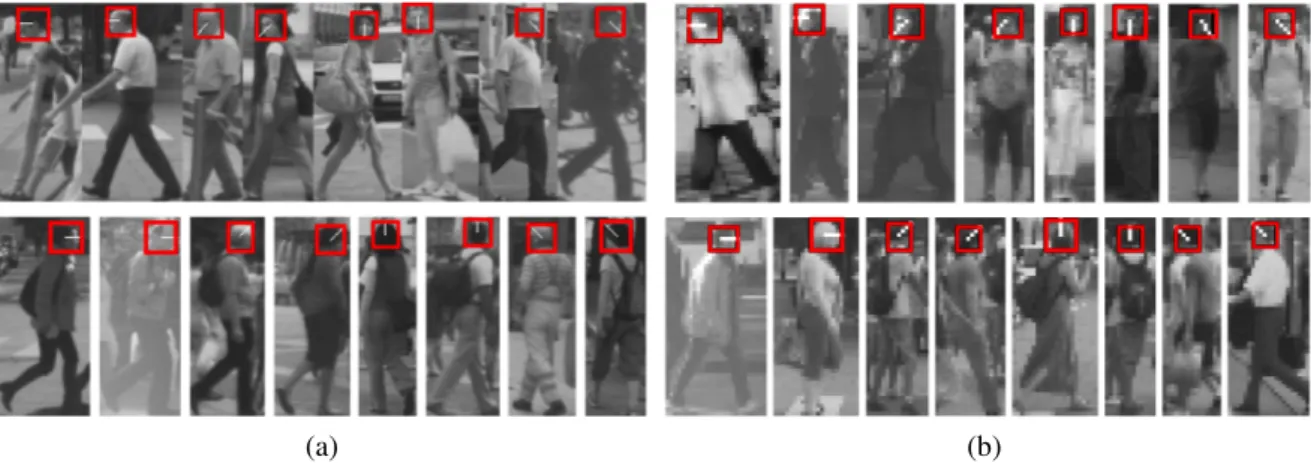
3.37 Samples with failing head localization . . . 68
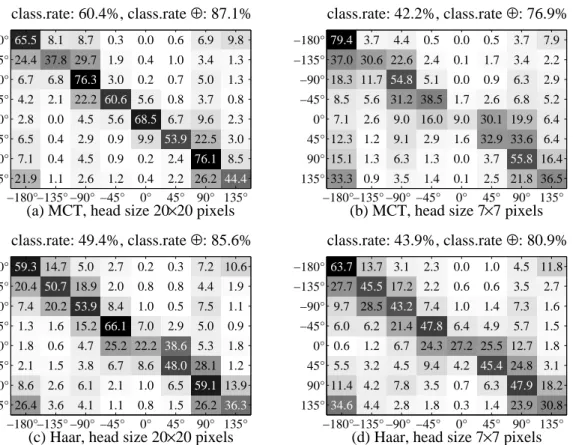
3.38 Confusion matrices single frame-based approach . . . 69
3.39 Samples with correct head pose estimation . . . 70
3.40 Samples with failing head pose estimation . . . 70
3.41 Ground truth vs. predicted head pose for CLEAR dataset . . . 71
3.42 Confusion matrices head pose tracking approach for CLEAR dataset . . . . 72
3.43 Angular error distribution for CLEAR dataset . . . 73
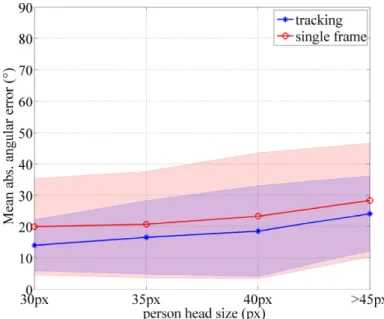
3.44 Mean absolute angular errors for CLEAR dataset . . . 73
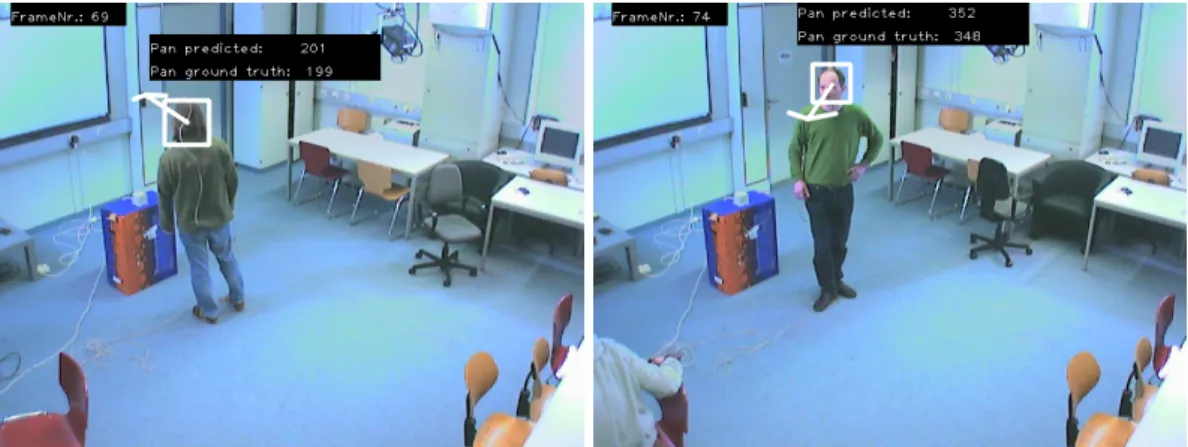
3.45 Head pose estimation images for CLEAR dataset . . . 74
3.46 Ground truth vs. predicted head pose for CAVIAR dataset . . . 75
3.47 Confusion matrices head pose tracking approach for CAVIAR dataset . . . 76
3.48 Angular error distribution for CAVIAR dataset . . . 76
3.49 Mean absolute angular errors for CAVIAR dataset . . . 77
3.50 Head pose estimation images for CAVIAR dataset . . . 77
3.51 Samples with correct head pose estimation results for tracking approach . . 78
3.52 Ground truth vs. predicted head pose for Bosch Inner-City dataset . . . 78
3.53 Confusion matrices head pose tracking approach for Bosch Inner-City dataset 79 3.54 Angular error distribution for Bosch Inner-City dataset . . . 80
3.55 Mean absolute angular errors for Bosch Inner-City dataset . . . 81
4.1 3D head pan angle estimation . . . 84
4.2 u- and v- disparity images . . . 89
4.3 Stereo-based head localization . . . 91
4.4 Stereo-based head localization rates . . . 97 4.5 Collection of pedestrian samples with correct stereo-based head localization 98
4.6 Collection of pedestrian samples with failing stereo-based head localization 99
4.7 Combined head localization rates over distance . . . 99
4.8 Confusion matrices for combined system . . . 100
4.9 Confusion matrices for combined system . . . 101
4.10 Head pose classification rates over distance for combined system . . . 101
5.1 System overview pedestrian intention recognition . . . 103
5.2 Latent-Dynamic Conditional Random Field model example . . . 105
5.3 Crossing and stopping examples Daimler dataset . . . 110
5.4 Bending and straight examples Daimler dataset . . . 110
5.5 Stopping probabilities over TTE for stopping vs. crossing scenarios . . . . 113
5.6 Bending probabilities over TTE for bending vs. straight scenarios . . . 114
5.7 First frontal head pose in stopping scenarios . . . 114
5.8 LDCRF vs. PHTM [Keller and Gavrila, 2014] . . . 115
5.9 LDCRF vs. SVM/RF stopping vs.crossing . . . 116
5.10 LDCRF vs. SVM/RF bending-in vs straight . . . 117
5.11 Classification rates for stopping scenarios LDCRF for different features . . 118
5.12 Classification rates for stopping scenarios LDCRF vs. PHTM . . . 119
5.13 Classification rates for stopping scenarios LDCRF vs. RF/SVM . . . 120
5.14 Classification rates in bending-in scenarios LDCRF for different features . . 121
5.15 Classification rates for bending in scenarios LDCRF vs. RF/SVM . . . 121
6.1 System overview pedestrian path prediction . . . 123
6.2 Lateral path prediction error for stopping vs. crossing scenarios . . . 134
3.1 Number of samples per head pose class for CLEAR training data. . . 50
3.2 Number of samples per head pose class for CLEAR evaluation data. . . 50
3.3 Number of samples per class for CLEAR evaluation camera 1 . . . 51
3.4 Number of samples per head pose class for CAVIAR dataset. . . 52
3.5 Number of samples per head pose class for CAVIAR dataset incl. mirroring 52 3.6 Number of samples per head pose class for the Bosch Inner-City training data. 53 3.7 Number of samples per head pose class for the Bosch Inner-City evaluation data. . . 53
3.8 Dataset Comparison . . . 54
3.9 Head pose tracking process noise parameters for CLEAR dataset . . . 56
3.10 Head tracking model parameters CLEAR dataset . . . 57
3.11 Head pose tracking system noise parameters CAVIAR dataset . . . 58
3.12 Head tracking model parameters CAVIAR dataset . . . 58
3.13 Head pose tracking system noise parameters for Bosch Inner-City dataset . 60 3.14 Head tracking model parameters for Bosch Inner-City dataset . . . 60
3.15 Evaluation results state of the art on CLEAR and CAVIAR dataset . . . 65
3.16 Head pose estimation runtimes . . . 66
3.17 Head localization rates for CLEAR dataset . . . 71
3.18 Mean angular errors for CLEAR dataset . . . 72
3.19 Head localization rates for CAVIAR dataset . . . 74
3.20 Head pose estimation performance for CAVIAR dataset . . . 75
3.21 Head pose estimation performance for Bosch Inner-City dataset . . . 79
4.1 Statistics for Bosch Inner-City Stereo dataset . . . 94
4.2 Number of samples per head pose class for Bosch Inner-City Stereo dataset 94 4.3 Number of sequences per scenario for Daimler Inner-City Stereo dataset . . 94
4.4 Statistics for Daimler Inner-City Stereo dataset . . . 95
4.5 Number of samples per head pose class for Daimler Inner-City Stereo dataset 95 4.6 System parameters for head pose tracking with integrated body motion . . . 95
4.7 System parameters for stereo-based head localization . . . 96
4.9 Stereo head localization rates over pedestrian distance . . . 97
4.10 Root causes for failing stereo-based head localization . . . 98
5.1 Modified number of sequences per scenario for Daimler dataset . . . 110
6.1 IMM model parameters . . . 131
6.2 Mean state sojourn times for Daimler dataset . . . 131
6.3 Mean lateral prediction error for crossing and stopping scenarios . . . 133
6.4 Predictivelog-likelihood for crossing and stopping scenarios . . . 135
6.5 Mean lateral prediction error for bending scenarios . . . 136
During the past years, worldwide commissions for transport and road traffic are increasingly focusing on the reduction of the number of pedestrian injuries and fatalities due to road ac-cidents. First measures for infrastructure, e.g. signalizing pedestrian areas and crosswalks, safety barriers and speed limits [WHO, 2013], and early active and passive safety systems for vehicles [Lawrence et al., 2004] resulted in a significant reduction of the total number of fatalities [Yannis et al., 2015]. But nevertheless, in 2013, 22% of all fatalities in road accidents within Europe still were pedestrians, see Figure 1.1.
Figure 1.1: Number of pedestrian fatalities and percentage of all road fatalities within EU, 2004-2013, [Yannis et al., 2015].
Additionally, in the U.S., the number of pedestrian fatalities of about 4,500 corresponding to 15% of all fatalities [NHTSA, 2016] still remains critically stable.
In this context, advanced driver assistance systems (ADAS) play an important role in man-ufacturing future vehicles to enhance safety for human drivers, passengers, and vulnerable road users such as pedestrians and cyclists. There are several reasons, namely increasing computational power of embedded platforms at low cost or emerging technologies in the sector of intelligent sensors like video, radar, laser or ultrasonic. Especially, the static im-proving performance of video-based pedestrian detection resulted in first commercial active pedestrian protection systems available for a wide range of vehicles, including Mercedes Benz, Volvo, or Volkswagen. Those kinds of systems try to avoid collisions to a limited extent in dangerous situations involving an inattentive driver and pedestrians by warning
the driver or triggering an automatic emergency braking (AEB), cf. [Euro NCAP, 2016]. Recently, new growing up companies from the Silicon Valley like Tesla Motors or Google integrate these kinds of technologies with additional extensions to manufacture completely self-driving vehicles realizing a fusion of multiple redundant sensors.
1.1 Motivation and Challenges
Most of those systems are already able to reliably detect pedestrians. However, for a higher benefit in collision avoidance or preventive actions one needs to get deeper information about the underlying scene and the pedestrian’s future behavior. One of the most challenging task is to interpret situations correctly, where pedestrians are laterally approaching the roadside. Due to the ability of having a high variability of movement patterns, pedestrians can change their walking direction within a short time period or suddenly start or stop. In the latter case of an abruptly stopping pedestrian, triggering an autonomous braking would be a false reac-tion, which could result in consequential damages involving the driver, passengers, and other traffic participants. Therefore, existing systems are designed in a very conservative way by limiting the system’s availability to a small set of controllable scenarios in order to reduce potential false activations (FAs) and thus, to meet the requirements of automotive safety in-tegrity levels (ASIL), cf. [ISO 26262-1:2011, 2011]. To overcome this limitation, a reliable pedestrian intention recognition and path prediction is of a great value. In this context the human head pose plays an important role as it gives a hint of the pedestrian’s awareness of an approaching vehicle. A pedestrian facing the vehicle may be aware of it and thus, is less likely to cause a critical situation in comparison to pedestrians just walking towards the road without observing the environment. A following derived intention recognition helps improv-ing situation interpretation and therefore, to avoid system false activations and at the same time keeping the benefit at a sufficiently high level.
As one can expect, a lot of difficult scenarios and reactions have to be considered and fig-ured out. [Schmidt and Färber, 2009] provide dominant features and their significance for pedestrian intention recognition, see Figure 1.2. Three quarter of the most powerful fea-tures, i.e., head/leg movement, dynamics, and characteristics, are related to the pedestrian itself. The remaining quarter includes aspects depending on the environment and context. This motivates to focus on pedestrian intention recognition, where most of these features are derived from internal data provided by an available stereo-video based driver assistance sys-tem. [Oxley et al., 1995] propose a study on head movement behavior for older and younger people during road crossings. In their experiments it turns out, that crossing pedestrians spend a dominant amount of time (>45%) in facing the nearside traffic, i.e., oncoming ve-hicles, while approaching the curbside. On average 1.4 to 1.5 dominant head turnings can be observed during that time. [Hamaoka et al., 2013] present similar results on head turning rates especially when pedestrians are already very close to the road. As a result thereof, the head pose is the important hint (most dominant feature in [Schmidt and Färber, 2009]) on
Figure 1.2: Feature categories for pedestrian intention recognition, [Schmidt and Färber, 2009]. Head(focusing, left/right turnings),Legs(foot liftings on the street), Dy-namics(running, walking, standing still),pedestrian characteristics(upper body movement, distance to curb, age),Traffic(traffic density, speed of oncoming ve-hicles),other(zebra crossing, mother with child, group behavior)
what the pedestrian will do next. In the context of ADAS, the head pose indicates the pedes-trians’ awareness of the vehicle existence but it also helps to predict the intended movement direction of the pedestrian for a further use within tracking methods or risk assessment. For the task of head pose estimation in video-based driver assistance systems using a vehicle mounted camera, one has to deal with low resolution, gray-value images, as well as highly dynamic variations in illumination and complex environment. Furthermore, operation should be possible at daytime, nighttime and under different weather conditions. Such a system also needs to be robust to large variations in pedestrian and head appearances, and it needs to guarantee a high degree of reliability.
From algorithmic point of view, the following problems arise. Because of the low resolution images and the wide head pan angle range required for such a system, head pose estima-tion based on facial feature detecestima-tion, as for example in [Gee and Cipolla, 1994,Horprasert et al., 1996,Vatahska et al., 2007], will not be suitable. The lack of color information also prevents the use of color histograms, cf. the works of [Benfold and Reid, 2008,Benfold and Reid, 2009,Canton-Ferrer et al., 2007,Canton-Ferrer et al., 2008,Siriteerakul et al., 2010] or [Robertson and Reid, 2006] for skin color detection. The main challenges in the context of this work are person bodies appearing on very low resolutions in inner-city scenarios, i.e., head sizes down to approximately 6×6 pixels in order to estimate the pedestrians’ intention as soon as possible, see Figure 1.3. Additionally, heads strongly vary in their appearances, e.g. for people wearing hats or umbrellas, with or without beard or having long or short hair. For intention recognition itself, one has to find a way to integrate all necessary information within a model that is robust against people dependent variations. For instance, elder pedes-trians are normally walking slower than younger ones. Some people turn their heads faster or slower than others or even do face the approaching vehicle but still cross the road.
One of the main critical aspects for current systems realizing an AEB on pedestrians is the predicted lateral impact point between approaching vehicle and pedestrian. Already a pre-diction error larger than 30cm can make the difference of having a false activation or saving a pedestrian life. Therefore, current systems restrict the range for the predicted impact point relevant for a brake intervention till a desired FA-rate is achieved over a larger endurance run while still guaranteeing a certain level of benefit. Without any further information as given by an estimated pedestrian intention recognition, the error in path prediction hardly lies below the desired threshold, especially for an abruptly stopping pedestrian. The arising question is then how to integrate pedestrian intentions in order to achieve better results. Also the path prediction result still has to show acceptable performance in case of an uncertain intention recognition.
Besides the functional requirements, algorithms have to operate in real-time with the compu-tational power of hardware that is used for automotive systems. In general, this is restricted in processor performance and on board memory, which prevents to application of more com-plex algorithms.
Another system requirement is a high degree of availability in terms of functional range. Figure 1.3 shows a typical brake characteristic of an AEB system. Visualized is the object distance relative to the ego vehicle, at which an automatic braking action has to be triggered, over the ego vehicle’s speed.
0 10 20 30 40 50 60 0 5 10 15 20 25 a max: −8.90m/s 2 distance (m) v ego (km/h)
Figure 1.3: Typical brake characteristic curve for AEB systems. Object distance at which an AEB with a maximum deceleration of -8.9m/s2 has to be triggered over ego vehicle speed.
For the addressed inner city scenarios, where vehicles are moving with a speed up to 60km/h, it is mandatory to reliably detect objects, more specifically pedestrians, and provide all nec-essary information for a later function reaction up to 25m. This means, that an initial object hypothesis already has to be generated at higher distances of up to 30m approximately, in order to be able to perform object plausibility checks and derive temporal information for a safe function decision. Later experiments will focus on system performance within this range.
1.2 Contribution
This work presents a system for pedestrian intention recognition and path prediction in city traffic scenarios. The scope of application is a video-based advanced driver assistance sys-tem for forward collision warning and collision avoidance of a driving car with other vul-nerable road users (VRU) such as pedestrians. The group of VRUs is a risky class because lack of attention by the driver and the pedestrian could result in a collision. Pedestrian candidates are detected by a stereo-video system mounted behind the windshield of an ap-proaching vehicle. Motivated by scientific evidence about pedestrian behavior in city traffic situations, [Hamaoka et al., 2013,Oxley et al., 1995,Schmidt and Färber, 2009], intention decisions will be made by two dominant factors. Firstly, the pedestrian dynamics by means of predicted lateral and longitudinal velocity components as a result of a non-linear dynam-ical system. Secondly, the pedestrian’s awareness of an oncoming vehicle with the help of observing the human head pose. Figure 1.4 shows a rough overview of the presented system.
Chapters 3 and 4 Chapters 5 and 6 50
Figure 1.4: System Overview. Pedestrians are detected and tracked by a stereo-video based generic obstacle detection and tracking approach and verified by an image intensity-value based classifier. For each pedestrian candidate the head orien-tation will be estimated from the image data. The previous extracted information serves as input for an iterative intention recognition and path prediction.
The overall processing pipeline of the system starts with the estimation of the pedestrian’s head pose and ends with a concrete prediction of the pedestrian’s future position and in-tention that can be incorporated into a function for automatic emergency braking. Similar to recent contributions to pedestrian intention recognition and the closely related field of pedestrian path prediction, this work uses the outputs from an existing system for video-based pedestrian detection. The main contributions of this work are:
1. A method for video-based pedestrian head localization and head pose estimation in low-resolution images taken from a stereo-video camera.
2. A system for pedestrian intention recognition using the information of the human head pose and additional features.
3. Integration of the pedestrian intention into an improved path prediction to be used for a later decision on forward collision warning (FCW) or automatic emergency braking.
Pedestrian Head Pose Estimation
In the first part of this work, a real-time method is proposed, that realizes a combined pedes-trian head localization and head pose estimation. The underlying resources are gray value im-ages taken from a vehicle mounted camera. These imim-ages contain complex highly dynamic inner-city scenarios, where pedestrian heads appear at very low resolution. In a first step a single frame based approach is developed, where the confidence outputs of eight trained head pose classifiers applied to the image region of a pedestrian candidate are processed to result in a head location and head pose estimate. Furthermore, head positions and head poses are tracked over time by implementing a particle filter. This leads to a more robust, more reliable and more efficient pedestrian head pose estimation. In addition, through the nature of the proposed method it is possible to estimate continuous head pan angles instead of de-termining only one of eight discrete head pose classes, cf. [Orozco et al., 2009,Siriteerakul et al., 2010]. By incorporating stereo depth information, head localization and head pose estimation results are improved in two ways. First, an additional stereo-based head local-ization achieves more robustness in scenarios with highly structured background. Second, estimates on the 3D object movement direction serve as prior knowledge for expected human head poses. The presented approach is applied on top of an overall system for stereo-vision based pedestrian detection and tracking and will serve as input for a later pedestrian intention recognition and path prediction. In comparison, recent approaches mainly rely on a pedes-trian orientation estimation to get an idea of the pedespedes-trian intention, cf. [Gandhi and Trivedi, 2008,Shimizu and Poggio, 2004,Enzweiler and Gavrila, 2010]. However, the pedestrian’s movement direction does not indicate the real pedestrian’s awareness of an approaching ve-hicle a priori. Hence, with the head pose estimation, a more reliable long-term intention recognition for the upcoming few seconds can be derived.
Pedestrian Intention Recognition
In this work, the use of a robust and highly performing machine learning approach, namely Latent-Dynamic Conditional Random Fields [Morency et al., 2007], for the task of intention recognition in different scenarios is investigated. This approach is able to model the intrin-sic sub-structure of a specific intention class while additionally capturing extrinintrin-sic dynamics between different intention classes in time-series. The method integrates features extracted from pedestrian dynamics as well as contextual information using the human head pose. An additional benefit of this model is the fact that it can work with time series of arbitrary
length, where additional confidence about pedestrian intentions can be retrieved by temporal integration. By the nature of the model, it is possible to capture dynamical changes for sin-gle features, such as head turnings or different movement behaviors. Different connections of features can be learned automatically from training data but nevertheless, expert knowl-edge still can be brought in when designing the structure of the model. Compared to recent approaches in literature, besides stopping and crossing pedestrians, a wider range of scenar-ios is addressed including pedestrians that initially walk along the sidewalks but then turn towards the road. The proposed latent-dynamic discriminative model applied on extracted time-series is then able to integrate all the previous mentioned features including pedestrian dynamics and pedestrian awareness, and to learn inner connections within a specific type of scenario and external correlations between different types of scenarios. The output of the presented approach will be integrated into a later system for pedestrian path prediction, but could also be used for controlling the switching states of the Switching Linear Dynamical System (SLDS) presented in [Kooij et al., 2014a].
Pedestrian Path Prediction
General object tracking algorithms basically consist of two steps, Prediction and Update. For prediction the object state is propagated using suitable motion models, resulting in an object state hypothesis for the next time instance. During the update step new sensor mea-surements are incorporated to correct the previously performed prediction. The underlying object tracking method consists of the well-known Interacting Multiple Model Filter (IMM), as this filter is able to deal with multiple motion models, which turned out to be practica-ble for the task of pedestrian tracking. Path prediction can be performed by applying the prediction steps multiple times for a small time horizon (< 1second) without incorporating new measurements. In this context, a method is developed that controls the filter prediction steps by incorporating the estimated pedestrian intentions. In doing so, the filter is supported to choose the appropriate motion model and thus, the resulting path prediction error can be reduced by a significant amount.
1.3 Outline
The remainder of this work is organized as follows. Chapter 2 presents an overview of related work in the field of video-based pedestrian detection, stereo-video based object detection and tracking and focuses on human head pose estimation in low resolution images as well as on pedestrian intention recognition and path prediction. The approach for pedestrian head pose estimation developed in this work is presented in Chapter 3. Chapter 4 demonstrates the benefits of using stereo vision for a more robust and reliable head localization and head pose estimation. The second major contribution of this work on pedestrian intention recognition is presented in Chapter 5, where the head pose estimation is integrated as a powerful feature.
Chapter 6 finally combines pedestrian intention recognition and tracking for path prediction within a controlled framework. The overall approach is embedded into an existing stereo-video system for pedestrian forward collision warning and automatic emergency braking. The work concludes with a discussion in Chapter 7.
This chapter gives an overview of related contributions. Since the substantial part of this work is based on the reliable detection and tracking of pedestrians in video sequences, related literature to this topic will be presented here. Furthermore, methods for 3D object detection using stereo video sensor data follows. As presented in Chapter 1, one core part of this work deals with the estimation of pedestrian head poses, which directly has impact on an intention recognition in a subsequent step. The latter in turn is used in order to achieve an improved path prediction to increase the benefit of automatic emergency braking systems. For all three contribution topics current related literature is presented. This chapter is structured as follows. Section 2.1 presents an overview of current approaches for image-based pedestrian recognition. General methods for 3D object detection and tracking using stereo-vision will be introduced in Section 2.2. In Section 2.3 pursuing approaches for detection of human heads and head pose estimation are introduced. Section 2.4 and 2.5 finally deal with the intention recognition of pedestrians and followed path prediction.
2.1 Monocular Pedestrian Detection
There has been done a lot of research in the field of video-based pedestrian detection during the past decade. Especially in the field of ADAS this task is very hard to handle due to a wide range of challenging scenarios, i.e., high variations in pedestrian appearance in highly dy-namic scenes. A broad overview of the research area on pedestrian detection for driver assis-tance systems is given by [Gandhi and Trivedi, 2007]. Here, besides video-based approaches, further methods using different sensor technologies like radar or laser are summarized. For the main subject of video-based pedestrian detection, [Enzweiler and Gavrila, 2009,Dollár et al., 2012b] and [Benenson et al., 2014] provide detailed evaluations of state-of-the-art approaches. Currently, so-called discriminative methods distinguished themselves. Here, one tries to learn decision functions based on extracted features using a huge amount of la-beled training examples, which allows a separation of pedestrians from other image contents. Available methods basically differ in the type of extracted features, the fusion of multiple fea-tures and the use of machine learning methods for determination of the separating plane. One of the most powerful features is given by the Histogram of oriented Gradients (HoG), which is robust against changes in scale and illumination and initially was introduced by [Dalal and
Triggs, 2005]. Variations thereof are presented and used in [Dalal et al., 2006,Jia and Zhang, 2007,Zhu et al., 2006,Wang et al., 2009,Maji et al., 2008,Dollár et al., 2010,Benenson et al., 2012b]. The basic idea is to represent the pedestrian appearance and shape in the image by a distribution of edge gradients. For this, a selected image patch is divided into overlapping blocks consisting of multiple cells. Image gradients contribute to a histogram per cell based on their orientation. The final feature vector is obtained by concatenating the normalized orientation histograms with respect to each block. [Wang et al., 2009] and [Zhu et al., 2006] describe HoG similar features, which are calculated using integral histograms and therefore significantly reduce computational effort compared to the conventional feature in order to achieve real-time capability. Other approaches for pedestrian recognition use illumination invariant local binary pattern (LBP) descriptors [Mu et al., 2008,Wang et al., 2009]. LBP features in their original form represent the 3×3 neighborhood of a pixel using a bit-string by comparing the intensity values of all pixels in the neighborhood with the one for the center pixel and hence are very fast to compute.
For discriminative methods different types of classifiers are used. In this context, Support Vector Machines (SVM) are widely used in both linear, [Dalal and Triggs, 2005,Dalal et al., 2006,Enzweiler and Gavrila, 2011,Wojek et al., 2009], and non-linear variants, see [ Pa-pageorgiou and Poggio, 1999,Dalal and Triggs, 2005,Maji et al., 2008]. Other popular classifiers include neural networks, [Gavrila and Munder, 2007,Enzweiler et al., 2010, En-zweiler and Gavrila, 2010], Adaptive Boosting (AdaBoost), [Dollár et al., 2010,Wojek et al., 2009] and cascades of boosted classifiers, [Tuzel et al., 2008,Viola et al., 2003,Zhu et al., 2006,Wang et al., 2009,Jia and Zhang, 2007]. In general, Adaboost classifiers as presented by [Freund and Schapire, 1997,Freund and Schapire, 1999] help to select the most power-ful features from an over-complete set of features, like Haar wavelets, cf. [Viola and Jones, 2001a].
Recent methods combine multiple features using shape-, texture- and color information in the form of integral channels in order to achieve higher detection rates, see [Dollár et al., 2009a,Dollár et al., 2010] and [Benenson et al., 2012b]. Most of the publications concerning automotive applications, use a fusion of several cues from depth, motion and intensity to-gether with object detection and classification techniques. [Gavrila and Munder, 2007,Keller et al., 2011a,Keller et al., 2011b,Schneider and Gavrila, 2013] for instance use stereo infor-mation, shape and texture based features as well as tracking approaches. Similar approaches are also used by [Bajracharya et al., 2009,Wojek et al., 2009,Walk et al., 2010,Enzweiler et al., 2010,Rohrbach et al., 2009]. Other methods directly make the use of stereo depth information in order to restrict the search space for a following pedestrian classification, cf. [Bertozzi et al., 2005,Bajracharya et al., 2009,Enzweiler et al., 2010,Enzweiler et al., 2012,Keller et al., 2011b]. Related to this topic, [Llorca et al., 2012] present a survey on stereo region of interest (ROI) selection. This significantly reduces the run-time for monoc-ular pedestrian detection resulting in real-time systems and helps to reduce the false positive rate while keeping a suitable detection rate, e.g., see [Enzweiler and Gavrila, 2011].
Further improvements can be achieved by incorporating scene context [Hoiem et al., 2006,
Torralba, 2003] or contextual information from neighboring regions on detector level [Ding and Xiao, 2012,Dollár et al., 2012a].
2.2 Stereo-Vision based Object Detection and
Tracking
Recent approaches for autonomous driving use the benefits provided by a stereo vision sen-sor. The idea is to extract 3D depth measurements in terms of disparities calculated by matching images regions from the left and right camera images. There already exists a wide range of stereo algorithms that differ in run-time, density and accuracy, see [Geiger et al., 2012] just like standard block matching or semi global matching. These algorithms mostly differ in the way how to describe image areas in order to easily find the best matching areas in both images in addition to smoothness assumptions for estimated disparities within a pixel neighborhood.
Most of existing methods for stereo-based object recognition try to divide the given dis-parity map into clusters or regions of interest belonging to raised obstacles, cf. [Labayrade et al., 2002,Leibe et al., 2007,Ess et al., 2007,Leibe et al., 2008,Ess et al., 2009,Nedevschi et al., 2009]. Some methods first try to extract the ground plane in order to restrict search space for vertical oriented column-wise features, also known asStixels, cf. [Labayrade et al., 2002,Badino et al., 2009,Pfeiffer and Franke, 2011]. For real-time applications, [Benenson et al., 2011,Benenson et al., 2012a] propose very fast versions for Stixel calculation without the necessity of a computed disparity map in a pre-processing step. Other methods, for in-stance [Ess et al., 2007,Ess et al., 2009], try to simultaneously infer the ground plane and the set of valid pedestrian hypotheses using a Bayesian Network for temporal stability and accu-racy. Concatenating similar segments in terms of similar depth estimates together results in larger object hypothesis or clusters. These generic obstacles are then tracked with a sequence of images using Kalman Filters, cf. [Bar-Shalom et al., 2002,Blackman and Popoli, 1999,Li and Jilkov, 2001,Li and Jilkov, 2003,Li and Jilkov, 2005], or particle filters, [Arulampalam et al., 2002,Isard and Blake, 1998], to get smooth, stable and more accurate estimates. Ad-ditionally, further unobservable information about the object state like velocity, acceleration or collision risk with respect to the ego vehicle can be obtained out of the filter. A fur-ther processing step involves object classification to separate vehicles, pedestrians or ofur-ther classes from objects generated on remaining infrastructure, [Leibe et al., 2007,Keller et al., 2011b,Enzweiler et al., 2012,Ess et al., 2009,Gavrila and Munder, 2007].
2.3 Human Head Localization and Head Pose
Estimation on low Resolution Images
yaw
pitch
roll
Figure 2.1: Headpose coordinate system.
As this work focuses on the head localization and head pose estimation problem for pedes-trians, related literature dealing with both problems is discussed here. Moreover, this section introduces some approaches for pedestrian orientation estimation due to their application similarity in the field of driver assistance systems.
The task of human head pose estimation mostly has to be divided into the two major parts, namely head localization or head detection and the actual head pose estimation given a head candidate. This work differentiates between head localization and head or face detection. Head localization is a specific type of head detection, where the number of heads in a given image is already known. In comparison to face detection, which usually deals with frontal poses of human heads, head localization tries to localize the head in any given pose. Nev-ertheless, the approach of this work is largely related to the problem of face detection in general. One of the most related contribution in this field is the work of [Viola and Jones, 2001a], where a cascade of boosting classifiers based on Haar-like features is used to detect faces in gray-value images. Due to the cascaded structure of the classifiers and the fast fea-ture computation using integral images, face detection can be performed in real-time. [Jones and Viola, 2003] generalize their method to detect faces appearing in multiple views and heads under various poses. Another major approach for face detection is the use of the Modified Census Transform (MCT) presented by [Fröba and Ernst, 2004] to describe the neighborhood around pixel positions by binary structures similar to the LBP feature. Fea-tures based on the MCT will be combined in a similar way to [Viola and Jones, 2001a] by training a cascaded boosting classifier. Recently, [Zheng et al., 2010] suggested an extended 12-bit MCT feature set for low resolution face detection in color images. Others like [Roy and Marcel, 2009] propose theHaar-LBP feature, a hybrid between Haar-like features and
Local Binary Patterns, to achieve an illumination-invariant face detection.
Head pose estimation approaches are usually application driven. [Murphy-Chutorian and Trivedi, 2009] present a survey of existing head pose estimation approaches for different scenarios and variable kinds of input data. Depending on the application, head pose estima-tion methods vary in their requirements on input data, accuracy, and run-time. Applicaestima-tions in human machine interaction, for example addressed by [Vatahska et al., 2007], require more precise pose measures related to rotations around the main axes of a head located coordinate system (pan/yaw, tilt/pitch, roll), see Figure 2.1. There, the input data mostly contains high resolution head images and sometimes depth information using stereo or mul-tiple camera systems, cf. [Fanelli et al., 2011,Martin et al., 2014,Seemann et al., 2004,Voit et al., 2008,Voit and Stiefelhagen, 2009]. These approaches mostly consider the range from frontal face poses to side views of heads (-90◦,...,90◦). Recent literature about head pose estimation for driver assistance systems mostly considers the determination of the driver’s head pose in the vehicle interior for health monitoring and intention recognition, cf. [Bär et al., 2012,Murphy-Chutorian et al., 2007] and [Martin et al., 2014]. In contrast, this work focuses on pedestrian head pose estimation using a vehicle mounted camera. For this task, also addressed by [Flohr et al., 2014,Rehder et al., 2014], or in the field surveillance as presented in [Benfold and Reid, 2009,Hirata et al., 2008,Orozco et al., 2009,Siriteerakul et al., 2010,Chen et al., 2011,Chen and Odobez, 2012,Robertson and Reid, 2006], one has to deal with low resolution images under harsh conditions in order to provide head pose estimates covering the full head pan angle. Fortunately, there are usually weaker demands such as estimating a discrete head pose class and larger pose steps without the necessity to give estimates on tilt and roll angles. Regarding the camera setup and available infor-mation, many approaches use a network of two or more calibrated cameras, cf. [Bäuml et al., 2010,Canton-Ferrer et al., 2008,Niese et al., 2006,Zhang et al., 2007,Seemann et al., 2004,Fanelli et al., 2011]. Nevertheless, some approaches are based on conventional 2D im-age signals, see [Ba and Odobez, 2004,Benfold and Reid, 2008,Benfold and Reid, 2009, Hi-rata et al., 2008,Orozco et al., 2009,Siriteerakul et al., 2010,Robertson and Reid, 2006]. To estimate the head pose, different algorithms have been presented. Recent methods make use of the Iterative Closest Point algorithm (ICP, [Chen and Medioni, 1992]) to find rigid transformations between a pre-defined 3D head model and sequentially extracted point clouds from consumer depth cameras to achieve highly accurate angle measurements, cf. [Bär et al., 2012,Martin et al., 2014]. However, high resolution images are required in addition to a pre-cise head position and head pose initialization. For the problem in this work, a so-called
detector array-based approach is chosen, where a series of head detectors each assigned to a specific head pose is trained. To estimate the head pose, a discrete pose class will be determined based on the detector with the greatest support over a given image region. Re-lated work on this can be found in [Jones and Viola, 2003,Rowley et al., 1998,Flohr et al., 2014,Zhang et al., 2007]. One advantage of this type of methods is, that it can be easily used for head localization as well by explicitly learning the separation from background regions
during the training process. In contrast, other methods have to work with regions including head candidates, that have to be generated in advance using generally trained head detectors or foreground-background segmentation as an output of complex environment models. An-other benefit of the chosen approach is the possibility to make use of head detectors, that are well suited for evaluation on low resolution images due to their integrated features which can work on lowest pixel level as presented in [Fröba and Ernst, 2004] and [Viola and Jones, 2004]. Some works estimate the head pose of a given head candidate by measuring the sim-ilarity to discrete appearance templates, cf. [Orozco et al., 2009], while others try to detect facial features and then estimate the head pose according to the geometrical positions of these features, cf. [Gee and Cipolla, 1994,Horprasert et al., 1996,Stiefelhagen et al., 1996] and [Vatahska et al., 2007]. [Benfold and Reid, 2008] and [Benfold and Reid, 2009] use
Fernsto determine skin and non-skin segments of the head, based on color information. In a second step they estimate the head pose to be one of eight pose classes.
The following two methods are presented in more detail as they serve as a baseline for later performance evaluation in this work. The method of [Orozco et al., 2009] builds upon a similarity distance between a given head sample and a set of pre-computed mean head pose templates. Motivated by the Kullback Leibler divergence, which was originally introduced in [Kullback and Leibler, 1951] to compare two probability density functions, they define
Kullback Leibler coefficientsδKLto measure the pixel-wise similarity of a given head image with all head pose templates. Defining the intensity values of the mean template corre-sponding to head pose class cand the input sample at pixel position(i, j) bymc
i,j andni,j, respectively, the divergence coefficient can be expressed as
δKL(mci,j||ni,j) = max RGB mci,j log m c i,j ni,j . (2.1)
The final feature descriptor is a 2D similarity distance weighting map {xi,j}i,j, where each pixel position(i, j)is determined by taking the maximum KL divergence coefficient at that position over all head pose templates, i.e.,
xi,j = max
c∈{1,...,8}δKL(m
c
i,j||ni,j). (2.2)
Figure 2.2 shows the mean pose templates for their eight head pose clusters and some input head samples with their corresponding descriptor.
For the final classifiers they compute the introduced descriptors on a set of training samples and train a multi-classone-vs.-allSVM. In their experiments they show better results in terms of higher classification rates compared to [Robertson and Reid, 2006].
The second method to compare with was introduced by [Siriteerakul et al., 2010]. Here, the basic idea is, that on very low resolution images one has to directly work on pixel level. The feature they propose, namely non-local Intensity Difference Feature (iDF) compares the
2
1
4
5
6
8
7
3
Figure 2.2: Method proposed by [Orozco et al., 2009]. Upper image: Head pose templates for each of eight discrete head pose classes using mean intensity image over training data. Lower Image Calculated Descriptor on a set of test samples.
Figure 2.3: The method of [Siriteerakul et al., 2010]. Non-local intensity differences features are calculated at multiple image positions to train a classifier.
intensity values of two arbitrarily chosen pixel positionsp1 andp2 as follows.
iDF(p1,p2) = 0 ifI(p1) =I(p2) 1 ifI(p1)> I(p2) 2 ifI(p1)< I(p2) , (2.3)
whereI(p)denotes the image intensity value at pixel positionp. Figure 2.3 shows different choices of pixel pairs for some input test samples. For training, 10000 random pixel pairs are chosen within a 20×20 image patch. Considering eight head pose classes, the iDF is calculated for a set of training samples to train a multi-class one-vs.-all SVM. After several training loops, choosing a random subset of pixel pairs to be considered and varying the
sam-ples taken for training and validation, they choose the best performing classifier at the end. Additionally, they present a non-local Color Difference Feature (cDF) using color images, which further improves classification rates in combination with the iDF.
Within the context of pedestrian intention recognition for driver assistance systems, ap-proaches on pedestrian orientation estimation are presented. From the application point of view, in video driver assistance systems the head pose is used as a cue for pedestrian inten-tion recogniinten-tion. Some works discuss the pedestrian body pose as an alternative measure of a pedestrian’s intention and gaze in order to improve tracking algorithms, cf. [Enzweiler and Gavrila, 2010,Gandhi and Trivedi, 2008,Shimizu and Poggio, 2004]. Most of them assume already detected pedestrians and try to estimate their orientations, see [Gandhi and Trivedi, 2008,Shimizu and Poggio, 2004]. Others integrate the pedestrian detection and orientation estimation within a probabilistic mixture of experts framework to achieve better results, cf. [Enzweiler and Gavrila, 2010]. [Shimizu and Poggio, 2004] use Haar-like features to train one-vs.-all SVMs, while [Gandhi and Trivedi, 2008] trainone-vs.-one SVMs using Histograms of oriented Gradients from [Dalal and Triggs, 2005]. [Enzweiler and Gavrila, 2010] also use HoG features combined with support vector machines, as well as adaptive lo-cal receptive fields (LRF) in combination with a multilayer neural network. Evaluations on their test data show the positive effect of the integrated detection and orientation estimation in comparison to the results of [Gandhi and Trivedi, 2008,Shimizu and Poggio, 2004]. Cur-rent methods in the field of surveillance or driver assistance systems take advantage of the fact, that the observed head pose is dependent on the human body pose and vice versa. [Chen et al., 2011,Flohr et al., 2014] give estimates for both head- and human body pose within a joint probabilistic framework, taking into account anatomical constraints and detector un-certainties.
2.4 Pedestrian Intention Recognition
This section lists the main recent contributions on pedestrian intention recognition. Pedes-trian behavior and intention in daily traffic situation has been studied for years from vari-ous perspectives like crash studies, crowd behavior and optimizing infrastructure to enhance pedestrian safety. In this context, many approaches from psychological aspect are based on statistical models, which are determined on the basis of collected data, see [Oxley et al., 1995,Schmidt and Färber, 2009,Fugger et al., 2001,Avineri et al., 2012,Evans and Norman, 2003,Kadari and Vedagiri, 2013,Bernhoft and Carstensen, 2008]. To take environmental aspects into account, [Hamaoka et al., 2013] analyze pedestrian head turning behaviors at crosswalks regarding the best point of warning for inattentive pedestrians. In the field of intelligent vehicles, one attempts to derive potential intentions of a pedestrian using sensor data like video sequences for instance. One related subject area is the field of action recogni-tion for human machine interacrecogni-tion, where a humanoid robot shall recognize a certain kind of human actions, gestures or facial expressions in order to react by offering support or
ex-ecuting commands. [Turaga et al., 2008] present a survey on this field. One basic idea is the use of the so-called motion history feature, where extracted human shapes are aggre-gated over a sequence of images to learn a template for one particular action. A derivation of this approach is used by [Köhler et al., 2012] and [Köhler et al., 2013] in the automo-tive field for early detection of a starting action for an initially standing pedestrian at the curbside. This only involves an infrastructure-based sensor setup, i.e., no on-board vehicle mounted camera. For a given pedestrian track, they calculate a motion contour image-based HoG-like descriptor. The differentiation of a standing pedestrian and a potential starting ac-tion is trained using the moac-tion-contour images in combinaac-tion with a linear support vector machine (SVM). [Schindler and Van Gool, 2008] extract textural information using Gabor filters and motion information using optical flow for a given action snippet to train linear one-vs.-all classifiers for a pre-defined set of actions. [Laptev et al., 2008] propose the use of local space-time features using HoG and Histograms of oriented Flow (HoF) within a cuboid around extracted Harris interest points, space-time pyramids and multichannel non-linear SVMs for human action recognition in movies. [Matikainen et al., 2009] choose the standard bag-of-words approach to set up a dictionary of trajectory words (trajectons) from a clustered set of trajectory snippets including temporally extracted features. A given sam-ple trajectory is represented by a normalized histogram of accumulated trajecton indices assigned to each snippet. This histogram is used to classify action categories using a trained linear SVM. [Matikainen et al., 2009] show an overall better classification performance com-pared to the method of [Laptev et al., 2008].
In the research area of intention recognition in comparison to action recognition one han-dles with the prediction of a future action and not the actual recognition thereof to perform preventive actions. Nevertheless, the step from action to intention recognition is a small one. [Wakim et al., 2004] formulate a Markov chain for the four discrete states "standing still", "walking", "jogging" and "running". Model transitions are influenced by successive pedestrian states within a trajectory including estimates for the pedestrian’s velocity magni-tude and direction. Initial state and transition probability distributions are statistically deter-mined from various studies on human gait pattern analysis. During simulations, the actual motion state is used to predict the potential impact of a crossing pedestrian and an approach-ing vehicle. [Furuhashi and Yamada, 2011] extract HoG descriptors for a set of pedestrian postures in a sequences and principal component analysis (PCA) to learn a model for cross-ing pedestrians uscross-ing ak-means classifier. [Kitani et al., 2012] use physical scene features (e.g., parking cars, buildings,...) within a static environment using semantic scene labeling from noisy visual input in combination with optimal control theory to infer future actions of pedestrians. For their system it is assumed, that people are fully aware of their environment in order to account for preferences to move around certain regions like sidewalks. [Tamura et al., 2012] define three types of pedestrian intentions, namelyfree walk, avoidandfollow, to formulate sub-goals, which are used to enhance the social force model of [Helbing and Molnár, 1995] for pedestrian behavior analysis.
Figure 2.4: Method for pedestrian intention recognition proposed by [Keller et al., 2011c]. For a given pedestrian candidate valid disparity and flow entries are filtered in a first step. A parallax flow field is computed by normalizing flow vectors with disparity and subtracting the influence of ego-motion. The resulting flow vectors contribute to a motion histogram over the upper and lower pedestrian body. PCA achieves dimensionality reduction. Histograms are extracted over time to result in a database of trajectories for stopping and crossing scenarios. For a given sample, the scenario given by the best matching trajectory from the database is chosen, performing an intelligent probabilistic tree search for efficiency.
Recent approaches for pedestrian intention recognition build upon an existing system for video-based pedestrian detection and mainly focus onto the situation of lateral approaching pedestrians. As accident statistics show, this covers the main scenario of accidents involving vehicles and pedestrians, cf. [Marchal et al., 2003]. [Keller and Gavrila, 2014] for example, propose two non-linear, higher order Markov models to estimate whether an approaching pedestrian will cross the street or stop at the curbside. First a Probabilistic Hierarchical Tra-jectory Matching (PHTM) is used to match an actual observation of a pedestrian track with a database of trajectory snippets. Using the information of future locations and pedestrian behavior from the best matching snippets future pedestrian motion and hence intention is extrapolated. In addition, a Gaussian Process Dynamical Model (GPDM) which models the dense flow for walking and stopping motions is suggested to predict future flow fields. Both suggested models integrate features that capture pedestrian positions and dynamics by means of dense optical flow. See Figure 2.4 for a basic overview of the PHTM approach. All these
models only try to access features from pedestrian moving dynamics but do not take the un-derlying scene context into account. [Bonnin et al., 2014] propose a generic context based model to predict crossing behaviors of pedestrians. Multiple models are combined within aContext Model Treecapturing general inner-city scenarios, as well as the special context of zebra crossings. Contextual features, e.g. distance/time to curbstone or distance/time to zebra crossing, are extracted with a stereo camera.
A common part of most of these methods is the use of machine learning approaches to clas-sify a series of extracted observations. At this point, the choice of the right method can have significant impact on later performance. [Morency et al., 2007] investigate the use of Latent-dynamic Conditional Random Fields (LDCRF) as an extension of conventional Con-ditional Random Fields (CRF, [Lafferty et al., 2001]) for labeled time series of observations by adding a layer of hidden latent states. These hidden state variables can model the intrin-sic sub-structure of a specific class label and capture extrinintrin-sic dynamics between different classes. Furthermore, LDCRFs proved to outperform typical CRF models, the well-known Hidden Markov Models (HMM) and conventional machine learning algorithms like Support Vector Machines (SVMs) in the field of gesture recognition. Figure 2.5 shows a simplified version of a LDCRF.
x
tx
t-1 ηt(1)-1 ht-1 (1,2) ηt(2)-1 ht-1 (2,1) ht-1 (2,2) ht-1 (1,1) ht (1,1) η(1)t ηt(2) ht (2,1) ht (2,2) ht (1,2)Figure 2.5: LDCRF for a 2-class problem with 2 hidden states per class label. Observables are displayed as shaded nodes. Connections between latent hidden states are colored. The hidden statesh(ji,1) andh(ji,2) model the intrinsic structure for class labelηj(i),i∈ {1,2}, while the connections betweenhj(1,k)andh(2j ,k),k ∈ {1,2}, model the extrinsic relations between the class labelsη(1)j andη(2)j .
2.5 Pedestrian Path Prediction Systems
The field of path prediction is closely related to pedestrian behavior or intention recogni-tion. For some works the difference is only the definition of a discrete intention in form of
a goal location depending on the predicted pedestrian path. Therefore, the previously intro-duced works of [Wakim et al., 2004,Kitani et al., 2012] or [Tamura et al., 2012] are suited for path prediction as well, as internally predicted future pedestrian positions are available. Most of these methods build upon agent models, where an observer tries to get an idea about the agent’s intention, it’s preferences to move around certain regions or behavior for collision avoidance with other agents or the observer itself. [Bandyopadhyay et al., 2013], for instance, propose a method for motion planning taking into account uncertain intention estimates for an interacting agent (pedestrian). For each of a finite set of potential intentions they construct a motion model based on social force for later combination within a Mixed Observability Markov Decision Processframework. The hidden intention thereby is the agent’s goal loca-tion, which cannot directly be extracted by the observer (robot vehicle). Related to the social force model presented by [Helbing and Molnár, 1995], [Pellegrini et al., 2009] propose a Lin-ear Trajectory Avoidancemodel for short-term path prediction, that uses the expected point of closest approach to foreshadow and minimize potential collisions of agents. [Chen et al., 2008] form trajectories including estimates for pedestrian position, velocity and heading an-gle to learn Motion Patternclusters for a multi-level prediction model. Within these levels long-, middle- and short-term predictions are carried out depending on the matching quality with a trained Motion Pattern. In driver assistance, most recent contributions on pedestrian intention recognition and the closely related field of pedestrian path prediction build upon an existing system for video-based pedestrian detection, see Section 2.1 for a survey. The focus of these approaches is to address the situation of lateral approaching pedestrians. The earlier introduced method of [Keller and Gavrila, 2014] for example is also used for path prediction. For their PHTM approach (Fig. 2.4), future pedestrian states can be easily extrapolated by forwarding the next steps using the best matching trajectory from the database. In addition, the proposed GPDM models the dense flow in order to predict future flow fields and thereby lateral velocity, which in turn is used for path prediction. [Quintero et al., 2014] follow up the GPDM approach in combination with 3D body language by means of joints and body parts determined using point clouds extracted from a stereo vision sensor. A GPDM is used for dimensionality reduction and learning pedestrian dynamics within a latent space for effi-cient path prediction over a time horizon of 0.8 seconds. [Goldhammer et al., 2014] focuses on pedestrian path prediction in static traffic scenes. Motion trajectories including veloc-ity estimates using pedestrian head tracking are extracted and approximated by polynomials for better generalization. Path prediction is carried out by training a Multilayer Perceptron (MLP) Artificial Neural Network (ANN), which is able to predict a continuous trajectory for a time horizon of 2.5 seconds. For path prediction in dynamic scenarios, [Schneider and Gavrila, 2013] analyze the usability of different linear and non-linear dynamical sys-tems involving Kalman filters (KF) and Interacting Multiple Models (IMM) to predict future pedestrian positions by propagating pedestrian states for a small time slot of 1.9 seconds. All these models only try to access features from pedestrian moving dynamics but do not take the underlying context into account. Initially, [Kooij et al., 2014a] present a Dynamic Bayesian
Network (DBN) on top of Switching Linear Dynamic System (SLDS) for path prediction, where they integrate contextual information using latent information from pedestrian aware-ness, the pedestrian position with respect to the curbside and the criticality of the underlying situation. To account for inattentive pedestrians they extract features from the human head pose inspired by the work of [Hamaoka et al., 2013]. Further, the expected point of closest approach, presented by [Pellegrini et al., 2009], serves as a measure for criticality. At the end an existing system for curb stone detection is used to determine, whether a pedestrian is at the curbside or still too far away to state a risk.
Head Localization and
Head Pose Estimation
This chapter describes one essential part of this work for pedestrian intention recognition and path prediction. From related literature ( [Schmidt and Färber, 2009,Oxley et al., 1995,Hamaoka et al., 2013]) it is known, that an essential indicator for future behavior of pedestrians in ro
![Figure 1.1: Number of pedestrian fatalities and percentage of all road fatalities within EU, 2004-2013, [Yannis et al., 2015].](https://thumb-us.123doks.com/thumbv2/123dok_us/838781.2606637/21.892.228.691.523.800/figure-number-pedestrian-fatalities-percentage-road-fatalities-yannis.webp)
![Figure 3.30: HoG descriptor from [Dalal and Triggs, 2005] calculated for different sam- sam-ples associated with 8 separated head pose classes](https://thumb-us.123doks.com/thumbv2/123dok_us/838781.2606637/82.892.141.730.421.618/figure-descriptor-triggs-calculated-different-associated-separated-classes.webp)
![Figure 3.33: iDF classifier from [Siriteerakul et al., 2010]: 20 most powerful pixel pairs per head pose class for a one-vs.-all multiclass Random Forest.](https://thumb-us.123doks.com/thumbv2/123dok_us/838781.2606637/83.892.231.684.909.1111/figure-classifier-siriteerakul-powerful-pixel-multiclass-random-forest.webp)