Thesis for The Degree of Licentiate of Engineering
A Collaborative Access
Control Framework for
Online Social Networks
Hanaa Alshareef
Division of Formal Methods
Department of Computer Science & Engineering Chalmers University of Technology
Hanaa Alshareef
Copyright ©2019 Hanaa Alshareef except where otherwise stated. All rights reserved.
Technical Report No Technical report 196L ISSN 1652-876X
Department of Computer Science & Engineering Division of Formal Methods
Chalmers University of Technology Gothenburg, Sweden
This thesis has been prepared using LATEX.
Printed by Chalmers Reproservice, Gothenburg, Sweden 2019.
Abstract
Online social networks (OSNs) are one of the most popular web-based services for people to communicate and share information with each other. With all their benefits, OSNs might raise serious problems in what concerns users’ privacy. One privacy risk is caused by accessing and sharing co-owned data items, i.e., when a user posts a data item that involves other users, some users’ privacy may be disclosed, since users generally have different privacy preferences regarding who can access and share their data. Another risk is caused by the privacy settings offered by OSNs that do not, in general, al-low fine-grained enforcement, especially in cases where posted data items concern other users. We discuss and give examples of these issues, in order to illustrate their impacts on current OSNs’ privacy protection mechanisms. We propose a collaborative access control framework to deal with such pri-vacy issues. Basically, in our framework, the decision whether a user can access or share a co-owned data item is based on the aggregated opinion of all users involved. Our solution is based on the sensitivity level of users with respect to the concerned data item, the trust among users, the types of
con-trollers(those who are concerned in making the collaborative decision) and
the types ofaccessors(those who are identified to access a given data item
or not). In order to observe how varying some of the parameters mentioned above influence the outcome of the permitting/denying decision of the pro-posed solution, we provide an evaluation of our framework. We also present a proof-of-concept implementation of our approach in the open source OSN Diaspora.
Keywords:Collaborative Access Control, Multiparty, Privacy, Online Social Networks
Acknowledgments
It is a pleasure for me to acknowledge the support of many people through-out my journey. Firstly, I would like to express my sincere and profound gratitude to my supervisor Gerardo, for his unwavering support, encourage-ment, guidance, thoughtful advice and insightful comments that have been helpful to improve and advance my knowledge.
I am also grateful to Dave and Wolfgang for their help in the past two years and for the interesting discussions about science, history, or food.
I am beholden to many whom by being around, have helped me to settle into welcoming surroundings and made my time here more pleasant. Thank you all! Raúl and Pablo, for the fruitful discussions and insightful comments; Mauricio for being a good friend and officemate and making the work place a fun space; Iulia for standing as inspiring model of women in computer science; Shirin for being such a good listener and supportive. Thank you, everyone who is making Chalmers such a welcoming and friendly environ-ment.
My deepest gratitude is directed towards my family, for your uncondi-tional love and countless support. A big thanks goes to my friends, Wafaa ALshareef, Muwada, Tagreed, Azhar, Mohammad and Travis who were the closest to me all over the way and still there, forgave much, put up with much and loved much.
Contents
Introduction 1
1 Privacy . . . 1
2 Online Social Networks . . . 2
2.1 Privacy Policies in Online Social Networks . . . 3
2.2 Access Control in Online Social Networks . . . 11
3 Thesis Overview . . . 14
Bibliography . . . 15
1 A Collaborative Access Control Framework for Online Social Networks 21 1 Introduction . . . 23
2 A Collaborative Access Control Framework for OSNs . . . . 25
2.1 OSN Model . . . 25
2.2 Access Control Policies . . . 29
2.3 Collaborative Access Control . . . 34
2.4 Computational Complexity . . . 39 3 Evaluation . . . 41 3.1 Proof-Of-Concept Implementation . . . 49 4 Related Work . . . 51 5 Conclusion . . . 53 Bibliography . . . 55 Appendix . . . 59
Introduction
1 Privacy
Although there is a prevailing belief that privacy is quite a new concept, de-veloped with the capability of new web-services technologies, this view is not quite precise. During the early time of the industrial revolution, officials perceived privacy as a default regulation of human life. The right of privacy that emerged during the Gilded Age (1840-1950), was formed into a constitu-tional creed by 1965, which considered the oldest constituconstitu-tional rights. War-ren and Brandeis define privacy as the "right to be let alone" [60]. Decades later, Westin referred to it as "the clime of individuals, groups, or institu-tions to determine for themselves when, how, and to what extent informa-tion about them is communicated to others." [61]. Because of the importance of privacy for an individual’s autonomy, identity, and integrity many have attempted to define privacy [3, 61]. However, the criticism on the complexity and ambiguity of such definitions is still quite prevalent [57].
Privacy is recognized as a human right by many international and re-gional agreements, such as the Universal Declaration of Human Rights [5, 40]. Privacy is closely related to other fundamental human rights such as dignity, personal autonomy or self-determination, freedom, individuality, re-spect, etc. This gives privacy paramount importance.
In the twenty-first century, technological change has apparently shaken up society and privacy along with it; thus, theories and models have been developed to achieve and meet the demands of this change. Information pri-vacy has firstly and clearly been realized as an issue when the internet was
entirely commercialized in the United States [21]. Hence, the Data Protection Directive of the European Union has defined information privacy explicitly as a basic human right [24].
Given the dramatic improvements in information technologies (e.g., Big Data, digital identity, biometrics and online social networks) in the last decade, and the increasing processing and storing capacity of computer devices, tech-nology has become pervasive in our daily activities. A massive amount of information is thus available over those technologies, making privacy par-ticularly important in the socio-technical landscape. The proliferation of on-line data collected in everyday life has a destructive effect on privacy due to the sensitivity of the data collected and shared without convenient control or monitoring.
Online services, such as online social networks, provide immense benefit for the entire society. However, they have also created lots of unanticipated privacy breaches that compromise individual privacy. In the following sec-tion, we briefly explain the structure of online social networks and its possi-ble privacy breaches.
2 Online Social Networks
With the increasing popularity of the World Wide Web (WWW), many dif-ferent web-based services become available, includingonline social networks
(OSNs). OSNs promote online social interactions between individuals, for
in-stance making a relationship, meeting others and sharing information [36]. As reported by Boyd and Ellison [10], OSNs are distinguished from other web-based services by three characteristics: first, they have a public or semi-public profile, which is a web-page that describes the user by information
such as age, location or interests among others; second, the profile contains a set of connections or relationships between users might be established based on suggestion from the OSN, relying on the public’s personal information such as name, location, birthday, personal interests, etc. to structure them. Third, OSNs provide users with the ability to share and view certain infor-mation (e.g., photos, contacts, interests, activities, backgrounds, etc.) about others they are linked to.
Since their introduction, OSNs like Facebook, Twitter, Instagram and LinkedIn have attracted over two billion users, who are uploading and shar-ing hundreds of billions of data items through them. And as they are gettshar-ing further integrated in the daily life of many more people, the number of users and amount of data they would be uploading and sharing are expected to continue growing in the coming years.
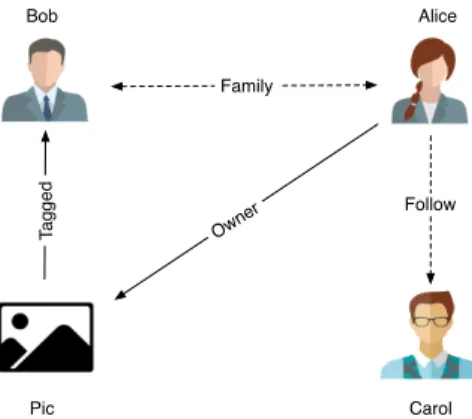
2. Online Social Networks Owner Tagged Pic Carol Bob Alice Family Follow
Figure 1:Social Graph Example
Given the inherent structure of OSNs, the most common way to represent OSNs aregraphs(usually calledsocial graphsin this context) [11]. Vertices
in the graph, represent users and resources (e.g., pictures, posts, etc.) and edges of the graph are utilized to model the relationships among users and resources.
Figure 1 shows an example of such graph. In this example, there are three users: Alice, Bob and Carol and one resource, a picture, indicated as Pic. Dot-ted arrows represent social relationships between users, while plain arrows are relationships between users and resources. Thefamilyrelationship
be-tween Alice and Bob is a bidirectional relation (symmetric), as in Facebook.
On the other hand, followis a unidirectional relation (asymmetric) which
means that a user can follow others without being followed. Additionally, the plain arrows indicate the connections between users and the resource Pic. The connection between Alice and Pic denotes that Alice is the owner of the picture, while Bob is tagged in it.
2.1 Privacy Policies in Online Social Networks
Privacy settings from which hereafter we will refer to asprivacy policies, in
today OSNs allow users to set who can accesswhat information. In most
existing OSNs, users are provided with a large variety of relationships that they use to create their own social circles, e.g., family, friends, colleagues, hiking group, acquaintances and so forth. The current privacy policies in OSNs are specified in terms of relationships. Typically, granting access to a data item is subject to the type of the relationship or its composition (e.g., friends, friends-of-friends). Moreover, privacy policies depend on the func-tionality and purpose of the OSN platform. For instance, in privacy policies
of Facebook, users can determine who can access their posts or friends lists and also, determine the actions that other users can perform. For example, users can define the social circle extent (e.g., friends-of-friends or everyone) of users who are able to send them a friendship request. Other OSNs, like Twitter, are very liberal with what they share to your news feed. Twitter users are able to choose whether to allow the general public to view their Tweets or to make them viewable only to people whom they approve to follow them. In private mode, users avoid having their Tweets viewed by anyone, and those Tweets will be out of any search engines such as Google. Unlike other OSNs, LinkedIn is based on full access and effortless disclosure of users professional and relevant information such as where they live, tele-phone numbers, occupations, professional connections and education. The profile acts as an online resume. However, since many users have privacy concerns, LinkedIn helps users to manage their privacy. A user can specify who can see herconnections list, and controls whether or not other users can
see if the user has viewed their profiles. Unlike other networks, LinkedIn allows users to control who can see their profile photos. For instance, "My Connections" means the profile photo will be seen by connection list only, while the "Network" option means that the user profile picture can be viewed by second and third level connections. Finally, in all OSNs, users can block other users. Blocking a user means she virtually does not exist anymore and prevents any interaction between the two users, hence excluding any abusive or harmful behaviour.
Although privacy policies enable users to protect their personal infor-mation from other users within the network, they are notoriously difficult to configure correctly and do not easily match the OSN’s users sharing in-tentions [2, 4, 20, 38, 45, 46, 47, 48]. Madden conducted a study where she found 48%of OSN users report struggles in managing their OSN privacy set-tings [46]. Another study reveals that only 37%of Facebook’s users consider that privacy settings match their expectations [45]. Due to this lack of under-standing and management difficulties, some users leave their privacy settings to thedefault, which mostly provides insufficient protection, allowing their
data be exposed to strangers [27, 43].
Although OSN companies are putting effort into improving privacy poli-cies for their users, there are still many privacy risks for their users that are caused by limitations in their current privacy protection mechanisms [14, 52]. The research community has identified a number of desirable fea-tures, that are considered to be requirements, in order to enhance privacy in OSNs [31, 66]. Privacy policies should be:
2. Online Social Networks
expertise in choosing the proper privacy policies that can protect their information from undesired disclosure [49]. Users require privacy mech-anisms that are easily understandable and manageable, and user friendly interfaces that help them to reduce the burden of setting their privacy policies.
• Interoperable: Usually, users have accounts on different OSNs such as
Facebook, LinkedIn, Instagram, etc. since each OSN has a specific ob-jective. For example, the purpose of Facebook is to facilitate users’ con-tact in their social relationships, while LinkedIn allows users to main-tain their professional network. Thus, it would be desirable for the privacy mechanisms and policies to be interoperable to protect cross-border data flows between OSNs.
• Sticky: Users’ data can span several organizations, applications and
lo-cations. Therefore, policies have to bestickywhich means they should
follow the piece of data to describe how it can be used after access to it has been granted.
• Fine-grained: Providing fine-grained privacy policies will make it
eas-ier for users to express their privacy preferences. For instance, a user should be able to specify privacy policies for individual blog entries, a specific picture (or part of it), or comments. Such privacy policy for-mulation can impact users’ understanding of privacy policies and thus their success in appropriately employing them. Although Facebook is a good example of how OSNs have come a long way in implementing fine-grained privacy policies, its privacy protection mechanism still lacks key elements. One of the most important is the absence of dis-tinguishability between accessing and sharing policies.
• Relationship-based: People share their information with others based
on the relationship they have with them. The properties of the rela-tionship such as strength, direction, type, etc. also affect the way that people share and disclose their personal information. This is supported by many studies in social psychology [25, 35, 62]. Consequently, there is a wide agreement that privacy control in OSNs should be modeled based on relationships that arise as consequence of the structure of OSNs (e.g.,[16, 17, 30, 32]).
• Specific to the type of content: In OSNs, users are able to post and share
different pieces of information as texts, photos, videos, comments, au-dio, events, hobbies, location, website (url), etc. A number of studies
demonstrate that the format of the information and its content have impact when defining privacy policies, and that there is a relationship between content types and the way users communicate (like, share, comment) [15, 41, 42, 64]. For example, Kim and Yang [41] conducted a study where they found out that posts containing pictures or videos were more likely to motivate users to like and share them.
• Multiparty: In the definition of a privacy policy all users who are
re-lated to a given piece of information, and such that their privacy can be affected by that, should be involved in deciding who should access that item. Furthermore, privacy protection mechanisms have to be able to automatically detect which pieces of information are co-owned by whom. As the protection mechanism contains more than one privacy preference, most of the time users, considered here asco-controllers,
have different desires regarding who they want to view this piece of information. So, it is possible that, within a privacy policy, a user is permitted and denied access at the same time, which creates a con-flict in the policies. Suppose that Alice takes a picture of her and Bob, and uploads it to her space1and tags Bob. Assume that Alice sets that her friends can see her picture and that Bob wants to customize his privacy policies to include only his close friends. In this case Bob’s privacy preference will conflict with some of Alice’s friends.
Multi-party privacyis designed to facilitate the harmonization of collectively
held privacy policies by all users that co-control a piece of informa-tion, where their privacy might be lost depending on with whom the co-controlled piece of information is shared.
• Trust-based: Besides being relationship-based, privacy policies need
to take into account a value for the trust of the relationships. Trust is an important component for building relations in online communi-ties where users can post and share their personal information, expe-riences, social activities and opinions without concerns about privacy. Many studies corroborated that trust has a significant effect on the level of information disclosure between users [39]. Thus, in order to balance the open nature of OSNs and preserve the privacy concerns of
1In this work, we use the termspaceto refer both to the user’s profile and her interactive
arena. A userprofileis a collection of settings and information associated with the user. It
may be defined to be the explicit digital representation of the user’s identity in the context of the given (OSN) environment. It includes information such as age, location, and interests.
The userinteractive arenais the arena for both public interaction and communication with
2. Online Social Networks
users, trust has to become a critical factor in privacy protection mech-anisms.
In order to develop a successful privacy protection mechanism for OSNs, all of the above features are desirable. In this thesis, we focus only on
Mul-tipartyandFine-grainedprivacy policy features. In what follows, we discuss
and give examples of problems arising from the lack of having these features. Multiparty privacy policy
As we mentioned, users can control access to their data by using the privacy settings that OSNs provide. They are implemented based on relationships between the owner of the data item and other users. All the data items in the user space are owned by that user, so we say that the user is theowner
of such data items. The relationship between the data item owner and other users depends on the OSN platform and the data item owner’s preference, e.g., friends, followers, friends of friends, etc. The privacy protection mech-anism implemented in current OSNs allows users to manage the access to data items that are uploaded by them or posted in their space. Besides up-loading and posting, users engage in communication on OSNs via behaviors that are dependent on the structure of the OSN’s platform and its purpose. For instance, Facebook offers the following five behaviors: like, comment,
tag, mention and share2. Whenever a data item is shared, or has tagged or
mentioned users, all the users who are involved should be able to express their privacy policies. Consider the following example. Assume that Alice uploaded a picture of herself drinking with her friend Bob. In this case, the picture is doubtlessly co-owned by both Alice and Bob. In Alice’s privacy set-ting, she sets that this picture can be viewed by her friends, colleagues and family. Bob considers this picture to be sensitive and does not want to share it with Alice’s family and colleagues. Thus, Bob’s privacy will be violated as his picture will be viewed by Alice’s family and friends. In order to protect him from such privacy violation, the OSN privacy protection mechanism has to be properly designed, considering and respecting the privacy preferences of all involved users.
Hundreds of billions of data items that are uploaded and shared in OSNs are co-owned by more than one user [37, 63]. Enge conducted a study on 4 million tweets and found that tweets with pictures acquired more than dou-ble the retweets and likes than a pictureless tweet would [26]. A study pro-cured by Mention’s Twitter Report [50], showed that almost 40%of tweets
include the mention symbol to engage more people in the conversation of the tweet and alert others to subjects of interest. Scholars have emphasized that tagging is one of the popular behaviours on OSNs (e.g., Facebook), where users commonly tag and are tagged [9, 22, 23]. Nowadays on most OSNs it is possible only for the owner of the space to specify the privacy policies of co-owned data items regardless of the privacy preferences of other users who are identified in these data items. Current OSNs offer limited support for managing co-owned data items where users can only use strategies like untagging or reporting inappropriate content.
When OSNs’ tags are normally used, users upload a picture and name other users in it with a link to their profile. There are some OSNs in which the tagged users receive notifications about the pictures they have been tagged in in order to approve them before the picture appears on their space. If the tagged users in a picture do not want to share it with their list of connec-tions (e.g., the user’s Friends List in Facebook), they can untag themselves from it. However, this strategy does not fulfill the users desires for different reasons. Firstly, when tagged users untag themselves from a picture, it does not mean that the actual picture is removed, or that they block the possibility of the picture to be accessed by undesired users. For example, assume that Alice and Bob are in a picture taken during their holiday trip. Alice decided to upload it to Facebook (making her the owner) tag Bob and share it with her friends. When Bob received the tag notification, he decided not to share the picture with his friends list; thus, he took action not to make the picture appear on his Facebook Timeline by not approving the tag (untagged him-self). Despite Bob untagging himself and the picture now not appearing in his own Timeline, the picture will still be viewed by other users according to Alice settings. So if Bob has common friends with Alice, all these friends will be able to view the picture in Alice’s Timeline because they are her friends too. This means, the act of tagging brought Bob into a state where he be-came connected to the picture by the choice of Alice, and despite untagging himself, he is still connected to the picture elsewhere in the network (Al-ice’s space) and accessing and visualizing this tagged picture only depends on Alice’s privacy policies.
For Bob, the fact that he is related (as co-owner) to the picture does not give him any control over who can access it from his social circle (like Friends List in Facebook) or the general social network. This lack of control stems from the fact that Alice has full rights to determine who can access the pic-ture. The second limitation in the untagging strategy is that the tagging is limited to one type of an OSN’s data item, a picture, but is not available for other items such as posts, events, comments. In posts and comments, OSNs
2. Online Social Networks
users can interact with each other through a mention feature that creates a direct link to the mentioned user’s profile. In some OSNs (like Facebook and Twitter) the mentioned users receive a notification that they were men-tioned. However, these posts or comments that have the mentions are solely controlled by users who created them. Finally, even though untagging is used as a management strategy [9], users expressed occasional discomfort at offending the user who tagged them in the picture by using the untagging feature [7, 8]. In some extreme situations tagged users are forced to ask the uploader personally to remove the data item or remove the relationship links. Most OSNs provide an option for users to report and make a request to eliminate a data item published by others, for example, because it is inap-propriate. This option does not guarantee that the data item will definitely be eliminated, and it is mostly used to handle highly inappropriate contents such as harassment, hate speech, child endangerment, violence, nudity or others which are considered publicly offensive. Hence, this mechanism does not solve the privacy issue due to co-ownership. In many scenarios the pri-vacy violations do not necessary happen within the context of an offence. For instance, tagged/mentioned users may simply not feel open to share some in-formation with other users due to privacy concerns, or they may want to re-strict the view of this information to a smaller or specific audience. Also, it is important to point out that reporting is not a proactive mechanism because flagging the data item as inappropriate normally happens after uploading. So, reporting may be too late, the privacy breach may have already occurred and the damage may have already been caused, or users may have been able to copy the data item and disseminate it using other platforms. The bottom line is that compensatory solutions are in general not enough [58, 59]. Coarse-grained privacy policy
One of OSNs shortcomings is the inflexibility of privacy policies to accom-modate the user’s needs and intentions. This lack of flexibility makes many privacy protection features, still in demand by users, unfulfilled whilst a few privacy violations from other users remain unsolved. In practice, many OSNs (such as Facebook) have already provided helpful and desirable privacy poli-cies, some of which can help users to manage their data items. For instance, in Facebook users can specify policies like "Only my friends can see my friends list", "Only friends of my friends can send me friends requests", "Only my friends can see what others post on my Timeline" or "The picture where I was tagged should not appear on my Timeline unless I approve it". Moreover, Facebook’s users can share their data items with a wide range of predefined
users, including friends, groups, friends of friends, or all [13]. These features enable users (the owner) to define which data items can be viewed and by which users. However, given their importance for users, many policies are missing in current privacy protection mechanisms. In Facebook, users can not state policies like "Only the users who live in the same country as me can send me a friend request", "I do not want to be tagged in pictures by anyone other than the members of my close friends group", "Nobody apart from my family group can know my child’s location" or "My post can be seen by my friends and friends of friends but nobody apart from my family group can share it".
Also, current OSNs’ privacy protection mechanisms offer the same op-tion of privacy policies without given consideraop-tion to the type of data item to be protected, whether it be a video, a picture, a location, an event, etc. Thus, users cannot specify their privacy policies according to the type of data item; for instance, in Facebook users cannot choose a policy like "Only my friends can see a post having my location", "Only my close friends group can see a post with a video". Furthermore, presently the privacy protection mechanisms do not equip the users with feature(s) to identify the level of pri-vacy concern(s) that they have with regards to their data item. For example, users are not able to express policies like "I have high sensitivity level for all posts containing location" or "I have medium sensitivity level for all pictures that I have been tagged in".
As we mentioned, current privacy protection mechanisms are built based on relationships. By their very nature, each relationship has its own intensity (degree of trust), thus relationships among users are not equal [34]. However, the privacy protection mechanisms make no effort to distinguish between users’ relationships; users are either in a relationship or are strangers. For example, in Facebook, users are classified either as friends or outsiders with nothing to choose from inbetween. At present, privacy protection mecha-nisms ignore the existence of trust differences; thus, users are neither able to express how much they trust other users nor to state policies by using a trust concept. Again, using Facebook as an example, users cannot specify policies that apply trust like "Whenever I am tagged by my friends whom I highly trust, the picture can be shown on my Timeline without approval" or "My posts can only be shared by highly trusted friends".
In general, OSNs’ privacy policies determine who can access which data items along with other special privacy policies, which differ from one OSN to another according to their characteristics and functionality (e.g., untag in Facebook). However, looking deeper at what users can do with someone else’ data items, there are two main actions: accessing and disseminating (sharing)
2. Online Social Networks
the data items. Since most privacy policies are centered around the data items accessibility that sharing policies are embedded within it, it can be inferred that privacy policies are indirectly in control of sharing, although the two actions are functionally different. Using Facebook as an example, suppose that Alice posted a picture specifying friends of friends privacy policy. This means it can be seen by her friends and their friends. Bob who is her friend can not only see the picture but even share it with his friends, friends of friends or everyone. Imagine now that Bob decides to share it with his friends of friends; this action will increase the picture’s audience to Alice’s friends of friends and Bob’s friends of friends. Despite that Alice set her privacy policy for only her friends of friends to see it, the picture is shared by her friend Bob and shown to more people than she expected. This lack of having policy options about sharing leads to undesirable results and privacy breaches.
In view of this, privacy policies need to be flexible to accommodate the user’s needs and intentions, and more fine-grained settings are needed. How-ever, fine granularity and flexible privacy policies may lead to an overwhelm-ing and complex cognitive demand for the users to deal with them. This rep-resents a burden that could worsen user’s tendency to ignore policy specifica-tion, and trust the default privacy policies. This obeys to the OSNs’ interests rather than the users. Additionally, such restricted privacy policies reduce the amount of data items shared in the OSNs; it makes the OSN platforms less likely to attract more users, which inevitably decreases their growth. So, an equilibrium between too little flexibility and an excessively complicated privacy policy management is needed.
2.2 Access Control in Online Social Networks
The privacy protection mechanism that is employed in OSNs today to con-trol the access and dissemination of users’ information isaccess control[1].
Access control mechanisms regulate how a subject may access an object [33] and is one of the most important features of today’s systems to protect access to data items [6]. It has three main concepts: setting the policies that autho-rize certain individuals to access certain data items; authenticating evidence associated with an access request; assessing the access request based on the given policies [33].
The access control model behind the privacy protection mechanism of OSNs is readily distinguishable from others access control mechanisms, such as Mandatory Access Control (MAC) [53], Discretionary Access Control (DAC) [55], Attribute-Based Access Control (ABAC) [65] and Role-Based Access Control (RBAC) [54]. Several access control models that have been devel-oped in recent years are aimed at effectively capturing the nature of
infor-mation accessed and shared in OSNs [12, 17, 18, 19, 29, 30]. Several stud-ies showed ample evidence that users’ relationships should be considered as a central concept in modeling the privacy protection mechanism of OSN [17, 29, 31, 35, 62]. In what follows, we provide background on the access control model OSNs implement.
Relationship-Based Access Control
InRelationship-Based Access Control(ReBAC), authorizations are specifically
based on relationships between users. This new access control paradigm was initially inspired by the structure of OSNs. Comparing with other access control models such as DAC, RBAC or ABAC, there are three distinguishing features of ReBAC model that are identified by Fong et al. [29].
• ReBAC model relies on leveraging social relationships as access policies.
So, users specify the audience of their data items based on their di-rect or indidi-rect relationship with others. Consider Alice, in Figure 1, who may state a policy that makes Pic solely accessible to her family members, that is Bob. Alternatively, she can specify that Pic can be accessed by her indirect family members (i.e., family of family) which results in Bob’s family members. Another policy option can be public which gives accessibility to everyone in OSN’s platform.
• Before granting the access to any data item, it has to be reachable in
the social graph.Reachability is a necessary step prior setting policies
regarding accessibility. In Figure 1 for example, Bob is reachable from Alice throughfamilyrelation. Thence, Bob can access Pic if permission
is granted. On the other hand, Carol would not be able to access Pic, since Alice and Bob are not reachable by him.
• Abstraction of the succession of events and interactions that take place in
the system. According to many access control systems, authorization
is a function that depends on the sequence of events and interactions [56]. As shown in Figure 1, family relationship is a bidirectional rela-tion that indicates to both users that they are required to agree before establishing the relationship. Envision that Carol wants to access Al-ice’s picture (Pic). In order to achieve that one possible option can be as following: 1) Carol sends a friendship request to Alice; 2) Alice ac-cepts the request; 3) Carol would be able access the Pic if Alice sets policies that grant her friends accessibility. In ReBAC, the sequence of events is abstracted into the social graph. Continuing with our previ-ous example, the impact of Alice and Carol becoming friends produces
2. Online Social Networks
a friend relationship between them. This abstraction of the event his-tory becomes a basis of authorization decisions in ReBAC.
ReBAC is a paradigm that captures the nature of information accessing in OSNs by taking into account users’ relationships as a core concept [30]. However, the ongoing privacy violations in OSNs indicate that ReBAC as applied on OSNs has limitations which means this model might need to be revised. Mondal et al. discuss insufficiency of managing privacy in OSNs by applying access control, while Fogues et al. discuss a few open challenges in ReBAC for OSNs [28, 51]. They bring up, among others, the following issues:
1. A privacy protection mechanism is needed to enforce the privacy
prefer-ences of all involved users when dealing with a data item that is related to
other users.This issue relates to the aforementioned problem of lack of
havingMultipartypolicies. To address multiple ownership in ReBAC,
the model has to be extended to consider all different relationship con-texts between a co-owned data item and the involved users. Moreover, the model should focus on supporting the detection and resolution of multiparty privacy conflicts, since individual privacy preferences may conflict because other involved users in the co-owned data item may want to grant access to or share it with different audiences. The recent line of work on privacy management and access control for OSNs is tackling this issue [58].
2. Privacy policies that OSNs provide do not capture how data items should
be disseminated.In OSNs, it is also important for the owner of the data
item or all involved users in case of co-owned data to specify privacy policies that limit who can disseminate their data items. For example, Alice might feel open to permit Bob an access to Pic, but maybe she does not want him to share it with Carol who, originally, did not have the right to view the Pic. It is important to design a mechanism that empowers users to express privacy policies that determinate who can disseminate their data items and who cannot. Ongoing work on con-trolling a shared data item is handling this issue [32, 44]. This issue is related to the problem arising from lack ofFine-grainedpolicy.
All in all, these two privacy issues show that OSNs’ privacy protection mechanisms should be supportive by multiparty privacy management as tra-ditional single-user approaches lack the flexibility to accommodate the co-owned data scenarios, causing undesired disclosure of sensitive data. More-over, OSNs’ privacy policies should be more expressive. In the next section,
we introduce our approach to address some of the privacy issues we have described.
3 Thesis Overview
Our aim in this work is to provide a framework that empowers OSNs’ users to collectively manage viewing and sharing their co-owned data items. As conflicting policies are commonly raised in multiple ownership privacy pro-tection mechanisms, we proposed Viewing and Sharing aggregation-based
algorithms which make a decision by solving potential conflicts between the different privacy settings of all the concerned users. This is achieved by tak-ing into account the followtak-ing aspects: the trust among users; the sensitivity level of users with respect to the concerned data item; and the weights of the following: (i) the types ofcontrollers(those who are concerned in the
deci-sion that determines who can access a given data item and who cannot) and (ii) the types ofaccessors(those who are identified to access a given data item
or not). We evaluated our solution by generating all possible combinations of components and performed experiments to show how the different com-ponents affect the decision on who should or should not, access or share the data items. Furthermore, we provided proof-of-concept implementation into the open source OSN Diaspora. This work is currently under submission to the Journal of Logical and Algebraic Methods in Programming (JLAMP) 2019 and was co-authored by Raúl Pardo, Gerardo Schneider and Pablo Picazo-Sanchez.
Regarding my contributions, I proposed the collaborative access control model, formalized the policies and developed the collaborative access con-trol algorithms. Moreover, I implemented the proof-of-concept prototype in Diaspora.
Bibliography
[1] S. Abiteboul, R. Agrawal, P. Bernstein, M. Carey, S. Ceri, B. Croft, D. De-Witt, M. Franklin, H. G. Molina, D. Gawlick, et al. The lowell database research self-assessment. Communications of the ACM, 48(5):111–118,
2005.
[2] A. Acquisti and R. Gross. Imagined communities: Awareness, informa-tion sharing, and privacy on the facebook. InInternational workshop on
privacy enhancing technologies, pages 36–58. Springer, 2006.
[3] I. Altman. A conceptual analysis. Environment and behavior, 8(1):7–29,
1976.
[4] J. Anderson and F. Stajano. Must social networking conflict with privacy?
IEEE Security & Privacy, 11(3):51–60, 2013.
[5] U. G. Assembly. Universal declaration of human rights. UN General
Assembly, 1948.
[6] E. Bertino and R. Sandhu. Database security-concepts, approaches, and challenges.IEEE Transactions on Dependable and secure computing, (1):2–
19, 2005.
[7] A. Besmer and H. Lipford. Tagged photos: concerns, perceptions, and protections. InCHI’09 Extended Abstracts on Human Factors in Computing
Systems, pages 4585–4590. ACM, 2009.
[8] A. Besmer and H. Richter Lipford. Moving beyond untagging: photo privacy in a tagged world. InProceedings of the SIGCHI Conference on
Human Factors in Computing Systems, pages 1563–1572. ACM, 2010.
[9] J. Birnholtz, M. Burke, and A. Steele. Untagging on social media: Who untags, what do they untag, and why? Computers in Human Behavior,
[10] D. M. Boyd and N. B. Ellison. Social network sites: Definition, his-tory, and scholarship. Journal of computer-mediated Communication,
13(1):210–230, 2007.
[11] N. Bronson, Z. Amsden, G. Cabrera, P. Chakka, P. Dimov, H. Ding, J. Fer-ris, A. Giardullo, S. Kulkarni, H. Li, et al. {TAO}: FacebookâĂŹs
dis-tributed data store for the social graph. InPresented as part of the 2013
{USENIX}Annual Technical Conference ({USENIX}{ATC}13), pages 49–60,
2013.
[12] B. Carminati, E. Ferrari, and A. Perego. Rule-based access control for social networks. InOTM Confederated International Conferences" On the
Move to Meaningful Internet Systems", pages 1734–1744. Springer, 2006.
[13] F. H. Center. What are the privacy settings for groups?, 2019. https://www.facebook.com/help/220336891328465#What-are-the-privacy-options-for-groups, Last accessed on 2019-3-23.
[14] T. H. Center. How to protect and unprotect your tweets, 2019. https://help.twitter.com/en/safety-and-security/how-to-make-twitter-private-and-public, Last accessed on 2019-3-18.
[15] K. Chauhan and A. Pillai. Role of content strategy in social media brand communities: a case of higher education institutes in india. Journal of
Product & Brand Management, 22(1):40–51, 2013.
[16] Y. Cheng, J. Park, and R. Sandhu. Relationship-based access control for online social networks: Beyond user-to-user relationships. In2012 International Conference on Privacy, Security, Risk and Trust and 2012
In-ternational Confernece on Social Computing, pages 646–655. IEEE, 2012.
[17] Y. Cheng, J. Park, and R. Sandhu. A user-to-user relationship-based ac-cess control model for online social networks. InIFIP Annual Conference
on Data and Applications Security and Privacy, pages 8–24. Springer, 2012.
[18] M. Cramer, J. Pang, and Y. Zhang. A logical approach to restricting ac-cess in online social networks. InProceedings of the 20th ACM Symposium
on Access Control Models and Technologies, pages 75–86. ACM, 2015.
[19] J. Crampton and J. Sellwood. Path conditions and principal matching: a new approach to access control. InProceedings of the 19th ACM
sym-posium on Access control models and technologies, pages 187–198. ACM,
Bibliography
[20] B. Debatin, J. P. Lovejoy, A.-K. Horn, and B. N. Hughes. Facebook and online privacy: Attitudes, behaviors, and unintended consequences.
Journal of computer-mediated communication, 15(1):83–108, 2009.
[21] J. W. DeCew.In pursuit of privacy: Law, ethics, and the rise of technology.
Cornell University Press, 1997.
[22] A. Dhir, G. M. Chen, and S. Chen. Why do we tag photographs on facebook? proposing a new gratifications scale. new media & society,
19(4):502–521, 2017.
[23] A. Dhir et al. Exploring online self-presentation in computer-mediated environments-motives and reasons for photo-tagging and untagging. 2016.
[24] E. Directive. 95/46/ec of the european parliament and of the council of 24 october 1995 on the protection of individuals with regard to the pro-cessing of personal data and on the free movement of such data.Official
Journal of the EC, 23(6), 1995.
[25] S. Duck. Human relationships. Sage, 2007.
[26] E. Eric. Twitter engagement unmasked: A study of more than 4m tweets, 2014. https://www.stonetemple.com/twitter-engagement-umasked/, Last accessed on 2019-3-20.
[27] M. Fire, D. Kagan, A. Elyashar, and Y. Elovici. Friend or foe? fake pro-file identification in online social networks.Social Network Analysis and
Mining, 4(1):194, 2014.
[28] R. Fogues, J. M. Such, A. Espinosa, and A. Garcia-Fornes. Open chal-lenges in relationship-based privacy mechanisms for social network ser-vices. International Journal of Human-Computer Interaction, 31(5):350–
370, 2015.
[29] P. W. Fong, M. Anwar, and Z. Zhao. A privacy preservation model for facebook-style social network systems. InEuropean Symposium on
Research in Computer Security, pages 303–320. Springer, 2009.
[30] P. W. Fong and I. Siahaan. Relationship-based access control policies and their policy languages. InProceedings of the 16th ACM symposium
on Access control models and technologies, pages 51–60. ACM, 2011.
[31] C. Gates. Access control requirements for web 2.0 security and privacy.
[32] R. Gay, J. Hu, H. Mantel, and S. Mazaheri. Relationship-based access control for resharing in decentralized online social networks. In FPS,
pages 18–34, 2017.
[33] D. Gollmann. Computer security.Wiley Interdisciplinary Reviews:
Com-putational Statistics, 2(5):544–554, 2010.
[34] M. S. Granovetter. The strength of weak ties. InSocial networks, pages
347–367. Elsevier, 1977.
[35] D. J. Houghton and A. N. Joinson. Privacy, social network sites, and social relations. Journal of Technology in Human Services, 28(1-2):74–94,
2010.
[36] B. Howard. Analyzing online social networks. Commun. ACM,
51(11):14–16, Nov. 2008.
[37] P. Ilia, I. Polakis, E. Athanasopoulos, F. Maggi, and S. Ioannidis. Face/off: Preventing privacy leakage from photos in social networks. In Proceed-ings of the 22nd ACM SIGSAC Conference on Computer and
Communica-tions Security, pages 781–792. ACM, 2015.
[38] M. Johnson, S. Egelman, and S. M. Bellovin. Facebook and privacy: it’s complicated. InProceedings of the eighth symposium on usable privacy
and security, page 9. ACM, 2012.
[39] A. Jøsang, R. Ismail, and C. Boyd. A survey of trust and reputation systems for online service provision.Decision support systems, 43(2):618–
644, 2007.
[40] S. Joseph and M. Castan.The international covenant on civil and political
rights: cases, materials, and commentary. Oxford University Press, 2013.
[41] C. Kim and S.-U. Yang. Like, comment, and share on facebook: How each behavior differs from the other. Public Relations Review, 43(2):441–
449, 2017.
[42] P. Klemperer, Y. Liang, M. Mazurek, M. Sleeper, B. Ur, L. Bauer, L. F. Cranor, N. Gupta, and M. Reiter. Tag, you can see it!: using tags for access control in photo sharing. InProceedings of the SIGCHI Conference
on Human Factors in Computing Systems, pages 377–386. ACM, 2012.
[43] B. Krishnamurthy and C. E. Wills. On the leakage of personally identi-fiable information via online social networks. InProceedings of the 2nd
Bibliography
[44] A. Lazouski, F. Martinelli, and P. Mori. Usage control in computer se-curity: A survey.Computer Science Review, 4(2):81–99, 2010.
[45] Y. Liu, K. P. Gummadi, B. Krishnamurthy, and A. Mislove. Analyzing facebook privacy settings: user expectations vs. reality. InProceedings of
the 2011 ACM SIGCOMM conference on Internet measurement conference,
pages 61–70. ACM, 2011.
[46] M. Madden. Privacy management on social media sites. Pew Internet
Report, pages 1–20, 2012.
[47] M. Madejski, M. Johnson, and S. M. Bellovin. A study of privacy settings errors in an online social network. In2012 IEEE International Conference
on Pervasive Computing and Communications Workshops, pages 340–345.
IEEE, 2012.
[48] M. Madejski, M. L. Johnson, and S. M. Bellovin. The failure of online social network privacy settings. 2011.
[49] A. Mazzia, K. LeFevre, and E. Adar. The pviz comprehension tool for social network privacy settings. InProceedings of the Eighth Symposium
on Usable Privacy and Security, page 13. ACM, 2012.
[50] Mention. The twitter engagement report 2018,users tagged, 2018.
https://mention.com/en/reports/twitter/users-tagged/, Last
accessed on 2019-3-20.
[51] M. Mondal, P. Druschel, K. P. Gummadi, and A. Mislove. Beyond access control: Managing online privacy via exposure. InProceedings of the
Workshop on Useable Security, pages 1–6, 2014.
[52] F. newsroom. Hard questions: What is facebook doing to address the challenges it faces?, 2019.https://newsroom.fb.com/news/2019/02/ addressing-challenges/, Last accessed on 2019-3-18.
[53] R. S. Sandhu. Lattice-based access control models. Computer, 26(11):9–
19, 1993.
[54] R. S. Sandhu. Role-based access control. In Advances in computers,
volume 46, pages 237–286. Elsevier, 1998.
[55] R. S. Sandhu and P. Samarati. Access control: principle and practice.
[56] F. B. Schneider. Enforceable security policies. ACM Trans. Inf. Syst.
Secur., 3(1):30–50, Feb. 2000.
[57] D. J. Solove. Understanding privacy, volume 173. Harvard university
press Cambridge, MA, 2008.
[58] J. M. Such and N. Criado. Multiparty privacy in social media. Commun. ACM, 61(8):74–81, 2018.
[59] J. M. Such, J. Porter, S. Preibusch, and A. Joinson. Photo privacy conflicts in social media: A large-scale empirical study. InProceedings of the 2017
CHI Conference on Human Factors in Computing Systems, pages 3821–
3832. ACM, 2017.
[60] S. D. Warren and L. D. Brandeis. Right to privacy. Harv. L. Rev., 4:193,
1890.
[61] A. F. Westin and O. M. Ruebhausen. Privacy and freedom, volume 1.
Atheneum New York, 1967.
[62] E. Wiese, A. Wykowska, J. Zwickel, and H. J. Müller. I see what you mean: how attentional selection is shaped by ascribing intentions to
oth-ers. PloS one, 7(9):e45391, 2012.
[63] H. Xu. Reframing privacy 2.0 in online social network. U. Pa. J. Const. L., 14:1077, 2011.
[64] C.-m. A. Yeung, L. Kagal, N. Gibbins, and N. Shadbolt. Providing access control to online photo albums based on tags and linked data. InAAAI
Spring Symposium: Social Semantic Web: Where Web 2.0 Meets Web 3.0,
pages 9–14, 2009.
[65] E. Yuan and J. Tong. Attributed based access control (abac) for web ser-vices. InIEEE International Conference on Web Services (ICWS’05). IEEE,
2005.
[66] C. Zhang, J. Sun, X. Zhu, and Y. Fang. Privacy and security for online social networks: challenges and opportunities. IEEE network, 24(4):13–
1
A Collaborative Access
Control Framework for
Online Social Networks
Hanaa Alshareef, Raúl Pardo, Gerardo Schneider, Pablo Picazo-Sanchez Journal of Logical and Algebraic Methods in Programming 2019
A
bstract. Most Online Social Networks allow users to set theirpri-vacy settings concerning posting information, but current imple-mentations do not allow a fine grained enforcement in case the posted item concerns other users. In this paper we propose a new collabora-tive access control framework that takes into account the relation of multiple users for viewing as well as for sharing items, eventually solv-ing conflicts in the privacy settsolv-ings of the users involved. Our solution is based on the sensitive level of users with regard to the posted item and on trust among users. We provide a thorough evaluation of our framework where we focus on how varying some of the parameters di-rectly influence the outcome of the permitting/denying decision of the proposed algorithms. Last but not least, we present a proof-of-concept implementation of our approach in Diaspora, an open source social net-work.
1 Introduction
Most Online Social Networks (OSNs) today have privacy settings that allow users to define their preferences in what concerns the use of their data. This usually includes aspects related to whom can have access to which informa-tion but it is limited in a number of ways. For example, in OSNs like Facebook or Twitter users may only describe who is the direct audience of a given item (post, message, picture, etc.), meaning that it only concerns who has access to the item based on the explicit relationships the user has previously de-fined. In many cases it involves only one level in the relationship order or two levels, e.g., friends or friends of friends. This is a limitation since users might be interested in defining privacy policies that limit the access to other users not directly connected with them beyond two levels. This is the case, for instance, whenever somebody who originally got access to the informa-tion, wants to share it with other users unrelated to the original source of the item.
In the majority of OSNs, the audience of a piece of information uploaded to the system is solely defined by a single user. Typically, the user defining the audience is the one uploading the data, be to her ownspace, or somewhere
else.1 However, many other users may also be concerned with the posted
data, so they should also have a say in who may access or not. Ideally, there should be a mechanism allowing all the involved users to take a decision collaboratively.
Current implementations of social networks rely on the so called Relationship-based Access Control (ReBAC) model [12] where the social relationships be-tween users are used to express access control policies. Though ReBAC has been shown to have many advantages with respect to other access control models in OSNs [10, 12] it does not allow a fine grained enforcement in case
1In this work, we use the termspaceto refer both to the user’s profile and her interactive
arena. A userprofileis a collection of settings and information associated with the user. It
may be defined to be the explicit digital representation of the user’s identity in the context of the given (OSN) environment. It includes information such as age, location, and interests.
The userinteractive arenais the arena for both public interaction and communication with
the posted item concerns many users, and the privacy settings usually do not allow for setting limits when a user wants to share the item she got access to. This lack of collaborative policies for access control may violate the privacy of the users who are part of the uploaded content, since they cannot decide who should access it: only the uploader of the data can decide that.
Additionally, apart from the aforementioned problem, ReBAC does not properly address users’ policy conflicts. It is possible that, within an access control policy, a user is permitted and denied access at the same time, thus creating a conflict in the policy. Thus, there is a need to solve the conflicts before deciding who has access to the shared object [29, 30, 31].
A promising line of work for collaborative access control is the so-called
aggregation-based models [29]. Using this approach the individual privacy
preferences of all users related to an item are aggregated to decide, for in-stance, whether the item can be shared. However, the main drawback is that existing models (such as [17, 35]) are too coarse grained to cover all cases, and, in some cases, rely again on the data owner to choose a conflict resolu-tion strategy.
We propose aViewingand aSharingaggregation-based algorithms which
take a decision by solving potential conflicts between the different privacy settings of all the concerned users. Our algorithms rely on four different components: the sensitivity level of the users with respect to the concerned item, a trust relationship between users, and different weights for both the
controller typesandaccessor types.2In order to be as general as possible,
try-ing to cover most of the existtry-ing OSNs nowadays, we include in our model
factorsto give (or take) importance to some components. In this way, by
giv-ing different values to such factors we can obtain different results in what concerns the decisions to grant or deny viewing/sharing capabilities. This gives us the possibility to tune the decision policy, getting the outcome to range from very conservative (e.g., a strong denial from one party may over-rule all the others) to more liberal (e.g., a majority granting access impose their decision).
We evaluate our solution by generating all possible combinations of the components under consideration (for a given value of the factors), and we perform experiments to show how the factors influence the decision on who should, or should not, access or share the posted items. Additionally, we pro-vide a proof-of-concept implementation into the open source OSN Diaspora [8].
In summary, ourcontributionsare:
2Controllerandaccessor typeswill be defined in Section 2; for the time being it suffices to
2. A Collaborative Access Control Framework for OSNs
• A collaborative access control framework for OSNs taking into ac-count: a trust relationship between users, sensitivity level of the users with respect to the concerned item, and different weights for both the controller types and accessor types (Section 2);
• An algorithm for collaboratively deciding who has access to an item (Section 2.3.1), and an algorithm to take such decision in case of sharing the item (Section 2.3.2);
• An evaluation of the behaviour of our algorithms based on an analysis of how the different components affect the decision to grant or deny access and sharing (Section 3);
• A proof of concept implementation of our framework in Diaspora (Sec-tion 3.1).
We compare our approach with previous work in Section 4, and we con-clude in the last section.
2 A Collaborative Access Control Framework for OSNs
Our framework consists of three components: 1) an OSN model (Section 2.1); 2) access control policies (Section 2.2), and; 3) the collaborative access control mechanism (Section 2.3).
2.1 OSN Model
OSNs are typically structured as graphs, where vertices represent users and items whereas the edges of the graph represent connections between nodes. Concretely, vertices in the model are split intoactors,items, andgroups.
Ac-tors represent the real users of OSNs.3Each actor has aspace, which includes
the user’s profile and interactive arena. Anitemis a digital representation of
the physical object (e.g.,picture, text) to be posted, shared, etc. Agroup
rep-resents a spot that connects a collection of users who have the same beliefs, interests, behaviours, etc.
We also consider Relationship types to represent connections between
vertices in the graph. For simplicity of presentation, and without loss of gen-erality, in the rest of the paper we assume that there can exist only one rela-tionship between any two vertices in the graph. In what follows we formally describe the OSN model that we use thorough this paper.
3For us it is not important whether the user is a physical individual, or an institution or
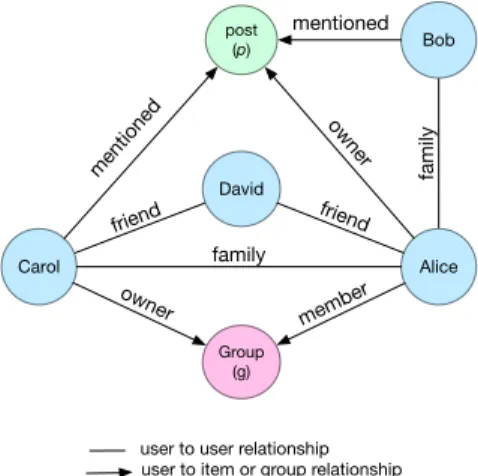
post (p) family owner mentioned Group (g) member
user to user relationship user to item or group relationship
friend Alice Bob Carol David family mentioned friend owner
Figure 1.1:A Sample OSN Model
Definition 1(OSN Model). LetAbe a set of actors,I a set of items andGa
set of groups. Consider also a set of relationship typesRT. AnOSN modelis a
graphSG= (A ∪ I ∪ G,{Ri}i∈RT)where the vertices in the graph are elements
of one of the setsA,I orG, and eachRi⊆(A ∪ I ∪ G)×(A ∪ I ∪ G)is a binary
relation representing the edges of the graph.
Figure 1.1 shows an example of an OSN. In this example, there are four actors, a post (p) and a group (g). The post is uploaded by Alice who
men-tionsher family members Bob and Carol. Also, the groupg was created by
Carol, and Alice is a member of it. As it can be seen, the social network has relationships between actors and the item, e.g.,owner (Aliceownsthe post
p) andmentioned(Bob and Carol are mentioned in the postp); relationships
between actors and groups, e.g.,owner(Carolownsthe groupg) andmember
(Alice is a member of the groupg); and relationships between actors4, e.g.,
family(both Bob and Carol are in a family relationship with Alice) andfriend
(David is a friend of both Carol and Alice).
Trust Model. Trust becomes a crucial concept in OSNs for improving pri-vacy mechanisms and reducing concerns about disclosing personal informa-tion [19]. Different techniques have been proposed in the literature (e.g., [4, 14, 20, 21]) to determine the optimum path and the trust value among users in OSNs. Ordinarily, people would like to express their trust using natu-ral languages instead of numerical values. The FuzzyTrust algorithm [21]
4Here we consider that the relationships between actors aresymmetric, though this might
2. A Collaborative Access Control Framework for OSNs
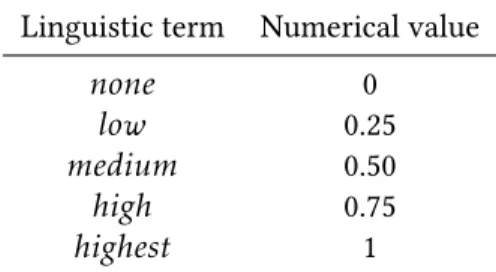
Table 1.1:Trust level weights Linguistic term Numerical value
none 0
low 0.25
medium 0.50
high 0.75
highest 1
allows us to do that, so in this work we use such algorithm to compute the trust between users. FuzzyTrust requires atrust graphwhere edges are
labelled with the following set of Trust Linguistic Terms (T LT) T LT = {none,low,medium,high,highest}.
We assign to each of the elements ofT LT a numerical value (see
Ta-ble 1.1), used in our algorithms (Section 2.3). Hence, we define a trust graph as
TG= (A,T R) where vertices are actors (A), which represent the OSN users,
and edgesT R ⊆ A × T LT × Aare defined as a set of triples(a, tv, v),
indi-cating thata’s trust level forvis equal totv. The functioninfer:A × A →R
computes the numerical trust value between two actors in a trust graph (note
that(1−infer)corresponds to thedistrust value). Given a trust graph TG,
we use the notationTG.inferto retrieve trust values among the actors inTG.
When actors are directly connected in the trust graph,infersimply returns
the numerical value corresponding to the label between the actors. On the contrary, if actors are not directly connected, infer applies the FuzzyTrust
algorithm (see [21] for details). For instance, Alice may assign a high trust level for all her friends and a medium trust level to all her family except Bob who is assigned to a low level. Theinfer function computes the numerical
value for trust between Alice and each of her friends, her family and Bob as following: 0.75, 0.50 and 0.25,respectively.
Associated Controllers. Similarly to [17], for each item we consider a set
ofassociated controllers, representing all the actors of the OSN concerned in
the decision of who should have access to a given item. We define a set of
controllers types CT ⊆ RT as {owner,stakeholder,contributor,originator}.
Though the elements inRT may differ depending on the concrete OSN, we
require that the elements inCT are always included inRT. We define the
set of associated controllers to itemi as Ci = {c | (c, i) ∈ Rj wherej ∈ C}
Owner. All the items in the actor space are owned by that actor. We say
that the actor is theowner of all those items. In our model we include
an owner relation between an actor and an item every time an item is posted in her space. We use the relationshipownerto indicate when
an actor is the owner of an item.
Stakeholder. Astakeholder is an actor who is tagged or mentioned in an
item. We use the relationshipstakeholderto indicate when an actor is
a stakeholder of an item.
Contributor. Acontributor is an actor who posts an item in a space
differ-ent than hers, e.g., Alice posting in Bob’s space, making Alice to be a contributor for that post and Bob is the owner. We use the relationship
contributorto indicate when an actor is a contributor of an item.
Originator. An actor is considered to be anoriginatorwhen an item is shared
from her space—note that the owner is the only one who can become an originator. For instance, if Alice shares an item from Bob’s space to Carol’s space, then Bob is the originator of the item. We use the relationshiporiginatorto indicate when an actor is an originator of an
item.
Note that for each item there is exactly one owner, at most one contributor, at most one originator, and zero or more stakeholders.
Controllers Types Weight.In our framework the associated controllers do not necessarily have the same importance. We use the principle that close people tend to be similar [2, 9], and thus we give the stakeholders the same importance as the owner for two reasons: 1) they are explicitly mentioned (or tagged) without their approval, and; 2) stakeholders who are conventionally related to the content of the item, by some way or another, becomes liable to the disclosure of their sensitive information.
Regarding the contributor and the originator controllers, and contrarily to other proposals (e.g., [18, 27, 28]), we get them involved into the collab-orative decision. The main difference with respect to the owner and stake-holder(s) is that we take into account the distance between them and the owner in the OSN model, and we give them different values. The distance
between the owner and each associated controller is defined as the shorter connection path length between them considering all the relationships that connect them.
We propose two algorithms,ViewingandSharing, corresponding to the
2. A Collaborative Access Control Framework for OSNs
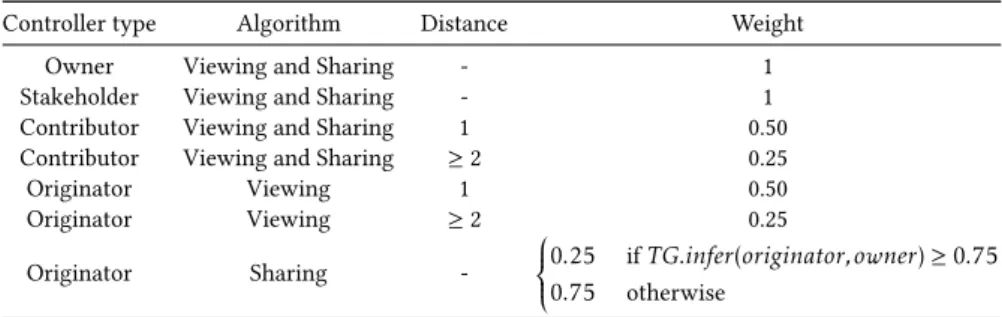
Table 1.2: Controllers types’ weights. Column 1 represents the types of associated
con-trollers; column 2 shows the algorithms for producing the collaborative decisions; column 3 is the minimum distance among all the social relationships between the owner and the associated controller; column 4 shows the weight we assign to the associated controllers
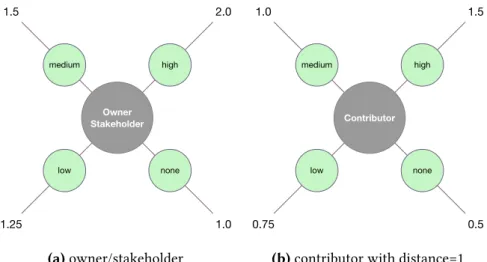
Controller type Algorithm Distance Weight Owner Viewing and Sharing - 1 Stakeholder Viewing and Sharing - 1 Contributor Viewing and Sharing 1 0.50 Contributor Viewing and Sharing ≥2 0.25
Originator Viewing 1 0.50 Originator Viewing ≥2 0.25 Originator Sharing -
0.25 ifTG.infer(originator,owner)≥0.75
0.75 otherwise
item. The algorithms depend on several parameters, among others theweight
of the associated controllers.
Each associated controller is weighted based on whether she is involved in the process of making the collaborative decision regarding viewing or sharing an item, and her distance from the owner. Table 1.2 shows how this weight is defined for each associated controller in both algorithms. Note that for the owner and stakeholder types, the weight is always one and it does not depend on the distance since both are equally involved in the process of mak-ing a collaborative decision. In the case of the contributor, she is weighted differently based on her distance from the owner in both algorithms (see rows 3 and 4).
For the originator, the weight is different for each algorithm: for Viewing the distance is calculated in the same way as for the contributor, whereas for Sharing the distance is not relevant as she is weighted based on the trust level between herself and the owner. The trust level is used to indicate how much influence an originator’s opinion will have on the aggregated decision. In this case, if the originator highly trusts the owner (with a value≥0.75) then
the weight is only 0.25, otherwise it will be 0.75. In other words, when the originator highly trusts the owner, the task of deciding whether to share or not is delegated to the trustee.
In what follows, we use a functionwct:CT →Rto retrieve the weight
of a controller type.
2.2 Access Control Policies
In this section, we introduce the access control policies that our collabora-tive algorithms use. Before explaining what an access control policy is and
how it is represented, we introduce two concepts: accessor specifications and sensitivity levels of data items.
Accessor Specification. In our framework each associated controller can identify a set of actors who can access her data and who cannot, the so-calledaccessors. Associated controllers can specify their permitted and
de-nied accessors using the following accessor types:actor names,group names
and relationship names. Formally, we define the set of accessor types as
AT ={an,gn,rn}. Many OSNs allow users to specify who can access their
information using these accessor types; they have also been used in other collaborative access control frameworks like in [17]. These accessor types help the controllers to customize their access control policies.
Definition 2(Accessor specification). We define an accessor specification as pair(A ∪ G ∪ RT)× AT. We useASto denote the set of accessor specifcations.
For example, the accessor specificationhAlice,aniindicates that Alice is
specified as actor, whilehf riends,rnidenotes that controller determines her
friends relationship either to access her data or not. We denote the universe of accessor specifications as,UAS ⊆2AS. Accessor types are organized
hi-erarchically forming a total order: rn>gn>anwherey > xmeans that x
ismore specific thany (or thaty ismore general than x). As we define
be-low, denying or permitting an actor by means of a policy that uses a specific accessor type contributes more to the final decision than policies using less specific accessor types.
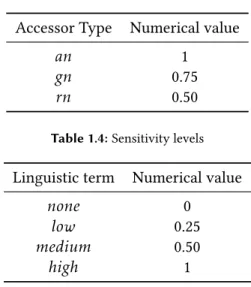
Accessor Type Weight.In our framework, not all accessor types are equal. For example, we consider that directly denying an actor (“Alice is denied”) should have a “stronger” effect on a collaborative decision than indirectly denying an actor because it belongs to a relationship (“My friends are de-nied”, where Alice is one of the friends). Thus, we weight the accessor types based on the most-specific-takes-precedence principle [6, 7]. We define the
function wat : AT → R to retrieve the weight of an accessor type, e.g.,
wat(getAccessorType(a, i))wheregetAccessorType(a, i)∈ {an,gn,rn}
accord-ing to the definition in Table 1.3.
Sensitivity levels of data items.The actor’s space, relationships and items, embody the actor’s data in OSNs. Usingsensitivity levels, the associated
con-trollers of an item indicate how much a disclosure of the item would harm them. In what follows we define a set of sensitivity levels that associated controllers can add in their access control policies (see Definition 3). Let