Theses & Dissertations Boston University Theses & Dissertations 2019
Advances in privacy-preserving
machine learning
https://hdl.handle.net/2144/39592 Boston UniversityGRADUATE SCHOOL OF ARTS AND SCIENCES
Dissertation
ADVANCES IN PRIVACY-PRESERVING MACHINE
LEARNING
by
OM DIPAKBHAI THAKKAR
B.Tech., Dhirubhai Ambani Institute of Information and
Communication Technology, India, 2014
Submitted in partial fulfillment of the
requirements for the degree of
Doctor of Philosophy
2019
First Reader
Adam Smith, Ph.D.
Professor, Computer Science
Second Reader
Sofya Raskhodnikova, Ph.D. Professor, Computer Science
Third Reader
Alina Ene, Ph.D.
Assistant Professor, Computer Science
Fourth Reader
Lorenzo Orecchia, Ph.D.
The work included in this dissertation was done in collaboration with Raef Bass-ily, Roger Iyengar, Prateek Jain, Joseph P. Near, Dawn Song, Abhradeep Thakurta, and Lun Wang. In particular, Chapter4is based on Iyengar, Near, Song, Thakkar, Thakurta, & Wang (2019b), Chapter 5 contains results from Bassily, Thakurta, & Thakkar (2018), and Chapter6comprises work in Jain, Thakkar, & Thakurta (2018). I am grateful to my collaborators for their invaluable contributions to these works. I would also like to thank Vitaly Feldman for his ideas about the possible exten-sions of the results in Section5.5, and Ilya Mironov for his helpful feedback on the empirical evaluation in Section6.4.
This dissertation would not have been possible without the incredible guidance of my advisor, Adam Smith. I always excitedly looked forward to my meetings with Adam because each meeting was a learning experience. Adam’s passion for research is contagious, and his patience as well as his skill of thinking from the other person’s perspective are virtues that I will always strive to achieve. Adam is truly an inspiration for me, and I will forever be grateful to him for making my Ph.D. journey enjoyable as well as fruitful.
I would like to thank my dissertation committee members Sofya Raskhod-nikova, Alina Ene, and Lorenzo Orecchia for agreeing to be readers for this dis-sertation and providing helpful feedback. I am especially grateful to Sofya for her detailed comments on the first three chapters that improved their presentation dramatically.
I’m really grateful to Abhradeep Thakurta, who has been instrumental in shap-ing my research to such an extent that he is a coauthor in all of the works included in this dissertation. My interest in machine learning was piqued largely during
I thank my other collaborators, namely Galen Andrew, Steve Chien, Brendan McMahan, Swaroop Ramaswamy, Ryan Rogers, Aaron Roth, Nathan Srebro, and Blake Woodworth, with whom I worked on research projects not included in this dissertation.
I am fortunate to have had three internship opportunities and two semester-long research visits during my Ph.D. I am thankful to many people: the CoreOS team at Apple; Nicholas Carlini, Steve Chien, Úlfar Erlingsson, Brendan McMa-han, Nicolas Papernot, Martin Pelikan, and Kunal Talwar at Google; Dawn Song from UC Berkeley; and Shibani Santurkar, and Nirvan Tyagi, for helping me dur-ing these experiences and makdur-ing them enjoyable.
I am thankful to have received support from 1) National Science Foundation grant CAREER CCF-0845701 awarded to Sofya Raskhodnikova, 2) National Sci-ence Foundation grant IIS-1832766 awarded to Adam Smith, 3) National SciSci-ence Foundation grant AF-1763786 awarded to Adam Smith, 4) a grant from the Sloan foundation, and 5) Berkeley Deep Drive. The work in this dissertation was done at Pennsylvania State University, Boston University, University of California, Berke-ley, and the Simons Institute for the Theory of Computing.
I extend my gratitude to the departmental staff at both Pennsylvania State Uni-versity and Boston UniUni-versity for going out of their way to help me efficiently complete all the administrative tasks throughout my Ph.D.
I would like to thank my friends Ramesh Krishnan and Nithin Varma for the innumerous helpful discussions, and being alongside me throughout my Ph.D. journey. I would also like to thank some of the other people who have had a big
teacher who sparked my love for Computer Science), and Rahul Muthu (my un-dergraduate advisor, who got me interested in Theoretical Computer Science).
I will forever be indebted to my parents and my sister for their encouragement and support in all of my decisions. I would like to conclude by thanking Nidhi Vyas from the bottom of my heart for her unwavering support and help in all aspects of my life.
LEARNING
OM DIPAKBHAI THAKKAR
Boston University, Graduate School of Arts and Sciences, 2019
Major Advisor: Adam Smith, Professor, Computer Science
ABSTRACT
Building useful predictive models often involves learning from personal data. For instance, companies use customer data to target advertisements, online edu-cation platforms collect student data to recommend content and improve user en-gagement, and medical researchers fit diagnostic models to patient data. A recent line of research aims to design learning algorithms that provide rigorous privacy guarantees for user data, in the sense that their outputs—models or predictions— leak as little information as possible about individuals in the training data. The goal of this dissertation is to design private learning algorithms with performance comparable to the best possible non-private ones. We quantify privacy using dif-ferential privacy, a well-studied privacy notion that limits how much information is leaked about an individual by the output of an algorithm. Training a model using a differentially private algorithm prevents an adversary from confidently determining whether a specific person’s data was used for training the model.
We begin by presenting a technique for practical differentially private convex optimization that can leverage any off-the-shelf optimizer as a black box. We also perform an extensive empirical evaluation of the state-of-the-art algorithms on a range of publicly available datasets, as well as in an industry application.
public data. We prove that the accuracy guarantee of our private algorithm in the PAC model of learning is comparable to that of the underlying non-private learner. Such a guarantee is not possible, in general, without public data.
Lastly, we consider building recommendation systems, which we model us-ing matrix completion. We present the first algorithm for matrix completion with provable user-level privacy and accuracy guarantees. Our algorithm consistently outperforms the state-of-the-art private algorithms on a suite of datasets. Along the way, we give an optimal algorithm for differentially private singular vector computation which leads to significant savings in terms of space and time when operating on sparse matrices. It can also be used for private low-rank approxima-tion.
Acknowledgements iv
Abstract vii
List of Tables xii
List of Figures xiii
List of Symbols and Abbreviations xvi
1 Introduction 1
1.1 The Landscape of “Private” Learning . . . 3
2 Preliminaries 7 2.1 Defining “Privacy” . . . 7
2.1.1 Differential Privacy . . . 8
2.1.2 Concentrated Differential Privacy . . . 10
2.2 The Framework of Learning . . . 11
3 Main Results 14 3.1 Overview . . . 14
3.2 Private Convex Optimization . . . 16
3.2.1 Objective Perturbation and its Practical Feasibility . . . 17
3.2.2 Our Approach: Approximate Minima Perturbation . . . 18
3.2.3 Empirical Evaluation, & Resources for Practitioners . . . 20
3.2.4 Main Contributions . . . 21 ix
3.3.2 Main Contributions . . . 25
3.4 Private Matrix Completion . . . 28
3.4.1 Problem Definition: Matrix Completion . . . 31
3.4.2 Main Contributions . . . 32
3.4.3 Comparison to Prior Work . . . 35
4 Private Convex Optimization 38 4.1 Additional Preliminaries . . . 38
4.2 Related Work . . . 39
4.3 Approximate Minima Perturbation . . . 42
4.4 Experimental Results . . . 51
4.4.1 Experiment Setup . . . 53
4.4.2 Loss Functions . . . 62
4.4.3 Experiment 1: Low-Dimensional Datasets . . . 63
4.4.4 Experiment 2: High-Dimensional Datasets . . . 63
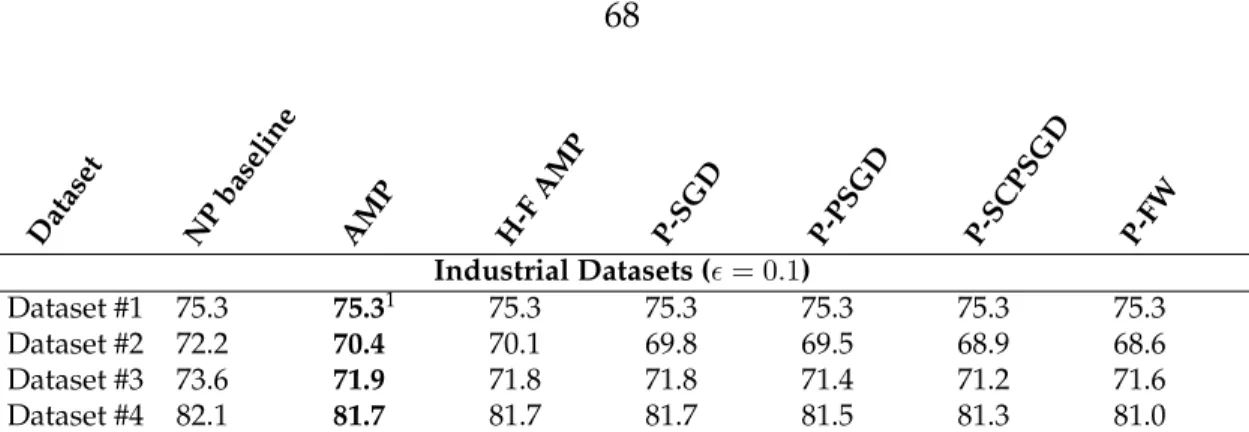
4.4.5 Experiment 3: Industrial Use Cases . . . 67
4.4.6 Results for Huber SVM . . . 68
4.4.7 Discussion . . . 72
5 Model-Agnostic Private Learning 74 5.1 Additional Preliminaries . . . 74
5.1.1 The Sparse Vector Technique . . . 75
5.2 Related Work . . . 76
5.3 Privately Answering Stable Online Queries . . . 76
5.3.3 Instantiation: Online Query Release via Subsample and
Ag-gregate . . . 82
5.4 Privately Answering Classification Queries . . . 84
5.5 Answering Queries to Model-agnostic Private Learning . . . 89
5.6 Discussion . . . 93
6 Private Matrix Completion 95 6.1 Additional Preliminaries . . . 95
6.1.1 Notions of Privacy . . . 95
6.1.2 The Frank-Wolfe Algorithm . . . 96
6.2 Private Matrix Completion via Frank-Wolfe . . . 99
6.2.1 Privacy and Utility Analysis . . . 103
6.2.2 Efficient PCA via Oja’s Algorithm . . . 110
6.3 Private Matrix Completion via Singular Value Decomposition . . . . 113
6.3.1 Privacy and Utility Analysis . . . 114
6.4 Experimental Evaluation . . . 118
6.4.1 Additional Experimental Evaluation . . . 121
7 Conclusions and Open Problems 125
Bibliography 127
Curriculum Vitae 138
3.1 Sample complexity bounds for matrix completion. m = no. of users,n =no. of items. The bounds hide privacy parametersand
log(1/δ), and polylog factors inm,n. . . 36
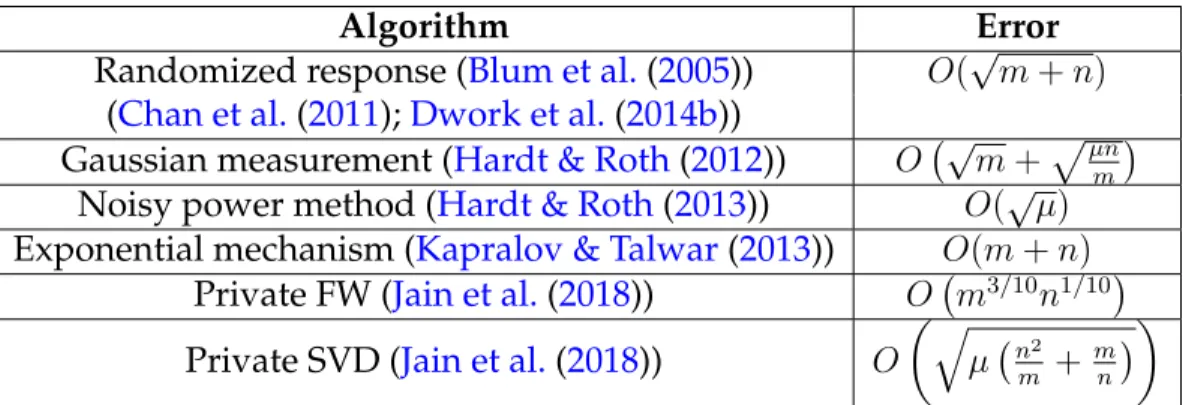
3.2 Error bounds (kY −Y∗kF) for low-rank approximation. µ∈[0, m]is the incoherence parameter (Definition 29). The bounds hide privacy parameters and log(1/δ), and polylog factors inm an n. Rank of the output matrixYpriv isO m2/5/n1/5 for Private FW, whereas it is O(1)for the others. . . 36
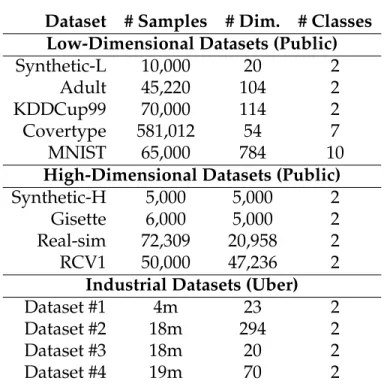
4.1 Datasets used in our evaluation . . . 57
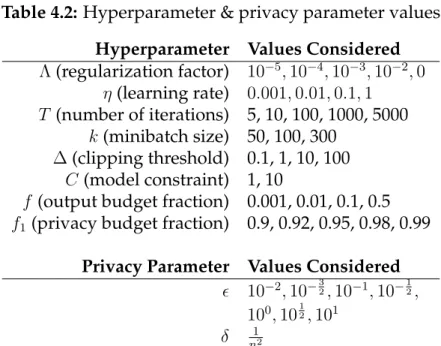
4.2 Hyperparameter & privacy parameter values . . . 59
4.3 List of abbreviations used for algorithms . . . 63
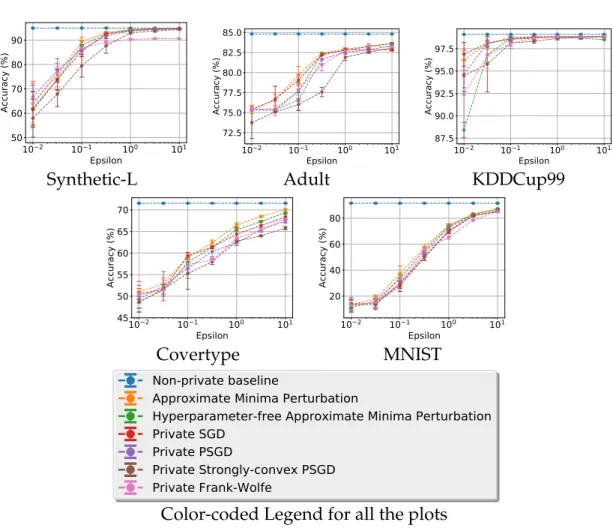
1.1 A schematic that depicts the considered setting of learning: several individuals sampled from a population contribute their data to a trusted central aggregator, who in turn runs a learning algorithm to generate a predictive model as its output. . . 1 4.1 Accuracy for logistic regression on low-dimensional datasets.
Hori-zontal axis depicts varying values of; vertical axis shows accuracy on the testing set. . . 64 4.2 Accuracy for logistic regression on high-dimensional datasets.
Hor-izontal axis depicts varying values of; vertical axis shows accuracy on the testing set. . . 65 4.3 Accuracy results for logistic regression on industrial datasets.
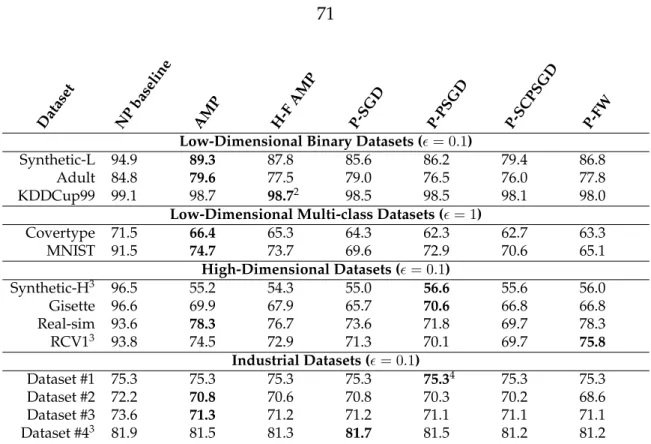
Hori-zontal axis depicts varying values of; vertical axis shows accuracy on the testing set. . . 65 4.4 Accuracy results (in %) for logistic regression on low-dimensional
datasets. For each dataset, the result in bold represents the DP al-gorithm with the best accuracy for that dataset. We report the ac-curacy for = 1 for multi-class datasets, as compared to = 0.1
for datasets with binary classification, because multi-class classifica-tion is a more difficult task than binary classificaclassifica-tion. A key for the abbreviations used for the algorithms is provided in Table 4.3. . . 66
rithm with the best accuracy for that dataset. A key for the abbrevi-ations used for the algorithms is provided in Table 4.3. . . 67 4.6 Accuracy results (in %) for logistic regression on industrial datasets.
For each dataset, the result in bold represents the DP algorithm with the best accuracy for that dataset. A key for the abbreviations used for the algorithms is provided in Table 4.3. . . 68 4.7 Accuracy results for Huber SVM on low-dimensional datasets.
Hor-izontal axis depicts varying values of; vertical axis shows accuracy (in %) on the testing set. . . 69 4.8 Accuracy results for Huber SVM on high-dimensional datasets.
Horizontal axis depicts varying values of ; vertical axis shows ac-curacy (in %) on the testing set. . . 70 4.9 Accuracy results for Huber SVM on industrial datasets. Horizontal
axis depicts varying values of; vertical axis shows accuracy (in %) on the testing set. . . 70 4.10 Accuracy results (in %) for Huber SVM. For each dataset, the result
in bold represents the DP algorithm with the best accuracy for that dataset. We report the accuracy for = 1for multi-class datasets, as compared to= 0.1for datasets with binary classification, as multi-class multi-classification is a more difficult task than binary multi-classification. A key for the abbreviations used for the algorithms is provided in Table 4.3. . . 71
gorithm 13. The solid boxes and arrows represent computations that are privileged and without external access, and the dotted boxes and arrows represent the unprivileged computations. . . 102 6.2 Root mean squared error (RMSE) vs. , on (a) synthetic, (b) Jester,
(c) MovieLens10M, (d) Netflix, and (e) Yahoo! Music datasets, for δ = 10−6. A legend for all the plots is given in (f). . . 122 6.3 Root mean squared error (RMSE) vs. , on (a) Synthetic-900, (b)
MovieLens10M, (c) Netflix, and (d) Yahoo! Music datasets, for δ = 10−6. A legend for all the plots is given in (e). . . 123
AMP Approximate Minima Perturbation
DP Differential Privacy
FW Frank-Wolfe
GD Gradient Descent
H-F AMP Hyperparameter-free AMP
NP baseline Non-private baseline
PGD Projected Gradient Descent
P-FW Private Frank-Wolfe
P-SGD Private Stochastic Gradient Descent
P-PSGD Private Permutation-based SGD
P-SCPSGD Private Strongly Convex PSGD
RMSE Root Mean Squared Error
SGD Stochastic Gradient Descent
CHAPTER 1 Introduction
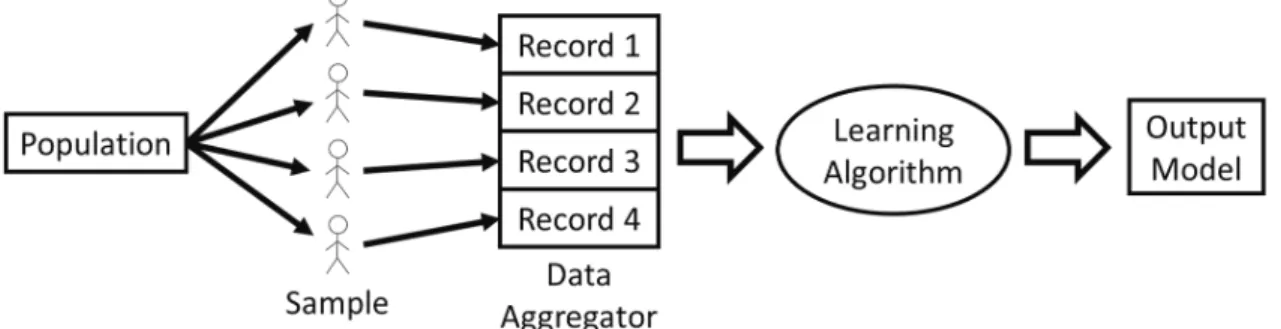
Building useful predictive models often involves learning from personal data. For instance, companies use customer data to target advertisements, online education platforms collect student data to recommend content and improve user engage-ment, and medical researchers fit diagnostic models to patient data. Learning, in the above context, refers to using the data of a small set of individuals sampled from a population to design useful predictive models. The goal is to generate mod-els about characteristics that are not only limited to the sampled individuals, but which generalize to the underlying population as well. For this dissertation, we consider a setting where the sampled individuals contribute their data to a trusted central aggregator. Then, the aggregator runs a learning algorithm on the collected data to generate a predictive model as its output. We provide a schematic of the framework in Figure 1.1.
Figure 1.1: A schematic that depicts the considered setting of learn-ing: several individuals sampled from a population contribute their data to a trusted central aggregator, who in turn runs a learning al-gorithm to generate a predictive model as its output.
Sankarara-man et al. (2009); Bun et al. (2014); Dwork et al. (2015b); Wu et al. (2016); Shokri et al.(2017); Carlini et al.(2018); Melis et al.(2018)) indicate, a model can leak in-formation about the sensitive data it was trained on, even though the data might have never been made public. This motivates the need for providing privacy guar-antees to the individuals whose data is a part of the training set.
We quantify privacy using differential privacy (Dwork et al. (2006b,a)), a well-studied privacy notion that limits how much information is leaked about an indi-vidual by the output of an algorithm. Differential privacy (DP) has been widely adopted by the academic community, as well as big corporations like Google and Apple. The philosophy underlying DP is that the output of an algorithm should not change significantly due to the presence or absence of any individual in the input. In other words, training a model using a differentially private algorithm prevents an adversary from confidently determining whether a specific person’s data was used for training the model. This guarantee holds even if the adversary has access to the trained model, and any external side information. We formally define DP in Definition 2.1.3.
In recent years, many works have focused on enabling learning with DP. The aim of this dissertation is to design private learning algorithms that provide gener-alization guarantees comparable to the best possible non-private ones. One of the highlights of this dissertation is a set of black-box methods for transforming non-private learning methods into non-private learning algorithms. Such transformations are useful as they tend to be modular, and can take advantage of novel learning techniques which may additionally have been tuned for performance. They can also make use of any customized infrastructure that may have been built for the non-private learning techniques. In contrast, white-box modifications, i.e.,
trans-formations dependent on the inner structure of specific techniques, often involve having to make adjustments to the hardware design and software pipelines. This can be time-consuming, expensive, and can result in a loss in efficiency of the tech-nique. For instance, the existing white-box modification of SGD within Tensorflow (Abadi et al.(2015)) results in reduced parallelism for the private technique.
Our first main result is a generic private algorithm for convex optimization that uses non-private algorithms as black-box. Convex optimization is central to ma-chine learning, and the advances therein also have implications to deep learning. Next, we provide black-box transformations for classification tasks in the semi-supervised learning setting.
In addition to black-box transformations, we also provide a private algorithm for recommendation systems, which we model via the problem of matrix com-pletion. Our algorithm builds on the popular Frank-Wolfe method (Frank & Wolfe(1956); Jaggi et al.(2010)), a standard iterative optimization technique hav-ing lightweight updates, which enables our algorithm to provide a strong privacy guarantee along with non-trivial utility for this problem.
1.1 THE LANDSCAPE OF “PRIVATE” LEARNING
In this section, we briefly describe some approaches taken by prior works to learn “privately”. Our focus is on providing rigorous guarantees, but there is a lot of work on methods with heuristic guarantees. A typical example is k-anonymity (Sweeney(2002)), which has been commonly used to make anonymized releases of sensitive data. Common methods for achievingk-anonymity release a version of the original input dataset in which some attribute values may be hidden, whereas some others may be generalized to broader categories. Even thoughk-anonymity
protects against a specific class oflinkage attacks, it does not provide any guarantee on the leakage of specific attributes of individual records. Moreover, anonymized releases of datasets may not exist in isolation, and k-anonymity has been shown (Ganta et al. (2008)) to be vulnerable to composition attacks which make use of side information to re-identify overlapping samples from mutiple independently anonymized datasets.
The notion of secure multi-party computation (see Lindell & Pinkas (2008);
Evans et al. (2018) for an overview) has been used in settings where rather than contributing private data to a central aggregator (as shown in Figure 1.1), individ-uals keep their data with themselves but want to collectively run an algorithm. Secure multi-party computation (MPC) has a different, and complementary, goal as compared to differential privacy. It focuses on ensuring that only the output of the joint computation is revealed; raw inputs and all intermediate results are kept secret. However, there can be cases where releasing the output of a computation can reveal the raw inputs. For instance, if the output of a sum of multiple non-negative integers is 0, it reveals that the value of each of the individual inputs is 0. To this end, DP focuses on bounding the leakage of information about any in-dividual input from releasing the output of a computation. DP algorithms can be implemented via an MPC protocol (for example,Dwork et al.(2006a)) to remove the need for a trusted aggregator. In particular, the algorithms proposed in this dissertation can be implemented via MPC.
A related line of work (for example,Koneˇcný et al.(2016);Konecný et al.(2016);
McMahan et al. (2017); McMahan & Ramage (2017)) has focused on Federated Learning, a framework which has many interpretations. The core idea of Feder-ated Learning is to collaboratively train a model on a central server without
di-rectly sharing any individual’s input data with the server. Although there is no single standard for privacy or confidentiality in the setting of Federated Learning, efficient approaches for MPC (for example, Bonawitz et al. (2017); Reyzin et al.
(2018)) can be advantageous in practice for incorporating DP in this setting.
In the absence of a guarantee of privacy, information about training data can be leaked in unexpected ways. There have been many works that demonstrate this by designing attacks to exploit the learning process. Dinur & Nissim(2003) design a generalreconstruction attack, which reconstructs the input dataset by taking advan-tage of multiple statistical queries being answered with sufficient accuracy on the input. Other works (for example,Homer et al.(2008);Sankararaman et al. (2009);
Bun et al.(2014);Dwork et al.(2015b);Shokri et al.(2017);Melis et al.(2018)) design membership inference attacksthat infer the presence or absence of a particular record in the training process by exploiting the predictions of the trained model and some side information.Carlini et al.(2018) focus onmemorization attacksthat extract sen-sitive input samples that were accidentally memorized by high-dimensional mod-els during training.
The initial works demonstrating attacks led to many notions being proposed for bounding the information leakage about inputs from the output of a training algorithm, and DP was one such rigorous notion to come out of those efforts. Al-though some basic mechanisms for obtaining DP (for example, the Laplace mech-anism fromDwork et al.(2006b), and the Gaussian mechanism fromNikolov et al.
(2013)) can be composed together to perform various tasks, it is often the case that custom, task-specific techniques provide better utility. Thus, much of the research in this area has focused on building DP mechanisms providing utility guarantees for complex tasks.
There are several major lines of work within differentially private learning. In recent years, designing DP techniques with utility guarantees for convex op-timization has been a very active area of research (for example, see Chaudhuri et al.(2011); Kifer et al.(2012); Song et al.(2013); Smith & Thakurta(2013);Bassily et al. (2014a); Jain & Thakurta (2014); Talwar et al. (2014); Wu et al. (2017); Feld-man et al.(2018)). There have also been efforts (Abadi et al.(2016);Papernot et al.
(2016, 2018)) on effectively training high-dimensional deep neural networks with differential privacy. There is a body of literature, includingKasiviswanathan et al.
(2008);Beimel et al.(2010);Chaudhuri & Hsu(2011);Beimel et al.(2013);Bun et al.
(2015), that studies the effect of incorporating privacy on the sample complexity for various families of problems in the standard PAC model of learning (Valiant
(1984); Kearns & Vazirani (1994)). Lastly, many works (for example, Blum et al.
(2005);McSherry & Mironov(2009);Chan et al.(2011);Hardt & Roth(2012);Dwork et al.(2014c);Hardt & Roth(2013);Liu et al.(2015)) have focused on designing DP recommendation systems. To that end, they provide algorithms for matrix com-pletion and low-rank approximation.
In this dissertation, we provide a detailed discussion of prior works on private recommendation systems in Section 3.4, DP convex optimization in Chapter 4, and private PAC learning in Chapter 5.
CHAPTER 2 Preliminaries
In this chapter, we formally define the notation, important definitions, and existing results that have been used in this dissertation.
We denote the data universe byU, and defineDto be a distribution overU. We denote an m-element dataset by D = {d1, d2, . . . , dm}. Typically, for each i ∈ [m]
we havedidrawn independently fromD, denoted bydi ∼ D.
2.1 DEFINING “PRIVACY”
Here, we provide formal definitions of the notions we use to quantify privacy, mainlydifferential privacy (DP), and a recent variant called concentrated differential privacy(CDP). We also describe some common privacy mechanisms that have been used in subsequent chapters.
DP bounds the effect of a record on the output of an algorithm, and this is captured by a “neighboring” relationship between datasets. There are two notions of neighboring used in this dissertation, which we define next.
Definition 2.1.1 (Neighboring under modification). A pair of datasets D, D0 ∈ Um are neighboring under modification if D0 can be obtained from D by modifying one sampledi ∈Dfor somei∈[m].
For defining neighboring under insertion/deletion, we denote the symmetric difference between any two datasetsD, D0 ∈U∗ byD4D0.
Definition 2.1.2(Neighboring under insertion/deletion). A pair of datasetsD, D0 ∈
U∗areneighboring under insertion/deletionif|D4D0|= 1. In other words,Dcan be obtained fromD0by either the addition or deletion of a sample.
We use the definition of neighboring under modification (Definition 2.1.1) in Chapter 4 and Chapter 6, whereas we use neighboring under insertion/deletion (Definition 2.1.2) in Chapter 5.
2.1.1 Differential Privacy
Here, we define differential privacy, state some of its useful properties, and de-scribe a few common mechanisms used for achieving DP.
Definition 2.1.3((, δ)-Differential Privacy (Dwork et al.(2006b,a))). A (randomized) algorithmAwith input domainU∗ and output rangeRis(, δ)-differentially privateif for all pairs of neighboring inputsD, D0 ∈U∗, and every measurableS⊆ R, we have
Pr (A(D)∈S)≤e·Pr (A(D0)∈S) +δ,
where probabilities are taken over the coin flips ofA.
When δ > 0, the notion is also known as approximate DP. On the other hand, whenδ= 0, it is known aspureDP, and is parameterized only by.
An important advantage of differential privacy is that it is closed under post-processing, and can be adaptively composed, which we describe next.
Lemma 2.1.4(Post-processing (Dwork et al.(2006b))). If a mechanismA : U∗ → R
is(, δ)-differentially private, then for any functionf :R → R0, we have thatf◦ Ais also
(, δ)-differentially private.
Lemma 2.1.5 (Basic Composition (Dwork et al. (2006b))). For each i ∈ [k], let al-gorithm Ai : U∗ ×
i−1
Q
j=1
A[k]:U∗ →
k
Q
j=1
Rj is defined such that
A[k](D) = (A1(D),A2(D,A1(D)), . . . ,Ak(D,A1(D), . . . ,Ak−1(D))) thenA[k]is k P i=1 i, k P i=1 δi -DP.
Lemma 2.1.6(Advanced Composition (Dwork et al.(2010);Kairouz et al.(2017))).
For eachi∈[k], let algorithmAi :U∗× i−1
Q
j=1
Rj → Ri be(i, δi)-DP in its first argument.
If algorithmA[k] :U∗ →
k
Q
j=1
Rj is defined such that
A[k](D) = (A1(D),A2(D,A1(D)), . . . ,Ak(D,A1(D), . . . ,Ak−1(D)))
then for everyδ0 >0, algorithmA[k]is
0,1−(1−δ0) k Q i=1 (1−δi) -DP, where 0 = min k X i=1 i, k X i=1 i(ei−1) ei+ 1 + v u u u u u u u t min k X i=1 22ilog e+ s k P i=1 2 i δ0 , k X i=1 22i log 1 δ0 .
To describe two of the common techniques for achieving differential privacy, we first define the global sensitivity of a function.
Definition 2.1.7(Lp-sensitivity). A functionf :U∗ →RnhasLp-sensitivity∆if
max
D,D0∈U∗s.t.
(D,D0)neighbors
kf(D)−f(D0)kp = ∆.
One of the most common techniques for achieving pure differential privacy is the Laplace mechanism, which we define next.
Lemma 2.1.8(Laplace mechanism (Dwork et al.(2006b))). If a functionf :U∗ →Rn
has L1-sensitivity ∆, and a mechanism A on input D ∈ U∗ outputs f(D) + b, where
b ∼ Lap(λIn×n) and λ = ∆, then A satisfies -differential privacy. Here, Lap(λIn×n)
denotes a vector ofni.i.d. samples from the Laplace distributionLap(λ).
Next, we define one of the most common techniques for achieving approximate differential privacy, which is the Gaussian mechanism.
Lemma 2.1.9(Gaussian mechanism (Nikolov et al.(2013))). If a function f : U∗ → RnhasL2-sensitivity∆, and a mechanismA on inputD ∈ U∗ outputsf(D) +b, where
b ∼ N 0,∆22 1 + q 2 log1δ 2 In×n
, then A satisfies (, δ)-differential privacy. Here, N(0, σ2In×n)denotes a vector ofni.i.d. samples from the zero-mean Gaussian distribution
having varianceσ2.
2.1.2 Concentrated Differential Privacy
In Chapter 6, we also use a recently proposed notion of privacy calledzero concen-trated differential privacy(zCDP) (Bun & Steinke(2016)). The definition of concen-trated differential privacy (CDP) was given byDwork & Rothblum(2016), which was then modified byBun & Steinke(2016).
Definition 2.1.10(ρ-zCDP (Bun & Steinke(2016))). A (randomized) algorithmAwith input domain U∗ and output range R is ρ-zCDP if for all pairs of neighboring inputs D, D0 ∈U∗, and for allα∈(1,∞), we have:
Dα(A(D)||A(D0))≤ρα where Dα(P||Q) = α−11 log Ex∼P P(x) Q(x) α−1
denotes the α-Rényi divergence be-tween distributionsP andQ.
Next, we provide the post-processing and composition properties of zCDP.
Lemma 2.1.11(Post-processing (Bun & Steinke(2016))). If a mechanismA:U∗ → R
isρ-zCDP, then for any functionf :R → R0
, we have thatf◦ Ais alsoρ-zCDP.
Lemma 2.1.12(Composition (Bun & Steinke(2016))). LetA1 : U∗ → R1, and A2 :
U∗ × R1 → R2 be two randomized algorithms, where A1 is ρ1-zCDP and A2(·, r1) is
ρ2-zCDP for each ri ∈ R1. If algorithmA : U∗ → R2 is composed such that A(D) =
A2(D,A1(D)), thenAis(ρ1+ρ2)-zCDP.
Now, we show that zCDP is an intermediate notion between pure DP and ap-proximate DP.
Lemma 2.1.13(Bun & Steinke(2016)). If a mechanismA :U∗ → Ris:
• -DP, thenAis 122
-zCDP.
• ρ-zCDP, thenAisρ+ 2pρlog (1/δ), δ-DP for everyδ∈(0,1). Lastly, we provide the zCDP guarantees of the Gaussian mechanism.
Lemma 2.1.14(Gaussian mechanism (Bun & Steinke(2016))). If a functionf :U∗ → RnhasL2-sensitivity∆, and a mechanismA on inputD ∈ U∗ outputsf(D) +b, where
b ∼ N0,∆2ρ2In×n
, then A satisfies ρ-zCDP. Here, N(0, σ2I
n×n) denotes a vector of n
i.i.d. samples from the zero-mean Gaussian distribution having varianceσ2.
2.2 THE FRAMEWORK OF LEARNING
Next, we provide some definitions from learning theory that will be useful in sub-sequent chapters.
Define a function ` : Θ × U → R for some set Θ, and let the average over a dataset be defined as L(θ;D) = m1
m
P
i=1
the expectation of Lover a distribution to beL(θ;D) = ED∼Dm(L(θ;D)). We first
define empirical risk and population risk.
Definition 2.2.1(Empirical Risk). Given an elementθˆ∈ Θand a datasetD∈ Um, the
empirical riskofθˆonDis
R(ˆθ;D) =L(ˆθ;D)−min
θ∈Θ L(θ;D).
Given an algorithm A : Θ×Um →
R, we define the empirical risk ofA on a
datasetD ∈ Um asR(A;D) = E(R(A(D);D)), where the expectation is over the internal randomness ofA.
Definition 2.2.2(Population Risk). Given a distribution DoverU and an elementθˆ∈ Θ, thepopulation riskofθˆonDis
R(ˆθ;D) = L(ˆθ;D)−min
θ∈ΘL(θ;D).
Given an input dataset D ∼ Dm, our central objective in the subsequent
chap-ters of this dissertation will be to find an element θˆ ∈ Θsuch that its population riskR(ˆθ;D)is low, and theprivacyof the input dataset Dis guaranteed. In other words, ifθopt = arg min
θ∈Θ L(θ;D), i.e.,θopt is an element in the classΘwith a
popula-tion risk equal to 0, we wantθˆto be competitive withθopt while guaranteeing the
privacy of datasetD. The classΘand the optimization function`will vary by the problem we are trying to solve, and each subsequent chapter addresses a special case:
• In Chapter 4, we haveΘ =Rnas then-dimensional model space, and the loss function`(θ;d)forθ ∈Θ, d∈U is convex in the first parameterθ. This formu-lation falls under unconstrained convex optimization, and finds applications
in a variety of settings, including machine learning via linear regression, lo-gistic regression, or support vector machines (SVMs).
• In Chapter 5, we operate in the standard PAC model of learning, where the universe is the space of feature vectors and labelsU =X × Y, and the search spaceΘ =His a hypothesis class where each hypothesish∈ His a mapping h: X → Y. Ford = (x, y)∈U, the loss function`(h;d) =I[h(x)6=y]denotes the classification error.
• In Chapter 6, we solve the problem of matrix completion, where the data uni-verse U consists of the entries of an (m×n) matrix Y∗ s.t. kY∗knuc ≤ k for somek >0, wherekY∗knucdenotes the nuclear norm of matrixY∗. The input is the incomplete matrixD = PΩ(Y∗), where Ω = {(i, j) ⊆ [m]×[n]}comes
from a distributionDthat is uniform over[m]×[n], the operatorPΩ(Y)ij =Yij
if(i, j)∈Ω, and 0 otherwise. The search spaceΘ ={Y ∈Rm×n :kYk
nuc ≤k},
and the loss function `(Y;PΩ(Y∗)i) = 2|Ω|m kPΩ(Y − Y∗)ik2F denotes a scaled
version of the Mean Squared Error (MSE) over the observed entries. We also present an optimal differentially private algorithm for singular vector com-putation, based on Oja’s method, that provides significant savings in terms of space and time when operating on sparse matrices. We conduct an em-pirical evaluation of our algorithm on a suite of datasets, and show that it consistently outperforms the state-of-the-art private algorithms.
CHAPTER 3 Main Results
In this chapter, we first provide an overview of the main results in this dissertation. Next, we describe each of the results in detail.
3.1 OVERVIEW
We start by presenting our two major contributions towards practical differen-tially private convex optimization. They were published in Iyengar, Near, Song, Thakkar, Thakurta, & Wang(2019b). First, we present Approximate Minima Per-turbation, a novel algorithm that can leverage any off-the-shelf optimizer. All the state-of-the-art algorithms have some hyperparameters that need to be tuned for obtaining good utility, thus incurring an additional cost to privacy. In contrast, we show that our algorithm can be employed without any hyperparameter tun-ing, thus making it attractive for practical deployment. Our second contribution is to perform an extensive empirical evaluation of the state-of-the-art algorithms for differentially private convex optimization, and compare it with our new approach. Our evaluation is on a range of publicly available benchmark datasets, as well as an industry application obtained through a collaboration with Uber.
Next, we present a learning algorithm (inspired byPapernot et al.(2016)) that outputs a private classifier when given black-box access to a non-private learner and a limited amount of unlabelled public data. It was published in Bassily, Thakurta, & Thakkar (2018). We start by providing a new differentially private algorithm for answering a sequence ofm online classification queries (given by a sequence ofmunlabeled public feature vectors) based on a training set with a fixed privacy budget. Our algorithm follows the paradigm of subsample-and-aggregate
(Nissim et al.(2007)), in which any generic non-private learner is trained on dis-joint subsets of the private training set, and then for each classification query, the votes of the resulting classifiers ensemble are aggregated in a differentially private fashion. Our private aggregation is based on a novel combination of the distance-to-instability framework (Smith & Thakurta (2013)), and the sparse-vector tech-nique (Dwork et al.(2009);Hardt & Rothblum(2010)). We show that our algorithm makes a conservative use of the privacy budget. In particular, if the underlying non-private learner yields a classification error of at mostα ∈(0,1), then our con-struction answers more queries, by at least a factor of1/αin some cases, than what is implied by a direct application of the advanced composition theorem for differ-ential privacy. Next, we apply the knowledge transfer technique (which is inspired by the early work ofBreiman(1996)) to construct a private learner that outputs a classifier, which can be used to answer an unlimited number of queries.
We analyze our construction in the (agnostic) PAC model, and prove upper bounds on the sample complexity for both the realizable and the non-realizable cases. Similar to non-private sample complexity, our bounds are completely char-acterized by the VC dimension of the concept class. If only private data is used, there are lower bounds showing that the private sample complexity will have a necessary dependence on the dimensionality of the model (Bassily et al. (2014a)), or the size of the model class (Bun et al. (2015)). Thus, such a guarantee is not possible, in general, without public data.
Lastly, we present the first provably DP algorithm with formal utility guaran-tees for the problem of user-level privacy-preserving matrix completion. It was published in Jain, Thakkar, & Thakurta (2018). Our algorithm is based on the Frank-Wolfe method for optimization, and it consistently estimates the underlying
preference matrix as long as the number of usersmisω(n5/4), wherenis the
num-ber of items, and each user provides her preference for at least √n randomly se-lected items. We also empirically evaluate our algorithm on a suite of datasets. We show that it provides nearly the same accuracy as the state-of-the-art non-private algorithm and outperforms the state-of-the-art private algorithm by 30% in some cases.
Our matrix completion algorithm involves computing a rank one approxima-tion of a matrix. For this purpose, we give an optimal differentially private al-gorithm for singular vector computation, based on Oja’s method, that provides significant savings in terms of space and time when operating on sparse matrices. Further, we show that it can be used for differentially private low-rank approxi-mation and thus might be of independent interest.
3.2 PRIVATE CONVEX OPTIMIZATION
With the recent advancements in machine learning and big data, private convex optimization has proven to be useful for large-scale learning over sensitive user data that has been collected by organizations. Our objective is to provide insight into practical differentially private convex optimization, with a specific focus on the classical technique of objective perturbation (Chaudhuri et al.(2011);Kifer et al.
(2012)). Our main technical contribution is to design a new algorithm for private convex optimization that is amenable to real-world scenarios, and provide privacy and utility guarantees for it. In addition, we conduct a broad empirical evaluation of approaches for private convex optimization, including our new approach. Our evaluation is more extensive than prior works (Chaudhuri et al.(2011);Song et al.
four industry use cases, obtained in collaboration with Uber Technologies, Inc. We provide advice and resources for practitioners, including open-source implemen-tations (Iyengar et al.(2019a)) of the algorithms evaluated, and benchmarks on all the public datasets considered.
3.2.1 Objective Perturbation and its Practical Feasibility
We focus our attention on the technique of objective perturbation, because prior works (Chaudhuri et al. (2011); Kifer et al.(2012)) as well as our own preliminary empirical results have hinted at its superior performance. The standard technique of objective perturbation (Chaudhuri et al.(2011)) consists of a two-stage process: “perturbing” the objective function by adding a random linear term, and releasing the minima of the perturbed objective. It has been shown (Chaudhuri et al.(2011);
Kifer et al. (2012)) that releasing such a minima can be done while achieving DP guarantees.
However, objective perturbation provides privacy guarantees only if the out-put of the mechanism is theexact minimaof the perturbed objective. Practical algo-rithms for convex optimization often involve the use of first-order iterative meth-ods, such as gradient descent or stochastic gradient descent (SGD) due to their scalability. However, such methods typically offer convergence rates that depend on the number of iterations carried out by the method, so they are not guaran-teed to reach the exact minima in finite time. As a result, it is not clear if objective perturbation in its current form can be applied in a practical setting, where one is usually constrained by resources such as computing power, and reaching the minima might not be feasible.
alter-native to standard objective perturbation which provides comparable privacy and utility guarantees when the released model isnot necessarilythe minima of the per-turbed objective? A major implication of this result is that one can use first-order iterative methods in combination with such an approach. This can be highly bene-ficial in terms of the time taken to obtain a private solution, as first-order methods often find a “good” solution quickly.
3.2.2 Our Approach: Approximate Minima Perturbation
We propose Approximate Minima Perturbation (AMP), a strengthened alternative to objective perturbation. Our method provides privacy and utility guarantees when the released model is a noisy “approximate” minima for the perturbed ob-jective. We measure the convergence of a model in terms of the Euclidean norm of its gradient of the perturbed objective. The scale of the noise added to the approx-imate minima contains a parameter representing the maximum tolerable gradient norm. This results in a trade-off between the gradient norm bound (consequently, the amount of noise to be added to the approximate minima) and the difficulty, in practice, of being able to obtain an approximate minima within the norm bound. This can be useful in settings where a limited computing power is available, which can in turn act as a guide for setting an appropriate norm bound. We note that if the norm bound is set to zero, then this approach reduces to the setting of stan-dard objective perturbation. Approximate Minima Perturbation also brings with it certain distinct advantages, which we will describe next.
Approximate Minima Perturbation works for all convex objective functions: Previous works (Chaudhuri et al.(2011);Kifer et al.(2012)) provide privacy guar-antees for objective perturbation only when the objective is a loss function of a
generalized linear model, i.e., when the loss function is parameterized by an inner product of the feature vector of the data, and the model. On the other hand, the guarantees provided for AMP hold foranyobjective function, and our analysis ex-tends to objective perturbation as well. In both cases, the objective functions are assumed to possess standard properties likeLipschitz continuityandsmoothness.
Approximate Minima Perturbation is the first feasible approach that can lever-age any off-the-shelf optimizer: AMP can accommodate any off-the-shelf opti-mizer as a black-box for carrying out its optimization step. This enables a simple implementation that inherits the scalability properties of the optimizer used, which can be particularly important in situations where high-performance optimizers are available. AMP is theonlyknown feasible algorithm for DP convex optimization that allows the use of any off-the-shelf optimizer.
Approximate Minima Perturbation has a competitive hyperparameter-free vari-ant: To ensure privacy for an algorithm, its hyperparameters must be chosen ei-ther independently of the data, or by using a differentially private hyperparameter tuning algorithm. Previous work (Chaudhuri et al.(2011); Chaudhuri & Vinterbo
(2013);Abadi et al.(2016)) has shown this to be a challenging task. AMP has only four hyperparameters: one related to the Lipschitz continuity of the objective, and the other three related to splitting the privacy budget within the algorithm. In Section 4.4.1, we present a data-independent method for setting all of them. Our empirical evaluation demonstrates that the resulting hyperparameter-free variant of AMP yields comparable accuracy to the standard variant with its hyperparam-eters tuned in a data-dependent manner (which may be non-private).
3.2.3 Empirical Evaluation, & Resources for Practitioners
We also report on an extensive and broad empirical study of the state-of-the-art differentially private convex optimization techniques. In addition to AMP and its hyperparameter-free variant, we evaluate four existing algorithms: private gra-dient descent with minibatching (Bassily et al. (2014a); Abadi et al. (2016)), both the variants (convex, and strongly convex) of the private Permutation-based SGD algorithm (Wu et al.(2017)), and the private Frank-Wolfe algorithm (Talwar et al.
(2014)).
Our evaluation is the largest to date, including a total of 13 datasets. We include datasets with a variety of different properties, including four high-dimensional datasets and four use cases represented by datasets obtained in collaboration with Uber.
The results of our empirical evaluation demonstrate three key findings. First, we confirm the expectation that the cost of privacy decreases as dataset size in-creases. For all the use cases in our evaluation, we obtain differentially private models that achieve an accuracy within 4% of the non-private baseline even for conservative settings of the privacy parameters. For reasonable values of the pri-vacy parameters, the accuracy of the best private model is within 2% of the base-line for two of these datasets, essentially identical to the basebase-line for one of them, and even slightly higher than the baseline for one of the datasets! This provides empirical evidence to further the claims of previous works (Bassily et al. (2014b);
Dwork et al.(2015a)) that DP can also act as a type of regularization, reducing the generalization error.
Second, our results demonstrate a general ordering of algorithms in terms of empirical accuracy. Our results show that AMP generally outperforms all the other
algorithms across all the considered datasets. Under specific conditions like high-dimensionality of the dataset and sparsity of the optimal predictive model for it, we see that private Frank-Wolfe provides the best performance.
Third, our results show that a hyperparameter-free variant of AMP achieves nearly the same accuracy as the standard variant with its hyperparameters tuned in a data-dependent manner. Approximate Minima Perturbation is therefore sim-ple to deploy in practice as it can leverage any off-the-shelf optimizer, and it has a competitive variant that does not require any hyperparameter tuning.
We provide an open-source implementation (Iyengar et al. (2019a)) of the al-gorithms evaluated, including our Approximate Minima Perturbation, and a com-plete set of benchmarks used in producing our empirical results. In addition to enabling the reproduction of our results, this set of benchmarks will provide a stan-dard point of reference for evaluating private algorithms proposed in the future. Our open-source release represents the first benchmark for differentially private convex optimization.
3.2.4 Main Contributions
Our main contributions are as follows:
• We propose Approximate Minima Perturbation, a strengthened alternative to objective perturbation that provides privacy guarantees even for an ap-proximate minima of the perturbed objective, and therefore allows the use of any off-the-shelf optimizer. No previous approach provides this capability. Compared to previous approaches, AMP also provides improved utility in practice, and works with any convex loss function under standard assump-tions.
• We conduct the largest empirical study to date of state-of-the-art DP convex optimization approaches, including as many as nine public datasets, four of which are high-dimensional. Our results demonstrate that AMP generally provides the best accuracy.
• We evaluate DP convex optimization on four use cases obtained in collabo-ration with Uber. Our results suggest that for the large-scale datasets used in practice, privacy-preserving models can obtain essentially the same accu-racy as non-private models for reasonable values of the privacy parameters. In one case, we show that a DP model achieves a higher accuracy than the non-private baseline.
• We present a competitive hyperparameter-free variant of AMP, allowing the approach to be deployed without the need for tuning on publicly available datasets, or by a DP hyperparameter tuning algorithm.
• We release open-source implementations (Iyengar et al. (2019a)) of all the algorithms we evaluate, and the first benchmarks for differentially private convex optimization algorithms on as many as nine public datasets.
3.3 MODEL-AGNOSTIC PRIVATE LEARNING
The main goal in the standard setting of differentially private learning is to design a differentially private learner that, given a private training set as input, outputs a model (or, a classifier) that is safe to publish. Despite being a natural way to de-fine the private learning problem, there are several limitations with this standard approach. First, there are pessimistic lower bounds in various learning problems implying that the error associated with the final private model will generally have
necessary dependence on the dimensionality of the model (Bassily et al. (2014a)), or the size of the model class (Bun et al. (2015)). Second, this approach often re-quires non-trivial, white-box modification of the existing non-private learners ( Ka-siviswanathan et al. (2008); Chaudhuri et al. (2011); Kifer et al. (2012); Smith & Thakurta (2013); Bassily et al. (2014a); Talwar et al. (2015); Abadi et al. (2016)), which can make some of these constructions less practical since they require mak-ing changes in the infrastructure of the existmak-ing systems. Third, designmak-ing algo-rithms for this setting often requires knowledge about the underlying structure of the learning problem, e.g., specific properties of the model class (Beimel et al.(2010,
2013);Bun et al.(2015)); or convexity, compactness, and other geometric properties of the model space (Bassily et al.(2014a);Talwar et al.(2015)).
We study the problem of differentially private learning when the learner has access to a limited amount ofpublic unlabeleddata. Our central goal is to character-ize in a basic model, such as the standard PAC model, the improvements one can achieve for private learning in such a relaxed setting compared to the aforemen-tioned standard setting. Towards this goal, we first consider a simpler problem, namely, privately answering classification queries given by a sequence of public unlabeled data Q = {˜x1,· · · ,x˜me}. In this problem, one is given a private labeled dataset denoted byD, and the goal is to design an(, δ)-differentially private algo-rithm that labels allme public feature vectors inQ. In designing such an algorithm,
there are four main goals we aim to achieve: (i) We wish to provide an algorithm that enables answering as many classification queries as possible while ensuring
(, δ)-differential privacy. This is a crucial property for the utility of such an al-gorithm since the utility in this problem is limited by the number of queries we can answer while satisfying the target privacy guarantee. (ii) We want to have a
modular design paradigm in which the private algorithm can use any generic non-private algorithm (learner) in ablack-boxfashion, i.e., it only has oracle access to the non-private algorithm. This property is very attractive from a practical standpoint as the implementation of such an algorithm does not require changing the inter-nal design of the existing non-private algorithms. (iii) We want to have a design paradigm that enables us to easily and formally transfer the accuracy guarantees of the underlying non-private algorithm into meaningful accuracy guarantees for the private algorithm. The most natural measure of accuracy in that setting would be the misclassification rate. (iv) We want to be able to use such an algorithm together with the public unlabeled data to construct a differentially private learner that out-puts a classifier, which can then be used to answer as many classification queries as we wish. In particular, given the second goal above, the final private learner would be completely agnostic to the intricacies of the underlying non-private learner and its model. Namely, it would be oblivious to whether the model is simple logistic regression, or a multi-layer deep neural network.
Given the above goals, a natural framework to consider is knowledge aggrega-tion and transfer, which is inspired by the early work ofBreiman(1996). The gen-eral idea is to train a non-private learner on different subsamples from the private dataset to generate an ensemble of classifiers. The ensemble is collectively used in a differentially private manner to generate privatized labels for the given un-labeled public data. Finally, the public data together with the private labels are used to train a non-private learner, which produces a final classifier that is safe to publish.
3.3.1 Our Techniques
We give a new construction for privately answering classification queries that is based on a novel framework combining two special techniques in the literature of differential privacy, namely, the subsampling stability framework (Nissim et al.
(2007); Smith & Thakurta (2013)) and the sparse vector technique (Dwork et al.
(2009);Hardt & Rothblum(2010);Dwork et al.(2014a)). Our construction also fol-lows the knowledge aggregation and transfer paradigm, but it exploits the stability properties of good non-private learners in a quantifiable and formal manner. Our construction is based on the following idea: if a good learner is independently trained b times on equally sized, independent training sets, then one would ex-pect the corresponding output classifiersh1,· · · , hb to predict “similarly” on a new
example from the same distribution. Using this idea, we show that amongme
clas-sification queries, one only needs to “pay the price of privacy” for the queries for which there is significant disagreement among the b classifiers. Using our con-struction and the unlabeled public data, we also provide a final private learner. We show via formal and quantifiable guarantees that our construction achieves our four main goals stated earlier.
We note that our framework is not restricted to classification queries; it can be used for privately answering any sequence of online queries that satisfy certain stability properties in the sense ofSmith & Thakurta(2013).
3.3.2 Main Contributions
Answering online classification queries using privacy conservatively: In Sec-tion 5.4, we give our (, δ)-DP construction for answering a sequence of online classification queries. Our construction uses any generic non-private learner in a
black-box fashion. The privacy guarantee is completely independent of the non-private learner and its accuracy. Moreover, the accuracy guarantee can be obtained directly from the accuracy of the non-private learner, i.e., the construction allows us to directly and formally “transform” the accuracy guarantee for the non-private learner into an accuracy guarantee for the final private algorithm.
We provide a new privacy analysis for the novel framework combining sub-sampling stability and sparse vector techniques. We analyze the accuracy of our algorithm in terms of its misclassification rate, defined as the ratio of misclassified queries to the total number of queries, in the standard (agnostic) PAC model. Our accuracy analysis is new, and is based on a simple counting argument. We con-sider both the realizable and non-realizable (agnostic) cases. In the realizable case, the underlying non-private learner is assumed to be a PAC learner for a hypothesis class H of VC-dimensionV. The private training set consists of mlabeled exam-ples, where the labels are generated by some unknown hypothesis h∗ ∈ H. The queries are given by a sequence of me i.i.d. unlabeled domain points drawn from
the same distribution as the domain points in the training set. We show that, with high probability, our private algorithm can answer up to ≈ m/V queries with a misclassification rate of ≈ V /m, which is essentially the optimal misclassification rate attainable without privacy. Thus, answering those queries essentially comes with no cost for privacy. When answeringm > m/Ve queries, the misclassification
rate is≈mVe 2/m2. A straightforward application of the advanced composition the-orem of differential privacy would have led to a misclassification rate≈ √mV /me , which can be significantly larger than our rate. This is because our construction pays a privacy cost only for “hard” queries for which the PAC learner tends to be incorrect. Our result for the realizable case is summarized below. We also provide
an analogous statement for the non-realizable case (Theorem 13).
Informal Theorem 3.3.1(Corresponding to Theorem 12). Given a PAC learner for a class Hof VC-dimension V, a private training set of sizem, and assuming realizability, our private construction (Algorithm 10) answers a sequence of up toΩ(e m/V)binary
clas-sification queries such that, with high probability, the misclasclas-sification rate is Oe(V /m).
When the number of queriesme is beyondΩ(e m/V), then with high probability, the
misclas-sification rate isOe(mVe 2/m2).
A model-agnostic private learner with formal guarantees: In Section 5.5, we use the knowledge transfer technique to bootstrap a privatelearnerfrom our construc-tion above. The idea is to use our private construcconstruc-tion to label a sufficient number of public feature vectors. Then, we use these newly labeled public data for training a non-private learner to finally output a classifier. Since there is no privacy con-straint associated with the public data, the overall construction remains private as differential privacy is closed under post-processing. Note that this construc-tion also uses the non-private learner as a black box, and hence it is agnostic to the structure of such learner and the associated model. This general technique has also been adopted in Papernot et al. (2016). Our main contribution here is that we provide formal and explicit utility guarantees for the final private learner in the standard (agnostic) PAC model. Our guarantees are in terms of upper bounds on the sample complexity in both realizable and non-realizable cases. Let L(h;D) , P
(x,y)∼D[h(x)6=y] denote the true classification error of a hypothesis h.
Given black-box access to an agnostic PAC learner for a classHof VC-dimension V, we obtain the following results:
Informal Theorem 3.3.2(Corresponding to Theorems 14, 17). Let0< α <1. Letm be the size of the private training set. There exists an(, δ)-differentially private algorithm
(Algorithm 11) that, given access to me = Oe
V α2
unlabeled public data points, w.h.p. outputs a classifier ˆh ∈ H such that the following guarantees hold: (i) Realizable case: L(ˆh;D) ≤ α forn = O Ve 3/2/α3/2
, and (ii) Agnostic case: L(ˆh;D) ≤ α +O(γ) for n=O Ve 3/2/α5/2
,whereγ = min
h∈HL(h;D).
Our bounds are only a factor ofOe
p
V /αworse than the corresponding opti-mal non-private bounds. In the agnostic case, however, we note that the accuracy of the output hypothesis in our case has a suboptimal dependency (by a small constant factor) onγ ,min
h∈HL(h;D).
We note that the same construction can serve as a private learner in a less re-strictive setting where only the labels of the training set are considered private information. This setting is known as label-private learning, and it has been ex-plored before in Chaudhuri & Hsu (2011) and Beimel et al. (2016). Both works have only considered pure, i.e.,(,0), differentially private learners, and their con-structions are white-box, i.e., they do not allow for using a black-box non-private learner. The bounds inChaudhuri & Hsu(2011) involve smoothness assumptions on the underlying distribution. InBeimel et al.(2016), an upper bound on the sam-ple comsam-plexity is derived for the realizable case. Their bound is a factor ofO(1/α)
worse than the optimal non-private bound for the realizable case.
3.4 PRIVATE MATRIX COMPLETION
Collaborative filtering (or matrix completion) is a popular approach for modeling the recommendation system problem, where the goal is to provide personalized recommendations about certain items to a user (Koren & Bell (2015)). In other words, the objective of a personalized recommendation system is to learn the entire users-items preference matrixY∗ ∈Rm×nusing a small number of user-item
pref-erencesYij∗,(i, j)∈[m]×[n], wheremis the number of users andnis the number of items. Naturally, in absence of any structure inY∗, the problem is ill-defined as the unknown entries ofY∗can be arbitrary. Hence, a popular modeling hypothesis is that the underlying preference matrixY∗ is low-rank, and thus, the collaborative filtering problem reduces to that of low-rank matrix completion (Recht(2011); Can-des & Recht(2012)). One can also enhance this formulation using side-information like user-features or item-features (Yu et al.(2014)).
Naturally, personalization problems require collecting and analyzing sensitive customer data like their preferences for various items, which can lead to serious privacy breaches (Korolova (2010); Narayanan & Shmatikov (2010); Calandrino et al. (2011)). We attempt to address this problem of privacy-preserving recom-mendations using collaborative filtering (McSherry & Mironov (2009); Liu et al.
(2015)). We answer the following question in theaffirmative: Can we design a ma-trix completion algorithm which keeps all the ratings of a user private, i.e., guarantees
user-level privacywhile still providing accurate recommendations? In particular, we provide the firstdifferentially private matrix completion algorithms withprovable accuracy guarantees.
Most of the prior works on DP matrix completion and low-rank approximation (Blum et al.(2005);Chan et al.(2011);Hardt & Roth(2012,2013);Kapralov & Talwar
(2013);Dwork et al.(2014b)) have provided guarantees which are non-trivial only in theentry-levelprivacy setting, i.e., they preserve privacy of only a single rating of a user. Hence, they are not suitable for preserving a user’s privacy in practical recommendation systems. In fact, their trivial extension to user-level privacy leads to vacuous bounds (see Table 3.1). Some works (McSherry & Mironov(2009);Liu et al.(2015)) do serve as an exception, and directly address the user-level privacy
problem. However, they only show empirical evidences of their effectiveness; they do not provide formal error bounds. In case ofLiu et al.(2015), the DP guarantee it-self might require an exponential amount of computation. In contrast, we provide an efficient algorithm based on the classic Frank-Wolfe (FW) procedure (Frank & Wolfe (1956)), and show that it gives strong utility guarantees while preserving user-level privacy. Furthermore, we empirically demonstrate its effectiveness on various benchmark datasets.
Our private FW procedure needs to compute the top right singular vector of a sparse user preference matrix, while preserving DP. For practical recommendation systems with a large number of items, this step turns out to be a significant bot-tleneck both in terms of space as well as time complexity. To alleviate this issue, we provide a method, based on the celebrated Oja’s algorithm (Jain et al. (2016)), which is nearly optimal in terms of the accuracy of the computed singular vector while still providing significant improvement in terms of space and computation. In fact, our method can be used to speed-up even the vanilla differentially private PCA computation (Dwork et al. (2014c)). To the best of our knowledge, this is the first algorithm for DP singular value computation with optimal utility guarantee, that also exploits the sparsity of the underlying matrix.
Notion of privacy:In the context of matrix completion, where the goal is to release theentire preference matrixwhile preserving privacy, the standard notion of differ-ential privacy (Definition 2.1.3) implies that the computed ratings/preferences for any particular user cannot depend strongly on her own personal preferences. Nat-urally, the resulting preference computation is going to be trivial and inaccurate (which also follows from the reconstruction attacks ofDinur & Nissim(2003) and
To alleviate this concern, we consider a relaxed but natural DP notion (for rec-ommendation systems) calledjoint differential privacy (Kearns et al. (2014)). Con-sider an algorithm Athat produces individual outputs Yi for each useri, i.e., the
i-th row of preference matrixY. Joint DP ensures that for each useri, the output of A for all other users (denoted byY−i) does not reveal “much” about the
pref-erences of user i. That is, the recommendations made to all the users except the i-th user do not depend significantly upon the i-th user’s preferences. Although not mentioned explicitly, previous works on DP matrix completion (McSherry & Mironov(2009);Liu et al.(2015)) strive to ensure Joint DP.
Granularity of privacy: DP protects the information about a user in the context of presence or absence of her data record. Prior works on DP matrix completion (McSherry & Mironov (2009); Liu et al. (2015)), and its close analogue, low-rank approximation (Blum et al.(2005);Chan et al.(2011);Hardt & Roth(2012);Dwork et al.(2014c); Hardt & Roth(2013)), have considered different variants of the no-tion of a data record. Some have considered a single entry in the matrix Y∗ as a data record (resulting in entry-level privacy), whereas others have considered a more practical setting where the complete row is a data record (resulting in user-level privacy). Here, we present all our results in the strictly harder user-user-level pri-vacy setting. To ensure a fair comparison, we present the results of prior works in the same setting.
3.4.1 Problem Definition: Matrix Completion
The goal of a low-rank matrix completion problem is to estimate a low-rank (or a convex relaxation of bounded nuclear norm) matrixY∗ ∈ Rm×n, having seen only
number of items. Let Ω = {(i, j) ⊆ [m] ×[n]} be the index set of the observed entries fromY ∗, and letPΩ :Rm×n →Rm×nbe a matrix operator s.t. PΩ(Y)ij =Yij
if (i, j) ∈ Ω, and 0 otherwise. Given, PΩ(Y∗), the objective is to output a matrix
Y such that the following generalization error, i.e., the error in approximating a uniformly random entry from the matrixY∗, is minimized:
L(Y) =E(i,j)∼unif[m]×[n]
h
Yij−Yij∗
2i
. (3.1)
Generalization error captures the ability of an algorithm to predict unseen samples fromY∗. We would want the generalization error to beo(1)in terms of the problem parameters when Ω = o(mn). Throughout this section and Chapter 6, we will assume thatm > n.
3.4.2 Main Contributions
We provide the first joint DP algorithm for low-rank matrix completion with for-mal non-trivial error bounds, which are summarized in Tables 3.1 and 3.2. At a high level, our key result can be summarized as follows:
Informal Theorem 3.4.1 (Corresponds to Corollary 6.2.1). Assume that each entry of a hidden matrixY∗ ∈ Rm×n is in [−1,1], and there are √n observed entries per user.
Also, assume that the nuclear norm of Y∗ is bounded by O(√mn), i.e., Y∗ has nearly constant rank. Then, there exist(, δ)-joint differentially private algorithms that haveo(1)
generalization error as long asm =ω(n5/4).
In other words, even with √nobserved ratings per user, we obtain asymptot-ically the correct estimation of each entry of Y∗ on average, as long as m is large enough. The sample complexity bound dependence onmcan be strengthened by
making additional assumptions, such asincoherence, onY∗.
Our algorithm is based on two important ideas: a) using local and global com-putation, b) using the Frank-Wolfe method as a base optimization technique. Local and global computation: The key idea that defines our algorithm, and al-lows us to get strong error bounds under joint DP is splitting the algorithm into two components: globalandlocal. Recall each row of the hidden matrixY∗belongs to an individual user. The global component of our algorithm computes statistics that are aggregate in nature (e.g., computing the correlation across columns of the revealed matrix PΩ(Y∗)). On the other hand, the local component independently
fine-tunes the statistics computed by the global component to generate accurate predictions for each user. Since the global component depends on the data of all users, adding noise to it (for privacy) does not significantly affect the accuracy of the predictions.McSherry & Mironov(2009);Liu et al.(2015) also exploit a similar idea of segregating the computation, but they do not utilize it formally to provide non-trivial error bounds.
Frank-Wolfe based method:We use the standard nuclear norm formulation (Recht
(2011);Shalev-Shwartz et al.(2011);Tewari et al.(2011);Candes & Recht(2012)) for the matrix completion problem:
min
kYknuc≤kL(Y; Ω), (3.2)
whereL(Y; Ω) = 2|Ω|1 kPΩ(Y −Y∗)k2F, the sum of singular values ofY is denoted by
kYknuc, and the underlying hidden matrixY∗ is assumed to have nuclear norm of at mostk. Note that we denote the empirical risk of a solutionY given the observed indicesΩbyL(Y; Ω). We use the popular Frank-Wolfe algorithm (Frank & Wolfe