Rapid climate change: scienti¯c challenges and
the new NERC programme
By M. A. S r ok o s z
Southampton Oceanography Centre, European Way, Southampton SO14 3ZH, UK([email protected])
Published online 22 July 2003
In this paper the scienti¯c challenges of observing, modelling, understanding and predicting rapid changes in climate are discussed, with a speci¯c focus on the role of the Atlantic thermohaline circulation. The palaeo and present-day observational and modelling studies being carried out to meet these challenges, under the aegis of a new NERC Rapid Climate Change thematic programme (RAPID), are outlined. In particular, the paper describes the work being done to monitor changes in the meridional overturning circulation of the North Atlantic. The paper concludes with some speculative comments about potential mechanisms for rapid changes.
Keywords: rapid climate change; thermohaline circulation ; palaeo; modelling; observations; Atlantic
1. Introduction and background
A range of model studies show that the presence of the oceanic thermohaline cir-culation (THC) and its northward Atlantic heat transport produces a substantially warmer climate in western Europe than would otherwise be the case (Manabe & Stou®er 1988; Schiller et al. 1997; Vellinga & Wood 2002). The THC consists of deep convection induced by surface cooling at high latitudes, sinking to depth, and upwelling of deep waters at lower latitudes, with horizontal shallow and deep currents feeding these vertical °ows. The deep convection and sinking in the North Atlantic (in the Labrador and Greenland Seas) have no counterpart in the North Paci¯c Ocean, where northward heat transport is consequently much weaker. However, the Atlantic THC has not always been like today’s. Palaeoclimate records indicate that abrupt change has occurred in the Northern Hemisphere, especially during and just after the last cold stage (Broecker & Denton 1989; Dansgaard et al. 1993; Broecker 2000), with THC change as the most plausible mechanism. Similar changes might occur in the future. Model results suggest that the human-induced increase in the atmospheric concentration of CO2 and other greenhouse gases will lead to a
signi¯-cant reduction in the strength of the Atlantic THC (Manabe & Stou®er 1993; Wood et al. 1999). This in turn will modify the projected rate and possibly the direction (cooling versus warming) of climate change over western Europe substantially. Fur-thermore, changes could occur rapidly, perhaps over as short a period as 10{20 years.
One contribution of 14 to a Discussion Meeting `Abrupt climate change: evidence, mechanisms and implications’.
Such rapid climate change would make adaptation to, and mitigation of, the impacts exceedingly di±cult for the a®ected countries. Therefore, it would be useful to esti-mate the probability of such changes. However, while most cliesti-mate models indicate that there will be THC weakening, there is considerable spread between their pro-jections (Cubaschet al. 2001), and at least two models show no change at all (Latif et al. 2000; Gent 2001).
Thus, while there is a possibility that the North Atlantic THC will undergo changes that will result in substantial and rapid climate change for western Europe and Scandinavia, the probability of this occurring cannot be reliably quanti¯ed at present. To assess this probability, it is necessary also to understand other potential drivers of rapid change and the intrinsic variability of the climate system. Progress has been made in acquiring high-quality palaeo observations documenting past rapid climate change (Dansgaard et al. 1989; Alley et al. 1993; Ko»c Karpuz & Jansen 1992) and Holocene climate variability (Mann et al. 1998; Bri®a et al. 2001). The challenge is to bring together the palaeo data and the climate models, in order to validate the models and develop estimates of uncertainty. This would improve our understanding of rapid climate change and of the intrinsic variability of the system, and test the models’ abilities across a range of time-scales that exceeds the period of instrumental records. (McAvaneyet al. (2001) summarize the current state of climate models and the use of palaeo data for model testing.)
Finally, it is important to note that present-day observations of the Atlantic THC (or, more precisely, of the meridional overturning circulation (MOC) of which the THC is the dominant component) are inadequate for detecting whether it is chang-ing. Recent observations at a few key locations are suggestive of signi¯cant changes occurring in the North Atlantic. These include changes in the characteristics of the cold deep over°ows (Hansen et al. 2001) and a freshening of the subsurface and surface waters (Dickson et al. 2002; Hakkinen 2002). A weakening of the MOC may already be in progress, unnoticed.
2. Scienti¯c challenges and the new NERC programme
In view of the above, the UK Natural Environment Research Council (NERC) has funded the RAPID programme to investigate and understand the causes of rapid climate change, with a main (but not exclusive) focus on the role of the Atlantic Ocean’s THC. Using present-day observations, palaeo data and a hierarchy of mod-els, RAPID is intended to improve understanding of the roles of the THC and other processes in rapid climate change, and of the global and regional impacts of such change. Thus, the ability to monitor and predict future rapid climate change, par-ticularly in the North Atlantic region, will be enhanced. The scienti¯c challenges are encapsulated in the programme objectives, de¯ned by the RAPID scienti¯c steering committee, which are
(1) to establish a pre-operational prototype system to continuously observe the strength and structure of the Atlantic MOC;
(3) to construct well-calibrated and time-resolved palaeo data records of past cli-mate change, including error esticli-mates, with a particular emphasis on the quan-ti¯cation of the timing and magnitude of rapid change at annual to centennial time-scales;
(4) to develop and use high-resolution physical models to synthesize observational data;
(5) to apply a hierarchy of modelling approaches to understand the processes that connect changes in ocean convection and its atmospheric forcing to the large-scale transports relevant to the modulation of climate;
(6) to understand, using model experimentation and data (palaeo and present day), the atmosphere’s response to large changes in Atlantic northward heat trans-port, in particular changes in storm tracks, storm frequency, storm strengths, and energy and moisture transports;
(7) to use both instrumental and palaeo data (see 1{3) for the quantitative testing of models’ abilities to reproduce climate variability and rapid changes on annual to centennial time-scales and to explore the extent to which these data can provide direct information about the THC and other possible rapid changes in the climate system and their impact;
(8) to quantify the probability and magnitude of potential future rapid climate change, and the uncertainties in these estimates.
These objectives are clearly interlinked. The ability to predict climate change (8) is predicated on understanding the current state of the climate (particularly a key component like the THC; 1 and 2) and past changes in climate (3), on developing models to investigate the THC and climate (4), on using the models to understand how the system works (5 and 6) and to test the response of the whole system (7).
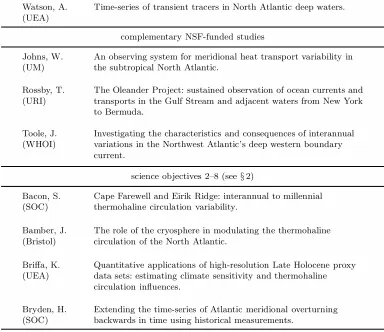
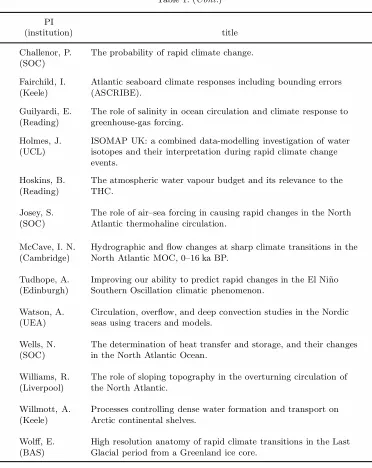
RAPID has been funded by the NERC at a level of £20M (ca. $30M) over a period of six years. The ¯rst funding decisions were made in November 2002, with studies beginning early in 2003. Table 1 lists the principal investigators (PIs), their institution and the titles of the funded projects. It is not possible here to go into a detailed description of all the projects funded, but they cover a range of palaeo and present-day observations, modelling and statistical methods applied to the problem of rapid climate change. Many of the projects also seek to bridge the `gaps’ between palaeo data, present-day observations and models, and some of the projects are directly complementary (for example, those of Bacon and McCave will both carry out studies at the Eirik Drift, linking present-day and palaeo observations). Taken together with the MOC monitoring projects (see below) the aim is to achieve a comprehensive and integrated view. These projects are the result of the ¯rst funding round and RAPID will be issuing further Announcements of Opportunity. These will aim to ensure that the work being carried out addresses all the programme objectives fully and to enhance integration between the di®erent funded projects.
Table 1.List of funded RAPID PIs and project titles
(The science objectives are listed inx2 of the paper. The ¯rst objective (monitoring the MOC) accounts for about one-quarter of the programme budget, and therefore was the subject of a separate Announcement of Opportunity and evaluation process. That evaluation was conducted jointly with the NSF in the USA, and included in the table are the NSF-funded studies that are complementary to the RAPID MOC-observing studies. For more details of the projects see the RAPID Web page,http://rapid.nerc.ac.uk/. SOC, Southampton Oceanography Centre; POL, Proudman Oceanographic Laboratory; UEA, University of East Anglia; UM, University of Miami; URI, University of Rhode Island; WHOI, Woods Hole Oceanographic Institution; UCL, University College London; BAS, British Antarctic Survey.)
PI
(institution) title
monitoring the MOC (science objective 1)
Hughes, C. (POL)
A monitoring array along the western margin of the Atlantic.
Marotzke, J. (SOC)
Monitoring the Atlantic Meridional Overturning Circulation at 26:5¯N.
Watson, A. (UEA)
Time-series of transient tracers in North Atlantic deep waters.
complementary NSF-funded studies
Johns, W. (UM)
An observing system for meridional heat transport variability in the subtropical North Atlantic.
Rossby, T. (URI)
The Oleander Project: sustained observation of ocean currents and transports in the Gulf Stream and adjacent waters from New York to Bermuda.
Toole, J. (WHOI)
Investigating the characteristics and consequences of interannual variations in the Northwest Atlantic’ s deep western boundary current.
science objectives 2{8 (seex2)
Bacon, S. (SOC)
Cape Farewell and Eirik Ridge: interannual to millennial thermohaline circulation variability.
Bamber, J. (Bristol)
The role of the cryosphere in modulating the thermohaline circulation of the North Atlantic.
Bri® a, K. (UEA)
Quantitative applications of high-resolution Late Holocene proxy data sets: estimating climate sensitivity and thermohaline circulation in° uences.
Bryden, H. (SOC)
Table 1. (Cont.)
PI
(institution) title
Challenor, P. (SOC)
The probability of rapid climate change.
Fairchild, I. (Keele)
Atlantic seaboard climate responses including bounding errors (ASCRIBE).
Guilyardi, E. (Reading)
The role of salinity in ocean circulation and climate response to greenhouse-gas forcing.
Holmes, J. (UCL)
ISOMAP UK: a combined data-modelling investigation of water isotopes and their interpretation during rapid climate change events.
Hoskins, B. (Reading)
The atmospheric water vapour budget and its relevance to the THC.
Josey, S. (SOC)
The role of air{sea forcing in causing rapid changes in the North Atlantic thermohaline circulation.
McCave, I. N. (Cambridge)
Hydrographic and ° ow changes at sharp climate transitions in the North Atlantic MOC, 0{16 ka BP.
Tudhope, A. (Edinburgh)
Improving our ability to predict rapid changes in the El Ni~no Southern Oscillation climatic phenomenon.
Watson, A. (UEA)
Circulation, over° ow, and deep convection studies in the Nordic seas using tracers and models.
Wells, N. (SOC)
The determination of heat transfer and storage, and their changes in the North Atlantic Ocean.
Williams, R. (Liverpool)
The role of sloping topography in the overturning circulation of the North Atlantic.
Willmott, A. (Keele)
Processes controlling dense water formation and transport on Arctic continental shelves.
Wol® , E. (BAS)
High resolution anatomy of rapid climate transitions in the Last Glacial period from a Greenland ice core.
[image:5.450.36.408.53.521.2]On a broader front, RAPID will contribute to and work with both ASOF (Arctic Sub-arctic Ocean Fluxes, see http://asof.polar.no and http://psc.apl.washington.edu/ search/ASOF.html) and CLIVAR(http://www.clivar.org).
3. Observing changes in the Atlantic MOC
For this part of RAPID, close collaboration has been established between the NERC and NSF, including a joint review of proposals. NSF is funding observations in the North Atlantic that will help to address the ¯rst RAPID science objective on mon-itoring the MOC (see table 1 for a list of the NSF-funded projects that are com-plementary to the RAPID ones; note that the studies of Johns and Marotzke and of Toole and Hughes are linked). Here the three NERC-funded components of the MOC-observing system are brie°y described. The key points to note are that these studies will address the issues of whether the MOC is changing and how changes at high latitudes in the MOC propagate south in the Atlantic. In particular, the 26:5¯N line and the boundary array will help in determining whether advective or boundary wave e®ects or some combination of the two accomplish the transfer of the climate signal, while the transient tracers can help to unravel the e®ects of horizontal recirculations on that signal.
(a) Observing the MOC at 26:5¯N
The rationale for this project is that it is ultimately the ocean heat transport around 25¯{35¯N that is most relevant for climate. Much of the heat transported northwards in the Atlantic is given o® to the atmosphere over the Gulf Stream exten-sion (e.g. Isemer et al. 1989), from where it is transported northeastward toward Europe by the atmosphere. Two characteristics of ocean heat-transport mechanisms are crucial. First, the ocean heat transport is mainly accomplished by the MOC (Hall & Bryden 1982; Ganachaud & Wunsch 2000). Second, °uctuations in heat transport are expected to be dominated by °uctuations in the transporting velocity ¯eld, and only to a lesser extent by variability in heat content (Jayne & Marotzke 2001). Thus monitoring the MOC will give insight also into the heat transport changes. Monitor-ing at 26:5¯N has the triple advantage of being close to the heat transport maximum in the Atlantic, of being the latitude of four modern hydrographic occupations, and of o®ering a long time-series of boundary current observations not available anywhere else (Baringer & Larsen 2001; work being continued under the NSF-funded study by Johns). Since it is not practical to monitor the MOC by constantly manning a hydrographic section across the ocean basin, an alternative approach is required.
-50 -48 -46 -44 -42 -40 -38 6000 5000 4000 3000 2000 1000 0
-23 -21 -19 -17 -15
6000 5000 4000 3000 2000 1000 0 100 km 100 km Mid-Atlantic Ridge Eastern Boundary @26.5º N, 1º =100.23 km
MAR2
MAR1 MAR3 MAR4
EB1 EB2 EB3 ADCP EBH1-H5 longitude longitude de pt h (m ) de pt h (m ) 0 1000 2000 3000 4000 5000 de pt h (m
) -15
-1 0 -10 -5 -5 0 ))) ADCP A WB1 WBH1 WBH2 WB2 B/WB3 WB4 0 0 ))) distance (km)
northward velocity component mean
E ADCP CM + Microcat Microcat pressure gauge moored profiler Homer
(c) (b)
(a)
[image:7.450.41.406.48.526.2]0 50 100 200 300 400 500
Figure 1. Schematic of the monitoring system at 26:5¯N, showing deployment of moorings at (a) the western boundary (the background is long-term averaged meridional velocity (Leeet al. 1996)), (b) the Mid-Atlantic Ridge and (c) the eastern boundary.
1 2 3 4 5
de
pt
h
(m
)
0 12 16
4 8 20
80º W 60º W 40º W 20º W
12 16
8 20 24 28
1980 1982 1984 1986 1988
year
10 14 18 22
FLAME 26º N OCCAM 26.4º N
t3
t1 t
2
t4 (a)
(b)
(c)
[image:8.450.41.413.42.362.2]Sv Sv
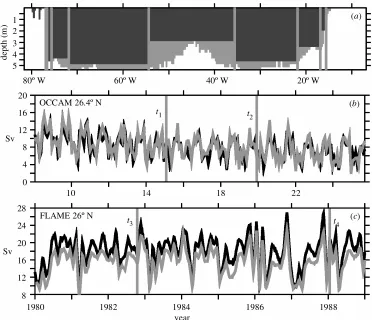
Figure 2. Reconstruction of the MOC of two high-resolution numerical models, based on the proposed mooring design. (a) Location of the moorings. Dark shading marks areas across which thermal wind shear is captured by the array; light shading marks `leakage’ area. (b) Time-series, maximum MOC (black) and maximum reconstruction (grey) for OCCAM. (c) Time-series, max-imum MOC (black) and maxmax-imum reconstruction (grey) for FLAME. For an updated version of these results see Hirschiet al. (2003).
calibration cruises. This makes the monitoring of the entire MOC equivalent to the task of monitoring the depth pro¯le at which the °ow through the Florida Straits returns southwards. Currently, its contribution to the MOC returns southwards at depths between 1000 and 4000 m (e.g. Roemmich & Wunsch 1985); dramatic shoal-ing of this return path would be equivalent to a collapse of the MOC (there is always expected to be wind-driven °ow through the Florida Straits).
0 12 16
4 8 Sv
12 16
8 20
4
-4
1981 1983 1985 1987 1989
year
10 14 18 22
t3
t1 t2 t4
1 2 3 4
5
de
pt
h
(m
)
(e)
(f) (d)
0 24
16 8
-8 0 24
16 8
-8 0 24
16 8
-8 0
16 8
-8 0
Sv
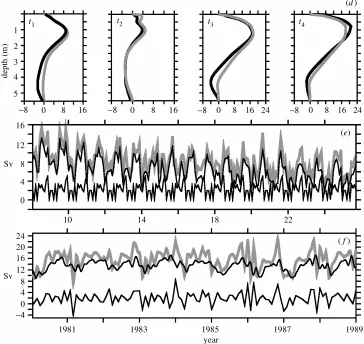
Figure 2. (Cont.) (d) Vertical pro¯les of MOC (black) and reconstruction (grey), at times indi-cated in (b) and (c). (e) Decomposition of reconstruction (grey) into contributions from thermal wind (upper thin line) and Ekman transport (lower thin line), for OCCAM. (f) Decomposition of reconstruction (grey) into contributions from thermal wind (upper thin line) and Ekman transport (lower thin line), for FLAME. For an updated version of these results see Hirschiet al. (2003).
(Jayne & Marotzke 2001). To test the array, two transoceanic-ship-based sections will be carried out to obtain hydrographic MOC estimates, towards the beginning and the end of the deployment period. The presence of the Mid-Atlantic Ridge (MAR) complicates the endpoint monitoring, because a pressure drop may exist across the ridge. Below the ridge crest, the sub-basins to the east and west therefore have to be monitored separately (¯gure 1). In addition, the sloping shelf-break topography, from the deep water to shallow depths, will be instrumented with CTDs, bottom pressure recorders (BPRs), and current meters, to obtain continuous observations at ¯xed depths. This provides an alternative vertical sampling strategy, and also helps to solve the so-called bottom-triangle problem (Whitworth & Peterson 1985).
This monitoring system has been tested by being `deployed’ in two high-resolution (`eddy-permitting’) numerical models, OCCAM (Webb 1996; 1
4
¯
[image:9.450.44.408.49.393.2]FLAME (Dengg et al. 1999; 1 3
¯
resolution). The MOC is reconstructed based on a superposition of Ekman and thermal wind contributions (cf. Lee & Marotzke 1998). Knowing the wind stress allows the determination of the Ekman transport from theory. It is assumed that the Ekman transport is compensated for by a spatially constant return °ow across the section, so that there is no net meridional mass transport related to the zonal wind stress. The thermal wind balance allows the cal-culation of the vertical shear of the meridional velocity component between adjacent vertical density pro¯les, across the section. Integrating the shear from bottom to top yields a meridional velocity ¯eld. As for the Ekman transport, a spatially (but not temporally) constant correction is applied to the velocity ¯eld in order to ensure zero net meridional mass transport. The vertical pro¯le of mass transport across the Florida Strait is assumed to be known (according to the information the underwater cable measurements and pro¯ling sections could provide in the real Atlantic). Fig-ure 2b; c demonstrates that the reconstruction does an good job in recovering the time history of the maximum MOC, at 26¯N. The FLAME analysis shows a slight bias ofca. 2 Sv, but the variability is very well reproduced. Figure 2dshows that the reconstruction reproduces the vertical structure of the MOC, as well as the evolution of the maximum. Figure 2e; f shows that it is both contributions to the reconstruc-tion (thermal wind and Ekman) that are required to capture the total MOC. Other numerical tests of the system design (results not shown) suggest that it should be possible to monitor the MOC using this approach.
(b) A monitoring array along the western margin of the Atlantic
Here the aim is to monitor the propagation of signals along the western boundary of the North Atlantic. Boundary waves represent the rapid, integrated response of the mid- and low-latitude ocean to deep-water formation events at high latitudes, and should allow changes in MOC at mid latitudes (as seen by the 26:5¯N array, see above) to be attributed to their high-latitude sources. The overturning circu-lation can respond far more rapidly and directly to high-latitude forcing through boundary Kelvin waves, or more generally coastal-trapped waves (Huthnance 1978) compared to the advective e®ects (Pickart 1992; Dickson & Brown 1994). The bound-ary waves remove unsupported boundbound-ary pressure anomalies, and rapidly and e±-ciently communicate MOC anomalies from high to low latitudes. This e®ect has been seen in a wide hierarchy of models, including highly idealized reduced-gravity models (Kawase 1987; Johnson & Marshall 2002a; b), idealized ocean global-change models (GCMs) (Yang 1999), global ocean GCMs (Goodman 2001) and the coupled ocean{atmosphere model HadCM3 (Dong & Sutton 2002).
35 40 45
la
ti
tu
de
-75 -70 -65 -60 -55 -50
36 41 44
37 42 43
38 39
depth (km)
-2
-3 0
-4 -1
[image:11.450.38.418.48.284.2]-5
Figure 3. Ocean depth shown by the contours (2, 2.8, 4 and 5 km) with proposed DWBC monitoring lines (with location of the moorings marked by +).
overturning being communicated from high to low latitudes. A simple calculation based on geostrophic transport integrals, together with the precision of the isopyc-nal height measurements, suggests that this system will be su±ciently accurate to measure DWBC transport to an accuracy of 1 Sv. This relies on assumptions about the impact of eddies, recirculations, and aliasing of high-frequency signals, which will only be properly assessed by detailed model studies and, a posteriori, from the ¯eld measurements. A preliminary assessment of the observational strategy has been made by examining the dynamical response along the western boundary to a pertur-bation in buoyancy forcing at high latitudes using an isopycnic model (Bleck & Smith 1990). This experiment demonstrates that high-latitude forcing excites a downstream response at lower latitudes along the western boundary involving three phases: ¯rst, rapid (time-scale of months) communication involving changes in the pressure ¯eld induced by topographic waves; second, an intermediate time-scale response involving advective changes in layer thickness generated by local circulation anomalies; third, a slower basin-scale advective response (seen in the model by studying the arrival of transient-tracer signals, see ¯gure 4). Overall, the results show that the array should be able to detect such changes.
(c) Time-series of transient tracers in North Atlantic deep waters
The ¯nal component of the monitoring of the MOC is by way of a pilot project look-ing at the possibility of uslook-ing transient tracers (SF6,129I) to monitor the spreading of
350 400 450
la
ye
r
th
ic
kn
es
s
(m
) 550 300 350
350 450 500
400
550
350 450 500
400
650
550 600
(e) (a)
(b)
(c)
(d)
100 101 102 103 104 105 0
0.10
0.05 0 0.4
0.2 0.6 0 0.4
0.2 0.6 0 0.4
0.2 0.6 0 0.4
[image:12.450.60.394.65.480.2]0.2 0.6
of a year, using the novel technology of titanium foil bags for the samples. If the pilot deployment proves successful, then further autosamplers may be deployed on moorings around the boundary of the North Atlantic. This will determine whether the tracers that have been detected (129I; Edmonds et al. 2001) or released (SF
6;
Watsonet al. 1999) at higher latitudes can be followed to lower latitudes, in particu-lar as they are advected along the western boundary. This approach will complement the hydrographic and dynamical measurements described above and will allow the determination of recirculation pathways. It will also take advantage of the fact that the source functions for the tracers are changing rapidly (for example,129I is a
prod-uct of nuclear-fuel reprocessing from northwest Europe, and its source rose rapidly through the ¯rst part of the 1990s, and has remained roughly constant since), thus allowing clear detection of signals.
(d) Developing novel instruments
In addition to funding scienti¯c projects, RAPID, through the Small Business Research Initiative, is also funding the development of novel instrumentation. This is to ensure that the instrumentation will be available in a timely manner. Two examples are HOMER|a bottom-mounted CTD-pro¯ling system|and turbulence probes for use on autonomous pro¯ling °oats. HOMER is required for both the 26:5¯ N line and the boundary array monitoring systems.
4. Speculating about future changes
One of the aims of the RAPID programme is to bring together di®erent insights that might aid our understanding of rapid (abrupt) climate change. Therefore, is seems appropriate to end by speculating on one of many possible mechanisms that arise out of a number of recent insights into the ocean and climate system. The chosen example highlights some of the challenges that face any attempt to derive a coherent picture of rapid changes.
18 20 22 24 26 28 ºC
Figure 5. Passive microwave sea-surface temperature (SST) data, from the TRMM (Tropi-cal Rainfall Monitoring Mission) Microwave Imager (TMI), showing the early (more easterly) retro° ection of the Agulhas in December 2000, as compared to December 1999 (the more usual situation). This situation lasted from October 2000 to March 2001. Note that TRMM is in a low-inclination orbit, so data are only available to 38¯S.
The above is known, so now consider some more speculative aspects. Global warm-ing could lead to changes in El Ni~no: both in its frequency and amplitude (Cubasch et al. 2001); note that one of the RAPID projects is looking at changes in El Ni~no (Tudhope, table 1). These in turn might lead to a signi¯cant disruption of the Agulhas leakage and so make the Atlantic MOC more susceptible to rapid change associated with changes in northern North Atlantic freshwater °uxes. This scenario takes no account of any potential feedbacks in the system. However, it does point up a number of issues where our ability to study potential rapid climate change is lacking. First, current climate models do not capture the full e®ects of the oceanic mesoscale (rings, eddies, fronts), but the next generation may do so better. Second, the 1990s were a decade of unprecedented satellite observations of the ocean on a global scale. These have enabled the study of transoceanic signals that might a®ect the global circula-tion. However, a decade (or even two decades) of such observations is hardly adequate to unravel all the possible climate linkages in the ocean. Third,in situ observations of aspects of the Agulhas system (e.g. the °ow round Madagascar) are sparse, as is also the case for many other parts of the global ocean circulation. This latter point is being addressed to some extent by the ARGO °oat programme (Roemmich & Owens 2000), data from which will be used in RAPID.
-30 -20 -10 0 10 20 30
50 60 70 80 90 100 110 120
Jan 93 Jan 94 Jan 95 Jan 96 Jan 97 Jan 98 Jan 99 Jan 00 Jan 01 Jan 02
cm
[image:15.450.110.336.43.358.2]longitude (º E)
Figure 6. Hovmoller diagram of TOPEX sea-surface height anomalies at the approximate lati-tude of the South Equatorial Current (SEC; 16{19¯S) from 50¯to 120¯E in the Indian Ocean. The superimposed pink line shows the propagation of a signal from the eastern Indian Ocean, associated with the 1997{1998 El Ni~no, to the coast of Madagascar. This suggests that the El Ni~no disrupted the SEC and the signal (pink line) reached the coast of Madagascar in mid 1999.
For more information see the RAPID Web pagehttp://rapid.nerc.ac.uk/.
This paper could not have been written without the RAPID team (Dr P. Newton, Dr C. Gom-menginger and Dr C. Yeomans), the RAPID Steering Committee and the RAPID PIs. I am particularly grateful to Professor J. Marotzke and Dr C. Hughes for help with the material on the MOC monitoring systems, and to my colleague Dr G. Quartly for the ¯gures of the Agulhas system.
References
Alley, R. B. (and 10 others) 1993 Abrupt increase in Greenland snow accumulation at the end of the Younger Dryas event.Nature 362, 527{529.
Baringer, M. O. & Larsen, J. C. 2001 Sixteen years of Florida Current transport at 27¯N. Geophys. Res. Lett.28, 3179{3182.
Bri® a, K. R., Osborn, T. J., Schweingruber, F. H., Harris, I. C., Jones, P. D., Shiyatov, S. G. & Vaganov, E. A. 2001 Low-frequency temperature variations from a northern tree ring density network.J. Geophys. Res.106, 2929{2941.
Broecker, W. S. 2000 Abrupt climate change: causal constraints provided by the paleoclimate record.Earth Sci. Rev.51, 137{154.
Broecker, W. S. & Denton, G. H. 1989 The role of ocean{atmosphere reorganisations in glacial cycles.Geochim. Cosmochim. Acta53, 2465{2501.
Cubasch, U., Meehl, G. A., Boer, G. J., Stou® er, R. J., Dix, M., Noda, A., Senior, C. A., Raper, S. & Yap, K. S. 2001 Projections of future climate change. InClimate change 2001: the scienti¯c basis. Contribution of Working Group I to the Third Assessment Report of the International Panel on Climate Change. (ed. J. T. Houghton, Y. Ding, D. J. Griggs, M. Noguer, P. J. van der Linden, X. Dai, K. Maskell & C. A. Johnson). Cambridge University Press.
Dansgaard, W., White, J. W. C. & Johnsen, S. J. 1989 The abrupt termination of the Younger Dryas climate event.Nature 339, 532{534.
Dansgaard, W. (and 10 others) 1993 Evidence for general instability of past climate from a 250 kyr ice-core record.Nature364, 218{220.
Dengg, J., Bonvig, C. W., Ernst, U., Redler, R. & Beckmann, A. 1999 E® ects of an improved model representation of over° ow water on the subpolar North Atlantic. Int. WOCE Newsl.
37, 10{15.
Dickson, R. R. & Brown, J. 1994 The production of North Atlantic Deep Water: sources, rates and pathways.J. Geophys. Res.99, 12 319{12 341.
Dickson, B., Yashayaev, I., Meincke, J., Turrell, B., Dye, S. & Holfort, J. 2002 Rapid freshening of the deep North Atlantic Ocean over the past four decades.Nature416, 832{837.
Dong, B.-W. & Sutton, R. T. 2002 Adjustment of the coupled ocean{atmosphere sys-tem to a sudden change in the thermohaline circulation. Geophys. Res. Lett. 29. (DOI:
10.1029/2002GL015229.)
Edmonds, H. N., Zhou, Z. Q., Raisbeck, G. M., Yiou, F., Kilius, L. & Edmond, J. M. 2001 Dis-tribution and behaviour of anthropogenic129I in water masses ventilating the North Atlantic Ocean.J. Geophys. Res.106, 6881{6894.
Ganachaud, A. & Wunsch, C. 2000 Improved estimates of global ocean circulation, heat trans-port and mixing from hydrographic data.Nature 408, 453{457. (Correction (2001) Nature
410, 240.)
Gent, P. R. 2001 Will the North Atlantic Ocean thermohaline circulation weaken during the 21st century?Geophys. Res. Lett.28, 1023{1026.
Goodman, P. J. 2001 Thermocline adjustment and advection in an OGCM.J. Phys. Oceanogr.
31, 1477{1497.
Hakkinen, S. 2002 Freshening of the Labrador Sea surface waters in the 1990s: another great salinity anomaly?Geophys. Res. Lett.29, 2232. (DOI:10.1029/2002/GL015243.)
Hall, M. M. & Bryden, H. L. 1982 Direct estimates and mechanisms of ocean heat transport. Deep Sea Res.29, 339{359.
Hansen, B., Turrell, W. R. & Â sterhus, S. 2001 Decreasing over° ow from the Nordic seas into the Atlantic Ocean through the Faroe Bank Channel since 1950.Nature 411, 927{930.
Hirschi, J., Baehr, J., Marotzke, J., Stark, J., Cunningham, S. & Beismann, J.-O. 2003 A mon-itoring design for the Atlantic meridional overturning circulation. Geophys. Res. Lett. 30. (DOI:10.1029/2002GL016776.)
Huthnance, J. M. 1978 On coastal-trapped waves: analysis and numerical calculation by inverse iteration.J. Phys. Oceanogr.8, 74{92.
Jayne, S. R. & Marotzke, J. 2001 The dynamics of ocean heat transport variability.Rev. Geophys.
39, 385{411.
Johnson, H. L. & Marshall, D. P. 2002aA theory for the surface Atlantic response to thermo-haline variability.J. Phys. Oceanogr.32, 1121{1132.
Johnson, H. L. & Marshall, D. P. 2002bLocalization of abrupt change in the North Atlantic thermohaline circulation.Geophys. Res. Lett.29. (DOI:10.1029/2001GL014140.)
Kawase, M. 1987 Establishment of deep ocean circulation driven by deep water production.J. Phys. Oceanogr.17, 2294{2317.
Ko»c Karpuz, N. & Jansen, E. 1992 A high resolution diatom record of the last deglaciation from the SE Norwegian Sea: documentation of rapid climatic changes. Paleoceanography 7, 499{520.
Latif, M., Roeckner, E., Mikola jewicz, U. & Voss, R. 2000 Tropical stabilisation of the thermo-haline circulation in a greenhouse warming simulation.J. Clim.13, 1809{1813.
Lee, T. & Marotzke, J. 1998 Seasonal cycles of meridional overturning and heat transport of the Indian Ocean.J. Phys. Oceanogr.28, 923{943.
Lee, T. N., Johns, W., Zantopp, R. & Fillenbaum, E. 1996 Moored observations of Western Boundary Current variability and thermohaline circulation at 26:5¯N in the subtropical North Atlantic.J. Phys. Oceanogr.26, 962{983.
Lynch-Stieglitz, J., Curry, W. B. & Slowey, N. 1999 Weaker Gulf Stream in the Florida Straits during the Last Glacial Maximum. Nature 402, 644{647.
McAvaney, B. J., Covey, C., Joussaume, S., Kattsov, V., Kitoh, A., Ogana, W., Pitman, A. J., Weaver, A. J., Wood, R. A. & Zhao, Z.-C. 2001 Model evaluation. In Climate change 2001: the scienti¯c basis. Contribution of Working Group I to the Third Assessment Report of the International Panel on Climate Change. (ed. J. T. Houghton, Y. Ding, D. J. Griggs, M. Noguer, P. J. van der Linden, X. Dai, K. Maskell & C. A. Johnson). Cambridge University Press.
McPhaden, M. J. & Zhang, D. 2002 Slowdown of the meridional overturning circulation in the upper Paci¯c Ocean. Nature 415, 603{608.
Manabe, S. & Stou® er, R. J. 1988 Two stable equilibria of a coupled ocean{atmosphere model. J. Clim.1, 841{866.
Manabe, S. & Stou® er, R. J. 1993 Century scale e® ects of increased atmospheric CO2 on the
ocean{atmosphere system.Nature 364, 215{218.
Mann, M. E., Bradley, R. S. & Hughes, M. K. 1998 Global-scale temperature patterns and climate forcing over the past six centuries.Nature392, 779{787.
Marotzke, J., Giering, R., Zhang, Q. K., Stammer, D., Hill, C. N. & Lee, T. 1999 Construction of the adjoint MIT ocean general circulation model and application to Atlantic heat transport sensitivity.J. Geophys. Res.104, 29 529{29 548.
Pickart, R. S. 1992 Water mass components of the North Atlantic deep western boundary current.Deep Sea Res.39, 1553{1572.
Quartly, G. D. & Srokosz, M. A. 2002 TMI observations of the Agulhas and Madagascar retro° ec-tions.J. Phys. Oceanogr.32, 1585{1592.
Roemmich, D. & Owens, W. B. 2000 The Argo Project: global ocean observations for under-standing and prediction of climate variability.Oceanography 13, 45{50.
Roemmich, D. & Wunsch, C. 1985 Two transatlantic sections: meridional circulation and heat ° ux in the subtropical North Atlantic Ocean.Deep Sea Res.32, 619{664.
Schiller, A., Mikolajewicz, U. & Voss, R. 1997 The stability of the thermohaline circulation in a coupled ocean{atmosphere general circulation model.Climate Dynam.13, 325{347.
Schouten, M. W., de Ruijter, W. P. M., van Leeuwen, P. J. & Dijkstra, H. A. 2002bAn oceanic teleconnection between the equatorial and southern Indian Ocean.Geophys. Res. Lett. 29. (DOI:10.1029/2001GL014542.)
Treguier, A. M., Boebel, O., Barnier, B. & Madec, G. 2003 Agulhas eddy ° ux in a 1=6¯Atlantic model.Deep-Sea Res. II 50, 251{280.
Vellinga, M. & Wood, R. A. 2002 Global climate impacts of a collapse of the Atlantic thermo-haline circulation.Climatic Change 54, 251{267.
Watson, A. J. (and 16 others) 1999 Mixing and convection in the Greenland Sea from a tracer-release experiment.Nature401, 902{904.
Webb, D. J. 1996 An ocean model code for array processor computers. Comput. Geosci. 22, 569{578.
Weijer, W., de Ruijter, W. P. M. & Dijkstra, H. A. 2002 The stability of the Atlantic overturning circulation: competition between Bering Strait freshwater ° ux and Agulhas heat and salt sources.J. Phys. Oceanogr.31, 2385{2402.
Whitworth, T. 1983 Monitoring the transport of the Antarctic Circumpolar Current at Drake Passage.J. Phys. Oceanogr.13, 2045{2057.
Whitworth, T. & Peterson, R. G. 1985 Volume transport of the Antarctic Circumpolar Current from bottom pressure measurements.J. Phys. Oceanogr.15, 810{816.
Wood, R. A., Keen, A. B., Mitchell, J. F. B. & Gregory, J. M. 1999 Changing spatial structure of the thermohaline circulation in response to atmospheric CO2 forcing in a climate model.
Nature 399, 572{575.